TypographyThe art of using text to produce professional looking publications.
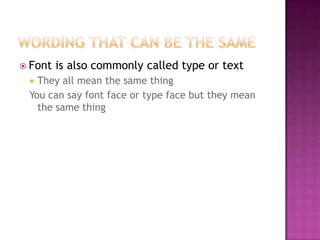
Wording that can be the sameFont is also commonly called type or textThey all mean the same thingYou can say font face or type face but they mean the same thing
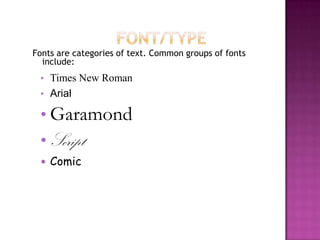
Font/TypeFonts are categories of text. Common groups of fonts include:Times New Roman
Arial
Garamond
Script
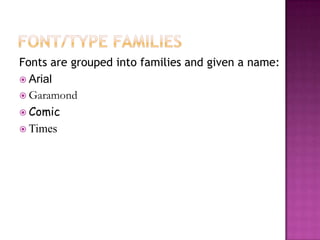
ComicFont/Type FamiliesFonts are grouped into families and given a name:ArialGaramondComicTimes
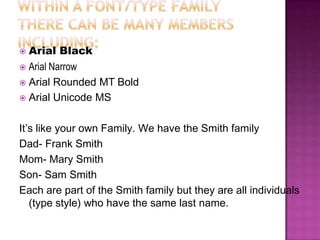
Within a Font/Type Family there can be many members including:Arial Black
Arial Narrow
Arial Rounded MT Bold
Arial Unicode MSIt’s like your own Family. We have the Smith familyDad- Frank SmithMom- Mary SmithSon- Sam SmithEach are part of the Smith family but they are all individuals (type style) who have the same last name.
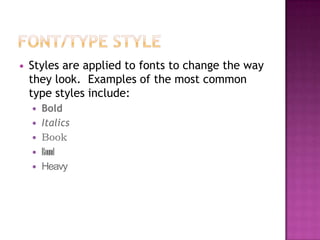
Font/Type StyleStyles are applied to fonts to change the way they look.  Examples of the most common type styles include:
Bold
Italics
Book
Round
HeavyIf you have a type style you have:Sam Smith with cowboy appeal Mary Smith with Gothic appealFrank Smith with Business appealYou can take away their styles but they are still members of the Smith family.
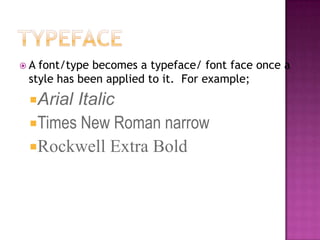
TypefaceA font/type becomes a typeface/ font face once a style has been applied to it.  For example;Arial ItalicTimes New Roman narrowRockwell Extra Bold
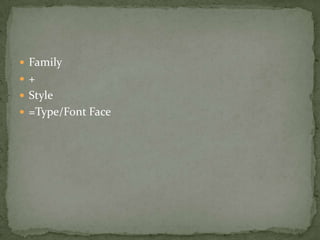
Family+Style =Type/Font Face
Fonts are used to help create a moodor a feeling in a publication.  Fonts can also limit or enhance readability so choose your fonts carefully.
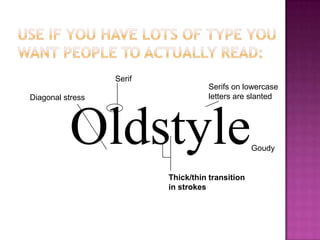
Use if you have lots of type you want people to actually read:SerifSerifs on lowercase letters are slantedOldstyleDiagonal stressGoudyThick/thin transition in strokes
  ModernNot good choices for extended amounts of body copyThin lines almost disappear, thick lines are prominentEffect on the page is called “dazzling”
SerifUsed in children’s books because of clean, straightforward lookExamples:Times New RomanCalifornian
Sans Serif“sans” (without) in FrenchNo thick/thin transition Same thickness all the way aroundGreat for creating eye-catching pages
ScriptLike cheesecake- they should be used sparingly so nobody gets sick
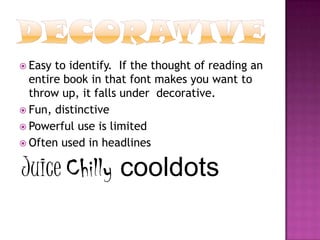
DecorativeEasy to identify.  If the thought of reading an entire book in that font makes you want to throw up, it falls under  decorative.Fun, distinctivePowerful use is limitedOften used in headlinesJuice Chillycooldots
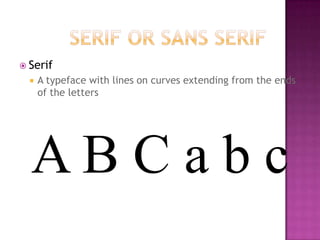
Serif or Sans SerifSerifA typeface with lines on curves extending from the ends of the lettersA B C a b c
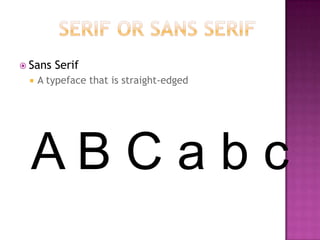
Serif or Sans SerifSans SerifA typeface that is straight-edgedA B C a b c
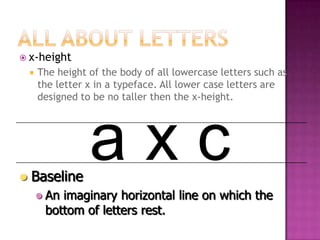
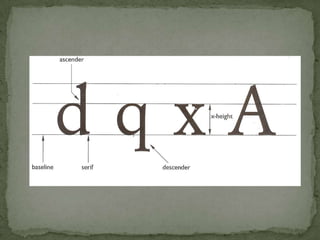
a x cAll About Lettersx-heightThe height of the body of all lowercase letters such as the letter x in a typeface. All lower case letters are designed to be no taller then the x-height.Baseline
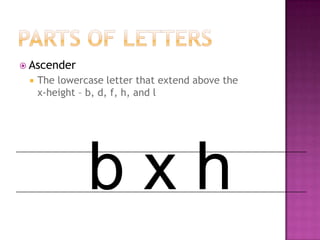
An imaginary horizontal line on which the bottom of letters rest.b x hParts of LettersAscenderThe lowercase letter that extend above the x-height – b, d, f, h, and l
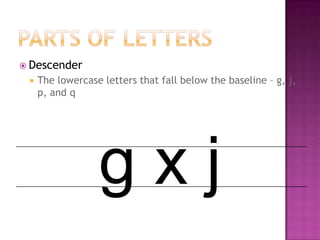
g x jParts of LettersDescenderThe lowercase letters that fall below the baseline – g, j, p, and q

Typography

  • 1.
    TypographyThe art ofusing text to produce professional looking publications.
  • 2.
    Wording that canbe the sameFont is also commonly called type or textThey all mean the same thingYou can say font face or type face but they mean the same thing
  • 3.
    Font/TypeFonts are categoriesof text. Common groups of fonts include:Times New Roman
  • 4.
  • 5.
  • 6.
  • 7.
    ComicFont/Type FamiliesFonts aregrouped into families and given a name:ArialGaramondComicTimes
  • 8.
    Within a Font/TypeFamily there can be many members including:Arial Black
  • 9.
  • 10.
  • 11.
    Arial Unicode MSIt’slike your own Family. We have the Smith familyDad- Frank SmithMom- Mary SmithSon- Sam SmithEach are part of the Smith family but they are all individuals (type style) who have the same last name.
  • 12.
    Font/Type StyleStyles areapplied to fonts to change the way they look. Examples of the most common type styles include:
  • 13.
  • 14.
  • 15.
  • 16.
  • 17.
    HeavyIf you havea type style you have:Sam Smith with cowboy appeal Mary Smith with Gothic appealFrank Smith with Business appealYou can take away their styles but they are still members of the Smith family.
  • 18.
    TypefaceA font/type becomesa typeface/ font face once a style has been applied to it. For example;Arial ItalicTimes New Roman narrowRockwell Extra Bold
  • 19.
  • 20.
    Fonts are usedto help create a moodor a feeling in a publication. Fonts can also limit or enhance readability so choose your fonts carefully.
  • 21.
    Use if youhave lots of type you want people to actually read:SerifSerifs on lowercase letters are slantedOldstyleDiagonal stressGoudyThick/thin transition in strokes
  • 22.
    ModernNotgood choices for extended amounts of body copyThin lines almost disappear, thick lines are prominentEffect on the page is called “dazzling”
  • 23.
    SerifUsed in children’sbooks because of clean, straightforward lookExamples:Times New RomanCalifornian
  • 24.
    Sans Serif“sans” (without)in FrenchNo thick/thin transition Same thickness all the way aroundGreat for creating eye-catching pages
  • 25.
    ScriptLike cheesecake- theyshould be used sparingly so nobody gets sick
  • 26.
    DecorativeEasy to identify. If the thought of reading an entire book in that font makes you want to throw up, it falls under decorative.Fun, distinctivePowerful use is limitedOften used in headlinesJuice Chillycooldots
  • 27.
    Serif or SansSerifSerifA typeface with lines on curves extending from the ends of the lettersA B C a b c
  • 28.
    Serif or SansSerifSans SerifA typeface that is straight-edgedA B C a b c
  • 29.
    a x cAllAbout Lettersx-heightThe height of the body of all lowercase letters such as the letter x in a typeface. All lower case letters are designed to be no taller then the x-height.Baseline
  • 30.
    An imaginary horizontalline on which the bottom of letters rest.b x hParts of LettersAscenderThe lowercase letter that extend above the x-height – b, d, f, h, and l
  • 31.
    g x jPartsof LettersDescenderThe lowercase letters that fall below the baseline – g, j, p, and q

Editor's Notes

  • #4 Older fonts included Old Style, Decorative, Sans, Sans Serif. They were the only ones available in the beginning of DTP
  • #6 Most family members have some physical features that similar to other members of their family