SARCOIDOSIS:
CLINICAL FEATURES
DIAGNOSIS & TREATMENT
DR ASWIN RM
SARCOIDOSIS
“Sarkodes”- fleshy
“Osis”- condition
SARCOIDOSIS
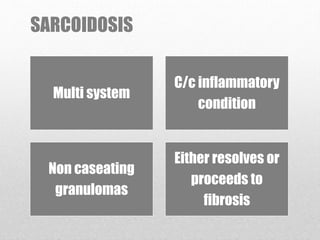
Multi system
C/c inflammatory
condition
Non caseating
granulomas
Either resolves or
proceeds to
fibrosis
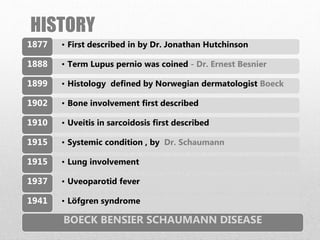
HISTORY
• First described in by Dr. Jonathan Hutchinson1877
• Term Lupus pernio was coined - Dr. Ernest Besnier1888
• Histology defined by Norwegian dermatologist Boeck1899
• Bone involvement first described1902
• Uveitis in sarcoidosis first described1910
• Systemic condition , by Dr. Schaumann1915
• Lung involvement1915
• Uveoparotid fever1937
• Löfgren syndrome1941
BOECK BENSIER SCHAUMANN DISEASE
ETIOLOGY
Exact aetiology Uncertain
Environmental factors
• Infective
• Non infective
Genetic factors
• HLA-DRB1*1101
• Other genes
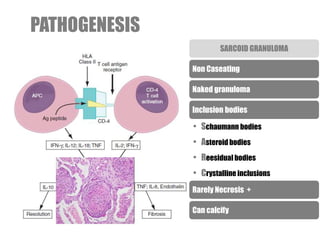
PATHOGENESIS
SARCOID GRANULOMA
Non Caseating
Naked granuloma
Inclusion bodies
• Schaumann bodies
• Asteroid bodies
• Reesidual bodies
• Crystalline inclusions
Rarely Necrosis +
Can calcify
EPIDEMIOLOGY
• F>M
• 3rd decade
• Almost all races
CLINICAL FEATURES
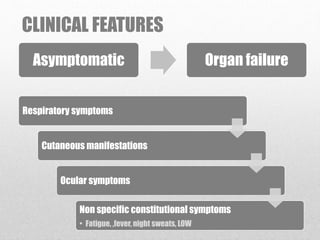
Asymptomatic Organ failure
Respiratory symptoms
Cutaneous manifestations
Ocular symptoms
Non specific constitutional symptoms
• Fatigue, ,fever, night sweats, LOW
CLINICAL FEATURES
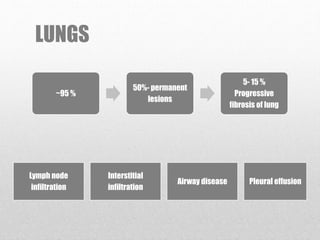
LUNGS
~95 %
50%- permanent
lesions
5- 15 %
Progressive
fibrosis of lung
Lymph node
infiltration
Interstitial
infiltration
Airway disease Pleural effusion
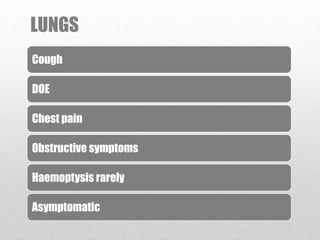
LUNGS
Cough
DOE
Chest pain
Obstructive symptoms
Haemoptysis rarely
Asymptomatic
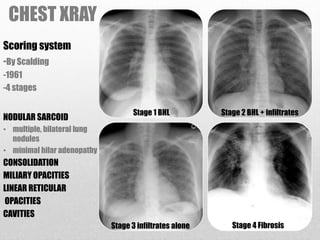
CHEST XRAY
Scoring system
-By Scalding
-1961
-4 stages
NODULAR SARCOID
• multiple, bilateral lung
nodules
• minimal hilar adenopathy
CONSOLIDATION
MILIARY OPACITIES
LINEAR RETICULAR
OPACITIES
CAVITIES
Stage 1 BHL Stage 2 BHL + infiltrates
Stage 3 infiltrates alone Stage 4 Fibrosis
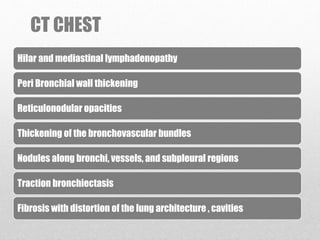
CT CHEST
Hilar and mediastinal lymphadenopathy
Peri Bronchial wall thickening
Reticulonodular opacities
Thickening of the bronchovascular bundles
Nodules along bronchi, vessels, and subpleural regions
Traction bronchiectasis
Fibrosis with distortion of the lung architecture , cavities
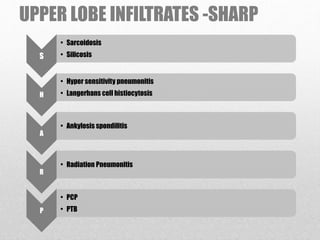
S
• Sarcoidosis
• Silicosis
H
• Hyper sensitivity pneumonitis
• Langerhans cell histiocytosis
A
• Ankylosis spondilitis
R
• Radiation Pneumonitis
P
• PCP
• PTB
UPPER LOBE INFILTRATES -SHARP
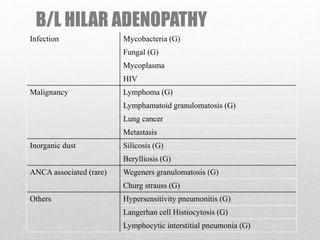
B/L HILAR ADENOPATHY
Infection Mycobacteria (G)
Fungal (G)
Mycoplasma
HIV
Malignancy Lymphoma (G)
Lymphamatoid granulomatosis (G)
Lung cancer
Metastasis
Inorganic dust Silicosis (G)
Berylliosis (G)
ANCA associated (rare) Wegeners granulomatosis (G)
Churg strauss (G)
Others Hypersensitivity pneumonitis (G)
Langerhan cell Histiocytosis (G)
Lymphocytic interstitial pneumonia (G)
AIRWAY DISEASE
• 50% has some obstructive disease
• Larger or smaller airways
• Many responds to bronchodilators and steroids
PLEURAL DISEASE
• Rare <1%
• Pleural effusion
• Chylothorax
OTHER FINDINGS
PFT
• Decreased Lung
volume
• 50% obstructive
findings
DLCO
• Reduced
PAH
• 5%
• Direct vascular
involvement
• Fibrosis
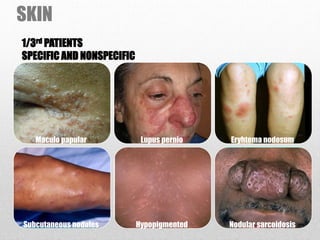
SKIN
Maculo papular Lupus pernio Eryhtema nodosum
Subcutaneous nodules Hypopigmented Nodular sarcoidosis
1/3rd PATIENTS
SPECIFIC AND NONSPECIFIC
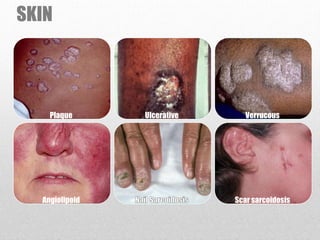
SKIN
Plaque Ulcerative Verrucous
Angiolipoid Scar sarcoidosis
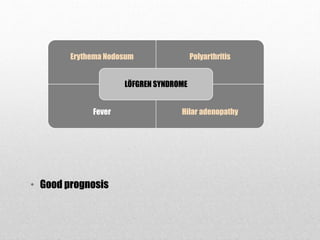
Erythema Nodosum Polyarthritis
Fever Hilar adenopathy
LÖFGREN SYNDROME
• Good prognosis
DIAGNOSIS
• Skin biopsy – Non caseating granulomas
DIFFERENTIAL DIAGNOSIS
• Foreign body reaction
• Lupus vulgaris
• Tuberculoid leprosy
• Drug eruptions
• DLE
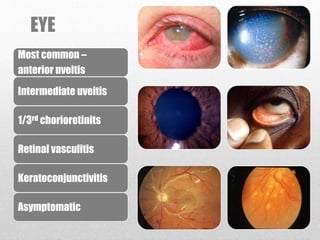
EYE
Most common –
anterior uveitis
Intermediate uveitis
1/3rd chorioretinits
Retinal vasculitis
Keratoconjunctivitis
Asymptomatic
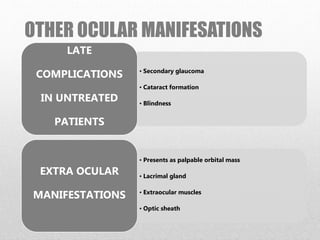
OTHER OCULAR MANIFESATIONS
• Secondary glaucoma
• Cataract formation
• Blindness
LATE
COMPLICATIONS
IN UNTREATED
PATIENTS
• Presents as palpable orbital mass
• Lacrimal gland
• Extraocular muscles
• Optic sheath
EXTRA OCULAR
MANIFESTATIONS
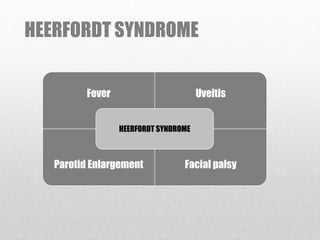
HEERFORDT SYNDROME
Fever Uveitis
Parotid Enlargement Facial palsy
HEERFORDT SYNDROME
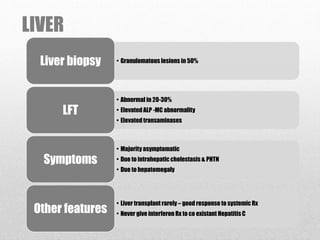
LIVER
• Granulomatous lesions in 50%Liver biopsy
• Abnormal in 20-30%
• Elevated ALP -MC abnormality
• Elevated transaminases
LFT
• Majority asymptomatic
• Due to intrahepatic cholestasis & PHTN
• Due to hepatomegaly
Symptoms
• Liver transplant rarely – good response to systemic Rx
• Never give interferon Rx to co existant Hepatitis COther features
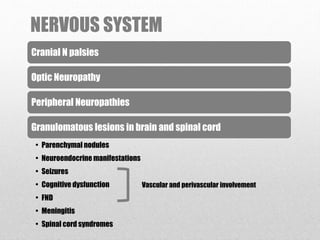
NERVOUS SYSTEM
Cranial N palsies
Optic Neuropathy
Peripheral Neuropathies
Granulomatous lesions in brain and spinal cord
• Parenchymal nodules
• Neuroendocrine manifestations
• Seizures
• Cognitive dysfunction
• FND
• Meningitis
• Spinal cord syndromes
Vascular and perivascular involvement
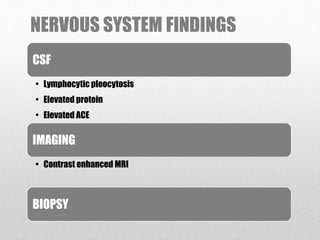
NERVOUS SYSTEM FINDINGS
CSF
• Lymphocytic pleocytosis
• Elevated protein
• Elevated ACE
IMAGING
• Contrast enhanced MRI
BIOPSY
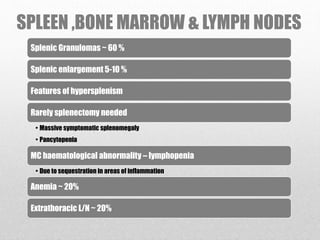
SPLEEN ,BONE MARROW & LYMPH NODES
Splenic Granulomas ~ 60 %
Splenic enlargement 5-10 %
Features of hypersplenism
Rarely splenectomy needed
• Massive symptomatic splenomegaly
• Pancytopenia
MC haematological abnormality – lymphopenia
• Due to sequestration in areas of inflammation
Anemia ~ 20%
Extrathoracic L/N ~ 20%
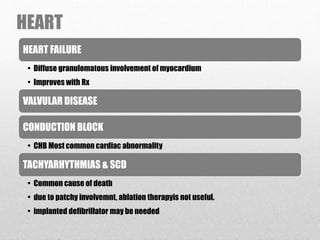
HEART
HEART FAILURE
• Diffuse granulomatous involvement of myocardium
• Improves with Rx
VALVULAR DISEASE
CONDUCTION BLOCK
• CHB Most common cardiac abnormality
TACHYARHYTHMIAS & SCD
• Common cause of death
• due to patchy involvemnt, ablation therapyis not useful.
• implanted defibrillator may be needed
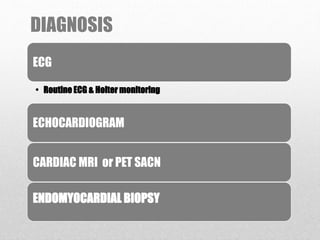
DIAGNOSIS
ECG
• Routine ECG & Holter monitoring
ECHOCARDIOGRAM
CARDIAC MRI or PET SACN
ENDOMYOCARDIAL BIOPSY
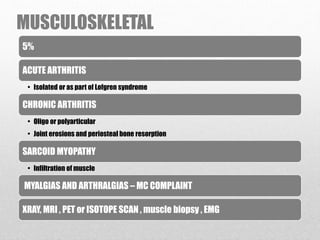
MUSCULOSKELETAL
5%
ACUTE ARTHRITIS
• Isolated or as part of Lofgren syndrome
CHRONIC ARTHRITIS
• Oligo or polyarticular
• Joint erosions and periosteal bone resorption
SARCOID MYOPATHY
• Infiltration of muscle
MYALGIAS AND ARTHRALGIAS – MC COMPLAINT
XRAY, MRI , PET or ISOTOPE SCAN , muscle biopsy , EMG
OTHER ORGANS
• Direct involvement – 5 %
• More symptomatic renal d/s secondary to hypercalcemia
KIDNEY
• Hypercalcemia and/or hypercalciuria
• 1,25-dihydroxyvitamin D by the granuloma
Ca METABOLISM
UPPER RESPIRATORY
TRACT
• Diffuse goiter or, rarely solitary thyroid nodule
• All patients are but euthyroid
THYROID
• Breast, testes, ovary & stomach.USUALLY SPARES
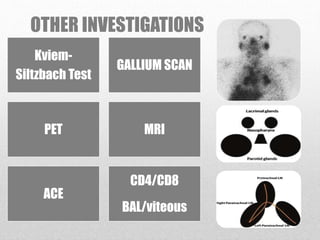
OTHER INVESTIGATIONS
Kviem-
Siltzbach Test
GALLIUM SCAN
PET MRI
ACE
CD4/CD8
BAL/viteous
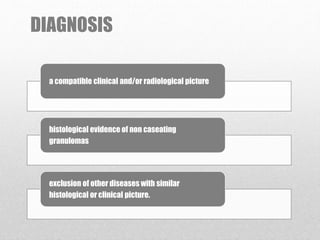
DIAGNOSIS
a compatible clinical and/or radiological picture
histological evidence of non caseating
granulomas
exclusion of other diseases with similar
histological or clinical picture.
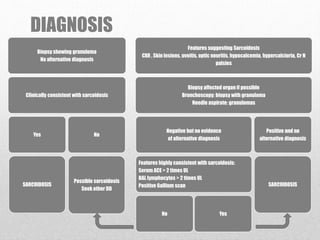
DIAGNOSIS
Biopsy showing granuloma
No alternative diagnosis
Clinically consistent with sarcoidosis
Yes
SARCOIDOSIS
No
Possible sarcoidosis
Seek other DD
Features suggesting Sarcoidosis
CXR , Skin lesions, uveitis, optic neuritis, hypocalcemia, hypercalciuria, Cr N
palsies
Biopsy affected organ if possible
Bronchoscopy: biopsy with granuloma
Needle aspirate: granulomas
Negative but no evidence
of alternative diagnosis
Features highly consistent with sarcoidosis:
Serum ACE > 2 times UL
BAL lymphocytes > 2 times UL
Positive Gallium scan
No Yes
Positive and no
alternative diagnosis
SARCOIDOSIS
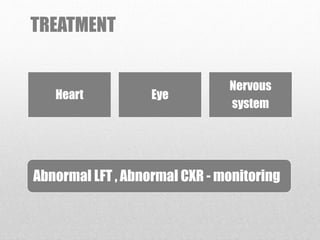
TREATMENT
Abnormal LFT , Abnormal CXR - monitoring
Heart Eye
Nervous
system
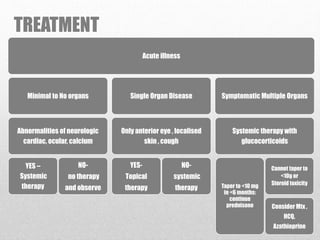
TREATMENT
Acute illness
Minimal to No organs
Abnormalities of neurologic
cardiac, ocular, calcium
YES –
Systemic
therapy
NO-
no therapy
and observe
Single Organ Disease
Only anterior eye , localised
skin , cough
YES-
Topical
therapy
NO-
systemic
therapy
Symptomatic Multiple Organs
Systemic therapy with
glucocorticoids
Taper to <10 mg
in <6 months:
continue
prednisone
Cannot taper to
<10g or
Steroid toxicity
Consider Mtx ,
HCQ,
Azathioprine
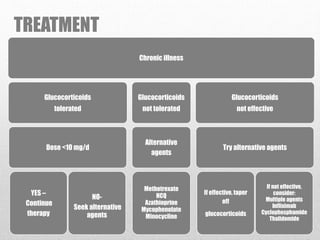
TREATMENT
Chronic illness
Glucocorticoids
tolerated
Dose <10 mg/d
YES –
Continue
therapy
NO-
Seek alternative
agents
Glucocorticoids
not tolerated
Alternative
agents
Methotrexate
HCQ
Azathioprine
Mycophenolate
Minocycline
Glucocorticoids
not effective
Try alternative agents
If effective, taper
off
glucocorticoids
If not effective,
consider:
Multiple agents
Infliximab
Cyclophosphamide
Thalidomide
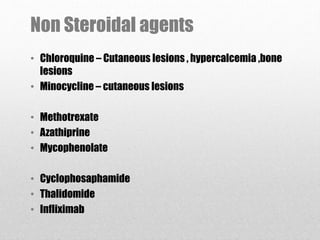
Non Steroidal agents
• Chloroquine – Cutaneous lesions , hypercalcemia ,bone
lesions
• Minocycline – cutaneous lesions
• Methotrexate
• Azathiprine
• Mycophenolate
• Cyclophosaphamide
• Thalidomide
• Infliximab
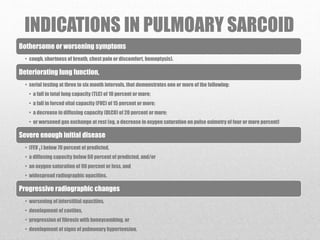
INDICATIONS IN PULMOARY SARCOID
Bothersome or worsening symptoms
• cough, shortness of breath, chest pain or discomfort, hemoptysis).
Deteriorating lung function,
• serial testing at three to six month intervals, that demonstrates one or more of the following:
• a fall in total lung capacity (TLC) of 10 percent or more;
• a fall in forced vital capacity (FVC) of 15 percent or more;
• a decrease in diffusing capacity (DLCO) of 20 percent or more;
• or worsened gas exchange at rest (eg, a decrease in oxygen saturation on pulse oximetry of four or more percent)
Severe enough initial disease
• (FEV 1 ) below 70 percent of predicted,
• a diffusing capacity below 60 percent of predicted, and/or
• an oxygen saturation of 90 percent or less, and
• widespread radiographic opacities.
Progressive radiographic changes
• worsening of interstitial opacities,
• development of cavities,
• progression of fibrosis with honeycombing, or
• development of signs of pulmonary hypertension.
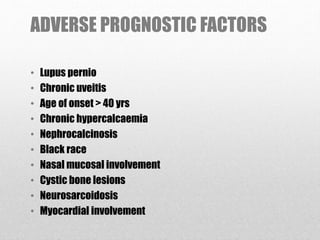
ADVERSE PROGNOSTIC FACTORS
• Lupus pernio
• Chronic uveitis
• Age of onset > 40 yrs
• Chronic hypercalcaemia
• Nephrocalcinosis
• Black race
• Nasal mucosal involvement
• Cystic bone lesions
• Neurosarcoidosis
• Myocardial involvement
THANK YOU

Sarcoidosis

  • 1.
  • 2.
  • 3.
    SARCOIDOSIS Multi system C/c inflammatory condition Noncaseating granulomas Either resolves or proceeds to fibrosis
  • 4.
    HISTORY • First describedin by Dr. Jonathan Hutchinson1877 • Term Lupus pernio was coined - Dr. Ernest Besnier1888 • Histology defined by Norwegian dermatologist Boeck1899 • Bone involvement first described1902 • Uveitis in sarcoidosis first described1910 • Systemic condition , by Dr. Schaumann1915 • Lung involvement1915 • Uveoparotid fever1937 • Löfgren syndrome1941 BOECK BENSIER SCHAUMANN DISEASE
  • 5.
    ETIOLOGY Exact aetiology Uncertain Environmentalfactors • Infective • Non infective Genetic factors • HLA-DRB1*1101 • Other genes
  • 6.
    PATHOGENESIS SARCOID GRANULOMA Non Caseating Nakedgranuloma Inclusion bodies • Schaumann bodies • Asteroid bodies • Reesidual bodies • Crystalline inclusions Rarely Necrosis + Can calcify
  • 7.
    EPIDEMIOLOGY • F>M • 3rddecade • Almost all races
  • 8.
    CLINICAL FEATURES Asymptomatic Organfailure Respiratory symptoms Cutaneous manifestations Ocular symptoms Non specific constitutional symptoms • Fatigue, ,fever, night sweats, LOW
  • 9.
  • 10.
    LUNGS ~95 % 50%- permanent lesions 5-15 % Progressive fibrosis of lung Lymph node infiltration Interstitial infiltration Airway disease Pleural effusion
  • 11.
  • 12.
    CHEST XRAY Scoring system -ByScalding -1961 -4 stages NODULAR SARCOID • multiple, bilateral lung nodules • minimal hilar adenopathy CONSOLIDATION MILIARY OPACITIES LINEAR RETICULAR OPACITIES CAVITIES Stage 1 BHL Stage 2 BHL + infiltrates Stage 3 infiltrates alone Stage 4 Fibrosis
  • 13.
    CT CHEST Hilar andmediastinal lymphadenopathy Peri Bronchial wall thickening Reticulonodular opacities Thickening of the bronchovascular bundles Nodules along bronchi, vessels, and subpleural regions Traction bronchiectasis Fibrosis with distortion of the lung architecture , cavities
  • 14.
    S • Sarcoidosis • Silicosis H •Hyper sensitivity pneumonitis • Langerhans cell histiocytosis A • Ankylosis spondilitis R • Radiation Pneumonitis P • PCP • PTB UPPER LOBE INFILTRATES -SHARP
  • 15.
    B/L HILAR ADENOPATHY InfectionMycobacteria (G) Fungal (G) Mycoplasma HIV Malignancy Lymphoma (G) Lymphamatoid granulomatosis (G) Lung cancer Metastasis Inorganic dust Silicosis (G) Berylliosis (G) ANCA associated (rare) Wegeners granulomatosis (G) Churg strauss (G) Others Hypersensitivity pneumonitis (G) Langerhan cell Histiocytosis (G) Lymphocytic interstitial pneumonia (G)
  • 16.
    AIRWAY DISEASE • 50%has some obstructive disease • Larger or smaller airways • Many responds to bronchodilators and steroids PLEURAL DISEASE • Rare <1% • Pleural effusion • Chylothorax
  • 17.
    OTHER FINDINGS PFT • DecreasedLung volume • 50% obstructive findings DLCO • Reduced PAH • 5% • Direct vascular involvement • Fibrosis
  • 18.
    SKIN Maculo papular Lupuspernio Eryhtema nodosum Subcutaneous nodules Hypopigmented Nodular sarcoidosis 1/3rd PATIENTS SPECIFIC AND NONSPECIFIC
  • 19.
  • 20.
    Erythema Nodosum Polyarthritis FeverHilar adenopathy LÖFGREN SYNDROME • Good prognosis
  • 21.
    DIAGNOSIS • Skin biopsy– Non caseating granulomas DIFFERENTIAL DIAGNOSIS • Foreign body reaction • Lupus vulgaris • Tuberculoid leprosy • Drug eruptions • DLE
  • 22.
    EYE Most common – anterioruveitis Intermediate uveitis 1/3rd chorioretinits Retinal vasculitis Keratoconjunctivitis Asymptomatic
  • 23.
    OTHER OCULAR MANIFESATIONS •Secondary glaucoma • Cataract formation • Blindness LATE COMPLICATIONS IN UNTREATED PATIENTS • Presents as palpable orbital mass • Lacrimal gland • Extraocular muscles • Optic sheath EXTRA OCULAR MANIFESTATIONS
  • 24.
    HEERFORDT SYNDROME Fever Uveitis ParotidEnlargement Facial palsy HEERFORDT SYNDROME
  • 25.
    LIVER • Granulomatous lesionsin 50%Liver biopsy • Abnormal in 20-30% • Elevated ALP -MC abnormality • Elevated transaminases LFT • Majority asymptomatic • Due to intrahepatic cholestasis & PHTN • Due to hepatomegaly Symptoms • Liver transplant rarely – good response to systemic Rx • Never give interferon Rx to co existant Hepatitis COther features
  • 26.
    NERVOUS SYSTEM Cranial Npalsies Optic Neuropathy Peripheral Neuropathies Granulomatous lesions in brain and spinal cord • Parenchymal nodules • Neuroendocrine manifestations • Seizures • Cognitive dysfunction • FND • Meningitis • Spinal cord syndromes Vascular and perivascular involvement
  • 27.
    NERVOUS SYSTEM FINDINGS CSF •Lymphocytic pleocytosis • Elevated protein • Elevated ACE IMAGING • Contrast enhanced MRI BIOPSY
  • 28.
    SPLEEN ,BONE MARROW& LYMPH NODES Splenic Granulomas ~ 60 % Splenic enlargement 5-10 % Features of hypersplenism Rarely splenectomy needed • Massive symptomatic splenomegaly • Pancytopenia MC haematological abnormality – lymphopenia • Due to sequestration in areas of inflammation Anemia ~ 20% Extrathoracic L/N ~ 20%
  • 29.
    HEART HEART FAILURE • Diffusegranulomatous involvement of myocardium • Improves with Rx VALVULAR DISEASE CONDUCTION BLOCK • CHB Most common cardiac abnormality TACHYARHYTHMIAS & SCD • Common cause of death • due to patchy involvemnt, ablation therapyis not useful. • implanted defibrillator may be needed
  • 30.
    DIAGNOSIS ECG • Routine ECG& Holter monitoring ECHOCARDIOGRAM CARDIAC MRI or PET SACN ENDOMYOCARDIAL BIOPSY
  • 31.
    MUSCULOSKELETAL 5% ACUTE ARTHRITIS • Isolatedor as part of Lofgren syndrome CHRONIC ARTHRITIS • Oligo or polyarticular • Joint erosions and periosteal bone resorption SARCOID MYOPATHY • Infiltration of muscle MYALGIAS AND ARTHRALGIAS – MC COMPLAINT XRAY, MRI , PET or ISOTOPE SCAN , muscle biopsy , EMG
  • 32.
    OTHER ORGANS • Directinvolvement – 5 % • More symptomatic renal d/s secondary to hypercalcemia KIDNEY • Hypercalcemia and/or hypercalciuria • 1,25-dihydroxyvitamin D by the granuloma Ca METABOLISM UPPER RESPIRATORY TRACT • Diffuse goiter or, rarely solitary thyroid nodule • All patients are but euthyroid THYROID • Breast, testes, ovary & stomach.USUALLY SPARES
  • 33.
    OTHER INVESTIGATIONS Kviem- Siltzbach Test GALLIUMSCAN PET MRI ACE CD4/CD8 BAL/viteous
  • 34.
    DIAGNOSIS a compatible clinicaland/or radiological picture histological evidence of non caseating granulomas exclusion of other diseases with similar histological or clinical picture.
  • 35.
    DIAGNOSIS Biopsy showing granuloma Noalternative diagnosis Clinically consistent with sarcoidosis Yes SARCOIDOSIS No Possible sarcoidosis Seek other DD Features suggesting Sarcoidosis CXR , Skin lesions, uveitis, optic neuritis, hypocalcemia, hypercalciuria, Cr N palsies Biopsy affected organ if possible Bronchoscopy: biopsy with granuloma Needle aspirate: granulomas Negative but no evidence of alternative diagnosis Features highly consistent with sarcoidosis: Serum ACE > 2 times UL BAL lymphocytes > 2 times UL Positive Gallium scan No Yes Positive and no alternative diagnosis SARCOIDOSIS
  • 36.
    TREATMENT Abnormal LFT ,Abnormal CXR - monitoring Heart Eye Nervous system
  • 37.
    TREATMENT Acute illness Minimal toNo organs Abnormalities of neurologic cardiac, ocular, calcium YES – Systemic therapy NO- no therapy and observe Single Organ Disease Only anterior eye , localised skin , cough YES- Topical therapy NO- systemic therapy Symptomatic Multiple Organs Systemic therapy with glucocorticoids Taper to <10 mg in <6 months: continue prednisone Cannot taper to <10g or Steroid toxicity Consider Mtx , HCQ, Azathioprine
  • 38.
    TREATMENT Chronic illness Glucocorticoids tolerated Dose <10mg/d YES – Continue therapy NO- Seek alternative agents Glucocorticoids not tolerated Alternative agents Methotrexate HCQ Azathioprine Mycophenolate Minocycline Glucocorticoids not effective Try alternative agents If effective, taper off glucocorticoids If not effective, consider: Multiple agents Infliximab Cyclophosphamide Thalidomide
  • 39.
    Non Steroidal agents •Chloroquine – Cutaneous lesions , hypercalcemia ,bone lesions • Minocycline – cutaneous lesions • Methotrexate • Azathiprine • Mycophenolate • Cyclophosaphamide • Thalidomide • Infliximab
  • 40.
    INDICATIONS IN PULMOARYSARCOID Bothersome or worsening symptoms • cough, shortness of breath, chest pain or discomfort, hemoptysis). Deteriorating lung function, • serial testing at three to six month intervals, that demonstrates one or more of the following: • a fall in total lung capacity (TLC) of 10 percent or more; • a fall in forced vital capacity (FVC) of 15 percent or more; • a decrease in diffusing capacity (DLCO) of 20 percent or more; • or worsened gas exchange at rest (eg, a decrease in oxygen saturation on pulse oximetry of four or more percent) Severe enough initial disease • (FEV 1 ) below 70 percent of predicted, • a diffusing capacity below 60 percent of predicted, and/or • an oxygen saturation of 90 percent or less, and • widespread radiographic opacities. Progressive radiographic changes • worsening of interstitial opacities, • development of cavities, • progression of fibrosis with honeycombing, or • development of signs of pulmonary hypertension.
  • 41.
    ADVERSE PROGNOSTIC FACTORS •Lupus pernio • Chronic uveitis • Age of onset > 40 yrs • Chronic hypercalcaemia • Nephrocalcinosis • Black race • Nasal mucosal involvement • Cystic bone lesions • Neurosarcoidosis • Myocardial involvement
  • 42.