QSAR-ROLE OF STRUCTURAL BIOINFORMATICS
Computational biology –YBT303
SUBMITTED TO PRESENTED BY
Ms.P. Mala E. Deepthika
Assistant professor ,department of Biotechnology 123011356012
Periyar maniammai institute of science and technology 2nd
Msc-Biotechnology
Vallam,Thanjavur
Pincode-613403
Introduction
 Quantitative structure-activity relationship (QSAR) has been playing a
major role in the field of agriculture chemistry, pharmacology, and
toxicology since last few years With the help of QSAR, we can design new
models and compare them with existing models or newly generated models
to the biological databases.
 The QSAR study assumes that the difference of the molecules in the
structural properties experimentally measured accounts for the difference
in their observed biological or chemical Properties.
 With the help of QSAR, it is now possible not only to develop a model for
a system but also to compare models from a biological database and to
draw analogies with models from a physical organic database.
 QSAR is able to identify the relationship between a molecule and its
structure and how the structure influences the activity of the molecule.
Fragment based 2D QSAR (FB 2D-QSAR)
 In this method, a drug candidate is first subjected to fragmentation into its
components and then bioactivities of drug candidates are correlated with
physicochemical properties of the molecular fragments through two sets of
coefficients: one is for the physicochemical properties and the other for the
molecular fragments .
 FB-QSAR is used to predict the model of neuraminidase inhibitors for
drug development against H5N1 influenza virus . This method is also used
to predict the new insights for dealing with the drug-resistant problem and
designing effective adamantane-based anti-flue drugs for influenza A
viruses .
Multiple field 3D QSAR (MF 3D QSAR)
 It is based on comparative molecular field analysis (CoMFA) in which two
sets of coefficients are involved: one is for the potential fields and the other
for the Cartesian three dimensional grid points.
Amino Acid-Based Peptide Prediction (AABPP)
 In this method, the biological activities of the peptides and proteins are
correlated with the physicochemical properties of all or partial residues of
the sequence through two sets of coefficients: one is for the
physicochemical properties of amino acids and the other for the weight
factors of the Residues. There is a clear cut limitation of QSAR as it can be
one taskOr one-target.
 Quantitative Structure–Activity Relationships (ot-QSAR) that predict the
biological activity of drugs against only one parasite species.
Consequently, multi-tasking learning used to predict drugs activity against
different species by a single model (mt-QSAR) becomes vitally important.
 The mt-QSARs offer a good opportunity The mt-QSARs offer a good
opportunity unpractical with ot-QSAR) to construct drug–drug similarity
Complex Networks and to map the contribution of sub-structures to
function for multiple species.
 In 2009 first tried to calculate probabilities of anti parasiticaction of drugs
against different parasites . These mt -QSARs offer a good opportunity to
construct drug-drug
 Complex Networks (CNs) that can be used to explore large and complex
drug-viral species databases. mt-QSAR models are used to predict the
antimicrobial activity against different fungi bacteria or parasite species.
Isolated Receptor Interactions
 Dihydrofolate reductases (DHFRs) play an important role in protein,
purine, and pyrimidine synthesis. They have acrystallo graphic structure
and are able to form a binary andternary complex. These specialties make
the DHFRs as a successful target for some heterocyclic ligand like 2, 4-
diamino-1,-3-diazapharmacophore.
Interactions at the Cellular Level
 QSAR analysis shows all the physico-chemical parameters involved in the
studies at the cellular level and at it also tracks the pharmacokinetics. Cell
culture method can also be performed to support the QSAR studies.
 Extensive QSAR studies have proved that 3-X-triazines possess toxic effect
on few mammalian and bacterial cell lines Cytotoxicity levels have been
compared between murineleukemia cells (L1210/S) and methotrexate-
resistant murine leukemia cells (L1210/R) and this comparison shows some
difference among the both.
In Vivo Interactions
 QSAR helps to compare a large dataset with in a limited time and may also
lead to heterogeneity and complexity of the data. Only few studies of QSAR
have been carried out by generating a very small number of datasets.
 The best example is an extensive study between renal and no renal
clearance rates among few blockers. These blockers are eleven in numbers
namely bufuralol, tolamolol, propranolol, alprenolol, oxprenolol, acebutol,
timolol, metoprolol, prindolol, atenolol, and nadolol. All of these were
compared and studied by QSAR.
APPLICATIONS OF QSAR
A normal QSAR analysis leads to formation of so many equations as it
compares and generates a large number of data set for biological systems.
 Hansch was the first to give an equation for drug-receptor interactions,
in which he considered that electronic, steric, and hydrophobic
contributions are the major factors which affect the interaction.
 Utilizing a nonlinear relationship between them and through pharmaco-
kinetics, the drug-receptor interaction can be tracked at cellular level.
 Kubinyi proposed a bilinear model and supported the concept of
delineation of drug receptor interaction.
 Dihydrofolate reductases (DHFRs) and a-chymotrypsin interaction was
studied in detail.
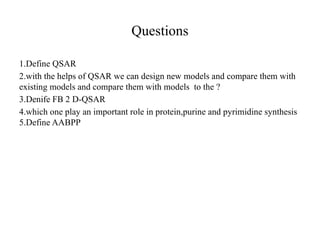
Questions
1.Define QSAR
2.with the helps of QSAR we can design new models and compare them with
existing models and compare them with models to the ?
3.Denife FB 2 D-QSAR
4.which one play an important role in protein,purine and pyrimidine synthesis
5.Define AABPP
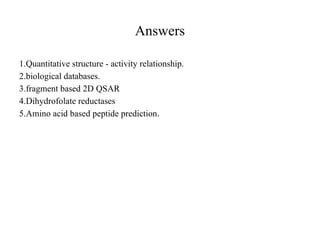
Answers
1.Quantitative structure - activity relationship.
2.biological databases.
3.fragment based 2D QSAR
4.Dihydrofolate reductases
5.Amino acid based peptide prediction.
THANKYOU

QSAR Quantitative Structure Activity Relationship (deepthika-123011356007)

  • 1.
    QSAR-ROLE OF STRUCTURALBIOINFORMATICS Computational biology –YBT303 SUBMITTED TO PRESENTED BY Ms.P. Mala E. Deepthika Assistant professor ,department of Biotechnology 123011356012 Periyar maniammai institute of science and technology 2nd Msc-Biotechnology Vallam,Thanjavur Pincode-613403
  • 2.
    Introduction  Quantitative structure-activityrelationship (QSAR) has been playing a major role in the field of agriculture chemistry, pharmacology, and toxicology since last few years With the help of QSAR, we can design new models and compare them with existing models or newly generated models to the biological databases.  The QSAR study assumes that the difference of the molecules in the structural properties experimentally measured accounts for the difference in their observed biological or chemical Properties.  With the help of QSAR, it is now possible not only to develop a model for a system but also to compare models from a biological database and to draw analogies with models from a physical organic database.  QSAR is able to identify the relationship between a molecule and its structure and how the structure influences the activity of the molecule.
  • 3.
    Fragment based 2DQSAR (FB 2D-QSAR)  In this method, a drug candidate is first subjected to fragmentation into its components and then bioactivities of drug candidates are correlated with physicochemical properties of the molecular fragments through two sets of coefficients: one is for the physicochemical properties and the other for the molecular fragments .  FB-QSAR is used to predict the model of neuraminidase inhibitors for drug development against H5N1 influenza virus . This method is also used to predict the new insights for dealing with the drug-resistant problem and designing effective adamantane-based anti-flue drugs for influenza A viruses .
  • 4.
    Multiple field 3DQSAR (MF 3D QSAR)  It is based on comparative molecular field analysis (CoMFA) in which two sets of coefficients are involved: one is for the potential fields and the other for the Cartesian three dimensional grid points. Amino Acid-Based Peptide Prediction (AABPP)  In this method, the biological activities of the peptides and proteins are correlated with the physicochemical properties of all or partial residues of the sequence through two sets of coefficients: one is for the physicochemical properties of amino acids and the other for the weight factors of the Residues. There is a clear cut limitation of QSAR as it can be one taskOr one-target.
  • 5.
     Quantitative Structure–ActivityRelationships (ot-QSAR) that predict the biological activity of drugs against only one parasite species. Consequently, multi-tasking learning used to predict drugs activity against different species by a single model (mt-QSAR) becomes vitally important.  The mt-QSARs offer a good opportunity The mt-QSARs offer a good opportunity unpractical with ot-QSAR) to construct drug–drug similarity Complex Networks and to map the contribution of sub-structures to function for multiple species.  In 2009 first tried to calculate probabilities of anti parasiticaction of drugs against different parasites . These mt -QSARs offer a good opportunity to construct drug-drug  Complex Networks (CNs) that can be used to explore large and complex drug-viral species databases. mt-QSAR models are used to predict the antimicrobial activity against different fungi bacteria or parasite species.
  • 6.
    Isolated Receptor Interactions Dihydrofolate reductases (DHFRs) play an important role in protein, purine, and pyrimidine synthesis. They have acrystallo graphic structure and are able to form a binary andternary complex. These specialties make the DHFRs as a successful target for some heterocyclic ligand like 2, 4- diamino-1,-3-diazapharmacophore. Interactions at the Cellular Level  QSAR analysis shows all the physico-chemical parameters involved in the studies at the cellular level and at it also tracks the pharmacokinetics. Cell culture method can also be performed to support the QSAR studies.
  • 7.
     Extensive QSARstudies have proved that 3-X-triazines possess toxic effect on few mammalian and bacterial cell lines Cytotoxicity levels have been compared between murineleukemia cells (L1210/S) and methotrexate- resistant murine leukemia cells (L1210/R) and this comparison shows some difference among the both. In Vivo Interactions  QSAR helps to compare a large dataset with in a limited time and may also lead to heterogeneity and complexity of the data. Only few studies of QSAR have been carried out by generating a very small number of datasets.  The best example is an extensive study between renal and no renal clearance rates among few blockers. These blockers are eleven in numbers namely bufuralol, tolamolol, propranolol, alprenolol, oxprenolol, acebutol, timolol, metoprolol, prindolol, atenolol, and nadolol. All of these were compared and studied by QSAR.
  • 8.
    APPLICATIONS OF QSAR Anormal QSAR analysis leads to formation of so many equations as it compares and generates a large number of data set for biological systems.  Hansch was the first to give an equation for drug-receptor interactions, in which he considered that electronic, steric, and hydrophobic contributions are the major factors which affect the interaction.  Utilizing a nonlinear relationship between them and through pharmaco- kinetics, the drug-receptor interaction can be tracked at cellular level.  Kubinyi proposed a bilinear model and supported the concept of delineation of drug receptor interaction.  Dihydrofolate reductases (DHFRs) and a-chymotrypsin interaction was studied in detail.
  • 9.
    Questions 1.Define QSAR 2.with thehelps of QSAR we can design new models and compare them with existing models and compare them with models to the ? 3.Denife FB 2 D-QSAR 4.which one play an important role in protein,purine and pyrimidine synthesis 5.Define AABPP
  • 10.
    Answers 1.Quantitative structure -activity relationship. 2.biological databases. 3.fragment based 2D QSAR 4.Dihydrofolate reductases 5.Amino acid based peptide prediction.
  • 11.