Werner's theory
Oxidation state (oxidation number)
• A number assigned to an element in chemical combination which
represents the number of electrons lost (or gained, if the number
is negative), by an atom of that element in the compound.
Coordination number
• The number of atoms or ions immediately surrounding a central
atom in a complex or crystal.
[Am (B)n]+ C-
↑
Coordination number satisfied by secondary valency
Oxidation state (oxidation number satisfied
by primary valency
↓
Alfred Werner received the Nobel
Prize of Chemistry in 1913 for
his coordination theory of
transition metal amine complexes.
Werner's theory of coordination compounds
• In 1893 Werner put forward a theory, called Werner's theory of
coordination compounds to explain the structure and properties
of Co(III) and Pt(IV) ammines.
• These ammines are given below:
• Co(III) ammines
– CoC13.6NH3 → Orange yellow
– CoC13.5NH3.H2O → Pink
– CoC13.5NH3 → Violet
– trans-CoC13.4NH3 → Green
– cis-CoC13.4NH3 → Violet
– CoC13.3NH3 → Blue-green
• Pt (IV) ammines
– PtC14.6NH3
– PtC14.5NH3
– PtC14.4NH3
– PtC14.3NH3
– PtC14.2NH3
Postulates of Werner’s coordination theory
Types of valency
• Two types of valency shown by the central metal atom in
coordination compounds.
• In complex compounds, the central metal atom exhibits two
types of valency viz. primary valency (also called principal
valency → corresponds to oxidation state → electrons lost or
gained) and secondary valency (also called auxiliary valency
→ corresponds to coordination number → ligands around the
central metal).
• The metal atom always tends to satisfy both of its valencies.
Characteristics of secondary valency
• In modem terminology, the secondary valency of the metallic
atom in a complex compound is equal to the coordination
number of that metal.
• Secondary valency of a metal is satisfied either by anions or by
neutral molecules alone or by anions and neutral molecules both.
• For example:
– Anions: In 4KCN.Fe(CN)2 or K4[Fe(CN)6], the secondary
valency of Fe-atom is six and is satisfied by six CN- ions
(anions).
– Neutral: In CoC13.6NH3 or [Co(NH3)6]C13, secondary valency
of Co-atom is six and is satisfied by six NH3 molecules (neutral
molecules).
– Neutral + anions: In CoC13.5NH3 or [Co(NH3)5C1]C12, the
secondary valency of Co-atom is six and is satisfied by five NH3
molecules (neutral molecules) and one Cl- ion (anion).
• According to modern concept of complex compounds, the species
satisfying the secondary valency are called ligands.
• While writing the structure of a complex compound, the species
satisfying the secondary valency and the metal are written inside
the coordination sphere. [Metal (Ligands)]
• For example in CoC13.4NH3, since four NH3 molecules and two Cl-
ions satisfy the secondary valency of Co-atom, its structure is
written as [CoC12.4NH3]C1 or [Co(NH3)4C12]C1.
• The secondary valencies have directional nature, since the
species satisfying the secondary valency (i.e., ligands) are
directed towards the fixed positions in space.
• The number of species satisfying the secondary valency gives
a definite geometry to the complex compound.
• For example, when the number of monodentate species
(ligands) which satisfy the secondary valency of the metal in a
complex compound is 2, 3, 4 or 6, the geometry of the
complex compound would be linear, trigonal planar,
tetrahedral or square planar and octahedral respectively.
• In each of the four Co (Ill) ammines viz., CoC13.6NH3,
CoC13.5NH3, CoCl3.4NH3 and CoC13.3NH3, since the
secondary valency of Co-atom is 6, each amine has octahedral
geometry.
• The species satisfying the secondary valency cannot be
obtained in the free state, when the aqueous solution of the
complex compound undergoes ionisation.
[Metal ← Ligands]
L → Geometry
• For example, when the aqueous solution of CoC13.4NH3 or
[Co(NH3)4C12]C1 undergoes ionisation, four NH3 molecules
and two Cl ions which satisfy the secondary valency of Co-
atom are not obtained in the free state as shown below:
• The above discussion can be concluded by saying that the
species satisfying the secondary valency are not ionisable
(non-ionisable) and hence cannot be precipitated.
• The attachment of the species satisfying the secondary valency
with the metal atom is shown by a solid line
Characteristics of primary valency
• In modem terminology, the primary valency of the metallic
atom in a complex compound is equal to the oxidation state
(or oxidation number) of that metal, e.g., the primary valency
of Co-atom in all the four Co(III) ammines is equal to +3.
• Primary valency of a metal in a complex compound is always
satisfied by anions, e.g., the primary valency of Co-atom in
each of the four ammines is equal to +3 and is satisfied by
three Cl- ions.
• The anions satisfying the primary valency are written outside
the coordination sphere while the anions which satisfy both
the valencies (dual character) are written inside the
coordination sphere.
• Thus the species satisfyinig primary valency may be present
inside and/or outside the coordination sphere.
• The species satisfying both the valencies (i.e., the species
placed inside the coordination sphere) are directed towards
specific directions in space and hence they have directional
characteristics.
• The species which satisfy primary valency and are placed
outside the coordination sphere have no directional
characteristics.
[CoIII(Ligands)]3+ → [CoIII(Ligands)]Cl3
[Metal(Ligands)] Anions
[Metal ← Anions] Anions
• The species satisfying the primary valency do not give any
geometry to the complex compound.
• The species satisfying the primary valency can be obtained either
completely or partially in their free state, when the complex
compound undergoes ionisation in aqueous solution.
• Examples:
• When the aqueous solution of CoC13.6NH3 or [Co(NH3)6]C13
undergoes ionisation, all the three Cl- ions which satisfy primary
valency of Co-atom are obtained in the free state.
• Although the primary valency of Co-atom in CoC13.5NH3 or
[Co(NH3)5C1]C12 is satisfied by three Cl- ions, only two Cl-
ions are obtained in the free state, when the aqueous solution
of this ammine undergoes ionisation.
Anions → No information for geometry
• The above discussion shows that all or some of the species
satisfying the primary valencies are ionisable and hence can be
precipitated by means of a suitable precipitating agent.
• For example, in the above ammine two Cl- ions can be
precipitated as AgC1 (white ppt.) by adding aqueous solution
of AgNO3.
• From the above discussion we can conclude that all the
anions placed outside the coordination sphere can be
obtained in the free state and hence can be precipitated.
• Thus all the anions placed outside the coordination sphere
are ionisable.
• The attachment of the species satisfying the primary
valency to the metal is shown by broken line (– – –).
[Metal(Ligands)] Anions → Ionisable
How to show the attachment between the central metal
and the species satisfying both the valencies
• The attachment between the metal and the species which
satisfy both the valencies is shown by a combined solid-
broken line .
• For example in CoC13.5NH3 or [Co(NH3)5C1]C12, since
one Cl- ion satisfies primary as well as secondary valency
of Co-atom, the attachment of this C1- ion to Co-atom is
shown as
To explain the structure of Co(III) ammines on the basis of
Werner's coordination theory
• With the help of the postulates of Werner's coordination
theory, the structure of Co (III) ammines viz. CoCl3.6NH3,
CoC13.5NH3, CoC13.4NH3 and CoC13.3NH3 can well be
explained. In all these ammines, the primary valency of cobalt
is equal to 3 while the secondary valency is equal to 6.
• Primary valency of 3 is satisfied by three Cl- ions and
hence these ions are attached with Co3+ ion by dotted line
(---).
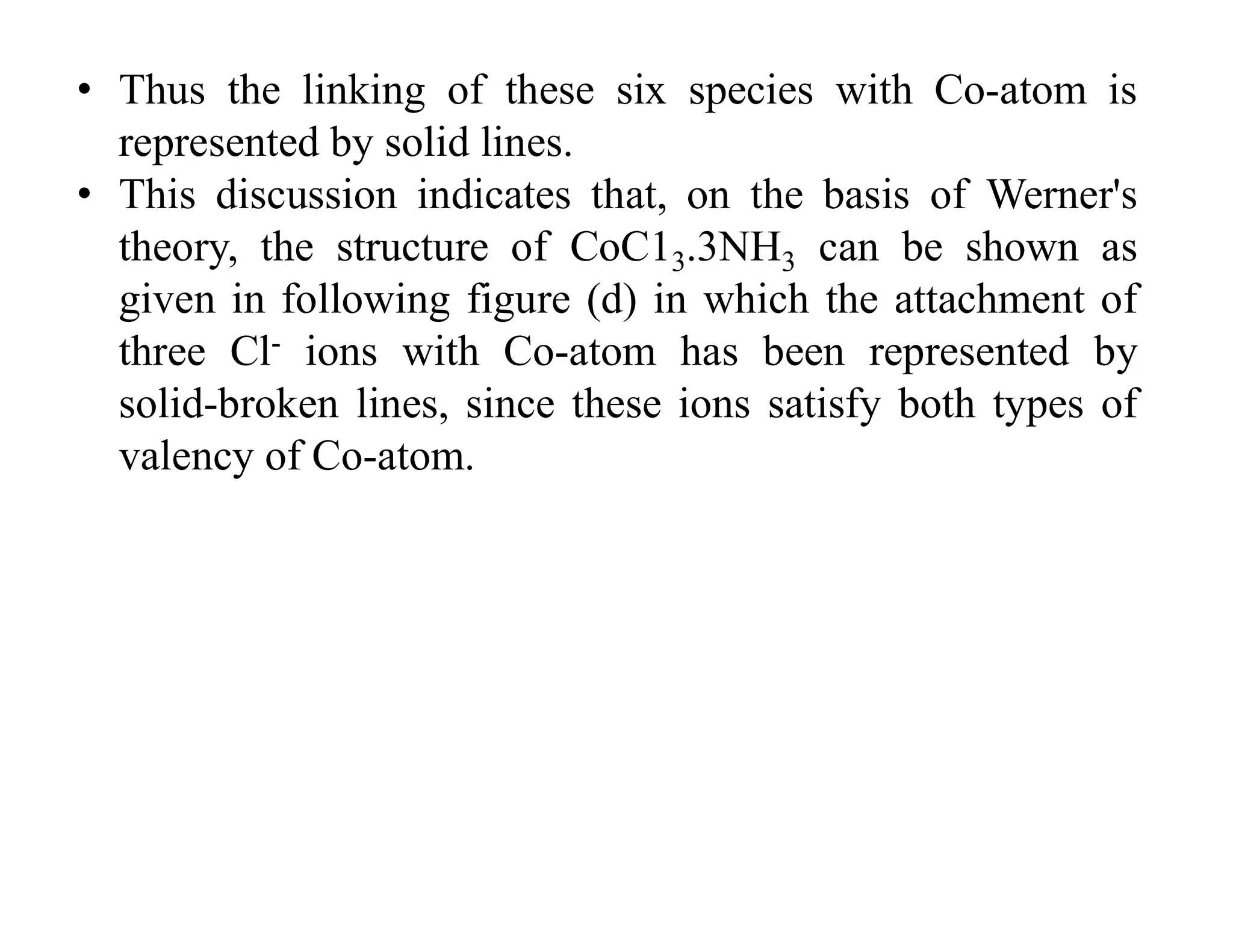
• Secondary valency of six is satisfied either by six NH3
molecules alone or by both NH3 molecules and Cl- ions.
• The species satisfying the secondary valency are attached
with Co3+ ion by solid line
1. CoC13.6NH3
• The primary valency of Co-atom which is equal to +3 is
satisfied by three Cl- ions and hence the attachment of
these ions with Co3+ ion is shown by broken lines
[following figure (a)].
• When this ammine is acted upon by an aqueous solution
of AgNO3, all the three C1- ions present in this ammine
are precipitated as AgC1 (white ppt).
• The precipitation of all the three Cl- ions indicates that
these ions are outside the coordination sphere and it is
only six NH3 molecules which, along with Co atom, are
present inside coordination sphere.
• Thus the structure of CoC13.6NH3 can be written as
[Co.6NH3]C13 or [Co(NH3)6]C13.
• This structure shows that the secondary valency of Co
atom which is equal to six is satisfied by six NH3
molecules placed inside the coordination sphere and
hence the attachment of NH3 molecules to Co-atom is
shown by solid lines [see following figure (a)].
2. CoC13.5NH3
• The primary valency of Co-atom in this ammine is equal
to 3 and is satisfied by three Cl- ions.
• The attachment of these ions with Co3+ ion is, therefore,
shown by broken lines [following figure (b)].
• The treatment of this ammine with the aqueous solution
of AgNO3 precipitates only two Cl- ions as AgC1 (white
ppt.).
• The precipitation of only two C1- ions indicates that two Cl- ions
are outside the coordination sphere and the remaining one Cl- ion
and five NH3 molecules are present inside the coordination sphere.
• Thus on the basis of these observations, the structure of
CoC13.5NH3 can be written as [CoC1.5NH3]C12 or
[Co(NH3)5C1]C12.
• This structure shows that the secondary valency of Co-
atom which is equal to six is satisfied by one Cl- ion and
five NH3 molecules placed inside the coordination sphere.
• The attachment of one Cl- ion and five NH3 molecules to
Co-atom is, therefore, shown by solid lines.
• The above discussion shows that, on the basis of Werner's
theory, the structure of CoC13.5NH3 can be shown as
depicted in following figure (b).
• This figure shows that out of the three Cl- ions, one Cl-
ion is attached with Co-atom by a combined solid-broken
line , since this ion satisfies both primary as well
as secondary valency of Co-atom.
Note → Some chloride ions must do double duty and help satisfy
the both of primary valence and secondary valence.
3. CoC13.4NH3
• The primary valency of Co-atom which is equal to 3 is
satisfied by three Cl- ions and hence the attachment of
these ions to Co-atom is shown by broken lines [see
following figure (c)].
• The treatment of this ammine with the aqueous solution
of AgNO3 precipitates only one Cl- ion as AgC1 (white
ppt.).
• The precipitation of only one Cl- ion indicates that one Cl-
ion is outside the coordination sphere and the remaining
two Cl- ions and four NH3 molecules are present inside
the coordination sphere.
• Thus the structure of CoC13.4NH3 can be represented as
[CoC12.4NH3]Cl or [Co(NH3)4 C12]C1 which shows that
the secondary valency of Co-atom which is equal to six is
satisfied by two Cl- ions and four NH3 molecules placed
inside the coordination sphere and hence the attachment
of these six species with Co-atom has been shown by
solid lines.
• Thus, on the basis of Werner's theory, the structure of
CoC13.4NH3 can be shown as given in following figure
(c) in which the attachment of two Cl- ions with Co-atom
has been shown by solid-broken lines, since these ions
satisfy both types of valency of Co-atom.
4. CoC13.3NH3
• The primary valency of Co-atom which is equal to 3 is
satisfied by three C1- ions and hence the attachment of
these ions with Co-atom is represented by broken lines
[see following figure (d)].
• When this ammine is treated with the aqueous solution of
AgNO3, no precipitate is obtained.
• The non-formation of any precipitate shows that no Cl- ion is
outside the coordination sphere, i.e., all the three C1- ions and
three NH3, along with Co-atom, are present inside the
coordination sphere.
• Thus the structure of this ammine can be written as
[CoC13.3NH3]0 or [Co(NH3)3C13]0.
• This structure shows that the secondary valency of Co-atom
which is equal to six is satisfied by three Cl- ions and three
NH3 molecules placed inside the co-ordination sphere.
• Thus the linking of these six species with Co-atom is
represented by solid lines.
• This discussion indicates that, on the basis of Werner's
theory, the structure of CoC13.3NH3 can be shown as
given in following figure (d) in which the attachment of
three Cl- ions with Co-atom has been represented by
solid-broken lines, since these ions satisfy both types of
valency of Co-atom.
To explain the structure of Pt(IV) ammines on the basis
of Werner's coordination theory
• We have already said the Pt(IV) gives five ammines
which are PtC14.6NH3, PtC14.5NH3, PtCl4.4NH3,
PtC14.3NH3 and PtCl4.2NH3.
• In each of these ammines, primary valency of Pt is equal
to its oxidation state (= +4) while the secondary valency is
equal to 6.
• Thus each ammine has octahedral geometry.
• The structure of these ammines can be written as shown
in following table.
Cryoscopic measurements
Cryoscopic measurements gives the number of ions furnished by the
dissociation of one molecule of the compound.
Limitations of Werner’s Theory
• Like all the major theories, Werner’s Theory was not
free from limitations.
• The common limitations of the theory are:
– It could not explain the inability of all elements to
form coordination compounds.
– The Werners theory could not explain the
directional properties of bonds in various
coordination compounds.
– It does not explain the colour, the magnetic and
optical properties shown by coordination
compounds.
The End

Werner's theory

  • 1.
    Werner's theory Oxidation state(oxidation number) • A number assigned to an element in chemical combination which represents the number of electrons lost (or gained, if the number is negative), by an atom of that element in the compound. Coordination number • The number of atoms or ions immediately surrounding a central atom in a complex or crystal. [Am (B)n]+ C- ↑ Coordination number satisfied by secondary valency Oxidation state (oxidation number satisfied by primary valency ↓
  • 2.
    Alfred Werner receivedthe Nobel Prize of Chemistry in 1913 for his coordination theory of transition metal amine complexes.
  • 3.
    Werner's theory ofcoordination compounds • In 1893 Werner put forward a theory, called Werner's theory of coordination compounds to explain the structure and properties of Co(III) and Pt(IV) ammines. • These ammines are given below: • Co(III) ammines – CoC13.6NH3 → Orange yellow – CoC13.5NH3.H2O → Pink – CoC13.5NH3 → Violet – trans-CoC13.4NH3 → Green – cis-CoC13.4NH3 → Violet – CoC13.3NH3 → Blue-green • Pt (IV) ammines – PtC14.6NH3 – PtC14.5NH3 – PtC14.4NH3 – PtC14.3NH3 – PtC14.2NH3
  • 4.
    Postulates of Werner’scoordination theory Types of valency • Two types of valency shown by the central metal atom in coordination compounds. • In complex compounds, the central metal atom exhibits two types of valency viz. primary valency (also called principal valency → corresponds to oxidation state → electrons lost or gained) and secondary valency (also called auxiliary valency → corresponds to coordination number → ligands around the central metal). • The metal atom always tends to satisfy both of its valencies. Characteristics of secondary valency • In modem terminology, the secondary valency of the metallic atom in a complex compound is equal to the coordination number of that metal. • Secondary valency of a metal is satisfied either by anions or by neutral molecules alone or by anions and neutral molecules both.
  • 5.
    • For example: –Anions: In 4KCN.Fe(CN)2 or K4[Fe(CN)6], the secondary valency of Fe-atom is six and is satisfied by six CN- ions (anions). – Neutral: In CoC13.6NH3 or [Co(NH3)6]C13, secondary valency of Co-atom is six and is satisfied by six NH3 molecules (neutral molecules). – Neutral + anions: In CoC13.5NH3 or [Co(NH3)5C1]C12, the secondary valency of Co-atom is six and is satisfied by five NH3 molecules (neutral molecules) and one Cl- ion (anion). • According to modern concept of complex compounds, the species satisfying the secondary valency are called ligands. • While writing the structure of a complex compound, the species satisfying the secondary valency and the metal are written inside the coordination sphere. [Metal (Ligands)] • For example in CoC13.4NH3, since four NH3 molecules and two Cl- ions satisfy the secondary valency of Co-atom, its structure is written as [CoC12.4NH3]C1 or [Co(NH3)4C12]C1.
  • 6.
    • The secondaryvalencies have directional nature, since the species satisfying the secondary valency (i.e., ligands) are directed towards the fixed positions in space. • The number of species satisfying the secondary valency gives a definite geometry to the complex compound. • For example, when the number of monodentate species (ligands) which satisfy the secondary valency of the metal in a complex compound is 2, 3, 4 or 6, the geometry of the complex compound would be linear, trigonal planar, tetrahedral or square planar and octahedral respectively. • In each of the four Co (Ill) ammines viz., CoC13.6NH3, CoC13.5NH3, CoCl3.4NH3 and CoC13.3NH3, since the secondary valency of Co-atom is 6, each amine has octahedral geometry. • The species satisfying the secondary valency cannot be obtained in the free state, when the aqueous solution of the complex compound undergoes ionisation. [Metal ← Ligands] L → Geometry
  • 7.
    • For example,when the aqueous solution of CoC13.4NH3 or [Co(NH3)4C12]C1 undergoes ionisation, four NH3 molecules and two Cl ions which satisfy the secondary valency of Co- atom are not obtained in the free state as shown below: • The above discussion can be concluded by saying that the species satisfying the secondary valency are not ionisable (non-ionisable) and hence cannot be precipitated. • The attachment of the species satisfying the secondary valency with the metal atom is shown by a solid line Characteristics of primary valency • In modem terminology, the primary valency of the metallic atom in a complex compound is equal to the oxidation state (or oxidation number) of that metal, e.g., the primary valency of Co-atom in all the four Co(III) ammines is equal to +3.
  • 8.
    • Primary valencyof a metal in a complex compound is always satisfied by anions, e.g., the primary valency of Co-atom in each of the four ammines is equal to +3 and is satisfied by three Cl- ions. • The anions satisfying the primary valency are written outside the coordination sphere while the anions which satisfy both the valencies (dual character) are written inside the coordination sphere. • Thus the species satisfyinig primary valency may be present inside and/or outside the coordination sphere. • The species satisfying both the valencies (i.e., the species placed inside the coordination sphere) are directed towards specific directions in space and hence they have directional characteristics. • The species which satisfy primary valency and are placed outside the coordination sphere have no directional characteristics. [CoIII(Ligands)]3+ → [CoIII(Ligands)]Cl3 [Metal(Ligands)] Anions [Metal ← Anions] Anions
  • 9.
    • The speciessatisfying the primary valency do not give any geometry to the complex compound. • The species satisfying the primary valency can be obtained either completely or partially in their free state, when the complex compound undergoes ionisation in aqueous solution. • Examples: • When the aqueous solution of CoC13.6NH3 or [Co(NH3)6]C13 undergoes ionisation, all the three Cl- ions which satisfy primary valency of Co-atom are obtained in the free state. • Although the primary valency of Co-atom in CoC13.5NH3 or [Co(NH3)5C1]C12 is satisfied by three Cl- ions, only two Cl- ions are obtained in the free state, when the aqueous solution of this ammine undergoes ionisation. Anions → No information for geometry
  • 10.
    • The abovediscussion shows that all or some of the species satisfying the primary valencies are ionisable and hence can be precipitated by means of a suitable precipitating agent. • For example, in the above ammine two Cl- ions can be precipitated as AgC1 (white ppt.) by adding aqueous solution of AgNO3. • From the above discussion we can conclude that all the anions placed outside the coordination sphere can be obtained in the free state and hence can be precipitated. • Thus all the anions placed outside the coordination sphere are ionisable. • The attachment of the species satisfying the primary valency to the metal is shown by broken line (– – –). [Metal(Ligands)] Anions → Ionisable
  • 11.
    How to showthe attachment between the central metal and the species satisfying both the valencies • The attachment between the metal and the species which satisfy both the valencies is shown by a combined solid- broken line . • For example in CoC13.5NH3 or [Co(NH3)5C1]C12, since one Cl- ion satisfies primary as well as secondary valency of Co-atom, the attachment of this C1- ion to Co-atom is shown as To explain the structure of Co(III) ammines on the basis of Werner's coordination theory • With the help of the postulates of Werner's coordination theory, the structure of Co (III) ammines viz. CoCl3.6NH3, CoC13.5NH3, CoC13.4NH3 and CoC13.3NH3 can well be explained. In all these ammines, the primary valency of cobalt is equal to 3 while the secondary valency is equal to 6.
  • 12.
    • Primary valencyof 3 is satisfied by three Cl- ions and hence these ions are attached with Co3+ ion by dotted line (---). • Secondary valency of six is satisfied either by six NH3 molecules alone or by both NH3 molecules and Cl- ions. • The species satisfying the secondary valency are attached with Co3+ ion by solid line 1. CoC13.6NH3 • The primary valency of Co-atom which is equal to +3 is satisfied by three Cl- ions and hence the attachment of these ions with Co3+ ion is shown by broken lines [following figure (a)]. • When this ammine is acted upon by an aqueous solution of AgNO3, all the three C1- ions present in this ammine are precipitated as AgC1 (white ppt).
  • 13.
    • The precipitationof all the three Cl- ions indicates that these ions are outside the coordination sphere and it is only six NH3 molecules which, along with Co atom, are present inside coordination sphere. • Thus the structure of CoC13.6NH3 can be written as [Co.6NH3]C13 or [Co(NH3)6]C13. • This structure shows that the secondary valency of Co atom which is equal to six is satisfied by six NH3 molecules placed inside the coordination sphere and hence the attachment of NH3 molecules to Co-atom is shown by solid lines [see following figure (a)].
  • 15.
    2. CoC13.5NH3 • Theprimary valency of Co-atom in this ammine is equal to 3 and is satisfied by three Cl- ions. • The attachment of these ions with Co3+ ion is, therefore, shown by broken lines [following figure (b)]. • The treatment of this ammine with the aqueous solution of AgNO3 precipitates only two Cl- ions as AgC1 (white ppt.). • The precipitation of only two C1- ions indicates that two Cl- ions are outside the coordination sphere and the remaining one Cl- ion and five NH3 molecules are present inside the coordination sphere. • Thus on the basis of these observations, the structure of CoC13.5NH3 can be written as [CoC1.5NH3]C12 or [Co(NH3)5C1]C12.
  • 16.
    • This structureshows that the secondary valency of Co- atom which is equal to six is satisfied by one Cl- ion and five NH3 molecules placed inside the coordination sphere. • The attachment of one Cl- ion and five NH3 molecules to Co-atom is, therefore, shown by solid lines. • The above discussion shows that, on the basis of Werner's theory, the structure of CoC13.5NH3 can be shown as depicted in following figure (b). • This figure shows that out of the three Cl- ions, one Cl- ion is attached with Co-atom by a combined solid-broken line , since this ion satisfies both primary as well as secondary valency of Co-atom.
  • 17.
    Note → Somechloride ions must do double duty and help satisfy the both of primary valence and secondary valence.
  • 18.
    3. CoC13.4NH3 • Theprimary valency of Co-atom which is equal to 3 is satisfied by three Cl- ions and hence the attachment of these ions to Co-atom is shown by broken lines [see following figure (c)]. • The treatment of this ammine with the aqueous solution of AgNO3 precipitates only one Cl- ion as AgC1 (white ppt.). • The precipitation of only one Cl- ion indicates that one Cl- ion is outside the coordination sphere and the remaining two Cl- ions and four NH3 molecules are present inside the coordination sphere.
  • 19.
    • Thus thestructure of CoC13.4NH3 can be represented as [CoC12.4NH3]Cl or [Co(NH3)4 C12]C1 which shows that the secondary valency of Co-atom which is equal to six is satisfied by two Cl- ions and four NH3 molecules placed inside the coordination sphere and hence the attachment of these six species with Co-atom has been shown by solid lines. • Thus, on the basis of Werner's theory, the structure of CoC13.4NH3 can be shown as given in following figure (c) in which the attachment of two Cl- ions with Co-atom has been shown by solid-broken lines, since these ions satisfy both types of valency of Co-atom.
  • 21.
    4. CoC13.3NH3 • Theprimary valency of Co-atom which is equal to 3 is satisfied by three C1- ions and hence the attachment of these ions with Co-atom is represented by broken lines [see following figure (d)]. • When this ammine is treated with the aqueous solution of AgNO3, no precipitate is obtained. • The non-formation of any precipitate shows that no Cl- ion is outside the coordination sphere, i.e., all the three C1- ions and three NH3, along with Co-atom, are present inside the coordination sphere. • Thus the structure of this ammine can be written as [CoC13.3NH3]0 or [Co(NH3)3C13]0. • This structure shows that the secondary valency of Co-atom which is equal to six is satisfied by three Cl- ions and three NH3 molecules placed inside the co-ordination sphere.
  • 22.
    • Thus thelinking of these six species with Co-atom is represented by solid lines. • This discussion indicates that, on the basis of Werner's theory, the structure of CoC13.3NH3 can be shown as given in following figure (d) in which the attachment of three Cl- ions with Co-atom has been represented by solid-broken lines, since these ions satisfy both types of valency of Co-atom.
  • 24.
    To explain thestructure of Pt(IV) ammines on the basis of Werner's coordination theory • We have already said the Pt(IV) gives five ammines which are PtC14.6NH3, PtC14.5NH3, PtCl4.4NH3, PtC14.3NH3 and PtCl4.2NH3. • In each of these ammines, primary valency of Pt is equal to its oxidation state (= +4) while the secondary valency is equal to 6. • Thus each ammine has octahedral geometry. • The structure of these ammines can be written as shown in following table. Cryoscopic measurements Cryoscopic measurements gives the number of ions furnished by the dissociation of one molecule of the compound.
  • 26.
    Limitations of Werner’sTheory • Like all the major theories, Werner’s Theory was not free from limitations. • The common limitations of the theory are: – It could not explain the inability of all elements to form coordination compounds. – The Werners theory could not explain the directional properties of bonds in various coordination compounds. – It does not explain the colour, the magnetic and optical properties shown by coordination compounds.
  • 27.