Presented by
Dr. Neelam
Department of chemistry
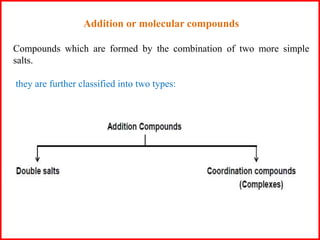
Addition or molecular compounds
Compounds which are formed by the combination of two more simple
salts.
they are further classified into two types:
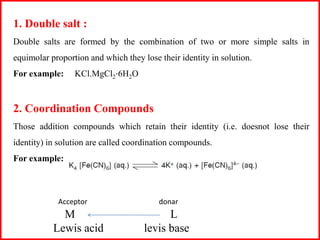
1. Double salt :
Double salts are formed by the combination of two or more simple salts in
equimolar proportion and which they lose their identity in solution.
For example: KCl.MgCl2⋅6H2O
2. Coordination Compounds
Those addition compounds which retain their identity (i.e. doesnot lose their
identity) in solution are called coordination compounds.
For example:
M L
Lewis acid levis base
Acceptor donar
K4[Fe(CN)6]
Coordination no.
Central metal ion
Ligand
Ionisable sphere
Or
counter sphere
Anionic complex
Coordination sphere
Central Atom/Ion :
the atom/ion to which are bound a fixed number of ligands in a definite
geometrical arrangement around it, is called the central atom or ion.
For example:
the central atom/ion in the coordination entities: [NiCl2(OH2)4],
[CoCl(NH3)5]2+ and [Fe(CN)6]3+ are Ni2+, Co3+ and Fe3+ Respectively.
Coordination Number :
It is defined as the number of coordinate bonds formed by central metal atom,
with the ligands.
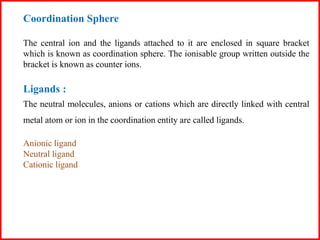
Coordination Sphere
The central ion and the ligands attached to it are enclosed in square bracket
which is known as coordination sphere. The ionisable group written outside the
bracket is known as counter ions.
Ligands :
The neutral molecules, anions or cations which are directly linked with central
metal atom or ion in the coordination entity are called ligands.
Anionic ligand
Neutral ligand
Cationic ligand
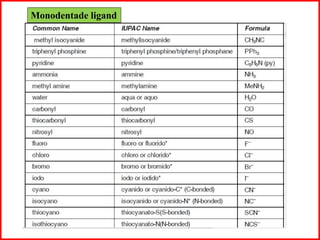
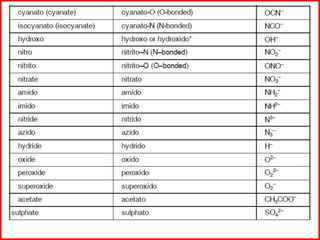
Monodentade ligand
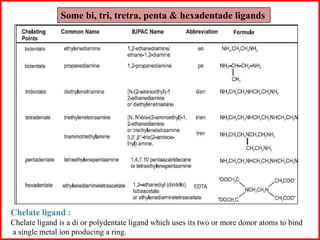
Some bi, tri, tretra, penta & hexadentade ligands
Chelate ligand :
Chelate ligand is a di or polydentate ligand which uses its two or more donor atoms to bind
a single metal ion producing a ring.
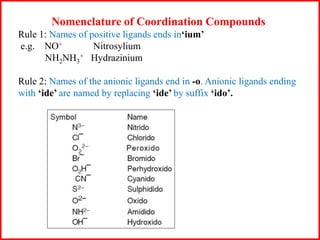
Nomenclature of Coordination Compounds
Rule 1: Names of positive ligands ends in‘ium’
e.g. NO+ Nitrosylium
NH2NH3
+ Hydrazinium
Rule 2: Names of the anionic ligands end in -o. Anionic ligands ending
with ‘ide’ are named by replacing ‘ide’ by suffix ‘ido’.
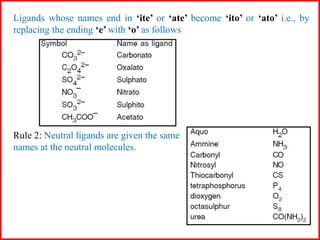
Ligands whose names end in ‘ite’ or ‘ate’ become ‘ito’ or ‘ato’ i.e., by
replacing the ending ‘e’ with ‘o’ as follows
Rule 2: Neutral ligands are given the same
names at the neutral molecules.
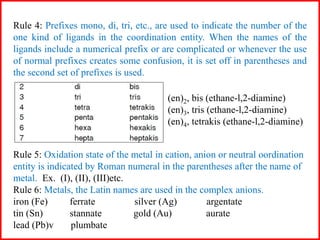
Rule 4: Prefixes mono, di, tri, etc., are used to indicate the number of the
one kind of ligands in the coordination entity. When the names of the
ligands include a numerical prefix or are complicated or whenever the use
of normal prefixes creates some confusion, it is set off in parentheses and
the second set of prefixes is used.
Rule 5: Oxidation state of the metal in cation, anion or neutral oordination
entity is indicated by Roman numeral in the parentheses after the name of
metal. Ex. (I), (II), (III)etc.
Rule 6: Metals, the Latin names are used in the complex anions.
iron (Fe) ferrate silver (Ag) argentate
tin (Sn) stannate gold (Au) aurate
lead (Pb)v plumbate
(en)2, bis (ethane-l,2-diamine)
(en)3, tris (ethane-l,2-diamine)
(en)4, tetrakis (ethane-l,2-diamine)
Some examples are:
(i) [Cr(NH3)3(H2O)3]Cl3 (complex cation + simple anion)
triamminetriaquachromium (III) chloride
(ii) [Co(NH2CH2CH2NH2)3]2(SO4) (complex cation + simple anion)
tris (ethane-l,2-diamine) cobalt (III) sulphate
(iii) K4 [Fe(CN)6] (simple cation + complex anion)
potassium hexacyanoferrate (II)
[NiCl2(PPh3)2]
dichloridobis(triphenylphosphine)nickel(II).
Cations + no. of ligands + name of ligand + central metal ion +
oxidation no. (in roman)(alphabatic order)
14

Coordination Chemistry

  • 1.
  • 2.
    Addition or molecularcompounds Compounds which are formed by the combination of two more simple salts. they are further classified into two types:
  • 3.
    1. Double salt: Double salts are formed by the combination of two or more simple salts in equimolar proportion and which they lose their identity in solution. For example: KCl.MgCl2⋅6H2O 2. Coordination Compounds Those addition compounds which retain their identity (i.e. doesnot lose their identity) in solution are called coordination compounds. For example: M L Lewis acid levis base Acceptor donar
  • 4.
    K4[Fe(CN)6] Coordination no. Central metalion Ligand Ionisable sphere Or counter sphere Anionic complex Coordination sphere
  • 5.
    Central Atom/Ion : theatom/ion to which are bound a fixed number of ligands in a definite geometrical arrangement around it, is called the central atom or ion. For example: the central atom/ion in the coordination entities: [NiCl2(OH2)4], [CoCl(NH3)5]2+ and [Fe(CN)6]3+ are Ni2+, Co3+ and Fe3+ Respectively. Coordination Number : It is defined as the number of coordinate bonds formed by central metal atom, with the ligands.
  • 6.
    Coordination Sphere The centralion and the ligands attached to it are enclosed in square bracket which is known as coordination sphere. The ionisable group written outside the bracket is known as counter ions. Ligands : The neutral molecules, anions or cations which are directly linked with central metal atom or ion in the coordination entity are called ligands. Anionic ligand Neutral ligand Cationic ligand
  • 7.
  • 9.
    Some bi, tri,tretra, penta & hexadentade ligands Chelate ligand : Chelate ligand is a di or polydentate ligand which uses its two or more donor atoms to bind a single metal ion producing a ring.
  • 10.
    Nomenclature of CoordinationCompounds Rule 1: Names of positive ligands ends in‘ium’ e.g. NO+ Nitrosylium NH2NH3 + Hydrazinium Rule 2: Names of the anionic ligands end in -o. Anionic ligands ending with ‘ide’ are named by replacing ‘ide’ by suffix ‘ido’.
  • 11.
    Ligands whose namesend in ‘ite’ or ‘ate’ become ‘ito’ or ‘ato’ i.e., by replacing the ending ‘e’ with ‘o’ as follows Rule 2: Neutral ligands are given the same names at the neutral molecules.
  • 12.
    Rule 4: Prefixesmono, di, tri, etc., are used to indicate the number of the one kind of ligands in the coordination entity. When the names of the ligands include a numerical prefix or are complicated or whenever the use of normal prefixes creates some confusion, it is set off in parentheses and the second set of prefixes is used. Rule 5: Oxidation state of the metal in cation, anion or neutral oordination entity is indicated by Roman numeral in the parentheses after the name of metal. Ex. (I), (II), (III)etc. Rule 6: Metals, the Latin names are used in the complex anions. iron (Fe) ferrate silver (Ag) argentate tin (Sn) stannate gold (Au) aurate lead (Pb)v plumbate (en)2, bis (ethane-l,2-diamine) (en)3, tris (ethane-l,2-diamine) (en)4, tetrakis (ethane-l,2-diamine)
  • 13.
    Some examples are: (i)[Cr(NH3)3(H2O)3]Cl3 (complex cation + simple anion) triamminetriaquachromium (III) chloride (ii) [Co(NH2CH2CH2NH2)3]2(SO4) (complex cation + simple anion) tris (ethane-l,2-diamine) cobalt (III) sulphate (iii) K4 [Fe(CN)6] (simple cation + complex anion) potassium hexacyanoferrate (II) [NiCl2(PPh3)2] dichloridobis(triphenylphosphine)nickel(II). Cations + no. of ligands + name of ligand + central metal ion + oxidation no. (in roman)(alphabatic order)
  • 14.