The document discusses the conjugate base mechanism for the base hydrolysis of cobalt(III) ammine complexes.
1) The complex [Co(NH3)5Cl]2+ acts as a Bronsted acid and loses a proton to form the conjugate base [Co(NH3)4(NH2)Cl]+.
2) The conjugate base is more labile than the original complex and undergoes an SN1 reaction by slowly dissociating chloride, forming a pentacoordinated intermediate.
3) Several experiments provide evidence that the reaction follows a conjugate base mechanism, including second-order kinetics and the rate being independent of hydroxide concentration at high levels.




![CONJUGATE BASE MECHANISM
The complex [Co(NH3)5Cl]2+ acts as a Bronsted acid is
converted into its conjugate base (CB), [Co(NH3)4(NH2)Cl]+.
The CB is obtained by removal of a proton (H+) from ammine
group (NH3) coordinated with the complex. CB is an amido
complex since it contains an amido group (H2N - ).
HO ion acts as a base and is converted into its conjugate
acid, H2O.](https://image.slidesharecdn.com/conjugatebasemechanism-201019174524/85/Conjugate-base-mechanism-6-320.jpg)

![ It has been observed that the CB [Co(NH3)4(NH2)Cl]+ is
more labile than the complex [Co(NH3)5Cl]2+.
Hence, it undergoes SN 1 dissociation mechanism by a slow
step to lose Cl ion and form a 5-Coordinated intermediate
species.](https://image.slidesharecdn.com/conjugatebasemechanism-201019174524/85/Conjugate-base-mechanism-8-320.jpg)

![ The five coordinated intermediate [Co(NH3)4(NH2)]2+ after
reaction with H2O to form the final product of hydration](https://image.slidesharecdn.com/conjugatebasemechanism-201019174524/85/Conjugate-base-mechanism-10-320.jpg)
![Direct and indirect evidences in
favor of conjugate mechanism
The above CB mechanism can be experimentally verified by
following explanations:
It has been observed that the 2nd order kinetics can follow
SN1(CB) mechanism because the equilibrium constant of
reaction (ii) is obtained very fast and the conjugate base (CB)
present at equilibrium is of small i.e. K is small since the
reaction (ii) involves the dissociation of Cl- from the conjugate
base it is slower than (i) and (iii) thus it is rate determining step r
= k[Co(NH3)4(NH2)Cl]+ From reaction (i) K =
[Co(NH3)4(NH2)Cl]+ / [Co(NH3)5Cl]+ [HO- ] so,
[Co(NH3)4(NH2)Cl]+ = K[Co(NH3)5Cl]2+[HO- ] r =
kK[Co(NH3)5Cl]2+[HO- ] = K’[Co(NH3)5Cl]+ [HO- ]](https://image.slidesharecdn.com/conjugatebasemechanism-201019174524/85/Conjugate-base-mechanism-11-320.jpg)
![ At very high [HO- ], the rate of base hydrolysis tend to be
almost independent of [HO- ], this observation can be
explained by SN 1 (CB) mechanism. If the amount of HO ion
added is very large, there would be very little differences in
the concentration of HO after adding acid HO can be taken
as constant so that the rate of hydrolysis as given above in (i)
becomes r = k’[Co(NH3)5Cl]2+[constant]](https://image.slidesharecdn.com/conjugatebasemechanism-201019174524/85/Conjugate-base-mechanism-12-320.jpg)
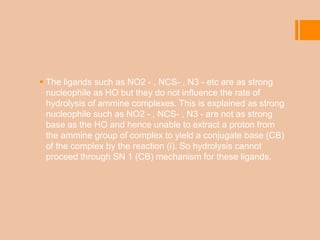
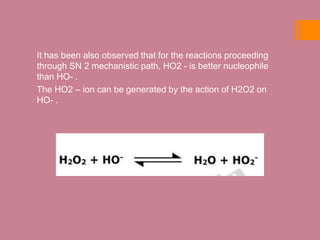

![ The isotopic exchange studies on base hydrolysis using
18OH supports the SN 1 (CB) mechanism for base
hydrolysis of CO(III) ammine complex.
It has been evident from the above explanation that the rate
of base hydrolysis is million fold faster than acid hydrolysis
provided –OH ion is used as base.
The reason of faster rate for base hydrolysis over acid
hydrolysis is proton abstraction from coordinated ammonia in
the reacting complex which forms a conjugate base (CB) and
[Co(NH3)4(NH2)Cl]+ acts as driving force for Cl dissociation.](https://image.slidesharecdn.com/conjugatebasemechanism-201019174524/85/Conjugate-base-mechanism-16-320.jpg)