Sampling Theory
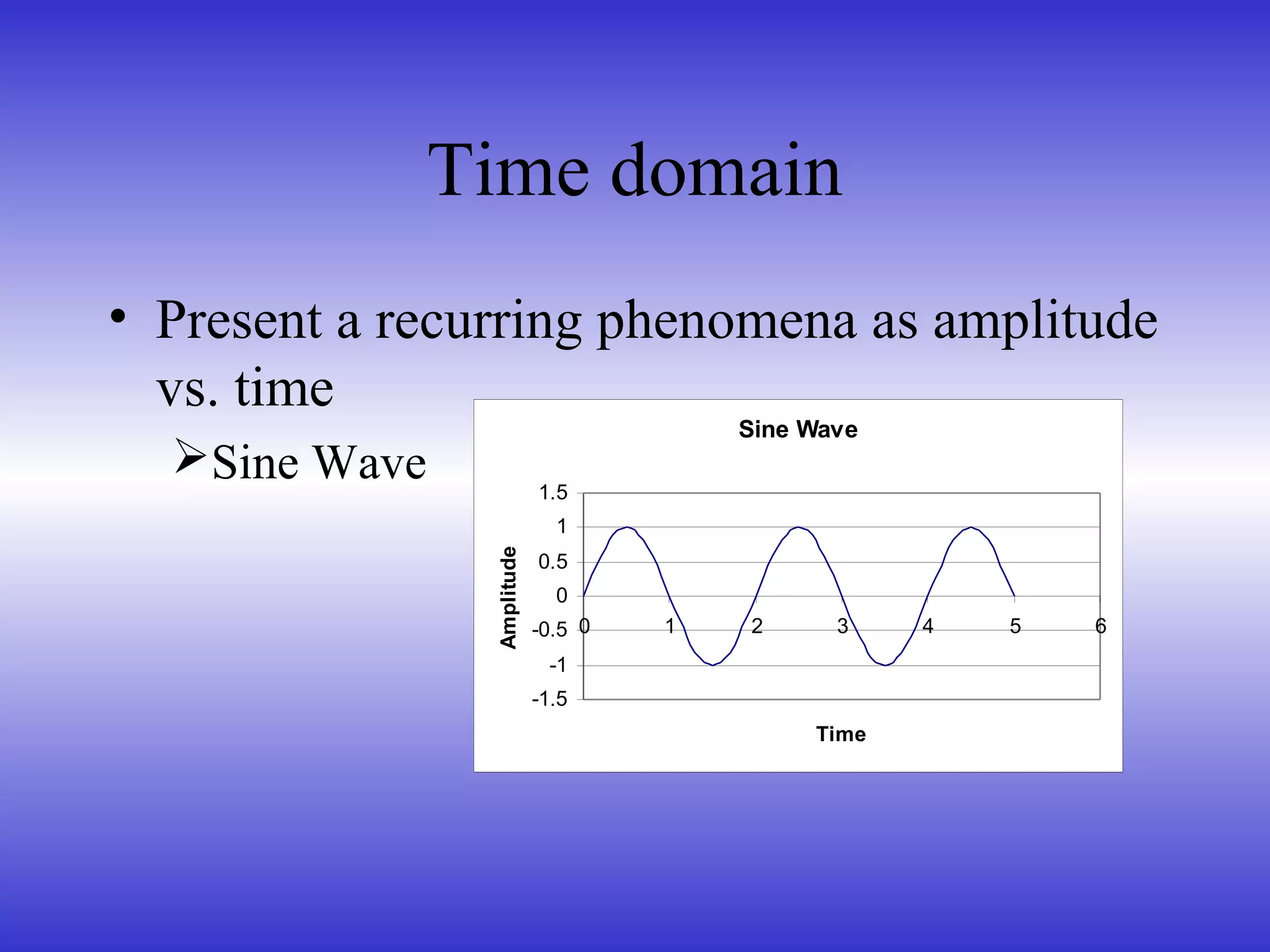
Time domain
• Present a recurring phenomena as amplitude
vs. time
Sine Wave
Sine Wave
-1.5
-1
-0.5
0
0.5
1
1.5
0 1 2 3 4 5 6
Time
Amplitude
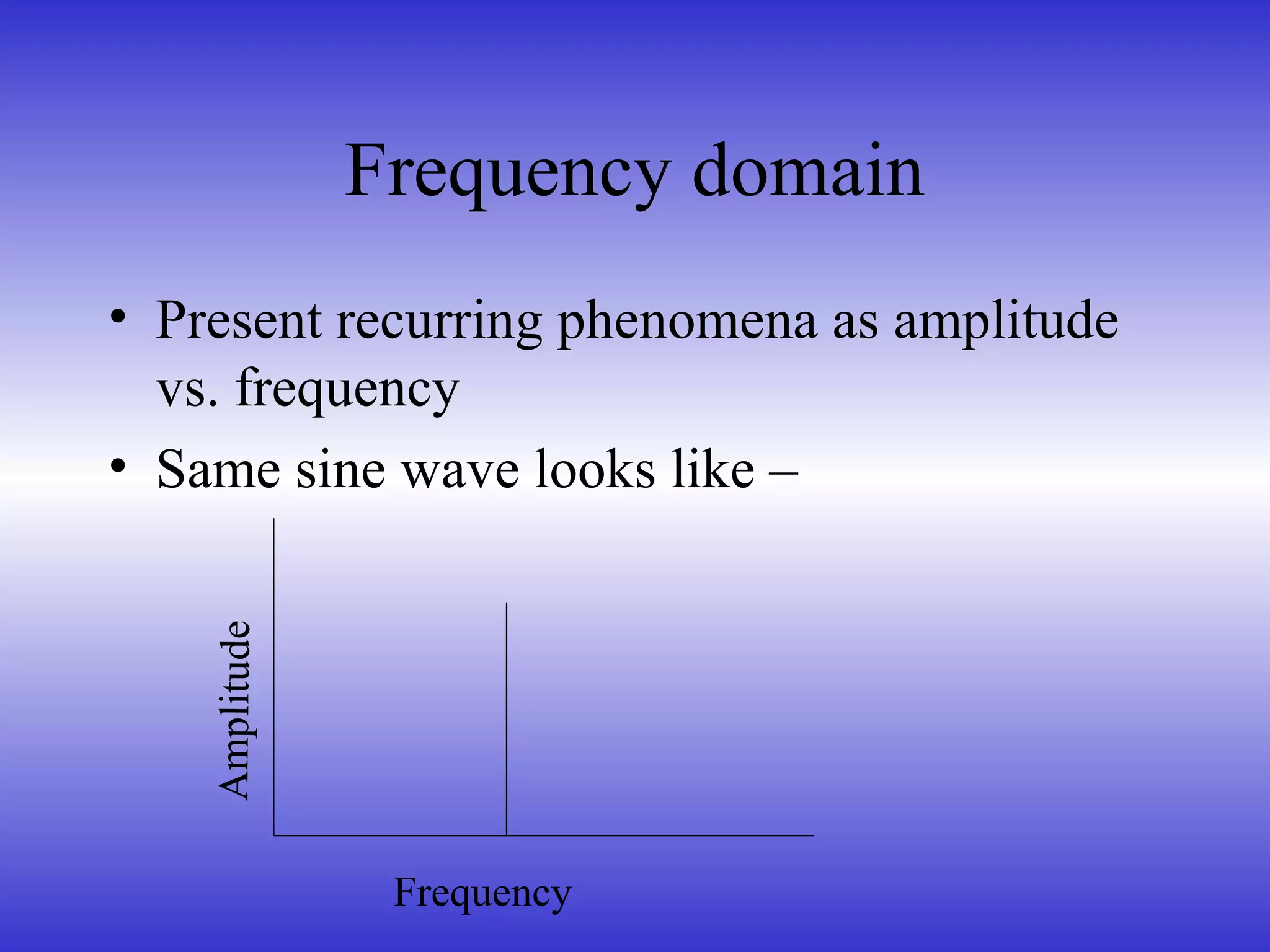
Frequency domain
• Present recurring phenomena as amplitude
vs. frequency
• Same sine wave looks like –
Amplitude
Frequency
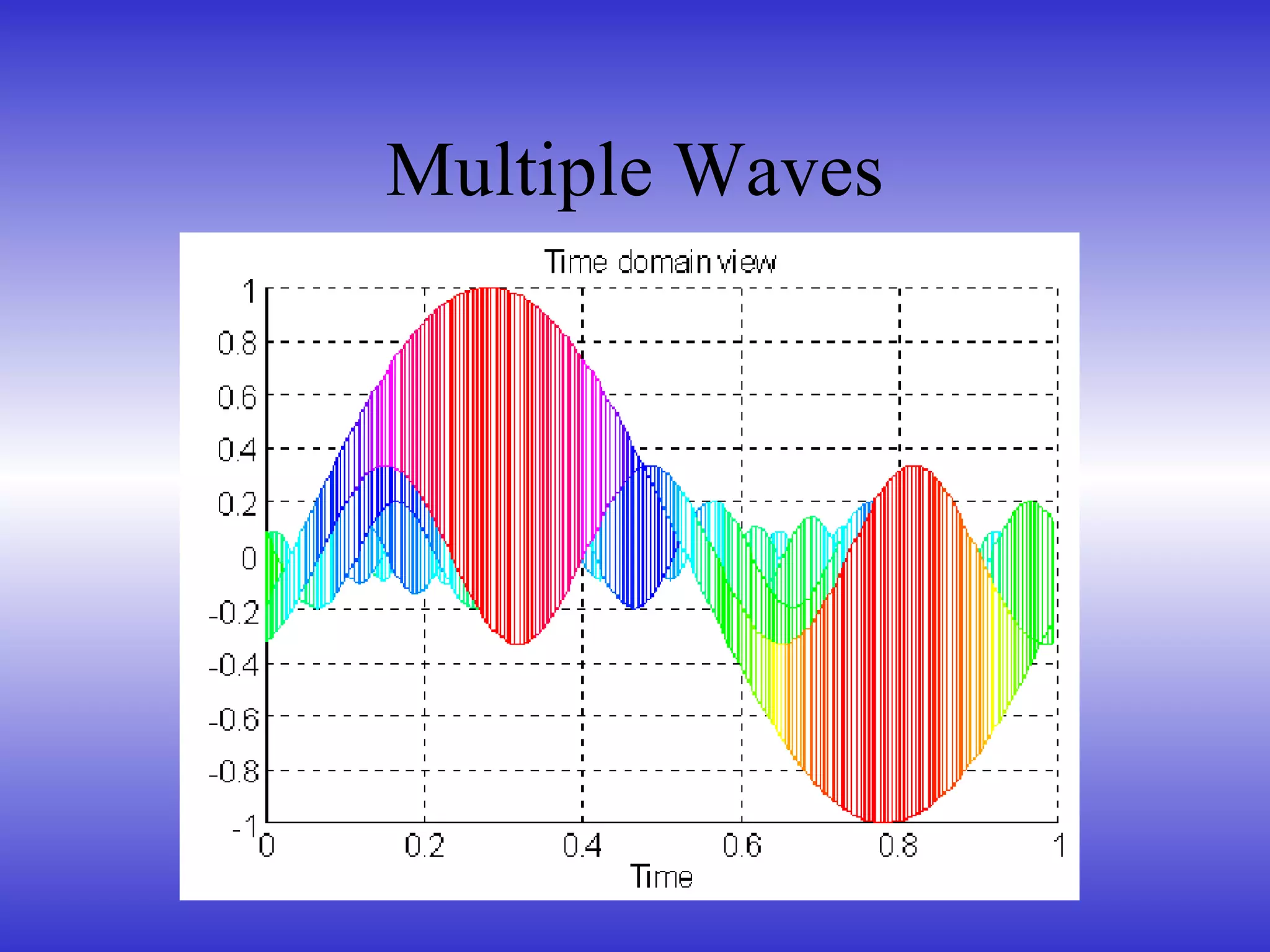
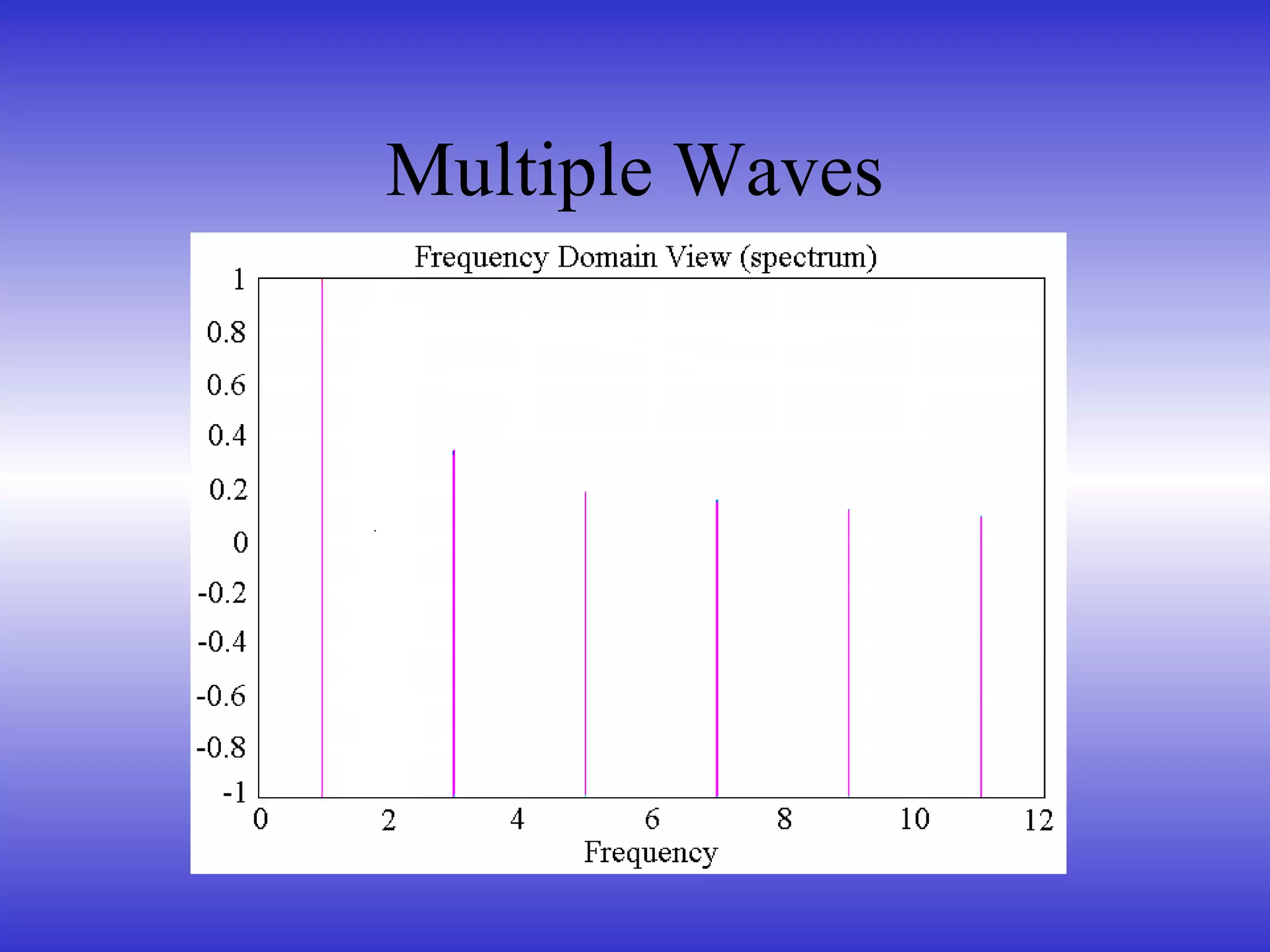
Multiple Waves
Multiple Waves
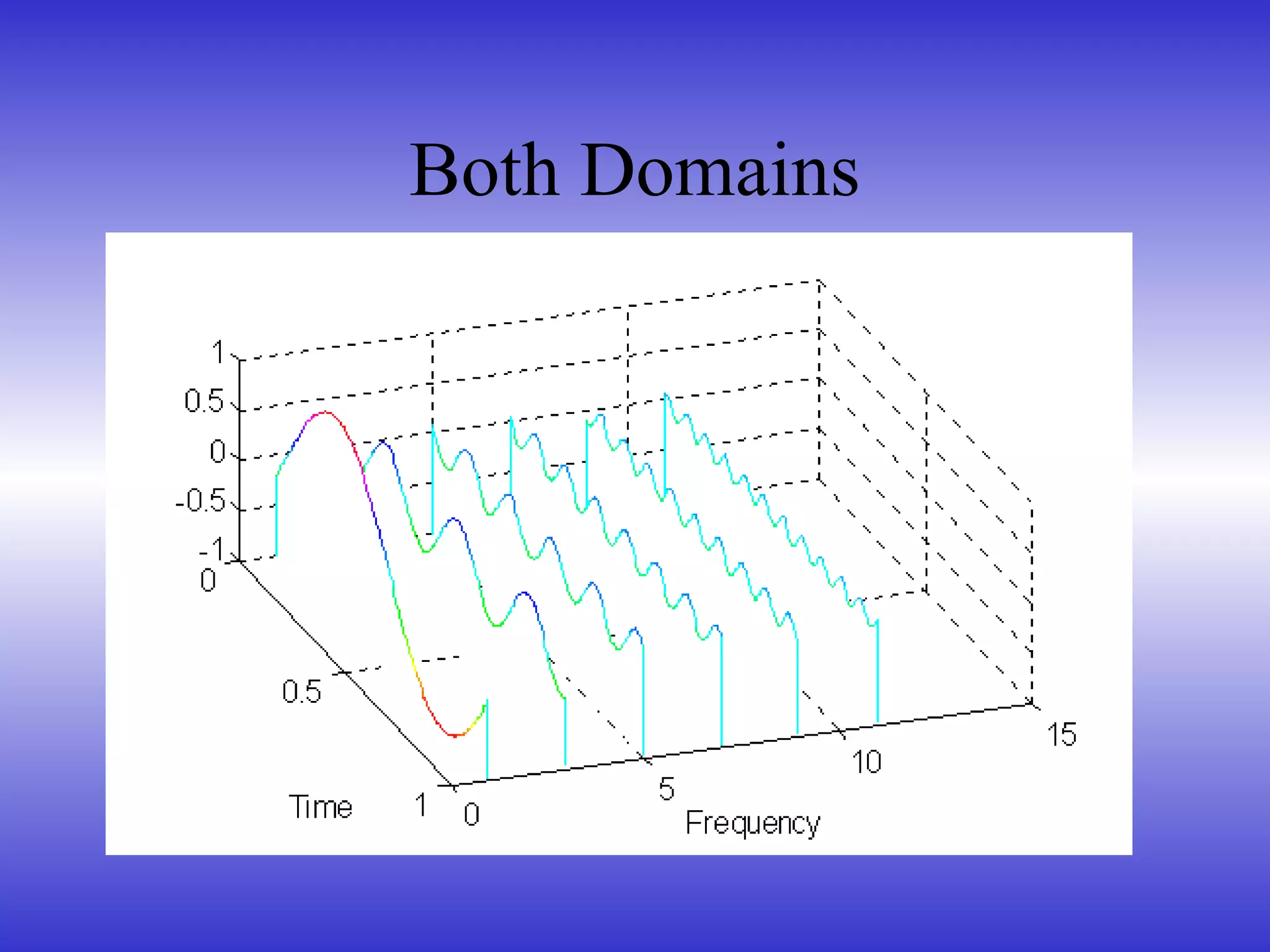
Both Domains
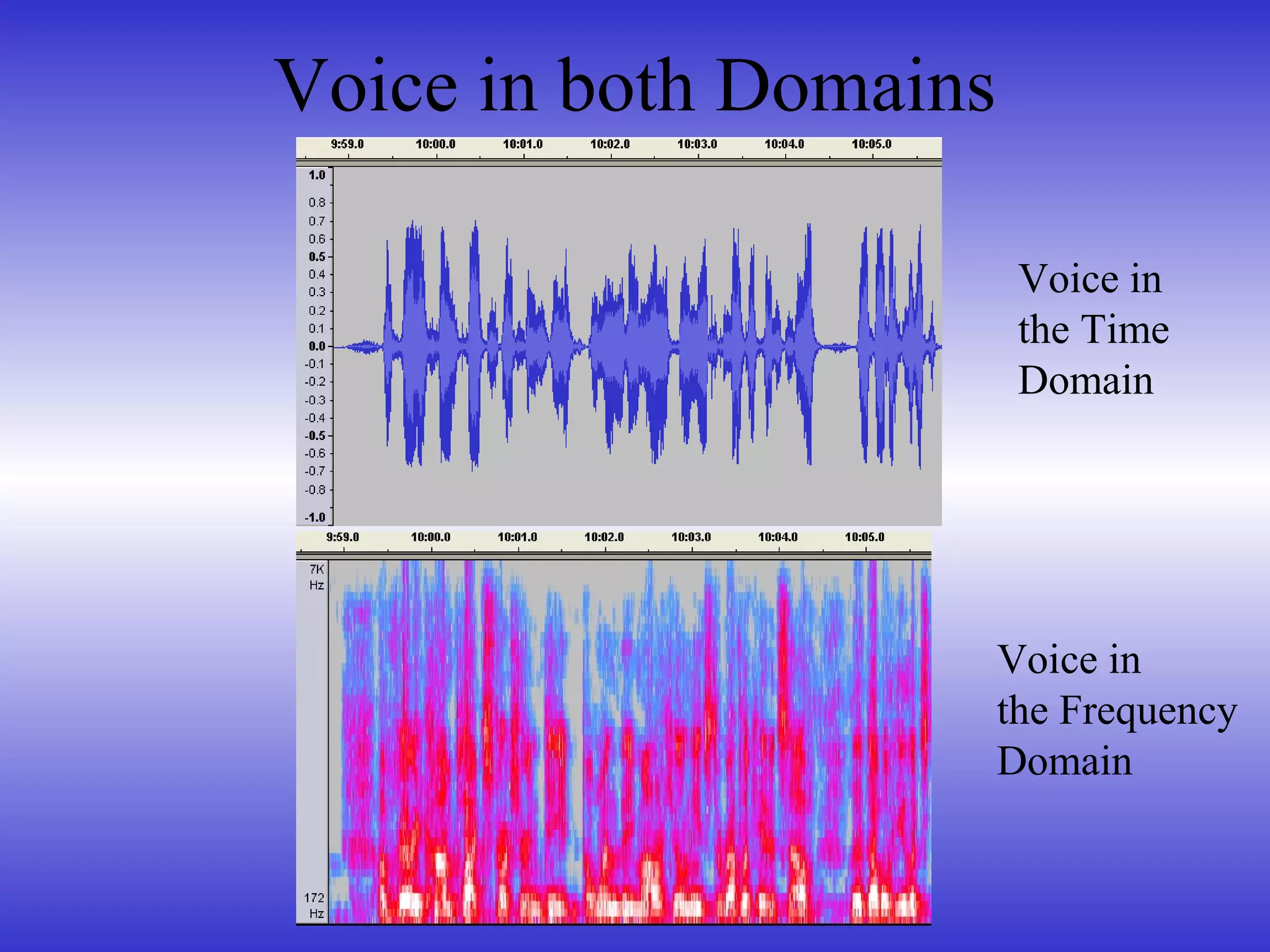
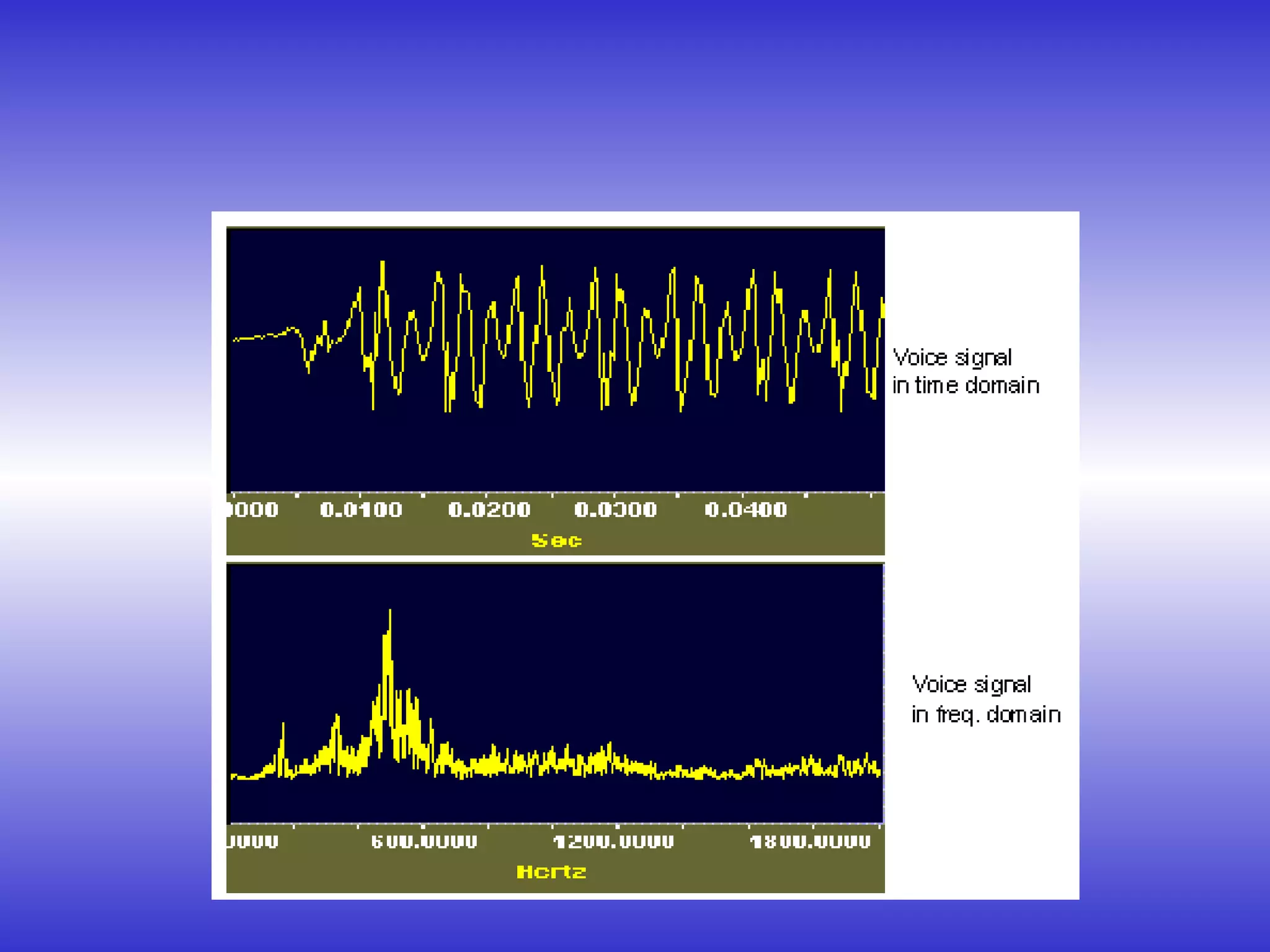
Voice in both Domains
Voice in
the Time
Domain
Voice in
the Frequency
Domain
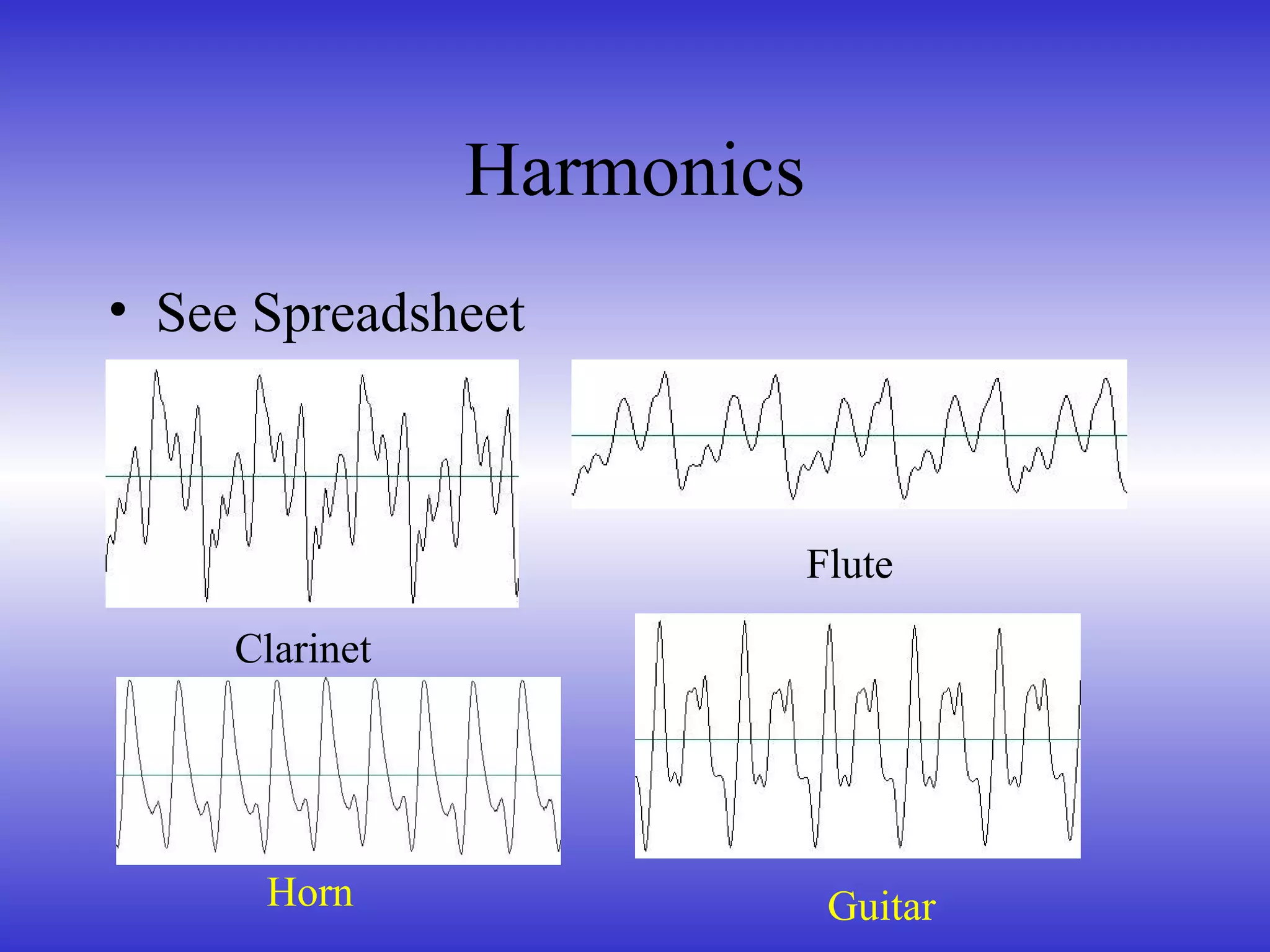
Harmonics
• See Spreadsheet
Clarinet
Flute
Horn Guitar
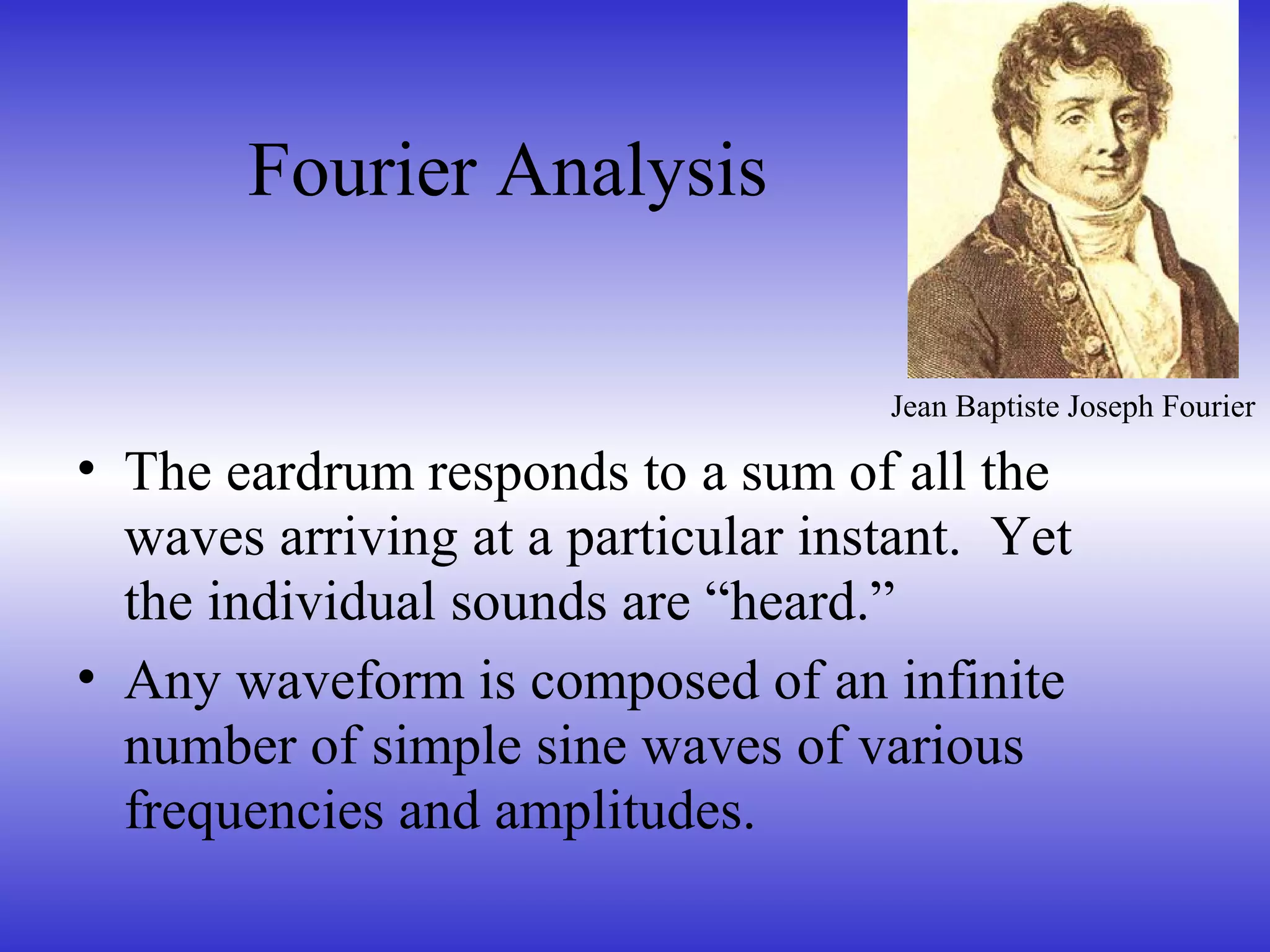
Fourier Analysis
• The eardrum responds to a sum of all the
waves arriving at a particular instant. Yet
the individual sounds are “heard.”
• Any waveform is composed of an infinite
number of simple sine waves of various
frequencies and amplitudes.
Jean Baptiste Joseph Fourier
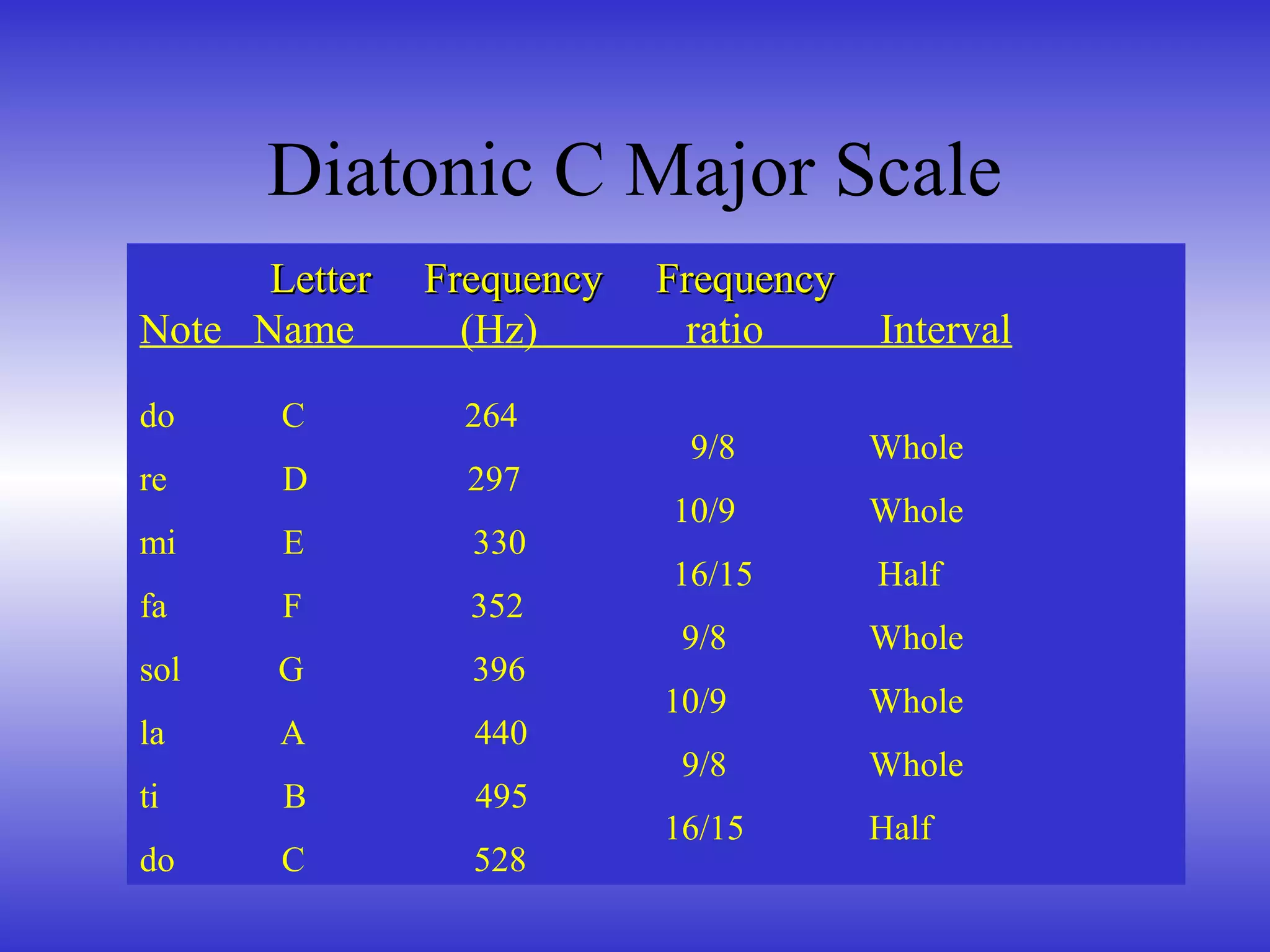
Letter Frequency FrequencyLetter Frequency Frequency
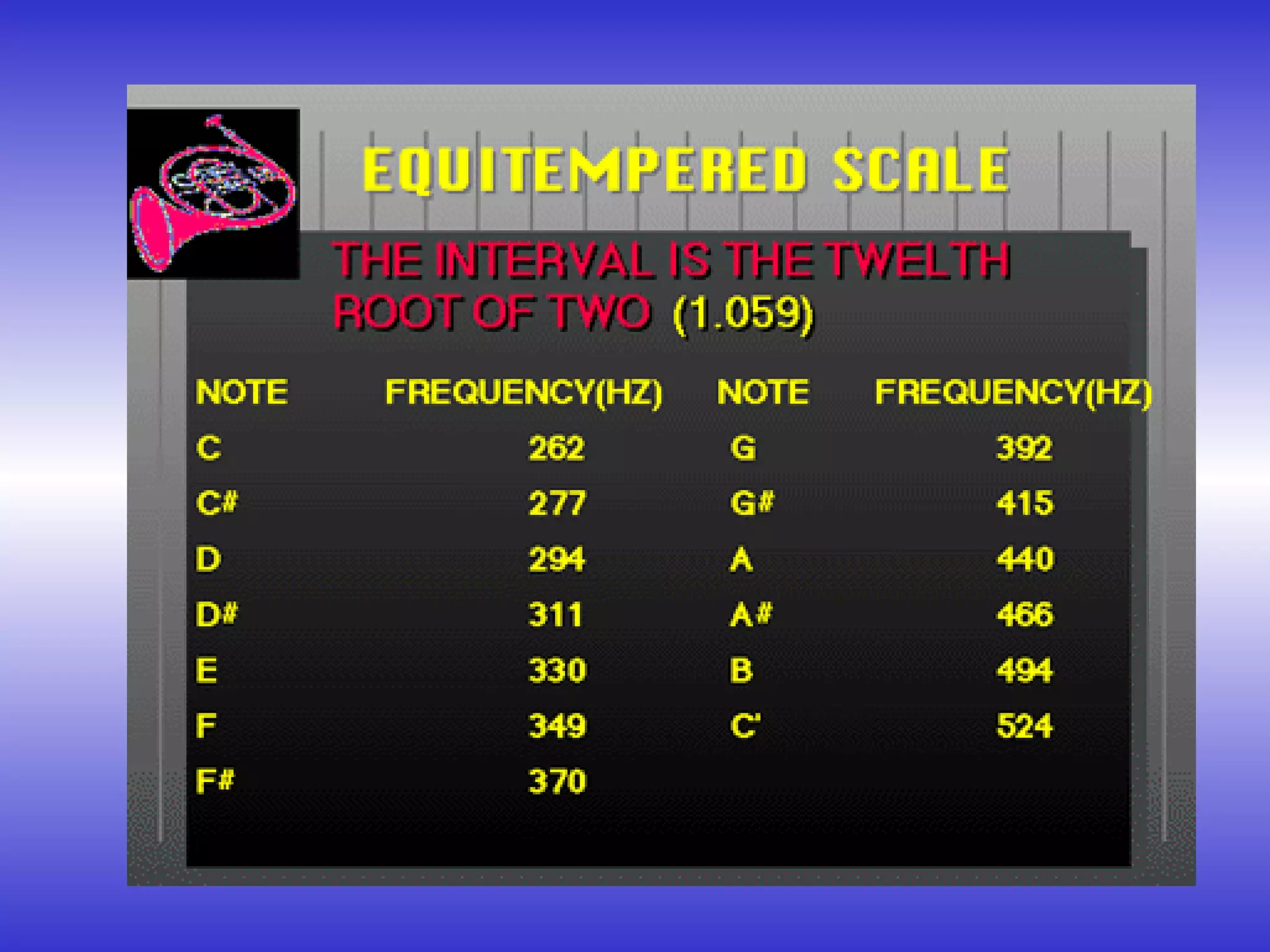
Note Name (Hz) ratio Interval
do C 264
9/8 Whole
re D 297
10/9 Whole
mi E 330
16/15 Half
fa F 352
9/8 Whole
sol G 396
10/9 Whole
la A 440
9/8 Whole
ti B 495
16/15 Half
do C 528
Diatonic C Major Scale
The Keyboard
• Virtual Keyboard
Digitizing the Sound
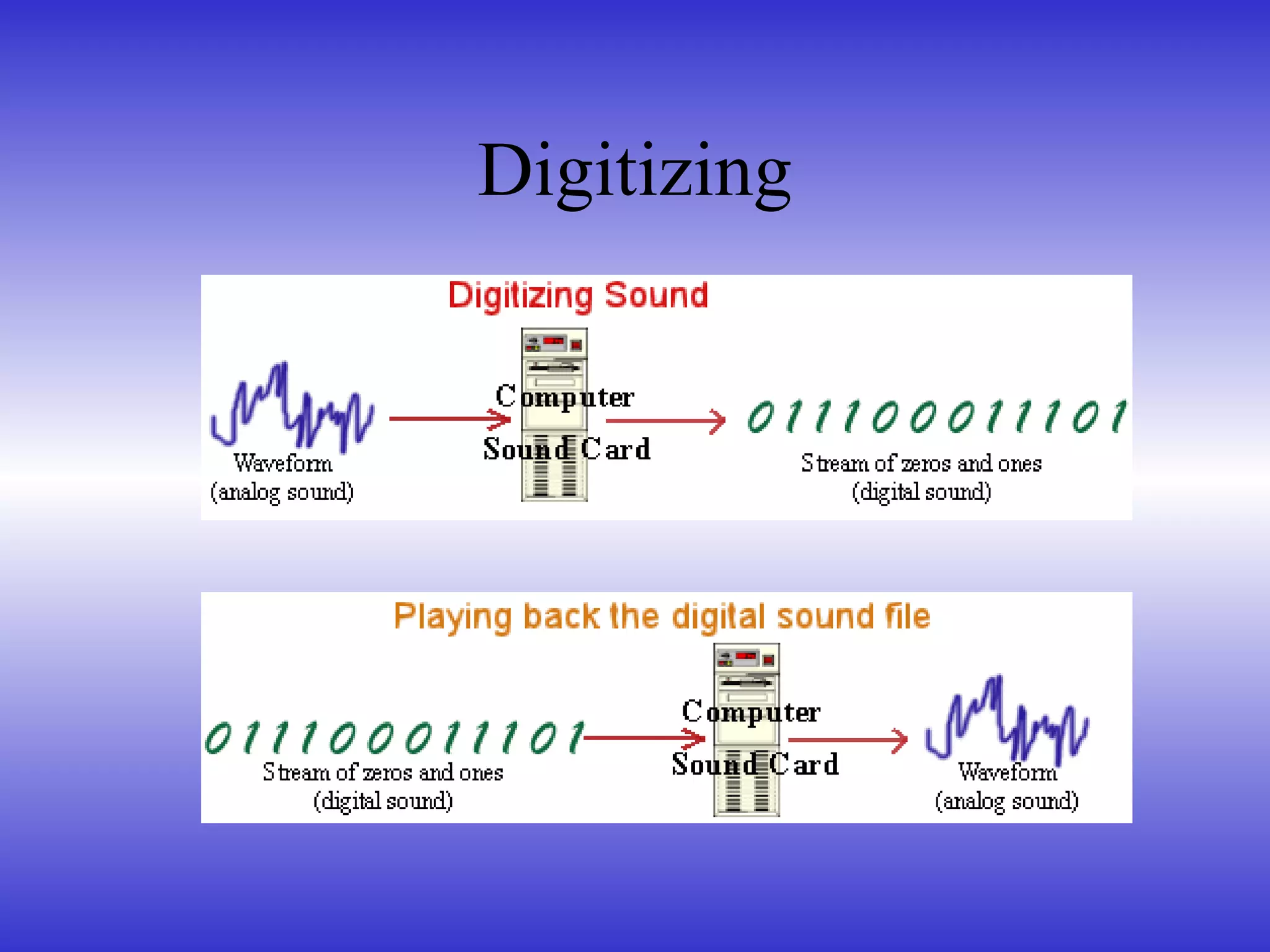
• We want to reconstruct the sound digitally
• How often must we obtain a sample to
faithfully reproduce the sound?
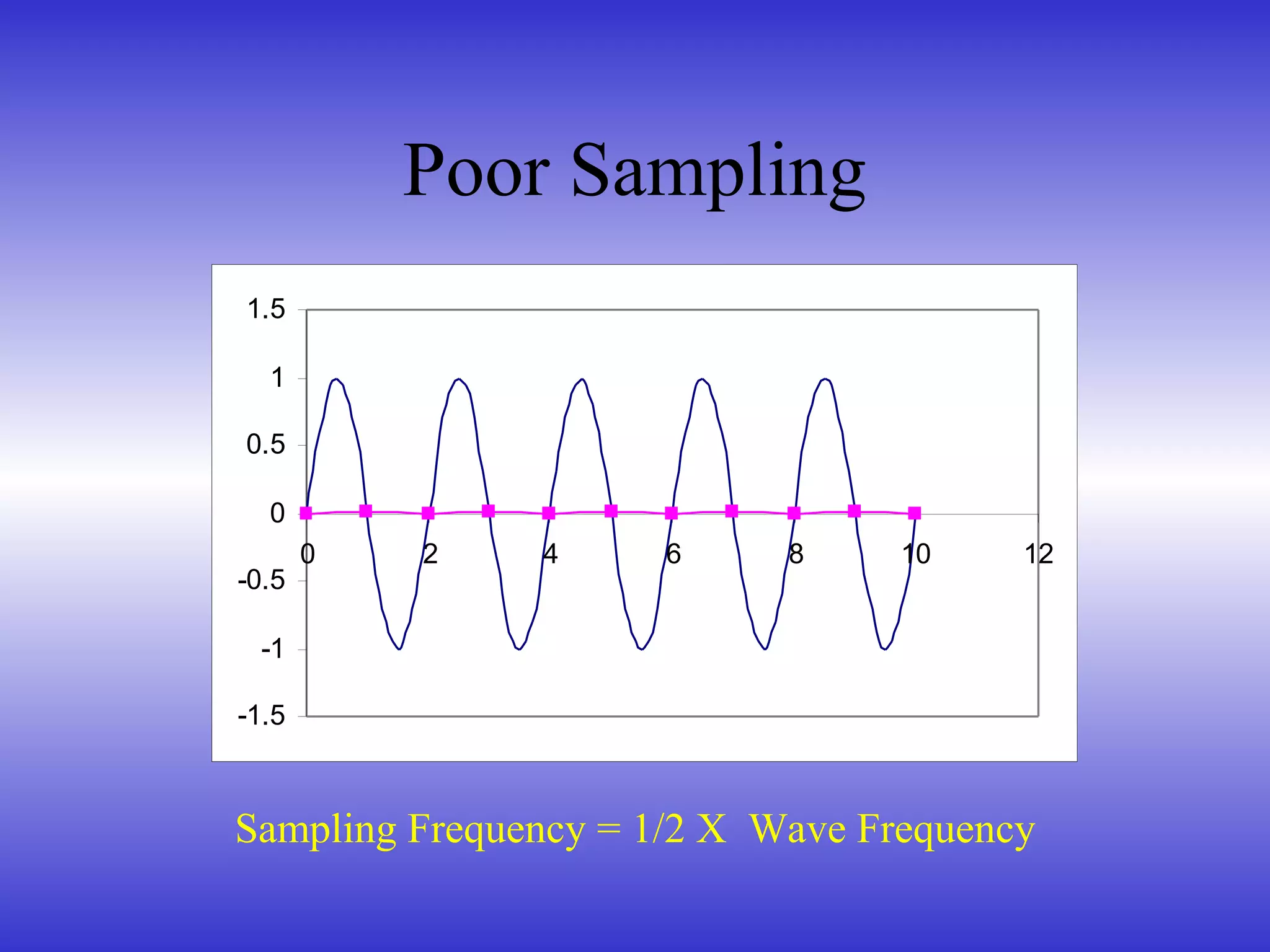
Poor Sampling
-1.5
-1
-0.5
0
0.5
1
1.5
0 2 4 6 8 10 12
Sampling Frequency = 1/2 X Wave Frequency
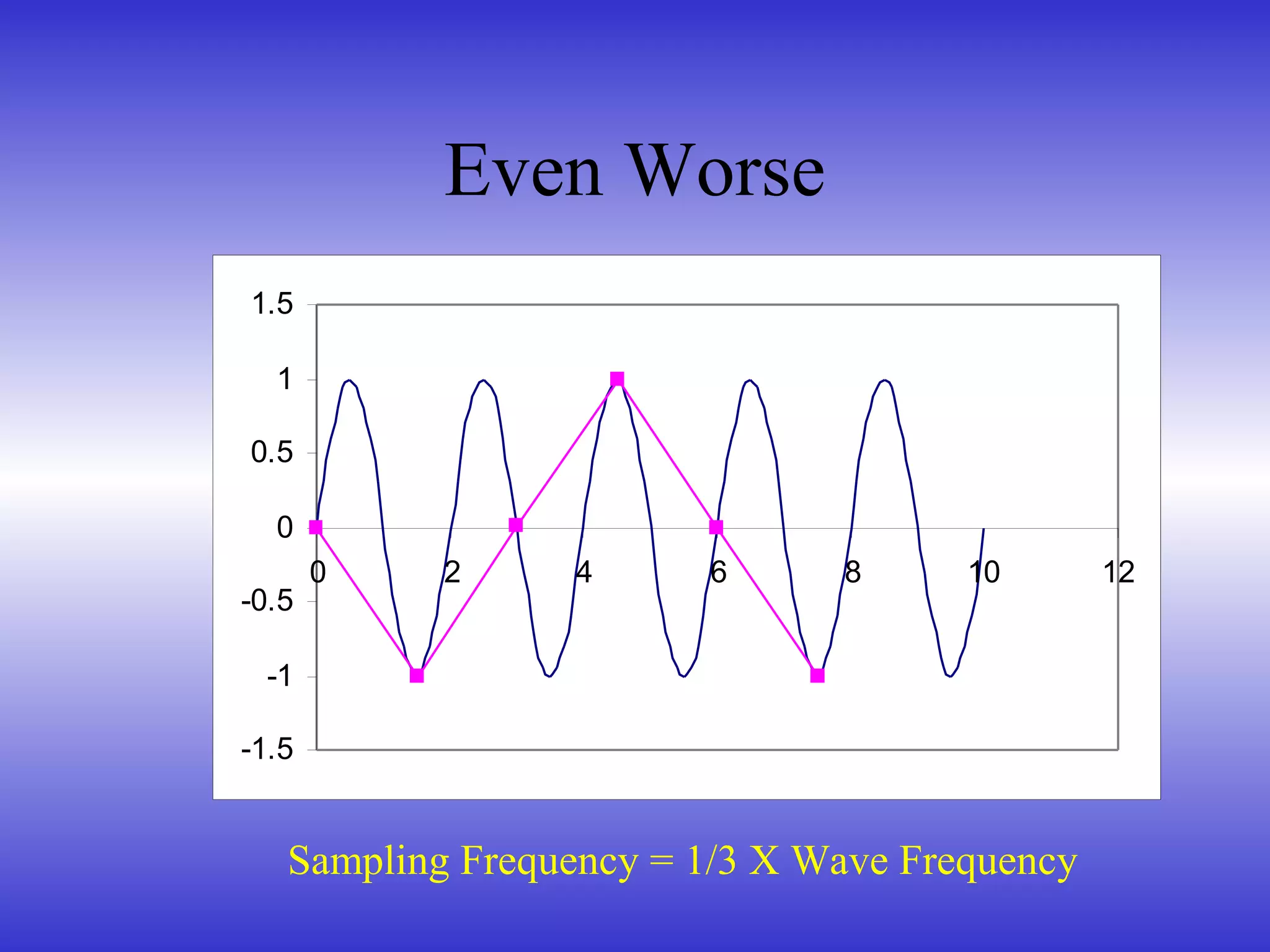
Even Worse
-1.5
-1
-0.5
0
0.5
1
1.5
0 2 4 6 8 10 12
Sampling Frequency = 1/3 X Wave Frequency
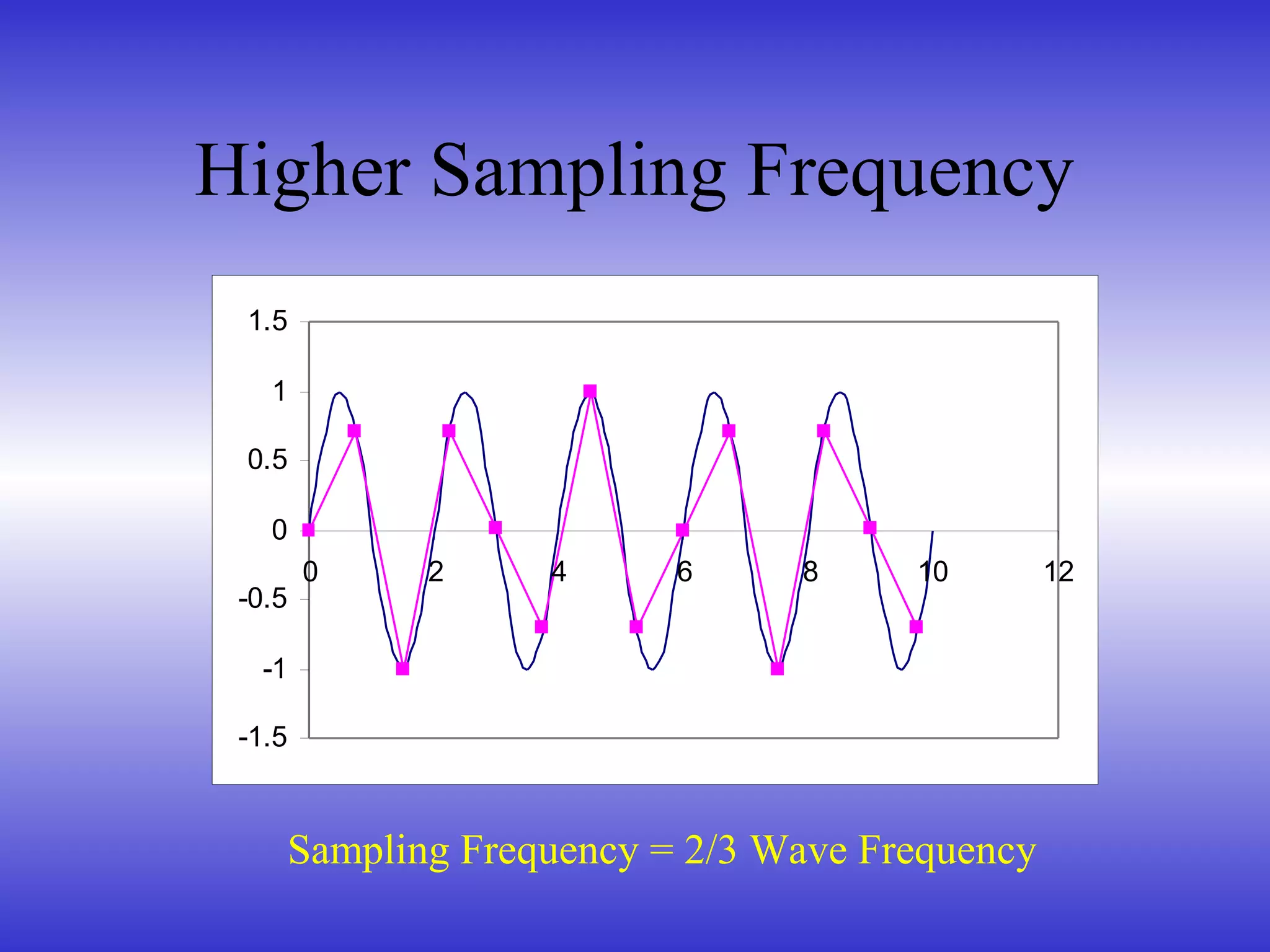
Higher Sampling Frequency
-1.5
-1
-0.5
0
0.5
1
1.5
0 2 4 6 8 10 12
Sampling Frequency = 2/3 Wave Frequency
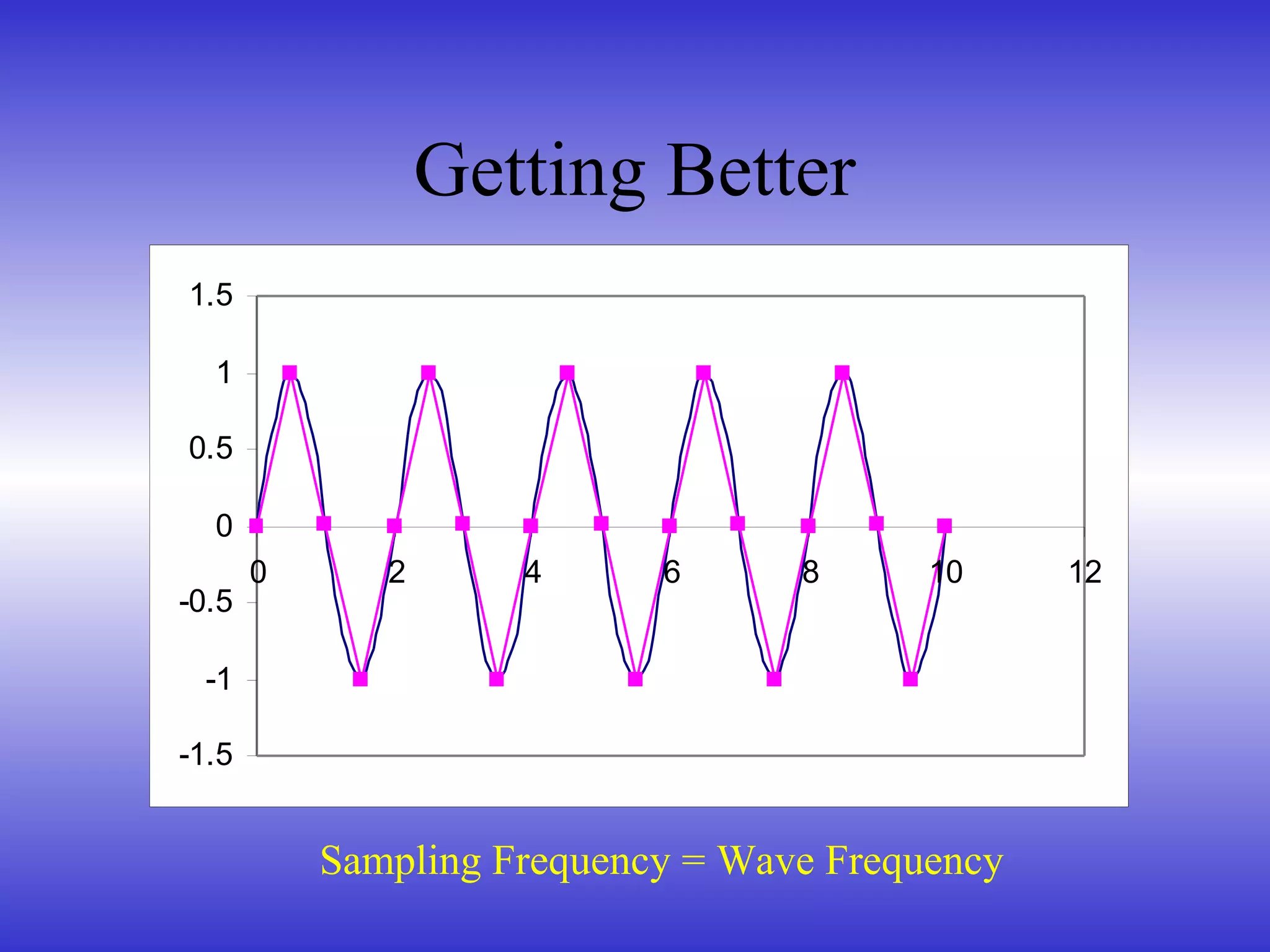
Getting Better
-1.5
-1
-0.5
0
0.5
1
1.5
0 2 4 6 8 10 12
Sampling Frequency = Wave Frequency
Good Sampling
-1.5
-1
-0.5
0
0.5
1
1.5
0 2 4 6 8 10 12
Sampling Frequency = 2 X Wave
Frequency
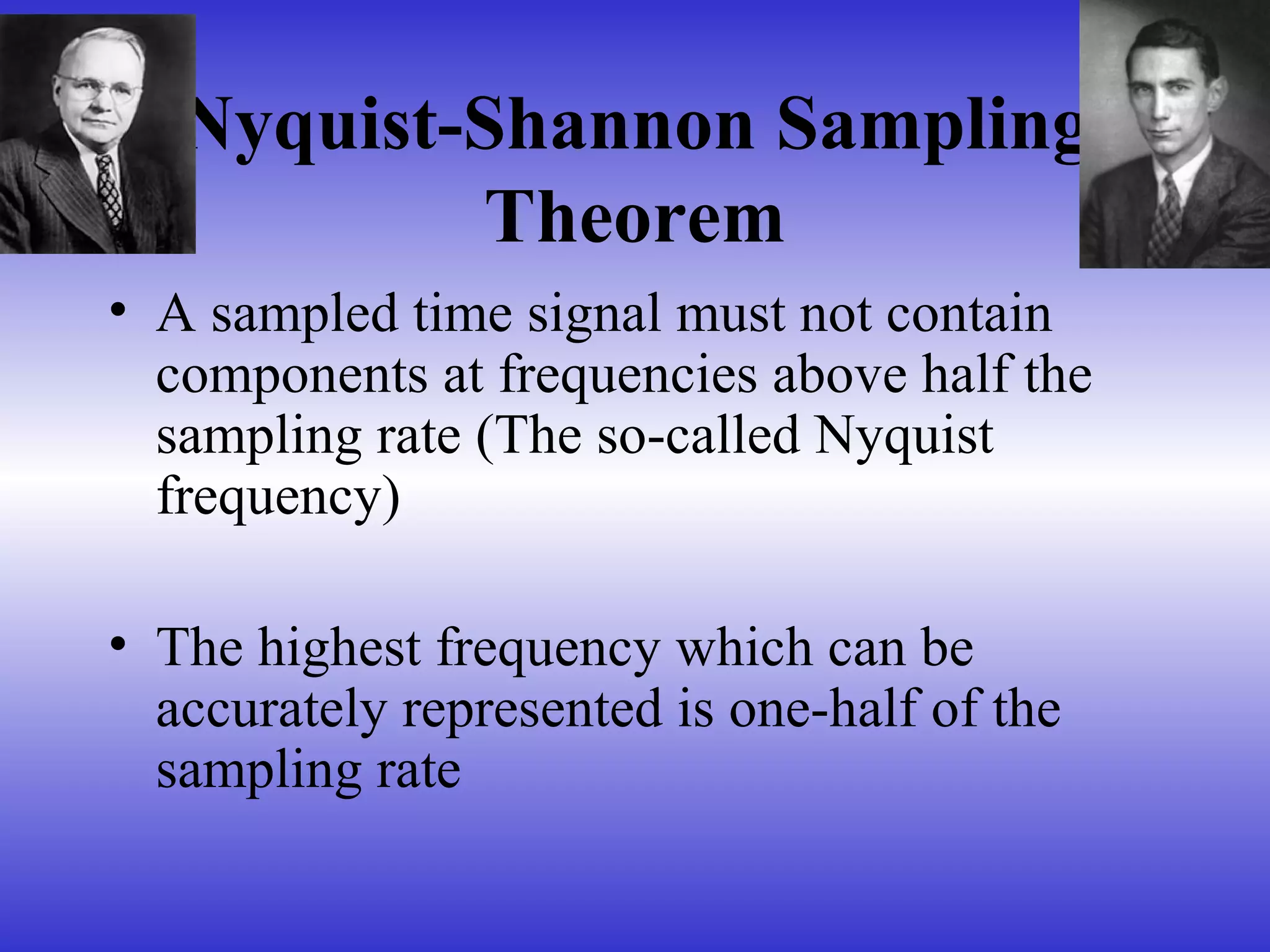
Nyquist-Shannon Sampling
Theorem
• A sampled time signal must not contain
components at frequencies above half the
sampling rate (The so-called Nyquist
frequency)
• The highest frequency which can be
accurately represented is one-half of the
sampling rate
Range of Human Hearing
• 20 – 20,000 Hz
• We lose high frequency response with age
• Women generally have better response than
men
• To reproduce 20 kHz requires a sampling
rate of 40 kHz
– Below the Nyquist frequency we introduce
aliasing
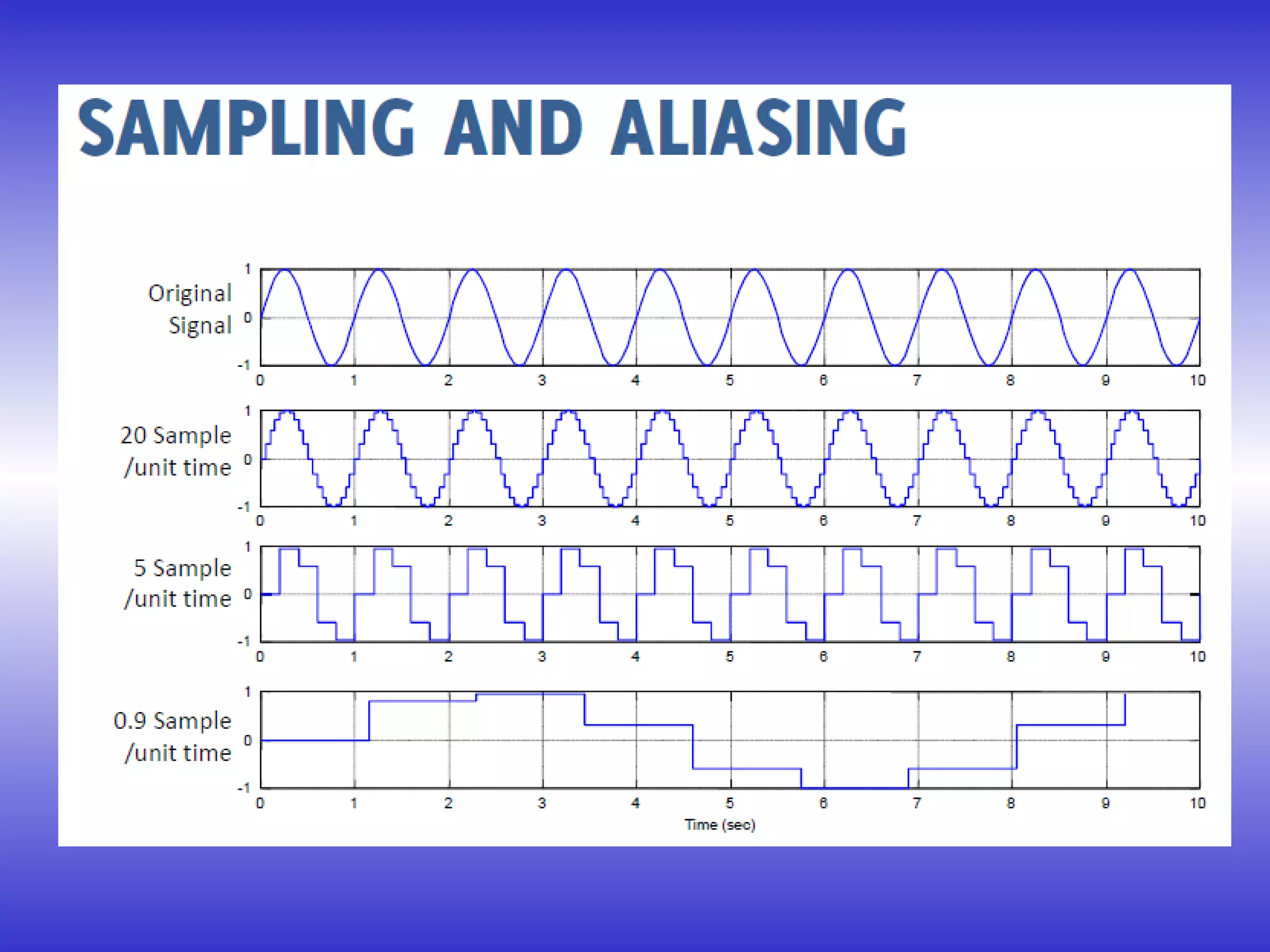
Effect of Aliasing
• Fourier Theorem states that any waveform
can be reproduced by sine waves.
• Improperly sampled signals will have other
sine wave components.
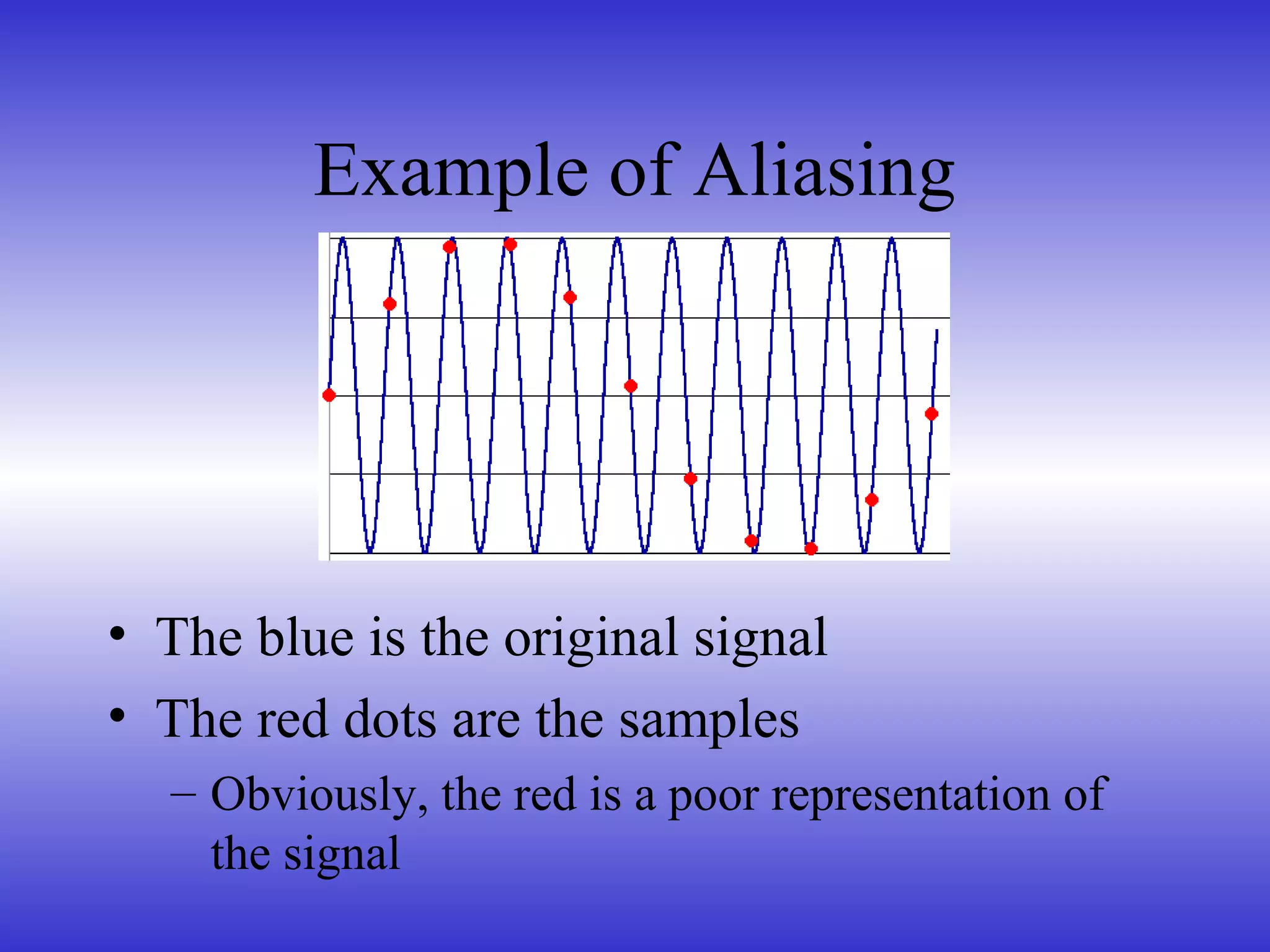
Example of Aliasing
• The blue is the original signal
• The red dots are the samples
– Obviously, the red is a poor representation of
the signal
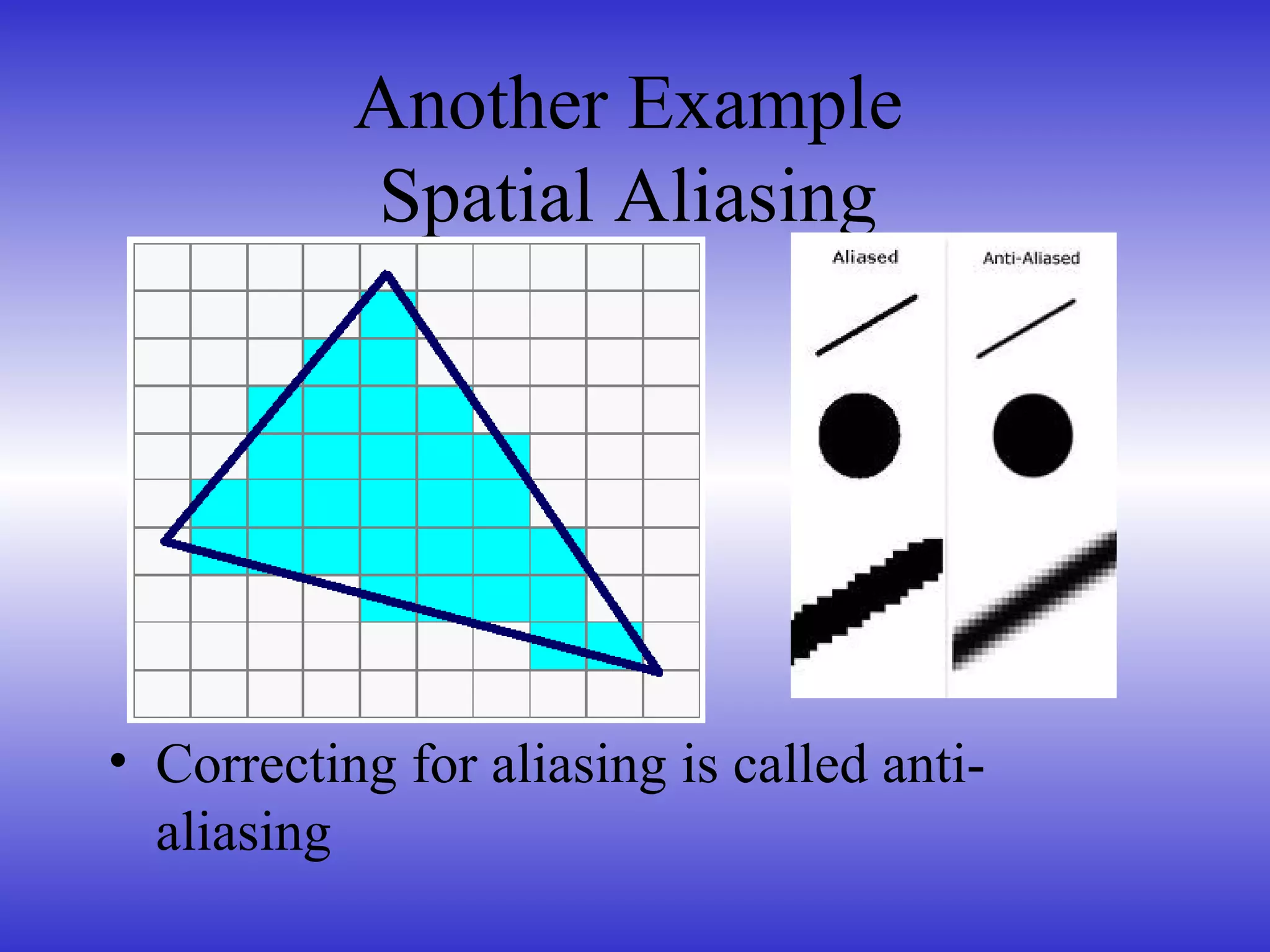
Another Example
Spatial Aliasing
• Correcting for aliasing is called anti-
aliasing
Temporal Aliasing
• Wagon Wheel
• Helicopter
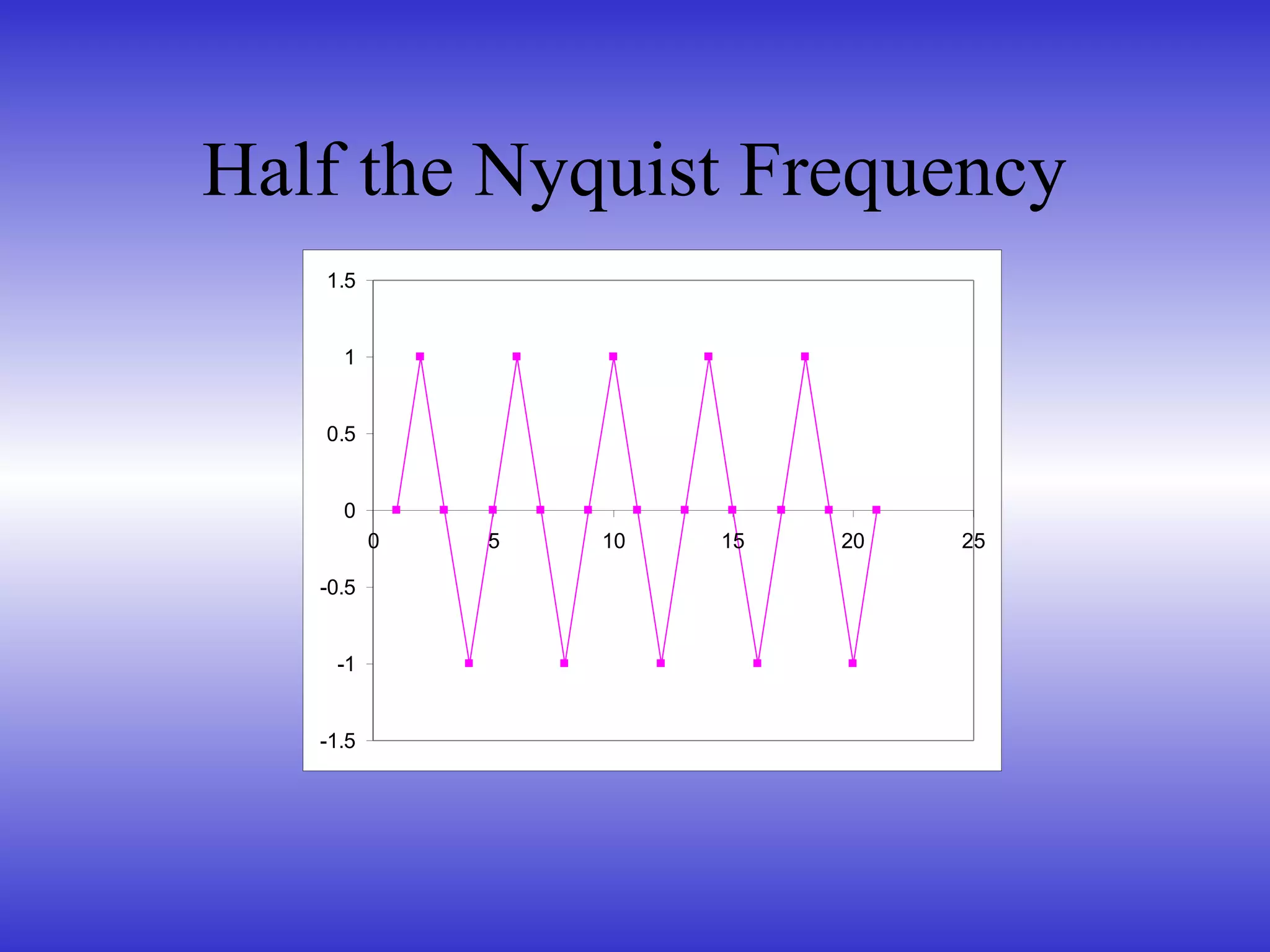
Half the Nyquist Frequency
-1.5
-1
-0.5
0
0.5
1
1.5
0 5 10 15 20 25
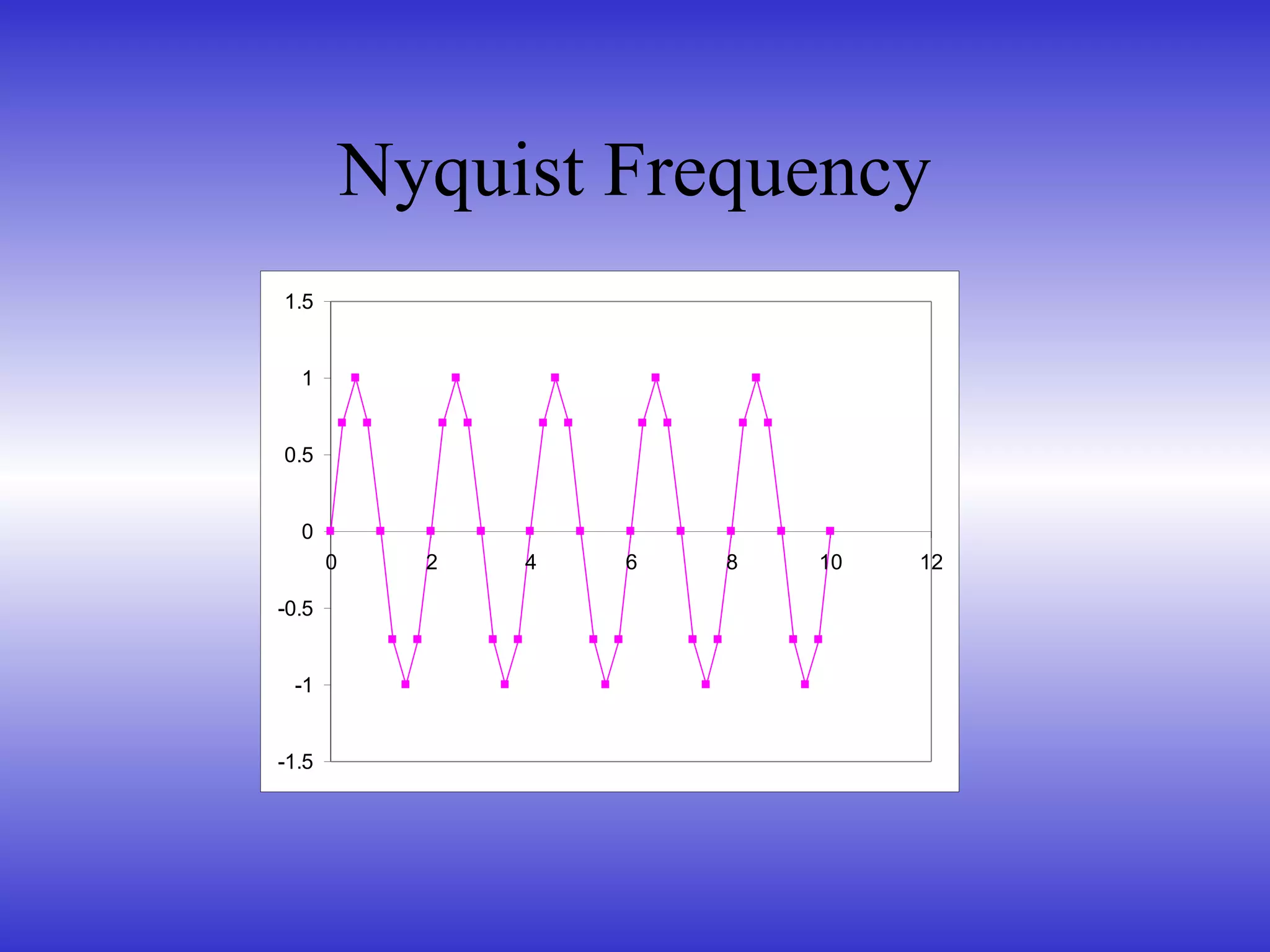
Nyquist Frequency
-1.5
-1
-0.5
0
0.5
1
1.5
0 2 4 6 8 10 12
Digitizing
Key Parameters
• Sampling frequency
– 11.025kHZ or 22.05kHZ or 44.1kHZ
• Number of bits per sample
– 8 bits (256 levels) or 16 bits (65,536 levels)
– 44.1 kHz at 8 bits gives 172.3 Hz/bit (almost an
octave) – [44,100 Hz/256 = 172.3 Hz/bit]
– 44.1 kHz at 16 bits gives 0.67 Hz/bit –
[44,100 Hz/65536 = 0.67 Hz/bit]
Digital Voice Telephone
Transmission (DS0)
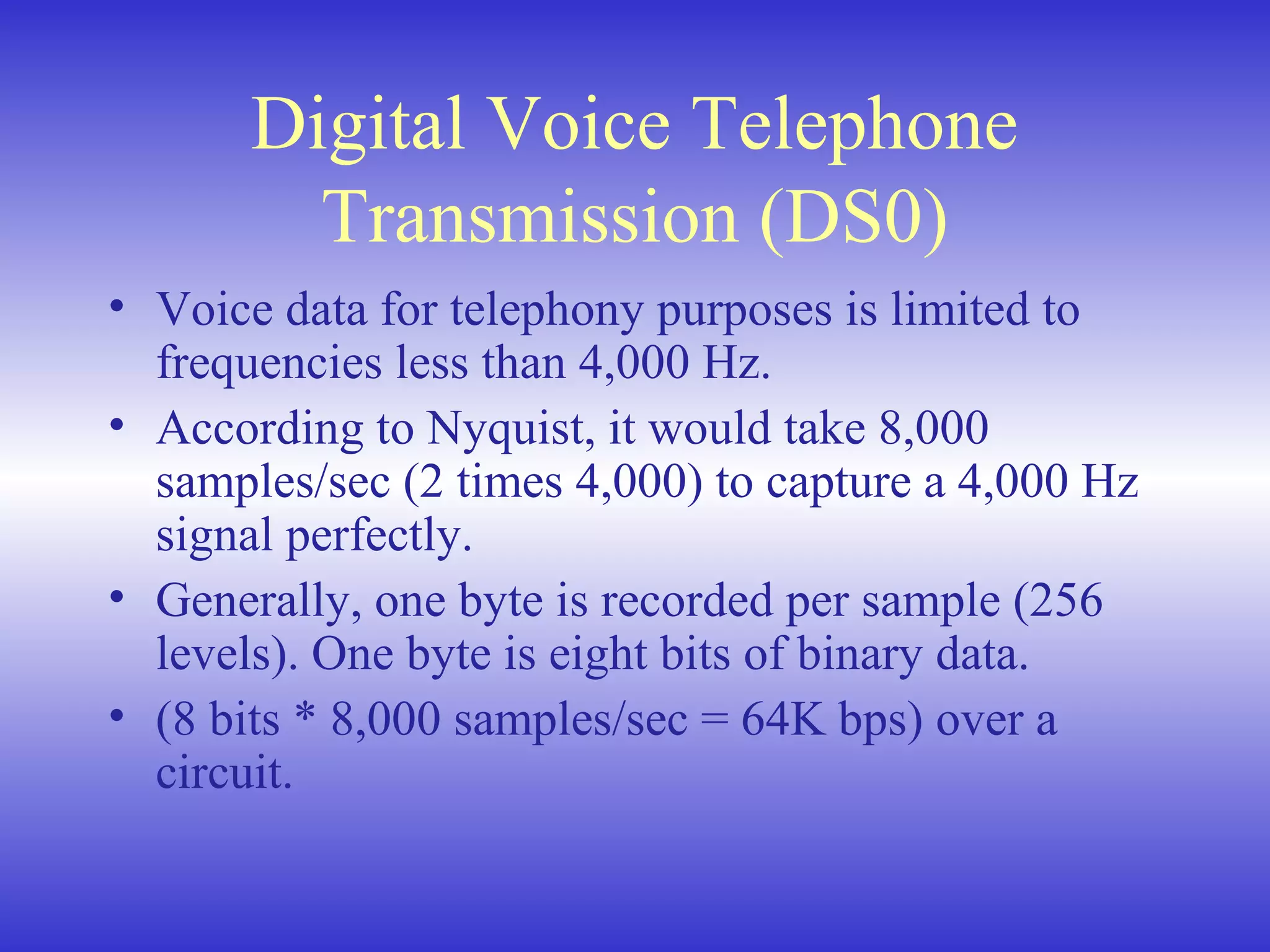
• Voice data for telephony purposes is limited to
frequencies less than 4,000 Hz.
• According to Nyquist, it would take 8,000
samples/sec (2 times 4,000) to capture a 4,000 Hz
signal perfectly.
• Generally, one byte is recorded per sample (256
levels). One byte is eight bits of binary data.
• (8 bits * 8,000 samples/sec = 64K bps) over a
circuit.
T-1 Transmisson
• T carrier circuits are designed around this
requirement, since they are primarily designed to
carry analog voice signals that have been
digitalized.
• For example, look at the DS-1 signal (digital
signal 1) which passes over a T-1 circuit. For DS-
1 transmissions, each frame contains 8 bits per
channel and there are 24 channels. Also, one
"framing bit" is required for each of the 24
channel frames.
T-1 Transmissons
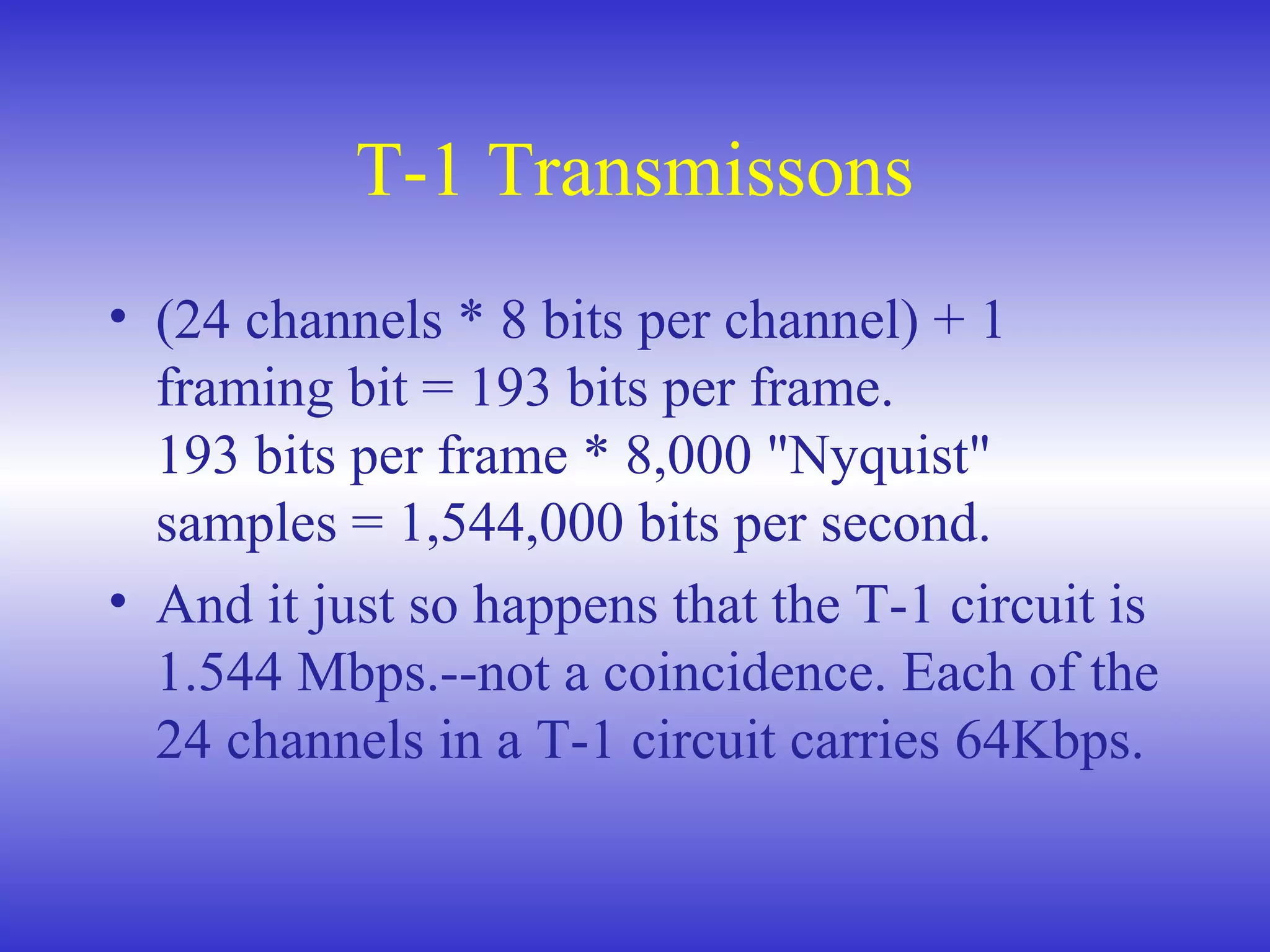
• (24 channels * 8 bits per channel) + 1
framing bit = 193 bits per frame.
193 bits per frame * 8,000 "Nyquist"
samples = 1,544,000 bits per second.
• And it just so happens that the T-1 circuit is
1.544 Mbps.--not a coincidence. Each of the
24 channels in a T-1 circuit carries 64Kbps.
• DS0 – also called timeslots - 64 kilobits per second
(telephone modem)
• ISDN - Two DS0 lines plus signaling (16 kilobytes
per second), or 128 kilobits per second
• T1 - 1.544 megabits per second (24 DS0 lines)
• T3 - 43.232 megabits per second (28 T1s)
• OC3 - 155 megabits per second (84 T1s)
• OC12 - 622 megabits per second (4 OC3s)
• OC48 - 2.5 gigabits per seconds (4 OC12s)
• OC192 - 9.6 gigabits per second (4 OC48s)
[Internet 2]
Standards
How Fast is It?
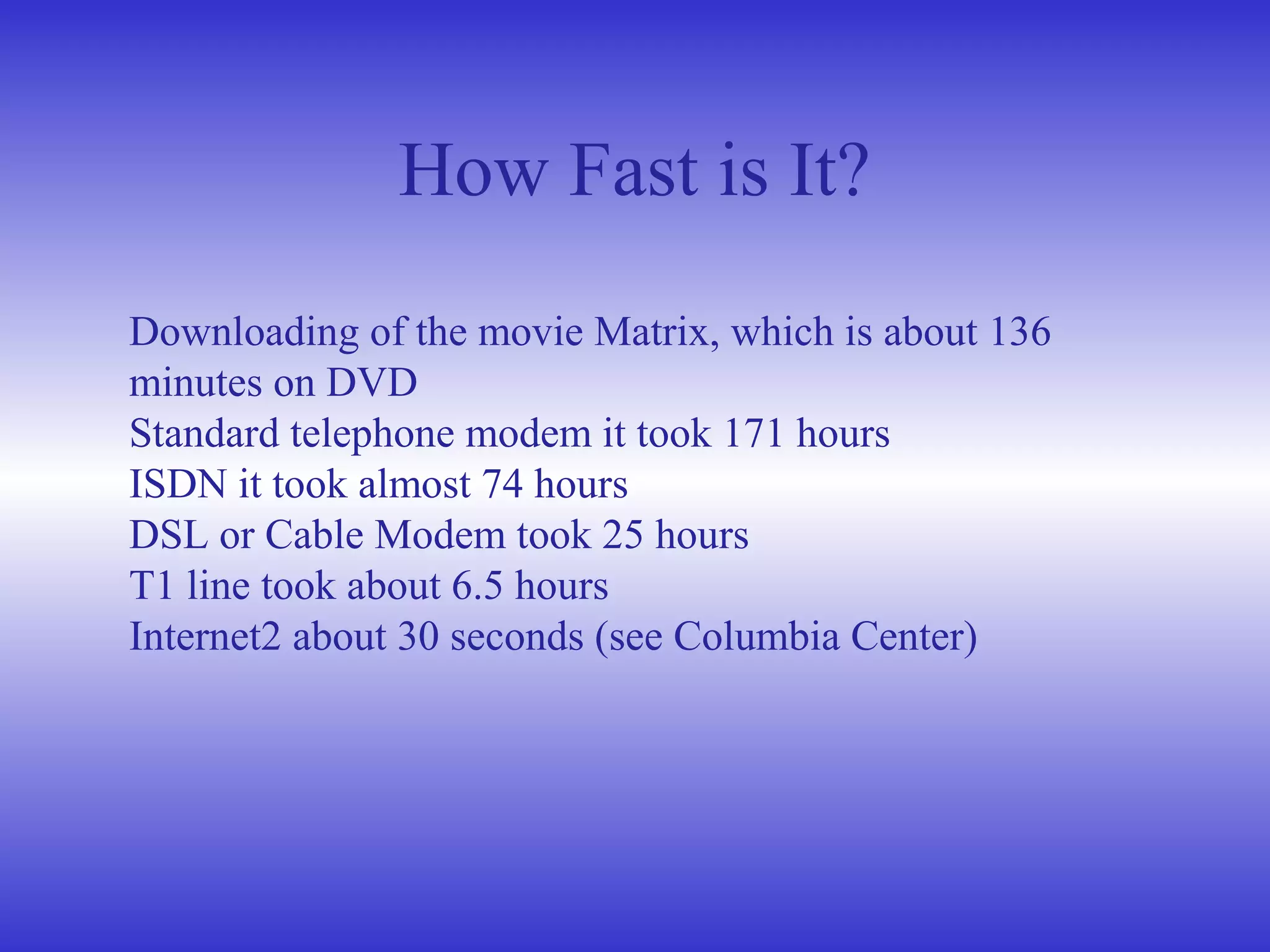
Downloading of the movie Matrix, which is about 136
minutes on DVD
Standard telephone modem it took 171 hours
ISDN it took almost 74 hours
DSL or Cable Modem took 25 hours
T1 line took about 6.5 hours
Internet2 about 30 seconds (see Columbia Center)
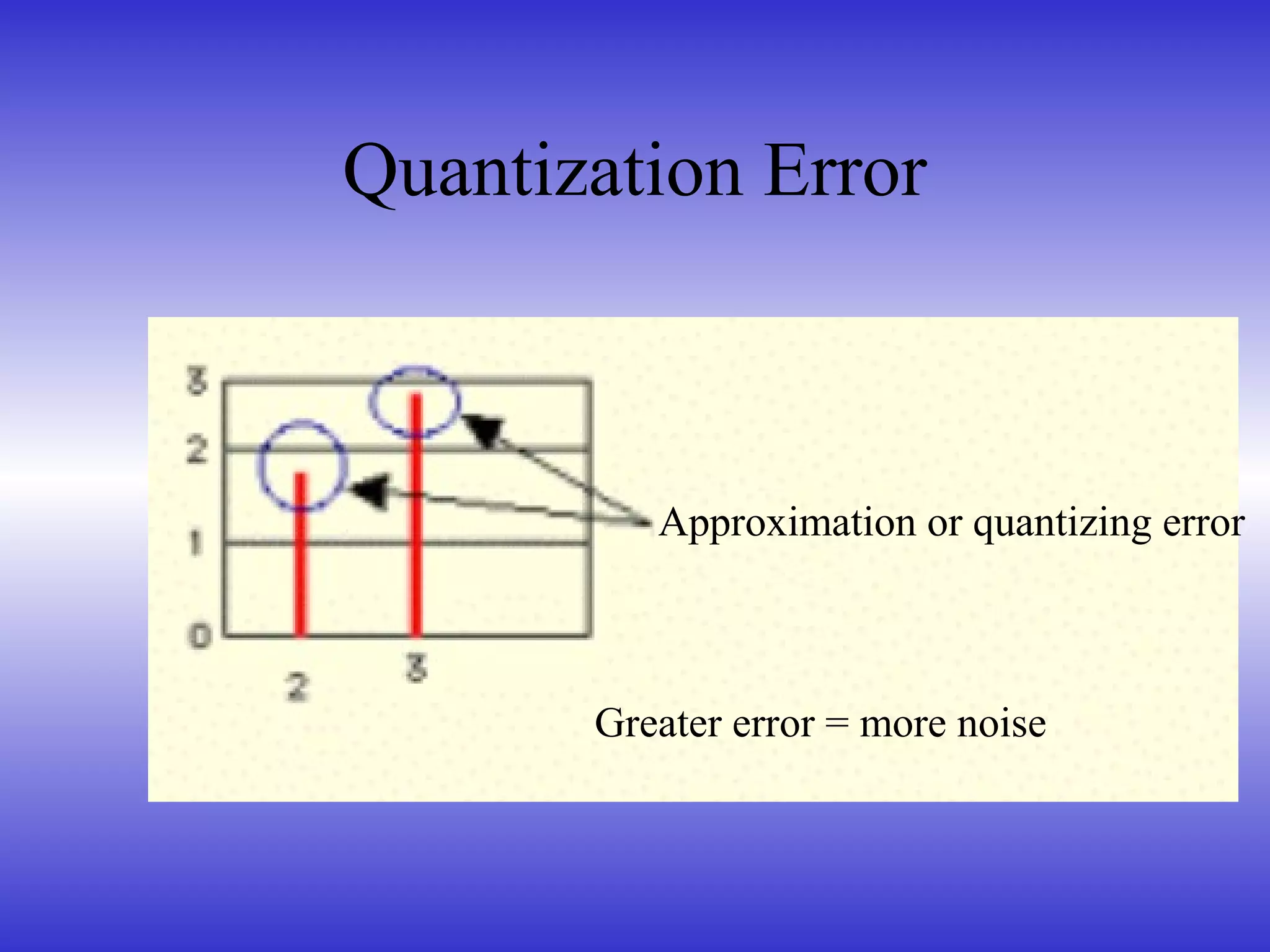
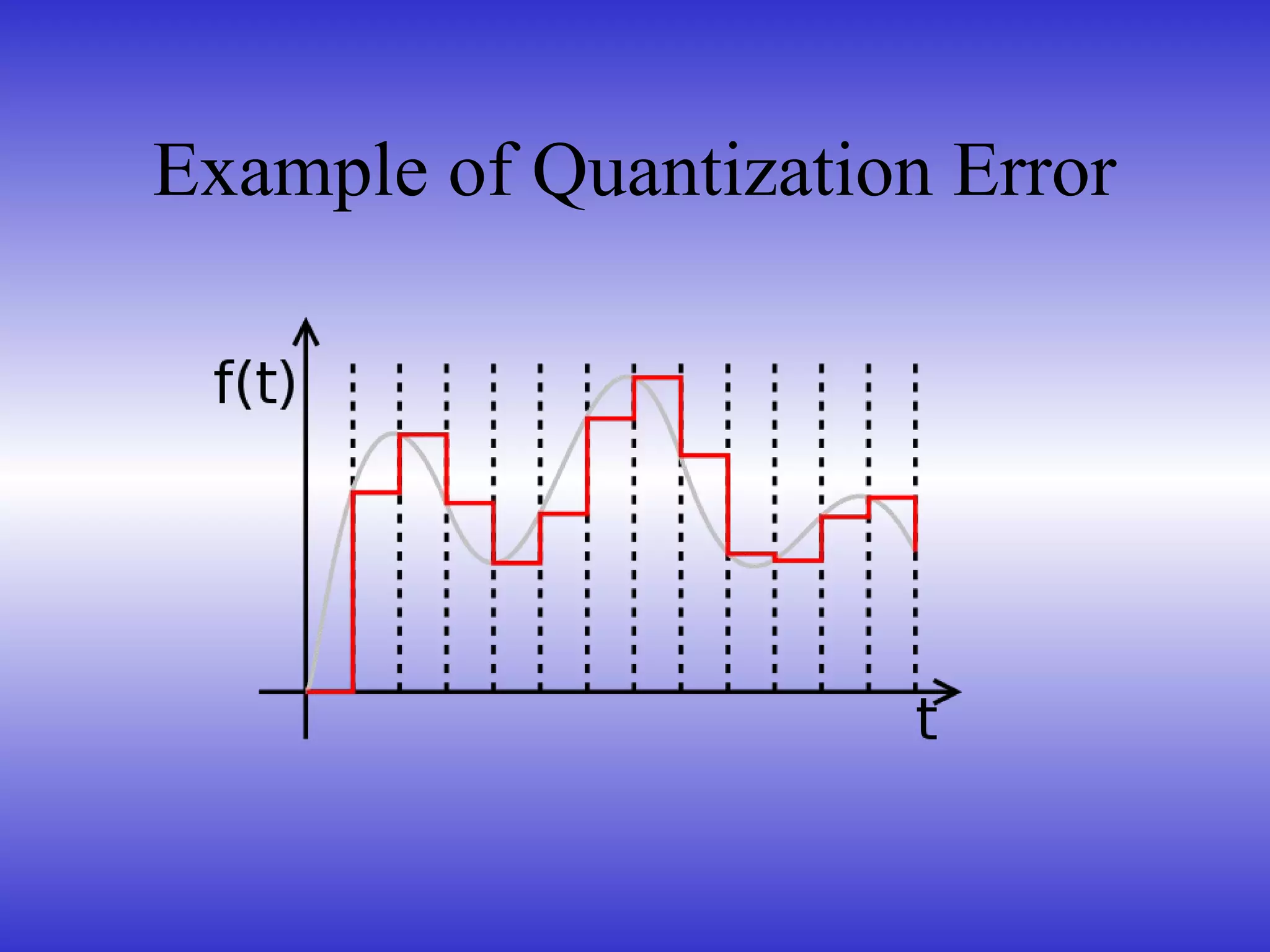
Quantization Error
Approximation or quantizing error
Greater error = more noise
Example of Quantization Error
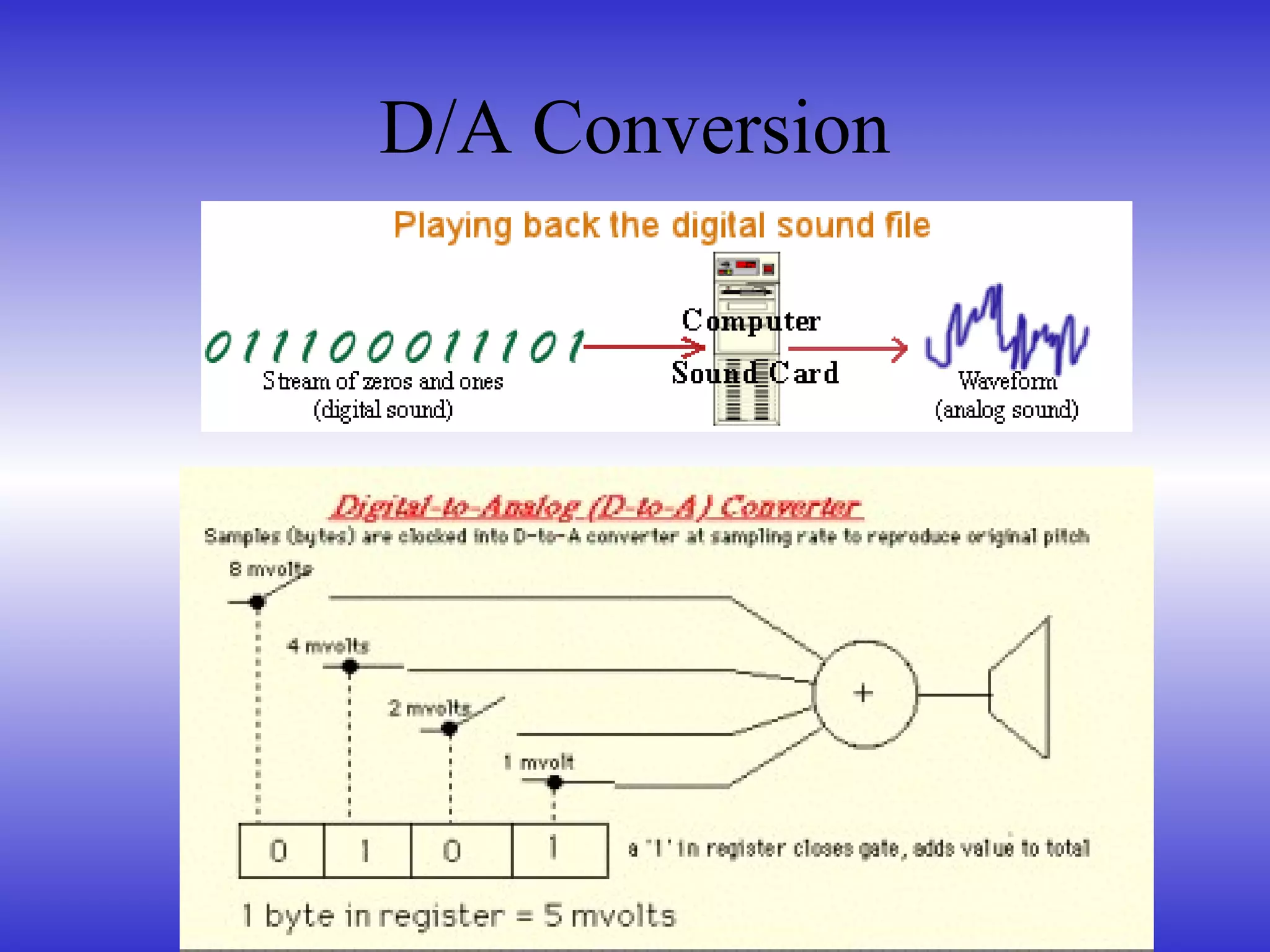
D/A Conversion
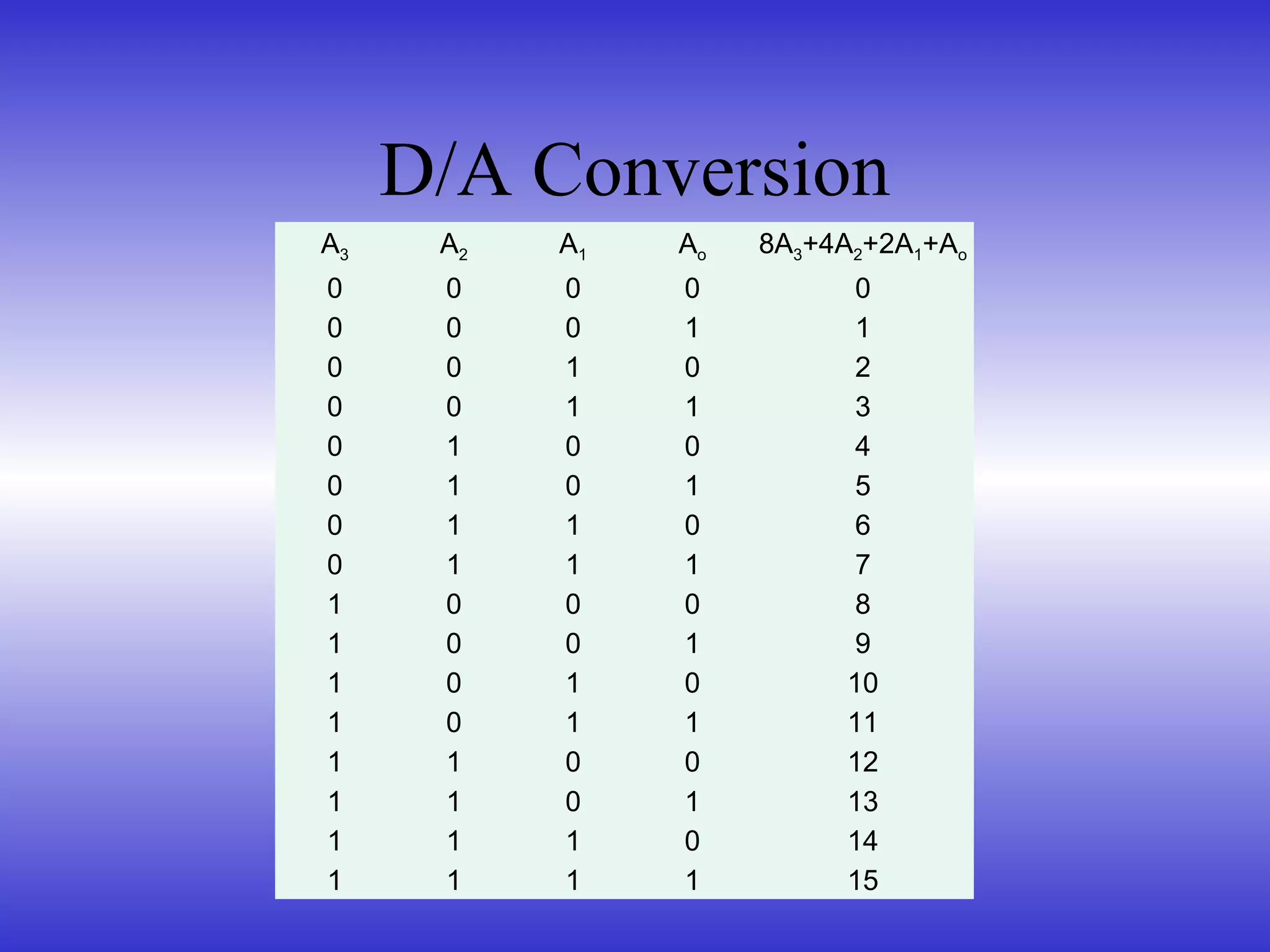
D/A Conversion
A3 A2 A1 Ao 8A3+4A2+2A1+Ao
0 0 0 0 0
0 0 0 1 1
0 0 1 0 2
0 0 1 1 3
0 1 0 0 4
0 1 0 1 5
0 1 1 0 6
0 1 1 1 7
1 0 0 0 8
1 0 0 1 9
1 0 1 0 10
1 0 1 1 11
1 1 0 0 12
1 1 0 1 13
1 1 1 0 14
1 1 1 1 15
CD ROMS
• Sampling rate is 44.1 kHz
• Nyquist Theorem says that the highest
reproduced frequency is 22.05 kHz.
– Any frequency above 22.05 kHz will produce
aliasing
• A low pass filter is used to block
frequencies above 22.05 kHz.
Problems with D/A
• Imperfect low pass filters
• Ideally you want 0 dB attenuation at 20 kHz
going up to 90 dB at 22 kHz
– Very expensive
• Oversampling will help
– Sample at 8 X 20 kHz = 160 kHz
• Then the low pass filtering needs to be
accomplished in 140 kHz not 2 kHz (160 kHz
sample rate – 20 kHz max range of hearing)
• Finite word length
– Most systems today do 16 bit digitizing
– 65536 different levels
• The loudest sounds need room, so the normal
sounds don’t use the entire range
– Problems occur at the low levels where sounds are
represented by only one or two bits. High distortions
result.
• Dithering adds low level broadband noise
Problems with D/A
• Clock speed variation (Jitter)
Problems with D/A

Sampling

  • 1.
  • 2.
    Time domain • Presenta recurring phenomena as amplitude vs. time Sine Wave Sine Wave -1.5 -1 -0.5 0 0.5 1 1.5 0 1 2 3 4 5 6 Time Amplitude
  • 3.
    Frequency domain • Presentrecurring phenomena as amplitude vs. frequency • Same sine wave looks like – Amplitude Frequency
  • 4.
  • 5.
  • 6.
  • 7.
    Voice in bothDomains Voice in the Time Domain Voice in the Frequency Domain
  • 9.
  • 10.
    Fourier Analysis • Theeardrum responds to a sum of all the waves arriving at a particular instant. Yet the individual sounds are “heard.” • Any waveform is composed of an infinite number of simple sine waves of various frequencies and amplitudes. Jean Baptiste Joseph Fourier
  • 11.
    Letter Frequency FrequencyLetterFrequency Frequency Note Name (Hz) ratio Interval do C 264 9/8 Whole re D 297 10/9 Whole mi E 330 16/15 Half fa F 352 9/8 Whole sol G 396 10/9 Whole la A 440 9/8 Whole ti B 495 16/15 Half do C 528 Diatonic C Major Scale
  • 12.
  • 14.
    Digitizing the Sound •We want to reconstruct the sound digitally • How often must we obtain a sample to faithfully reproduce the sound?
  • 15.
    Poor Sampling -1.5 -1 -0.5 0 0.5 1 1.5 0 24 6 8 10 12 Sampling Frequency = 1/2 X Wave Frequency
  • 16.
    Even Worse -1.5 -1 -0.5 0 0.5 1 1.5 0 24 6 8 10 12 Sampling Frequency = 1/3 X Wave Frequency
  • 17.
    Higher Sampling Frequency -1.5 -1 -0.5 0 0.5 1 1.5 02 4 6 8 10 12 Sampling Frequency = 2/3 Wave Frequency
  • 18.
    Getting Better -1.5 -1 -0.5 0 0.5 1 1.5 0 24 6 8 10 12 Sampling Frequency = Wave Frequency
  • 19.
    Good Sampling -1.5 -1 -0.5 0 0.5 1 1.5 0 24 6 8 10 12 Sampling Frequency = 2 X Wave Frequency
  • 20.
    Nyquist-Shannon Sampling Theorem • Asampled time signal must not contain components at frequencies above half the sampling rate (The so-called Nyquist frequency) • The highest frequency which can be accurately represented is one-half of the sampling rate
  • 21.
    Range of HumanHearing • 20 – 20,000 Hz • We lose high frequency response with age • Women generally have better response than men • To reproduce 20 kHz requires a sampling rate of 40 kHz – Below the Nyquist frequency we introduce aliasing
  • 22.
    Effect of Aliasing •Fourier Theorem states that any waveform can be reproduced by sine waves. • Improperly sampled signals will have other sine wave components.
  • 23.
    Example of Aliasing •The blue is the original signal • The red dots are the samples – Obviously, the red is a poor representation of the signal
  • 24.
    Another Example Spatial Aliasing •Correcting for aliasing is called anti- aliasing
  • 25.
    Temporal Aliasing • WagonWheel • Helicopter
  • 26.
    Half the NyquistFrequency -1.5 -1 -0.5 0 0.5 1 1.5 0 5 10 15 20 25
  • 27.
  • 28.
  • 29.
    Key Parameters • Samplingfrequency – 11.025kHZ or 22.05kHZ or 44.1kHZ • Number of bits per sample – 8 bits (256 levels) or 16 bits (65,536 levels) – 44.1 kHz at 8 bits gives 172.3 Hz/bit (almost an octave) – [44,100 Hz/256 = 172.3 Hz/bit] – 44.1 kHz at 16 bits gives 0.67 Hz/bit – [44,100 Hz/65536 = 0.67 Hz/bit]
  • 30.
    Digital Voice Telephone Transmission(DS0) • Voice data for telephony purposes is limited to frequencies less than 4,000 Hz. • According to Nyquist, it would take 8,000 samples/sec (2 times 4,000) to capture a 4,000 Hz signal perfectly. • Generally, one byte is recorded per sample (256 levels). One byte is eight bits of binary data. • (8 bits * 8,000 samples/sec = 64K bps) over a circuit.
  • 31.
    T-1 Transmisson • Tcarrier circuits are designed around this requirement, since they are primarily designed to carry analog voice signals that have been digitalized. • For example, look at the DS-1 signal (digital signal 1) which passes over a T-1 circuit. For DS- 1 transmissions, each frame contains 8 bits per channel and there are 24 channels. Also, one "framing bit" is required for each of the 24 channel frames.
  • 32.
    T-1 Transmissons • (24channels * 8 bits per channel) + 1 framing bit = 193 bits per frame. 193 bits per frame * 8,000 "Nyquist" samples = 1,544,000 bits per second. • And it just so happens that the T-1 circuit is 1.544 Mbps.--not a coincidence. Each of the 24 channels in a T-1 circuit carries 64Kbps.
  • 33.
    • DS0 –also called timeslots - 64 kilobits per second (telephone modem) • ISDN - Two DS0 lines plus signaling (16 kilobytes per second), or 128 kilobits per second • T1 - 1.544 megabits per second (24 DS0 lines) • T3 - 43.232 megabits per second (28 T1s) • OC3 - 155 megabits per second (84 T1s) • OC12 - 622 megabits per second (4 OC3s) • OC48 - 2.5 gigabits per seconds (4 OC12s) • OC192 - 9.6 gigabits per second (4 OC48s) [Internet 2] Standards
  • 34.
    How Fast isIt? Downloading of the movie Matrix, which is about 136 minutes on DVD Standard telephone modem it took 171 hours ISDN it took almost 74 hours DSL or Cable Modem took 25 hours T1 line took about 6.5 hours Internet2 about 30 seconds (see Columbia Center)
  • 35.
    Quantization Error Approximation orquantizing error Greater error = more noise
  • 36.
  • 38.
  • 39.
    D/A Conversion A3 A2A1 Ao 8A3+4A2+2A1+Ao 0 0 0 0 0 0 0 0 1 1 0 0 1 0 2 0 0 1 1 3 0 1 0 0 4 0 1 0 1 5 0 1 1 0 6 0 1 1 1 7 1 0 0 0 8 1 0 0 1 9 1 0 1 0 10 1 0 1 1 11 1 1 0 0 12 1 1 0 1 13 1 1 1 0 14 1 1 1 1 15
  • 40.
    CD ROMS • Samplingrate is 44.1 kHz • Nyquist Theorem says that the highest reproduced frequency is 22.05 kHz. – Any frequency above 22.05 kHz will produce aliasing • A low pass filter is used to block frequencies above 22.05 kHz.
  • 41.
    Problems with D/A •Imperfect low pass filters • Ideally you want 0 dB attenuation at 20 kHz going up to 90 dB at 22 kHz – Very expensive • Oversampling will help – Sample at 8 X 20 kHz = 160 kHz • Then the low pass filtering needs to be accomplished in 140 kHz not 2 kHz (160 kHz sample rate – 20 kHz max range of hearing)
  • 42.
    • Finite wordlength – Most systems today do 16 bit digitizing – 65536 different levels • The loudest sounds need room, so the normal sounds don’t use the entire range – Problems occur at the low levels where sounds are represented by only one or two bits. High distortions result. • Dithering adds low level broadband noise Problems with D/A
  • 43.
    • Clock speedvariation (Jitter) Problems with D/A