Introduction
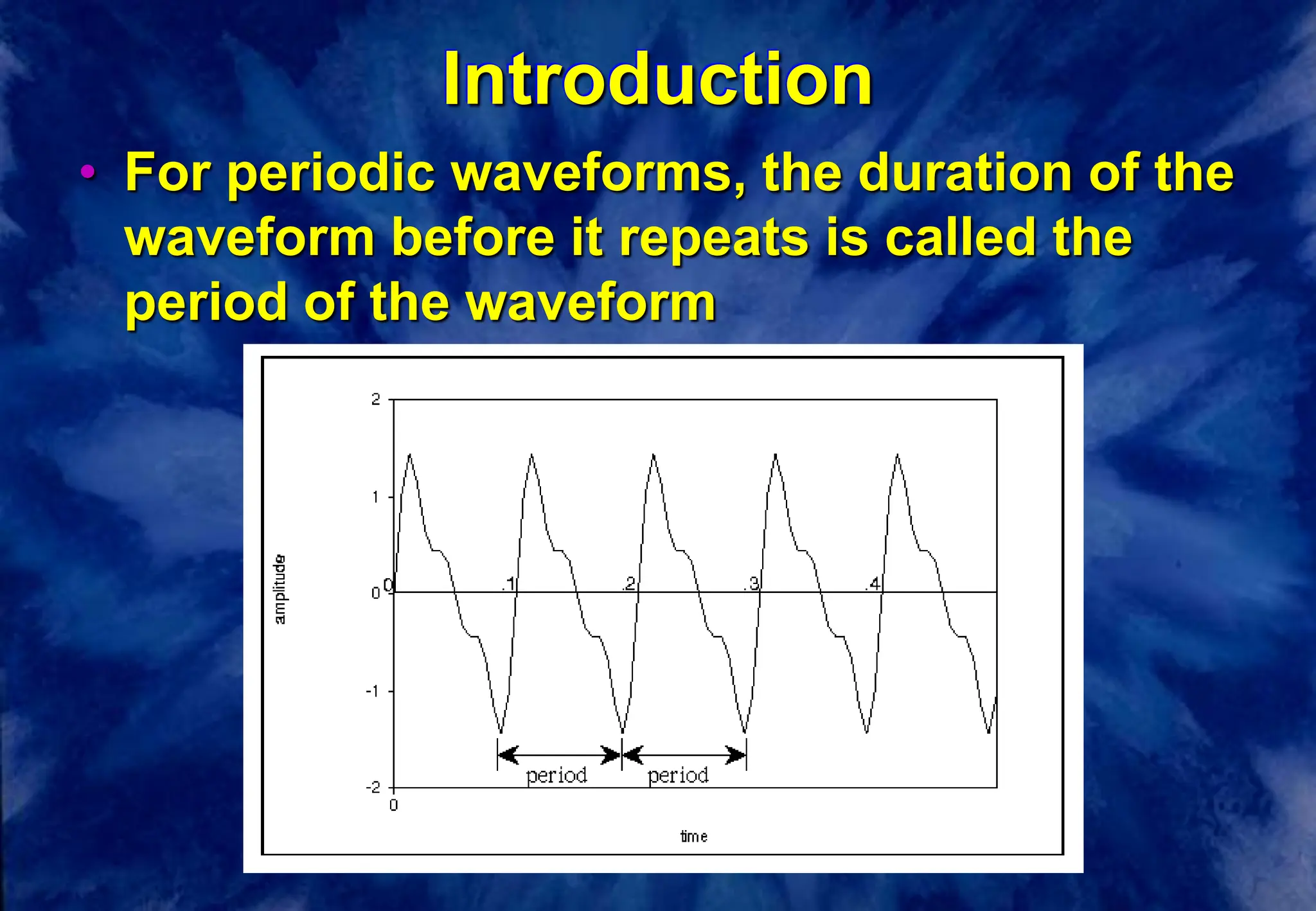
• For periodic waveforms, the duration of the
waveform before it repeats is called the
period of the waveform
Frequency
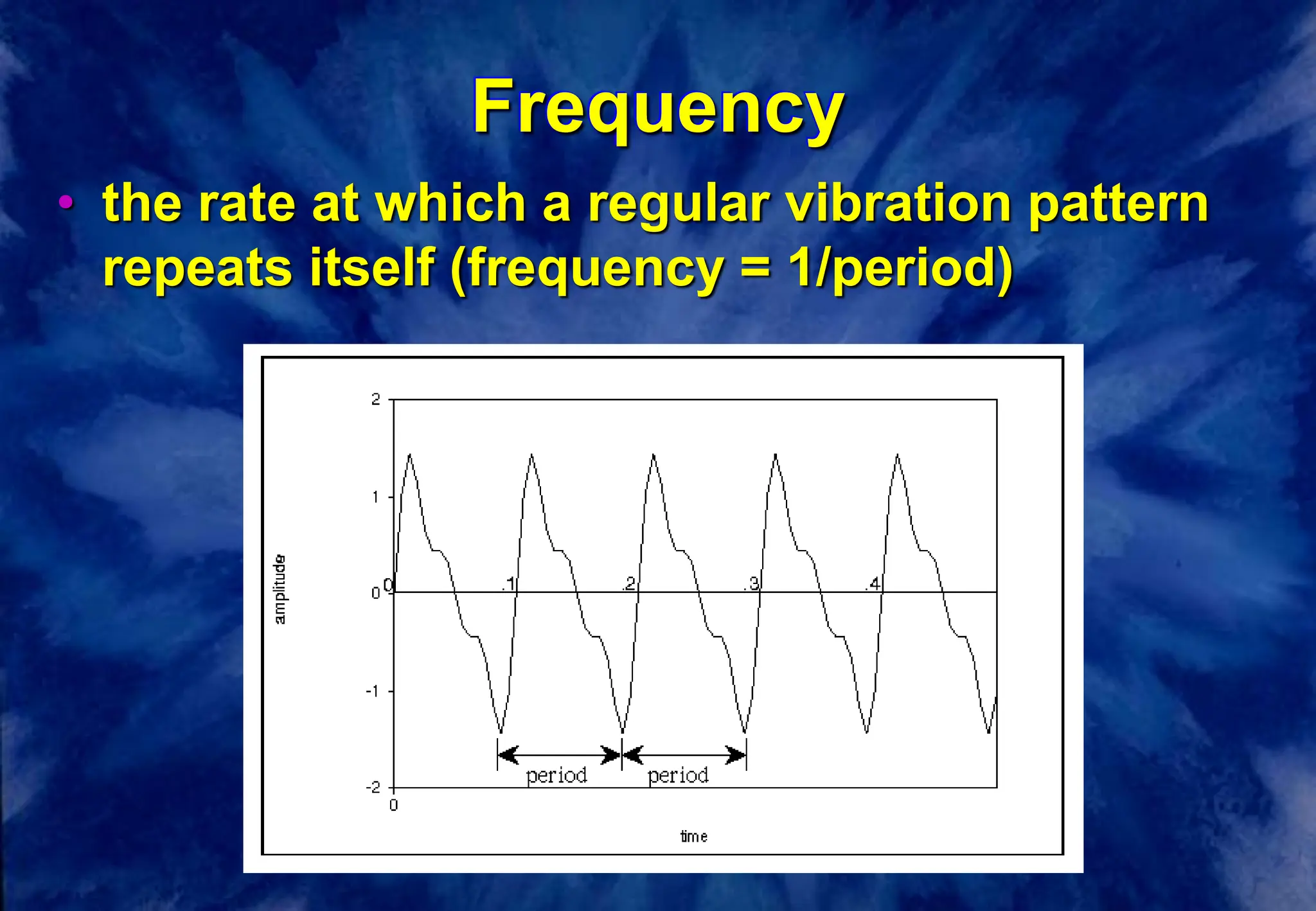
• the rate at which a regular vibration pattern
repeats itself (frequency = 1/period)
Frequency of a Waveform
• The unit for frequency is cycles/second,
also called Hertz (Hz).
• The frequency of a waveform is equal to
the reciprocal of the period.
frequency = 1/period
Frequency of a Waveform
• Examples:
frequency = 10 Hz
period = .1 (1/10) seconds
frequency = 100 Hz
period = .01 (1/100) seconds
frequency = 261.6 Hz (middle C)
period = .0038226 (1/ 261.6) seconds
Waveform Sampling
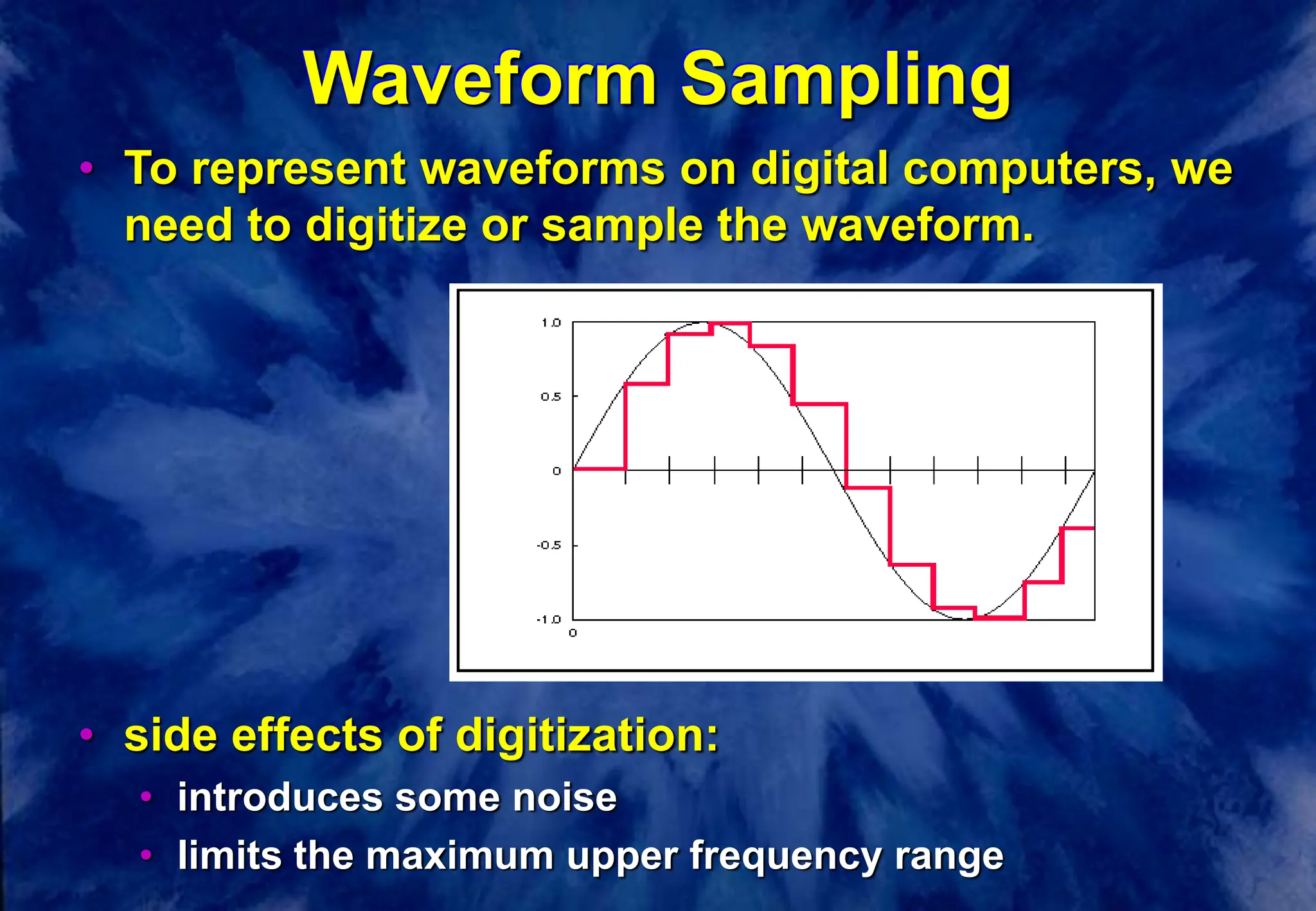
• To represent waveforms on digital computers, we
need to digitize or sample the waveform.
• side effects of digitization:
• introduces some noise
• limits the maximum upper frequency range
Sampling Rate
• The sampling rate (SR) is the rate at which
amplitude values are digitized from the
original waveform.
• CD sampling rate (high-quality):
SR = 44,100 samples/second
• medium-quality sampling rate:
SR = 22,050 samples/second
• phone sampling rate (low-quality):
SR = 8,192 samples/second
Sampling
Rate
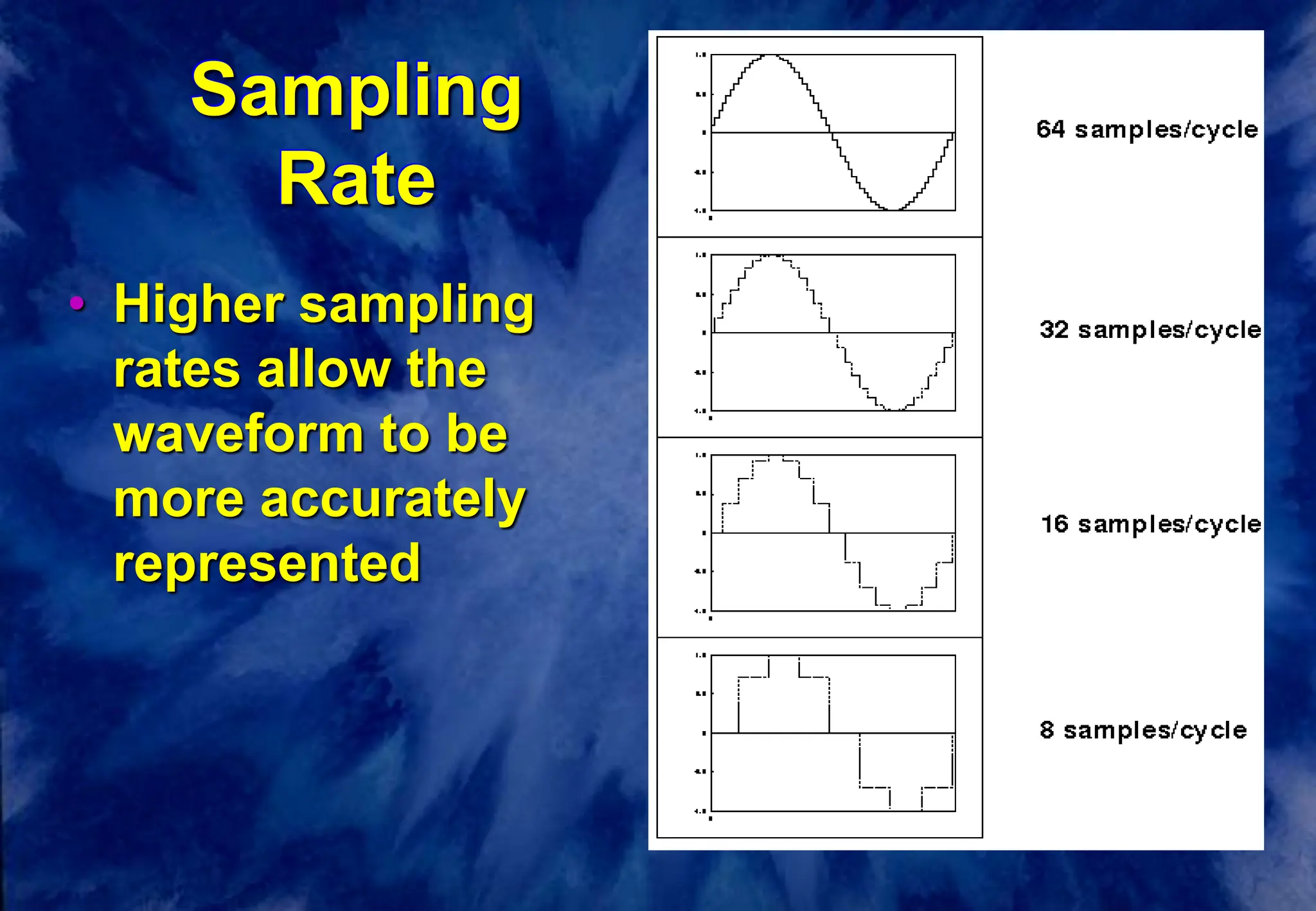
• Higher sampling
rates allow the
waveform to be
more accurately
represented
Nyquist Theorem and Aliasing
• Nyquist Theorem:
We can digitally represent only frequencies up to
half the sampling rate.
• Example:
CD: SR=44,100 Hz
Nyquist Frequency = SR/2 = 22,050 Hz
• Example:
SR=22,050 Hz
Nyquist Frequency = SR/2 = 11,025 Hz
Nyquist Theorem and Aliasing
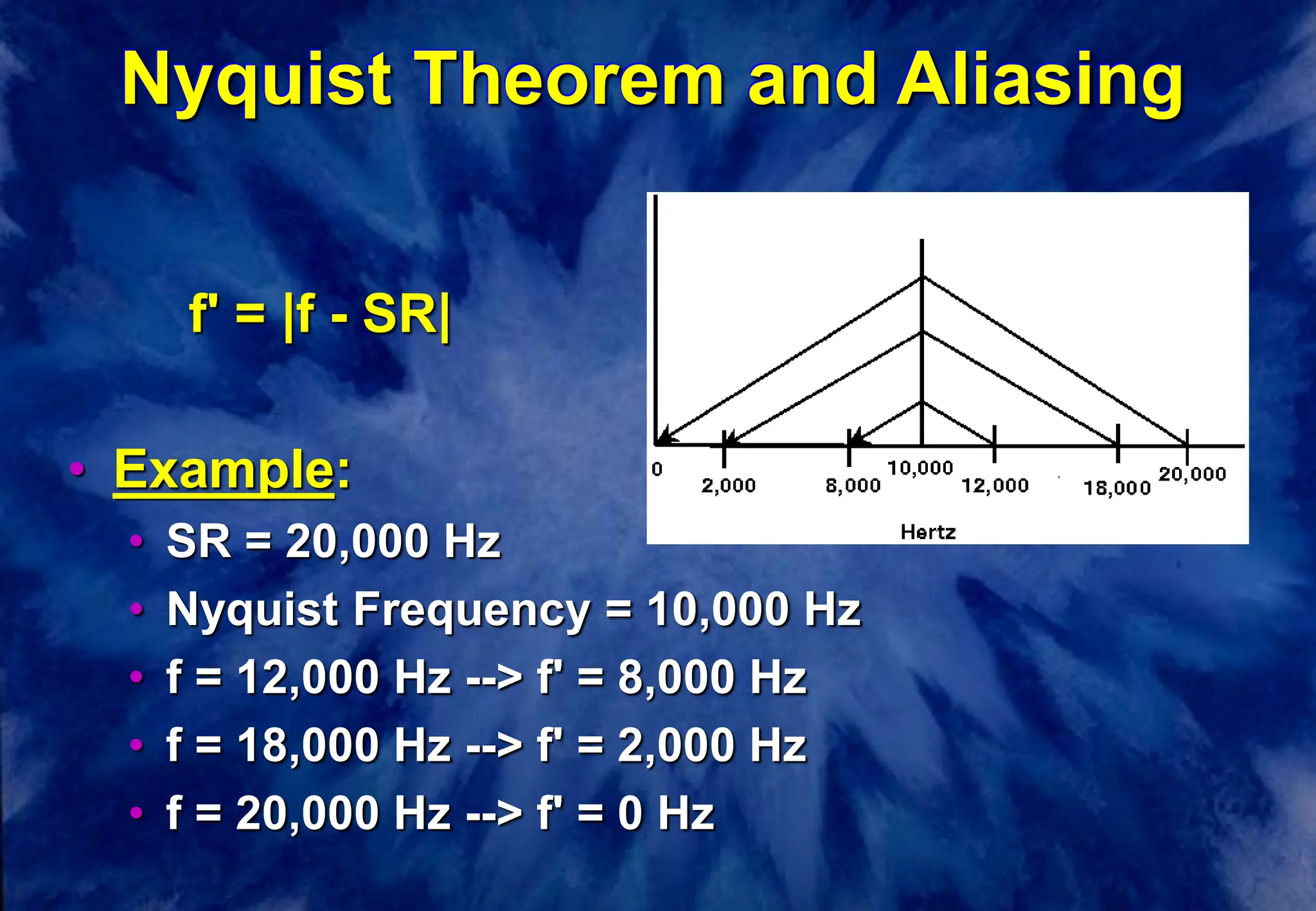
• Frequencies above Nyquist frequency
"fold over" to sound like lower
frequencies.
• This foldover is called aliasing.
• Aliased frequency f in range [SR/2, SR]
becomes f':
f' = |f - SR|
Nyquist Theorem and Aliasing
f' = |f - SR|
• Example:
• SR = 20,000 Hz
• Nyquist Frequency = 10,000 Hz
• f = 12,000 Hz --> f' = 8,000 Hz
• f = 18,000 Hz --> f' = 2,000 Hz
• f = 20,000 Hz --> f' = 0 Hz
Nyquist Theorem and Aliasing
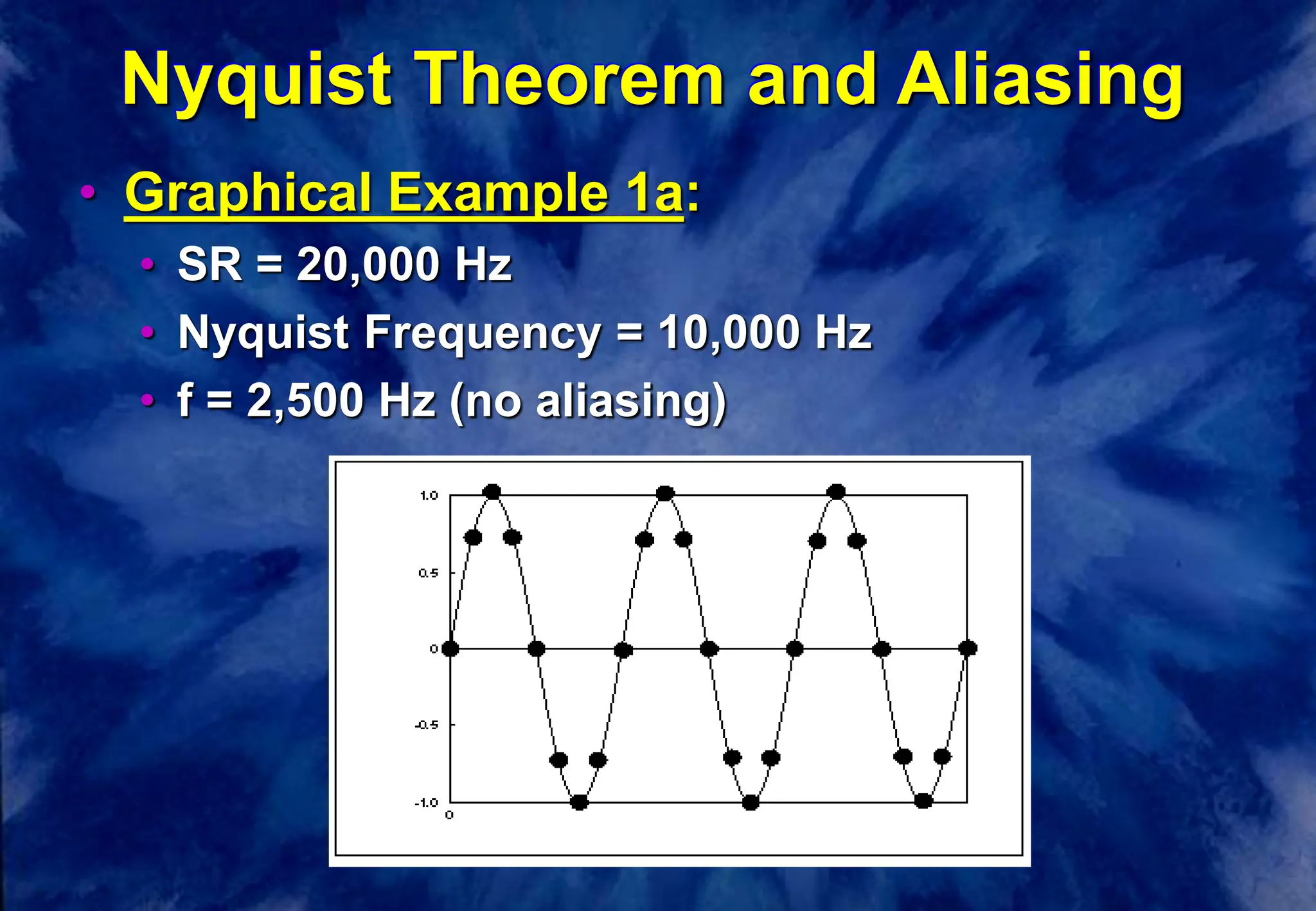
• Graphical Example 1a:
• SR = 20,000 Hz
• Nyquist Frequency = 10,000 Hz
• f = 2,500 Hz (no aliasing)
Nyquist Theorem and Aliasing
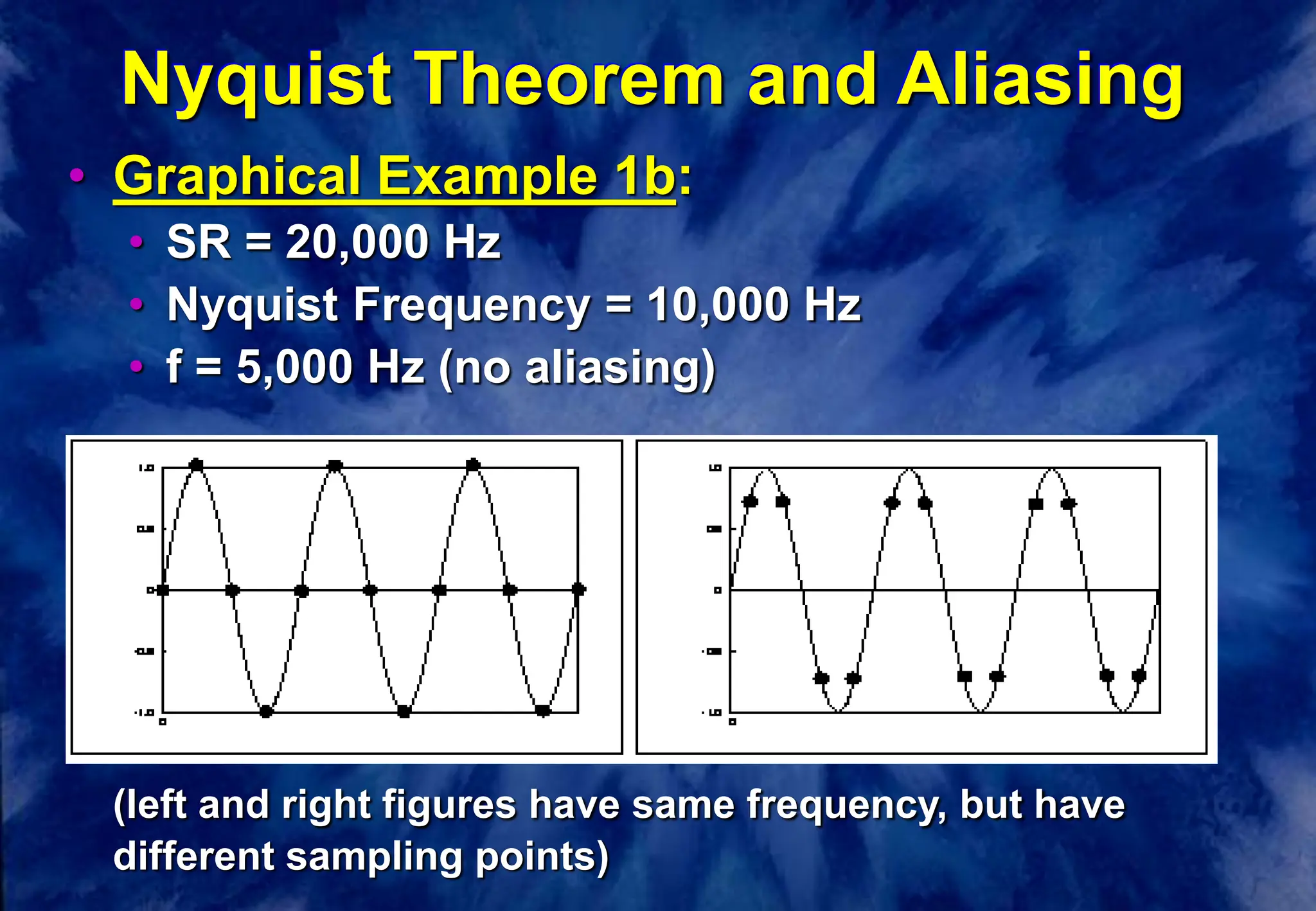
• Graphical Example 1b:
• SR = 20,000 Hz
• Nyquist Frequency = 10,000 Hz
• f = 5,000 Hz (no aliasing)
(left and right figures have same frequency, but have
different sampling points)
Nyquist Theorem and Aliasing
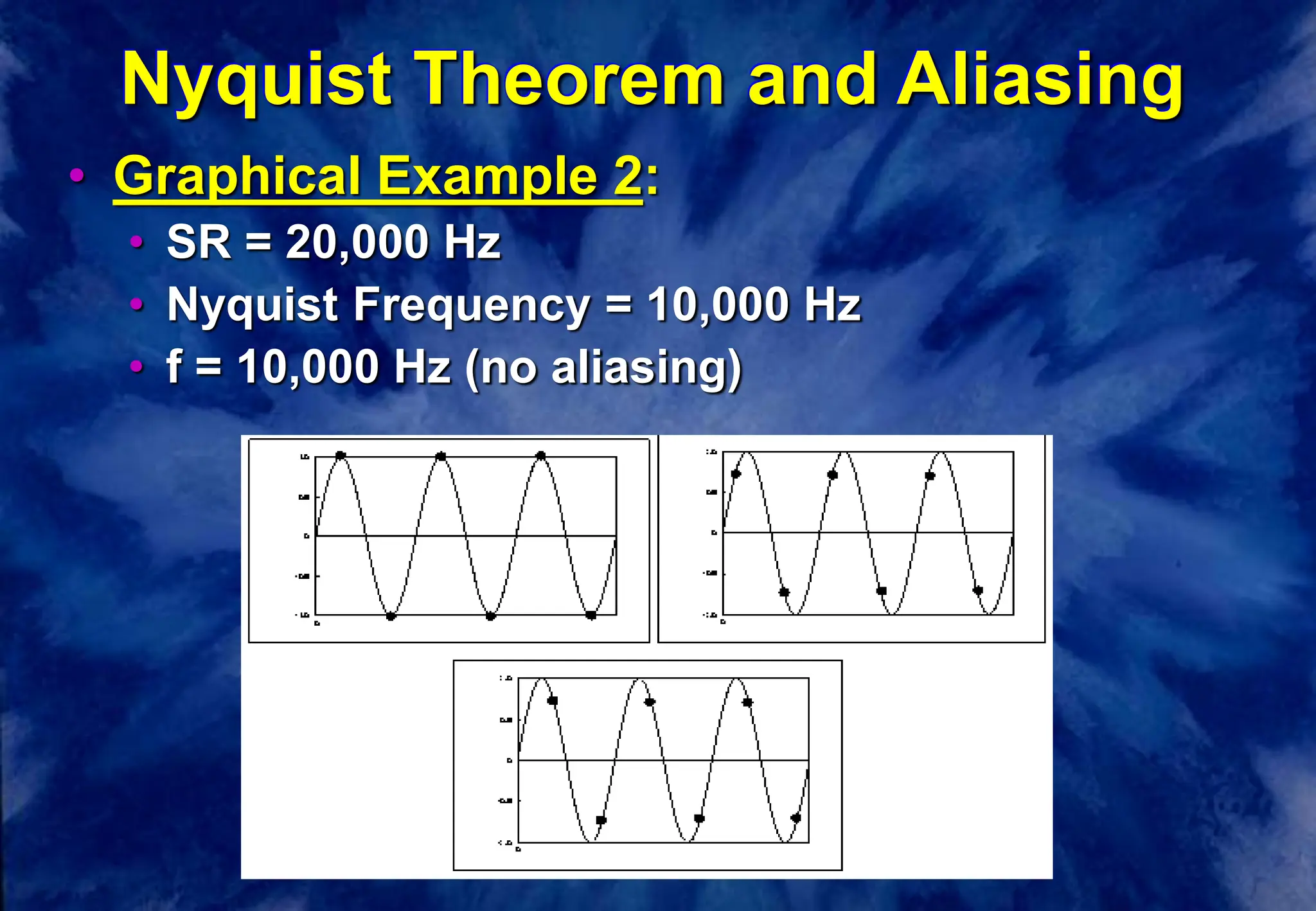
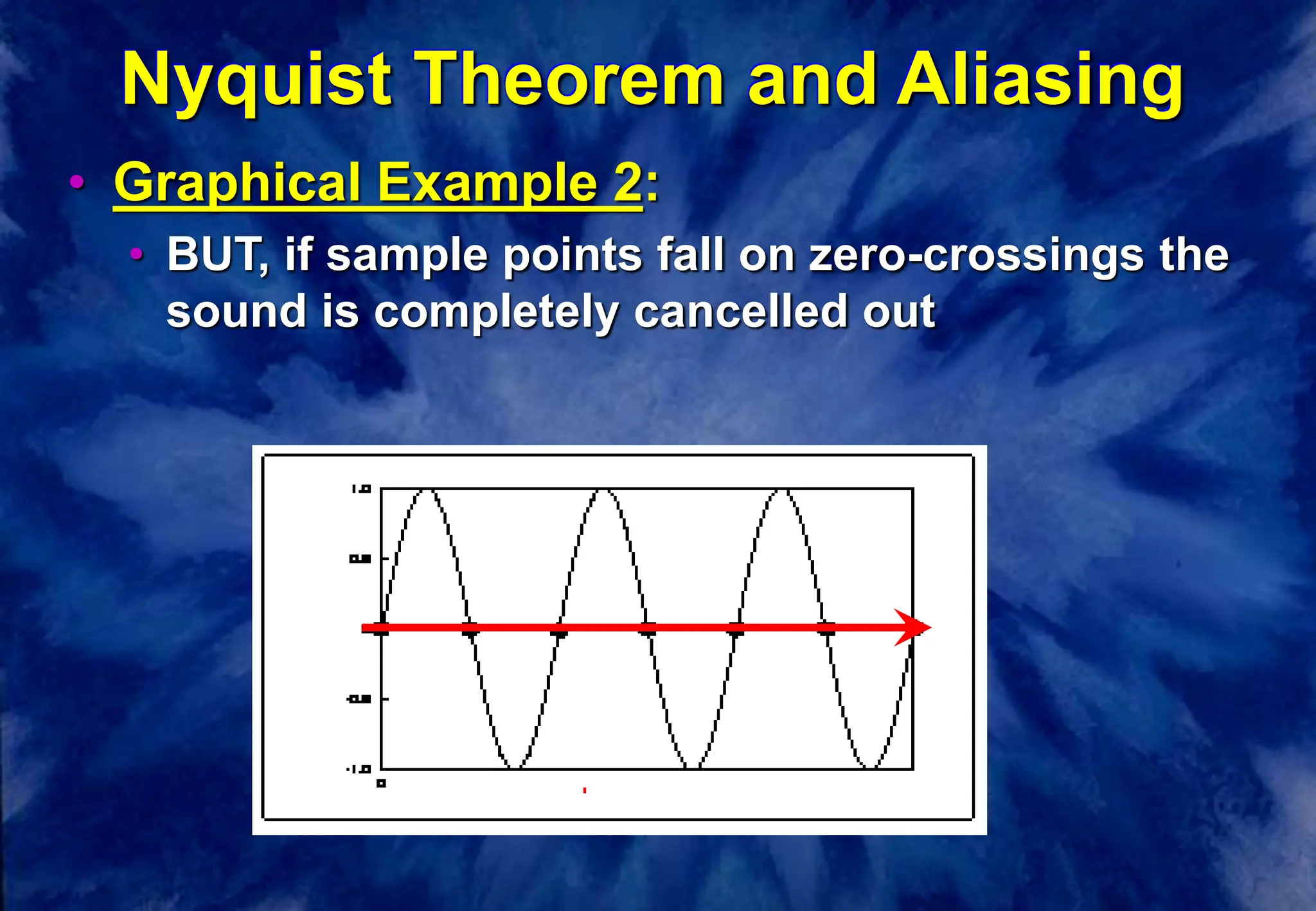
• Graphical Example 2:
• SR = 20,000 Hz
• Nyquist Frequency = 10,000 Hz
• f = 10,000 Hz (no aliasing)
Nyquist Theorem and Aliasing
• Graphical Example 2:
• BUT, if sample points fall on zero-crossings the
sound is completely cancelled out
Nyquist Theorem and Aliasing
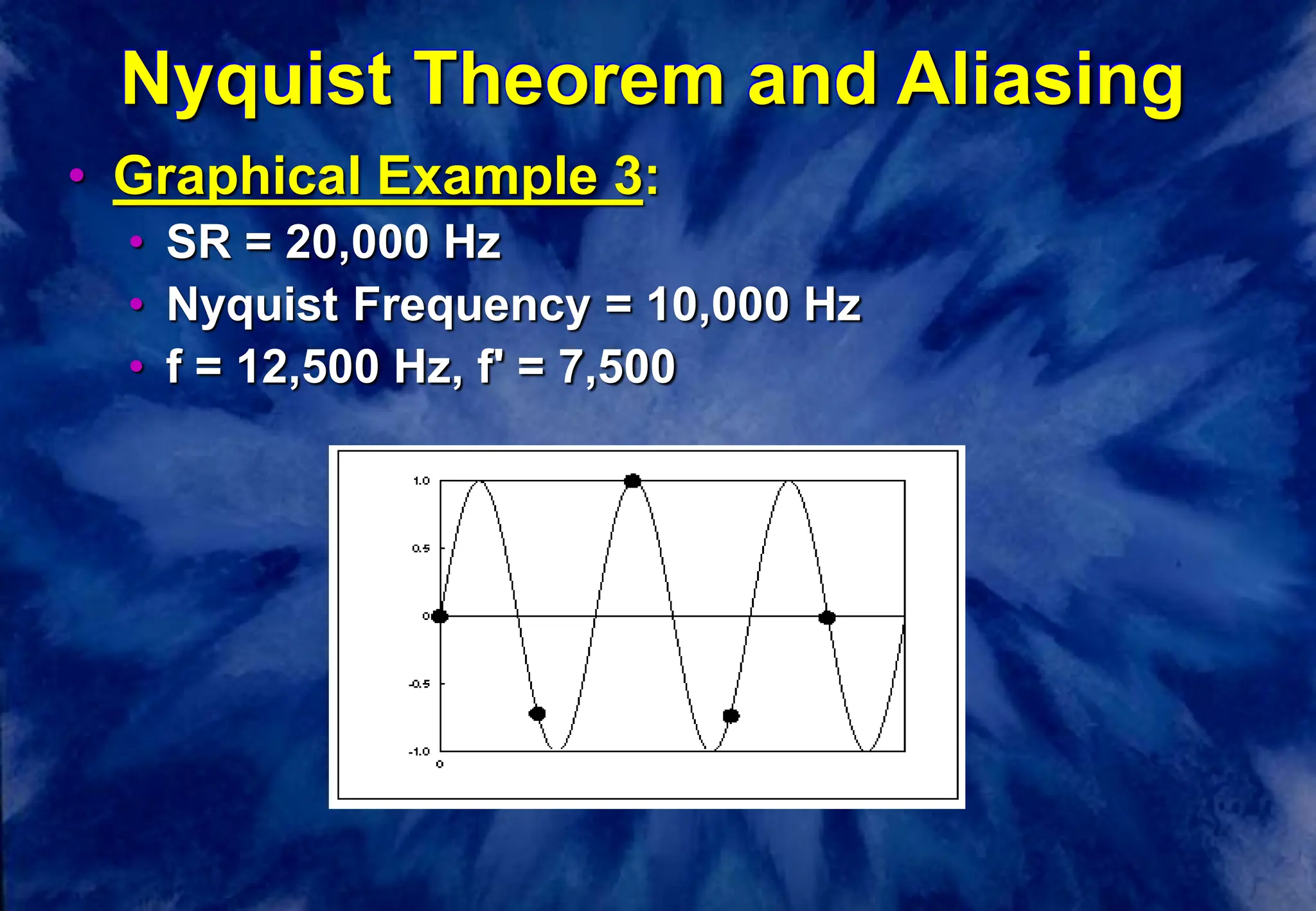
• Graphical Example 3:
• SR = 20,000 Hz
• Nyquist Frequency = 10,000 Hz
• f = 12,500 Hz, f' = 7,500
Nyquist Theorem and Aliasing
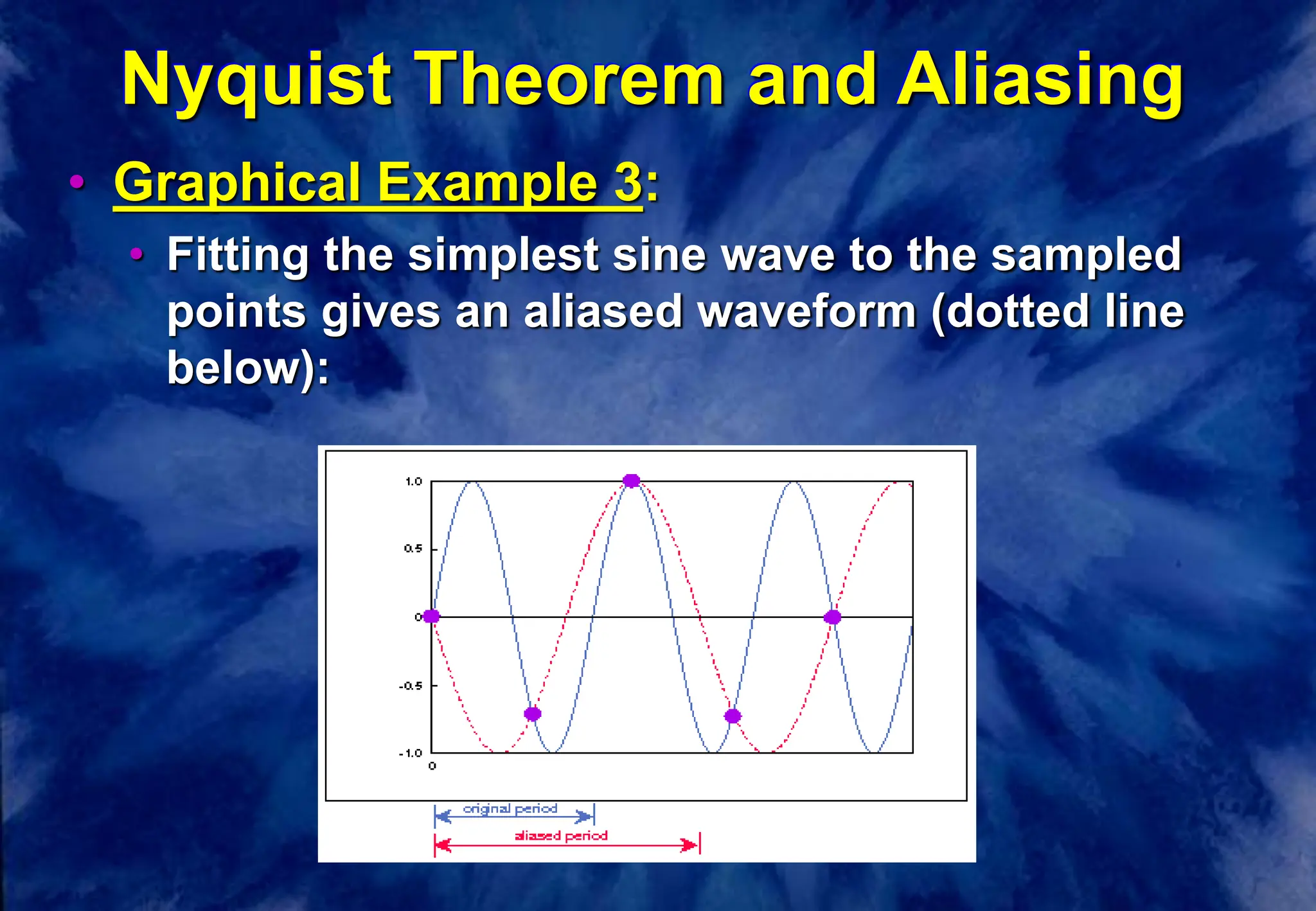
• Graphical Example 3:
• Fitting the simplest sine wave to the sampled
points gives an aliased waveform (dotted line
below):
Aliasing — Sound Examples
• [i:33] sine wave with variable frequency, SR
= 22050
Aliasing — Sound Examples
• Musical examples on the Bach trumpet:
• [i:34] SR=22050, highest frequency in music is
about 7000 Hz. (no aliasing)
• [i:35] SR=11025 (some aliasing; adds a little
metallic quality)
• [i:36] SR=4410 (lots of aliasing; sounds like
bad video game)

waveforms.ppt

  • 2.
    Introduction • For periodicwaveforms, the duration of the waveform before it repeats is called the period of the waveform
  • 3.
    Frequency • the rateat which a regular vibration pattern repeats itself (frequency = 1/period)
  • 4.
    Frequency of aWaveform • The unit for frequency is cycles/second, also called Hertz (Hz). • The frequency of a waveform is equal to the reciprocal of the period. frequency = 1/period
  • 5.
    Frequency of aWaveform • Examples: frequency = 10 Hz period = .1 (1/10) seconds frequency = 100 Hz period = .01 (1/100) seconds frequency = 261.6 Hz (middle C) period = .0038226 (1/ 261.6) seconds
  • 6.
    Waveform Sampling • Torepresent waveforms on digital computers, we need to digitize or sample the waveform. • side effects of digitization: • introduces some noise • limits the maximum upper frequency range
  • 7.
    Sampling Rate • Thesampling rate (SR) is the rate at which amplitude values are digitized from the original waveform. • CD sampling rate (high-quality): SR = 44,100 samples/second • medium-quality sampling rate: SR = 22,050 samples/second • phone sampling rate (low-quality): SR = 8,192 samples/second
  • 8.
    Sampling Rate • Higher sampling ratesallow the waveform to be more accurately represented
  • 9.
    Nyquist Theorem andAliasing • Nyquist Theorem: We can digitally represent only frequencies up to half the sampling rate. • Example: CD: SR=44,100 Hz Nyquist Frequency = SR/2 = 22,050 Hz • Example: SR=22,050 Hz Nyquist Frequency = SR/2 = 11,025 Hz
  • 10.
    Nyquist Theorem andAliasing • Frequencies above Nyquist frequency "fold over" to sound like lower frequencies. • This foldover is called aliasing. • Aliased frequency f in range [SR/2, SR] becomes f': f' = |f - SR|
  • 11.
    Nyquist Theorem andAliasing f' = |f - SR| • Example: • SR = 20,000 Hz • Nyquist Frequency = 10,000 Hz • f = 12,000 Hz --> f' = 8,000 Hz • f = 18,000 Hz --> f' = 2,000 Hz • f = 20,000 Hz --> f' = 0 Hz
  • 12.
    Nyquist Theorem andAliasing • Graphical Example 1a: • SR = 20,000 Hz • Nyquist Frequency = 10,000 Hz • f = 2,500 Hz (no aliasing)
  • 13.
    Nyquist Theorem andAliasing • Graphical Example 1b: • SR = 20,000 Hz • Nyquist Frequency = 10,000 Hz • f = 5,000 Hz (no aliasing) (left and right figures have same frequency, but have different sampling points)
  • 14.
    Nyquist Theorem andAliasing • Graphical Example 2: • SR = 20,000 Hz • Nyquist Frequency = 10,000 Hz • f = 10,000 Hz (no aliasing)
  • 15.
    Nyquist Theorem andAliasing • Graphical Example 2: • BUT, if sample points fall on zero-crossings the sound is completely cancelled out
  • 16.
    Nyquist Theorem andAliasing • Graphical Example 3: • SR = 20,000 Hz • Nyquist Frequency = 10,000 Hz • f = 12,500 Hz, f' = 7,500
  • 17.
    Nyquist Theorem andAliasing • Graphical Example 3: • Fitting the simplest sine wave to the sampled points gives an aliased waveform (dotted line below):
  • 18.
    Aliasing — SoundExamples • [i:33] sine wave with variable frequency, SR = 22050
  • 19.
    Aliasing — SoundExamples • Musical examples on the Bach trumpet: • [i:34] SR=22050, highest frequency in music is about 7000 Hz. (no aliasing) • [i:35] SR=11025 (some aliasing; adds a little metallic quality) • [i:36] SR=4410 (lots of aliasing; sounds like bad video game)