Synchronous Digital Hierarchy
          (SDH)
Contents-

•   Introduction
•   SDH
•   Use of SDH
•   Benefits of SDH
•   Advantages of SDH
•   Services
Continued..


• When to SDH
• SDH frame Structure
• Elements of frame Structure
Introduction

• SDH provides transmission network with
  vendor independent environment.
• (SDH) signals the beginning of a new
  phase in evolution of the world‘s
  telecommunication network.
Continued..


• The network operator will experience significant cost
  savings associated with reduced amount of hardware
  in the network and increased efficiency and reliability
  of the network.
• Designed to support future services such as
  Metropolitan Area Network (MAN), Broadband
  ISDN etc
What is SDH?

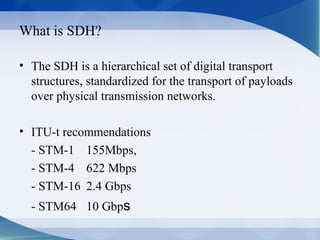
• The SDH is a hierarchical set of digital transport
  structures, standardized for the transport of payloads
  over physical transmission networks.

• ITU-t recommendations
  - STM-1 155Mbps,
  - STM-4 622 Mbps
  - STM-16 2.4 Gbps
  - STM64 10 Gbps
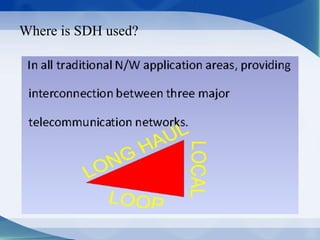
Where is SDH used?
Benefits of SDH-

• Network Simplification -performs the function of
  the entire Plesiochronous multiplexer mountain‘
  hence reduces no of equipment used . Simplified
  maintenance, reduction in floor space required by
  equipment and lower power consumption.
Continued..


• Survivability -deployment of optical fiber makes end
  to end monitoring and maintenance possible. The
  failure of links or even nodes to be identified
  immediately. Uses self-healing ring architecture, the
  network will be automatically reconfigured , re-
  routed as the faulty section has been repaired. As a
  result, failures will not disrupt services.
Continued..


• Software Control -fully software controllable. Other
  functions such as performance monitoring,
  configuration management, resource management,
  network security etc. Remote provisioning and
  centralized maintenance will mean a great saving in
  time .Reduces expenses.

• Bandwidth on Demand -possible to dynamically
  allocate network capacity or bandwidth on demand.
Continued..


• Future-proof Networking -ideal platform for
  services ranging form POTS, ISDN and mobile radio
  through to data communications (LAN, WAN etc.).
  Handles latest services like video on demand and
  digital video broadcasting via ATM. Selected as the
  bearer network for the next generation of
  telecommunication network.
Advantages of the SDH system

• First world standard in digital format.
• First optical Interfaces.
• Transversal compatibility reduces networking cost.
  Multi vendor environment drives price down
• Flexible synchronous multiplexing structure.
• Easy and cost-efficient traffic add-and-drop and cross
  connect capability.
• Reduced number of back-to-back interfaces improves
  network reliability and serviceability.
Continued..


• Powerful management capability.
• New network architecture. Highly flexible and
  survivable self healing rings available.
• Backward and forward compatibility: Backward
  compatibility to existing PDH
• Forward compatibility to future B-ISDN, etc.
Services supported are -

•   Low/High speed data.
•   Voice
•   Interconnection of LAN
•   Computer links
•   Feature services like H.D.T.V.
•   Broadband ISDN transport (ATM transport)
When to use SDH?

• Networks need increased transmission capacity.
• Networks need to provide improve flexibility (quick
  response)
• Networks need to provide improve survivability.
• Networks need to reduce operation costs.
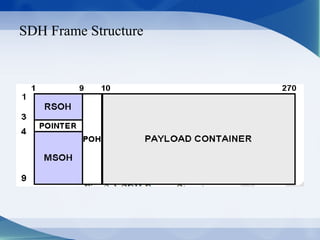
SDH Frame Structure
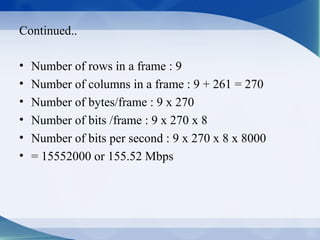
Continued..

•   Number of rows in a frame : 9
•   Number of columns in a frame : 9 + 261 = 270
•   Number of bytes/frame : 9 x 270
•   Number of bits /frame : 9 x 270 x 8
•   Number of bits per second : 9 x 270 x 8 x 8000
•   = 15552000 or 155.52 Mbps
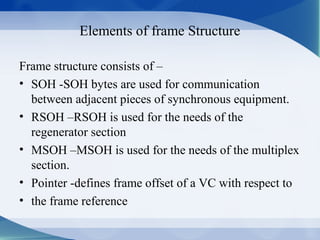
Elements of frame Structure

Frame structure consists of –
• SOH -SOH bytes are used for communication
  between adjacent pieces of synchronous equipment.
• RSOH –RSOH is used for the needs of the
  regenerator section
• MSOH –MSOH is used for the needs of the multiplex
  section.
• Pointer -defines frame offset of a VC with respect to
• the frame reference
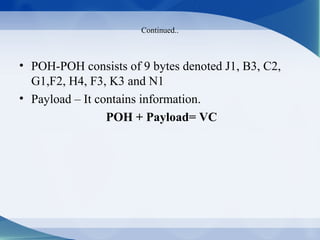
Continued..


• POH-POH consists of 9 bytes denoted J1, B3, C2,
  G1,F2, H4, F3, K3 and N1
• Payload – It contains information.
                 POH + Payload= VC
Contents
•   Mapping In SDH
•   Alignment In SDH
•   Multiplexing In SDH
•   Principle of SDH Multiplexing
•   SDH Multiplexing Structure
•   PDH Signal to STM frame conversion
•   Multiplexing of 140Mbps Signal
•   Multiplexing of 34Mbps Signal
•   Multiplexing of 2Mbps Signal
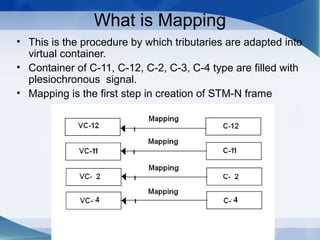
What is Mapping
• This is the procedure by which tributaries are adapted into
  virtual container.
• Container of C-11, C-12, C-2, C-3, C-4 type are filled with
  plesiochronous signal.
• Mapping is the first step in creation of STM-N frame
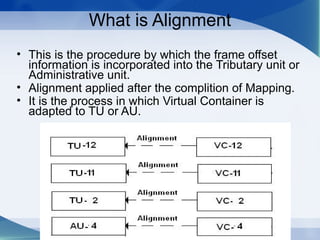
What is Alignment
• This is the procedure by which the frame offset
  information is incorporated into the Tributary unit or
  Administrative unit.
• Alignment applied after the complition of Mapping.
• It is the process in which Virtual Container is
  adapted to TU or AU.
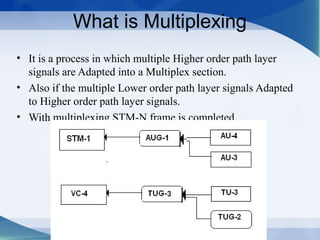
What is Multiplexing
• It is a process in which multiple Higher order path layer
  signals are Adapted into a Multiplex section.
• Also if the multiple Lower order path layer signals Adapted
  to Higher order path layer signals.
• With multiplexing STM-N frame is completed.
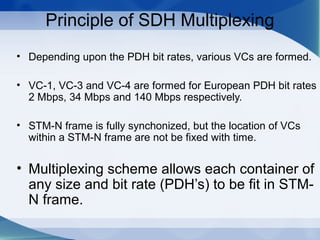
Principle of SDH Multiplexing
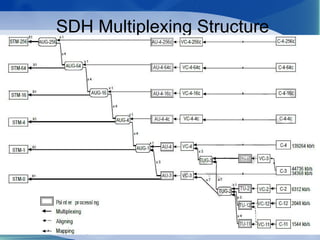
• Depending upon the PDH bit rates, various VCs are formed.

• VC-1, VC-3 and VC-4 are formed for European PDH bit rates
  2 Mbps, 34 Mbps and 140 Mbps respectively.

• STM-N frame is fully synchonized, but the location of VCs
  within a STM-N frame are not be fixed with time.


• Multiplexing scheme allows each container of
  any size and bit rate (PDH’s) to be fit in STM-
  N frame.
SDH Multiplexing Structure
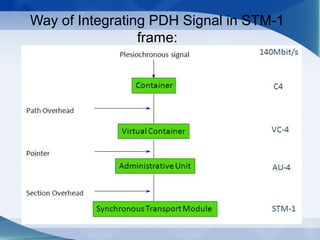
Way of Integrating PDH Signal in STM-1
                 frame:
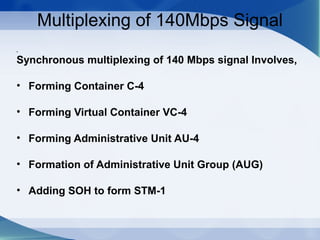
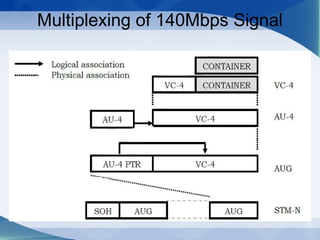
Multiplexing of 140Mbps Signal
•

Synchronous multiplexing of 140 Mbps signal Involves,

• Forming Container C-4

• Forming Virtual Container VC-4

• Forming Administrative Unit AU-4

• Formation of Administrative Unit Group (AUG)

• Adding SOH to form STM-1
Multiplexing of 140Mbps Signal
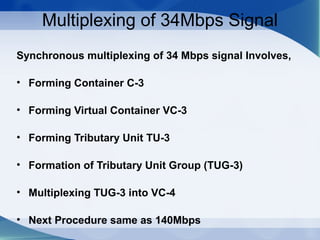
Multiplexing of 34Mbps Signal
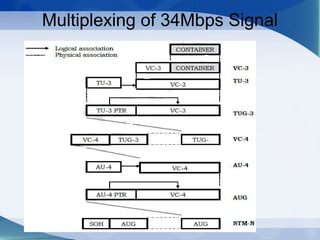
Synchronous multiplexing of 34 Mbps signal Involves,

• Forming Container C-3

• Forming Virtual Container VC-3

• Forming Tributary Unit TU-3

• Formation of Tributary Unit Group (TUG-3)

• Multiplexing TUG-3 into VC-4

• Next Procedure same as 140Mbps
Multiplexing of 34Mbps Signal
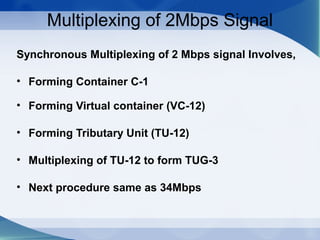
Multiplexing of 2Mbps Signal
Synchronous Multiplexing of 2 Mbps signal Involves,

• Forming Container C-1

• Forming Virtual container (VC-12)

• Forming Tributary Unit (TU-12)

• Multiplexing of TU-12 to form TUG-3

• Next procedure same as 34Mbps
Contents
•   Introduction
•   SDH Network in Layers
•   Elements of SDH Network
•   Terminal multiplexer
•   ADD/DROP multiplexer
•   Regenerators
•   Digital cross connect(DXC)
•   Network management system(NMS)
Introduction

• Devices that implement SDH transmission referred as
  SDH NE’s.
• NE’s include regenerator section, multiplex section
  and path terminating section equipment's.
• SDH NE’s integrate to form the Digital loop
  carrier(DLC) to support SDH architecture and
  topologies.
• SDH NE are subdivided into various layers.
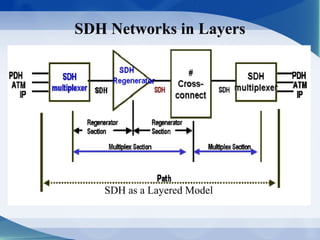
SDH Networks in Layers


   SDH as a Layered Model
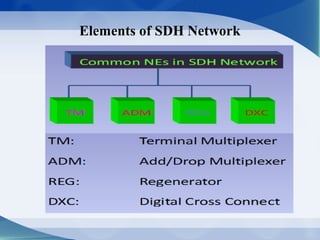
Elements of SDH Network
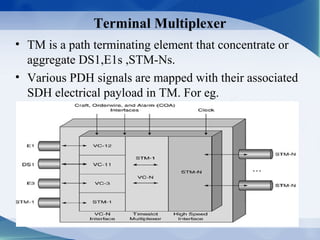
Terminal Multiplexer
• TM is a path terminating element that concentrate or
  aggregate DS1,E1s ,STM-Ns.
• Various PDH signals are mapped with their associated
  SDH electrical payload in TM. For eg.
Terminal Multiplexer

• Application of TM:
  1. Transmission system (STM-1, STM-4,STM-16)
  2. Multiplexing of Signals
  3. For higher bit rates signals
  4. Point-to-point (Chain network)
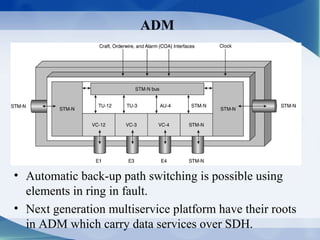
ADD/DROP Multiplexer(ADM)
• PTE that can multiplex & demultiplex various signals
  to or from STM-N signals. At add/drop side, only
  those signals that need to be accessed are dropped or
  inserted. Remaining traffic continues through NE
  without signal processing.
• Single stage ADM can multiplex or demultiplex one
  or more tributary signals to or from STM-N. Used in
  Terminal side(low speed side) where lower bit rate
  signals can add or drop into high speed SDH signals.
ADM


• Automatic back-up path switching is possible using
  elements in ring in fault.
• Next generation multiservice platform have their roots
  in ADM which carry data services over SDH.
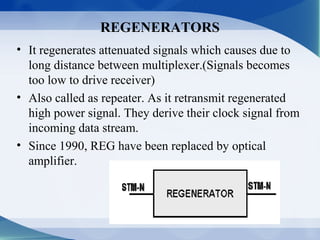
REGENERATORS
• It regenerates attenuated signals which causes due to
  long distance between multiplexer.(Signals becomes
  too low to drive receiver)
• Also called as repeater. As it retransmit regenerated
  high power signal. They derive their clock signal from
  incoming data stream.
• Since 1990, REG have been replaced by optical
  amplifier.
REGENERATORS

• Functions of REG.:
  1. Regeneration of signals
  2. Amplification
  3. Retransmission of high power signals toward
       receiver.
• Applications:
  1. In point-to-point and in ring network
  2. For long haul distance communication
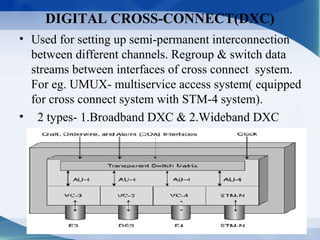
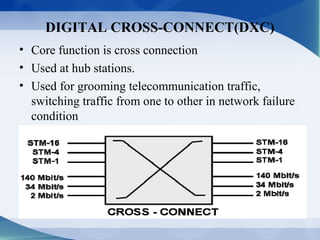
DIGITAL CROSS-CONNECT(DXC)
• Used for setting up semi-permanent interconnection
  between different channels. Regroup & switch data
  streams between interfaces of cross connect system.
  For eg. UMUX- multiservice access system( equipped
  for cross connect system with STM-4 system).
• 2 types- 1.Broadband DXC & 2.Wideband DXC
DIGITAL CROSS-CONNECT(DXC)
• Core function is cross connection
• Used at hub stations.
• Used for grooming telecommunication traffic,
  switching traffic from one to other in network failure
  condition
NETWORK MANAGEMENT SYSTEM
• NMS is combination of software & hardware used to
  monitor and administer a network.
• Network elements(NE’s ) in a network are managed
  by this NMS system.
• NMS manages NE such as fault, accounting,
  configuration and performance managements.
• NMS employs various protocols to perform these
  tasks such as SNMP protocol can be used to gather
  information from devices in network.
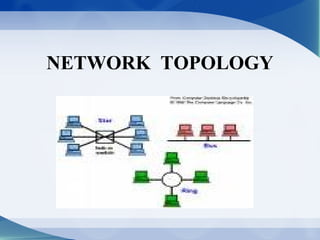
NETWORK TOPOLOGY


         By
     Nita kulkarni.
CONTENTS
a) Introduction.
b) Topology types
    i)point to point.
    ii)point to multipoint.
    iii)Ring topology.
    iv)Mesh topology.
    v) star topology.
c)Extended star topology.
d)Deployment of SDH.
Introduction
1)How the nodes in the system are connected.
2)Topology can be considered at many different levels:
  physical, logical, connection, or organizational.
3)Topology is considered in terms of the information
  flow.
   – Nodes in the graph are individual computers or
     programs,
   – links between nodes indicate that those nodes are
     sharing information regularly in the system.
Topology types
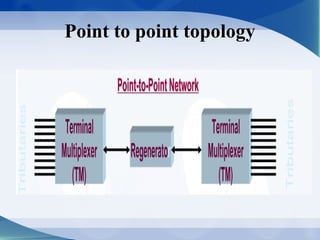
a) Point to point topology
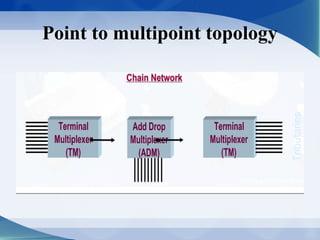
b) Point to multipoint topology
c)Ring topology
d)Mesh topology
e)Star topology
Point to point topology
Point to multipoint topology
Ring topology
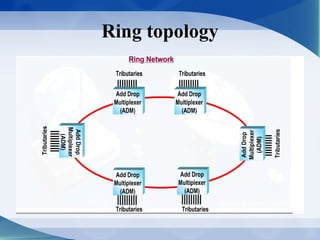
• A single centralized server cannot handle high client
  load, so a common solution is to use a cluster of
  machines arranged in a ring to act as a distributed
  server.
• Communication between the nodes coordinates state-
  sharing, producing a group of nodes that provide
  identical function but have failover and load-
  balancing capabilities.
• Unlike the other topologies here, ring systems are
  generally built assuming the machines are all nearby
  on the network and owned by a single organization.
Ring topology
Mesh topology

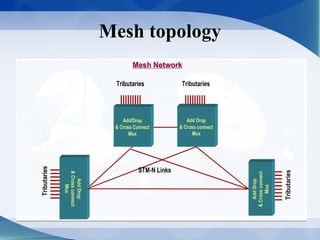
Each node is connected to every other
node.
Allows communication to continue in the
event of a break in any one connection
It is “Fault Tolerant.”
Mesh topology
Mesh Topology advantages
        &disadvantages
            Advantage.
  1.Improves Fault Tolerance

              Disadvantages.
1.Expensive
2.Difficult to install
3.Difficult to manage
4.Difficult to troubleshoot
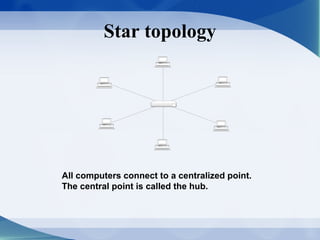
Star topology


All computers connect to a centralized point.
The central point is called the hub.
Star topology advantages
• Advantages
• Easy to add devices as the network expands
• One cable failure does not bring down the
  entire network (resilience)
• Hub provides centralised management
• Easy to find device and cable problems
• Can be upgraded to faster speeds
• Lots of support as it is the most used
Star topology disadvantages

 Disadvantages
A star network requires more cable than a ring
or bus network
Failure of the central hub can bring down the
entire network
Costs are higher (installation and equipment)
than for most bus networks
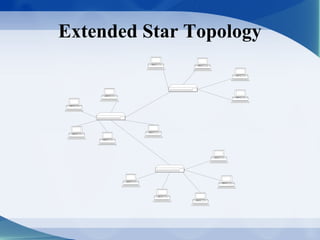
Extended Star Topology
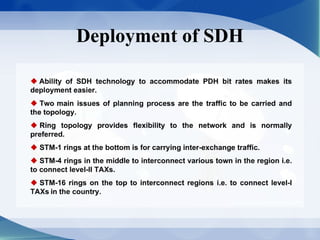
Deployment of SDH
ANY QUESTION?
Sdh total final

Sdh total final

  • 1.
  • 2.
    Contents- • Introduction • SDH • Use of SDH • Benefits of SDH • Advantages of SDH • Services
  • 3.
    Continued.. • When toSDH • SDH frame Structure • Elements of frame Structure
  • 4.
    Introduction • SDH providestransmission network with vendor independent environment. • (SDH) signals the beginning of a new phase in evolution of the world‘s telecommunication network.
  • 5.
    Continued.. • The networkoperator will experience significant cost savings associated with reduced amount of hardware in the network and increased efficiency and reliability of the network. • Designed to support future services such as Metropolitan Area Network (MAN), Broadband ISDN etc
  • 6.
    What is SDH? •The SDH is a hierarchical set of digital transport structures, standardized for the transport of payloads over physical transmission networks. • ITU-t recommendations - STM-1 155Mbps, - STM-4 622 Mbps - STM-16 2.4 Gbps - STM64 10 Gbps
  • 7.
  • 8.
    Benefits of SDH- •Network Simplification -performs the function of the entire Plesiochronous multiplexer mountain‘ hence reduces no of equipment used . Simplified maintenance, reduction in floor space required by equipment and lower power consumption.
  • 9.
    Continued.. • Survivability -deploymentof optical fiber makes end to end monitoring and maintenance possible. The failure of links or even nodes to be identified immediately. Uses self-healing ring architecture, the network will be automatically reconfigured , re- routed as the faulty section has been repaired. As a result, failures will not disrupt services.
  • 10.
    Continued.. • Software Control-fully software controllable. Other functions such as performance monitoring, configuration management, resource management, network security etc. Remote provisioning and centralized maintenance will mean a great saving in time .Reduces expenses. • Bandwidth on Demand -possible to dynamically allocate network capacity or bandwidth on demand.
  • 11.
    Continued.. • Future-proof Networking-ideal platform for services ranging form POTS, ISDN and mobile radio through to data communications (LAN, WAN etc.). Handles latest services like video on demand and digital video broadcasting via ATM. Selected as the bearer network for the next generation of telecommunication network.
  • 12.
    Advantages of theSDH system • First world standard in digital format. • First optical Interfaces. • Transversal compatibility reduces networking cost. Multi vendor environment drives price down • Flexible synchronous multiplexing structure. • Easy and cost-efficient traffic add-and-drop and cross connect capability. • Reduced number of back-to-back interfaces improves network reliability and serviceability.
  • 13.
    Continued.. • Powerful managementcapability. • New network architecture. Highly flexible and survivable self healing rings available. • Backward and forward compatibility: Backward compatibility to existing PDH • Forward compatibility to future B-ISDN, etc.
  • 14.
    Services supported are- • Low/High speed data. • Voice • Interconnection of LAN • Computer links • Feature services like H.D.T.V. • Broadband ISDN transport (ATM transport)
  • 15.
    When to useSDH? • Networks need increased transmission capacity. • Networks need to provide improve flexibility (quick response) • Networks need to provide improve survivability. • Networks need to reduce operation costs.
  • 16.
  • 17.
    Continued.. • Number of rows in a frame : 9 • Number of columns in a frame : 9 + 261 = 270 • Number of bytes/frame : 9 x 270 • Number of bits /frame : 9 x 270 x 8 • Number of bits per second : 9 x 270 x 8 x 8000 • = 15552000 or 155.52 Mbps
  • 18.
    Elements of frameStructure Frame structure consists of – • SOH -SOH bytes are used for communication between adjacent pieces of synchronous equipment. • RSOH –RSOH is used for the needs of the regenerator section • MSOH –MSOH is used for the needs of the multiplex section. • Pointer -defines frame offset of a VC with respect to • the frame reference
  • 19.
    Continued.. • POH-POH consistsof 9 bytes denoted J1, B3, C2, G1,F2, H4, F3, K3 and N1 • Payload – It contains information. POH + Payload= VC
  • 20.
    Contents • Mapping In SDH • Alignment In SDH • Multiplexing In SDH • Principle of SDH Multiplexing • SDH Multiplexing Structure • PDH Signal to STM frame conversion • Multiplexing of 140Mbps Signal • Multiplexing of 34Mbps Signal • Multiplexing of 2Mbps Signal
  • 21.
    What is Mapping •This is the procedure by which tributaries are adapted into virtual container. • Container of C-11, C-12, C-2, C-3, C-4 type are filled with plesiochronous signal. • Mapping is the first step in creation of STM-N frame
  • 22.
    What is Alignment •This is the procedure by which the frame offset information is incorporated into the Tributary unit or Administrative unit. • Alignment applied after the complition of Mapping. • It is the process in which Virtual Container is adapted to TU or AU.
  • 23.
    What is Multiplexing •It is a process in which multiple Higher order path layer signals are Adapted into a Multiplex section. • Also if the multiple Lower order path layer signals Adapted to Higher order path layer signals. • With multiplexing STM-N frame is completed.
  • 24.
    Principle of SDHMultiplexing • Depending upon the PDH bit rates, various VCs are formed. • VC-1, VC-3 and VC-4 are formed for European PDH bit rates 2 Mbps, 34 Mbps and 140 Mbps respectively. • STM-N frame is fully synchonized, but the location of VCs within a STM-N frame are not be fixed with time. • Multiplexing scheme allows each container of any size and bit rate (PDH’s) to be fit in STM- N frame.
  • 25.
  • 26.
    Way of IntegratingPDH Signal in STM-1 frame:
  • 27.
    Multiplexing of 140MbpsSignal • Synchronous multiplexing of 140 Mbps signal Involves, • Forming Container C-4 • Forming Virtual Container VC-4 • Forming Administrative Unit AU-4 • Formation of Administrative Unit Group (AUG) • Adding SOH to form STM-1
  • 28.
  • 29.
    Multiplexing of 34MbpsSignal Synchronous multiplexing of 34 Mbps signal Involves, • Forming Container C-3 • Forming Virtual Container VC-3 • Forming Tributary Unit TU-3 • Formation of Tributary Unit Group (TUG-3) • Multiplexing TUG-3 into VC-4 • Next Procedure same as 140Mbps
  • 30.
  • 31.
    Multiplexing of 2MbpsSignal Synchronous Multiplexing of 2 Mbps signal Involves, • Forming Container C-1 • Forming Virtual container (VC-12) • Forming Tributary Unit (TU-12) • Multiplexing of TU-12 to form TUG-3 • Next procedure same as 34Mbps
  • 32.
    Contents • Introduction • SDH Network in Layers • Elements of SDH Network • Terminal multiplexer • ADD/DROP multiplexer • Regenerators • Digital cross connect(DXC) • Network management system(NMS)
  • 33.
    Introduction • Devices thatimplement SDH transmission referred as SDH NE’s. • NE’s include regenerator section, multiplex section and path terminating section equipment's. • SDH NE’s integrate to form the Digital loop carrier(DLC) to support SDH architecture and topologies. • SDH NE are subdivided into various layers.
  • 34.
    SDH Networks inLayers SDH as a Layered Model
  • 35.
  • 36.
    Terminal Multiplexer • TMis a path terminating element that concentrate or aggregate DS1,E1s ,STM-Ns. • Various PDH signals are mapped with their associated SDH electrical payload in TM. For eg.
  • 37.
    Terminal Multiplexer • Applicationof TM: 1. Transmission system (STM-1, STM-4,STM-16) 2. Multiplexing of Signals 3. For higher bit rates signals 4. Point-to-point (Chain network)
  • 38.
    ADD/DROP Multiplexer(ADM) • PTEthat can multiplex & demultiplex various signals to or from STM-N signals. At add/drop side, only those signals that need to be accessed are dropped or inserted. Remaining traffic continues through NE without signal processing. • Single stage ADM can multiplex or demultiplex one or more tributary signals to or from STM-N. Used in Terminal side(low speed side) where lower bit rate signals can add or drop into high speed SDH signals.
  • 39.
    ADM • Automatic back-uppath switching is possible using elements in ring in fault. • Next generation multiservice platform have their roots in ADM which carry data services over SDH.
  • 40.
    REGENERATORS • It regeneratesattenuated signals which causes due to long distance between multiplexer.(Signals becomes too low to drive receiver) • Also called as repeater. As it retransmit regenerated high power signal. They derive their clock signal from incoming data stream. • Since 1990, REG have been replaced by optical amplifier.
  • 41.
    REGENERATORS • Functions ofREG.: 1. Regeneration of signals 2. Amplification 3. Retransmission of high power signals toward receiver. • Applications: 1. In point-to-point and in ring network 2. For long haul distance communication
  • 42.
    DIGITAL CROSS-CONNECT(DXC) • Usedfor setting up semi-permanent interconnection between different channels. Regroup & switch data streams between interfaces of cross connect system. For eg. UMUX- multiservice access system( equipped for cross connect system with STM-4 system). • 2 types- 1.Broadband DXC & 2.Wideband DXC
  • 43.
    DIGITAL CROSS-CONNECT(DXC) • Corefunction is cross connection • Used at hub stations. • Used for grooming telecommunication traffic, switching traffic from one to other in network failure condition
  • 44.
    NETWORK MANAGEMENT SYSTEM •NMS is combination of software & hardware used to monitor and administer a network. • Network elements(NE’s ) in a network are managed by this NMS system. • NMS manages NE such as fault, accounting, configuration and performance managements. • NMS employs various protocols to perform these tasks such as SNMP protocol can be used to gather information from devices in network.
  • 45.
    NETWORK TOPOLOGY By Nita kulkarni.
  • 46.
    CONTENTS a) Introduction. b) Topologytypes i)point to point. ii)point to multipoint. iii)Ring topology. iv)Mesh topology. v) star topology. c)Extended star topology. d)Deployment of SDH.
  • 47.
    Introduction 1)How the nodesin the system are connected. 2)Topology can be considered at many different levels: physical, logical, connection, or organizational. 3)Topology is considered in terms of the information flow. – Nodes in the graph are individual computers or programs, – links between nodes indicate that those nodes are sharing information regularly in the system.
  • 48.
    Topology types a) Pointto point topology b) Point to multipoint topology c)Ring topology d)Mesh topology e)Star topology
  • 49.
  • 50.
  • 51.
    Ring topology • Asingle centralized server cannot handle high client load, so a common solution is to use a cluster of machines arranged in a ring to act as a distributed server. • Communication between the nodes coordinates state- sharing, producing a group of nodes that provide identical function but have failover and load- balancing capabilities. • Unlike the other topologies here, ring systems are generally built assuming the machines are all nearby on the network and owned by a single organization.
  • 52.
  • 53.
    Mesh topology Each nodeis connected to every other node. Allows communication to continue in the event of a break in any one connection It is “Fault Tolerant.”
  • 54.
  • 55.
    Mesh Topology advantages &disadvantages Advantage. 1.Improves Fault Tolerance Disadvantages. 1.Expensive 2.Difficult to install 3.Difficult to manage 4.Difficult to troubleshoot
  • 56.
    Star topology All computersconnect to a centralized point. The central point is called the hub.
  • 57.
    Star topology advantages •Advantages • Easy to add devices as the network expands • One cable failure does not bring down the entire network (resilience) • Hub provides centralised management • Easy to find device and cable problems • Can be upgraded to faster speeds • Lots of support as it is the most used
  • 58.
    Star topology disadvantages Disadvantages A star network requires more cable than a ring or bus network Failure of the central hub can bring down the entire network Costs are higher (installation and equipment) than for most bus networks
  • 59.
  • 60.
  • 61.