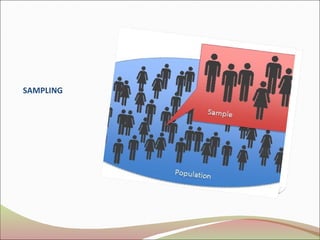
SAMPLING
SOME IMPORTANT TERMS.
Population: The aggregate of all units pertaining
to a study is called population
Element: A member of a population is an
element(subject)
Sample: A part of the population is known as the
sample
Sampling: It is the process of drawing sample from
a larger population
Sampling frame: The list of sampling units from
which a sample is taken is called the sampling
frame
CHARACTERISTICS OF A GOOD SAMPLE
1. Representativeness: Represent the population
2. Accuracy: Degree to which bias is free from the
sample
3. Precision: Precision is measured by SD and
standard error
4. Adequate sample size ensures reliability
ADVANTAGES OF SAMPLING.
1. Reduces time and cost of
research
2. Saves labour
3. Quality of study is often
better
4. Produce quicker results
5. If population is infinite
sampling is only procedure
possible
LIMITATIONS OF SAMPLING
Sampling demands a
thorough knowledge of
sampling methods and
procedures.
Complicated sampling
plan requires more
labour.
Classification of sampling methods
 Probability sampling
 Non probability sampling
PROBABILITY SAMPLING
Probability sampling are those that clearly specify the
probability or likelihood of inclusion of each element
or individual in the sample .
CONDITIONS OF PROBABILITY
SAMPLING
The size of the parent population must be known to
the investigator.
Each element in the population must have equal
chance of being included in subsequent sample.
The desired sample size must be clearly specified.
Positive&negative points…
Positive point :-The obtained samples are considered
representative.
Negative point : Certain amount of sampling error
exists because there is a limited amount of the entire
population.
Types of probability sampling…
Simple random sampling
Stratified random sampling
Systematic sampling
Cluster sampling
Area sampling
Multi-stage sampling
Multi phase sampling
Sampling with probability proportionate to size
Replicated sampling
Simple random sampling
A simple random sample selected from a population
in such a way that every member of the population
has equal chance of being selected and selection of
any individual does not influence the selection of any
other
Random sample is a sample selected at random.
Sample selection should be done in such a way that
any bias on the part of the observer shall be avoided
PROCEDURE
Enumeration of all elements in the population
Preparation of a list of all elements
Drawing sample numbers by using lottery method,
tables of random numbers or a computer
Two methods for random sampling
Lottery method
Table of random numbers
LOTTERY METHOD
All items of the universe are numbered or named on
separates lips of paper of identical size and shape
Slips are then folded
Mixed in a container
A blind fold selection
Number of slips taken =desired sample size
TABLE OF RANDOM NUMBERS
Several standard tables of standard tables of random
numbers are available
E.g.: Tippet’s table, Fisher’s table, Kendall’s table,
Rao’s etc
These tables are known as random sampling
numbers
Tables are used for getting random numbers
corresponding to which we select from population
ADVANTAGES
All elements in the population
have an equal chance of being
selected
Easiest to study
Most simple type of probability
sample
Does not require prior knowledge
The amount of sampling error can
be early computed
Disadvantages
It is impractical because of non availability of
population list
If the size of the sample selected is small ,the results
may not be reliable
A simple random design may be expensive in time
and money
The size of the sample required to ensure its
representativeness is usually larger under this type of
study
Sampling error in this sampling is greater than other
probability samples
This technique does not ensure proportionate
representations to various groups consulting the
population
The use of simple random sampling may be wasteful
because we fail to use all the known informations
about the population
Stratified random sampling
In stratified random sampling ,we must devide the
population into different subgroups known as strata
Items in each stratum are homogeneous
From each strata items are selected by simple random
sample method
This method has the advantage of a simple random
sampling method
Different groups in the population get
representations
It ensures greater accuracy
It is appropriate for large heterogeneous population
Stratification ensures representation to all relevant
subgroups
Provides data for analyzing various subgroups.
Division of stratified sampling
 1.proportionate stratified sampling
2. dispropotionate stratified sampling
Propotionate stratified sampling ..
In propotionate stratified sampling ,number of items
selected from each sample is propotional to size of
each stratum
Number of items taken from each stratum is on the
basis of size of each stratum
( eg)
Advantages
It enhances representativeness of the sample
It gives higher statistical efficiency
It is easy to carry out
Disadvantages
A prior knowledge of the composition of the
population is required
This method is very expensive in money &time
Identification of strata might lead to classification
errors
Disproportionate stratified
sampling
Dispropotionate stratified random sampling where
equal number of items is selected from each
stratum ,irrespective of size
Advantages
It is less time consuming
It facilitates giving appropriate weightage to
particular groups which are small but important
Disadvantages
The sample may be less representative
This method requires prior knowledge
Systematic sampling
This method of sampling is an alternative to random
sampling
It consist of taking K th (or N th)item in the
population after a random start with an item from 1
to K
as the interval between sample units are fixed ,this
method is also called fixed interval method
Advantages
It is much simpler than random sampling
It is easy to instruct the field investigations
The method requires less time
This method is cheaper than simple random sampling
Easier to check whether every K th has been included
in the sample
Sample is spread evenly over the population
It is statistically more efficient than simple random
sampling
Disadvantage
This method ignores all element between two K th
elements selected
As each element does not have equal chances of
being selected ,the resulting sample is not a random
one
This method may sometimes gives a biased sample
Cluster sampling
When population are scattered over a wider area
and a list of population element is not readily
available.
Cluster sampling means random selection of
sampling units consisting of population elements
Cluster sampling - the subjects are selected in
groups or clusters rather than randomly
Cluster sampling process
Identify clusters
Examine the nature of clusters
Determine the number of stages
Advantages
The method is much easier and more convenient to
apply when large populations are studied or large
geographic areas are covered
The cost of this method is much less
This method promotes convenience of field work
Sampling does not require more time
This method is flexible
Disadvantages
The cluster may vary and this variation could increase
the bias of the resulting sample
The sampling error in this method of sampling is
greater
Area sampling ..
This is an important form of cluster sampling
As the geographic areas are selected as sampling units
in such cases their sampling is called area sampling
Area sampling invariably involves multistage
sampling and sub sampling
Eg…
Multi stage sampling
In this sampling is carried out in two or more stages
The population is regarded as being composed of a
number of first stage sampling unit
First a sample of the first stage sampling unit is
drawn
From each first stage sampling units a sample of the
second stage sampling units is drawn
The procedures comes down to the final sampling
units
Appropriate random sampling method is adopted at
each stage
Advantages
It results in concentration of field work in compact
small areas and consequently in saving time ,labour
and money
It is convenient ,efficient, and flexible than single
stage sampling.
Disadvantages
The procedure of estimating sampling error is
complicated
Sampling with probability proportional
size(PPS)
If one primary cluster has twice as large population as
another ,it is given twice the chance of being selected
The PPS is a better method for getting a
representative sample of population element in
multistage sampling
Not all clusters are the same size.
Can weigh the clusters to equate the difference.
Can weigh the chances of a cluster being selected
Advantages
Clusters of various size gets proportionate
representation
PPS leads to great precision and a constant sampling
fraction at the second stage
Limitation
PPS cannot be used when the sizes of the primary
sampling clusters are not known
Application
Used in all multi stage sampling
Multi-phase sampling
Multi phase sampling is different from multi stage
sampling
In multi phase sampling the different phases of
observation relate to sample units of the same type
Replicated sample
Replicated sampling involves selection of a certain
number of sub samples rather than one full sample
in a population
Advantages
It provides simple means of calculating the sampling
errors
Its is practical
Dis advantages
A disadvantage of replicated sampling is that its
limits the amount of stratification that can be
employed
II NON PROBABILITY SAMPLING
Non probability sampling
Non probability sampling is one in which there is no
way of assessing the probability of the element or
group elements ,of population being included in the
sample .
Important sampling methods..
Quota sampling
Accidental sampling
Judgmental sampling
Snowball sampling
 purposive or deliberate
Convenience sampling
Self selection sampling
Quota sampling
Quota sampling - quotas for certain types of
people or organizations are selected as the sample
Interviewers are required to find cases with particular
characteristics
E.g., certain number of teenagers, etc.
Advantage– better than convenience; introduce
some diversity
disadvantage –
It is nonrandom sampling
Accidental sampling
Accidental sampling is a type of
nonprobability sampling which involves the sample
being drawn from that part of the population which is
close to hand. That is, a sample population selected
because it is readily available and convenient
The researcher using such a sample cannot
scientifically make generalizations about the total
population from this sample because it would not be
representative enough
This type of sampling is most useful for pilot testing
Eg (shoping complex)
Judgemental sampling
In judgement sampling, the researcher or some other
"expert" uses his/her judgement in selecting the units
from the population for study based on the
population’s parameters.
Snow ball sampling
Snowball sampling – an individual or group of individuals
are sampled. They provide other sources to be sampled.
Sampling snowballs into a large selection.
Useful for hard to identify groups.
E.g., study of criminal organizations
May lead to biased sample
Sociogram – a map of individuals and their references.
Purposive sampling
Purposive sampling is the selection of items in
accordance with some purposive principle the items
are selected in accordance with that criterion
Convenience sampling method
In this method investigator is the most important
person
The whole sample is picked up according to his
convenience
He decided what should or should not be included in
the sample
It is to be seen as to what is the availability
,accessibility as well as the command of the
investigator
Sample is not picked up with the help of any scientific
method.
There is no preplanning for the preparation of a
sample
Obviously in research this method is quite
undependable
Self-selection sampling
Self-selection sampling – test yourself
Often used in sensation/perception experiments
Problems
Lacks diversity
Can be extremely biased
Sampling
Sampling

Sampling

  • 1.
  • 2.
    SOME IMPORTANT TERMS. Population:The aggregate of all units pertaining to a study is called population Element: A member of a population is an element(subject) Sample: A part of the population is known as the sample Sampling: It is the process of drawing sample from a larger population Sampling frame: The list of sampling units from which a sample is taken is called the sampling frame
  • 3.
    CHARACTERISTICS OF AGOOD SAMPLE 1. Representativeness: Represent the population 2. Accuracy: Degree to which bias is free from the sample 3. Precision: Precision is measured by SD and standard error 4. Adequate sample size ensures reliability
  • 4.
    ADVANTAGES OF SAMPLING. 1.Reduces time and cost of research 2. Saves labour 3. Quality of study is often better 4. Produce quicker results 5. If population is infinite sampling is only procedure possible
  • 5.
    LIMITATIONS OF SAMPLING Samplingdemands a thorough knowledge of sampling methods and procedures. Complicated sampling plan requires more labour.
  • 6.
    Classification of samplingmethods  Probability sampling  Non probability sampling
  • 7.
    PROBABILITY SAMPLING Probability samplingare those that clearly specify the probability or likelihood of inclusion of each element or individual in the sample .
  • 8.
    CONDITIONS OF PROBABILITY SAMPLING Thesize of the parent population must be known to the investigator. Each element in the population must have equal chance of being included in subsequent sample. The desired sample size must be clearly specified.
  • 9.
    Positive&negative points… Positive point:-The obtained samples are considered representative. Negative point : Certain amount of sampling error exists because there is a limited amount of the entire population.
  • 10.
    Types of probabilitysampling… Simple random sampling Stratified random sampling Systematic sampling Cluster sampling Area sampling Multi-stage sampling Multi phase sampling Sampling with probability proportionate to size Replicated sampling
  • 11.
    Simple random sampling Asimple random sample selected from a population in such a way that every member of the population has equal chance of being selected and selection of any individual does not influence the selection of any other Random sample is a sample selected at random. Sample selection should be done in such a way that any bias on the part of the observer shall be avoided
  • 12.
    PROCEDURE Enumeration of allelements in the population Preparation of a list of all elements Drawing sample numbers by using lottery method, tables of random numbers or a computer
  • 13.
    Two methods forrandom sampling Lottery method Table of random numbers
  • 14.
    LOTTERY METHOD All itemsof the universe are numbered or named on separates lips of paper of identical size and shape Slips are then folded Mixed in a container A blind fold selection Number of slips taken =desired sample size
  • 15.
    TABLE OF RANDOMNUMBERS Several standard tables of standard tables of random numbers are available E.g.: Tippet’s table, Fisher’s table, Kendall’s table, Rao’s etc These tables are known as random sampling numbers Tables are used for getting random numbers corresponding to which we select from population
  • 16.
    ADVANTAGES All elements inthe population have an equal chance of being selected Easiest to study Most simple type of probability sample Does not require prior knowledge The amount of sampling error can be early computed
  • 17.
    Disadvantages It is impracticalbecause of non availability of population list If the size of the sample selected is small ,the results may not be reliable A simple random design may be expensive in time and money The size of the sample required to ensure its representativeness is usually larger under this type of study
  • 18.
    Sampling error inthis sampling is greater than other probability samples This technique does not ensure proportionate representations to various groups consulting the population The use of simple random sampling may be wasteful because we fail to use all the known informations about the population
  • 19.
    Stratified random sampling Instratified random sampling ,we must devide the population into different subgroups known as strata Items in each stratum are homogeneous From each strata items are selected by simple random sample method This method has the advantage of a simple random sampling method Different groups in the population get representations It ensures greater accuracy
  • 20.
    It is appropriatefor large heterogeneous population Stratification ensures representation to all relevant subgroups Provides data for analyzing various subgroups.
  • 21.
    Division of stratifiedsampling  1.proportionate stratified sampling 2. dispropotionate stratified sampling
  • 22.
    Propotionate stratified sampling.. In propotionate stratified sampling ,number of items selected from each sample is propotional to size of each stratum Number of items taken from each stratum is on the basis of size of each stratum ( eg)
  • 23.
    Advantages It enhances representativenessof the sample It gives higher statistical efficiency It is easy to carry out
  • 24.
    Disadvantages A prior knowledgeof the composition of the population is required This method is very expensive in money &time Identification of strata might lead to classification errors
  • 25.
    Disproportionate stratified sampling Dispropotionate stratifiedrandom sampling where equal number of items is selected from each stratum ,irrespective of size
  • 26.
    Advantages It is lesstime consuming It facilitates giving appropriate weightage to particular groups which are small but important
  • 27.
    Disadvantages The sample maybe less representative This method requires prior knowledge
  • 28.
    Systematic sampling This methodof sampling is an alternative to random sampling It consist of taking K th (or N th)item in the population after a random start with an item from 1 to K as the interval between sample units are fixed ,this method is also called fixed interval method
  • 29.
    Advantages It is muchsimpler than random sampling It is easy to instruct the field investigations The method requires less time This method is cheaper than simple random sampling Easier to check whether every K th has been included in the sample Sample is spread evenly over the population It is statistically more efficient than simple random sampling
  • 30.
    Disadvantage This method ignoresall element between two K th elements selected As each element does not have equal chances of being selected ,the resulting sample is not a random one This method may sometimes gives a biased sample
  • 31.
    Cluster sampling When populationare scattered over a wider area and a list of population element is not readily available. Cluster sampling means random selection of sampling units consisting of population elements Cluster sampling - the subjects are selected in groups or clusters rather than randomly
  • 32.
    Cluster sampling process Identifyclusters Examine the nature of clusters Determine the number of stages
  • 33.
    Advantages The method ismuch easier and more convenient to apply when large populations are studied or large geographic areas are covered The cost of this method is much less This method promotes convenience of field work Sampling does not require more time This method is flexible
  • 34.
    Disadvantages The cluster mayvary and this variation could increase the bias of the resulting sample The sampling error in this method of sampling is greater
  • 35.
    Area sampling .. Thisis an important form of cluster sampling As the geographic areas are selected as sampling units in such cases their sampling is called area sampling Area sampling invariably involves multistage sampling and sub sampling Eg…
  • 36.
    Multi stage sampling Inthis sampling is carried out in two or more stages The population is regarded as being composed of a number of first stage sampling unit First a sample of the first stage sampling unit is drawn From each first stage sampling units a sample of the second stage sampling units is drawn The procedures comes down to the final sampling units Appropriate random sampling method is adopted at each stage
  • 37.
    Advantages It results inconcentration of field work in compact small areas and consequently in saving time ,labour and money It is convenient ,efficient, and flexible than single stage sampling.
  • 38.
    Disadvantages The procedure ofestimating sampling error is complicated
  • 39.
    Sampling with probabilityproportional size(PPS) If one primary cluster has twice as large population as another ,it is given twice the chance of being selected The PPS is a better method for getting a representative sample of population element in multistage sampling Not all clusters are the same size. Can weigh the clusters to equate the difference. Can weigh the chances of a cluster being selected
  • 40.
    Advantages Clusters of varioussize gets proportionate representation PPS leads to great precision and a constant sampling fraction at the second stage
  • 41.
    Limitation PPS cannot beused when the sizes of the primary sampling clusters are not known
  • 42.
    Application Used in allmulti stage sampling
  • 43.
    Multi-phase sampling Multi phasesampling is different from multi stage sampling In multi phase sampling the different phases of observation relate to sample units of the same type
  • 44.
    Replicated sample Replicated samplinginvolves selection of a certain number of sub samples rather than one full sample in a population
  • 45.
    Advantages It provides simplemeans of calculating the sampling errors Its is practical
  • 46.
    Dis advantages A disadvantageof replicated sampling is that its limits the amount of stratification that can be employed
  • 48.
  • 49.
    Non probability sampling Nonprobability sampling is one in which there is no way of assessing the probability of the element or group elements ,of population being included in the sample .
  • 50.
    Important sampling methods.. Quotasampling Accidental sampling Judgmental sampling Snowball sampling  purposive or deliberate Convenience sampling Self selection sampling
  • 51.
    Quota sampling Quota sampling- quotas for certain types of people or organizations are selected as the sample Interviewers are required to find cases with particular characteristics E.g., certain number of teenagers, etc. Advantage– better than convenience; introduce some diversity disadvantage – It is nonrandom sampling
  • 52.
    Accidental sampling Accidental samplingis a type of nonprobability sampling which involves the sample being drawn from that part of the population which is close to hand. That is, a sample population selected because it is readily available and convenient
  • 53.
    The researcher usingsuch a sample cannot scientifically make generalizations about the total population from this sample because it would not be representative enough This type of sampling is most useful for pilot testing Eg (shoping complex)
  • 54.
    Judgemental sampling In judgementsampling, the researcher or some other "expert" uses his/her judgement in selecting the units from the population for study based on the population’s parameters.
  • 55.
    Snow ball sampling Snowballsampling – an individual or group of individuals are sampled. They provide other sources to be sampled. Sampling snowballs into a large selection. Useful for hard to identify groups. E.g., study of criminal organizations May lead to biased sample Sociogram – a map of individuals and their references.
  • 57.
    Purposive sampling Purposive samplingis the selection of items in accordance with some purposive principle the items are selected in accordance with that criterion
  • 58.
    Convenience sampling method Inthis method investigator is the most important person The whole sample is picked up according to his convenience He decided what should or should not be included in the sample It is to be seen as to what is the availability ,accessibility as well as the command of the investigator
  • 59.
    Sample is notpicked up with the help of any scientific method. There is no preplanning for the preparation of a sample Obviously in research this method is quite undependable
  • 60.
    Self-selection sampling Self-selection sampling– test yourself Often used in sensation/perception experiments Problems Lacks diversity Can be extremely biased