M.Sc POST GRADUATE DEGREE IN NURSING
Nursing Research and Statistics
Unit -VI
SAMPLING
Sampling techniques
Prof Mrs.G. Sivagami
Objectives
Define sampling
Explain population
Understand methods of quantitative sampling
Discuss methods of qualitative sampling
List down the problems of sampling
Discuss on sampling error
INTRODUCTION
Sampling is a process of selecting representative units
from an entire population of a study.
It is not always possible to study an entire population;
therefore, the researcher draws a representative part
of a population through sampling process.
In other words, sampling is the selection of some part
of an aggregate or a whole on the basis of which
judgments or inferences about the aggregate or mass
is made.
Population is defined as the entire mass of
observation, which is the parent group from which
a sample is to be formed.
Sample is defined as the aggregate of objects,
person or elements, selected from the universe.
Sampling- The method of taking the
sample is known as sampling.
Importance
of
Sampling
Economical
Accuracy
Save
time
and
efforts
Easily
approachable
Errors can
be
controlled
Practical
 Important Terminologies
◦ Representation – the extent to which the sample is
representative of the population
◦ Generalization – the extent to which the results of the
study can be reasonably extended from the sample to the
population
◦ Sampling error
The chance of occurrence that a randomly selected
sample is not representative of the population due to errors
inherent in the sampling technique
 Important terminologies (continued)
◦ Sampling bias
 It is a bias in which a sample is collected in such a way
that some members of the intended population have a
lower sampling probability than others.
◦ Three fundamental steps in quantitative sampling
 Identify a population
 Define the sample size
 Select the sample
Sampling Techniques
Probability
Non
Probability
Probability sampling
• Every unit of the
population has an equal
chance of being
selected for the sample.
Non probability
sampling
• Sampling techniques
one cannot estimate
beforehand the chance
of each element being
included in the sample.
A. Simple random sampling
B. Stratified random sampling
C. Systematic sampling
D. Cluster sampling
E. Multi-stage sampling
Probability sampling
A. Simple Random sampling is applied when the
method of selection assures each individual element in
the universe an equal chance of being chosen.
Random numbers of table
6 8 4 2 5 7 9 5 4 1 2 5 6 3 2 1
4 0
5 8 2 0 3 2 1 5 4 7 8 5 9 6 2 0
2 4
3 6 2 3 3 3 2 5 4 7 8 9 1 2 0 3
2 5
9 8 5 2 6 3 0 1 7 4 2 4 5 0 3 6
Simple random
sampling
Types of Simple Random Sample
With Replacement
The unit once selected has the chance for
again selection
Without Replacement
The unit once selected can not be
selected again
Lottery Method
Tippet’s Number
Grid method
Method of The Lottery
• Lottery is one of the oldest methods and is a mechanical
example of random sampling.
• In this method, each member of the population has to be
numbered systematically and in a consequent manner by
writing each number on a separate piece of paper.
• These pieces of paper are mixed and put into a box and
then numbers are drawn out of the box in a random
manner.
Advantages
Conjunction
with other
methods
unbiased
Easy to find
errors
Equal
chance
Consumes
time and
energy
More
chances of
misleading
sample
Difficult for
compariso
n study
B. Stratified sampling - When the
population is divided into different strata
then samples are selected from each
stratum by simple random sampling or
by regular interval method we call it as
stratified random sampling method.
Advantages
• Comparing sub-
categories
• Saves time, money
and energy
• Can represent
various group
Requires more
efforts
Needs a larger sample
size
Strata are overlapping, chances of bias
Stratified
sampling
Disproportionate
sampling
Proportionate
sampling
Disproportionate stratification
Disproportionate stratification is a type of stratified
sampling. With disproportionate stratification, the sample
size of each stratum does not have to be proportionate to
the population size of the stratum. This means that two or
more strata will have different sampling fractions.
For example,
In disproportionate stratified random sampling, the different
strata do not have the same sampling fractions as each
other. For instance, if your four strata contain 200, 400,
600, and 800 people, you may choose to have different
sampling fractions for each stratum. Perhaps the first
stratum with 200 people has a sampling fraction of ½,
resulting in 100 people selected for the sample, while the
last stratum with 800 people has a sampling fraction of ¼,
resulting in 200 people selected for the sample
Proportionate Stratified Random Sample
In proportional stratified random sampling, the size of each
stratum is proportionate to the population size of the strata
when examined across the entire population. This means
that each stratum has the same sampling fraction.
For example, let’s say you have four strata with population
sizes of 200, 400, 600, and 800. If you choose a sampling
fraction of ½, this means you must randomly sample 100,
200, 300, and 400 subjects from each stratum
respectively. The same sampling fraction is used for each
stratum regardless of the differences in population size of
the strata.
C. Systemic sampling
This sampling is obtaining a collection of elements
by drawing every nth
person after that; n is a number
termed as sampling interval.
C. Systemic sampling
It can be likened to an arithmetic progression,
wherein the difference between any two consecutive
numbers is the same.
It involves the selection of every Kth case from list of
group, such as every 10th person on a patient list or
every 100th person from a phone directory.
Systematic sampling is sometimes used to sample
every Kth person entering a bookstore, or passing down
the street or leaving a hospital & so forth.
C. Systemic sampling
If we had a list of subjects or sampling frame, the
following procedure could be adopted. The desired
sample size is established at some number (n) &
the size of population must know or estimated (N).
K = N/n
Size of sample
For example, a researcher wants to choose about
100 subjects from a total target population of 500
people. Therefore, 500/100=5. Therefore, every
5thperson will be selected.
Advantages
•Easy to use
Disadvantages
•Over representation of several
groups is greater.
D. Cluster Sampling-
The whole population is surveyed and such areas are
located wherein elements are seen clustering
themselves and sample is selected from such clusters
and they reflect all characteristics of the Universe.
Section 4
Section 5
Section 3
Cluster sampling
Section 2
Section 1
Advantage
• Low cost/high frequency of use
• Requires list of all clusters, but only of individuals
within chosen clusters
• Can estimate characteristics of both
cluster and population
• For multistage, has strengths of used methods
• Researchers lack a good sampling
frame for a dispersed population
• Easier to apply larger Geographical area
Disadvantage
s
Not good representative of the
population
Sampling error
Same individual can belong to
two clusters and studied twice
D. Multi stage sampling
Sample is selected in various stages but only
last sample is studied.
Multistage sampling refers to sampling plans where
the sampling is carried out in stages using smaller
and smaller sampling units at each stage.
Not all Secondary Units Sampled normally used to
overcome problems associated with a geographically
dispersed population
Multistage Random Sampling
1
2
3
4
5
6
7
8
9
10
Primary
Clusters
1
2
3
4
5
6
7
8
9
10
11
12
13
14
15
Secondary
Clusters Simple Random Sampling within Secondary Clusters
Advantages
•Good representative of population
•Improvement of other sampling
methods
Disadvantages
•Difficult and complex method
A. Incidental/ Accidental sampling
B. Convenience sampling
C. Purposive sampling
D.Quota sampling
Non Probability Sampling
A. Incidental or Accidental sampling
means selecting the units on basis of
easy approaches.
Advantages
• Easy and quick results
• Saves time, money and
energy
Disadvantages
• Not representative of
population
• Cannot produce reliable
results
B. Convenience method, the
investigator selects certain items are to
his convenience. No pre planning is
necessary for the selection of items.
disadvantages
• Biased data
• Not
representative
population
Advantages
• Easy method
• Economical
C. Purposive sampling- The selection of
elements is based upon the judgement of the
researcher, the purposive sampling is called
judgement sample
Advantage
• Control on variable
Disadvantage
•Reliability of criterion
is questionable
D. Quota sampling:-In the quota sampling the
interviewers are instructed to interview a
specified number of persons from each
category.
• Practical
• Economical
Advantages
• Not true
representative
• Not free from
error
disadvantages
Technique Strength Weakness
Probability
Simple Random
Sampling
Easily understood, results
projectable
Expensive, assurance of
representative
Stratified sampling Includes all important sub
populations
Expensive, Difficult to
select relevant
stratification variables
Systemic sampling Increases
representativenes
Can decrease
representative
ness
Cluster sampling Easy to implement, cost
effective
Difficult to interpret
results
Non probability
Convenience sampling Least expensive, least
time consuming.
Quota sampling Sample can be controlled
for certain characteristics
Bias, no assurance
of
representativeness
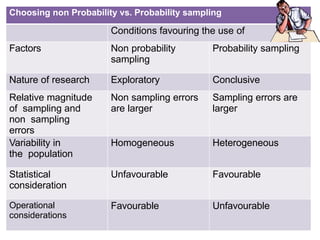
Choosing non Probability vs. Probability sampling
Conditions favouring the use of
Factors Non probability
sampling
Probability sampling
Nature of research Exploratory Conclusive
Relative magnitude
of sampling and
non sampling
errors
Non sampling errors
are larger
Sampling errors are
larger
Variability in
the population
Homogeneous Heterogeneous
Statistical
consideration
Unfavourable Favourable
Operational
considerations
Favourable Unfavourable
SAMPLING IN
QUALITATIVE
RESEARCH
Researchers in qualitative research select
their participants according to their :
1) Characteristics
2) Knowledge
The purposeful sampling
It is when the researcher chooses persons or
sites which provide specific knowledge about the
topic of the study.
1) Maximal Variation
Sampling
2) Typical Sampling
3) Theory or Concept
Sampling
4) Homogeneous Sampling
5) Critical Sampling
6) Opportunistic Sampling
7) Snowball Sampling
It is when you select individuals that differ on a
certain characteristic. In this strategy you should first
identify the characteristic and then find individuals or
sites which display that characteristic.
1. Maximal Variation Sampling
It is when you study a person or a site that is “typical” to
those unfamiliar with the situation. You can select a typical
sample by collecting demographic data or survey data
about all cases.
2. Typical Sampling
It is when you select individuals or sites because they
can help you to generate a theory or specific concepts
within the theory. In this strategy you need a full
understanding of the concept or the theory expected to
discover during the study.
3. Theory or Concept Sampling
4. Homogeneous Sampling
It is when you select certain sites or people because they
possess similar characteristics. In this strategy, you need
to identify the characteristics and find individuals or sites
that possess it.
It is when you study an exceptional case
represents the central phenomenon in
dramatic terms.
5. Critical Sampling
It is used after data collection begins, when you may find
that you need to collect new information to answer your
research questions.
6. Opportunistic Sampling
Snowball Sampling
It is when you don't know the best people to study
because of the unfamiliarity of the topic or the
complexity of events. So you ask participants during
interviews to suggest other individuals to be sampled.
PROBLEMS OF SAMPLING
Sampling errors
Lack of sample representativeness
Difficulty in estimation of sample size
Lack of knowledge about the sampling process
Lack of resources
Lack of cooperation
Lack of existing appropriate sampling frames for larger
population
Errors
Sampling
Errors
Biased
errors
Unbiased
errors
Non Sampling
Errors
SAMPLING ERROR
It is the deviation of the selected sample from the
true characteristics, traits, behaviours, qualities or
figures of the entire population.
CAUSES OF SAMPLING ERROR
Individual difference of subjects: Researchers
draw different subjects from the same population but
still the subjects have individual difference. A sample
is only, a subset of the entire population. Therefore,
there may be a difference between the sample and the
population.
Biased sampling procedure:It is a tendency to
favour a selection of sample units that posses a
particular characteristics. It may occur in the form of
over and under-representation bias.
Chance error :
The error occurs by chance. e.g. – Someone did a
comparative study on mal-nutrition on under five children in
two cities A and B. Unfortunately if city B had a large
number of slum dwellers, so, this will comprise a large
number of mal-nourished children than city-A which is going
to give a skewed result.
A process of randomization and probability sampling is
done to minimize such kind of sampling errors but it is still
possible that all the randomized subjects are not the
representative of the population
CONT…
Difficulty in estimation of sample size:
There is lack of availability of population parameters; in the
absence of population parameters it becomes very difficult
to estimate the sample size. Studies conducted on
undetermined sample size do not facilitate to generalize
the findings for the particular population.
Lack of knowledge about the sampling
process
If the researcher is having superficial knowledge about the
sampling methods and sampling process then this will lead
to poor selection and ultimately affects the study results
Lack of re-sources
Resource allocation for nursing research studies are very
poor in developing country like India. So in the absence of
appropriate resources drawing a good representative
sample is very difficult and biased too
Lack of cooperation
Sometimes study subjects are not co-operative with
researcher and after selection of samples by means of
simple random sampling they are not willing to participate
in the study, at this time, then it will create a problem for the
researcher in sampling.
OVER-COMING STRATEGIES
There is only one way to eliminate this kind of error...that ,
to eliminate the concepts of sample and to test the entire
population, which is really not possible, so, one has to
adapt then... a following strategies for overcoming these
types of problems...these are –
Use of proper and un-biased probability sampling
Avoid convenient or judgmental sampling.
Ensure that the target population is well defined and the
sample frame should match it as much as possible
.
Increasing the size of sample.
Inclusion and exclusion criteria
Increasing the size of sample :
SAMPLING
ERROR
SAMPLING
ERROR
sampl
e
sampl
e
NON SAMPLING ERRORS
A non-sampling error is a statistical term that
refers to an error that results during data
collection, causing the data to differ from the true
values. A non-sampling error differs from a
sampling error. In general, the sampling errors
decrease as the sample size increases, whereas
non-sampling error increases as the sample size
increases.
CAUSES
i) Lack of trained and qualified investigators
ii) Due to wrong answers to the questions
iii) Due to incomplete coverage
iv) Biasness of the investigators
v) Vague questionnaire
vi) Faulty list of population
vii) Wrong method of asking questions
viii) Wrong calculations while processing the data
ix) Failure of respondent memory to recall past
events
x)Error while printing the results
SUMMARY
Sampling enables the selection of right data
points from within the larger data set to estimate
the characteristics of the whole population.
Sampling helps a lot in research. It is one of the
most important factors which determines the
accuracy of your research/survey result. If
anything goes wrong with your sample then it will
be directly reflected in the final result.
 Creswell, J., W. (2012) Educational research: Planning,
Conducting, and Evaluating Quantitative and Qualitative
Research, 4th ed.
 Patton, M.Q. (2002). Qualitative Research and
Evaluation Methods. Thousand Oaks, CA: Sage.

20 APR_NR_ Sampling techniques_Part II.pptx

  • 1.
    M.Sc POST GRADUATEDEGREE IN NURSING Nursing Research and Statistics Unit -VI SAMPLING Sampling techniques Prof Mrs.G. Sivagami
  • 2.
    Objectives Define sampling Explain population Understandmethods of quantitative sampling Discuss methods of qualitative sampling List down the problems of sampling Discuss on sampling error
  • 3.
    INTRODUCTION Sampling is aprocess of selecting representative units from an entire population of a study. It is not always possible to study an entire population; therefore, the researcher draws a representative part of a population through sampling process. In other words, sampling is the selection of some part of an aggregate or a whole on the basis of which judgments or inferences about the aggregate or mass is made.
  • 4.
    Population is definedas the entire mass of observation, which is the parent group from which a sample is to be formed. Sample is defined as the aggregate of objects, person or elements, selected from the universe.
  • 5.
    Sampling- The methodof taking the sample is known as sampling.
  • 6.
  • 7.
     Important Terminologies ◦Representation – the extent to which the sample is representative of the population ◦ Generalization – the extent to which the results of the study can be reasonably extended from the sample to the population ◦ Sampling error The chance of occurrence that a randomly selected sample is not representative of the population due to errors inherent in the sampling technique
  • 8.
     Important terminologies(continued) ◦ Sampling bias  It is a bias in which a sample is collected in such a way that some members of the intended population have a lower sampling probability than others. ◦ Three fundamental steps in quantitative sampling  Identify a population  Define the sample size  Select the sample
  • 9.
  • 10.
    Probability sampling • Everyunit of the population has an equal chance of being selected for the sample. Non probability sampling • Sampling techniques one cannot estimate beforehand the chance of each element being included in the sample.
  • 11.
    A. Simple randomsampling B. Stratified random sampling C. Systematic sampling D. Cluster sampling E. Multi-stage sampling Probability sampling
  • 12.
    A. Simple Randomsampling is applied when the method of selection assures each individual element in the universe an equal chance of being chosen.
  • 13.
    Random numbers oftable 6 8 4 2 5 7 9 5 4 1 2 5 6 3 2 1 4 0 5 8 2 0 3 2 1 5 4 7 8 5 9 6 2 0 2 4 3 6 2 3 3 3 2 5 4 7 8 9 1 2 0 3 2 5 9 8 5 2 6 3 0 1 7 4 2 4 5 0 3 6
  • 14.
  • 15.
    Types of SimpleRandom Sample With Replacement The unit once selected has the chance for again selection Without Replacement The unit once selected can not be selected again
  • 16.
  • 17.
    Method of TheLottery • Lottery is one of the oldest methods and is a mechanical example of random sampling. • In this method, each member of the population has to be numbered systematically and in a consequent manner by writing each number on a separate piece of paper. • These pieces of paper are mixed and put into a box and then numbers are drawn out of the box in a random manner.
  • 18.
  • 19.
  • 20.
    B. Stratified sampling- When the population is divided into different strata then samples are selected from each stratum by simple random sampling or by regular interval method we call it as stratified random sampling method.
  • 22.
    Advantages • Comparing sub- categories •Saves time, money and energy • Can represent various group
  • 23.
    Requires more efforts Needs alarger sample size Strata are overlapping, chances of bias
  • 24.
  • 25.
    Disproportionate stratification Disproportionate stratificationis a type of stratified sampling. With disproportionate stratification, the sample size of each stratum does not have to be proportionate to the population size of the stratum. This means that two or more strata will have different sampling fractions.
  • 26.
    For example, In disproportionatestratified random sampling, the different strata do not have the same sampling fractions as each other. For instance, if your four strata contain 200, 400, 600, and 800 people, you may choose to have different sampling fractions for each stratum. Perhaps the first stratum with 200 people has a sampling fraction of ½, resulting in 100 people selected for the sample, while the last stratum with 800 people has a sampling fraction of ¼, resulting in 200 people selected for the sample
  • 27.
    Proportionate Stratified RandomSample In proportional stratified random sampling, the size of each stratum is proportionate to the population size of the strata when examined across the entire population. This means that each stratum has the same sampling fraction.
  • 28.
    For example, let’ssay you have four strata with population sizes of 200, 400, 600, and 800. If you choose a sampling fraction of ½, this means you must randomly sample 100, 200, 300, and 400 subjects from each stratum respectively. The same sampling fraction is used for each stratum regardless of the differences in population size of the strata.
  • 29.
    C. Systemic sampling Thissampling is obtaining a collection of elements by drawing every nth person after that; n is a number termed as sampling interval.
  • 30.
    C. Systemic sampling Itcan be likened to an arithmetic progression, wherein the difference between any two consecutive numbers is the same. It involves the selection of every Kth case from list of group, such as every 10th person on a patient list or every 100th person from a phone directory. Systematic sampling is sometimes used to sample every Kth person entering a bookstore, or passing down the street or leaving a hospital & so forth.
  • 31.
    C. Systemic sampling Ifwe had a list of subjects or sampling frame, the following procedure could be adopted. The desired sample size is established at some number (n) & the size of population must know or estimated (N). K = N/n Size of sample For example, a researcher wants to choose about 100 subjects from a total target population of 500 people. Therefore, 500/100=5. Therefore, every 5thperson will be selected.
  • 32.
    Advantages •Easy to use Disadvantages •Overrepresentation of several groups is greater.
  • 33.
    D. Cluster Sampling- Thewhole population is surveyed and such areas are located wherein elements are seen clustering themselves and sample is selected from such clusters and they reflect all characteristics of the Universe.
  • 35.
    Section 4 Section 5 Section3 Cluster sampling Section 2 Section 1
  • 36.
    Advantage • Low cost/highfrequency of use • Requires list of all clusters, but only of individuals within chosen clusters • Can estimate characteristics of both cluster and population • For multistage, has strengths of used methods • Researchers lack a good sampling frame for a dispersed population • Easier to apply larger Geographical area
  • 37.
    Disadvantage s Not good representativeof the population Sampling error Same individual can belong to two clusters and studied twice
  • 38.
    D. Multi stagesampling Sample is selected in various stages but only last sample is studied.
  • 39.
    Multistage sampling refersto sampling plans where the sampling is carried out in stages using smaller and smaller sampling units at each stage. Not all Secondary Units Sampled normally used to overcome problems associated with a geographically dispersed population Multistage Random Sampling
  • 40.
  • 41.
    Advantages •Good representative ofpopulation •Improvement of other sampling methods Disadvantages •Difficult and complex method
  • 42.
    A. Incidental/ Accidentalsampling B. Convenience sampling C. Purposive sampling D.Quota sampling Non Probability Sampling
  • 43.
    A. Incidental orAccidental sampling means selecting the units on basis of easy approaches.
  • 44.
    Advantages • Easy andquick results • Saves time, money and energy Disadvantages • Not representative of population • Cannot produce reliable results
  • 45.
    B. Convenience method,the investigator selects certain items are to his convenience. No pre planning is necessary for the selection of items.
  • 46.
    disadvantages • Biased data •Not representative population Advantages • Easy method • Economical
  • 47.
    C. Purposive sampling-The selection of elements is based upon the judgement of the researcher, the purposive sampling is called judgement sample
  • 48.
    Advantage • Control onvariable Disadvantage •Reliability of criterion is questionable
  • 49.
    D. Quota sampling:-Inthe quota sampling the interviewers are instructed to interview a specified number of persons from each category.
  • 50.
    • Practical • Economical Advantages •Not true representative • Not free from error disadvantages
  • 51.
    Technique Strength Weakness Probability SimpleRandom Sampling Easily understood, results projectable Expensive, assurance of representative Stratified sampling Includes all important sub populations Expensive, Difficult to select relevant stratification variables Systemic sampling Increases representativenes Can decrease representative ness Cluster sampling Easy to implement, cost effective Difficult to interpret results Non probability Convenience sampling Least expensive, least time consuming. Quota sampling Sample can be controlled for certain characteristics Bias, no assurance of representativeness
  • 52.
    Choosing non Probabilityvs. Probability sampling Conditions favouring the use of Factors Non probability sampling Probability sampling Nature of research Exploratory Conclusive Relative magnitude of sampling and non sampling errors Non sampling errors are larger Sampling errors are larger Variability in the population Homogeneous Heterogeneous Statistical consideration Unfavourable Favourable Operational considerations Favourable Unfavourable
  • 53.
  • 54.
    Researchers in qualitativeresearch select their participants according to their : 1) Characteristics 2) Knowledge
  • 55.
    The purposeful sampling Itis when the researcher chooses persons or sites which provide specific knowledge about the topic of the study.
  • 56.
    1) Maximal Variation Sampling 2)Typical Sampling 3) Theory or Concept Sampling 4) Homogeneous Sampling 5) Critical Sampling 6) Opportunistic Sampling 7) Snowball Sampling
  • 57.
    It is whenyou select individuals that differ on a certain characteristic. In this strategy you should first identify the characteristic and then find individuals or sites which display that characteristic. 1. Maximal Variation Sampling
  • 58.
    It is whenyou study a person or a site that is “typical” to those unfamiliar with the situation. You can select a typical sample by collecting demographic data or survey data about all cases. 2. Typical Sampling
  • 59.
    It is whenyou select individuals or sites because they can help you to generate a theory or specific concepts within the theory. In this strategy you need a full understanding of the concept or the theory expected to discover during the study. 3. Theory or Concept Sampling
  • 60.
    4. Homogeneous Sampling Itis when you select certain sites or people because they possess similar characteristics. In this strategy, you need to identify the characteristics and find individuals or sites that possess it.
  • 61.
    It is whenyou study an exceptional case represents the central phenomenon in dramatic terms. 5. Critical Sampling
  • 62.
    It is usedafter data collection begins, when you may find that you need to collect new information to answer your research questions. 6. Opportunistic Sampling
  • 63.
    Snowball Sampling It iswhen you don't know the best people to study because of the unfamiliarity of the topic or the complexity of events. So you ask participants during interviews to suggest other individuals to be sampled.
  • 64.
    PROBLEMS OF SAMPLING Samplingerrors Lack of sample representativeness Difficulty in estimation of sample size Lack of knowledge about the sampling process Lack of resources Lack of cooperation Lack of existing appropriate sampling frames for larger population
  • 65.
  • 66.
    SAMPLING ERROR It isthe deviation of the selected sample from the true characteristics, traits, behaviours, qualities or figures of the entire population.
  • 67.
    CAUSES OF SAMPLINGERROR Individual difference of subjects: Researchers draw different subjects from the same population but still the subjects have individual difference. A sample is only, a subset of the entire population. Therefore, there may be a difference between the sample and the population. Biased sampling procedure:It is a tendency to favour a selection of sample units that posses a particular characteristics. It may occur in the form of over and under-representation bias.
  • 68.
    Chance error : Theerror occurs by chance. e.g. – Someone did a comparative study on mal-nutrition on under five children in two cities A and B. Unfortunately if city B had a large number of slum dwellers, so, this will comprise a large number of mal-nourished children than city-A which is going to give a skewed result. A process of randomization and probability sampling is done to minimize such kind of sampling errors but it is still possible that all the randomized subjects are not the representative of the population CONT…
  • 69.
    Difficulty in estimationof sample size: There is lack of availability of population parameters; in the absence of population parameters it becomes very difficult to estimate the sample size. Studies conducted on undetermined sample size do not facilitate to generalize the findings for the particular population. Lack of knowledge about the sampling process If the researcher is having superficial knowledge about the sampling methods and sampling process then this will lead to poor selection and ultimately affects the study results
  • 70.
    Lack of re-sources Resourceallocation for nursing research studies are very poor in developing country like India. So in the absence of appropriate resources drawing a good representative sample is very difficult and biased too Lack of cooperation Sometimes study subjects are not co-operative with researcher and after selection of samples by means of simple random sampling they are not willing to participate in the study, at this time, then it will create a problem for the researcher in sampling.
  • 71.
    OVER-COMING STRATEGIES There isonly one way to eliminate this kind of error...that , to eliminate the concepts of sample and to test the entire population, which is really not possible, so, one has to adapt then... a following strategies for overcoming these types of problems...these are – Use of proper and un-biased probability sampling Avoid convenient or judgmental sampling. Ensure that the target population is well defined and the sample frame should match it as much as possible . Increasing the size of sample. Inclusion and exclusion criteria
  • 72.
    Increasing the sizeof sample : SAMPLING ERROR SAMPLING ERROR sampl e sampl e
  • 73.
    NON SAMPLING ERRORS Anon-sampling error is a statistical term that refers to an error that results during data collection, causing the data to differ from the true values. A non-sampling error differs from a sampling error. In general, the sampling errors decrease as the sample size increases, whereas non-sampling error increases as the sample size increases.
  • 74.
    CAUSES i) Lack oftrained and qualified investigators ii) Due to wrong answers to the questions iii) Due to incomplete coverage iv) Biasness of the investigators v) Vague questionnaire vi) Faulty list of population vii) Wrong method of asking questions viii) Wrong calculations while processing the data ix) Failure of respondent memory to recall past events x)Error while printing the results
  • 75.
    SUMMARY Sampling enables theselection of right data points from within the larger data set to estimate the characteristics of the whole population. Sampling helps a lot in research. It is one of the most important factors which determines the accuracy of your research/survey result. If anything goes wrong with your sample then it will be directly reflected in the final result.
  • 76.
     Creswell, J.,W. (2012) Educational research: Planning, Conducting, and Evaluating Quantitative and Qualitative Research, 4th ed.  Patton, M.Q. (2002). Qualitative Research and Evaluation Methods. Thousand Oaks, CA: Sage.