POPULATION/SAMPLE
In research, aproblem relates to the estimation of certain characteristics of
‘’universe’’ or ‘’population’’
A selected portion of the universe is called ‘’sampling’’.
The sample is a miniature replica of population
3.
POPULATION IN RESEARCH
Aresearch population is generally a large collection of individuals or
objects that is the main focus of a scientific query.
It is for the benefit of the population that researches are done. However,
due to the large sizes of populations, researchers often cannot test every
individual in the population because it is too expensive and time-
consuming.
This is the reason why researchers rely on sampling techniques.
4.
WHAT IS ASAMPLE?
A sample is a subset of the population.
The concept of sample arises from the inability of the researchers to test all the
individuals in a given population.
The sample must be representative of the population from which it was drawn
and it must have good size to undergo statistical analysis.
5.
WHAT IS ASAMPLING?
The idea of sampling was first given by A. L. Bowley
Therefore it is understood, that to study any problem, it is difficult to study the
entire population, as most educational phenomena consists of a large number of
units.
At times, populations are so large that ,that the study would be expensive in terms
of money, time effort and manpower.
Thus, the representative proportion of the population is called a sample.
6.
SO,
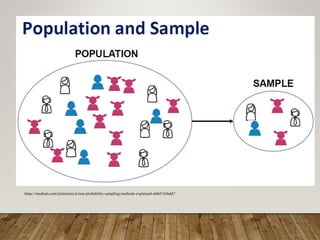
The Population:
A “population”consists of all the subjects you want to study. A
population comprises all the possible cases (persons, objects,
events) that constitute a known whole.
Sampling
• Sampling is the process of selecting a group of subjects for a study
in such a way that the individuals represent the group from which
they were selected.
• This representative portion of a population is called a sample.
PROBABILITY SAMPLING
In probabilitysampling ,the units of population are not selected by the of the
researcher, It is already there.
There are certain procedures which ensures that every unit of population has a
chance of being included in the sample.
9.
PROBABILITY SAMPLING
Characteristics:
• Theprocess of sampling is automatic.
• Each unit in the sampling has some known probability of entering the sample.
• Different methods are adopted in selecting a probability sample,All has its
own advantages and disadvantages.
RANDOM SAMPLING
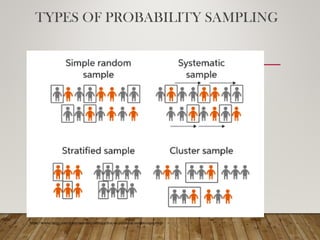
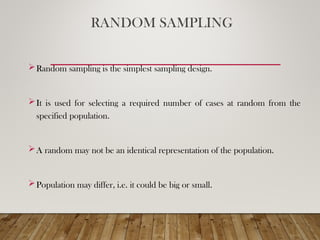
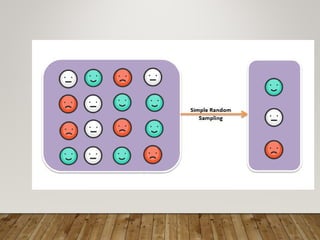
Random samplingis the simplest sampling design.
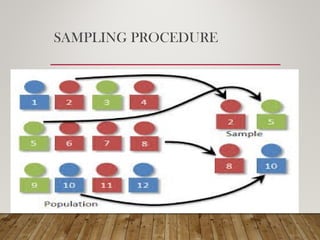
It is used for selecting a required number of cases at random from the
specified population.
A random may not be an identical representation of the population.
Population may differ, i.e. it could be big or small.
RANDOM SAMPLING
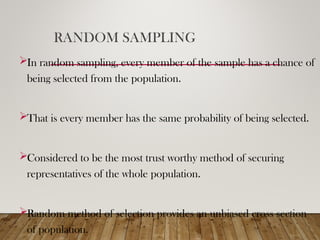
In randomsampling, every member of the sample has a chance of
being selected from the population.
That is every member has the same probability of being selected.
Considered to be the most trust worthy method of securing
representatives of the whole population.
Random method of selection provides an unbiased cross section
of population.
16.
RANDOM SAMPLING
Simple randomsampling :
A simple random sample is a fair sampling technique with no biasing. It involves a large
frame of samples.
The researcher need not have prior knowledge about the data being collected. It involves
no restriction on the sample size. As more samples are involved, the more is the quality
of the data.
Methods:
Lottery method, Fish bowl, Rotatory drum, Tippette
number etc.
In small group, a coin may be flipped to select .
17.
RANDOM SAMPLING
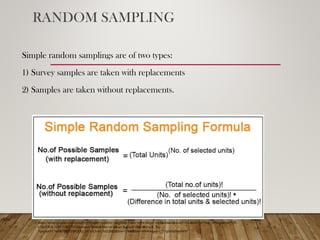
Simple randomsamplings are of two types:
1) Survey samples are taken with replacements
2) Samples are taken without replacements.
https://www.google.com/search?q=Simple+random+sampling+with+or+without+replacement&sxsrf=ALeKk01pI1Nep_D3mgcdypd9QX-
n7hQOEA:1628715617018&source=lnms&tbm=isch&sa=X&ved=2ahUKEwjR_Kq-
7qnyAhVCbn0KHWHZBUUQ_AUoA3oECAEQBQ&biw=1366&bih=600#imgrc=r_T5g0ebpN60MM
18.
RANDOM SAMPLING
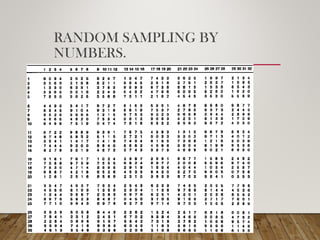
The bestmethod is to employ a table of random numbers, such
as those prepared by Fisher and Yates, Tippett or Kendall and
Babington – Smith.
This can be done by assigning the consecutive numbers in any
direction eg., horizontally, vertically and diagonally.
In some instances a sample may be a multi-stage process i.e.,
randomization may be performed at several stages of selection
until the final desired grouping is obtained.
ADVANTAGES OF RANDOMSAMPLING
• Requires a minimum knowledge.
• Free of errors.
• Appropriate for data analysis which includes use of inferential
statistic.
• Free from bias.
• Method is simple.
• Gives more representation of the population.
• It is easy to form groups.
• Easily apply findings to the entire population.
21.
• Carries largererrors of the sample size.
• If units are widely dispersed, the selection of sample becomes impossible.
• If units are heterogeneous in nature that is of different size, random sampling
would not be applicable.
• A sample size that is too large, or too small, creates problems with the survey.
• No additional knowledge is given consideration, like the researcher’s personal
bias.
• It is generally time-consuming.
• When individuals are in groups, the results of research can get distorted, as
their answers tend to be influenced by the answers given by others.
• This sampling adds monetary cost for the research process when compared
to other data collection methods.
• There is no guarantee that this survey will be accepted universally.
Disadvantages of Random sampling
22.
SYSTEMATIC SAMPLING
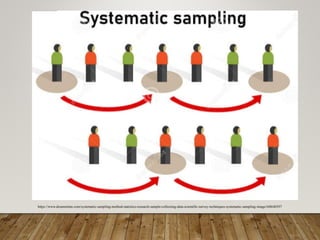
• Systematicsampling is commonly used to guarantee complete coverage of an
area or time. It always has a random start with subsequent sample units
located at a set interval.
• In this type of sampling method, a researcher makes a list of potential
samples, then chooses a random point to select the subject in the sampling
frame.
23.
SYSTEMATIC SAMPLING
• Itis a variation of simple random technique.
• When a frame of population is available, or when a population is
accurately listed and is finite, a method of systematic sampling is used.
• A systematic selection will provide a sample which approximates a
random sample.
• In systematic sampling, a researcher starts with a list in which all the N
units of population are listed in alphabetical or some other order.
24.
SYSTEMATIC SAMPLING
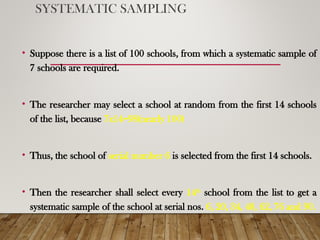
• Supposethere is a list of 100 schools, from which a systematic sample of
7 schools are required.
• The researcher may select a school at random from the first 14 schools
of the list, because 7x14=98(nearly 100)
• Thus, the school of serial number 6 is selected from the first 14 schools.
• Then the researcher shall select every 14th
school from the list to get a
systematic sample of the school at serial nos. 6, 20, 34, 48, 62, 76 and 90.
SYSTEMATIC SAMPLING
• Thismethod gives a sample which is more like random sampling, but
here, it is systematic and more convenient to draw.
• Systematic sampling provides a more even spread of members of the
sample over the population. This fact leads to greater accuracy.
• In random sampling, the selection of each member is independent of
the selection of other members, which is not so in systematic sampling.
• Systematic sampling is easier and speedier to draw than random sample.
27.
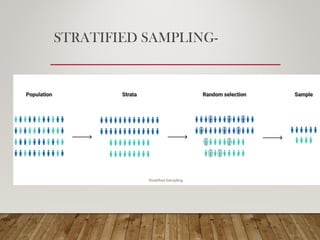
STRATIFIED SAMPLING
Itmeans it gives a type of a control as means of increasing precision and
representativeness.
A stratified random sample is, in effect a weighted combination of random sub-
samples joined to give an overall sample value.
The population is divided into smaller homogeneous groups or strata by some
characteristics, and each of these smaller homogeneous groups ,draws at
random predetermined number of units.
The usual stratification factors are:
gender, age, socio-economic status, educational background, residence,
(urban/rural), occupation, political party affiliation, religion and race etc.
PROCESS OF STRATIFYING
Different variables involved in the study of the problem may be noted.
The size of each stratum in the universe should be large enough to provide selection of
units on random basis.
There should be maximum homogeneity in the different units of strata.
The units should differ significantly from stratum to stratum.
Stratum should be clear cut and free from overlapping.
The number of units selected from each stratum are in the same ratio as the total number of
units in the stratum.
30.
KINDS OF STRATIFIEDSAMPLE
Proportional stratified sampling:
The number of units to be drawn from each stratum is in the same proportion as
they stand in the universe.
Disproportionate stratified sampling:
An equal number of cases are taken from each stratum regardless of the size of
strata in proportion to universe.
31.
ADVANTAGES
• In randomsample although every unit has an equal chance
of being selected, sometimes important units are left out by
chance, but, under stratified sampling, no significant group
can remain unrepresented.
• Replacement of a unit can be done conveniently if the
originally selected case is inaccessible. E.g.., If a person
refuses to co-operate with the survey, he can easily
substitute by another unit from the same stratum.
32.
DISADVANTAGES
Bias maybe caused in the sample through improper stratification, owing
to over lapping in the strata or disproportionate selection.
When the size of different strata are unequal attainment of correct
proportion becomes difficult.
Lack of accurate information may lead to faulty classification.
The task of stratified sampling is not easy, placing variables in the proper
and right strata is not an easy task. It depends on the understanding and
knowledge of the investigator
33.
CLUSTER SAMPLING
• Clustersampling is a design in which the sample consists of multiple cases, e.g-a school
population, family, classroom, city, system etc.
• It is a variation of a simple random sample,(particularly appropriate when the population
to be studied is infinite i.e when the geographic distribution of individuals is widely
scattered )
• It is also known as area sampling, when the selection of individuals is made on the basis
of place of residence or employment.
• This sampling is done at various levels until they arrive at an individual value. For
example, in geographical groups, a village can be a cluster.
• Some authors also call it multi-stage sampling.
34.
EXAMPLE:
In a sampleof primary school children, instead of listing all the primary school
children in a city, a researcher lists all primary schools in a city, selects at random
20% of these clusters of units. He either uses all the children in the selected
schools or selects a sample of children randomly within these schools.
In cluster sampling ,stages are possible, such sampling is also called multi-stage
sampling.
This method is applied when the area to be covered is very wide ,and it is not
possible to study the whole population at one stage.
Cluster sampling is independent of the other kinds and classification of sampling
designs. It is very close to a stratified sampling design.
35.
EXAMPLE:
• Suppose ,forthe purpose of a national survey, researcher wants to
select a sample from all secondary school teachers in India.
• So, from all the states a sample of 5 states are selected randomly
from the northern, southern, western, eastern and central zone.
• Now, from all the 5 states, all the districts are listed.
• A random sample of 50 districts are selected. From the 50 districts all
the secondary schools are listed and a random of 100 schools are
selected. now, from the 100 schools we can easily get the list of all the
teachers, from which a random sample of 700 teachers are selected.
• The successive random sampling of --
states>> districts>> schools>> teachers constitute multi stage sampling.
36.
ADVANTAGES
• It permitseasy accumulation of large samples.
• More information obtained concerning one or more areas.
• Easier and economical.(observing clusters of units in fewer
schools are easier ,than randomly selected students scattered in
many schools.)
• used when an individual sample is not available.
37.
DISADVANTAGES
• May producea larger sampling error.
• Sample bias because of unequal size of some of the sub-sets.
• An overlapping effect may take place in this sampling.


![sampling[1].pptx](https://cdn.slidesharecdn.com/ss_thumbnails/sampling1-220819060046-600e7719-thumbnail.jpg?width=640&height=640&fit=bounds)


![Sample_Designs[1] (1).pptx presentation on education](https://cdn.slidesharecdn.com/ss_thumbnails/sampledesigns11-250706184217-c590a99a-thumbnail.jpg?width=640&height=640&fit=bounds)


