NEW VEHICLE
SAFETY
SYSTEMS
New Vehicle
Safety Systems

OVERVIEW
VEHICLE AIRBAG
ENERGY ABSORBING BUMBERS
ROLL BARS/CAGES
ROLL OVER PROTECTION SYSTEM
New Vehicle
Safety Systems

Undeployed Airbags
New Vehicle
Safety Systems

VEHICLE AIRBAG
A) Deployed airbag is usually safe
1. Dust residue from deployed airbags
can be hazardous if it contacts the
skin or is inhaled
a) Use appropriate personal
protective equipment
New Vehicle
Safety Systems

VEHICLE AIRBAG
B) Types of airbag systems
1.Supplemental Restraint Systems
(SRS)
2.Side Impact Protection Systems
(SIPS)
3.Head Protection Systems (HPS)
4.Knee bolsters
5.Seat belt pretentioners
New Vehicle
Safety Systems

VEHICLE AIRBAG
C) Undeployed airbags

1.Steering wheel
2.Inflatable tube/side airbags
3.Window curtain
4.1998 and newer vehicles can
have 1-14 airbags
New Vehicle
Safety Systems

VEHICLE AIRBAG
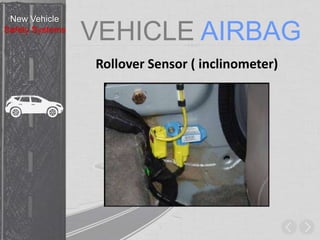
Rollover Sensor ( inclinometer)
New Vehicle
Safety Systems

VEHICLE AIRBAG
Rollover Sensor ( inclinometer)
• Designed to measure the lateral and
vertical acceleration, vehicle speed
and roll rate to predict an impending
rollover
• When the sensors detect a potential
rollover, the control module triggers
the curtain airbags and seat belt pretensioners
New Vehicle
Safety Systems

VEHICLE AIRBAG
New Style Curtain Airbag
• These sensors work in conjunction
with a new style curtain airbag
New Vehicle
Safety Systems

VEHICLE AIRBAG
New Style Curtain Airbag
• "Safety Canopy" airbags
• In SUV’s 3rd Row Seating
• Tethers located on the bottom corners
of the bag, lock them in place to
prevent occupants from being ejected.
New Vehicle
Safety Systems

VEHICLE AIRBAG
Safety Canopy Extrication Safety
• During cutting operations, rescuers
should be aware that with the addition
of the third row section, they may find
two compressed gas inflaters on both
sides of the roof rail instead of one
• These must be visually exposed before
cutting operations begin
New Vehicle
Safety Systems

VEHICLE AIRBAG
Safety Canopy Concerns:
• These airbags have a controlled
deployment speed and may deploy
much faster than other airbags. The
deployment zone is from the roof rail
to the bottom of the window, the full
length of the vehicle and the bag is
about 5 inches thick
New Vehicle
Safety Systems

VEHICLE AIRBAG
Safety Canopy Concerns:
• Never lean through the window when
approaching the vehicle.
• These deploy straight down about 18
inches, or to the bottom of the
window and are capable of snapping a
person's neck
New Vehicle
Safety Systems

VEHICLE AIRBAG
Safety Canopy Concerns:
New Vehicle
Safety Systems

Types of Airbags

KEY CONCEPTS:

LOCATIONS

DISTANCE

SAFETY

PLACEMENT
New Vehicle
Safety Systems

VEHICLE AIRBAG
D) Disabling the airbag
1. Disconnect battery
2. Some models stay active for up to 30
minutes after power is disconnected
New Vehicle
Safety Systems

IMAGE GALLERY
New Vehicle
Safety Systems

IMAGE GALLERY
New Vehicle
Safety Systems

ENERGY ABSORBING
BUMPERS

1. 1974 and newer
2. Avoid direct contact in front or back of vehicle if on fire
New Vehicle
Safety Systems

ENERGY ABSORBING
BUMPERS
New Vehicle
Safety Systems

ENERGY ABSORBING
BUMPERS
New Vehicle
Safety Systems

ENERGY ABSORBING
BUMPERS

Extrication Safety:
Approach front and rear
bumpers at a 45 O angle
New Vehicle
Safety Systems

ROLLOVER
PROTECTION SYSTEM
“Roll Over Protection System (ROPS)” refers to
operator compartment structures (usually cabs or
frames) intended to protect equipment operators and
motorists from injuries caused by vehicle overturns or
rollovers

Backup power supply – In case main power shuts off
Remote Batteries in some vehicles
Safety:
Manual Deployment: Usually on the dash
Takes approximately 4 seconds
Personnel can now safely work and hold C-Spine
New Vehicle
Safety Systems

ROLLOVER
PROTECTION SYSTEM
New Vehicle
Safety Systems

ROLLOVER
PROTECTION SYSTEM

History
One of the earliest ROPS
systems was introduced
by Mercedes in 1986.
New Vehicle
Safety Systems

ROLLOVER
PROTECTION SYSTEM

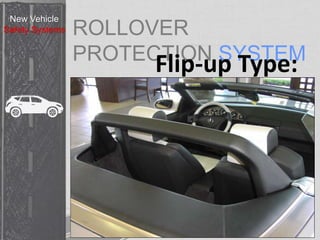
2 Types:
1. Flip-up type
2. Pop-up type
New Vehicle
Safety Systems

ROLLOVER
PROTECTION SYSTEM

Deployment:
1. Hydraulic
2. Spring Loaded
New Vehicle
Safety Systems

ROLLOVER
PROTECTION SYSTEM

Actuator:
1. Inclinometer used to
sense vehicle inclination
and lateral acceleration
2. G-sensor that detects
vehicle weightlessness if
the vehicle becomes
airborne
New Vehicle
Safety Systems

ROLLOVER
PROTECTION SYSTEM

Actuator:
Sensors send information
to a control module the
same as SRS senors do
New Vehicle
Safety Systems

ROLLOVER
PROTECTION SYSTEM

Actuator Limitations:
• When the vehicle approaches a lateral angle limit of 62
degrees.
• When the vehicle experiences a lateral acceleration of
approximately 3 Gs.
• When the vehicle approaches it's longitudinal angle
limit at approximately 72 degrees.
• When a combination of longitudinal acceleration and
longitudinal angle would cause the vehicle to roll over in
the forward direction.
• When the vehicle becomes airborne and achieves
weightlessness for at least 80ms.
New Vehicle
Safety Systems

ROLLOVER
PROTECTION SYSTEM

31
New Vehicle
Safety Systems

ROLLOVER
PROTECTION SYSTEM

Flip-up Type:
•
•

Deployable rollbars are concealed
until activated.
Flip up in less than three tenths of
a second, much the same as a
deploying airbag
Example: Mercedes two seat
roadster
New Vehicle
Safety Systems

ROLLOVER
PROTECTION SYSTEM

Flip-up Type:
New Vehicle
Safety Systems

ROLLOVER
PROTECTION SYSTEM

Deployment:
•
•

Deployable rollbars are concealed
until activated.
Flip up in less than three tenths of
a second, much the same as a
deploying airbag
Example: Mercedes two seat
roadster
New Vehicle
Safety Systems

ROLLOVER
PROTECTION SYSTEM

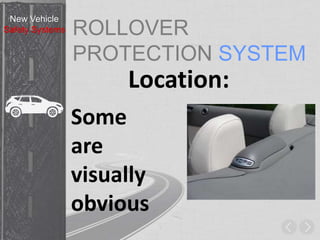
Location:
Some
are
visually
obvious
New Vehicle
Safety Systems

ROLLOVER
PROTECTION SYSTEM

Location:
Others popup through
holes
behind the
rear head
rest.
New Vehicle
Safety Systems

ROLLOVER
PROTECTION SYSTEM
New Vehicle
Safety Systems

ROLLOVER
PROTECTION SYSTEM

Extrication Safety:
The control module is just like the
ones used with SRS systems.
They contain capacitors that supply
power to the system in case the
battery is destroyed in the crash.
The average capacitor drain time is 10
seconds.
New Vehicle
Safety Systems

ROLLOVER
PROTECTION SYSTEM
New Vehicle
Safety Systems

ROLLOVER
PROTECTION SYSTEM

Extrication Safety:
EMS personnel should never lean
over the back of a convertible as in
holding C-Spine on an occupant. This
would put the rescuer's head right
over the undeployed roll-bar
New Vehicle
Safety Systems

ROLLOVER
PROTECTION SYSTEM

Extrication Safety:
Rescuers must stay out of the
deployment zone in these cases. The
deployment zone is 20 inches straight
up from the bars
New Vehicle
Safety Systems

ROLLOVER
PROTECTION SYSTEM
New Vehicle
Safety Systems

ROLLOVER
PROTECTION SYSTEM
New Vehicle
Safety Systems

IT’S BEEN

Safety restraint systems

Editor's Notes

  • #5 PPE- Turnouts, gloves, eye protection
  • #17 How long can some airbag systems stay active after the power is disconnected?
  • #20 How long can some airbag systems stay active after the power is disconnected?
  • #25 High strength low alloyUnibody FramesCrumple ZonesGlass “High Penetration Resistant” glass--- Plastic Laminated between two pieces of glass
  • #38 High strength low alloyUnibody FramesCrumple ZonesGlass “High Penetration Resistant” glass--- Plastic Laminated between two pieces of glass