Seat Design
for Driver Satisfaction
            Mac Reynolds, Ph.D.
Professor Emeritus, Michigan State University
               CEO, ERL LLC
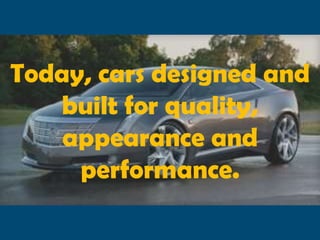
Today, cars designed and
   built for quality,
    appearance and
     performance.
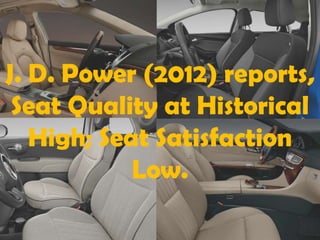
J. D. Power (2012) reports,
 Seat Quality at Historical
   High; Seat Satisfaction
            Low.
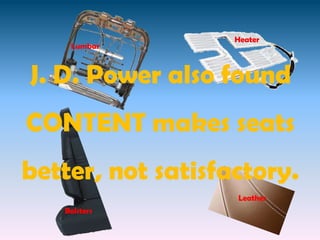
Heater
    Lumbar


J. D. Power also found
CONTENT makes seats
better, not satisfactory.
                   Leather
   Bolsters
What’s the problem?
Seats, Sitting & Satisfaction
• Seat position satisfies body size.


• Drivers dissatisfied with sitting postures.


• Seat satisfaction meets driver preferences.
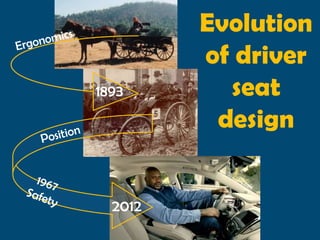
Evolution
         of driver
1893       seat
          design


  2012
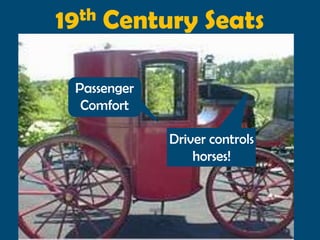
19th   Century Seats

 Passenger
  Comfort

             Driver controls
                 horses!
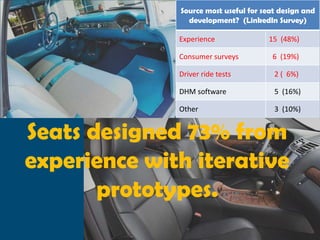
Source most useful for seat design and
                development? (LinkedIn Survey)

              Experience              15 (48%)

              Consumer surveys         6 (19%)

              Driver ride tests         2 ( 6%)

              DHM software              5 (16%)

              Other                     3 (10%)


Seats designed 73% from
experience with iterative
       prototypes.
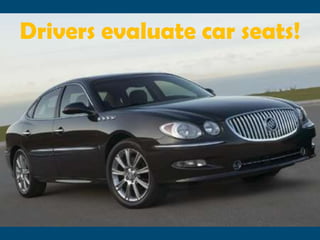
Drivers evaluate car seats!
Who are the drivers?
 • Engineers in prototype seats


 • Press in production vehicles


 • Owners in production vehicles
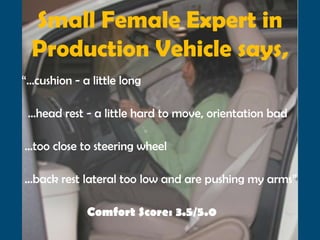
Small Female Expert in
  Production Vehicle says,
“…cushion - a little long

 …head rest - a little hard to move, orientation bad

…too close to steering wheel

…back rest lateral too low and are pushing my arms”

             Comfort Score: 3.5/5.0
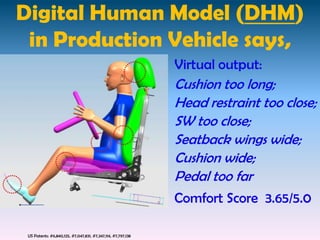
Digital Human Model (DHM)
 in Production Vehicle says,
                                                              Virtual output:
                                                              Cushion too long;
                                                              Head restraint too close;
                                                              SW too close;
                                                              Seatback wings wide;
                                                              Cushion wide;
                                                              Pedal too far
                                                              Comfort Score 3.65/5.0

 US Patents: #6,840,125, #7,047,831, #7,347,114, #7,797,138
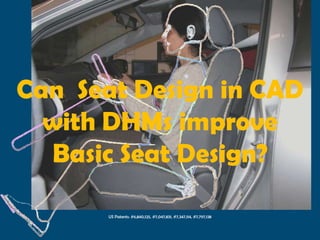
Can Seat Design in CAD
  with DHMs improve
  Basic Seat Design?

       US Patents: #6,840,125, #7,047,831, #7,347,114, #7,797,138
Seat Design
 for Driver Satisfaction
  Seat must accommodate
variation in drivers’ body size
and preferred sitting postures.
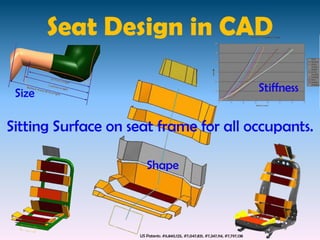
Seat Design in CAD

 Size                                                                            Stiffness


Sitting Surface on seat frame for all occupants.

                       Shape


                    US Patents: #6,840,125, #7,047,831, #7,347,114, #7,797,138
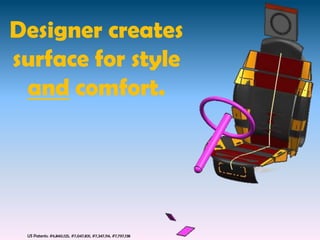
Designer creates
surface for style
 and comfort.


 US Patents: #6,840,125, #7,047,831, #7,347,114, #7,797,138
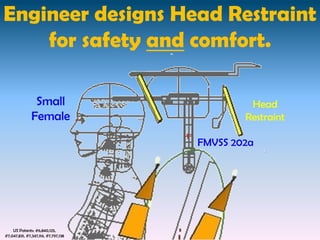
Engineer designs Head Restraint
    for safety and comfort.

                Small                         Head
               Female                        Restraint

                                     FMVSS 202a


    US Patents: #6,840,125,
#7,047,831, #7,347,114, #7,797,138
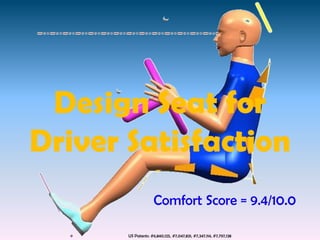
Design Seat for
Driver Satisfaction
                     Comfort Score = 9.4/10.0

       US Patents: #6,840,125, #7,047,831, #7,347,114, #7,797,138
Models for Seat Satisfaction
      • Virtual Driver (DHM)

      • Virtual Sitting Surface

      • Virtual Car Interior

      • Drivers’ Comfort

      • Optimization
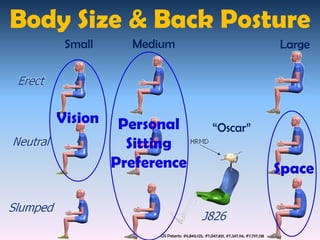
Body Size & Back Posture
    Small     Medium                                                           Large


   Vision    Personal                          “Oscar”
              Sitting
            Preference                                                         Space


                  US Patents: #6,840,125, #7,047,831, #7,347,114, #7,797,138
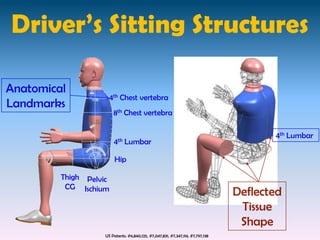
Driver’s Sitting Structures

Anatomical
                      4th Chest vertebra
Landmarks
                        8th Chest vertebra

                                                                                        4th Lumbar
                        4th   Lumbar

                         Hip

         Thigh Pelvic
          CG Ischium
                                                                                 Deflected
                                                                                  Tissue
                                                                                  Shape
                    US Patents: #6,840,125, #7,047,831, #7,347,114, #7,797,138
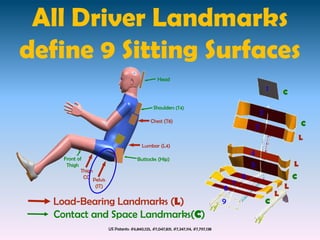
All Driver Landmarks
define 9 Sitting Surfaces
                                                     Head
                                                                                                               1

                                                   Shoulders (T4)
                                                                                                           2
                                                 Chest (T8)
                                                                                                       3

                                            Lumbar (L4)
                                                                                                   4
     Front of                             Buttocks (Hip)
      Thigh                                                                                        5
            Thigh
              CG Pelvis                                                                        6
                  (IT)
                                                                                           7
                                                                                       8
   Load-Bearing Landmarks (L)                                                          9
   Contact and Space Landmarks(C)
                          US Patents: #6,840,125, #7,047,831, #7,347,114, #7,797,138
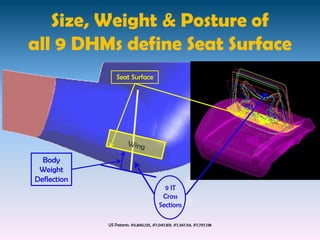
Size, Weight & Posture of
all 9 DHMs define Seat Surface
                 Seat Surface


  Body
 Weight
Deflection
                                           9 IT
                                          Cross
                                         Sections

             US Patents: #6,840,125, #7,047,831, #7,347,114, #7,797,138
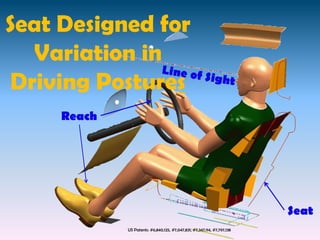
Seat Designed for
  Variation in
Driving Postures
     Reach


                                                                          Seat
             US Patents: #6,840,125, #7,047,831, #7,347,114, #7,797,138
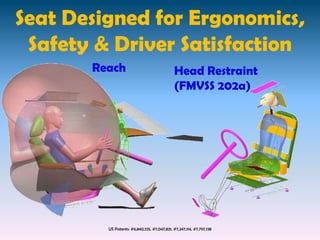
Seat Designed for Ergonomics,
 Safety & Driver Satisfaction
       Reach                                 Head Restraint
                                             (FMVSS 202a)


         US Patents: #6,840,125, #7,047,831, #7,347,114, #7,797,138
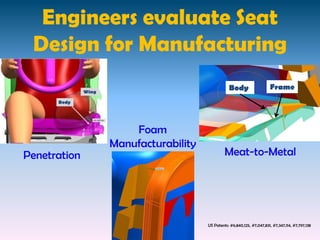
Engineers evaluate Seat
 Design for Manufacturing
                                             Body                   Frame


                  Foam
              Manufacturability
Penetration                                Meat-to-Metal


                                  US Patents: #6,840,125, #7,047,831, #7,347,114, #7,797,138
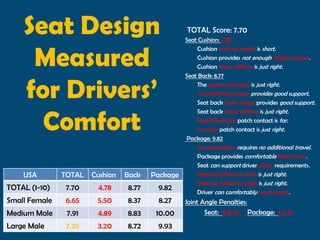
Seat Design                                   TOTAL Score: 7.70
                                                  Seat Cushion: 4.78


     Measured
                                                      Cushion contact length is short.
                                                      Cushion provides not enough thigh support.
                                                      Cushion insert stiffness is just right.
                                                  Seat Back: 8.77


    for Drivers’                                      The upper seat back is just right.
                                                       Overall Wing shape provides good support.
                                                      Seat back Insert shape provides good support.


      Comfort
                                                      Seat back insert stiffness is just right.
                                                      Head Restraint patch contact is far.
                                                      Lumbar patch contact is just right.
                                                   Package: 9.82
                                                      Travel window requires no additional travel.
                                                      Package provides comfortable head room.
                                                      Seat can support driver vision requirements.
    USA        TOTAL   Cushion   Back   Package       Steering Wheel to chest is just right.
                                                      Steering Wheel to thigh is just right.
TOTAL (1-10)   7.70     4.78     8.77    9.82
                                                      Driver can comfortably reach pedal.
Small Female   6.65     5.50     8.37    8.27     Joint Angle Penalties:
Medium Male     7.91    4.89     8.83    10.00           Seat: 0.8 % Package: 1.6 %
Large Male      7.26    3.20     8.72    9.93
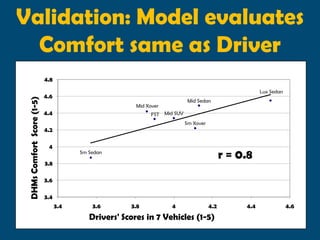
Validation: Model evaluates
  Comfort same as Driver
                            4.8
                                                                                                       Lux Sedan
                            4.6
 DHMs Comfort Score (1-5)


                                                                            Mid Sedan
                                                        Mid Xover
                            4.4                              FST Mid SUV
                                                                           Sm Xover
                            4.2

                             4
                                        Sm Sedan
                                                                                            r = 0.8
                            3.8

                            3.6

                            3.4
                                  3.4       3.6       3.8           4                 4.2        4.4               4.6
                                           Drivers' Scores in 7 Vehicles (1-5)
All Global Drivers
have Universal Needs
 • Vision
 • Operate Controls
 • Sitting in preferred posture
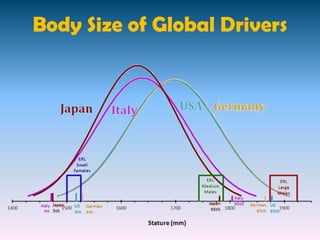
Body Size of Global Drivers
Alert             Neutral


   Driving Conditions
affect Preferred Posture

Relaxed               Alert
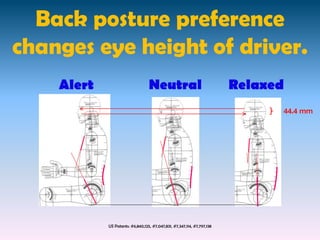
Back posture preference
changes eye height of driver.
    Alert                         Neutral                                Relaxed
                                                                               44.4 mm


            US Patents: #6,840,125, #7,047,831, #7,347,114, #7,797,138
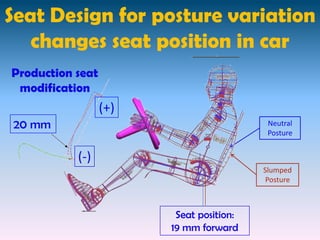
Seat Design for posture variation
   changes seat position in car
Production seat
 modification
                  (+)
20 mm                                      Neutral
                                           Posture


           (-)
                                          Slumped
                                           Posture


                         Seat position:
                        19 mm forward
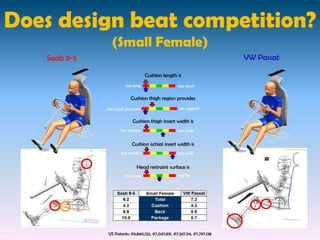
Does design beat competition?
                (Small Female)
   Saab 9-5                                                                VW Passat

                                   Cushion length is
                       too long                      too short

                          Cushion thigh region provides
              too much pressure                       no support

                           Cushion thigh insert width is
                     too narrow                      too wide


                           Cushion ischial insert width is
                     too narrow                      too wide


                             Head restraint surface is
                       too close                     too far


              US Patents: #6,840,125, #7,047,831, #7,347,114, #7,797,138
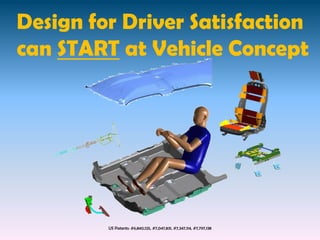
Design for Driver Satisfaction
can START at Vehicle Concept


         US Patents: #6,840,125, #7,047,831, #7,347,114, #7,797,138
Conclusion

  Improved seat satisfaction comes
from design for all sitting preferences.
Acknowledgements
• ERL LLC (Ray Brodeur, D.C., Ph.D., et al.)


• Michigan State University (George Stockman, Ph.D., et al.)


• General Motors Corporation (Don Maertens, et al.)

Car seat design for driver satisfaction

  • 1.
    Seat Design for DriverSatisfaction Mac Reynolds, Ph.D. Professor Emeritus, Michigan State University CEO, ERL LLC
  • 2.
    Today, cars designedand built for quality, appearance and performance.
  • 3.
    J. D. Power(2012) reports, Seat Quality at Historical High; Seat Satisfaction Low.
  • 4.
    Heater Lumbar J. D. Power also found CONTENT makes seats better, not satisfactory. Leather Bolsters

  • 5.
  • 6.
    Seats, Sitting &Satisfaction • Seat position satisfies body size. • Drivers dissatisfied with sitting postures. • Seat satisfaction meets driver preferences.
  • 7.
    Evolution of driver 1893 seat design 2012
  • 8.
    19th Century Seats Passenger Comfort Driver controls horses!
  • 9.
    Source most usefulfor seat design and development? (LinkedIn Survey) Experience 15 (48%) Consumer surveys 6 (19%) Driver ride tests 2 ( 6%) DHM software 5 (16%) Other 3 (10%) Seats designed 73% from experience with iterative prototypes.
  • 10.
  • 11.
    Who are thedrivers? • Engineers in prototype seats • Press in production vehicles • Owners in production vehicles
  • 12.
    Small Female Expertin Production Vehicle says, “…cushion - a little long …head rest - a little hard to move, orientation bad …too close to steering wheel …back rest lateral too low and are pushing my arms” Comfort Score: 3.5/5.0
  • 13.
    Digital Human Model(DHM) in Production Vehicle says, Virtual output: Cushion too long; Head restraint too close; SW too close; Seatback wings wide; Cushion wide; Pedal too far Comfort Score 3.65/5.0 US Patents: #6,840,125, #7,047,831, #7,347,114, #7,797,138
  • 14.
    Can Seat Designin CAD with DHMs improve Basic Seat Design? US Patents: #6,840,125, #7,047,831, #7,347,114, #7,797,138
  • 15.
    Seat Design forDriver Satisfaction Seat must accommodate variation in drivers’ body size and preferred sitting postures.
  • 16.
    Seat Design inCAD Size Stiffness Sitting Surface on seat frame for all occupants. Shape US Patents: #6,840,125, #7,047,831, #7,347,114, #7,797,138
  • 17.
    Designer creates surface forstyle and comfort. US Patents: #6,840,125, #7,047,831, #7,347,114, #7,797,138
  • 18.
    Engineer designs HeadRestraint for safety and comfort. Small Head Female Restraint FMVSS 202a US Patents: #6,840,125, #7,047,831, #7,347,114, #7,797,138
  • 19.
    Design Seat for DriverSatisfaction Comfort Score = 9.4/10.0 US Patents: #6,840,125, #7,047,831, #7,347,114, #7,797,138
  • 20.
    Models for SeatSatisfaction • Virtual Driver (DHM) • Virtual Sitting Surface • Virtual Car Interior • Drivers’ Comfort • Optimization
  • 21.
    Body Size &Back Posture Small Medium Large Vision Personal “Oscar” Sitting Preference Space US Patents: #6,840,125, #7,047,831, #7,347,114, #7,797,138
  • 22.
    Driver’s Sitting Structures Anatomical 4th Chest vertebra Landmarks 8th Chest vertebra 4th Lumbar 4th Lumbar Hip Thigh Pelvic CG Ischium Deflected Tissue Shape US Patents: #6,840,125, #7,047,831, #7,347,114, #7,797,138
  • 23.
    All Driver Landmarks define9 Sitting Surfaces Head 1 Shoulders (T4) 2 Chest (T8) 3 Lumbar (L4) 4 Front of Buttocks (Hip) Thigh 5 Thigh CG Pelvis 6 (IT) 7 8 Load-Bearing Landmarks (L) 9 Contact and Space Landmarks(C) US Patents: #6,840,125, #7,047,831, #7,347,114, #7,797,138
  • 24.
    Size, Weight &Posture of all 9 DHMs define Seat Surface Seat Surface Body Weight Deflection 9 IT Cross Sections US Patents: #6,840,125, #7,047,831, #7,347,114, #7,797,138
  • 25.
    Seat Designed for Variation in Driving Postures Reach Seat US Patents: #6,840,125, #7,047,831, #7,347,114, #7,797,138
  • 26.
    Seat Designed forErgonomics, Safety & Driver Satisfaction Reach Head Restraint (FMVSS 202a) US Patents: #6,840,125, #7,047,831, #7,347,114, #7,797,138
  • 27.
    Engineers evaluate Seat Design for Manufacturing Body Frame Foam Manufacturability Penetration Meat-to-Metal US Patents: #6,840,125, #7,047,831, #7,347,114, #7,797,138
  • 28.
    Seat Design TOTAL Score: 7.70 Seat Cushion: 4.78 Measured Cushion contact length is short. Cushion provides not enough thigh support. Cushion insert stiffness is just right. Seat Back: 8.77 for Drivers’ The upper seat back is just right. Overall Wing shape provides good support. Seat back Insert shape provides good support. Comfort Seat back insert stiffness is just right. Head Restraint patch contact is far. Lumbar patch contact is just right. Package: 9.82 Travel window requires no additional travel. Package provides comfortable head room. Seat can support driver vision requirements. USA TOTAL Cushion Back Package Steering Wheel to chest is just right. Steering Wheel to thigh is just right. TOTAL (1-10) 7.70 4.78 8.77 9.82 Driver can comfortably reach pedal. Small Female 6.65 5.50 8.37 8.27 Joint Angle Penalties: Medium Male 7.91 4.89 8.83 10.00 Seat: 0.8 % Package: 1.6 % Large Male 7.26 3.20 8.72 9.93
  • 29.
    Validation: Model evaluates Comfort same as Driver 4.8 Lux Sedan 4.6 DHMs Comfort Score (1-5) Mid Sedan Mid Xover 4.4 FST Mid SUV Sm Xover 4.2 4 Sm Sedan r = 0.8 3.8 3.6 3.4 3.4 3.6 3.8 4 4.2 4.4 4.6 Drivers' Scores in 7 Vehicles (1-5)
  • 30.
    All Global Drivers haveUniversal Needs • Vision • Operate Controls • Sitting in preferred posture
  • 31.
    Body Size ofGlobal Drivers
  • 32.
    Alert Neutral Driving Conditions affect Preferred Posture Relaxed Alert
  • 33.
    Back posture preference changeseye height of driver. Alert Neutral Relaxed 44.4 mm US Patents: #6,840,125, #7,047,831, #7,347,114, #7,797,138
  • 34.
    Seat Design forposture variation changes seat position in car Production seat modification (+) 20 mm Neutral Posture (-) Slumped Posture Seat position: 19 mm forward
  • 35.
    Does design beatcompetition? (Small Female) Saab 9-5 VW Passat Cushion length is too long too short Cushion thigh region provides too much pressure no support Cushion thigh insert width is too narrow too wide Cushion ischial insert width is too narrow too wide Head restraint surface is too close too far US Patents: #6,840,125, #7,047,831, #7,347,114, #7,797,138
  • 36.
    Design for DriverSatisfaction can START at Vehicle Concept US Patents: #6,840,125, #7,047,831, #7,347,114, #7,797,138
  • 37.
    Conclusion Improvedseat satisfaction comes from design for all sitting preferences.
  • 38.
    Acknowledgements • ERL LLC(Ray Brodeur, D.C., Ph.D., et al.) • Michigan State University (George Stockman, Ph.D., et al.) • General Motors Corporation (Don Maertens, et al.)