PASSENGER COMFORT AND
SAFETY
UNIT-6.3
 With development of society, there is increase in
vehicle number and traffic
 Accident have become frequent and serious
 Science and technology have also improved
 Regulatory act have also progressing to increase
road safety
 decreased in fatal accident
 Due to improved safety
 Vehicle manufacturer are also developing new
feature for safety
 Main purpose of vehicle safety is safety of vehicle
crew and other road user.
Safety of an automobile is of
two type
 1. Active safety- before accident
 2. Passive safety- after accident
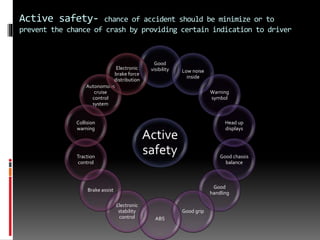
Active safety- chance of accident should be minimize or to
prevent the chance of crash by providing certain indication to driver
Active
safety
Good
visibility Low noise
inside
Warning
symbol
Head up
displays
Good chassis
balance
Good
handling
Good grip
ABS
Electronic
stability
control
Brake assist
Traction
control
Collision
warning
Autonomous
cruise
control
system
Electronic
brake force
distribution
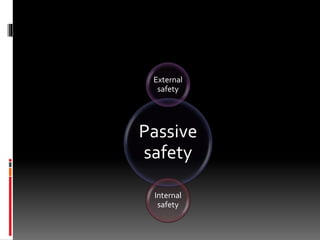
Passive
safety
External
safety
Internal
safety
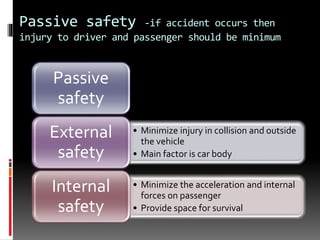
Passive safety -if accident occurs then
injury to driver and passenger should be minimum
Passive
safety
• Minimize injury in collision and outside
the vehicle
• Main factor is car body
External
safety
• Minimize the acceleration and internal
forces on passenger
• Provide space for survival
Internal
safety
 Behavior of car body during deformation
 Strength of passenger compartment
 Deceleration system
 Control system
 Fire protection
 Seat belt
 Air bags
 Laminated glass
 Fuel tank position
 Fuel pump kill switch
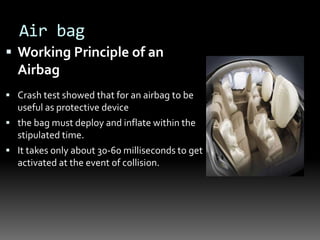
Air bag
 Working Principle of an
Airbag
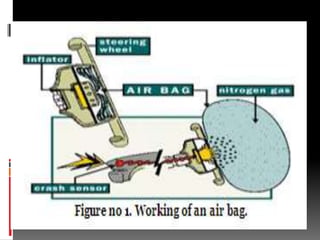
 Crash test showed that for an airbag to be
useful as protective device
 the bag must deploy and inflate within the
stipulated time.
 It takes only about 30-60 milliseconds to get
activated at the event of collision.
 Airbags become energy-absorbing buffers between people and the
hard interior surfaces of vehicles.
 Normally air bags are hidden in the hub of the steering wheel or in
the dash on the passengers side
 Once the sensor has turned on the electrical circuit, a pallet of
sodium azide (NaN3) is ignited, and a rapid reaction occurs,
generating nitrogen gas.
 This gas fills a nylon or poly amide bag at a velocity of 150-230 miles
per hour.
 In order for the air bag to cushion the head for maximum
protection, the air bag must begin to deflate by the time the body
hits. Otherwise the high internal pressure of the airbag would create
a surface as hard as stone not the protective cushion.
Seat belt
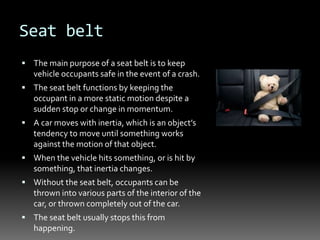
 The main purpose of a seat belt is to keep
vehicle occupants safe in the event of a crash.
 The seat belt functions by keeping the
occupant in a more static motion despite a
sudden stop or change in momentum.
 A car moves with inertia, which is an object’s
tendency to move until something works
against the motion of that object.
 When the vehicle hits something, or is hit by
something, that inertia changes.
 Without the seat belt, occupants can be
thrown into various parts of the interior of the
car, or thrown completely out of the car.
 The seat belt usually stops this from
happening.
Collapsible steering
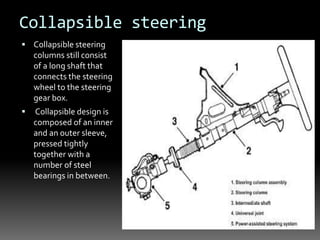
 Collapsible steering
columns still consist
of a long shaft that
connects the steering
wheel to the steering
gear box.
 Collapsible design is
composed of an inner
and an outer sleeve,
pressed tightly
together with a
number of steel
bearings in between.
 These steel bearings are pressed into the metal sleeves, and are held in
place with a strong safety resin
 which is designed to harden and then shatter when a specific level of
pressure is applied.
 In the event of a frontal impact, the steel bearings between the sleeves
break free
 allowing the inner sleeve to be moved further into the outer sleeve in
telescopic fashion before enough pressure is achieved to ram the whole
steering column into the driver.
 In this manner, the energy received through a frontal impact is completely
absorbed by the steering column's collapsing parts, allowing most modern
drivers to remain completely unaware of the danger they have avoided.
Passenger comfort and safety

Passenger comfort and safety

  • 1.
  • 3.
     With developmentof society, there is increase in vehicle number and traffic  Accident have become frequent and serious  Science and technology have also improved  Regulatory act have also progressing to increase road safety  decreased in fatal accident  Due to improved safety  Vehicle manufacturer are also developing new feature for safety  Main purpose of vehicle safety is safety of vehicle crew and other road user.
  • 4.
    Safety of anautomobile is of two type  1. Active safety- before accident  2. Passive safety- after accident
  • 5.
    Active safety- chanceof accident should be minimize or to prevent the chance of crash by providing certain indication to driver Active safety Good visibility Low noise inside Warning symbol Head up displays Good chassis balance Good handling Good grip ABS Electronic stability control Brake assist Traction control Collision warning Autonomous cruise control system Electronic brake force distribution
  • 6.
  • 7.
    Passive safety -ifaccident occurs then injury to driver and passenger should be minimum Passive safety • Minimize injury in collision and outside the vehicle • Main factor is car body External safety • Minimize the acceleration and internal forces on passenger • Provide space for survival Internal safety
  • 8.
     Behavior ofcar body during deformation  Strength of passenger compartment  Deceleration system  Control system  Fire protection  Seat belt  Air bags  Laminated glass  Fuel tank position  Fuel pump kill switch
  • 9.
    Air bag  WorkingPrinciple of an Airbag  Crash test showed that for an airbag to be useful as protective device  the bag must deploy and inflate within the stipulated time.  It takes only about 30-60 milliseconds to get activated at the event of collision.
  • 11.
     Airbags becomeenergy-absorbing buffers between people and the hard interior surfaces of vehicles.  Normally air bags are hidden in the hub of the steering wheel or in the dash on the passengers side  Once the sensor has turned on the electrical circuit, a pallet of sodium azide (NaN3) is ignited, and a rapid reaction occurs, generating nitrogen gas.  This gas fills a nylon or poly amide bag at a velocity of 150-230 miles per hour.  In order for the air bag to cushion the head for maximum protection, the air bag must begin to deflate by the time the body hits. Otherwise the high internal pressure of the airbag would create a surface as hard as stone not the protective cushion.
  • 12.
    Seat belt  Themain purpose of a seat belt is to keep vehicle occupants safe in the event of a crash.  The seat belt functions by keeping the occupant in a more static motion despite a sudden stop or change in momentum.  A car moves with inertia, which is an object’s tendency to move until something works against the motion of that object.  When the vehicle hits something, or is hit by something, that inertia changes.  Without the seat belt, occupants can be thrown into various parts of the interior of the car, or thrown completely out of the car.  The seat belt usually stops this from happening.
  • 13.
    Collapsible steering  Collapsiblesteering columns still consist of a long shaft that connects the steering wheel to the steering gear box.  Collapsible design is composed of an inner and an outer sleeve, pressed tightly together with a number of steel bearings in between.
  • 14.
     These steelbearings are pressed into the metal sleeves, and are held in place with a strong safety resin  which is designed to harden and then shatter when a specific level of pressure is applied.  In the event of a frontal impact, the steel bearings between the sleeves break free  allowing the inner sleeve to be moved further into the outer sleeve in telescopic fashion before enough pressure is achieved to ram the whole steering column into the driver.  In this manner, the energy received through a frontal impact is completely absorbed by the steering column's collapsing parts, allowing most modern drivers to remain completely unaware of the danger they have avoided.