14-CE-29
14-C14-CE-29
14-CE-61
14-CE-105
E-61
14-CE-105
1
Presented By: AKHLAQ AMAN
(2K17-FT-MS-TR-08)
Presented to: Prof.Dr. Imran Hafeez
Department of Civil Engineering
Faculty of Civil & Environmental Engineering
University of Engineering and Technology, Taxila
2
Introduction
design, construction, equipment and regulation
minimize the occurrence and consequences
 Automobile safety is the study and practice of
to
of
automobileaccidents.
3
Introduction
Modern Cars :
 Mercedes s-class
 Range Rover
 Rolls-Royce phantom
 Bentley Mulsanne
 Porsche Panamera
 BMW 7 Series
 Audi A8
4
 Adaptive Cruise control
 Automatic High beams
 Front parking sensors
 Parking Assist
 Rear Automated Emergency Bracking
 Blind spot monitor
 Lane departure warning
 Rear cross Traffic monitoring
 Lane keeping Assist
.
Mercedes s-class and their safety Features:
5
Range Rover and their safety Features
 Airbags, frontal
 Tractional control
 Daytime running lights
 Door curb lights
 Parking Assist
 Keyless access system
 Door locks
 Content theft-deterrent alarm
 Blind spot sensor
6
Rolls-Royce phantom and their safety Features
 Anti-lock brakes
 Stability control
 Front impact air bages
 Stability control
 Side impact air bages
 Over head air bags
 Pretensioners
 Anti-whiplash
 Knee airbags
7
Bentley Mulsanne and their safety Feature:
 Forward collision warning
 Electronic stability control
 High speed auto emergency Bracking
 Driver attention detection
 Front side curtain airbag
 Active cursive control
 Adjustable steering column
 Rear side curtain air bags
 Tractional control
 Stability control
 Seat belt pretension Driver
 Seat belt pretension passenger
 Day lights running light
8
Porsche Panamera and their safety Feature:
 4-Wheel ABS
 Electronic stability control
 Daytime running lights
 Child safety locks
 Night vision
 Tractional control
 Blind spot monitor
 Auto-leveling headlights
 Lane departure warning
 Lane keeping assist
 Driver air bag
 Front and rear air bag
9
BMW 7 Series and their safety features:
 ABS
 Cornering brake control
 Dynamic stability control
 Electronic vehicle immobilizer
 crash sensor
 Headrests front
 Tractional control
 Blind spot monitor
 Side Impact protection Lane
 pyrotechnic belt tensioners
 Front and rear air bag
 Warning triangle with first-aid kit.
10
Audi A8 and their safety features
 Electronic stability control (ESC)
 ABS And Traction control
 Side impact beams
 Front and rear parking sensors
 Audi pre sense basic forward collision
 Tire pressure warning
 Dual stage driver and passenger front air bags
 Airbag occupancy sensors
 Rear child safety locks
 Back-up camera
11
Safety features & their capacity
for reducing the risk of injury
Safety features in modern cars 12
Seat belts
 A properly worn seat belt provides good protection but does not
always prevent injuries.
 seat belts reduce the risk of death by 45 %
Belt Alert
 Audible and visual warning to alert driver
 sensor detects the front passenger
13
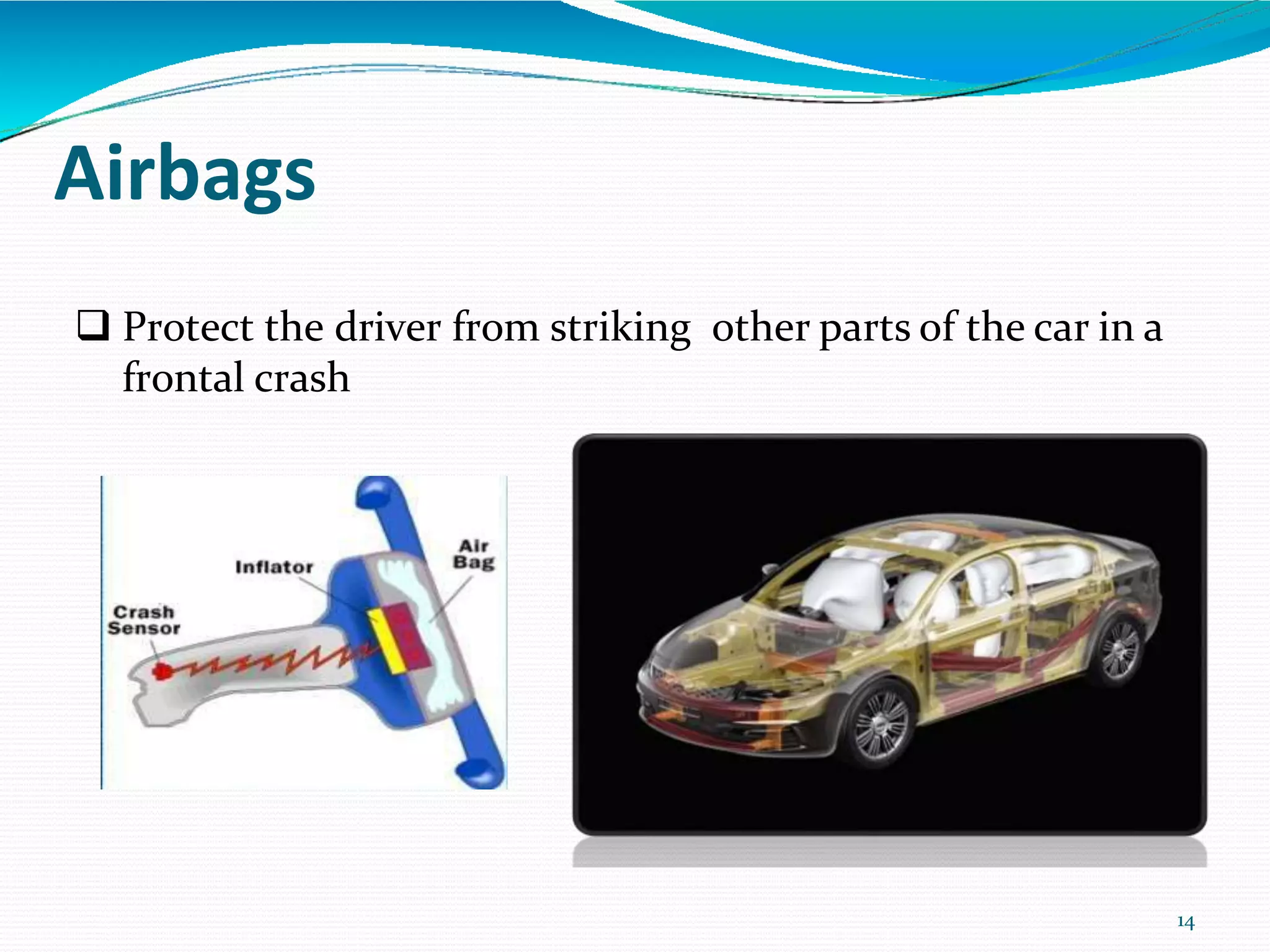
Airbags
 Protect the driver from striking other parts of the car in a
frontal crash
14
Shatter proof Windscreen
Safety features in modern cars 15
 The car windscreen is actually two glass glued together
topreventsplinting in an eventof collision.
 The safety glass is specially designed to break into
large, circular pieces instead of shattering into
dangerous glass shards in a car collision. This prevents
severe injury for the person inside thecar.
Damaged windscreen
Safety features in modern cars 16
Side impact protection
 Increased side door strength, internal padding can
improve protection in side impact crashes. Most new
cars have side intrusion beams or other protection
within the door structure.
17
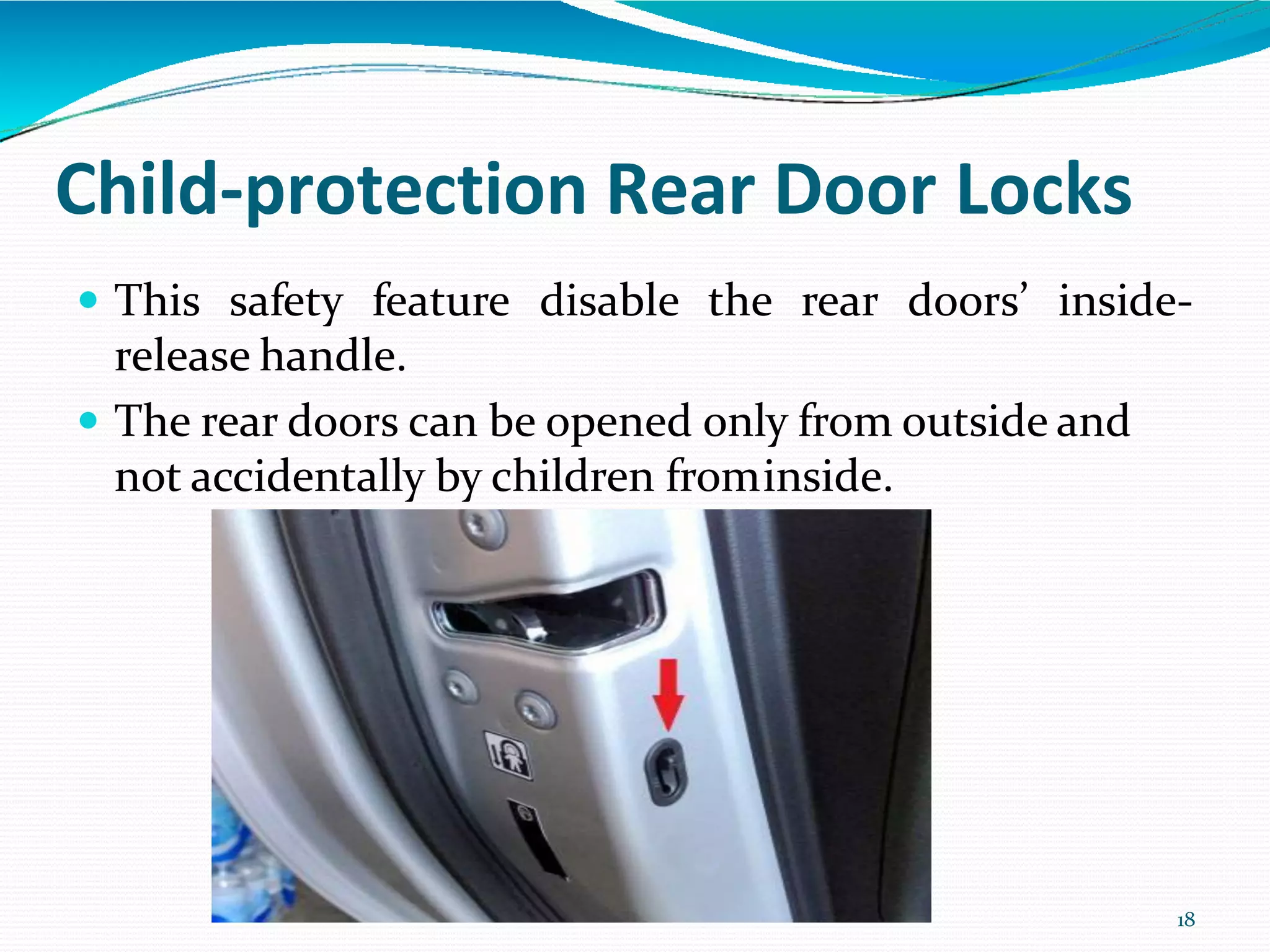
Child-protection Rear Door Locks
 This safety feature disable the rear doors’ inside-
release handle.
 The rear doors can be opened only from outside and
not accidentally by children frominside.
18
Head rests
 Head rests are important safety features and should be
fitted to all seats - front and back. Head rest position is
critical for preventing whiplash in rear impact crashes.
Whiplash is caused by the head extending backward
from the torso in the initial stage of rear impact, then
being thrown forward.
 To prevent whiplash the head rest should be at least as
high as the head's centre of gravity (eye level and
higher) and as close to the back of the head as
possible.
19
Head rests
20
Adjustable Steering Column
 you adjust the steering wheel into the perfect
position, offering better safety, comfort and
visibility.
 Adjustments include the height of the wheel and its
distance from the driver.
21
Automatic headlamps
 A sensor activates the headlights often when the car
enters a dark underground parking or tunnels in broad
daylight
 This feature alerts the driver by the head lights turning
on encountering suddendarkness.
22
0
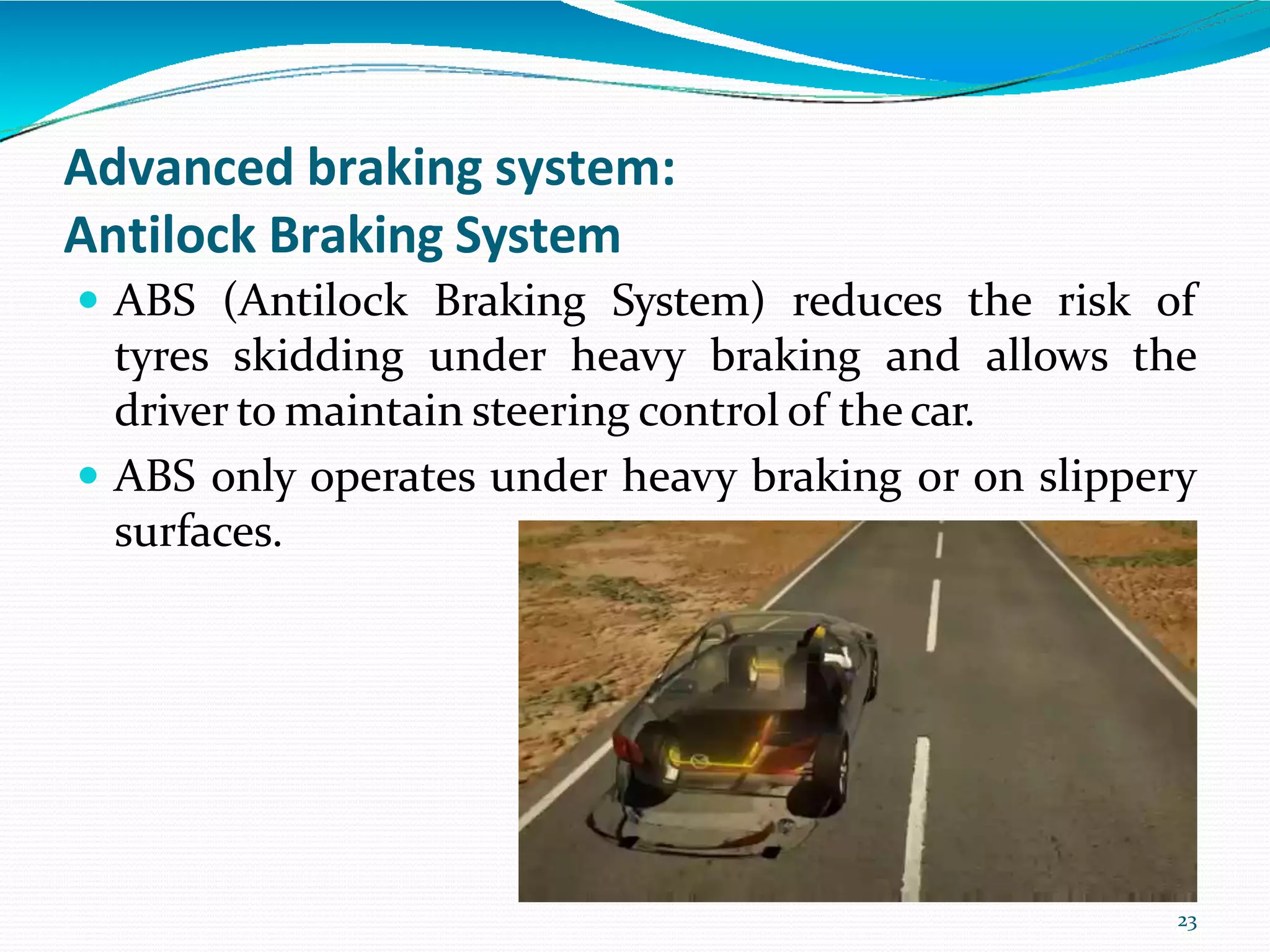
Advanced braking system:
Antilock Braking System
 ABS (Antilock Braking System) reduces the risk of
tyres skidding under heavy braking and allows the
driver to maintain steering control of thecar.
 ABS only operates under heavy braking or on slippery
surfaces.
23
Anti-lock braking system (ABS)
24
Active Braking Systems
 Active braking systems are a new safety technology
that provide drivers with braking support during
emergency situations.
 Brake Assist, measure the speed and force of brake
application to determine whether the driver is
attempting an emergency stop. If such an emergency is
determined, the system applies additional brake
pressure to allow the driver to take full advantage of
the Anti-lock braking system (ABS) which prevents
wheel lock up.
25
Vertical stability control - VSC
 It is a safety feature that deploys when cornering. As a
car enters a curve, it eliminates both understeer and
oversteer, which control the driver has over the
vehicle.
26
Traction Control
 Traction Control systems optimize grip and stability of
the car on the road during acceleration by measuring
wheel rotation. It stops wheel spin by reducing engine
power or temporarily applying the brakes to that
wheel, allowing the car to accelerate smoothly, even on
slippery surfaces.
 Limited slip differentials also help provide a more even
distribution of traction forces when the car is on a
slippery surface.
27
Traction Control
28
Electronic Stability Control
 Electronic Stability Control (ESC)
helps drivers to avoid crashes by
reducing the danger of skidding, or
losing control as a result of over-
steering. ESC becomes active when a
driver loses control of their car. It uses
computer controlled technology to
apply individual brakes and help
bring the car safely back on track,
without the danger offish-tailing.
29
The DSC (Dynamic Stability Control)
 The DSC (Dynamic Stability Control) is BMW's
electronic stability control system. It controls the
suspension with the help of three other single
programs – ABS (Anti-lock Brake System), ASC +
T (Automatic Stability Control + Traction) and
CBC (Cornering Break Control).
 It constantly checks vehicle speed, steering angle,
wheel rotation, lateral and transverse acceleration,
brake pressure and yaw to register imminent
instability when cornering, especially on slippery
conditions like snow and rain
30
Cornering Brake Control or CBC
31
Cornering Brake Control or CBC is an automotive safety
system introduced by carmakers BMW and Mercedes-Benz. It is
a further development and expansion of the ABS, designed to
distribute braking force during braking whilst cornering.
It works by applying braking pressure asymmetrically despite
physically difficult conditions (e.g. the car swerving towards the
inside of the bend when the wheel load changes). By
asymmetrically distributing brake pressure to the left- and right-
side brakes or by reducing pressure (to the rear axle), even if the
driver brakes outside the normal range of ABS.
31
Adaptive cruise control
32
 This uses forward-looking sensors like radar and
cameras to monitor thedistance toa lead vehicle.
 The system will automatically slow the vehicle down in
traffic to maintain a safe following distance without
thedriver having todoanything.
 As traffic speeds up, the vehicle accelerates to
maintain the presetspeed.
32
Lane Keep Assist
33
 Lane keep assist proactively steers the car back into
the lane. When the car is close to a marking, the
system gently steers the car away from the line until it
issafely within the lane.
33
Collision avoidance systems
34
 Collision Avoidance systems is part of adaptive cruise
control, which helps to avoidcollisions.
 The technology uses radar to keep a check on the
vehicles ahead, and decreases the speed automatically
byautonomous braking.
34
Daytime Running Lights
 Daytime Running Lights (DRLs) are headlights that
are illuminated
vehicles more
during the day in order to
visible and thus reduce
make
their
involvement in crashes. It is possible to fit vehicles
with a device that will automatically activate DRLs
when the ignition is switched on but is overridden by
full strength headlights.
 DRLs have been found to increase driver’s peripheral
perception of vehicles. It is also easier for drivers to
estimate the distance to vehicles with DRLs.
35
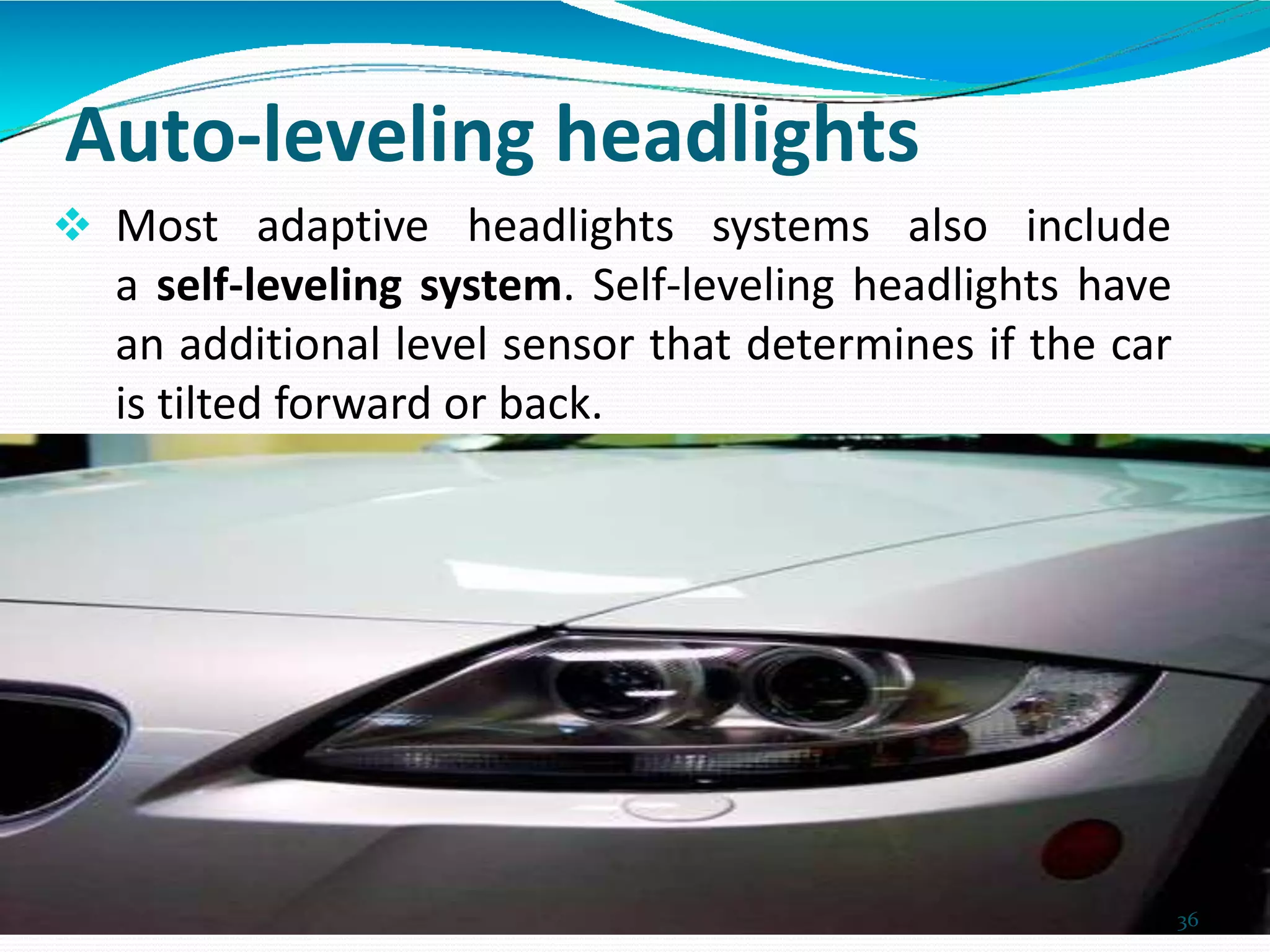
Auto-leveling headlights
180
 Most adaptive headlights systems also include
a self-leveling system. Self-leveling headlights have
an additional level sensor that determines if the car
is tilted forward or back.
36
Night-vision assist
180
 Night vision can be executed in different forms, such
as infrared headlamps or thermal-imaging cameras.
But no matter the science, the goal is the same: to
help you see farther down the road and to spot
animals, people or trees in the path — even at nearly
1,000 feet away. An image is generated through a
cockpit display, brightening the objects that are hard
to see with the naked eye.
37
38
38
Cross Traffic Alert system
 Have you ever gone to reverse out of a nose-in car park
only to be blasted by a vehicle driving perhaps too fast
behind you?
 This system uses sensors in the rear corners of the car
to determine if it is safe or not to reverse out. If the
sensors detect a vehicle, the dash gives you a beep to
warnyou.
39
Cross Traffic Alert system
40
40
Fog Lamps
 Fog lamps must only be used in low visibility
conditions such as fog orsnow.
41
Reversing Camera
 Reversing cameras improves the rearward view and
can assist drivers in detecting persons or objects in the
path of a reversingvehicle.
42
Reverse backup sensors
 For use with or without a camera, this equipment
beeps if you are about to hit something while backing
up.
43
Blind-spot Warning System
 Blind spot warning systems detect the distance and closing
speed of objects in adjacent lanes and alert the driver if a
collision is imminent.
44
Lane Departure Warning
45
 Lane departure warning systems rely on distinct lane markings
45
Tyre Pressure Monitor
46
 Tyre pressure monitors detect when a tyre drops below
thedesignated pressureand alerts thedriver.
46
Run-flat tire
47
 A run-flat tire is a pneumatic vehicle tire that is
designed to resist the effects of deflation when
punctured, and to enable the vehicle to continue to be
driven at reduced speeds up to 80 km/h, and for
limited distances of up to 160km.
 These tires contain an extra lining within the tire that
self-seals in the event of a small hole due to a nail. In
this way, the loss of air is prevented from the outset
such that the tire is either permanently self-repairing
orat least losesairvery slowly.
47
Security Alarm
48
 This safety feature blows the horn intermittently and
flashes the turn signal lamps to deter vandalism and
theft.
 It protects the vehicle from theft
48
Driver Drowsiness Detection (DDD)
 DDD utilizes a driver’s steering input to determine
their level of drowsiness.
 A visual and/oraudiblealert is delivered to thedriver
when drowsiness isdetected.
49
49
Safety features in modern cars 50
50

Safety Features in Modern Cars.pptx

  • 1.
  • 2.
    Presented By: AKHLAQAMAN (2K17-FT-MS-TR-08) Presented to: Prof.Dr. Imran Hafeez Department of Civil Engineering Faculty of Civil & Environmental Engineering University of Engineering and Technology, Taxila 2
  • 3.
    Introduction design, construction, equipmentand regulation minimize the occurrence and consequences  Automobile safety is the study and practice of to of automobileaccidents. 3
  • 4.
    Introduction Modern Cars : Mercedes s-class  Range Rover  Rolls-Royce phantom  Bentley Mulsanne  Porsche Panamera  BMW 7 Series  Audi A8 4
  • 5.
     Adaptive Cruisecontrol  Automatic High beams  Front parking sensors  Parking Assist  Rear Automated Emergency Bracking  Blind spot monitor  Lane departure warning  Rear cross Traffic monitoring  Lane keeping Assist . Mercedes s-class and their safety Features: 5
  • 6.
    Range Rover andtheir safety Features  Airbags, frontal  Tractional control  Daytime running lights  Door curb lights  Parking Assist  Keyless access system  Door locks  Content theft-deterrent alarm  Blind spot sensor 6
  • 7.
    Rolls-Royce phantom andtheir safety Features  Anti-lock brakes  Stability control  Front impact air bages  Stability control  Side impact air bages  Over head air bags  Pretensioners  Anti-whiplash  Knee airbags 7
  • 8.
    Bentley Mulsanne andtheir safety Feature:  Forward collision warning  Electronic stability control  High speed auto emergency Bracking  Driver attention detection  Front side curtain airbag  Active cursive control  Adjustable steering column  Rear side curtain air bags  Tractional control  Stability control  Seat belt pretension Driver  Seat belt pretension passenger  Day lights running light 8
  • 9.
    Porsche Panamera andtheir safety Feature:  4-Wheel ABS  Electronic stability control  Daytime running lights  Child safety locks  Night vision  Tractional control  Blind spot monitor  Auto-leveling headlights  Lane departure warning  Lane keeping assist  Driver air bag  Front and rear air bag 9
  • 10.
    BMW 7 Seriesand their safety features:  ABS  Cornering brake control  Dynamic stability control  Electronic vehicle immobilizer  crash sensor  Headrests front  Tractional control  Blind spot monitor  Side Impact protection Lane  pyrotechnic belt tensioners  Front and rear air bag  Warning triangle with first-aid kit. 10
  • 11.
    Audi A8 andtheir safety features  Electronic stability control (ESC)  ABS And Traction control  Side impact beams  Front and rear parking sensors  Audi pre sense basic forward collision  Tire pressure warning  Dual stage driver and passenger front air bags  Airbag occupancy sensors  Rear child safety locks  Back-up camera 11
  • 12.
    Safety features &their capacity for reducing the risk of injury Safety features in modern cars 12
  • 13.
    Seat belts  Aproperly worn seat belt provides good protection but does not always prevent injuries.  seat belts reduce the risk of death by 45 % Belt Alert  Audible and visual warning to alert driver  sensor detects the front passenger 13
  • 14.
    Airbags  Protect thedriver from striking other parts of the car in a frontal crash 14
  • 15.
    Shatter proof Windscreen Safetyfeatures in modern cars 15  The car windscreen is actually two glass glued together topreventsplinting in an eventof collision.  The safety glass is specially designed to break into large, circular pieces instead of shattering into dangerous glass shards in a car collision. This prevents severe injury for the person inside thecar.
  • 16.
  • 17.
    Side impact protection Increased side door strength, internal padding can improve protection in side impact crashes. Most new cars have side intrusion beams or other protection within the door structure. 17
  • 18.
    Child-protection Rear DoorLocks  This safety feature disable the rear doors’ inside- release handle.  The rear doors can be opened only from outside and not accidentally by children frominside. 18
  • 19.
    Head rests  Headrests are important safety features and should be fitted to all seats - front and back. Head rest position is critical for preventing whiplash in rear impact crashes. Whiplash is caused by the head extending backward from the torso in the initial stage of rear impact, then being thrown forward.  To prevent whiplash the head rest should be at least as high as the head's centre of gravity (eye level and higher) and as close to the back of the head as possible. 19
  • 20.
  • 21.
    Adjustable Steering Column you adjust the steering wheel into the perfect position, offering better safety, comfort and visibility.  Adjustments include the height of the wheel and its distance from the driver. 21
  • 22.
    Automatic headlamps  Asensor activates the headlights often when the car enters a dark underground parking or tunnels in broad daylight  This feature alerts the driver by the head lights turning on encountering suddendarkness. 22
  • 23.
    0 Advanced braking system: AntilockBraking System  ABS (Antilock Braking System) reduces the risk of tyres skidding under heavy braking and allows the driver to maintain steering control of thecar.  ABS only operates under heavy braking or on slippery surfaces. 23
  • 24.
  • 25.
    Active Braking Systems Active braking systems are a new safety technology that provide drivers with braking support during emergency situations.  Brake Assist, measure the speed and force of brake application to determine whether the driver is attempting an emergency stop. If such an emergency is determined, the system applies additional brake pressure to allow the driver to take full advantage of the Anti-lock braking system (ABS) which prevents wheel lock up. 25
  • 26.
    Vertical stability control- VSC  It is a safety feature that deploys when cornering. As a car enters a curve, it eliminates both understeer and oversteer, which control the driver has over the vehicle. 26
  • 27.
    Traction Control  TractionControl systems optimize grip and stability of the car on the road during acceleration by measuring wheel rotation. It stops wheel spin by reducing engine power or temporarily applying the brakes to that wheel, allowing the car to accelerate smoothly, even on slippery surfaces.  Limited slip differentials also help provide a more even distribution of traction forces when the car is on a slippery surface. 27
  • 28.
  • 29.
    Electronic Stability Control Electronic Stability Control (ESC) helps drivers to avoid crashes by reducing the danger of skidding, or losing control as a result of over- steering. ESC becomes active when a driver loses control of their car. It uses computer controlled technology to apply individual brakes and help bring the car safely back on track, without the danger offish-tailing. 29
  • 30.
    The DSC (DynamicStability Control)  The DSC (Dynamic Stability Control) is BMW's electronic stability control system. It controls the suspension with the help of three other single programs – ABS (Anti-lock Brake System), ASC + T (Automatic Stability Control + Traction) and CBC (Cornering Break Control).  It constantly checks vehicle speed, steering angle, wheel rotation, lateral and transverse acceleration, brake pressure and yaw to register imminent instability when cornering, especially on slippery conditions like snow and rain 30
  • 31.
    Cornering Brake Controlor CBC 31 Cornering Brake Control or CBC is an automotive safety system introduced by carmakers BMW and Mercedes-Benz. It is a further development and expansion of the ABS, designed to distribute braking force during braking whilst cornering. It works by applying braking pressure asymmetrically despite physically difficult conditions (e.g. the car swerving towards the inside of the bend when the wheel load changes). By asymmetrically distributing brake pressure to the left- and right- side brakes or by reducing pressure (to the rear axle), even if the driver brakes outside the normal range of ABS. 31
  • 32.
    Adaptive cruise control 32 This uses forward-looking sensors like radar and cameras to monitor thedistance toa lead vehicle.  The system will automatically slow the vehicle down in traffic to maintain a safe following distance without thedriver having todoanything.  As traffic speeds up, the vehicle accelerates to maintain the presetspeed. 32
  • 33.
    Lane Keep Assist 33 Lane keep assist proactively steers the car back into the lane. When the car is close to a marking, the system gently steers the car away from the line until it issafely within the lane. 33
  • 34.
    Collision avoidance systems 34 Collision Avoidance systems is part of adaptive cruise control, which helps to avoidcollisions.  The technology uses radar to keep a check on the vehicles ahead, and decreases the speed automatically byautonomous braking. 34
  • 35.
    Daytime Running Lights Daytime Running Lights (DRLs) are headlights that are illuminated vehicles more during the day in order to visible and thus reduce make their involvement in crashes. It is possible to fit vehicles with a device that will automatically activate DRLs when the ignition is switched on but is overridden by full strength headlights.  DRLs have been found to increase driver’s peripheral perception of vehicles. It is also easier for drivers to estimate the distance to vehicles with DRLs. 35
  • 36.
    Auto-leveling headlights 180  Mostadaptive headlights systems also include a self-leveling system. Self-leveling headlights have an additional level sensor that determines if the car is tilted forward or back. 36
  • 37.
    Night-vision assist 180  Nightvision can be executed in different forms, such as infrared headlamps or thermal-imaging cameras. But no matter the science, the goal is the same: to help you see farther down the road and to spot animals, people or trees in the path — even at nearly 1,000 feet away. An image is generated through a cockpit display, brightening the objects that are hard to see with the naked eye. 37
  • 38.
  • 39.
    Cross Traffic Alertsystem  Have you ever gone to reverse out of a nose-in car park only to be blasted by a vehicle driving perhaps too fast behind you?  This system uses sensors in the rear corners of the car to determine if it is safe or not to reverse out. If the sensors detect a vehicle, the dash gives you a beep to warnyou. 39
  • 40.
    Cross Traffic Alertsystem 40 40
  • 41.
    Fog Lamps  Foglamps must only be used in low visibility conditions such as fog orsnow. 41
  • 42.
    Reversing Camera  Reversingcameras improves the rearward view and can assist drivers in detecting persons or objects in the path of a reversingvehicle. 42
  • 43.
    Reverse backup sensors For use with or without a camera, this equipment beeps if you are about to hit something while backing up. 43
  • 44.
    Blind-spot Warning System Blind spot warning systems detect the distance and closing speed of objects in adjacent lanes and alert the driver if a collision is imminent. 44
  • 45.
    Lane Departure Warning 45 Lane departure warning systems rely on distinct lane markings 45
  • 46.
    Tyre Pressure Monitor 46 Tyre pressure monitors detect when a tyre drops below thedesignated pressureand alerts thedriver. 46
  • 47.
    Run-flat tire 47  Arun-flat tire is a pneumatic vehicle tire that is designed to resist the effects of deflation when punctured, and to enable the vehicle to continue to be driven at reduced speeds up to 80 km/h, and for limited distances of up to 160km.  These tires contain an extra lining within the tire that self-seals in the event of a small hole due to a nail. In this way, the loss of air is prevented from the outset such that the tire is either permanently self-repairing orat least losesairvery slowly. 47
  • 48.
    Security Alarm 48  Thissafety feature blows the horn intermittently and flashes the turn signal lamps to deter vandalism and theft.  It protects the vehicle from theft 48
  • 49.
    Driver Drowsiness Detection(DDD)  DDD utilizes a driver’s steering input to determine their level of drowsiness.  A visual and/oraudiblealert is delivered to thedriver when drowsiness isdetected. 49 49
  • 50.
    Safety features inmodern cars 50 50