Automotive Design   with Respect to Ergonomics VINAY .S
Introduction to Design A goal- directed  problem solving  activity (Archer 1965). Design is a  interplay  between  what we want to achieve  and  how we want to satisfy them  (Suh 1990). Design is a process of  converting  information  that  characterize the needs  and requirements for a product  into knowledge  about the product (Mistree 1992).
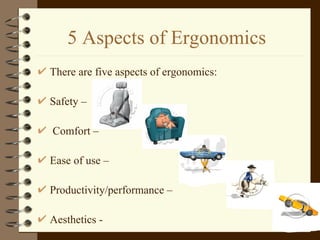
5 Aspects of Ergonomics There are five aspects of ergonomics:  Safety – Comfort –  Ease of use –  Productivity/performance –  Aesthetics -
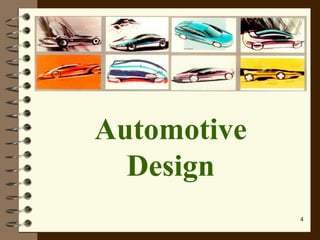
Automotive Design
Aspects of  Designing Car Occupant Packaging Computer-Aided Ergonomics Design Of car Visual Aspects in vehicle Design Automotive  Seat Design  for sitting comfort Physical Aspect of Car Design Design of symbols for automobile Control and Displays Informational aspect of vehicle Design
Ergonomic Aspects in automobile Design Visual aspect Air Bag warnings Comfort, usability seat belts Collision avoidance system Traction control system Brake assist system Navigation system Vehicle interior, controls, pedals etc Reach to advanced recreational systems.
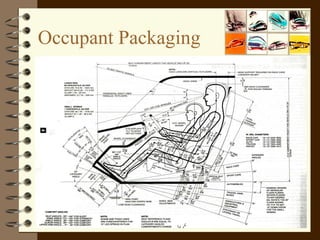
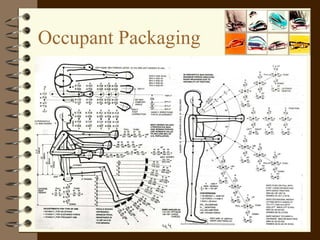
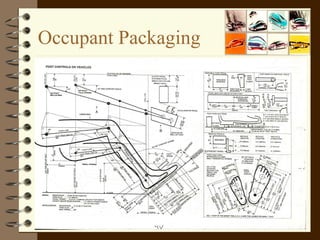
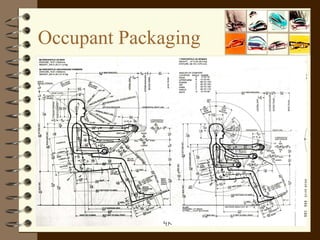
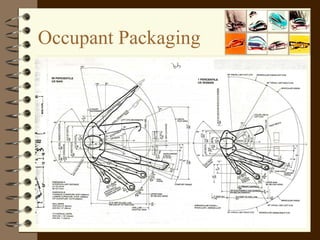
Occupant Packaging Workspace Anthropometry  : Conventional Static Measurements anthropologist (are taken on the  human body in rigid , standarized position) Functional Task Oriented Measurements Engineer Designer (are taken with the human body at work , in motion or in workspace attitude and typically are expressed as 3 dimensions.)
Occupant Packaging
Occupant Packaging
Occupant Packaging
Occupant Packaging
Occupant Packaging
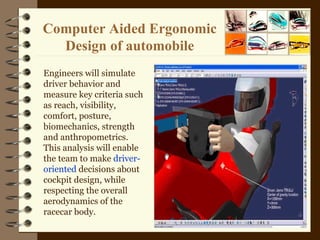
Computer Aided Ergonomic Design of automobile Engineers will simulate driver behavior and measure key criteria such as reach, visibility, comfort, posture, biomechanics, strength and anthropometrics. This analysis will enable the team to make  driver-oriented  decisions about cockpit design, while respecting the overall aerodynamics of the racecar body.
Simulation with computer To optimize  cockpit  ergonomics, engineers will first create a  digital model of each driver  using a combination of  laser scanning  and manual  anthropometrical techniques .  The resulting virtual models will be used to analyze and improve specific accommodation issues such as  driver comfort  and  security , and  accessibility  and  serviceability  of components inside the cockpit during pit stops—without the need to involve the actual drivers .
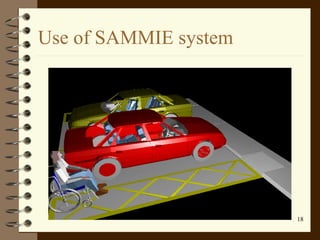
The SAMMIE system SAMMIE CAD Limited is an Ergonomics Design Consultancy dedicated to improving product, workplace, and service design for the benefit of the user and ultimately the producer.  SAMMIE CAD Limited was started in 1986 by the SAMMIE system originators to continue the consultancy work of the SAMMIE Research Group, U.K. Has its reach in other 91 countries Approved by SAE
The SAMMIE System  The  SAMMIE  system is a computer based Human Modeling tool .  Its capabilities make it an  invaluable tool  to designers and design teams working on products that are used by people .  The system offers the following  advantages :  3D analysis of fit, reach, vision and posture.  reduced timescale.  early input of ergonomics expertise.  rapid interactive design.  improved communication.  cost effective ergonomics
Application areas These include the design and layout of equipment and furniture in public areas, offices and homes; cockpit, cabin and interior evaluations for all types of vehicles; design of control panels; field of view, reflection and mirror evaluations; safety and maintenance evaluations etc.
Use of SAMMIE system
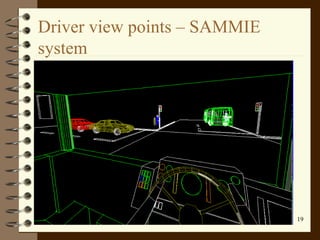
Driver view points – SAMMIE system
Advantages of SAMMIE Product concepts can be built within SAMMIE or imported from an external CAD system and rapidly assessed.  A complete range of human mannikins can be created to simulate any age, gender, nationality, and body shape.  Ergonomics input is provided right from the concept stage of design reducing the likelihood of expensive or unfeasible modifications being necessary at downstream stages.  The system promotes the exploration of a wide range of design solutions.  The systems supports the 3D analysis of complex tasks.  The combination of product concepts populated with human mannikins provides an excellent forum for all members of the design team.  The ergonomics issues can be investigated throughout the design process thereby promoting the 'right first time' philosophy.
Automotive  Seat Design  For Sitting Comfort kind of motor vehicles: 1. Family and personal business sedan 2. Minivan and off-road vehicle 3. Sport cars Three different occupants in the vehicle :  1)Driver 2) Front seat passenger 3) Rear set passengers
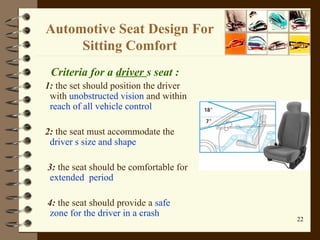
Automotive Seat Design For Sitting Comfort Criteria for a  driver  s seat : 1:  the set should position the driver with  unobstructed vision  and within  reach of all vehicle control 2:  the seat must accommodate the  driver s size and shape 3:  the seat should be comfortable for  extended  period 4:  the seat should provide a  safe zone for the driver in a crash
Why should respect  Ergonomics In Design?   Safety Safety in a race car is the  art  of  protecting  the human occupant, at  whatever cost  to the car. Designing the car to be damaged minimally while hindering driver safety is definitely the wrong approach. So how do we protect the driver?  Well first we need to consider the basic physiological weak points of the human body.
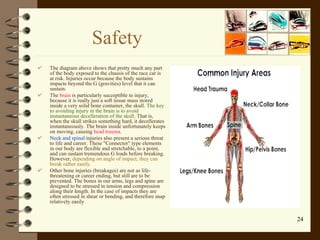
Safety The diagram above shows that pretty much any part of the body exposed to the chassis of the race car is at risk .  Injuries occur because the body sustains impacts beyond the G  ( gravities )  level that it can sustain . The  brain  is particularly succeptible to injury, because it is really just a soft tissue mass stored inside a very solid bone container, the skull.  The key to avoiding injury in the brain is to avoid instantaneous decelleration of the skull . That is, when the skull strikes something hard, it decellerates instantaneously. The brain inside unfortunately keeps on moving, causing  head trauma.   Neck and spinal  injuries also present a serious threat to life and career. These "Connector" type elements in our body are flexible and stretchable, to a point, and can sustain tremendous G loads before breaking. However,  depending on angle of impact, they can break rather easily. Other bone injuries (breakages) are not as life-threatening or career ending, but still are to be prevented. The bones in our arms, legs and spine are designed to be stressed in tension and compression along their length. In the case of impacts they are often stressed in shear or bending, and therefore snap relatively easily
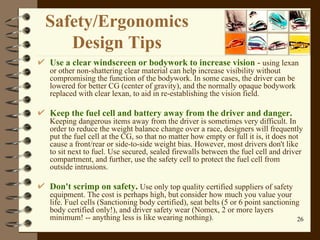
Safety / Ergonomics  Design Tips  Use energy absorbing materials in the collapsable crash structure  -  In lower cost racing cars, most of the car is usually built from mild steel. Using that same mild steel in areas such as wishbones means that impacts will bend the material long before it breaks the material, meaning energy absorption takes place over a longer period.  For light weight, use a stressed skin over a lightweight core material  -  crushable zones such as the nose cone on a formula car can be made from balsa, honeycomb or high density styrofoam covered with a stressed skin of composites .  Triangulate the driver "safety cell" to prevent collapse -   The safety cell can be designed in such a way that a catastrophic impact which collapses the safety cell, will make the safety cell expand away from the driver, instead of collapsing it onto the driver. In the case of a frontal impact, this would mean the sides of the cockpit would expand outward, upward and downward, instead of inward.
Use a clear windscreen or bodywork to increase vision  -  using lexan or other non-shattering clear material can help increase visibility without compromising the function of the bodywork. In some cases, the driver can be lowered for better CG (center of gravity), and the normally opaque bodywork replaced with clear lexan, to aid in re-establishing the vision field.  Keep the fuel cell and battery away from the driver and danger.   Keeping dangerous items away from the driver is sometimes very difficult. In order to reduce the weight balance change over a race, designers will frequently put the fuel cell at the CG, so that no matter how empty or full it is, it does not cause a front/rear or side-to-side weight bias. However, most drivers don't like to sit next to fuel. Use secured, sealed firewalls between the fuel cell and driver compartment, and further, use the safety cell to protect the fuel cell from outside intrusions.  Don't scrimp on safety .  Use only top quality certified suppliers of safety equipment. The cost is perhaps high, but consider how much you value your life. Fuel cells (Sanctioning body certified), seat belts (5 or 6 point sanctioning body certified only!), and driver safety wear (Nomex, 2 or more layers minimum! -- anything less is like wearing nothing).  Safety / Ergonomics  Design Tips
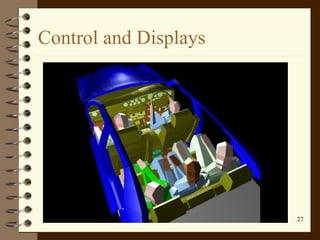
Control and Displays
Design Of Symbols For  Automobile Control and Displays 1) Digital meters  Discreet digital meters maximize forward visibility and help create a sense of uncluttered spaciousness.  2) Triangle-motif steering wheel  The triangle-motif steering wheel helps harmonize exterior and interior design, for a feeling of unity throughout.  3) Centrally positioned audio panel  A 2DIN opening for audio components is centrally positioned at the top of the instrument panel for easy access and visibility.  4) Textured dashboard and console  The dashboard centre, floor console, and front pillars are trimmed with a new textured material with a refined look and feel.  5) Sporty two-tone fascia  The sporty two-tone fascia adds a touch of pizzazz to the Liana's interior.
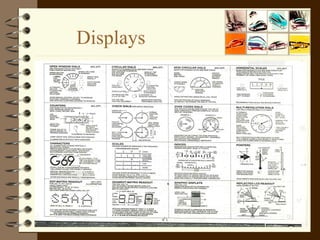
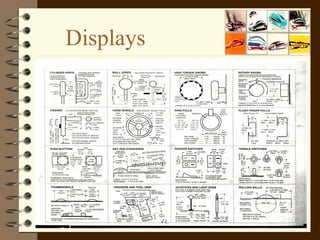
Displays
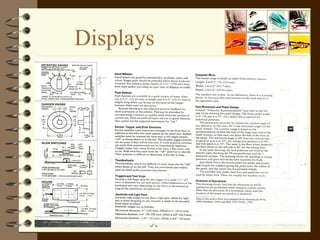
Displays
Displays
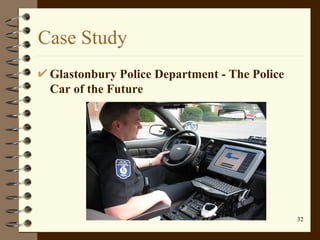
Case Study Glastonbury Police Department - The Police Car of the Future
PROBLEM The benefits of new technology have transformed patrol cars across the country; a vehicle mounted computing device with wireless capability means officers have realtime access to information, database files and GPS mapping systems. However, this capability does not come without drawbacks.  Two of the most frequently cited complaints are space issues in the cab as more and more hardware is installed and the need to look down to type and access the computer system.  Furthermore, departments are constrained by cost, space limits, power and existing infrastructure. The overall objectives for the department are officer safety and to improve environment and efficiency while watching the cost.
Problems Cont… Officer Robin Timmer of the Glastonbury Police Department describes the older system installed in the patrol cars. “You couldn’t move around the car, keys flew off the keyboard, when an officer turned in his seat he would knock a USB loose. Once an officer accidentally spilled milk on the laptop and fried the system! We had to explain that our computers are lactose intolerant.”  The current system simply was not built for in-vehicle usage and posed a threat to officer safety.  When considering a new mobile solution the Glastonbury PD placed a high importance on human factors and ergonomics. “There’s more stuff, more radios, more hardware, and a lot of it is mounted directly in front of the airbag,”  Timmer explains. “Over the past several years, we’ve seen violent offenses against police decline, but what we’ve seen is a 30 – 35% increase in the amount of injuries to an officer in a police cruiser.
Solutions The GPD performed their due diligence in researching a mobile computing solution. They wanted a system that would meet their exacting needs for ruggedness, interior ergonomics and officer safety as well as offer best in class computing technology
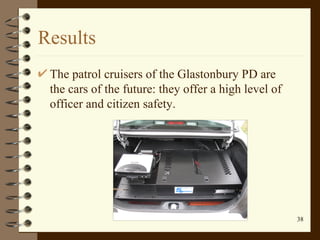
Instruments installed cabled to a TG-3 backlit,  spill resistant keyboard and  Bright Planar LX1200 touch screen display in the front of the patrol car on ergonomic The Glastonbury PD took their mobile solution one step farther: they installed the 54WARD Integrated Solution system developed by 54WARD.  The 54WARD™ CORE command provides a single operational platform that allows multiple levels  of operation such as voice command, touch screen control and traditional methods of operation  This system utilizes software originally developed by the University of New Hampshire.
Overveiw The Glastonbury Police Department patrols 54 square miles - the largest municipility in the state of Connecticut. The GPD fleet of 17 marked patrol cars has deployed an extremely progressive mobile computing solution which has brought them in the spotlight of national attention.
Results The patrol cruisers of the Glastonbury PD are the cars of the future: they offer a high level of officer and citizen safety.
The sayings “ The new computing system is easy to use . . . no problems. A definite improvement from what we had. Before we had to hunt and peck the same time we were trying to drive. This new system has greatly improved officer safety.” Agent Jeff HodderGlastonbury PD
REFERENCES Aesthetics and Engineering Design http://design.stanford.edu/PD/kbase/Aesthetics_and_Engineering_Design.pdf Introduction of design   http://deed.ryerson.ca/DesignScience/1.html design basics in IT http://www-3.ibm.com/ibm/easy/eou_ext.nsf/Publish/6 user engineering in IT http://www-3.ibm.com/ibm/easy/eou_ext.nsf/Publish/1996 Automotive Ergonomics Brayan Peacock & Waldemar Karowski Sitting posture   E. Granjin
 
THANK YOU

Ergonomics Automotive

  • 1.
    Automotive Design with Respect to Ergonomics VINAY .S
  • 2.
    Introduction to DesignA goal- directed problem solving activity (Archer 1965). Design is a interplay between what we want to achieve and how we want to satisfy them (Suh 1990). Design is a process of converting information that characterize the needs and requirements for a product into knowledge about the product (Mistree 1992).
  • 3.
    5 Aspects ofErgonomics There are five aspects of ergonomics: Safety – Comfort – Ease of use – Productivity/performance – Aesthetics -
  • 4.
  • 5.
    Aspects of Designing Car Occupant Packaging Computer-Aided Ergonomics Design Of car Visual Aspects in vehicle Design Automotive Seat Design for sitting comfort Physical Aspect of Car Design Design of symbols for automobile Control and Displays Informational aspect of vehicle Design
  • 6.
    Ergonomic Aspects inautomobile Design Visual aspect Air Bag warnings Comfort, usability seat belts Collision avoidance system Traction control system Brake assist system Navigation system Vehicle interior, controls, pedals etc Reach to advanced recreational systems.
  • 7.
    Occupant Packaging WorkspaceAnthropometry : Conventional Static Measurements anthropologist (are taken on the human body in rigid , standarized position) Functional Task Oriented Measurements Engineer Designer (are taken with the human body at work , in motion or in workspace attitude and typically are expressed as 3 dimensions.)
  • 8.
  • 9.
  • 10.
  • 11.
  • 12.
  • 13.
    Computer Aided ErgonomicDesign of automobile Engineers will simulate driver behavior and measure key criteria such as reach, visibility, comfort, posture, biomechanics, strength and anthropometrics. This analysis will enable the team to make driver-oriented decisions about cockpit design, while respecting the overall aerodynamics of the racecar body.
  • 14.
    Simulation with computerTo optimize cockpit ergonomics, engineers will first create a digital model of each driver using a combination of laser scanning and manual anthropometrical techniques . The resulting virtual models will be used to analyze and improve specific accommodation issues such as driver comfort and security , and accessibility and serviceability of components inside the cockpit during pit stops—without the need to involve the actual drivers .
  • 15.
    The SAMMIE systemSAMMIE CAD Limited is an Ergonomics Design Consultancy dedicated to improving product, workplace, and service design for the benefit of the user and ultimately the producer. SAMMIE CAD Limited was started in 1986 by the SAMMIE system originators to continue the consultancy work of the SAMMIE Research Group, U.K. Has its reach in other 91 countries Approved by SAE
  • 16.
    The SAMMIE System The SAMMIE system is a computer based Human Modeling tool . Its capabilities make it an invaluable tool to designers and design teams working on products that are used by people . The system offers the following advantages : 3D analysis of fit, reach, vision and posture. reduced timescale. early input of ergonomics expertise. rapid interactive design. improved communication. cost effective ergonomics
  • 17.
    Application areas Theseinclude the design and layout of equipment and furniture in public areas, offices and homes; cockpit, cabin and interior evaluations for all types of vehicles; design of control panels; field of view, reflection and mirror evaluations; safety and maintenance evaluations etc.
  • 18.
  • 19.
    Driver view points– SAMMIE system
  • 20.
    Advantages of SAMMIEProduct concepts can be built within SAMMIE or imported from an external CAD system and rapidly assessed. A complete range of human mannikins can be created to simulate any age, gender, nationality, and body shape. Ergonomics input is provided right from the concept stage of design reducing the likelihood of expensive or unfeasible modifications being necessary at downstream stages. The system promotes the exploration of a wide range of design solutions. The systems supports the 3D analysis of complex tasks. The combination of product concepts populated with human mannikins provides an excellent forum for all members of the design team. The ergonomics issues can be investigated throughout the design process thereby promoting the 'right first time' philosophy.
  • 21.
    Automotive SeatDesign For Sitting Comfort kind of motor vehicles: 1. Family and personal business sedan 2. Minivan and off-road vehicle 3. Sport cars Three different occupants in the vehicle : 1)Driver 2) Front seat passenger 3) Rear set passengers
  • 22.
    Automotive Seat DesignFor Sitting Comfort Criteria for a driver s seat : 1: the set should position the driver with unobstructed vision and within reach of all vehicle control 2: the seat must accommodate the driver s size and shape 3: the seat should be comfortable for extended period 4: the seat should provide a safe zone for the driver in a crash
  • 23.
    Why should respect Ergonomics In Design? Safety Safety in a race car is the art of protecting the human occupant, at whatever cost to the car. Designing the car to be damaged minimally while hindering driver safety is definitely the wrong approach. So how do we protect the driver? Well first we need to consider the basic physiological weak points of the human body.
  • 24.
    Safety The diagramabove shows that pretty much any part of the body exposed to the chassis of the race car is at risk . Injuries occur because the body sustains impacts beyond the G ( gravities ) level that it can sustain . The brain is particularly succeptible to injury, because it is really just a soft tissue mass stored inside a very solid bone container, the skull. The key to avoiding injury in the brain is to avoid instantaneous decelleration of the skull . That is, when the skull strikes something hard, it decellerates instantaneously. The brain inside unfortunately keeps on moving, causing head trauma. Neck and spinal injuries also present a serious threat to life and career. These "Connector" type elements in our body are flexible and stretchable, to a point, and can sustain tremendous G loads before breaking. However, depending on angle of impact, they can break rather easily. Other bone injuries (breakages) are not as life-threatening or career ending, but still are to be prevented. The bones in our arms, legs and spine are designed to be stressed in tension and compression along their length. In the case of impacts they are often stressed in shear or bending, and therefore snap relatively easily
  • 25.
    Safety / Ergonomics Design Tips Use energy absorbing materials in the collapsable crash structure - In lower cost racing cars, most of the car is usually built from mild steel. Using that same mild steel in areas such as wishbones means that impacts will bend the material long before it breaks the material, meaning energy absorption takes place over a longer period. For light weight, use a stressed skin over a lightweight core material - crushable zones such as the nose cone on a formula car can be made from balsa, honeycomb or high density styrofoam covered with a stressed skin of composites . Triangulate the driver "safety cell" to prevent collapse - The safety cell can be designed in such a way that a catastrophic impact which collapses the safety cell, will make the safety cell expand away from the driver, instead of collapsing it onto the driver. In the case of a frontal impact, this would mean the sides of the cockpit would expand outward, upward and downward, instead of inward.
  • 26.
    Use a clearwindscreen or bodywork to increase vision - using lexan or other non-shattering clear material can help increase visibility without compromising the function of the bodywork. In some cases, the driver can be lowered for better CG (center of gravity), and the normally opaque bodywork replaced with clear lexan, to aid in re-establishing the vision field. Keep the fuel cell and battery away from the driver and danger. Keeping dangerous items away from the driver is sometimes very difficult. In order to reduce the weight balance change over a race, designers will frequently put the fuel cell at the CG, so that no matter how empty or full it is, it does not cause a front/rear or side-to-side weight bias. However, most drivers don't like to sit next to fuel. Use secured, sealed firewalls between the fuel cell and driver compartment, and further, use the safety cell to protect the fuel cell from outside intrusions. Don't scrimp on safety . Use only top quality certified suppliers of safety equipment. The cost is perhaps high, but consider how much you value your life. Fuel cells (Sanctioning body certified), seat belts (5 or 6 point sanctioning body certified only!), and driver safety wear (Nomex, 2 or more layers minimum! -- anything less is like wearing nothing). Safety / Ergonomics Design Tips

  • 27.
  • 28.
    Design Of SymbolsFor Automobile Control and Displays 1) Digital meters Discreet digital meters maximize forward visibility and help create a sense of uncluttered spaciousness. 2) Triangle-motif steering wheel The triangle-motif steering wheel helps harmonize exterior and interior design, for a feeling of unity throughout. 3) Centrally positioned audio panel A 2DIN opening for audio components is centrally positioned at the top of the instrument panel for easy access and visibility. 4) Textured dashboard and console The dashboard centre, floor console, and front pillars are trimmed with a new textured material with a refined look and feel. 5) Sporty two-tone fascia The sporty two-tone fascia adds a touch of pizzazz to the Liana's interior.
  • 29.
  • 30.
  • 31.
  • 32.
    Case Study GlastonburyPolice Department - The Police Car of the Future
  • 33.
    PROBLEM The benefitsof new technology have transformed patrol cars across the country; a vehicle mounted computing device with wireless capability means officers have realtime access to information, database files and GPS mapping systems. However, this capability does not come without drawbacks. Two of the most frequently cited complaints are space issues in the cab as more and more hardware is installed and the need to look down to type and access the computer system. Furthermore, departments are constrained by cost, space limits, power and existing infrastructure. The overall objectives for the department are officer safety and to improve environment and efficiency while watching the cost.
  • 34.
    Problems Cont… OfficerRobin Timmer of the Glastonbury Police Department describes the older system installed in the patrol cars. “You couldn’t move around the car, keys flew off the keyboard, when an officer turned in his seat he would knock a USB loose. Once an officer accidentally spilled milk on the laptop and fried the system! We had to explain that our computers are lactose intolerant.” The current system simply was not built for in-vehicle usage and posed a threat to officer safety. When considering a new mobile solution the Glastonbury PD placed a high importance on human factors and ergonomics. “There’s more stuff, more radios, more hardware, and a lot of it is mounted directly in front of the airbag,” Timmer explains. “Over the past several years, we’ve seen violent offenses against police decline, but what we’ve seen is a 30 – 35% increase in the amount of injuries to an officer in a police cruiser.
  • 35.
    Solutions The GPDperformed their due diligence in researching a mobile computing solution. They wanted a system that would meet their exacting needs for ruggedness, interior ergonomics and officer safety as well as offer best in class computing technology
  • 36.
    Instruments installed cabledto a TG-3 backlit, spill resistant keyboard and Bright Planar LX1200 touch screen display in the front of the patrol car on ergonomic The Glastonbury PD took their mobile solution one step farther: they installed the 54WARD Integrated Solution system developed by 54WARD. The 54WARD™ CORE command provides a single operational platform that allows multiple levels of operation such as voice command, touch screen control and traditional methods of operation This system utilizes software originally developed by the University of New Hampshire.
  • 37.
    Overveiw The GlastonburyPolice Department patrols 54 square miles - the largest municipility in the state of Connecticut. The GPD fleet of 17 marked patrol cars has deployed an extremely progressive mobile computing solution which has brought them in the spotlight of national attention.
  • 38.
    Results The patrolcruisers of the Glastonbury PD are the cars of the future: they offer a high level of officer and citizen safety.
  • 39.
    The sayings “The new computing system is easy to use . . . no problems. A definite improvement from what we had. Before we had to hunt and peck the same time we were trying to drive. This new system has greatly improved officer safety.” Agent Jeff HodderGlastonbury PD
  • 40.
    REFERENCES Aesthetics andEngineering Design http://design.stanford.edu/PD/kbase/Aesthetics_and_Engineering_Design.pdf Introduction of design http://deed.ryerson.ca/DesignScience/1.html design basics in IT http://www-3.ibm.com/ibm/easy/eou_ext.nsf/Publish/6 user engineering in IT http://www-3.ibm.com/ibm/easy/eou_ext.nsf/Publish/1996 Automotive Ergonomics Brayan Peacock & Waldemar Karowski Sitting posture E. Granjin
  • 41.
  • 42.