SAI TEJA
15311A03D3
MECHANICAL
B3
 What is an Anti-Lock Braking System (ABS)?
 Motivation for ABS Development
 Illustration Of ABS
 Slip Rate
 Components Of ABS
 Block Diagram Of an ABS
 Types Of ABS
 Advantages and Applications
 Disadvantages
 Conclusion
 An anti-lock brake system is a
feedback control system that
modulates brake pressure in
response to measured wheel
deceleration, preventing the
controlled wheels from becoming
fully locked
 Under hard braking, an ideal braking system
should:
 provide the shortest stopping distances on all
surfaces
 maintain vehicle stability and steerability
Anti-lock braking systems were
developed to best meet these needs.
 During ABS operation, the
target slip rate can be
from 10 to 30%.
 0% slip means the wheel is
rolling freely, while 100 %
means the wheel is fully
locked
 A slip rate of 25 % means
the velocity of a wheel is
25 % less than that of a
freely rolling wheel at the
same vehicle speed
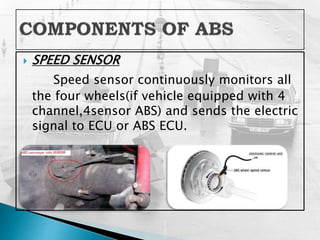
 SPEED SENSOR
Speed sensor continuously monitors all
the four wheels(if vehicle equipped with 4
channel,4sensor ABS) and sends the electric
signal to ECU or ABS ECU.
 PUMP AND VALVES
The function of valves is to release pressure
of the brake lines when ECU signals it.
Valve Has three Positions:
 In position one, the valve is open; pressure from
the master cylinder is passed right through to the
brake.
 In position two, the valve blocks the line,
isolating that brake from the master cylinder.
 In position three, the valve releases some of the
pressure from the brakes
Pump’s function is to restore pressure
in the brake lines every time the valve releases.
 ELECTRONIC CONTROL UNIT(ECU)
 The function of ECU is to control the valve and
pump actions and to receive the signal from the
speed sensor.
 It acts as a brain of the ABS.
 Apart from being an integral part of ABS,it
performs all the other automation work in the
vehicle viz : Electronic fuel injection(EFI) etc.
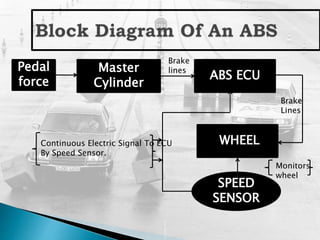
Master
Cylinder
ABS ECU
Pedal
force
WHEEL
SPEED
SENSOR
Brake
lines
Brake
Lines
Continuous Electric Signal To ECU
By Speed Sensor.
Monitors
wheel
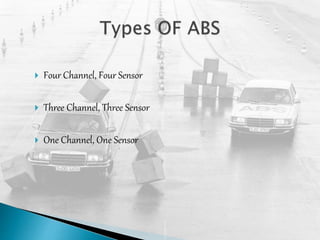
 Four Channel, Four Sensor
 Three Channel, Three Sensor
 One Channel, One Sensor
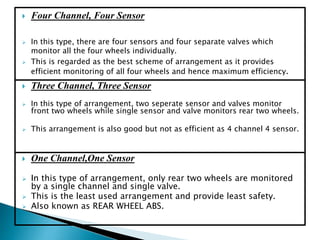
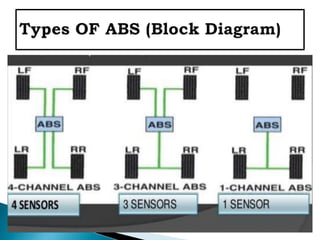
 One Channel,One Sensor
 In this type of arrangement, only rear two wheels are monitored
by a single channel and single valve.
 This is the least used arrangement and provide least safety.
 Also known as REAR WHEEL ABS.
 Four Channel, Four Sensor
 In this type, there are four sensors and four separate valves which
monitor all the four wheels individually.
 This is regarded as the best scheme of arrangement as it provides
efficient monitoring of all four wheels and hence maximum efficiency.
 Three Channel, Three Sensor
 In this type of arrangement, two seperate sensor and valves monitor
front two wheels while single sensor and valve monitors rear two wheels.
 This arrangement is also good but not as efficient as 4 channel 4 sensor.
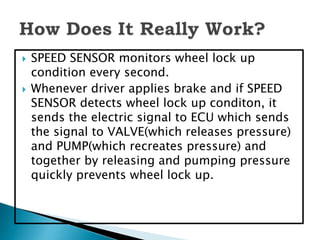
 SPEED SENSOR monitors wheel lock up
condition every second.
 Whenever driver applies brake and if SPEED
SENSOR detects wheel lock up conditon, it
sends the electric signal to ECU which sends
the signal to VALVE(which releases pressure)
and PUMP(which recreates pressure) and
together by releasing and pumping pressure
quickly prevents wheel lock up.
 It provides steering ability to the driver in
case of wheel lock up.
 It provides better control of the vehicle in wet
road conditions.
 It provides better cornering.
 Overall it is an essential safety feature when
used wisely.
 It reduces stopping distance of the
vehicle(not necessarily).
 ABS is effective on dry concrete roads as it
reduces stopping distance of the vehicle.
.
BETTER CORNERING STEERING ABILITY
 It is costly.
 It is a speed sensitive equipment.
 Since the primary objective of ABS is to give
steer ability and hence the stopping distance
may not necessarily decrease every time.
 Maintenance cost of a car equipped with
ABS is more.
 ABS is a very essential safety equipment
which should be equipped in every vehicle for
more safety on road.
 Also it should be kept in mind that driver
should drive wisely, he should not over speed
the vehicle on account of ABS as a high speed
turning may roll the vehicle.

ABS Powerpoint Presntation

  • 1.
  • 2.
     What isan Anti-Lock Braking System (ABS)?  Motivation for ABS Development  Illustration Of ABS  Slip Rate  Components Of ABS  Block Diagram Of an ABS  Types Of ABS  Advantages and Applications  Disadvantages  Conclusion
  • 3.
     An anti-lockbrake system is a feedback control system that modulates brake pressure in response to measured wheel deceleration, preventing the controlled wheels from becoming fully locked
  • 4.
     Under hardbraking, an ideal braking system should:  provide the shortest stopping distances on all surfaces  maintain vehicle stability and steerability Anti-lock braking systems were developed to best meet these needs.
  • 5.
     During ABSoperation, the target slip rate can be from 10 to 30%.  0% slip means the wheel is rolling freely, while 100 % means the wheel is fully locked  A slip rate of 25 % means the velocity of a wheel is 25 % less than that of a freely rolling wheel at the same vehicle speed
  • 6.
     SPEED SENSOR Speedsensor continuously monitors all the four wheels(if vehicle equipped with 4 channel,4sensor ABS) and sends the electric signal to ECU or ABS ECU.
  • 7.
     PUMP ANDVALVES The function of valves is to release pressure of the brake lines when ECU signals it. Valve Has three Positions:  In position one, the valve is open; pressure from the master cylinder is passed right through to the brake.  In position two, the valve blocks the line, isolating that brake from the master cylinder.  In position three, the valve releases some of the pressure from the brakes Pump’s function is to restore pressure in the brake lines every time the valve releases.
  • 8.
     ELECTRONIC CONTROLUNIT(ECU)  The function of ECU is to control the valve and pump actions and to receive the signal from the speed sensor.  It acts as a brain of the ABS.  Apart from being an integral part of ABS,it performs all the other automation work in the vehicle viz : Electronic fuel injection(EFI) etc.
  • 11.
  • 12.
     Four Channel,Four Sensor  Three Channel, Three Sensor  One Channel, One Sensor
  • 13.
     One Channel,OneSensor  In this type of arrangement, only rear two wheels are monitored by a single channel and single valve.  This is the least used arrangement and provide least safety.  Also known as REAR WHEEL ABS.  Four Channel, Four Sensor  In this type, there are four sensors and four separate valves which monitor all the four wheels individually.  This is regarded as the best scheme of arrangement as it provides efficient monitoring of all four wheels and hence maximum efficiency.  Three Channel, Three Sensor  In this type of arrangement, two seperate sensor and valves monitor front two wheels while single sensor and valve monitors rear two wheels.  This arrangement is also good but not as efficient as 4 channel 4 sensor.
  • 15.
     SPEED SENSORmonitors wheel lock up condition every second.  Whenever driver applies brake and if SPEED SENSOR detects wheel lock up conditon, it sends the electric signal to ECU which sends the signal to VALVE(which releases pressure) and PUMP(which recreates pressure) and together by releasing and pumping pressure quickly prevents wheel lock up.
  • 16.
     It providessteering ability to the driver in case of wheel lock up.  It provides better control of the vehicle in wet road conditions.  It provides better cornering.  Overall it is an essential safety feature when used wisely.  It reduces stopping distance of the vehicle(not necessarily).
  • 17.
     ABS iseffective on dry concrete roads as it reduces stopping distance of the vehicle. .
  • 18.
  • 19.
     It iscostly.  It is a speed sensitive equipment.  Since the primary objective of ABS is to give steer ability and hence the stopping distance may not necessarily decrease every time.  Maintenance cost of a car equipped with ABS is more.
  • 20.
     ABS isa very essential safety equipment which should be equipped in every vehicle for more safety on road.  Also it should be kept in mind that driver should drive wisely, he should not over speed the vehicle on account of ABS as a high speed turning may roll the vehicle.