Car Safety Features
A Short Introduction to safety in cars.
Common Safety Features
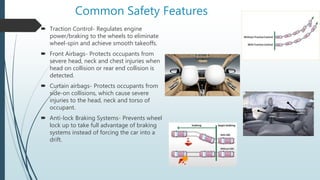
 Traction Control- Regulates engine
power/braking to the wheels to eliminate
wheel-spin and achieve smooth takeoffs.
 Front Airbags- Protects occupants from
severe head, neck and chest injuries when
head on collision or rear end collision is
detected.
 Curtain airbags- Protects occupants from
side-on collisions, which cause severe
injuries to the head, neck and torso of
occupant.
 Anti-lock Braking Systems- Prevents wheel
lock up to take full advantage of braking
systems instead of forcing the car into a
drift.
Energy Transfer in Braking/Accidents.
 In Braking:
 Brakes apply pressure to in wheel rotor disc,
which reduces acceleration as kinetic energy of
the wheels turn into heat energy due to the
friction applied by the brake.
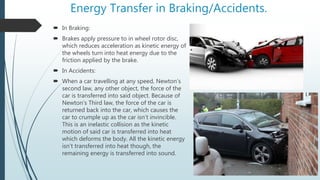
 In Accidents:
 When a car travelling at any speed, Newton’s
second law, any other object, the force of the
car is transferred into said object. Because of
Newton’s Third law, the force of the car is
returned back into the car, which causes the
car to crumple up as the car isn’t invincible.
This is an inelastic collision as the kinetic
motion of said car is transferred into heat
which deforms the body. All the kinetic energy
isn’t transferred into heat though, the
remaining energy is transferred into sound.
Active & Passive Safety Features.
 Active Features:
 Anti-Lock Braking systems
 Traction Control
 Forward Collision sensors
 Lane Departure sensors
 Passive Features:
 Paddle shift controls
 Crumple zones
 Seat-belts
 Airbags
My Safety Features
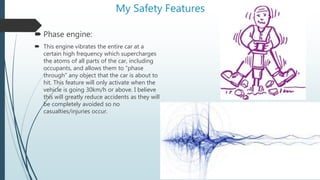
 Phase engine:
 This engine vibrates the entire car at a
certain high frequency which supercharges
the atoms of all parts of the car, including
occupants, and allows them to “phase
through” any object that the car is about to
hit. This feature will only activate when the
vehicle is going 30km/h or above. I believe
this will greatly reduce accidents as they will
be completely avoided so no
casualties/injuries occur.

Car safety features

  • 1.
    Car Safety Features AShort Introduction to safety in cars.
  • 2.
    Common Safety Features Traction Control- Regulates engine power/braking to the wheels to eliminate wheel-spin and achieve smooth takeoffs.  Front Airbags- Protects occupants from severe head, neck and chest injuries when head on collision or rear end collision is detected.  Curtain airbags- Protects occupants from side-on collisions, which cause severe injuries to the head, neck and torso of occupant.  Anti-lock Braking Systems- Prevents wheel lock up to take full advantage of braking systems instead of forcing the car into a drift.
  • 3.
    Energy Transfer inBraking/Accidents.  In Braking:  Brakes apply pressure to in wheel rotor disc, which reduces acceleration as kinetic energy of the wheels turn into heat energy due to the friction applied by the brake.  In Accidents:  When a car travelling at any speed, Newton’s second law, any other object, the force of the car is transferred into said object. Because of Newton’s Third law, the force of the car is returned back into the car, which causes the car to crumple up as the car isn’t invincible. This is an inelastic collision as the kinetic motion of said car is transferred into heat which deforms the body. All the kinetic energy isn’t transferred into heat though, the remaining energy is transferred into sound.
  • 4.
    Active & PassiveSafety Features.  Active Features:  Anti-Lock Braking systems  Traction Control  Forward Collision sensors  Lane Departure sensors  Passive Features:  Paddle shift controls  Crumple zones  Seat-belts  Airbags
  • 5.
    My Safety Features Phase engine:  This engine vibrates the entire car at a certain high frequency which supercharges the atoms of all parts of the car, including occupants, and allows them to “phase through” any object that the car is about to hit. This feature will only activate when the vehicle is going 30km/h or above. I believe this will greatly reduce accidents as they will be completely avoided so no casualties/injuries occur.