Viral Exanthem Part III:
Rubella:
Introduction:
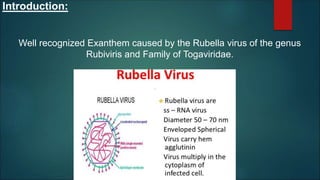
Well recognized Exanthem caused by the Rubella virus of the genus
Rubiviris and Family of Togaviridae.
Epidemiology:
Incidence and prevalence
 Epidemics occur during the spring.
 Transmission via droplets from the nasopharynx.
 Infectivity is greatest at the end of the incubation period and falls
rapidly during the 4 days after the appearance of the rash.
Age
 Infection is most common amongst older children and young adults.
Pathophysiology:
Causative organisms
 Rubella virus is a member of the Rubivirus genus of the family
Togaviridae.
 Four types (1E, 1G, 1J and 2B) account for over 70% of infections.
Clinical features:
 Incubation period of about 14 days (range 12–21 days).
 Children rarely experience prodromal symptoms
 Adults have a brief prodromal illness lasting 1–5 days:
 Fever up to 39°C,
 Headache and malaise,
 sore throat without coryza and
 suffusion of the conjunctivae with a gritty sensation.
 The symptoms subside as the rash develops.
 Forschheimer sign: An enanthem of dull‐red macules or petechiae confined to the soft
palate is present in up to 20% of patients during the prodromal period or on the first day of
the rash.
Lymphadenopathy:
 Begins 5–7 days before the rash appears and reaches a maximum on the first or second
day of the rash.
 Lymphadenopathy is generalized but characteristically involves the suboccipital,
postauricular and cervical glands.
 The tenderness of the glands subsides after a day or two but palpable enlargement may
continue for several weeks.
Rash:
 Appears towards the end of the Incubation period.
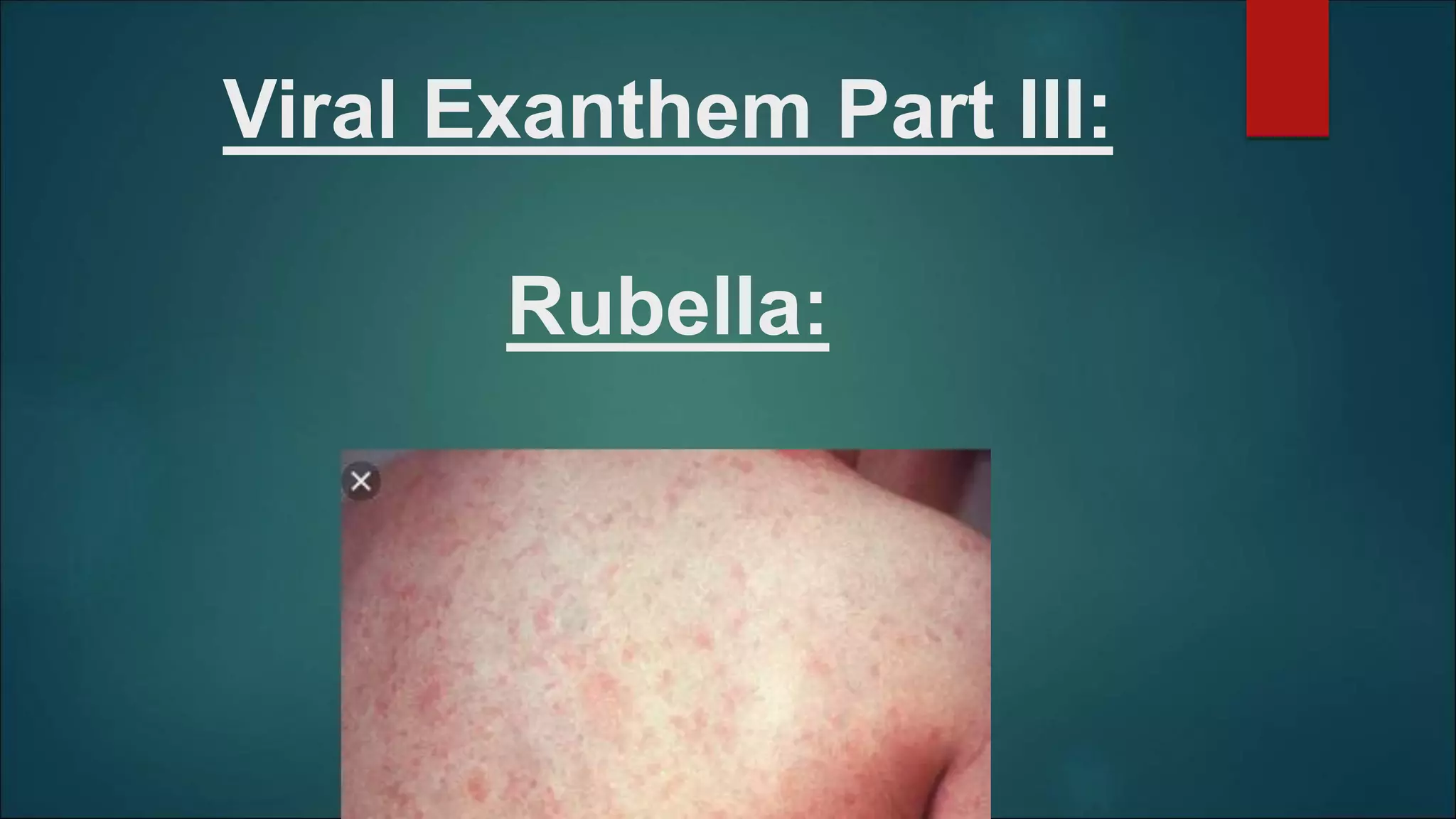
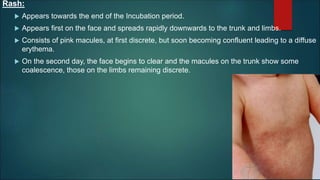
 Appears first on the face and spreads rapidly downwards to the trunk and limbs.
 Consists of pink macules, at first discrete, but soon becoming confluent leading to a diffuse
erythema.
 On the second day, the face begins to clear and the macules on the trunk show some
coalescence, those on the limbs remaining discrete.
Complications and co‐morbidities
 In older children and adults:
 Arthritis affects up to 70% of females and 5% of males.
 Arthritis usually resolves within a month.
 Purpura – thrombocytopaenic or non‐thrombocytopaenic
 Encephalitis
 Haemophagocytic syndrome
Rubella in pregnancy:
First 11 weeks:
 The overall risk of fetal damage and multiple birth defects: 85%.
 Most of the defects are of neurological nature.
 Heart and eye damage is most frequent in embryos infected under 6 weeks;
Between weeks 12 and 16:
 The risk defect: 35% and is principally that of deafness.
 Mental deficiency occurs in embryos of all ages up to about 16 weeks.
After 16 weeks:
 Although fetal infection occurs it does not result in damage.
During the neonatal period:
 Congenital rubella may give rise to a number of manifestations which are self‐limiting
 The most frequent is thrombocytopenic purpura, which may manifest as a transient purpuric rash.
 Jaundice
 Bone lesions
Disease course and prognosis:
By the third day:
 The rash on the trunk has cleared
By the fourth day:
 The eruption on the limbs has also faded.
The rash may be absent in some 40% of cases.
Investigations:
 Labs must be carried out to confirm a diagnosis in pregnancy or immunosuppression.
 Serology remains the gold standard method.
 First clotted blood to be taken immediately upon the appearance of the rash as the antirubella
antibodies can be detected from the time when the rash appears.
 A second blood sample is taken after 7–10 days.
 IgM antibodies suggest acute or recent rubella infection.
 IgG antibodies appear 2–3 weeks later or may indicate prior exposure and immunity.
 In neonates, the presence of IgM and continued antibody production are
indicative of congenital infection.
 RT‐PCR amplification of viral RNA from saliva and throat swabs can also be done.
 Complete Blood Count:
 Normal or
 Leukopenia with an inconstant increase in Plasma Cells.
Management
Prophylaxis:
 Active immunization: with live attenuated rubella virus as part of MMR vaccine is offered to
infants aged 1–2 years old,
 A preschool booster of MMR is also recommended.
 At risk women for e.g. Medical or nursing staff and school teachers can also be given the
rubella vaccine.
 A quadruple vaccine including varicella is also available but there has been concern, but not
confirmation, that this combination leads to a slight increase in convulsions.
 Pregnancy is a contraindication to vaccine and should be avoided for 4 weeks after its
administration.
 Arthralgia is common in adult women 2–4 weeks after vaccination and in children a rubelliform
rash may occur.
 Encephalitis has been reported
Treatment:
 No specific treatment is needed.
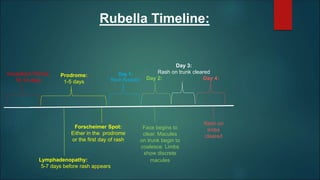
Prodrome:
1-5 days
Forscheimer Spot:
Either in the prodrome
or the first day of rash
Day 1:
Rash Appears Day 2:
Day 3:
Rash on trunk clearedIncubation Period:
10-14 days
Lymphadenopathy:
5-7 days before rash appears
Face begins to
clear. Macules
on trunk begin to
coalesce. Limbs
show discrete
macules
Day 4:
Rash on
limbs
cleared
Rubella Timeline:
Topic to be Discussed in Future:
Erythema Infectiosum.
Previously Discussed:
Measles
Roseola Infantum
Rubella virus ppt

Rubella virus ppt

  • 1.
    Viral Exanthem PartIII: Rubella:
  • 2.
    Introduction: Well recognized Exanthemcaused by the Rubella virus of the genus Rubiviris and Family of Togaviridae.
  • 3.
    Epidemiology: Incidence and prevalence Epidemics occur during the spring.  Transmission via droplets from the nasopharynx.  Infectivity is greatest at the end of the incubation period and falls rapidly during the 4 days after the appearance of the rash. Age  Infection is most common amongst older children and young adults.
  • 4.
    Pathophysiology: Causative organisms  Rubellavirus is a member of the Rubivirus genus of the family Togaviridae.  Four types (1E, 1G, 1J and 2B) account for over 70% of infections.
  • 5.
    Clinical features:  Incubationperiod of about 14 days (range 12–21 days).  Children rarely experience prodromal symptoms  Adults have a brief prodromal illness lasting 1–5 days:  Fever up to 39°C,  Headache and malaise,  sore throat without coryza and  suffusion of the conjunctivae with a gritty sensation.  The symptoms subside as the rash develops.  Forschheimer sign: An enanthem of dull‐red macules or petechiae confined to the soft palate is present in up to 20% of patients during the prodromal period or on the first day of the rash.
  • 6.
    Lymphadenopathy:  Begins 5–7days before the rash appears and reaches a maximum on the first or second day of the rash.  Lymphadenopathy is generalized but characteristically involves the suboccipital, postauricular and cervical glands.  The tenderness of the glands subsides after a day or two but palpable enlargement may continue for several weeks.
  • 7.
    Rash:  Appears towardsthe end of the Incubation period.  Appears first on the face and spreads rapidly downwards to the trunk and limbs.  Consists of pink macules, at first discrete, but soon becoming confluent leading to a diffuse erythema.  On the second day, the face begins to clear and the macules on the trunk show some coalescence, those on the limbs remaining discrete.
  • 8.
    Complications and co‐morbidities In older children and adults:  Arthritis affects up to 70% of females and 5% of males.  Arthritis usually resolves within a month.  Purpura – thrombocytopaenic or non‐thrombocytopaenic  Encephalitis  Haemophagocytic syndrome
  • 9.
    Rubella in pregnancy: First11 weeks:  The overall risk of fetal damage and multiple birth defects: 85%.  Most of the defects are of neurological nature.  Heart and eye damage is most frequent in embryos infected under 6 weeks; Between weeks 12 and 16:  The risk defect: 35% and is principally that of deafness.  Mental deficiency occurs in embryos of all ages up to about 16 weeks. After 16 weeks:  Although fetal infection occurs it does not result in damage. During the neonatal period:  Congenital rubella may give rise to a number of manifestations which are self‐limiting  The most frequent is thrombocytopenic purpura, which may manifest as a transient purpuric rash.  Jaundice  Bone lesions
  • 10.
    Disease course andprognosis: By the third day:  The rash on the trunk has cleared By the fourth day:  The eruption on the limbs has also faded. The rash may be absent in some 40% of cases.
  • 11.
    Investigations:  Labs mustbe carried out to confirm a diagnosis in pregnancy or immunosuppression.  Serology remains the gold standard method.  First clotted blood to be taken immediately upon the appearance of the rash as the antirubella antibodies can be detected from the time when the rash appears.  A second blood sample is taken after 7–10 days.  IgM antibodies suggest acute or recent rubella infection.  IgG antibodies appear 2–3 weeks later or may indicate prior exposure and immunity.  In neonates, the presence of IgM and continued antibody production are indicative of congenital infection.  RT‐PCR amplification of viral RNA from saliva and throat swabs can also be done.  Complete Blood Count:  Normal or  Leukopenia with an inconstant increase in Plasma Cells.
  • 12.
    Management Prophylaxis:  Active immunization:with live attenuated rubella virus as part of MMR vaccine is offered to infants aged 1–2 years old,  A preschool booster of MMR is also recommended.  At risk women for e.g. Medical or nursing staff and school teachers can also be given the rubella vaccine.  A quadruple vaccine including varicella is also available but there has been concern, but not confirmation, that this combination leads to a slight increase in convulsions.  Pregnancy is a contraindication to vaccine and should be avoided for 4 weeks after its administration.  Arthralgia is common in adult women 2–4 weeks after vaccination and in children a rubelliform rash may occur.  Encephalitis has been reported Treatment:  No specific treatment is needed.
  • 13.
    Prodrome: 1-5 days Forscheimer Spot: Eitherin the prodrome or the first day of rash Day 1: Rash Appears Day 2: Day 3: Rash on trunk clearedIncubation Period: 10-14 days Lymphadenopathy: 5-7 days before rash appears Face begins to clear. Macules on trunk begin to coalesce. Limbs show discrete macules Day 4: Rash on limbs cleared Rubella Timeline:
  • 14.
    Topic to beDiscussed in Future: Erythema Infectiosum. Previously Discussed: Measles Roseola Infantum