Measels
(rubeola)
By
Dr. Saurabh Agrawal
Intro
• Highly infectious disease of childhood
• Caused by Specific virus of the group
myxoviruses.
Clicnical characteristics
• Fever
• Catarahal symp. (coryza, cough)
• Typical rash.
• High morbidity and mortality in developing
countries
• Only humans no animal reservoir
Problem statement
• Endemic in entire world
• Common in developing countries and rare in
industrial countries
• Challange for eradication
– Weak immunization sys
– High infectious nature
– Refusal of immunization by population
Epidemiological determinants
Agent fac:
• Agent = RNA paramyxovirus
• Source of infe: case of measles
• Infective mat: secretion of nose, throat, RT
• Period of communi: 4 days before and 4 days
after appearance of rash
Epidemiological determinants
Host fac:
• Age: 6mth- 3yrs in developing countries
– Over 5 yrs in developed countries
• Sex: equal
• Immunity: no age is immune if no previous
immunity
• Nutrition: 400 times more chance of mortality
in malnourished children
Environmental fac:
• Can spread in any season
• Tropical zone- Mostly dry season
• Temperate zone- winters
Transmission
• Person to person
• Droplet and droplet nuclie
• Portal of entry: RT
Incubation period
• 10 days from exposure to onset of fever
• 14 days to appearance of rash
Clinical features
• 3 stages
• 1. Prodromal stage:
– Begins 10 days after infec
– Fever, coryza, sneezing, nasal discharge, cough,
lacrimation, photophobia
– Vomiting and diarrhoea might be present
– KOPLIKS SPOT= day or 2 before appearance of rash
• Table salt crystal appearance on buccal mucosa opp to 1st
and 2nd lower molar
• Small blueish white spot on red base, small the pin head
• 2. Eruptive stage:
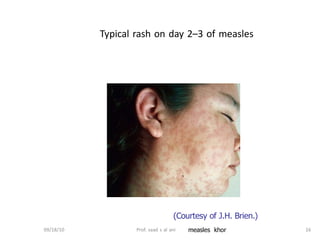
– Red dusky macular/ maculo papular rash
– Begins behind ears, spread rapidly in hrs over face
and neck, exteds to lower body in 2-3 days
– Fades in same appearance leaving brownish
discolouration
• Post eruptive stage:
– Wt. Loss
– Growth retardation
Korting GW: Hautkrankheiten bei Kindern und Jugendlichen, 3rd ed. Stuttgart, FK
Schattauer Verlag, 1982
09/18/10 Prof. saad s al ani measles khor 15
Maculopapular rash of measles
Typical rash on day 2–3 of measles
(Courtesy of J.H. Brien.)
09/18/10 Prof. saad s al ani measles khor 16
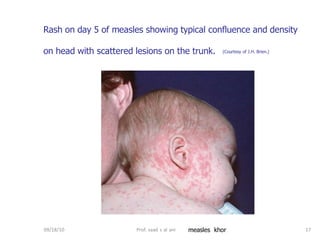
Rash on day 5 of measles showing typical confluence and density
on head with scattered lesions on the trunk. (Courtesy of J.H. Brien.)
09/18/10 Prof. saad s al ani measles khor 17
Complication
• Measels ass. Diarrhoea
• Pneumonia and other RTI
• Otitis media
• Neurological condition like- convulsion,
encephalitis
Prevention
• Vaccination-
– Live attenuated is safe and effective
– Freezed dried product
– Lose 50% potency in 1 hr @ 20 c and all @37c]
• Age- as close to 9 month
• Administration: SC/ IM

Measels

  • 1.
  • 2.
    Intro • Highly infectiousdisease of childhood • Caused by Specific virus of the group myxoviruses.
  • 3.
    Clicnical characteristics • Fever •Catarahal symp. (coryza, cough) • Typical rash. • High morbidity and mortality in developing countries • Only humans no animal reservoir
  • 4.
    Problem statement • Endemicin entire world • Common in developing countries and rare in industrial countries • Challange for eradication – Weak immunization sys – High infectious nature – Refusal of immunization by population
  • 5.
    Epidemiological determinants Agent fac: •Agent = RNA paramyxovirus • Source of infe: case of measles • Infective mat: secretion of nose, throat, RT • Period of communi: 4 days before and 4 days after appearance of rash
  • 6.
    Epidemiological determinants Host fac: •Age: 6mth- 3yrs in developing countries – Over 5 yrs in developed countries • Sex: equal • Immunity: no age is immune if no previous immunity • Nutrition: 400 times more chance of mortality in malnourished children
  • 7.
    Environmental fac: • Canspread in any season • Tropical zone- Mostly dry season • Temperate zone- winters
  • 8.
    Transmission • Person toperson • Droplet and droplet nuclie • Portal of entry: RT
  • 9.
    Incubation period • 10days from exposure to onset of fever • 14 days to appearance of rash
  • 10.
    Clinical features • 3stages • 1. Prodromal stage: – Begins 10 days after infec – Fever, coryza, sneezing, nasal discharge, cough, lacrimation, photophobia – Vomiting and diarrhoea might be present – KOPLIKS SPOT= day or 2 before appearance of rash • Table salt crystal appearance on buccal mucosa opp to 1st and 2nd lower molar • Small blueish white spot on red base, small the pin head
  • 11.
    • 2. Eruptivestage: – Red dusky macular/ maculo papular rash – Begins behind ears, spread rapidly in hrs over face and neck, exteds to lower body in 2-3 days – Fades in same appearance leaving brownish discolouration
  • 12.
    • Post eruptivestage: – Wt. Loss – Growth retardation
  • 15.
    Korting GW: Hautkrankheitenbei Kindern und Jugendlichen, 3rd ed. Stuttgart, FK Schattauer Verlag, 1982 09/18/10 Prof. saad s al ani measles khor 15 Maculopapular rash of measles
  • 16.
    Typical rash onday 2–3 of measles (Courtesy of J.H. Brien.) 09/18/10 Prof. saad s al ani measles khor 16
  • 17.
    Rash on day5 of measles showing typical confluence and density on head with scattered lesions on the trunk. (Courtesy of J.H. Brien.) 09/18/10 Prof. saad s al ani measles khor 17
  • 18.
    Complication • Measels ass.Diarrhoea • Pneumonia and other RTI • Otitis media • Neurological condition like- convulsion, encephalitis
  • 19.
    Prevention • Vaccination- – Liveattenuated is safe and effective – Freezed dried product – Lose 50% potency in 1 hr @ 20 c and all @37c] • Age- as close to 9 month • Administration: SC/ IM