AB
G
S U B M I T T E D B Y : K H A L I D A . A L - H A R B I .
What IS ABG ?
- Arterial Blood Gasses
*the purpose of collecting ABG ?
- To measures the acidity (PH) and the
levels of oxygen and carbon
dioxide in.the blood from an artery
*WHAT ARE THE SITES BLOOD CAN BE DRAWN
FOR BLOOD GAS ANALYSIS ?
- Usually from peripheral art. (Radial, Brachial,
Femoral or Dorsalis pedis)
- Arterialised capillary sample.
.- Rare cases venous blood is used
How arterialised capillary sample is taken
* Site – Finger, toe, heel or ear lobe
* Wrapping in warm pad (40-430 C) for 10 minutes
* Massage ear lobe for 2-3 minutes
* Heparinised capillary tube should be sealed after
collecting sample with clay at one end
•* Short steel wire is inserted then other end is sealed
* Steel wire is moved with magnet to mix the sample
EQUIPMENT
Gloves
Heparin
Medical Swap
Cotton
Plaster
Syringe 1-3 CC
Procedure of ABG Sample Collection
Prepare Collect Send to Lab
*WHAT IS THE DIFFERENCE BETWEEN :
BLOOD GAS MONITORING
&
BLOOD GAS ANALYSIS
?
- Blood gas monitor is a patient dedicated device
that measures arterial pH, PaCO2 and
PaO2without permanently removing
blood.
- For blood gas analysis – Blood is removed from
Patient .
* BLOOD GAS ANALYSIS?
- Acid-base status.
.- Oxygenation
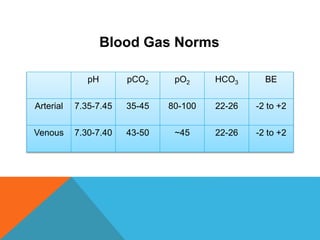
Blood Gas Norms
pH pCO2 pO2 HCO3 BE
Arterial 7.35-7.45 35-45 80-100 22-26 -2 to +2
Venous 7.30-7.40 43-50 ~45 22-26 -2 to +2
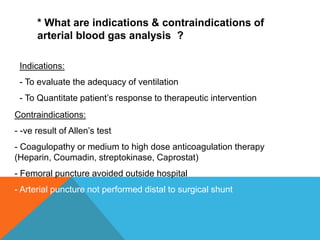
* What are indications & contraindications of
arterial blood gas analysis ?
Indications:
- To evaluate the adequacy of ventilation
- To Quantitate patient’s response to therapeutic intervention
Contraindications:
- -ve result of Allen’s test
- Coagulopathy or medium to high dose anticoagulation therapy
(Heparin, Coumadin, streptokinase, Caprostat)
- Femoral puncture avoided outside hospital
- Arterial puncture not performed distal to surgical shunt
* What are the complications of Arterial Puncture?
- Arteriospasm, Haematoma, Emboli (Air or clotted blood),
Anaphylaxis if LA is used, Haemorrhage, Trauma to vessel
, Arterial occlusion, Vasovagal response and Pain
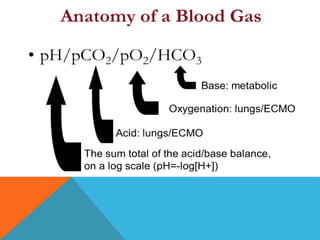
- PH in ABG?
1- Determine if pH is acidotic or
alkalotic
2-Determine cause:
A-Respiratory
B-Metabolic
C-Mixed
3. Check oxygenation
Acid-Base Regulation
* Three mechanisms to maintain pH
- Respiratory (CO2)
- Buffer (in the blood: carbonic acid/bicarbonate,
phosphate buffers, Hgb)
- Renal (HCO3
-)
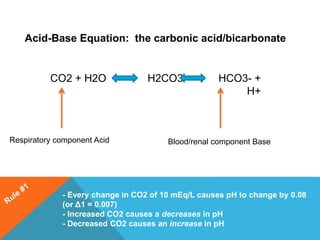
CO2 + H2O H2CO3 HCO3- +
H+
Respiratory component Acid Blood/renal component Base
Acid-Base Equation: the carbonic acid/bicarbonate
- Every change in CO2 of 10 mEq/L causes pH to change by 0.08
(or Δ1 = 0.007)
- Increased CO2 causes a decreases in pH
- Decreased CO2 causes an increase in pH
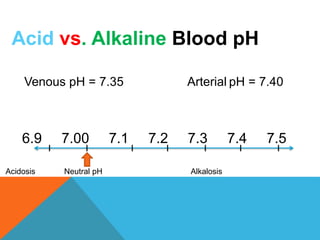
Acid vs. Alkaline Blood pH
Venous pH = 7.35 Arterial pH = 7.40
6.9 7.00 7.1 7.2 7.3 7.4 7.5
Acidosis Neutral pH Alkalosis
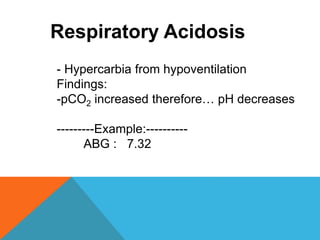
Respiratory Acidosis
- Hypercarbia from hypoventilation
Findings:
-pCO2 increased therefore… pH decreases
---------Example:----------
ABG : 7.32
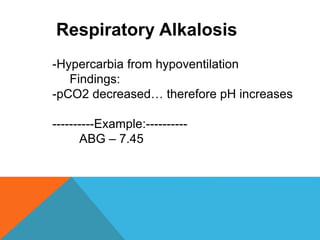
Respiratory Alkalosis
-Hypercarbia from hypoventilation
Findings:
-pCO2 decreased… therefore pH increases
--------------------Example:
ABG – 7.45
Metabolic Changes
-Remember normal HCO3
- is 22-26
Rule #2
Every change in HCO3
- of 10 mEq/L causes pH to change by 0.15
Increased HCO3
- causes an increase in pH
Decreased HCO3
- causes a decrease in pH

ABG slidshare

  • 1.
    AB G S U BM I T T E D B Y : K H A L I D A . A L - H A R B I .
  • 2.
    What IS ABG? - Arterial Blood Gasses *the purpose of collecting ABG ? - To measures the acidity (PH) and the levels of oxygen and carbon dioxide in.the blood from an artery
  • 3.
    *WHAT ARE THESITES BLOOD CAN BE DRAWN FOR BLOOD GAS ANALYSIS ? - Usually from peripheral art. (Radial, Brachial, Femoral or Dorsalis pedis) - Arterialised capillary sample. .- Rare cases venous blood is used
  • 4.
    How arterialised capillarysample is taken * Site – Finger, toe, heel or ear lobe * Wrapping in warm pad (40-430 C) for 10 minutes * Massage ear lobe for 2-3 minutes * Heparinised capillary tube should be sealed after collecting sample with clay at one end •* Short steel wire is inserted then other end is sealed * Steel wire is moved with magnet to mix the sample
  • 5.
  • 6.
    Procedure of ABGSample Collection Prepare Collect Send to Lab
  • 7.
    *WHAT IS THEDIFFERENCE BETWEEN : BLOOD GAS MONITORING & BLOOD GAS ANALYSIS ? - Blood gas monitor is a patient dedicated device that measures arterial pH, PaCO2 and PaO2without permanently removing blood. - For blood gas analysis – Blood is removed from Patient .
  • 8.
    * BLOOD GASANALYSIS? - Acid-base status. .- Oxygenation
  • 10.
    Blood Gas Norms pHpCO2 pO2 HCO3 BE Arterial 7.35-7.45 35-45 80-100 22-26 -2 to +2 Venous 7.30-7.40 43-50 ~45 22-26 -2 to +2
  • 11.
    * What areindications & contraindications of arterial blood gas analysis ? Indications: - To evaluate the adequacy of ventilation - To Quantitate patient’s response to therapeutic intervention Contraindications: - -ve result of Allen’s test - Coagulopathy or medium to high dose anticoagulation therapy (Heparin, Coumadin, streptokinase, Caprostat) - Femoral puncture avoided outside hospital - Arterial puncture not performed distal to surgical shunt
  • 12.
    * What arethe complications of Arterial Puncture? - Arteriospasm, Haematoma, Emboli (Air or clotted blood), Anaphylaxis if LA is used, Haemorrhage, Trauma to vessel , Arterial occlusion, Vasovagal response and Pain
  • 13.
    - PH inABG? 1- Determine if pH is acidotic or alkalotic 2-Determine cause: A-Respiratory B-Metabolic C-Mixed 3. Check oxygenation
  • 14.
    Acid-Base Regulation * Threemechanisms to maintain pH - Respiratory (CO2) - Buffer (in the blood: carbonic acid/bicarbonate, phosphate buffers, Hgb) - Renal (HCO3 -)
  • 15.
    CO2 + H2OH2CO3 HCO3- + H+ Respiratory component Acid Blood/renal component Base Acid-Base Equation: the carbonic acid/bicarbonate - Every change in CO2 of 10 mEq/L causes pH to change by 0.08 (or Δ1 = 0.007) - Increased CO2 causes a decreases in pH - Decreased CO2 causes an increase in pH
  • 16.
    Acid vs. AlkalineBlood pH Venous pH = 7.35 Arterial pH = 7.40 6.9 7.00 7.1 7.2 7.3 7.4 7.5 Acidosis Neutral pH Alkalosis
  • 17.
    Respiratory Acidosis - Hypercarbiafrom hypoventilation Findings: -pCO2 increased therefore… pH decreases ---------Example:---------- ABG : 7.32
  • 18.
    Respiratory Alkalosis -Hypercarbia fromhypoventilation Findings: -pCO2 decreased… therefore pH increases --------------------Example: ABG – 7.45
  • 19.
    Metabolic Changes -Remember normalHCO3 - is 22-26 Rule #2 Every change in HCO3 - of 10 mEq/L causes pH to change by 0.15 Increased HCO3 - causes an increase in pH Decreased HCO3 - causes a decrease in pH