TARUNA SINGH
1208213035
AGENDA
 Introduction
 Overview of Routers
 Router Attack Topology
 Common Router Attacks
 Performing Forensics
 Incidence Investigation
 Accessing the Router
 Documentation
 What are the “BAD GUYS” doing
 What are the “GOOD GUYS” doing
 Why do we need to protect Router Resources
 Why do we need outer Forensics
INTRODUCTION
It is the application of proven
scientific methods and techniques
in order to recover data from
routers in case of an intruder attack
and apply forensics( law
enforcement, documentation of the
incidence) .
WHAT IS ROUTER?
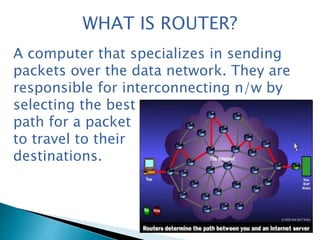
A computer that specializes in sending
packets over the data network. They are
responsible for interconnecting n/w by
selecting the best
path for a packet
to travel to their
destinations.
HOW DOES ROUTER WORK
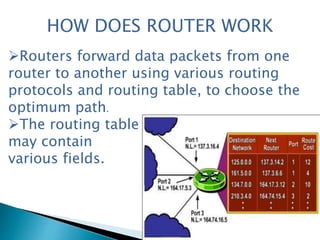
Routers forward data packets from one
router to another using various routing
protocols and routing table, to choose the
optimum path.
The routing table
may contain
various fields.
COMMUNICATION WITH ROUTERS
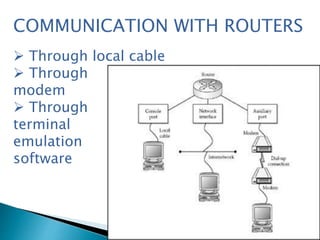
 Through local cable
 Through
modem
 Through
terminal
emulation
software
ROUTER COMPONENTS
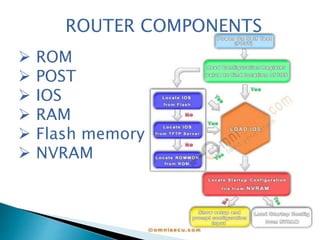
 ROM
 POST
 IOS
 RAM
 Flash memory
 NVRAM
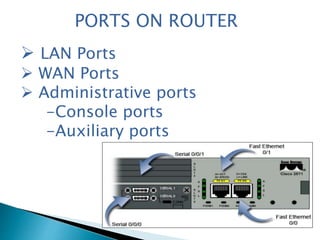
PORTS ON ROUTER
 LAN Ports
 WAN Ports
 Administrative ports
-Console ports
-Auxiliary ports
MODES OF ROUTER
 Setup Mode
 User Mode
 Privileged Mode
 Global Configuration Mode
 Interface Mode
ROUTER ATTACK TOPOLOGY
Reconnaissance
Scanning and enumeration
Gaining access
Escalation of privilege
Maintaining access
Covering tracks and placing
backdoors
COMMON ROUTER ATTACKS
Denial of Service Attacks
Packet Mistreating Attacks
Routing Table Poisoning
Hit and Run Attacks
Persistent Attacks
PERFORMING FORENSICS
Collection
Examination
Analysis
Reporting
GATHER VOLATILE ROUTER DATA
Connect to console port for this need cable
and laptop with terminal emulation software.
Record System Time and determine who is
logged on
Save the router configuration.
Review the routing table to detect malicious
static routes modified by attacker.
View the ARP cache for evidence for IP or MAC
spoofing
INCIDENCE INVESTIGATION
Direct compromise: via physical access,
listening services, password guessing by TFTP,
console access
Routing table manipulations: by
modifying routing protocols( RIP, IGRP), review
routing table with “show IP route”
Theft of Information: via access control
and network topology
DoS: resource and bandwidth consumption
reduces functionality and n/w bandwidth
Contd...
FOR RECOVERY:
Eliminate listening services
Upgrade of software
Access restriction
Authentication
Change all passwords
Avoid password reuse
Remove static routing entries
ACCESSING THE ROUTER
DO
 Access the router
through the console
 Record your entire
console session
 Run show commands
 Record the actual
time and the router’s
time
 Record the volatile
information
DON’T
 REBOOT THE
ROUTER
 Access the router
through the
network
 Run configuration
commands
 Rely only on
persistent
information
DOCUMENTATION
 Chain of Custody: to prove the integrity
of the evidence
 Case reports: employee remediation,
employee termination ,civil proceedings,
criminal prosecution, case Summary,
bookmarks
 Incident response: it is the effort of an
organisation to define and document the
nature and scope of a computer security
incident.
WHAT THE “BAD GUYS” ARE DOING
Internet Router Protocol Attack Suite
(IRPAS): A suite of tools designed to abuse
inherent design insecurity in routers and routing
protocols –Tools: ass, igrp, hsrp
VIPPR: Can be used to establish MITM for
compromised routers
UltimaRatio: Working exploit tool for use
against 1000, 1600/1700 and 2600 series routers
Research
WHAT THE GOOD GUYS ARE
DOING
Router Audit Tool (RAT): Written in Perl,
highly customizable, Passive tool to analyze a
Cisco router, Scores the overall security of your
router, Support for Unix and Windows systems
Books, white papers on securing routers
Employ strong authentication: encrypted
traffic mgmt, two phase authentication,
centralised authentication source.
WHY WE NEED TO PROTECT
ROUTER RESOURCES
Often the “heart” of the network
Gaining a lot more attention from attackers
Few procedures on hardening routers
Routers are much slower to get upgraded to
solve security bugs
Few people monitor their configurations
regularly
Few security measures in place
There are millions of them
NEED FOR ROUTER FORENSICS
Operational Troubleshooting
Log Monitoring
Data Recovery
Data Acquisition
Due Diligence/Regulatory compliance
Router forensics

Router forensics

  • 1.
  • 2.
    AGENDA  Introduction  Overviewof Routers  Router Attack Topology  Common Router Attacks  Performing Forensics  Incidence Investigation  Accessing the Router  Documentation  What are the “BAD GUYS” doing  What are the “GOOD GUYS” doing  Why do we need to protect Router Resources  Why do we need outer Forensics
  • 3.
    INTRODUCTION It is theapplication of proven scientific methods and techniques in order to recover data from routers in case of an intruder attack and apply forensics( law enforcement, documentation of the incidence) .
  • 4.
    WHAT IS ROUTER? Acomputer that specializes in sending packets over the data network. They are responsible for interconnecting n/w by selecting the best path for a packet to travel to their destinations.
  • 5.
    HOW DOES ROUTERWORK Routers forward data packets from one router to another using various routing protocols and routing table, to choose the optimum path. The routing table may contain various fields.
  • 6.
    COMMUNICATION WITH ROUTERS Through local cable  Through modem  Through terminal emulation software
  • 7.
    ROUTER COMPONENTS  ROM POST  IOS  RAM  Flash memory  NVRAM
  • 8.
    PORTS ON ROUTER LAN Ports  WAN Ports  Administrative ports -Console ports -Auxiliary ports
  • 9.
    MODES OF ROUTER Setup Mode  User Mode  Privileged Mode  Global Configuration Mode  Interface Mode
  • 10.
    ROUTER ATTACK TOPOLOGY Reconnaissance Scanningand enumeration Gaining access Escalation of privilege Maintaining access Covering tracks and placing backdoors
  • 11.
    COMMON ROUTER ATTACKS Denialof Service Attacks Packet Mistreating Attacks Routing Table Poisoning Hit and Run Attacks Persistent Attacks
  • 12.
  • 13.
    GATHER VOLATILE ROUTERDATA Connect to console port for this need cable and laptop with terminal emulation software. Record System Time and determine who is logged on Save the router configuration. Review the routing table to detect malicious static routes modified by attacker. View the ARP cache for evidence for IP or MAC spoofing
  • 14.
    INCIDENCE INVESTIGATION Direct compromise:via physical access, listening services, password guessing by TFTP, console access Routing table manipulations: by modifying routing protocols( RIP, IGRP), review routing table with “show IP route” Theft of Information: via access control and network topology DoS: resource and bandwidth consumption reduces functionality and n/w bandwidth
  • 15.
    Contd... FOR RECOVERY: Eliminate listeningservices Upgrade of software Access restriction Authentication Change all passwords Avoid password reuse Remove static routing entries
  • 16.
    ACCESSING THE ROUTER DO Access the router through the console  Record your entire console session  Run show commands  Record the actual time and the router’s time  Record the volatile information DON’T  REBOOT THE ROUTER  Access the router through the network  Run configuration commands  Rely only on persistent information
  • 17.
    DOCUMENTATION  Chain ofCustody: to prove the integrity of the evidence  Case reports: employee remediation, employee termination ,civil proceedings, criminal prosecution, case Summary, bookmarks  Incident response: it is the effort of an organisation to define and document the nature and scope of a computer security incident.
  • 18.
    WHAT THE “BADGUYS” ARE DOING Internet Router Protocol Attack Suite (IRPAS): A suite of tools designed to abuse inherent design insecurity in routers and routing protocols –Tools: ass, igrp, hsrp VIPPR: Can be used to establish MITM for compromised routers UltimaRatio: Working exploit tool for use against 1000, 1600/1700 and 2600 series routers Research
  • 19.
    WHAT THE GOODGUYS ARE DOING Router Audit Tool (RAT): Written in Perl, highly customizable, Passive tool to analyze a Cisco router, Scores the overall security of your router, Support for Unix and Windows systems Books, white papers on securing routers Employ strong authentication: encrypted traffic mgmt, two phase authentication, centralised authentication source.
  • 20.
    WHY WE NEEDTO PROTECT ROUTER RESOURCES Often the “heart” of the network Gaining a lot more attention from attackers Few procedures on hardening routers Routers are much slower to get upgraded to solve security bugs Few people monitor their configurations regularly Few security measures in place There are millions of them
  • 21.
    NEED FOR ROUTERFORENSICS Operational Troubleshooting Log Monitoring Data Recovery Data Acquisition Due Diligence/Regulatory compliance