MODULE 4
Network Security
Venkatesh Bhat
Senior Associate Professor
Department of CSE
AIET, Moodbidri
SYLLABUS – MODULE 4
•Overview of Network Security: Elements of Network Security,
Classification of Network Attacks.
•Security Methods
•Symmetric-Key Cryptography: Data Encryption Standard (DES),
Advance Encryption Standard (AES)
•Public-Key Cryptography: RSA Algorithm, Diffie-Hellman Key-
Exchange Protocol,
•Authentication: Hash Function, Secure Hash Algorithm (SHA),
•Digital Signatures,
•Firewalls and Packet Filtering, Packet Filtering, Proxy Server.
****************************************************************************************************
Text book2: Nader F Mir, Computer and Communication Networks,
2nd
Edition, Pearson, 2014; Chapter 10
10.1 Overview of Network Security
--- Syllabus
•Elements of Network Security
•Classification of Network Attacks
10.1.1 Elements of Network Security
Network security is concerned mainly with the following
two elements:
•Confidentiality. Information should be available only to
those who have rightful access to it.
•Authenticity and Integrity. The sender of a message
and the message itself should be verified at the
receiving point.
EXAMPLE
User 1 sends a message (“I am user 1”) to User 2.
There are Two Cases:
•Message content and sender identity
falsified by intruder.
•A method of applied security
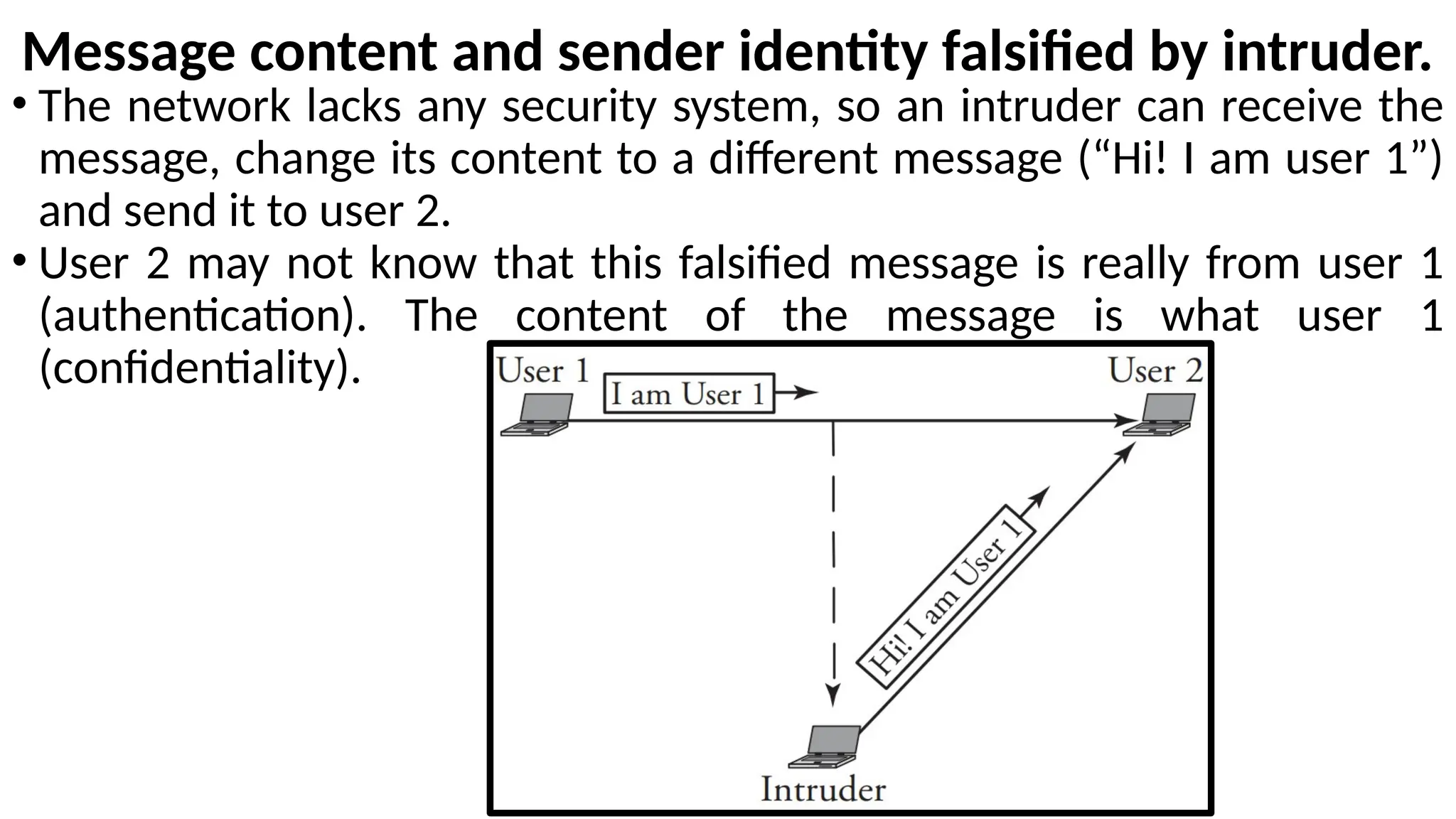
Message content and sender identity falsified by intruder.
• The network lacks any security system, so an intruder can receive the
message, change its content to a different message (“Hi! I am user 1”)
and send it to user 2.
• User 2 may not know that this falsified message is really from user 1
(authentication). The content of the message is what user 1
(confidentiality).
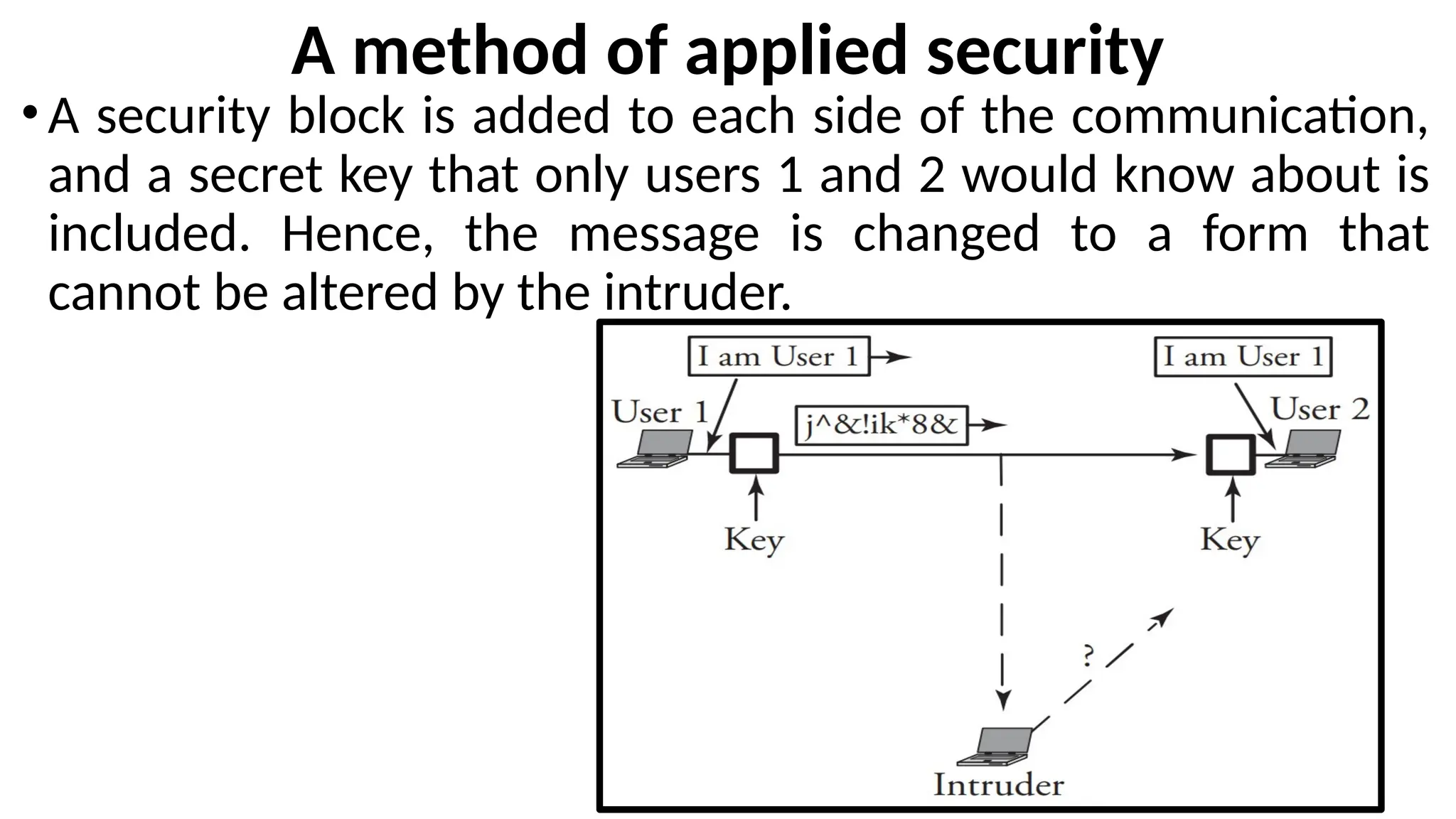
A method of applied security
•A security block is added to each side of the communication,
and a secret key that only users 1 and 2 would know about is
included. Hence, the message is changed to a form that
cannot be altered by the intruder.
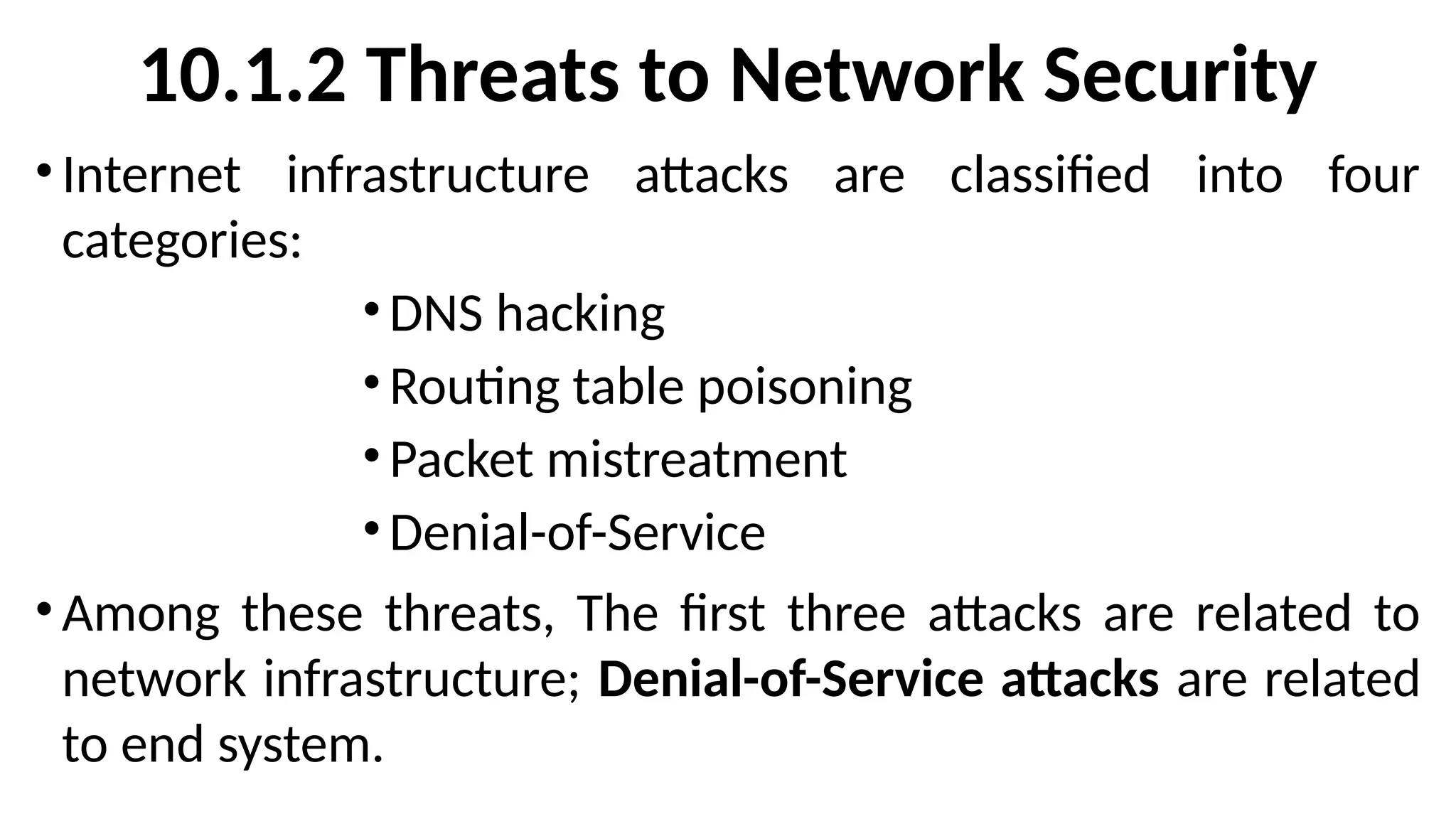
10.1.2 Threats to Network Security
• Internet infrastructure attacks are classified into four
categories:
•DNS hacking
•Routing table poisoning
•Packet mistreatment
•Denial-of-Service
• Among these threats, The first three attacks are related to
network infrastructure; Denial-of-Service attacks are related
to end system.
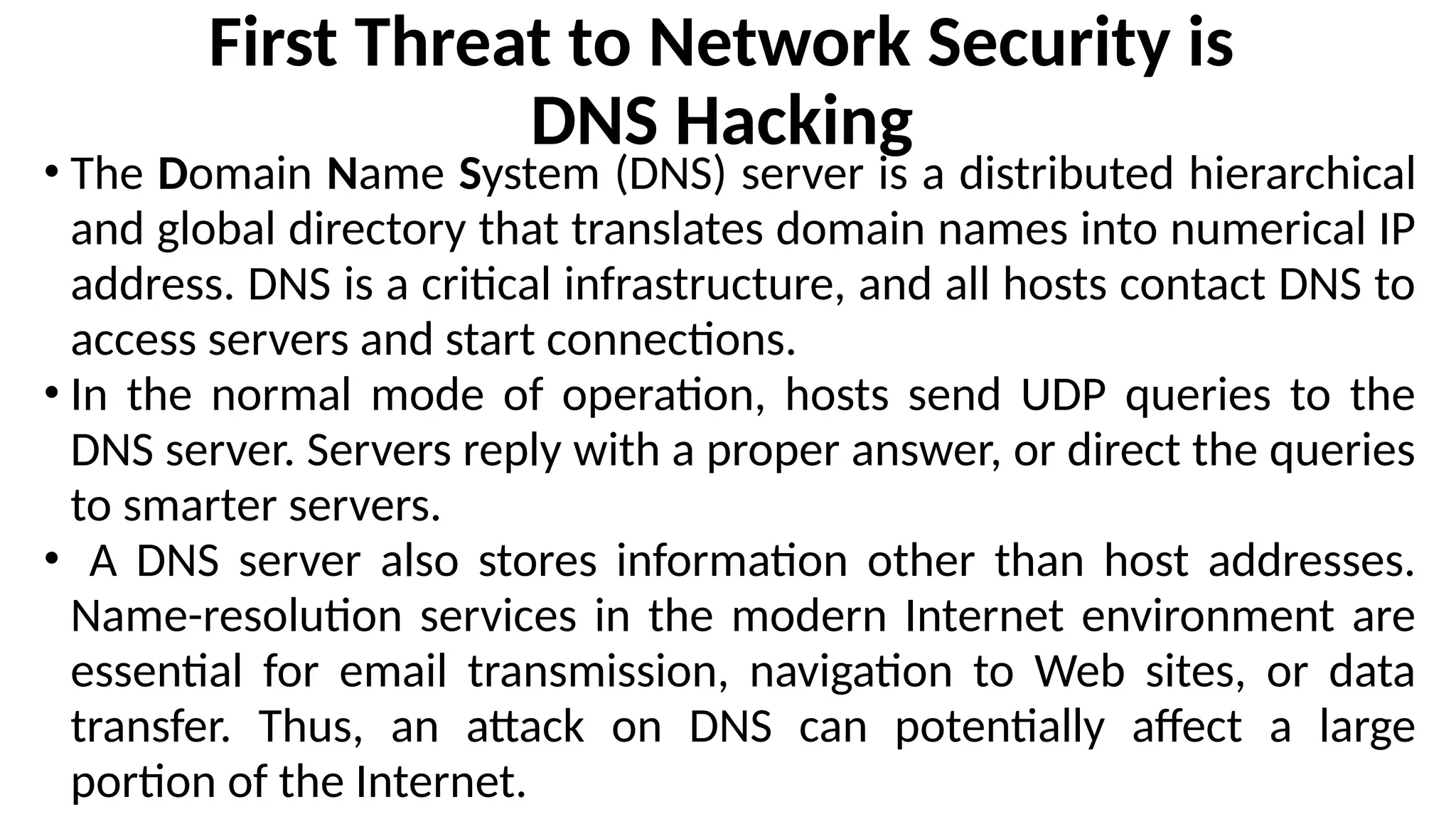
First Threat to Network Security is
DNS Hacking
• The Domain Name System (DNS) server is a distributed hierarchical
and global directory that translates domain names into numerical IP
address. DNS is a critical infrastructure, and all hosts contact DNS to
access servers and start connections.
• In the normal mode of operation, hosts send UDP queries to the
DNS server. Servers reply with a proper answer, or direct the queries
to smarter servers.
• A DNS server also stores information other than host addresses.
Name-resolution services in the modern Internet environment are
essential for email transmission, navigation to Web sites, or data
transfer. Thus, an attack on DNS can potentially affect a large
portion of the Internet.
Result of DNS Hacking Attack
A DNS Hacking Attack may result in the lack of
data authenticity and integrity.
•Different forms of the DNS Hacking:
•Information-Level Attack
•Masquerading Attack (Middle-Man Attack)
•Information Leakage Attack
•Domain High Jacking Attack
Information-Level Attack
•An Information-Level Attack forces a server to
correspond with other than the correct answer.
•With cache poisoning, a hacker tricks a remote name
server into caching the answer for a third-party domain
by providing malicious information for the domain’s
authorized servers.
•Hackers can then redirect traffic to a preselected site.
Masquerading Attack (Middle-Man Attack)
•In a masquerading attack, the adversary poses as a
trusted entity and obtains all the secret information.
•In this, the attacker can stop any message from being
transmitted further or can change the content or
redirect the packet to bogus servers.
•This action is also known as a middle-man attack.
•The attacker normally sends queries to each host and
receives in reply the DNS host name.
Information Leakage Attack
•In an Information Leakage Attack, the attacker
sends queries to all hosts and identifies which IP
addresses are not used.
•Later on, the intruder can use those IP addresses
to make other types of attacks.
•Once a domain name is selected, it has to be
registered. Various tools are available to register
domain names over the Internet.
Domain High Jacking Attack
•In the Domain High Jacking Attack, whenever a
user enters a domain address, she/he is forced to
enter into the attacker’s Web site.
•This can be very irritating and can cause a great
loss of Internet usage ability.
Second Threat to Network Security is
Routing Table Poisoning Attacks
• A Routing Table Poisoning Attack is the undesired
modification of routing tables.
• An attacker can do this by maliciously modifying the routing
information update packets sent by routers.
• This is a challenging and important problem, as a routing
table is the basis of routing in the Internet.
• Any false entry in a routing table could lead to significant
consequences, such as congestion, an overwhelmed host,
looping, illegal access to data, and network partition.
Two types of Routing Table Poisoning Attacks
•Link Attack
•Router attack.
Link Attack
•A Link Attack occurs when a hacker gets access to a link
and thereby intercepts, interrupts, or modifies routing
messages on packets.
•Link attacks act similarly on both the link-state and the
distance-vector protocols.
•If an attacker succeeds in placing an attack in a link-
state routing protocol, a router may send incorrect
updates about its neighbors or remain silent even if the
link state of its neighbor has changed.
Link Attack --- Contd…
•The attack through a link can be so severe that the
attacker can program a router to either drop packets
from a victim or readdress packets to a victim, resulting
in a lower throughput of the network. Sometimes, a
router can stop an intended packet from being
forwarded further. Since more than one path to any
destination exists, the packet ultimately reaches its
destination.
Router Attack
• Router attacks may affect the link-state protocol or the
distance-vector protocol.
• If link-state protocol routers are attacked, they become
malicious. They may add a non-existing link to a routing
table, delete an existing link, or may change cost of a link.
• This attack may cause a router to simply ignore the updates
sent by its neighbors, leading to a serious impact on the
operability of the network traffic flow.
Router Attack --- Contd…
•In the distance-vector protocol, an attacker may cause
routers to send wrong updates about any node in the
network, thereby misleading a router and resulting in
network problems.
•Most unprotected routers have no way to validate
updates. Therefore, both link-state and distance-vector
router attacks are very effective.
Router Attack --- Contd…
•In the distance-vector protocol, for example, a
malicious router can send wrong information in the
form of a distance vector to all its neighbors.
•A neighbor may not be able to detect this kind of attack
and thus proceeds to update its routing table, based on
wrong distance vectors.
•The error can in turn be propagated to a great portion
of the network before being detected.
Third Threat to Network Security is
Packet-Mistreatment Attacks
•A packet-mistreatment attack can occur during
any data transmission.
•A hacker may capture certain data packets and
mistreat them.
•This type of attack is very difficult to detect.
•The attack may result in congestion, lowering
throughput, and denial-of-service attacks.
Third Threat to Network Security is
Packet-Mistreatment Attacks -- Contd…
•Similar to routing table poisoning attacks, packet-
mistreatment attacks can also be subclassified into
link attacks and router attacks.
•The link attack causes interruption, modification,
or replication of data packets.
•A router attack can misroute all packets and may
result in congestion or denial of service.
Examples of a Packet-Mistreatment Attack
•Interruption.
•Modification.
•Replication.
•Ping of death.
•Malicious misrouting of packets.
Interruption
•If an attacker intercepts packets, they may not be
allowed to be propagated to their destinations,
resulting in a lower throughput of the network.
•This kind of attack cannot be detected easily, as even
in normal operations, routers can drop some
packets, for various reasons.
Modification
•Attackers may succeed in accessing the content
of a packet while in transit and change its
content.
•They can then change the address of the packet
or even change its data.
•To solve this kind of problem, a digital signature
mechanism can be used.
Replication
•An attacker might trap a packet and replay it.
•This kind of attack can be detected by using the
sequence number for each packet.
Ping of death
•An attacker may send a ping message, which is large
and therefore must be fragmented for transport.
•The receiver then starts to reassemble the fragments
as the ping fragments arrive.
•The total packet length becomes too large and might
cause a system crash.
Malicious Misrouting of Packets.
•A hacker may attack a router and change its
routing table, resulting in misrouting of data
packets, causing a denial of service.
Fourth Threat to Network Security is
Denial-of-Service Attacks
•A denial-of-service attack is a type of security breach that
prohibits a user from accessing normally provided services.
•The denial of service does not result in information theft or
any kind of information loss but can nonetheless be very
dangerous, as it can cost the target person a large amount
of time and money.
•Denial-of-service attacks affect the destination rather than
a data packet or router.
Fourth Threat to Network Security is
Denial-of-Service Attacks ---- Contd…
•Denial-of-service attacks are easy to generate but
difficult to detect.
•They take important servers out of action for few
hours, thereby denying service to all users.
•There are yet a few other situations that can cause this
kind of attack, such as UDP flood, a TCP flood and ICMP
flood.
Denial-of-Service Attacks are Two Types
•Single-Source.
•An attacker sends a large number of packets to a target
system to overwhelm and disable it.
•Distributed.
•In this type of attack, a large number of hosts are used
to flood unwanted traffic to a single target. The target
cannot then be accessible to other users in the network,
as it is processing the flood of traffic.
End of 10.1
Overview of Network Security
SYLLABUS – MODULE 4
•Overview of Network Security: Elements of Network Security,
Classification of Network Attacks.
•Security Methods: Cryptographic Techniques, Authentication Techniques
•Symmetric-Key Cryptography: Data Encryption Standard (DES),
Advance Encryption Standard (AES)
•Public-Key Cryptography: RSA Algorithm, Diffie-Hellman Key-
Exchange Protocol,
•Authentication: Hash Function, Secure Hash Algorithm (SHA),
•Digital Signatures,
•Firewalls and Packet Filtering, Packet Filtering, Proxy Server.
****************************************************************************************************
Text book2: Nader F Mir, Computer and Communication Networks,
2nd
Edition, Pearson, 2014; Chapter 10
10.2 Security Methods Syllabus
10.2.1 Cryptographic Techniques.
10.2.2 Authentication Techniques.
10.2 Overview of Security Methods
•Common solutions that can protect computer
communication networks from attacks are
classified as
•Cryptographic Techniques or
•Authentication Techniques (Verification)
10.2.1 Cryptographic Techniques
•Cryptography is the process of transforming a
piece of information or message shared by two
parties into some sort of code.
•The message is scrambled before transmission so
that it is undetectable by outside watchers.
•This kind of message needs to be decoded at the
receiving end before any further processing.
10.2.1 Cryptographic Techniques ---- Contd…
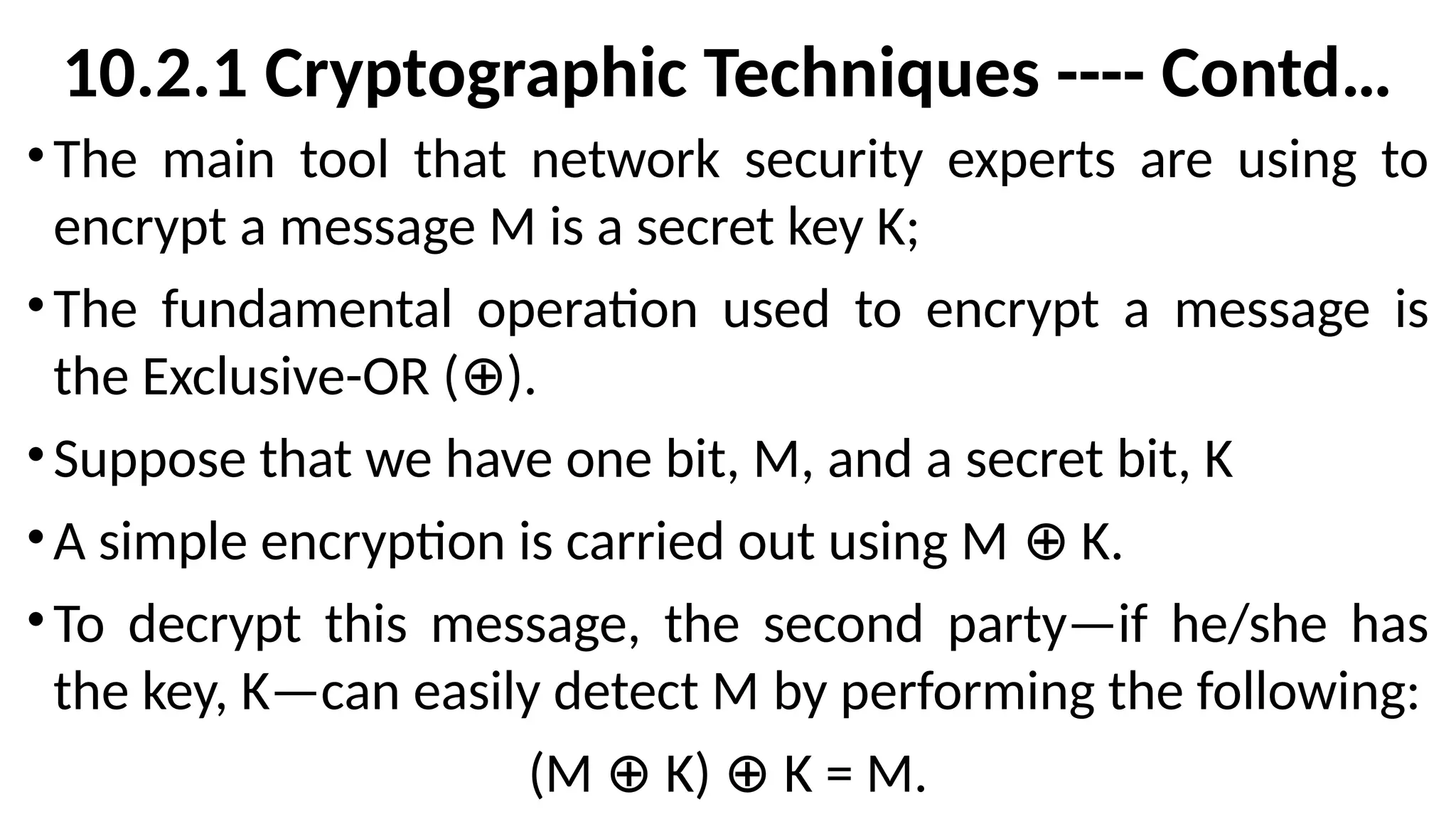
•The main tool that network security experts are using to
encrypt a message M is a secret key K;
•The fundamental operation used to encrypt a message is
the Exclusive-OR ( ).
⊕
•Suppose that we have one bit, M, and a secret bit, K
•A simple encryption is carried out using M K.
⊕
•To decrypt this message, the second party—if he/she has
the key, K—can easily detect M by performing the following:
(M K) K = M.
⊕ ⊕
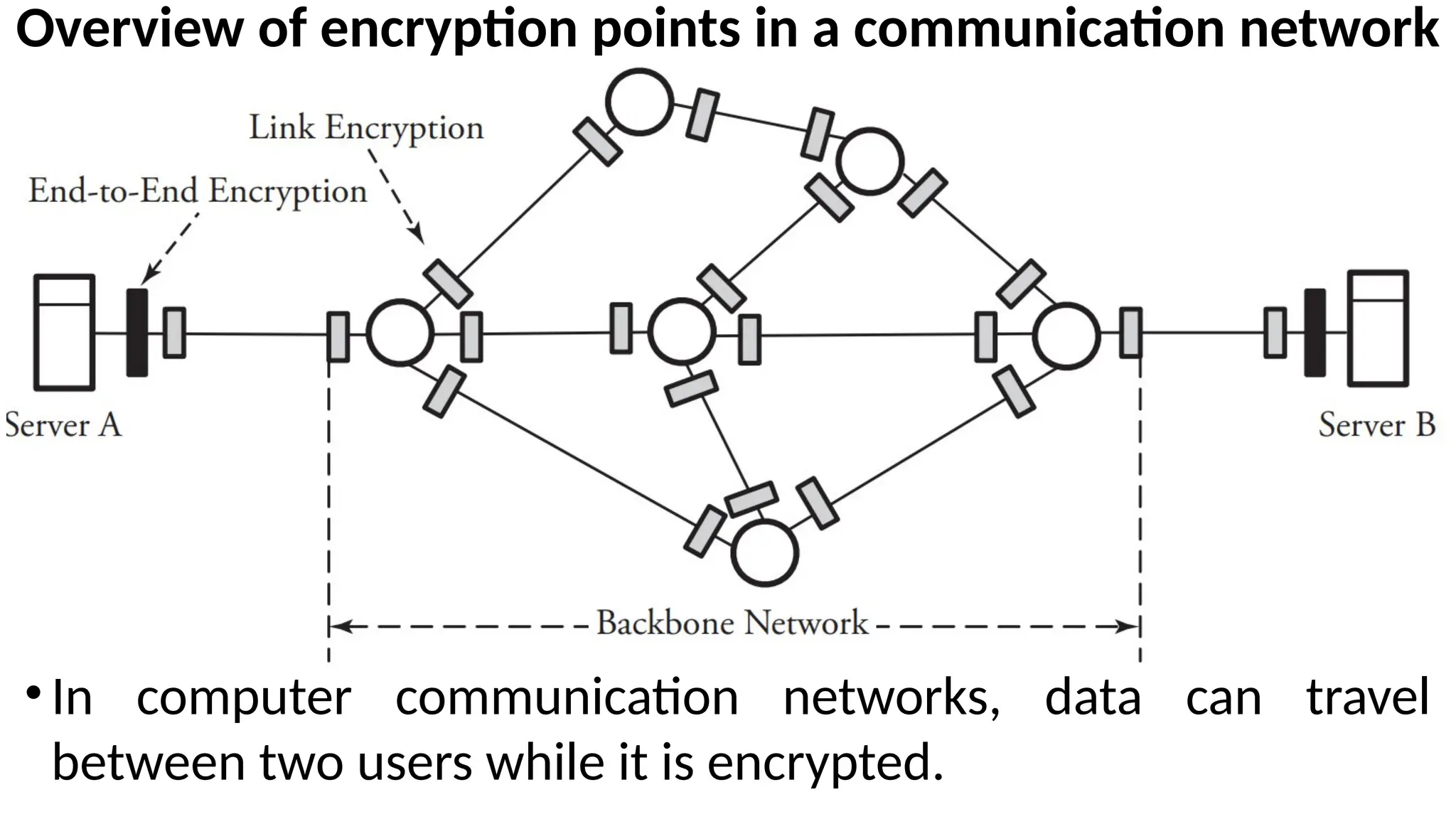
Overview of encryption points in a communication network
•In computer communication networks, data can travel
between two users while it is encrypted.
Overview of encryption points in a communication network
• Two servers are exchanging data while two types of encryption
devices are installed in their communication network.
•The first encryption device is end-to-end encryption,
whereby secret coding is carried out at both end systems.
•In the figure (Previous Slide), server A encodes its data,
which can be decoded only at the other end server.
•The second phase of encryption is link encryption, which
secures all the traffic passing over that link.
The Two Types of Encryption Techniques
•Secret-Key Encryption
•Public-Key Encryption
Secret-Key Model and Public-Key Model
•In a Secret-Key Model, both sender and
receiver conventionally use the same key
for an encryption process.
•In a Public-Key Model, a sender and a
receiver each use a different key.
Advantage of the Public-Key System
over Secret-Key System
•The Public-Key System is more powerful than
the Secret-Key System.
•The Public-Key System provides better security.
• The Public-Key System provides better
message privacy.
Drawback of Public-Key Encryption is Speed
•The Public-Key System is more complex
computationally and may not be practical in many
cases.
•Hence, the Public-Key System is used only to establish
a session to exchange a session key. Then, this session
key is used in a Secret-Key System for encrypting
messages for the duration of the session.
10.2.2 Authentication Techniques
• Encryption methods offer the assurance of message confidentiality.
•A networking system must be able to verify the authenticity
of the message and the sender of the message.
•These forms of security techniques in computer networks
are known as authentication techniques and are
categorized as authentication with message digest and
authentication with digital signature.
•Message authentication protects a user in a network
against data falsification and ensures data integrity. These
methods do not necessarily use keys.
End of 10.2
Security Methods
SYLLABUS – MODULE 4
•Overview of Network Security: Elements of Network Security,
Classification of Network Attacks.
•Security Methods: Cryptographic Techniques, Authentication Techniques
•Symmetric-Key Cryptography: Data Encryption Standard (DES),
Advance Encryption Standard (AES)
•Public-Key Cryptography: RSA Algorithm, Diffie-Hellman Key-
Exchange Protocol,
•Authentication: Hash Function, Secure Hash Algorithm (SHA),
•Digital Signatures,
•Firewalls and Packet Filtering, Packet Filtering, Proxy Server.
****************************************************************************************************
Text book2: Nader F Mir, Computer and Communication Networks,
2nd
Edition, Pearson, 2014; Chapter 10
10.3 Symmetric-Key Cryptography
(Or Secret Key Encryption Protocol)
-- Syllabus
10.3.1 Data Encryption Standard (DES).
10.3.2 Advance Encryption Standard (AES)
10.3 Secret-Key Encryption Protocols
(Or Symmetric Encryption Protocols
Or Single-Key Encryption Protocols
•Secret-key encryption protocols consist of
•An encryption algorithm,
•A key, and
•A decryption algorithm.
•At the end point, the encrypted message is called
ciphertext.
Standard Mechanisms to implement a
Secret-Key Encryption Algorithm
10.3.1 Data Encryption Standard (DES) and
10.3.2 Advanced Encryption Standard (AES)
General Features of Secret-Key Encryption Algorithms
•A shared secret key between a transmitter and a receiver is
assigned at the transmitter and receiver points.
•The encryption algorithm produces a different key at any
time for a specific transmission.
•Changing the key changes the output of the algorithm.
•At the receiving end, the encrypted information can be
transformed back to the original data by using a decryption
algorithm and the same key that was used for encryption.
•The security of encryption depends on the secrecy of the key,
not on the secrecy of the encryption algorithm.
• The algorithm need not be kept secret; only the key has to be secret.
10.3.1 Data Encryption Standard (DES)
•With the Data Encryption Standard (DES), plaintext
messages are converted into 64- bit blocks, each
encrypted using a key.
•The key length is 64 bits but contains only 56 usable
bits; thus, the last bit of each 8 byte in the key is a
parity bit for the corresponding byte.
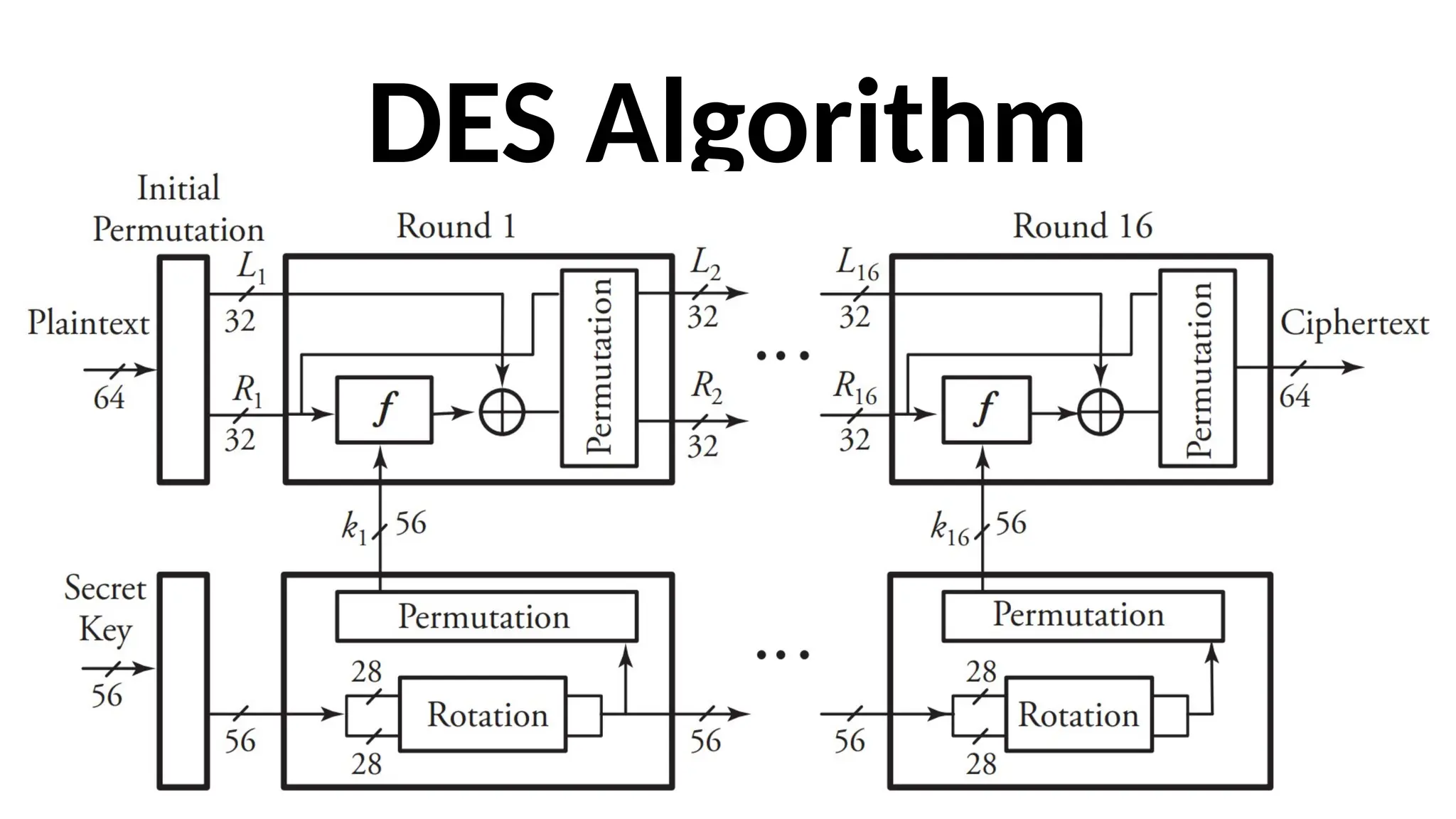
•DES consists of 16 identical rounds of an operation.
DES Algorithm
DES Algorithm
1. Initialize. Before round 1 begins, all 64 bits of an
incoming message and all 56 bits of the secret key
are separately permuted (shuffled).
2. Each incoming 64-bit message is broken into two
32-bit halves denoted by Li and Ri, respectively .
3. The 56 bits of the key are also broken into two
28-bit halves, and each half is rotated one or two
bit positions, depending on the round.
DES Algorithm --- Contd…
4. All 56 bits of the key are permuted, producing
version ki of the key on round i.
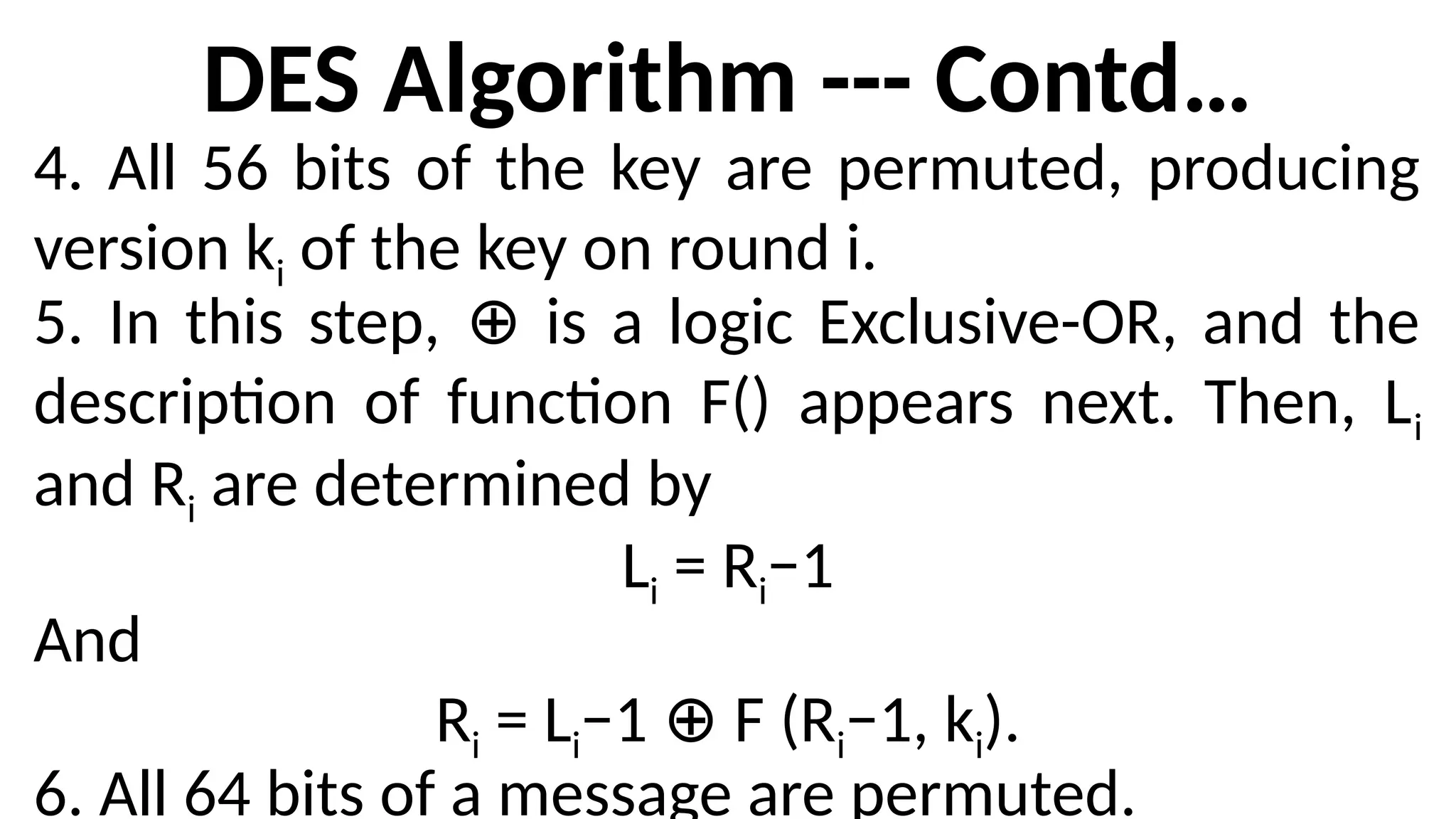
5. In this step, is a logic Exclusive-OR, and the
⊕
description of function F() appears next. Then, Li
and Ri are determined by
Li = Ri−1
And
Ri = Li−1 F (R
⊕ i−1, ki).
6. All 64 bits of a message are permuted.
The operation of function F() at any round i of DES
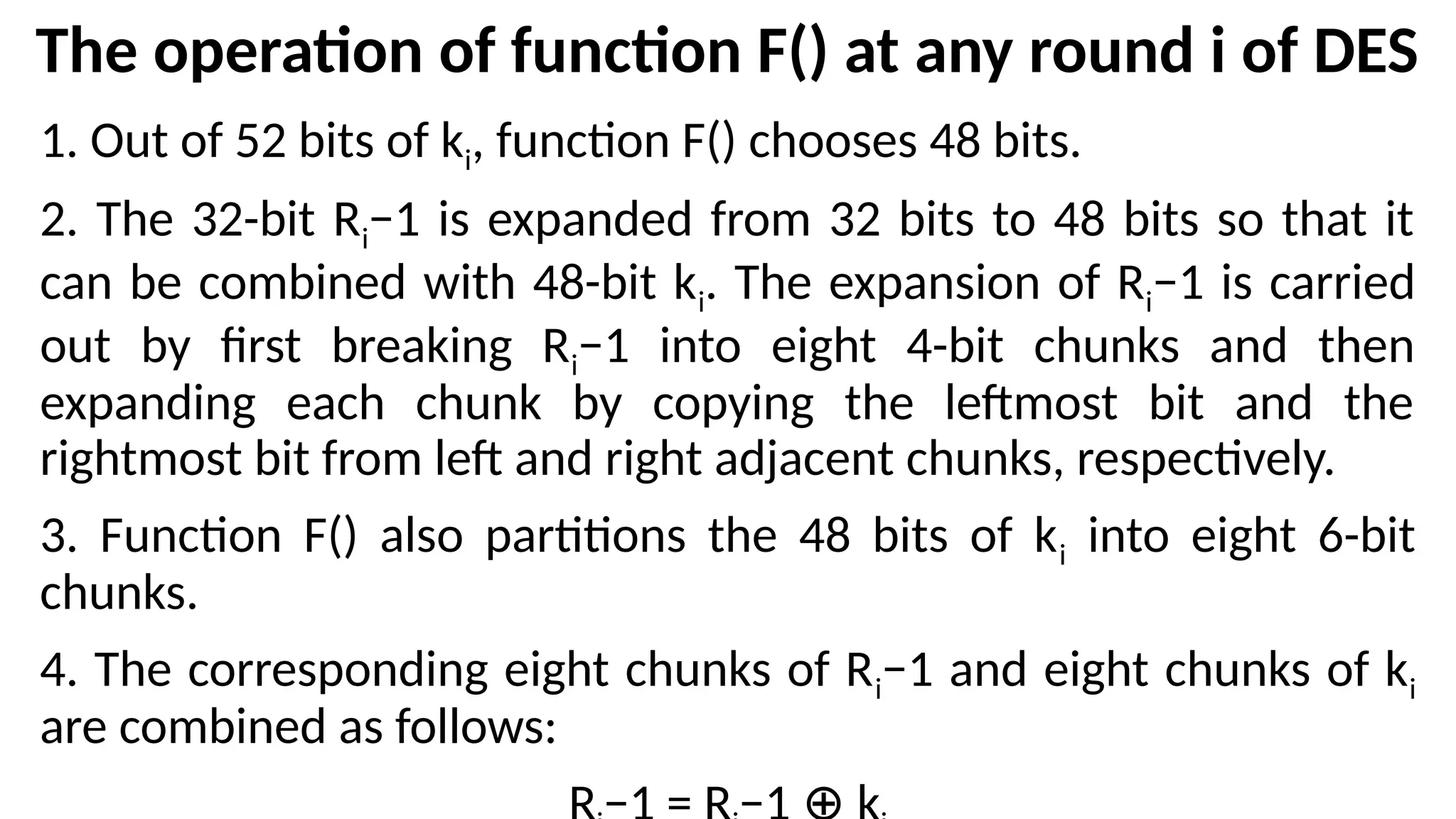
1. Out of 52 bits of ki, function F() chooses 48 bits.
2. The 32-bit Ri−1 is expanded from 32 bits to 48 bits so that it
can be combined with 48-bit ki. The expansion of Ri−1 is carried
out by first breaking Ri−1 into eight 4-bit chunks and then
expanding each chunk by copying the leftmost bit and the
rightmost bit from left and right adjacent chunks, respectively.
3. Function F() also partitions the 48 bits of ki into eight 6-bit
chunks.
4. The corresponding eight chunks of Ri−1 and eight chunks of ki
are combined as follows:
Contd…
•At the receiver, the same steps and the same key are
used to reverse the encryption.
•It is now apparent that the 56-bit key length may not be
sufficient to provide full security. This argument is still
controversial. Triple DES provides a solution for this
controversy: three keys are used, for a total of 168 bits.
•It should also be mentioned that DES can be implemented
more efficiently in hardware than in software.
10.3.2 Advanced Encryption Standard (AES)
•The Advanced Encryption Standard (AES) protocol has a better
security strength than DES. AES supports 128-bit symmetric
block messages and uses 128-bit key, 192-bit key, or 256-bit key.
•The number of rounds in AES is variable from 10 to 14 rounds,
depending on the key and block sizes.
• There are ten rounds of encryptions for the key size of 128 bits.
•All rounds are identical except for the last round, which has
no mix-column stage.
10.3.2 Advanced Encryption Standard (AES)
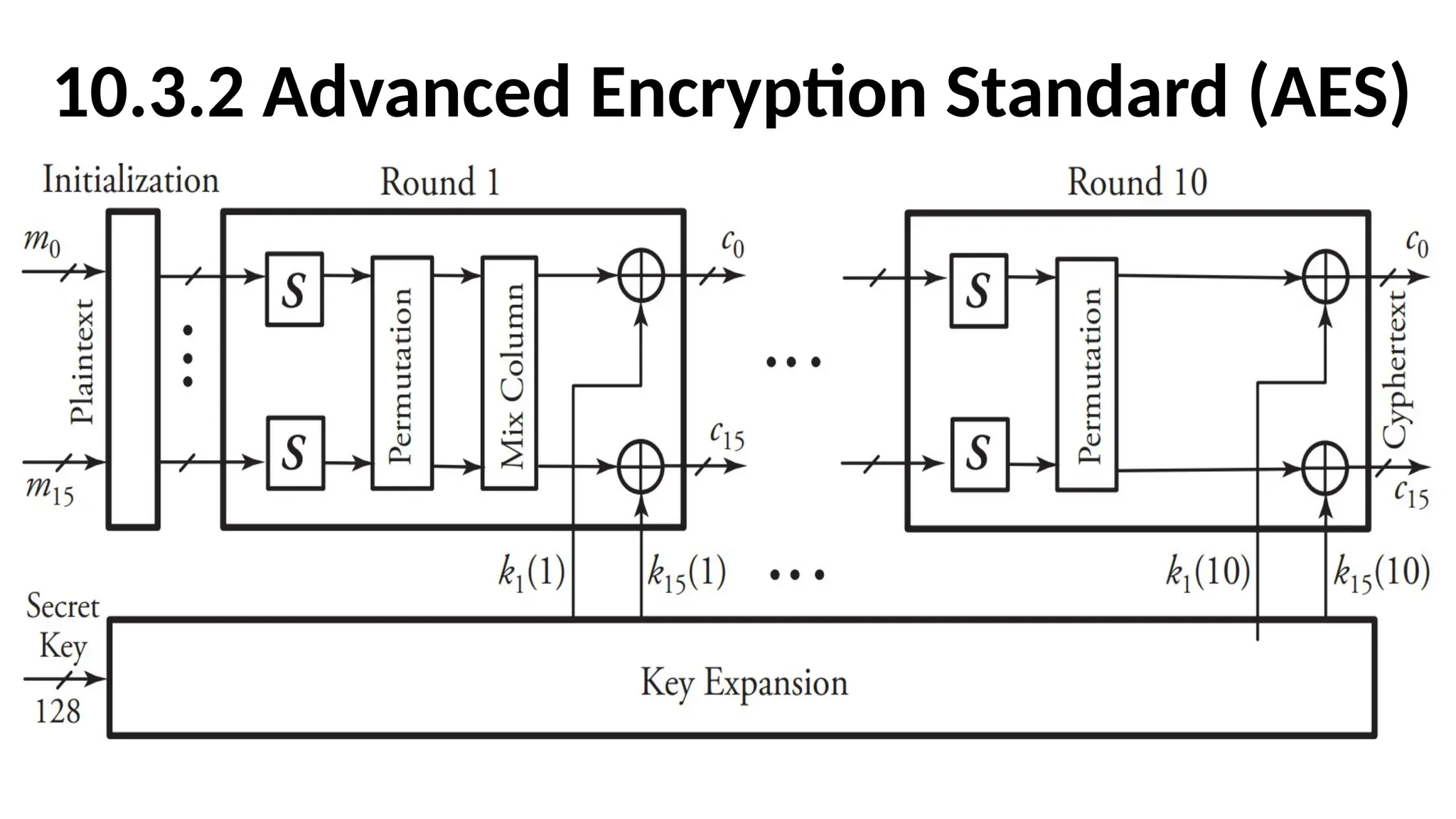
•A single block of 128-bit plaintext (16 bytes) as an input
arrives from the left.
•The plaintext is formed as 16 bytes m0 through m15
and is fed into round 1 after an initialization stage.
•In this round, substitute units—indicated by S in the
figure— perform a byte-by-byte substitution of blocks.
The ciphers, in the form of rows and columns, move
through a permutation stage to shift rows to mix
columns.
10.3.2 Advanced Encryption Standard (AES)
•At the end of this round, all 16 blocks of ciphers are
Exclusive-ORed with the 16 bytes of round 1 key k0(1)
through k15(1).
•The 128-bit key is expanded for ten rounds.
•The AES decryption algorithm is fairly simple.
•It is the reverse of the encryption algorithm at each
stage of a round.
•All stages of each round are reversible.
End of 10.3
Symmetric-Key Cryptography
SYLLABUS – MODULE 4
•Overview of Network Security: Elements of Network Security,
Classification of Network Attacks.
•Security Methods: Cryptographic Techniques, Authentication Techniques
•Symmetric-Key Cryptography: Data Encryption Standard (DES),
Advance Encryption Standard (AES)
•Public-Key Cryptography: RSA Algorithm, Diffie-Hellman Key-
Exchange Protocol,
•Authentication: Hash Function, Secure Hash Algorithm (SHA),
•Digital Signatures,
•Firewalls and Packet Filtering, Packet Filtering, Proxy Server.
****************************************************************************************************
Text book2: Nader F Mir, Computer and Communication Networks,
2nd
Edition, Pearson, 2014; Chapter 10
10.4 Public-Key Encryption Protocols
10.4.1 RSA Algorithm.
10.4.2 Diffie-Hellman Key-Exchange Protocol.
Public-Key Cryptography
•Public-Key Cryptography provided a very clever method for
key exchange.
•In the Public-Key Encryption Model, a sender/receiver pair
use different keys.
•This model is sometimes known as asymmetric, or two-key,
encryption.
•Public-Key Algorithm is based on mathematical functions
rather than on substitution or permutation, although the
security of any encryption scheme depends on the length of
the key and the computational work involved in breaking an
encrypted message.
Different types of Public-Key Cryptography Algorithm
•Rivert, Shamir, and Aldeman (RSA) Protocol
•Diffie-Hillman Key-Exchange Protocol
General Features of the Public-Key Encryption Methods
•In the public-key encryption methods, either of the two
related keys can be used for encryption; the other one, for
decryption.
•It is computationally infeasible to determine the decryption
key given only the algorithm and the encryption key.
•Each system using this encryption method generates a pair
of keys to be used for encryption and decryption of a
message that it will receive.
•Each system publishes its encryption key by placing it in a
public register or file and sorts out the key as a public one.
•The companion key is kept private.
Example
•If A wishes to send a message to B, A encrypts the
message by using B’s public key.
•On receiving the message, B decrypts it with the private B
key. No other recipients can decrypt the message, since
only B knows its private key.
•This way, public-key encryption secures an incoming
communication as long as a system controls its private key.
•Public-key encryption has extra computational overhead
and is more complex than the conventional one.
10.4.1 RSA Algorithm
•Assume that a plaintext m must be encrypted to
a ciphertext c.
•The RSA algorithm has three phases for this:
•Key Generation,
•Encryption, and
•Decryption.
Key Generation
•In the RSA scheme, the key length is typically 512 bits,
which requires an enormous computational power.
•A plaintext is encrypted in blocks, with each block
having a binary value less than some number n.
•Encryption and decryption are done as follows,
beginning with the generation of a public key and a
private key.
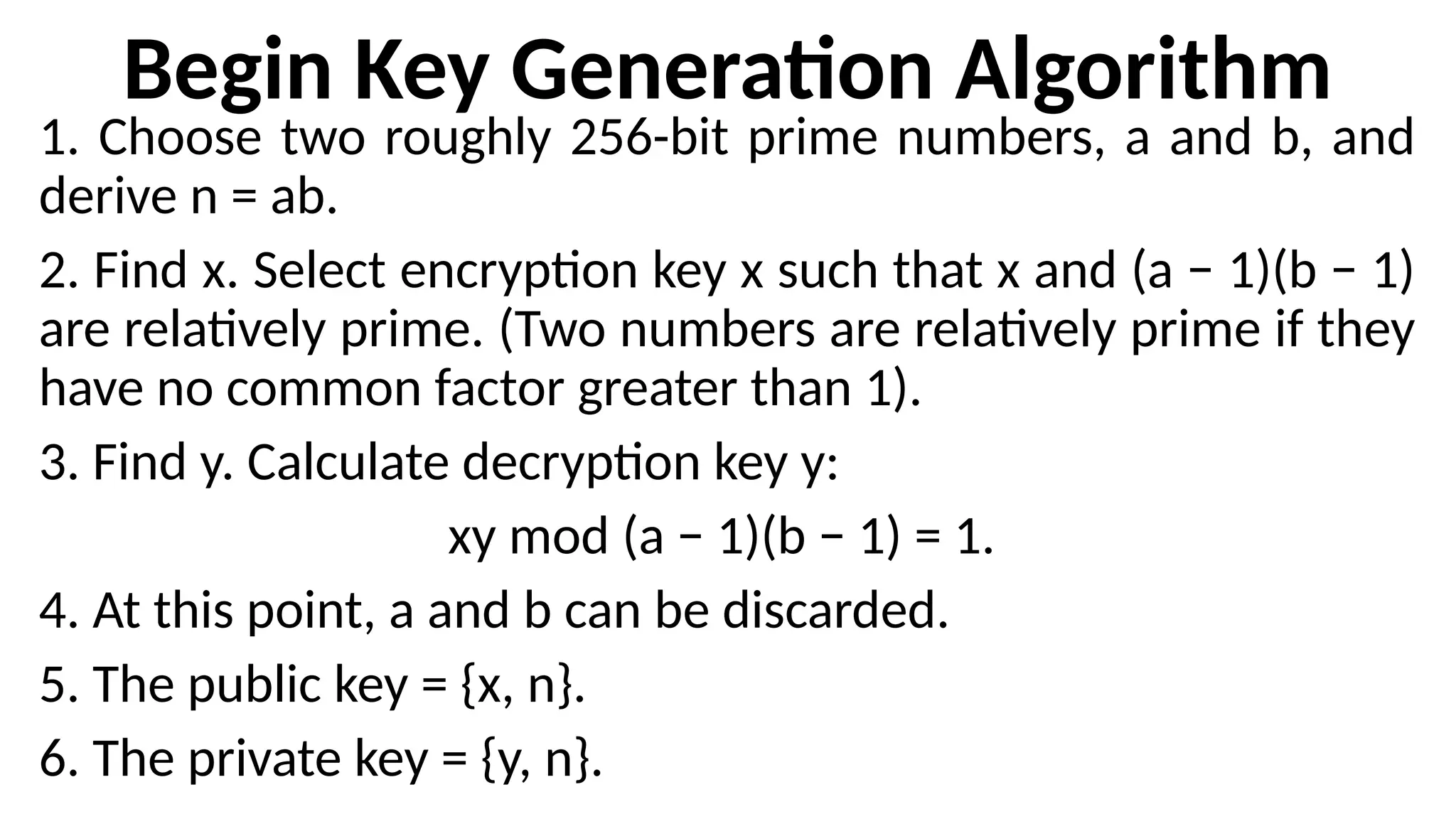
Begin Key Generation Algorithm
1. Choose two roughly 256-bit prime numbers, a and b, and
derive n = ab.
2. Find x. Select encryption key x such that x and (a − 1)(b − 1)
are relatively prime. (Two numbers are relatively prime if they
have no common factor greater than 1).
3. Find y. Calculate decryption key y:
xy mod (a − 1)(b − 1) = 1.
4. At this point, a and b can be discarded.
5. The public key = {x, n}.
6. The private key = {y, n}.
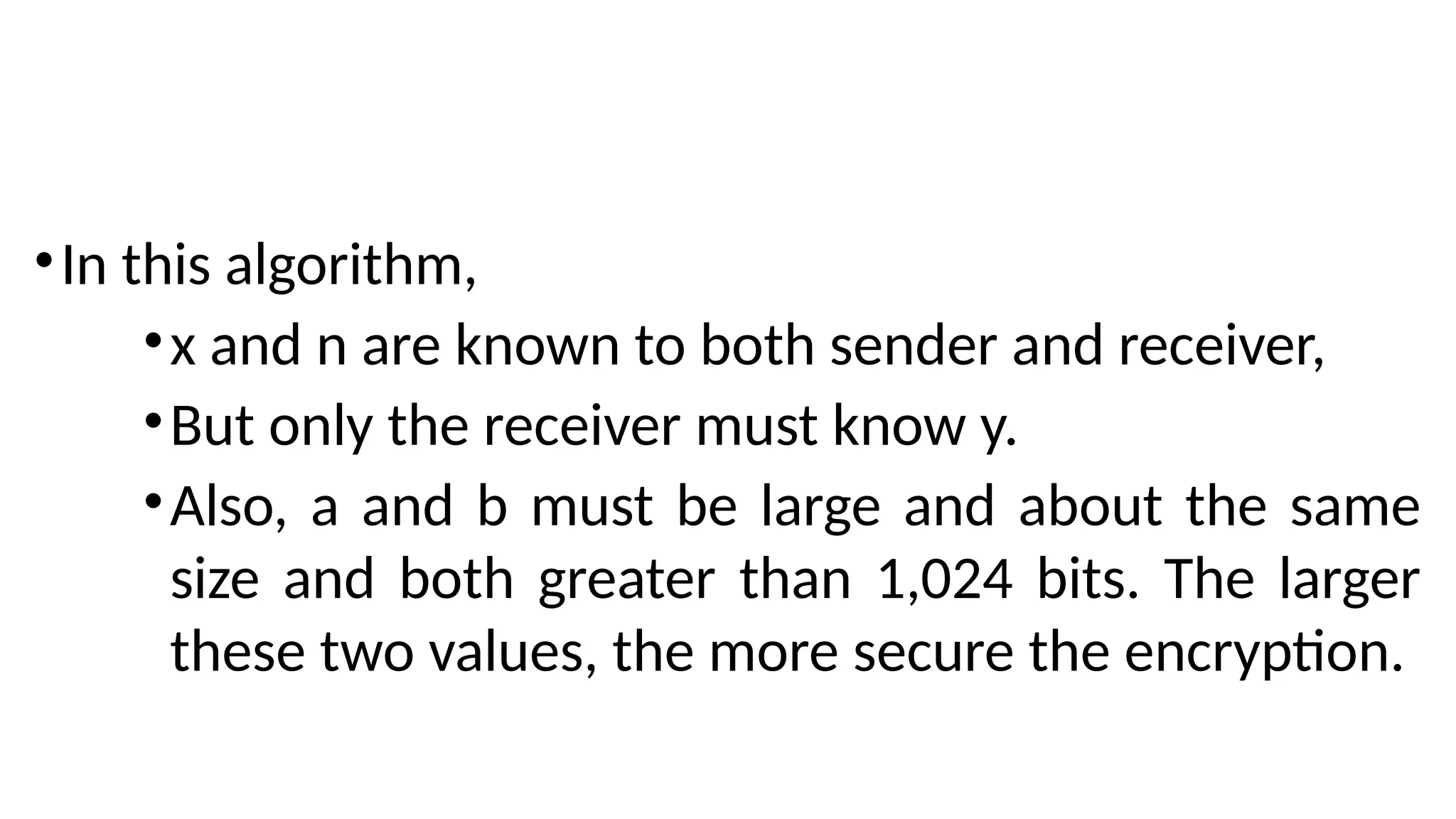
•In this algorithm,
•x and n are known to both sender and receiver,
•But only the receiver must know y.
•Also, a and b must be large and about the same
size and both greater than 1,024 bits. The larger
these two values, the more secure the encryption.
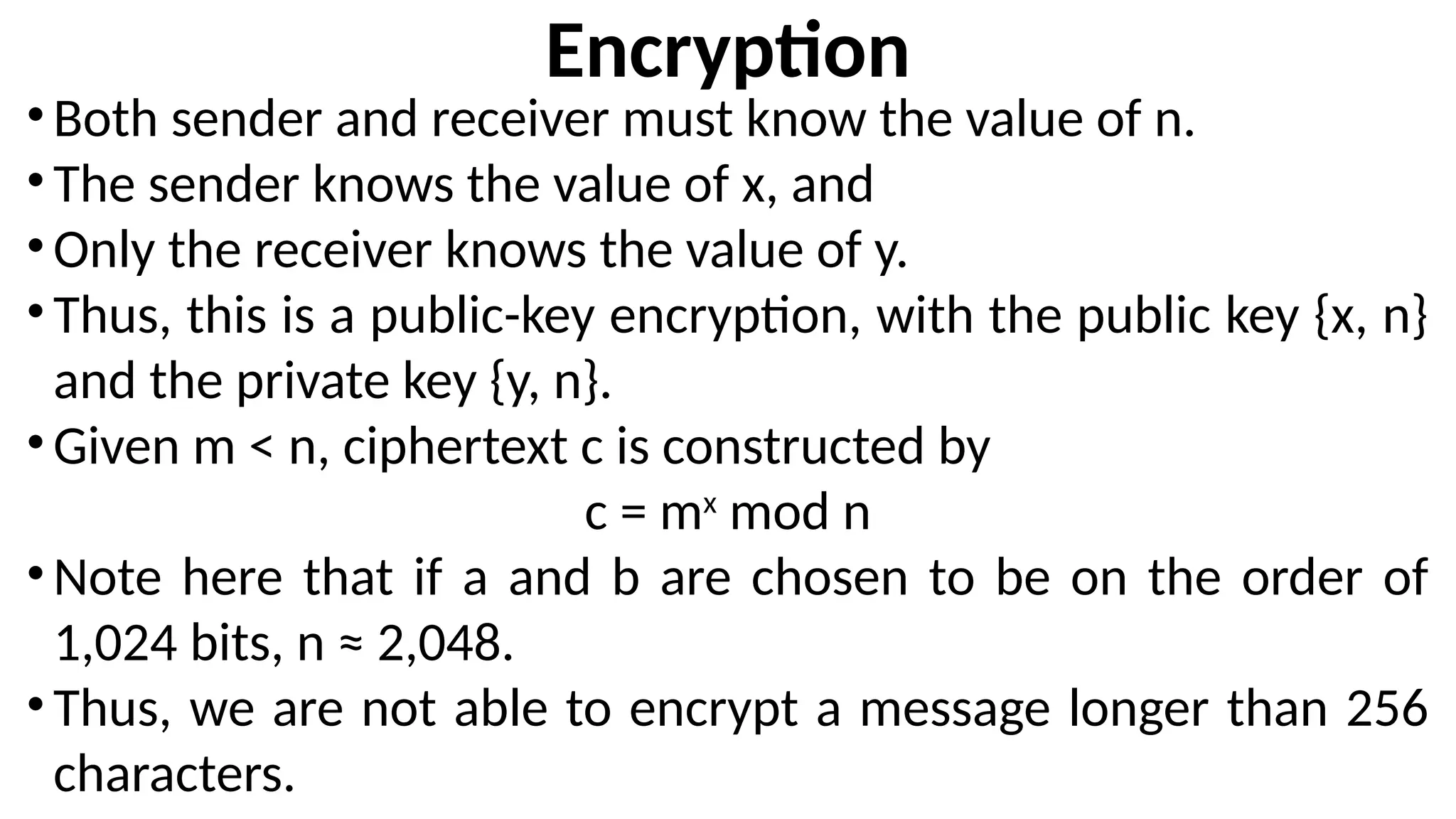
Encryption
•Both sender and receiver must know the value of n.
•The sender knows the value of x, and
•Only the receiver knows the value of y.
•Thus, this is a public-key encryption, with the public key {x, n}
and the private key {y, n}.
•Given m < n, ciphertext c is constructed by
c = mx
mod n
•Note here that if a and b are chosen to be on the order of
1,024 bits, n ≈ 2,048.
•Thus, we are not able to encrypt a message longer than 256
characters.
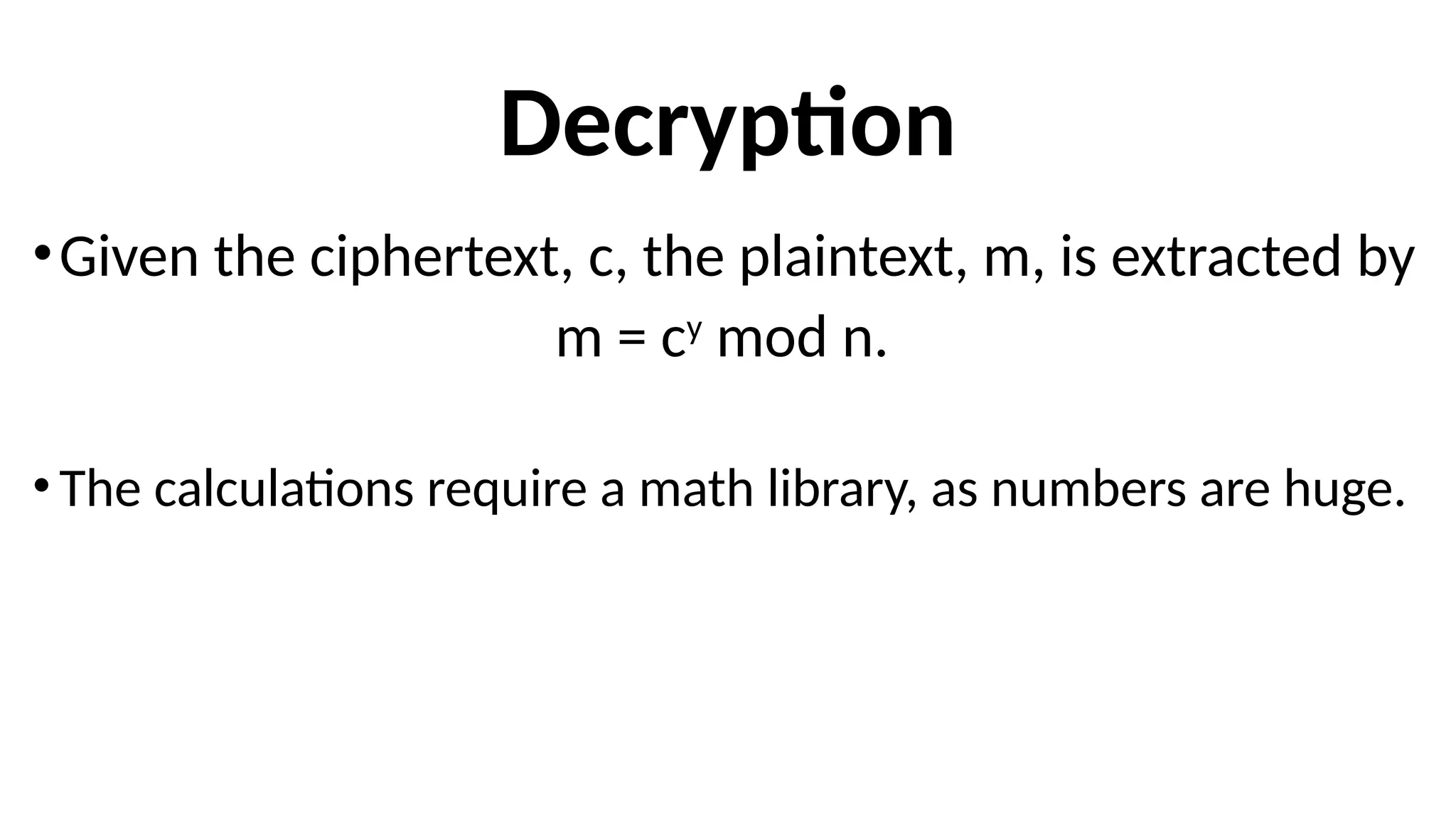
Decryption
•Given the ciphertext, c, the plaintext, m, is extracted by
m = cy
mod n.
•The calculations require a math library, as numbers are huge.
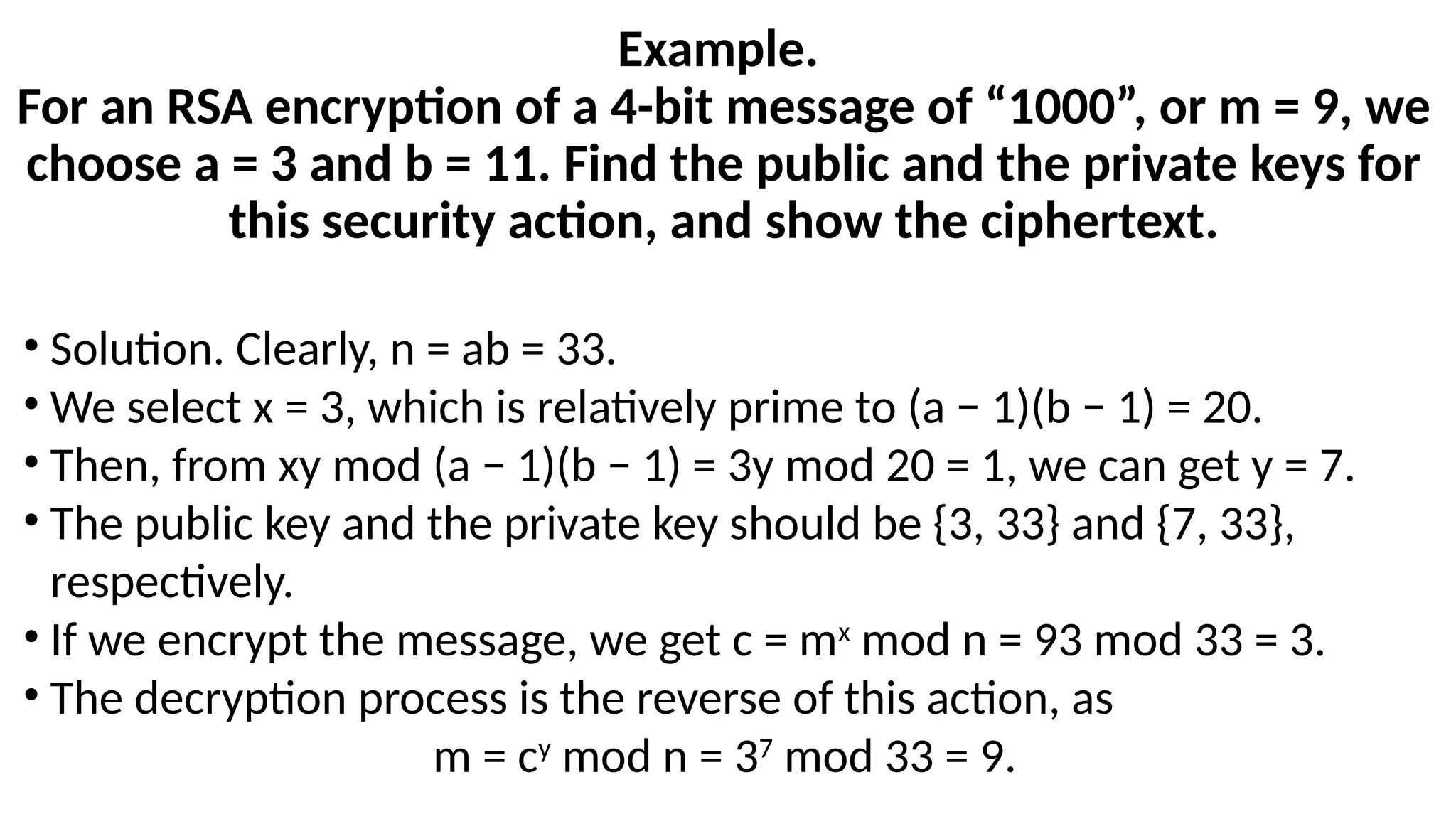
Example.
For an RSA encryption of a 4-bit message of “1000”, or m = 9, we
choose a = 3 and b = 11. Find the public and the private keys for
this security action, and show the ciphertext.
• Solution. Clearly, n = ab = 33.
• We select x = 3, which is relatively prime to (a − 1)(b − 1) = 20.
• Then, from xy mod (a − 1)(b − 1) = 3y mod 20 = 1, we can get y = 7.
• The public key and the private key should be {3, 33} and {7, 33},
respectively.
• If we encrypt the message, we get c = mx
mod n = 93 mod 33 = 3.
• The decryption process is the reverse of this action, as
m = cy
mod n = 37
mod 33 = 9.
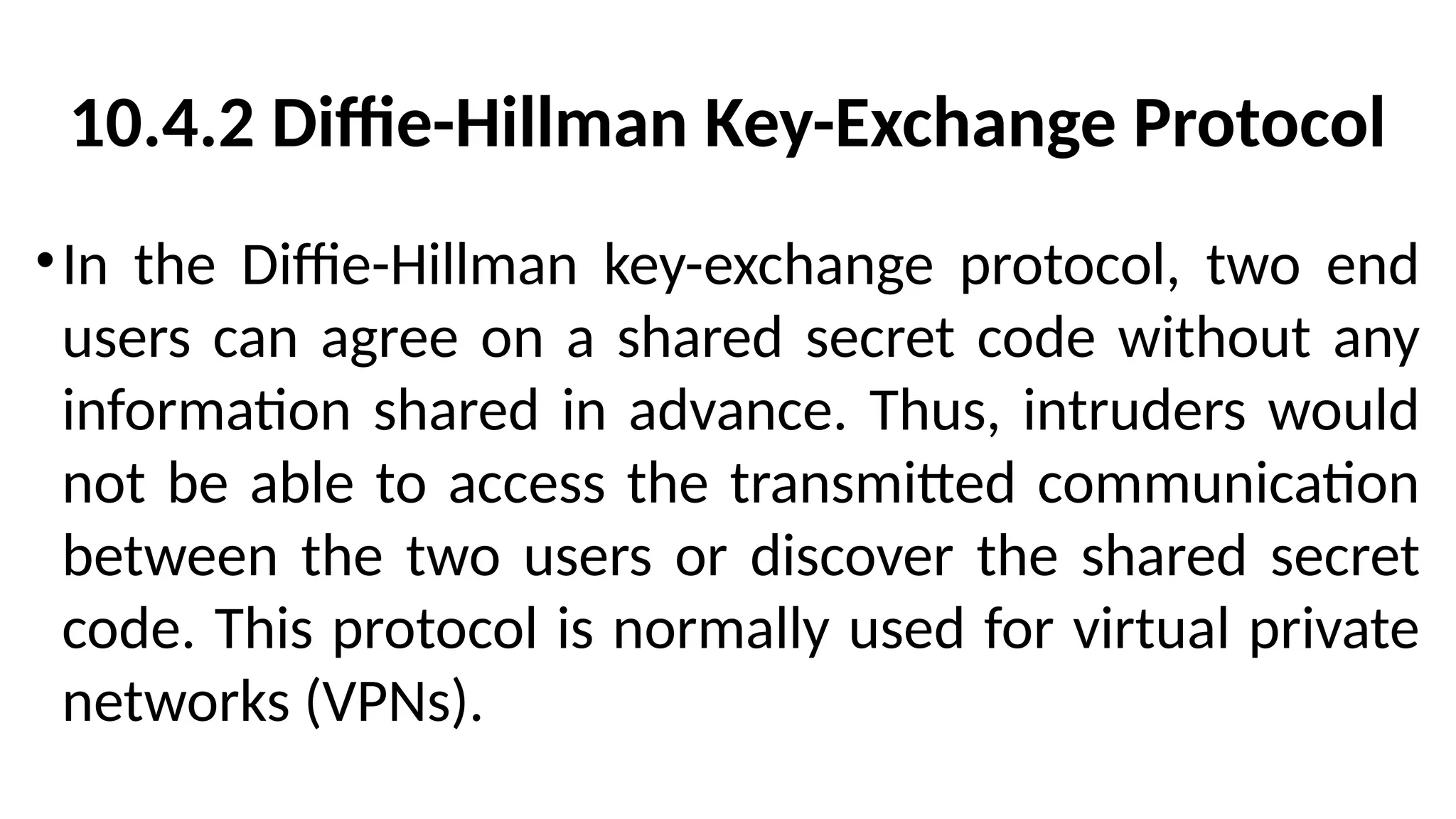
10.4.2 Diffie-Hillman Key-Exchange Protocol
•In the Diffie-Hillman key-exchange protocol, two end
users can agree on a shared secret code without any
information shared in advance. Thus, intruders would
not be able to access the transmitted communication
between the two users or discover the shared secret
code. This protocol is normally used for virtual private
networks (VPNs).
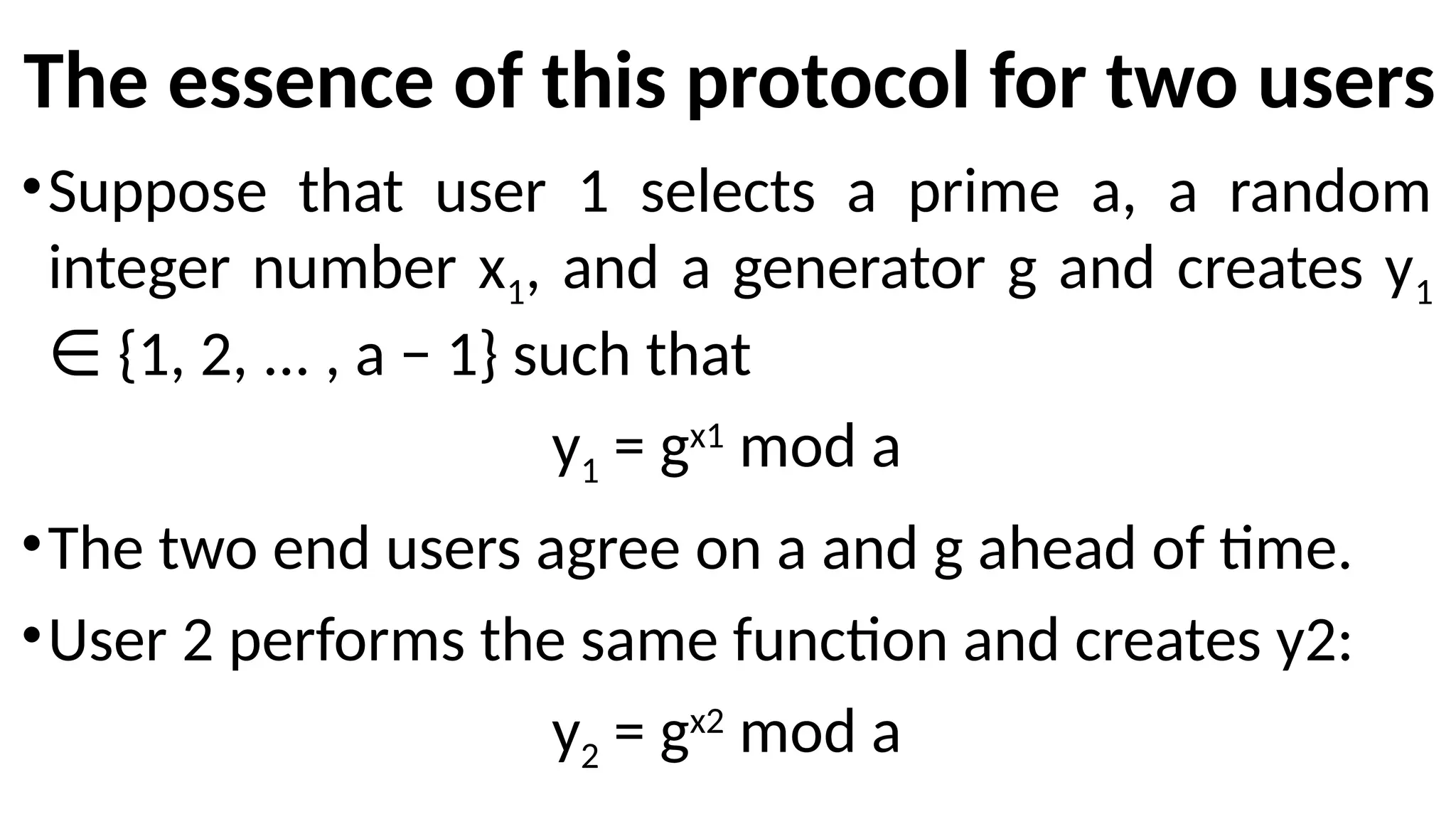
The essence of this protocol for two users
•Suppose that user 1 selects a prime a, a random
integer number x1, and a generator g and creates y1
{1, 2, ... , a − 1} such that
∈
y1 = gx1
mod a
•The two end users agree on a and g ahead of time.
•User 2 performs the same function and creates y2:
y2 = gx2
mod a
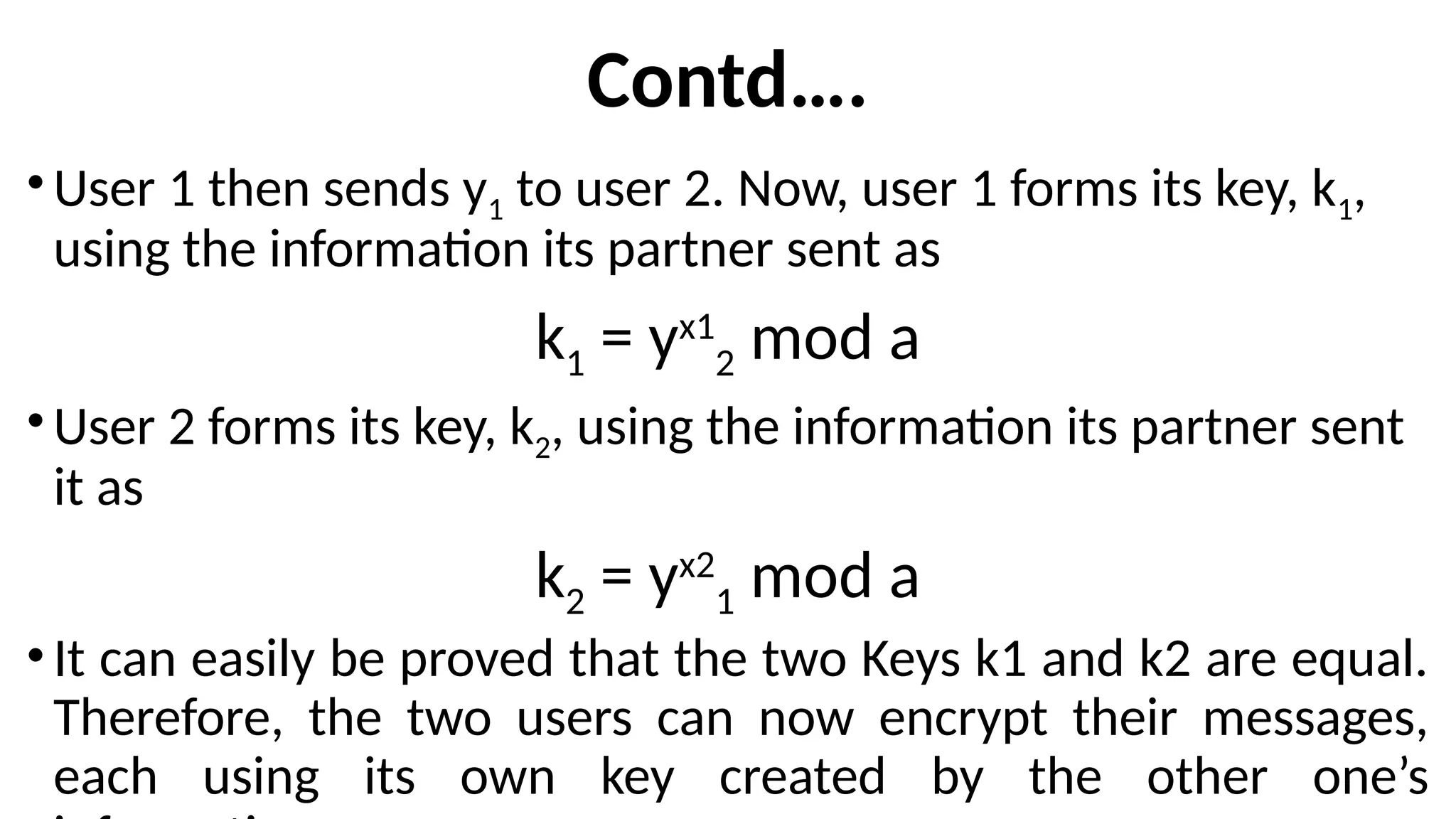
Contd….
•User 1 then sends y1 to user 2. Now, user 1 forms its key, k1,
using the information its partner sent as
k1 = yx1
2 mod a
•User 2 forms its key, k2, using the information its partner sent
it as
k2 = yx2
1 mod a
•It can easily be proved that the two Keys k1 and k2 are equal.
Therefore, the two users can now encrypt their messages,
each using its own key created by the other one’s
End of 10.4
Public-Key Cryptography
SYLLABUS – MODULE 4
•Overview of Network Security: Elements of Network Security,
Classification of Network Attacks.
•Security Methods: Cryptographic Techniques, Authentication Techniques
•Symmetric-Key Cryptography: Data Encryption Standard (DES),
Advance Encryption Standard (AES)
•Public-Key Cryptography: RSA Algorithm, Diffie-Hellman Key-
Exchange Protocol,
•Authentication: Hash Function, Secure Hash Algorithm (SHA),
•Digital Signatures,
•Firewalls and Packet Filtering, Packet Filtering, Proxy Server.
****************************************************************************************************
Text book2: Nader F Mir, Computer and Communication Networks,
2nd
Edition, Pearson, 2014; Chapter 10
10.5 Authentication -- Syllabus
10.5.1 Introduction to Hash Function.
10.5.2 Secure Hash Algorithm (SHA)
Roles of the Authentication Techniques
•Authentication techniques are used to verify identity.
•Message authentication verifies the authenticity of
both the message content and the message sender.
•Message content is authenticated through
implementation of a hash function and encryption of
the resulting message digest.
•The sender’s authenticity can be implemented by use
of a digital signature.
Hash Function
•A common technique for authenticating a message is to
implement a hash function.
•It is used to produce a “fingerprint” of a message.
•The hash value is added at the end of message before
transmission. The receiver recomputes the hash value
from the received message and compares it to the
received hash value. If the two hash values are the
same, the message was not altered during transmission.
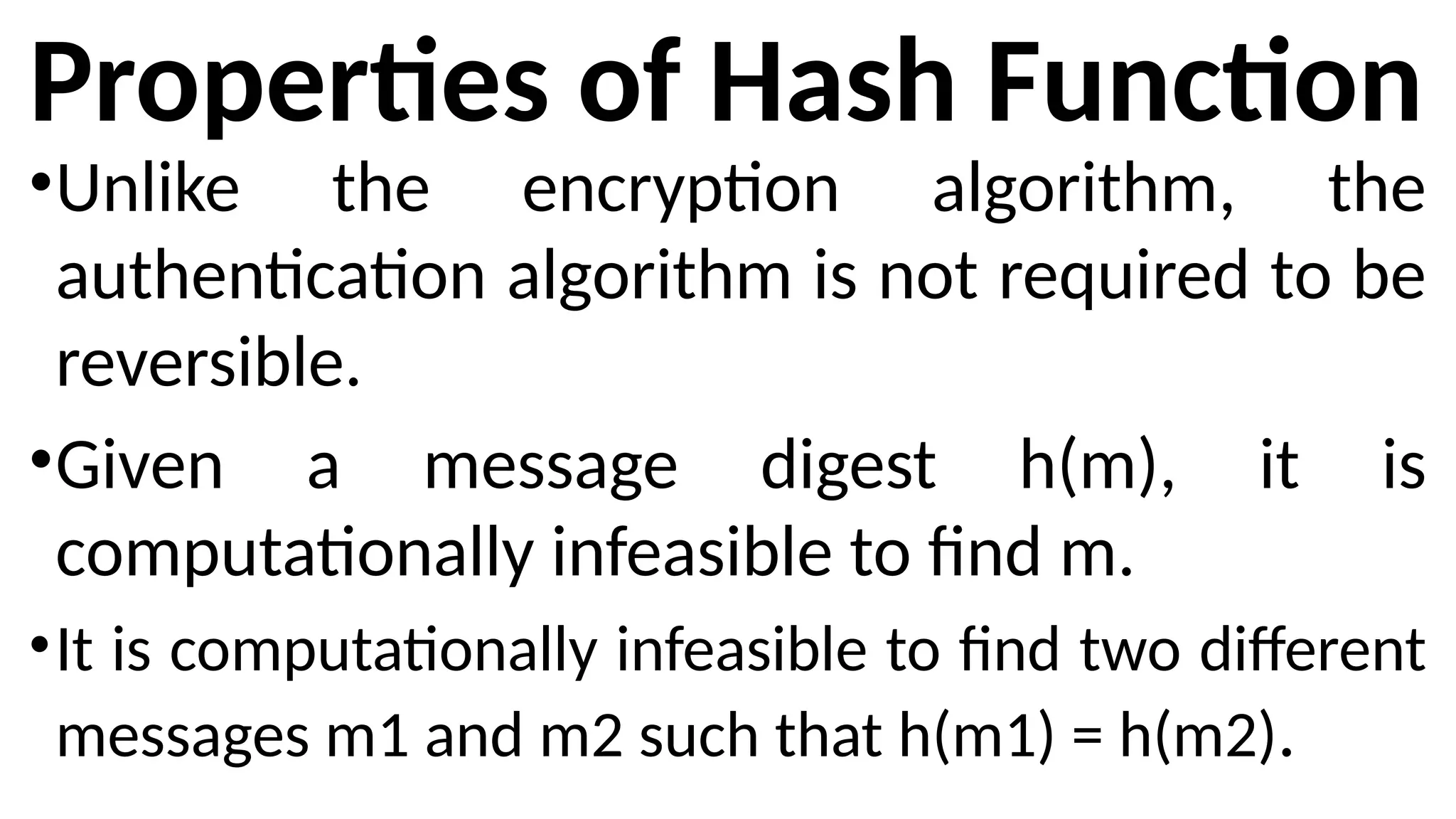
Once a hash function is applied on a message, m, the
result is known as a message digest, or h(m).
Properties of Hash Function
•Unlike the encryption algorithm, the
authentication algorithm is not required to be
reversible.
•Given a message digest h(m), it is
computationally infeasible to find m.
•It is computationally infeasible to find two different
messages m1 and m2 such that h(m1) = h(m2).
Message Authentication
Message authentication can be
implemented by two methods.
•Combined with Encryption
•Use of the Hash Function
Message Authentication: Combined with Encryption
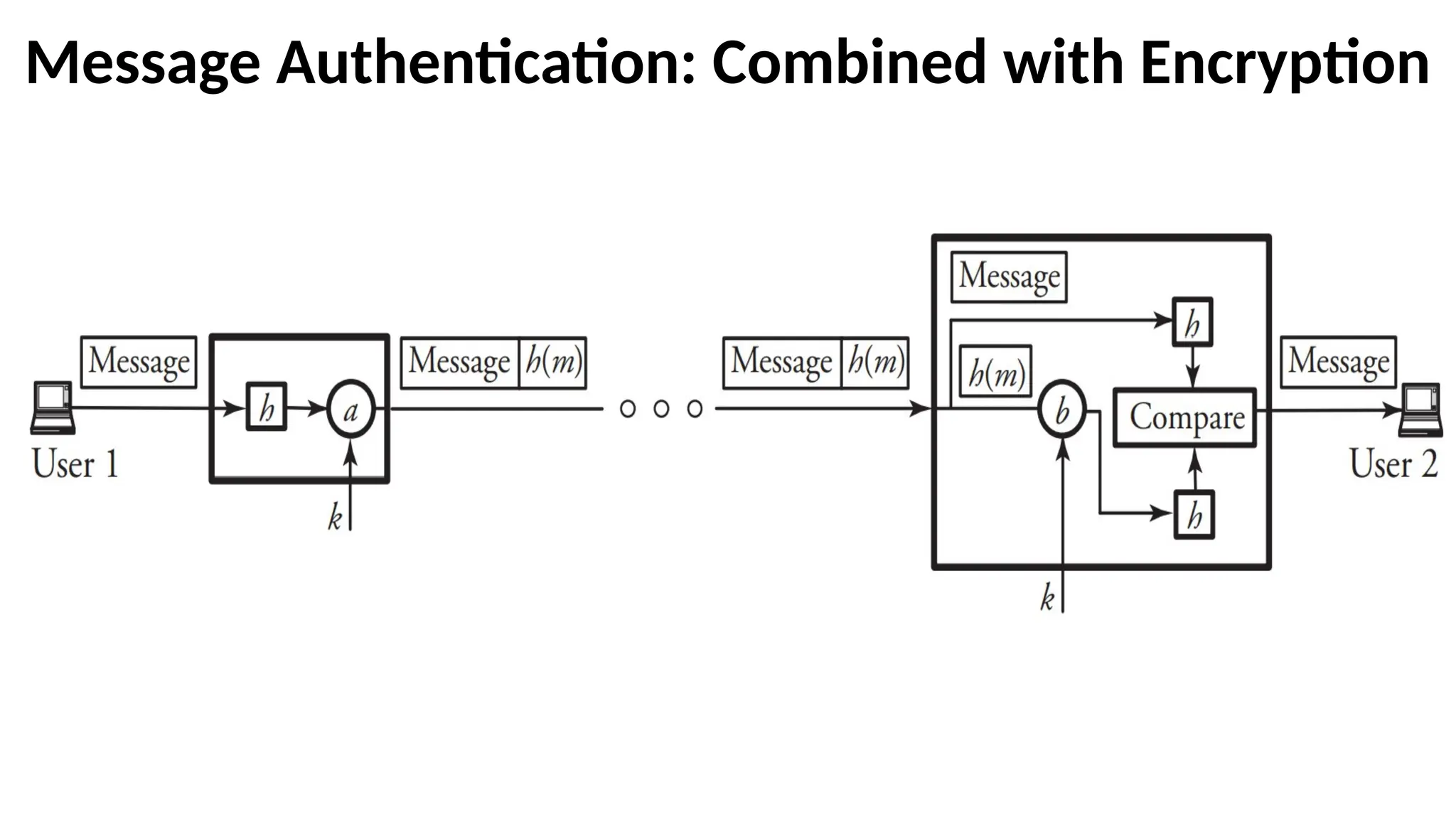
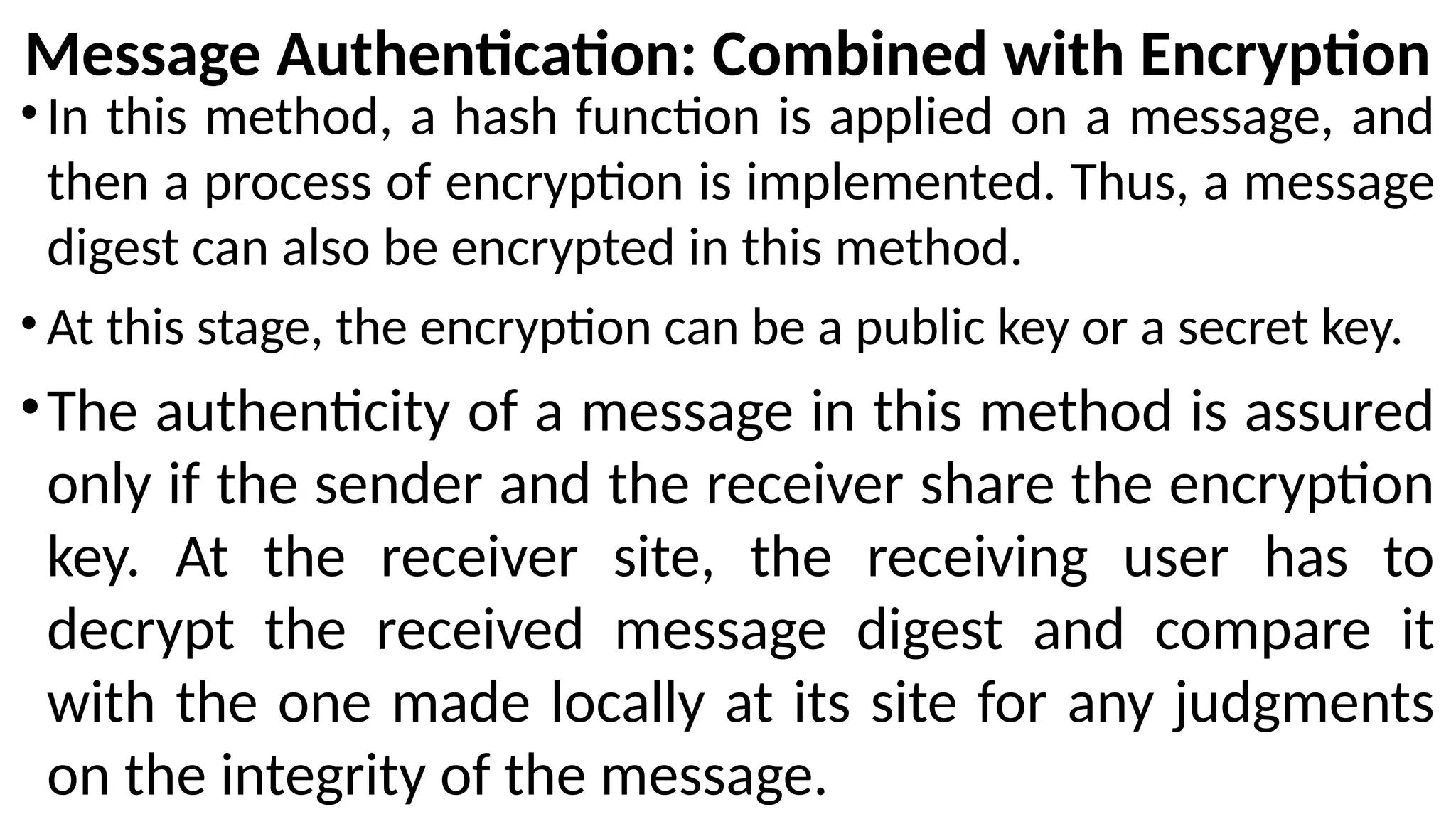
•In this method, a hash function is applied on a message, and
then a process of encryption is implemented. Thus, a message
digest can also be encrypted in this method.
• At this stage, the encryption can be a public key or a secret key.
•The authenticity of a message in this method is assured
only if the sender and the receiver share the encryption
key. At the receiver site, the receiving user has to
decrypt the received message digest and compare it
with the one made locally at its site for any judgments
on the integrity of the message.
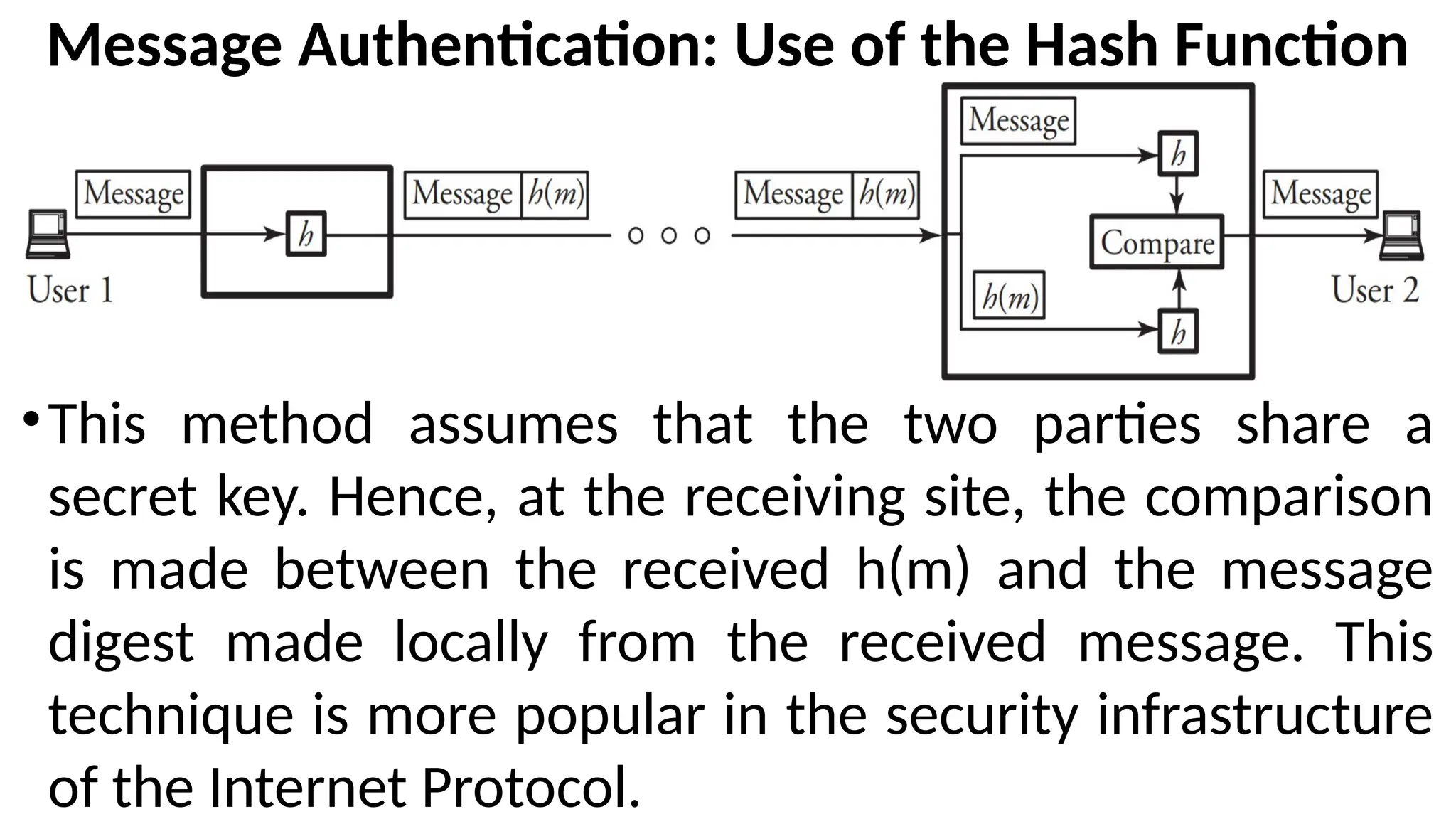
Message Authentication: Use of the Hash Function
•This method assumes that the two parties share a
secret key. Hence, at the receiving site, the comparison
is made between the received h(m) and the message
digest made locally from the received message. This
technique is more popular in the security infrastructure
of the Internet Protocol.
Message Authentication Protocols
•MD5 Hash Algorithm
•Secure Hash Algorithm (SHA).
10.5.2 Secure Hash Algorithm (SHA)
•The Secure Hash Algorithm (SHA) was proposed
as part of the digital signature standard.
•The first version of this standard is SHA-1.
•SHA-1 takes messages with a maximum length
of 224 and produces a 160-bit digest.
•With this algorithm, SHA-1 uses five registers,
R1 through R5, to maintain a “state” of 20 bytes.
Two Steps in SHA-1 Algorithm
•Padding a message m with length Lm
•Expand Each Block
First Step is Padding a message m with length Lm
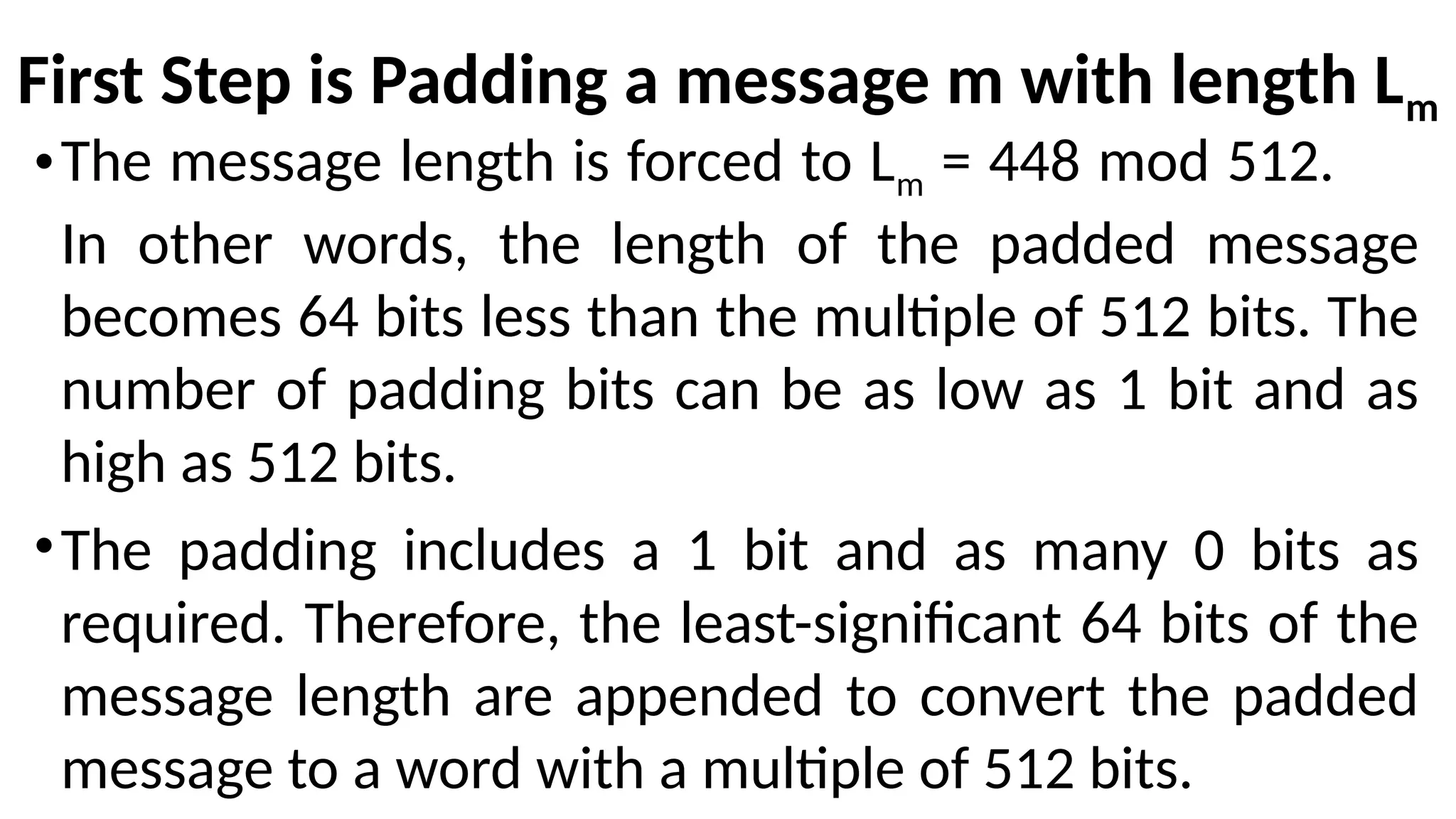
•The message length is forced to Lm = 448 mod 512.
In other words, the length of the padded message
becomes 64 bits less than the multiple of 512 bits. The
number of padding bits can be as low as 1 bit and as
high as 512 bits.
•The padding includes a 1 bit and as many 0 bits as
required. Therefore, the least-significant 64 bits of the
message length are appended to convert the padded
message to a word with a multiple of 512 bits.
Second Step is Expand Each Block
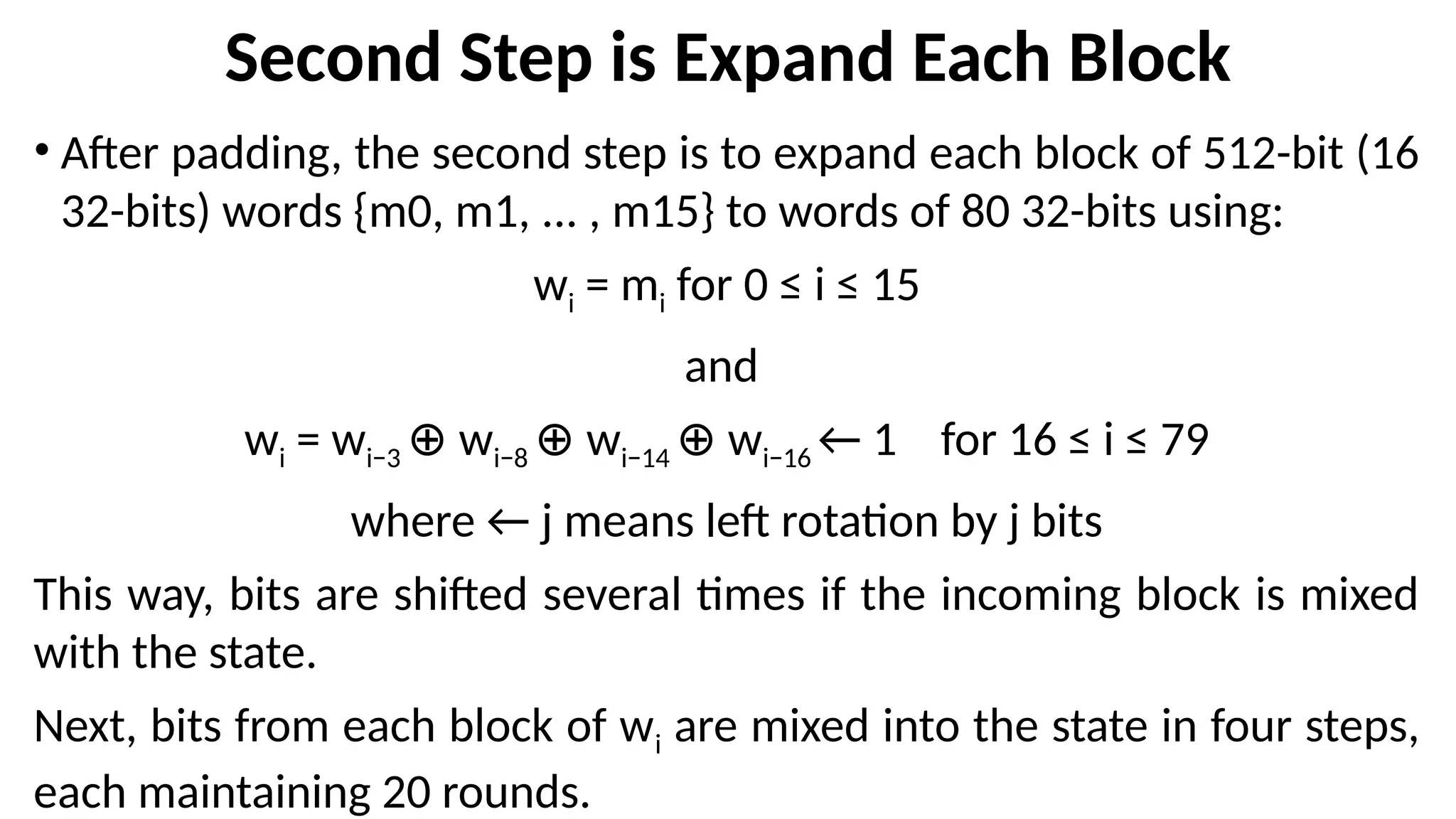
• After padding, the second step is to expand each block of 512-bit (16
32-bits) words {m0, m1, ... , m15} to words of 80 32-bits using:
wi = mi for 0 ≤ i ≤ 15
and
wi = wi−3 w
⊕ i−8 w
⊕ i−14 w
⊕ i−16 ← 1 for 16 ≤ i ≤ 79
where ← j means left rotation by j bits
This way, bits are shifted several times if the incoming block is mixed
with the state.
Next, bits from each block of wi are mixed into the state in four steps,
each maintaining 20 rounds.
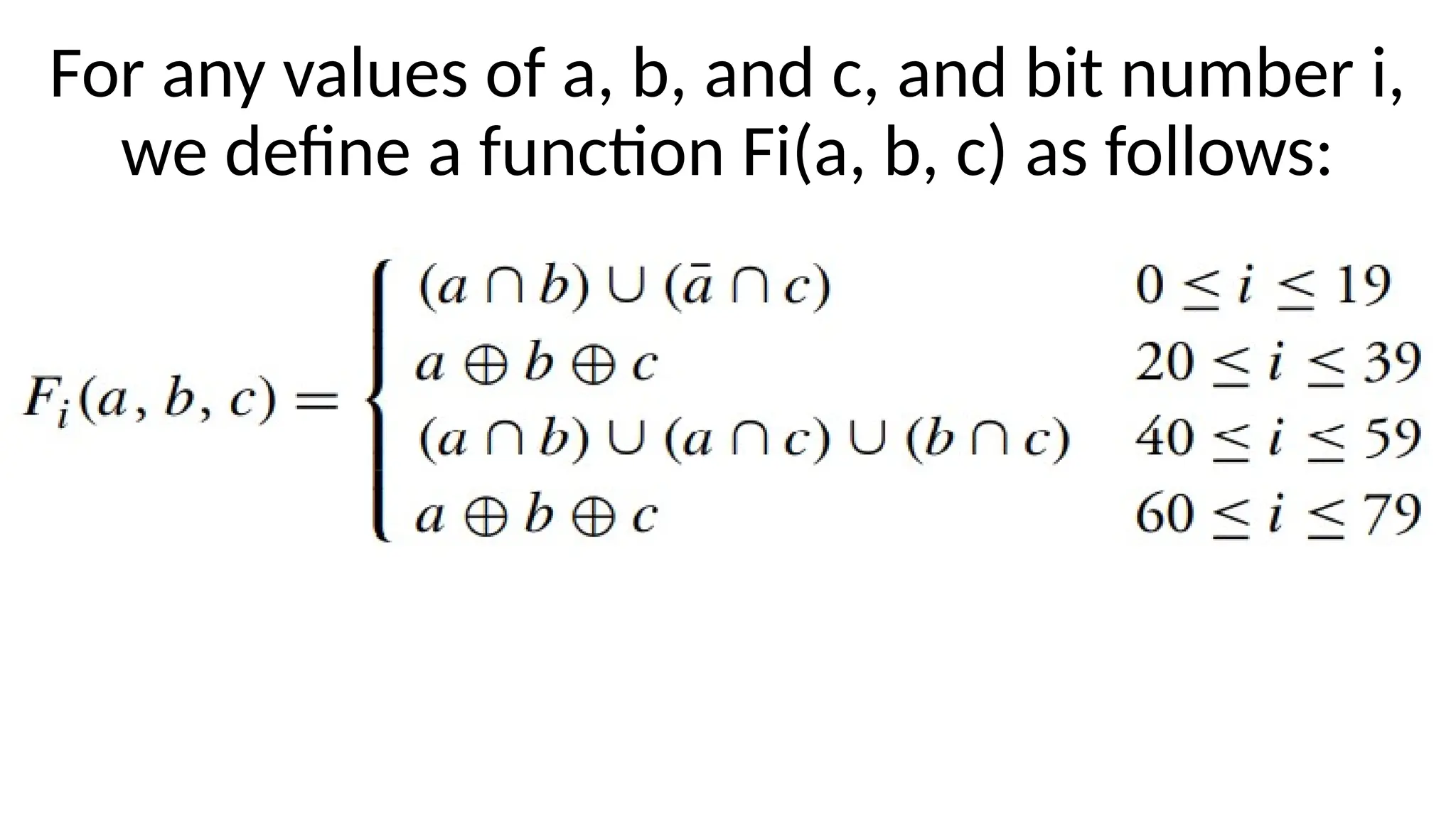
For any values of a, b, and c, and bit number i,
we define a function Fi(a, b, c) as follows:
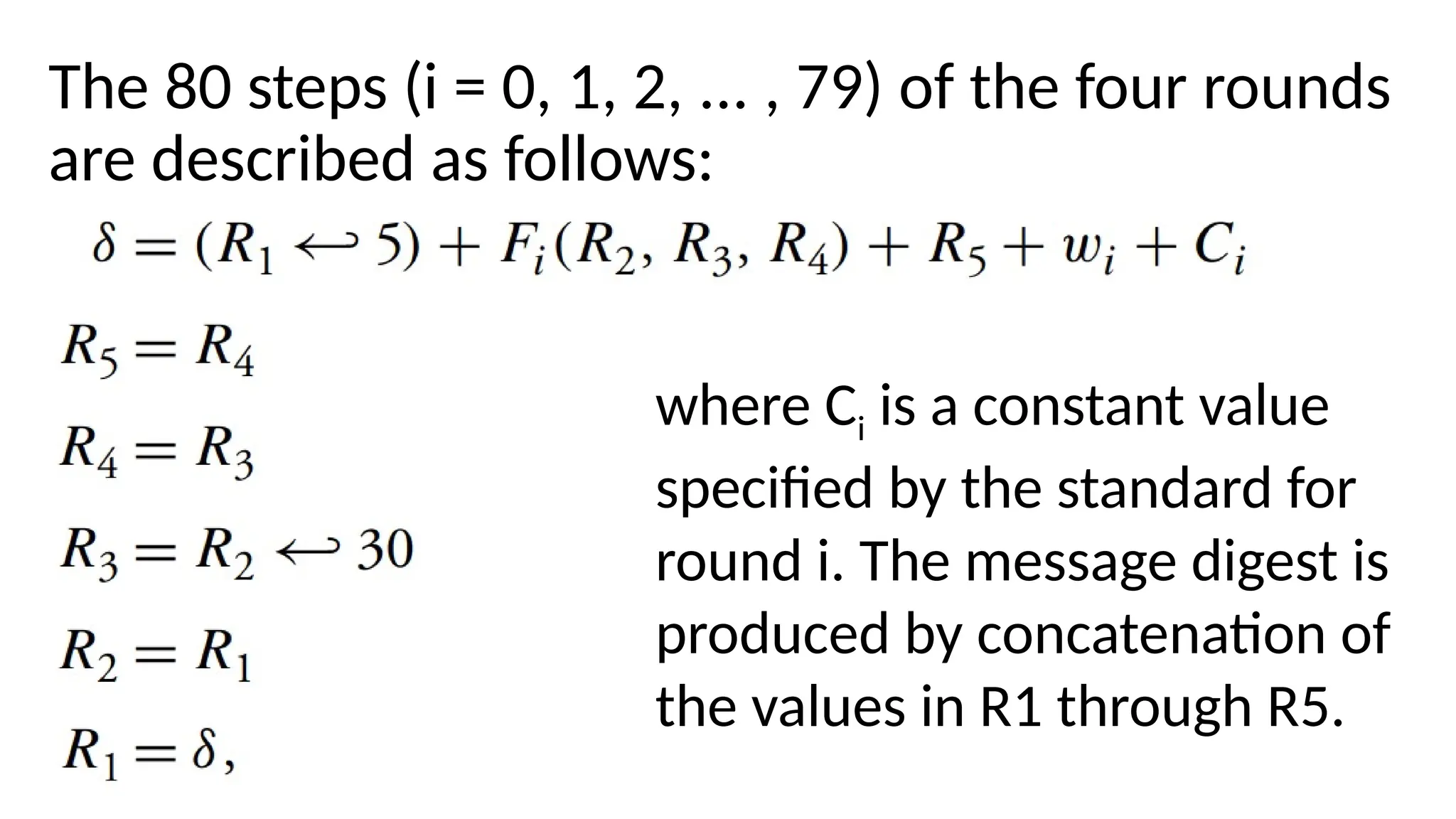
The 80 steps (i = 0, 1, 2, ... , 79) of the four rounds
are described as follows:
where Ci is a constant value
specified by the standard for
round i. The message digest is
produced by concatenation of
the values in R1 through R5.
End of 10.5
Authentication
SYLLABUS – MODULE 4
•Overview of Network Security: Elements of Network Security,
Classification of Network Attacks.
•Security Methods: Cryptographic Techniques, Authentication Techniques
•Symmetric-Key Cryptography: Data Encryption Standard (DES),
Advance Encryption Standard (AES)
•Public-Key Cryptography: RSA Algorithm, Diffie-Hellman Key-
Exchange Protocol,
•Authentication: Hash Function, Secure Hash Algorithm (SHA),
•Digital Signatures,
•Firewalls and Packet Filtering, Packet Filtering, Proxy Server.
****************************************************************************************************
Text book2: Nader F Mir, Computer and Communication Networks,
2nd
Edition, Pearson, 2014; Chapter 10
10.6 Authentication and Digital Signature
•A digital signature on a message is required for
the authentication and identification of the
right sender.
•The digital signature is unique to an individual
and serves as a means of identifying the sender.
Digital Signature Process
•The technical method of providing a sender’s authentication
is performed through cryptography.
•The RSA algorithm implements both encryption and digital
signature.
•When RSA is applied, the message is encrypted with the
sender’s private key. Thus, the entire encrypted message
serves as a digital signature. This means that at the receiving
end, the receiver can decrypt it, using the public key. This
authenticates that the packet comes from the right user.
End of 10.6
Digital Signature
SYLLABUS – MODULE 4
•Overview of Network Security: Elements of Network Security,
Classification of Network Attacks.
•Security Methods: Cryptographic Techniques, Authentication Techniques
•Symmetric-Key Cryptography: Data Encryption Standard (DES),
Advance Encryption Standard (AES)
•Public-Key Cryptography: RSA Algorithm, Diffie-Hellman Key-
Exchange Protocol,
•Authentication: Hash Function, Secure Hash Algorithm (SHA),
•Digital Signatures,
•Firewalls and Packet Filtering, Packet Filtering, Proxy Server.
****************************************************************************************************
Text book2: Nader F Mir, Computer and Communication Networks,
2nd
Edition, Pearson, 2014; Chapter 10
10.8 Firewalls
•A firewall protects data from the outside world.
•A firewall can be a software program or a hardware device.
•A firewall is a simple router implemented with a special
program.
•This unit is placed between hosts of a certain network and
the outside world.
•A firewall is used to protect the network from unwanted
Web sites and potential hackers.
10.8 Firewalls
Firewall
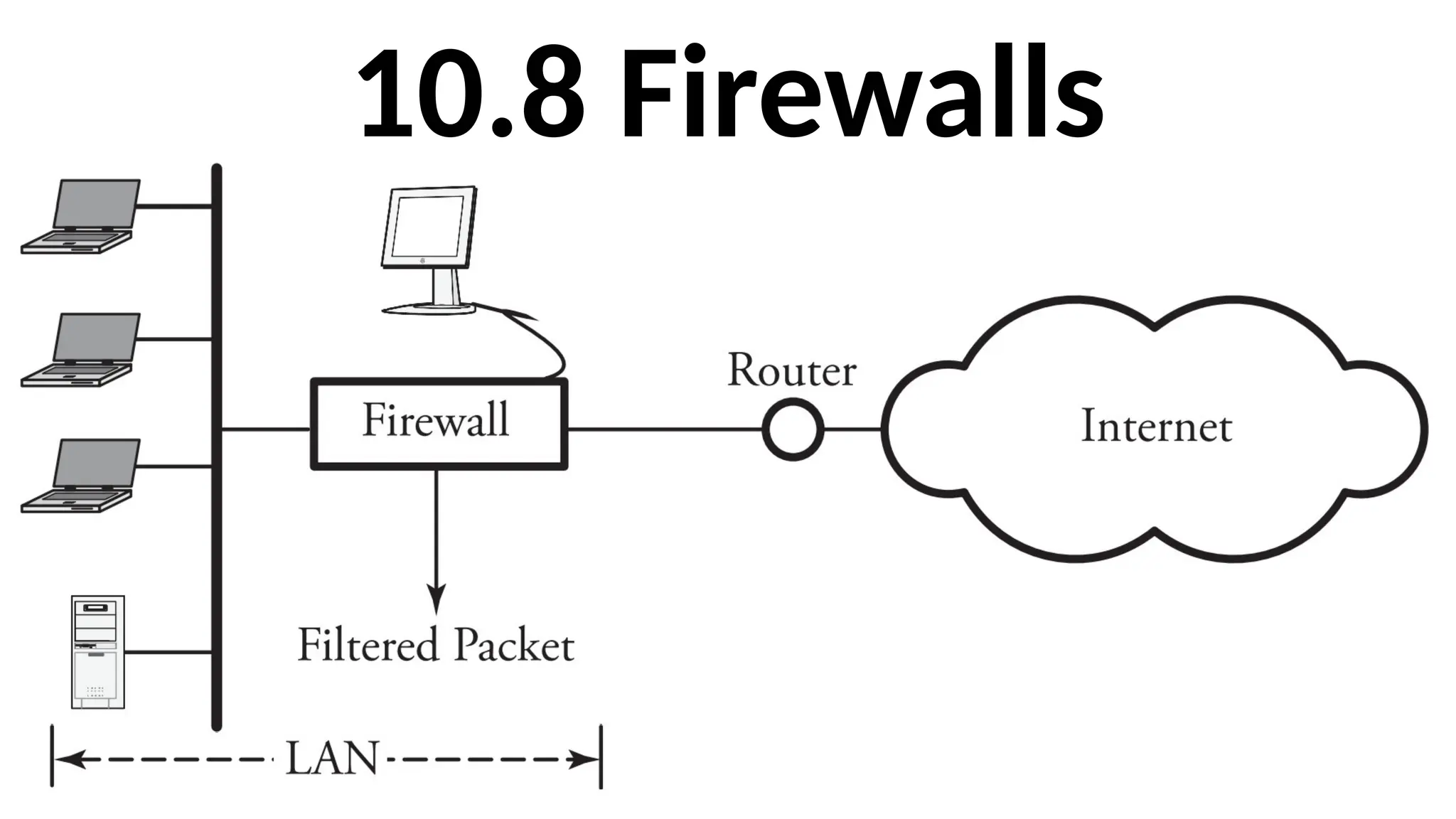
•A firewall is placed on the link between a network
router and the Internet or between a user and a router.
•The objective of such a configuration is to monitor and
filter packets coming from unknown sources.
• Hackers do not have access to penetrate through a
system if a firewall protects the system.
•For a large company with many small networks, the
firewall is placed on every connection attached to the
Internet.
Firewall
•Companies can set rules about how their networks or
particular systems need to work in order to maintain
security.
•Companies can also set rules on how a system can
connect to Web sites.
•The firewall can control how a network works with an
Internet connection.
•A firewall can also be used to control data traffic.
---- Contd…
Software Firewall Programs
•Software firewall programs can be installed in
home computers by using an Internet connection
with these so-called gateways.
•The computer with such a software can access
Web servers only through this software firewall.
Hardware Firewall
•Hardware firewalls are more secure than software
firewalls.
•Hardware firewalls are not expensive.
•Some firewalls also offer virus protection.
The Biggest Security Advantage
•The biggest security advantage of installing a
firewall in a business network is to protect from
any outsider logging on to the network under
protection.
•A firewall is put where a large amount of data flow
is normally expected.
Three Methods of Controlling the
Flow of Traffic in Firewall
•Packet Filtering
•Filtering based on Source IP Address
•Denial of Service
Packet Filtering
•Apart from forwarding packets between networks, a
firewall filters those packets that pass through.
•If packets can get through the filter, they reach their
destinations; otherwise, they are discarded.
•A firewall can be programmed to throw away certain
packets addressed to a particular IP host or TCP port
number. This condition is useful if a particular host does
not want to respond to any access from an external source.
Filtering based on Source IP Address
•The second method is that a firewall filters
packets based on the source IP address.
•This filtering is helpful when a host has to be
protected from any unwanted external
packets.
Denial of Service
•The third method, denial of service.
•This method controls the number of packets
entering a network.
End of 10.7
Firewalls
End of
Module 4
Network Security

VTU V SEM CNS Module 4 PPT 2018 Batch students

  • 1.
    MODULE 4 Network Security VenkateshBhat Senior Associate Professor Department of CSE AIET, Moodbidri
  • 2.
    SYLLABUS – MODULE4 •Overview of Network Security: Elements of Network Security, Classification of Network Attacks. •Security Methods •Symmetric-Key Cryptography: Data Encryption Standard (DES), Advance Encryption Standard (AES) •Public-Key Cryptography: RSA Algorithm, Diffie-Hellman Key- Exchange Protocol, •Authentication: Hash Function, Secure Hash Algorithm (SHA), •Digital Signatures, •Firewalls and Packet Filtering, Packet Filtering, Proxy Server. **************************************************************************************************** Text book2: Nader F Mir, Computer and Communication Networks, 2nd Edition, Pearson, 2014; Chapter 10
  • 3.
    10.1 Overview ofNetwork Security --- Syllabus •Elements of Network Security •Classification of Network Attacks
  • 4.
    10.1.1 Elements ofNetwork Security Network security is concerned mainly with the following two elements: •Confidentiality. Information should be available only to those who have rightful access to it. •Authenticity and Integrity. The sender of a message and the message itself should be verified at the receiving point.
  • 5.
    EXAMPLE User 1 sendsa message (“I am user 1”) to User 2. There are Two Cases: •Message content and sender identity falsified by intruder. •A method of applied security
  • 6.
    Message content andsender identity falsified by intruder. • The network lacks any security system, so an intruder can receive the message, change its content to a different message (“Hi! I am user 1”) and send it to user 2. • User 2 may not know that this falsified message is really from user 1 (authentication). The content of the message is what user 1 (confidentiality).
  • 7.
    A method ofapplied security •A security block is added to each side of the communication, and a secret key that only users 1 and 2 would know about is included. Hence, the message is changed to a form that cannot be altered by the intruder.
  • 8.
    10.1.2 Threats toNetwork Security • Internet infrastructure attacks are classified into four categories: •DNS hacking •Routing table poisoning •Packet mistreatment •Denial-of-Service • Among these threats, The first three attacks are related to network infrastructure; Denial-of-Service attacks are related to end system.
  • 9.
    First Threat toNetwork Security is DNS Hacking • The Domain Name System (DNS) server is a distributed hierarchical and global directory that translates domain names into numerical IP address. DNS is a critical infrastructure, and all hosts contact DNS to access servers and start connections. • In the normal mode of operation, hosts send UDP queries to the DNS server. Servers reply with a proper answer, or direct the queries to smarter servers. • A DNS server also stores information other than host addresses. Name-resolution services in the modern Internet environment are essential for email transmission, navigation to Web sites, or data transfer. Thus, an attack on DNS can potentially affect a large portion of the Internet.
  • 10.
    Result of DNSHacking Attack A DNS Hacking Attack may result in the lack of data authenticity and integrity. •Different forms of the DNS Hacking: •Information-Level Attack •Masquerading Attack (Middle-Man Attack) •Information Leakage Attack •Domain High Jacking Attack
  • 11.
    Information-Level Attack •An Information-LevelAttack forces a server to correspond with other than the correct answer. •With cache poisoning, a hacker tricks a remote name server into caching the answer for a third-party domain by providing malicious information for the domain’s authorized servers. •Hackers can then redirect traffic to a preselected site.
  • 12.
    Masquerading Attack (Middle-ManAttack) •In a masquerading attack, the adversary poses as a trusted entity and obtains all the secret information. •In this, the attacker can stop any message from being transmitted further or can change the content or redirect the packet to bogus servers. •This action is also known as a middle-man attack. •The attacker normally sends queries to each host and receives in reply the DNS host name.
  • 13.
    Information Leakage Attack •Inan Information Leakage Attack, the attacker sends queries to all hosts and identifies which IP addresses are not used. •Later on, the intruder can use those IP addresses to make other types of attacks. •Once a domain name is selected, it has to be registered. Various tools are available to register domain names over the Internet.
  • 14.
    Domain High JackingAttack •In the Domain High Jacking Attack, whenever a user enters a domain address, she/he is forced to enter into the attacker’s Web site. •This can be very irritating and can cause a great loss of Internet usage ability.
  • 15.
    Second Threat toNetwork Security is Routing Table Poisoning Attacks • A Routing Table Poisoning Attack is the undesired modification of routing tables. • An attacker can do this by maliciously modifying the routing information update packets sent by routers. • This is a challenging and important problem, as a routing table is the basis of routing in the Internet. • Any false entry in a routing table could lead to significant consequences, such as congestion, an overwhelmed host, looping, illegal access to data, and network partition.
  • 16.
    Two types ofRouting Table Poisoning Attacks •Link Attack •Router attack.
  • 17.
    Link Attack •A LinkAttack occurs when a hacker gets access to a link and thereby intercepts, interrupts, or modifies routing messages on packets. •Link attacks act similarly on both the link-state and the distance-vector protocols. •If an attacker succeeds in placing an attack in a link- state routing protocol, a router may send incorrect updates about its neighbors or remain silent even if the link state of its neighbor has changed.
  • 18.
    Link Attack ---Contd… •The attack through a link can be so severe that the attacker can program a router to either drop packets from a victim or readdress packets to a victim, resulting in a lower throughput of the network. Sometimes, a router can stop an intended packet from being forwarded further. Since more than one path to any destination exists, the packet ultimately reaches its destination.
  • 19.
    Router Attack • Routerattacks may affect the link-state protocol or the distance-vector protocol. • If link-state protocol routers are attacked, they become malicious. They may add a non-existing link to a routing table, delete an existing link, or may change cost of a link. • This attack may cause a router to simply ignore the updates sent by its neighbors, leading to a serious impact on the operability of the network traffic flow.
  • 20.
    Router Attack ---Contd… •In the distance-vector protocol, an attacker may cause routers to send wrong updates about any node in the network, thereby misleading a router and resulting in network problems. •Most unprotected routers have no way to validate updates. Therefore, both link-state and distance-vector router attacks are very effective.
  • 21.
    Router Attack ---Contd… •In the distance-vector protocol, for example, a malicious router can send wrong information in the form of a distance vector to all its neighbors. •A neighbor may not be able to detect this kind of attack and thus proceeds to update its routing table, based on wrong distance vectors. •The error can in turn be propagated to a great portion of the network before being detected.
  • 22.
    Third Threat toNetwork Security is Packet-Mistreatment Attacks •A packet-mistreatment attack can occur during any data transmission. •A hacker may capture certain data packets and mistreat them. •This type of attack is very difficult to detect. •The attack may result in congestion, lowering throughput, and denial-of-service attacks.
  • 23.
    Third Threat toNetwork Security is Packet-Mistreatment Attacks -- Contd… •Similar to routing table poisoning attacks, packet- mistreatment attacks can also be subclassified into link attacks and router attacks. •The link attack causes interruption, modification, or replication of data packets. •A router attack can misroute all packets and may result in congestion or denial of service.
  • 24.
    Examples of aPacket-Mistreatment Attack •Interruption. •Modification. •Replication. •Ping of death. •Malicious misrouting of packets.
  • 25.
    Interruption •If an attackerintercepts packets, they may not be allowed to be propagated to their destinations, resulting in a lower throughput of the network. •This kind of attack cannot be detected easily, as even in normal operations, routers can drop some packets, for various reasons.
  • 26.
    Modification •Attackers may succeedin accessing the content of a packet while in transit and change its content. •They can then change the address of the packet or even change its data. •To solve this kind of problem, a digital signature mechanism can be used.
  • 27.
    Replication •An attacker mighttrap a packet and replay it. •This kind of attack can be detected by using the sequence number for each packet.
  • 28.
    Ping of death •Anattacker may send a ping message, which is large and therefore must be fragmented for transport. •The receiver then starts to reassemble the fragments as the ping fragments arrive. •The total packet length becomes too large and might cause a system crash.
  • 29.
    Malicious Misrouting ofPackets. •A hacker may attack a router and change its routing table, resulting in misrouting of data packets, causing a denial of service.
  • 30.
    Fourth Threat toNetwork Security is Denial-of-Service Attacks •A denial-of-service attack is a type of security breach that prohibits a user from accessing normally provided services. •The denial of service does not result in information theft or any kind of information loss but can nonetheless be very dangerous, as it can cost the target person a large amount of time and money. •Denial-of-service attacks affect the destination rather than a data packet or router.
  • 31.
    Fourth Threat toNetwork Security is Denial-of-Service Attacks ---- Contd… •Denial-of-service attacks are easy to generate but difficult to detect. •They take important servers out of action for few hours, thereby denying service to all users. •There are yet a few other situations that can cause this kind of attack, such as UDP flood, a TCP flood and ICMP flood.
  • 32.
    Denial-of-Service Attacks areTwo Types •Single-Source. •An attacker sends a large number of packets to a target system to overwhelm and disable it. •Distributed. •In this type of attack, a large number of hosts are used to flood unwanted traffic to a single target. The target cannot then be accessible to other users in the network, as it is processing the flood of traffic.
  • 33.
    End of 10.1 Overviewof Network Security
  • 34.
    SYLLABUS – MODULE4 •Overview of Network Security: Elements of Network Security, Classification of Network Attacks. •Security Methods: Cryptographic Techniques, Authentication Techniques •Symmetric-Key Cryptography: Data Encryption Standard (DES), Advance Encryption Standard (AES) •Public-Key Cryptography: RSA Algorithm, Diffie-Hellman Key- Exchange Protocol, •Authentication: Hash Function, Secure Hash Algorithm (SHA), •Digital Signatures, •Firewalls and Packet Filtering, Packet Filtering, Proxy Server. **************************************************************************************************** Text book2: Nader F Mir, Computer and Communication Networks, 2nd Edition, Pearson, 2014; Chapter 10
  • 35.
    10.2 Security MethodsSyllabus 10.2.1 Cryptographic Techniques. 10.2.2 Authentication Techniques.
  • 36.
    10.2 Overview ofSecurity Methods •Common solutions that can protect computer communication networks from attacks are classified as •Cryptographic Techniques or •Authentication Techniques (Verification)
  • 37.
    10.2.1 Cryptographic Techniques •Cryptographyis the process of transforming a piece of information or message shared by two parties into some sort of code. •The message is scrambled before transmission so that it is undetectable by outside watchers. •This kind of message needs to be decoded at the receiving end before any further processing.
  • 38.
    10.2.1 Cryptographic Techniques---- Contd… •The main tool that network security experts are using to encrypt a message M is a secret key K; •The fundamental operation used to encrypt a message is the Exclusive-OR ( ). ⊕ •Suppose that we have one bit, M, and a secret bit, K •A simple encryption is carried out using M K. ⊕ •To decrypt this message, the second party—if he/she has the key, K—can easily detect M by performing the following: (M K) K = M. ⊕ ⊕
  • 39.
    Overview of encryptionpoints in a communication network •In computer communication networks, data can travel between two users while it is encrypted.
  • 40.
    Overview of encryptionpoints in a communication network • Two servers are exchanging data while two types of encryption devices are installed in their communication network. •The first encryption device is end-to-end encryption, whereby secret coding is carried out at both end systems. •In the figure (Previous Slide), server A encodes its data, which can be decoded only at the other end server. •The second phase of encryption is link encryption, which secures all the traffic passing over that link.
  • 41.
    The Two Typesof Encryption Techniques •Secret-Key Encryption •Public-Key Encryption
  • 42.
    Secret-Key Model andPublic-Key Model •In a Secret-Key Model, both sender and receiver conventionally use the same key for an encryption process. •In a Public-Key Model, a sender and a receiver each use a different key.
  • 43.
    Advantage of thePublic-Key System over Secret-Key System •The Public-Key System is more powerful than the Secret-Key System. •The Public-Key System provides better security. • The Public-Key System provides better message privacy.
  • 44.
    Drawback of Public-KeyEncryption is Speed •The Public-Key System is more complex computationally and may not be practical in many cases. •Hence, the Public-Key System is used only to establish a session to exchange a session key. Then, this session key is used in a Secret-Key System for encrypting messages for the duration of the session.
  • 45.
    10.2.2 Authentication Techniques •Encryption methods offer the assurance of message confidentiality. •A networking system must be able to verify the authenticity of the message and the sender of the message. •These forms of security techniques in computer networks are known as authentication techniques and are categorized as authentication with message digest and authentication with digital signature. •Message authentication protects a user in a network against data falsification and ensures data integrity. These methods do not necessarily use keys.
  • 46.
  • 47.
    SYLLABUS – MODULE4 •Overview of Network Security: Elements of Network Security, Classification of Network Attacks. •Security Methods: Cryptographic Techniques, Authentication Techniques •Symmetric-Key Cryptography: Data Encryption Standard (DES), Advance Encryption Standard (AES) •Public-Key Cryptography: RSA Algorithm, Diffie-Hellman Key- Exchange Protocol, •Authentication: Hash Function, Secure Hash Algorithm (SHA), •Digital Signatures, •Firewalls and Packet Filtering, Packet Filtering, Proxy Server. **************************************************************************************************** Text book2: Nader F Mir, Computer and Communication Networks, 2nd Edition, Pearson, 2014; Chapter 10
  • 48.
    10.3 Symmetric-Key Cryptography (OrSecret Key Encryption Protocol) -- Syllabus 10.3.1 Data Encryption Standard (DES). 10.3.2 Advance Encryption Standard (AES)
  • 49.
    10.3 Secret-Key EncryptionProtocols (Or Symmetric Encryption Protocols Or Single-Key Encryption Protocols •Secret-key encryption protocols consist of •An encryption algorithm, •A key, and •A decryption algorithm. •At the end point, the encrypted message is called ciphertext.
  • 50.
    Standard Mechanisms toimplement a Secret-Key Encryption Algorithm 10.3.1 Data Encryption Standard (DES) and 10.3.2 Advanced Encryption Standard (AES)
  • 51.
    General Features ofSecret-Key Encryption Algorithms •A shared secret key between a transmitter and a receiver is assigned at the transmitter and receiver points. •The encryption algorithm produces a different key at any time for a specific transmission. •Changing the key changes the output of the algorithm. •At the receiving end, the encrypted information can be transformed back to the original data by using a decryption algorithm and the same key that was used for encryption. •The security of encryption depends on the secrecy of the key, not on the secrecy of the encryption algorithm. • The algorithm need not be kept secret; only the key has to be secret.
  • 52.
    10.3.1 Data EncryptionStandard (DES) •With the Data Encryption Standard (DES), plaintext messages are converted into 64- bit blocks, each encrypted using a key. •The key length is 64 bits but contains only 56 usable bits; thus, the last bit of each 8 byte in the key is a parity bit for the corresponding byte. •DES consists of 16 identical rounds of an operation.
  • 53.
  • 54.
    DES Algorithm 1. Initialize.Before round 1 begins, all 64 bits of an incoming message and all 56 bits of the secret key are separately permuted (shuffled). 2. Each incoming 64-bit message is broken into two 32-bit halves denoted by Li and Ri, respectively . 3. The 56 bits of the key are also broken into two 28-bit halves, and each half is rotated one or two bit positions, depending on the round.
  • 55.
    DES Algorithm ---Contd… 4. All 56 bits of the key are permuted, producing version ki of the key on round i. 5. In this step, is a logic Exclusive-OR, and the ⊕ description of function F() appears next. Then, Li and Ri are determined by Li = Ri−1 And Ri = Li−1 F (R ⊕ i−1, ki). 6. All 64 bits of a message are permuted.
  • 56.
    The operation offunction F() at any round i of DES 1. Out of 52 bits of ki, function F() chooses 48 bits. 2. The 32-bit Ri−1 is expanded from 32 bits to 48 bits so that it can be combined with 48-bit ki. The expansion of Ri−1 is carried out by first breaking Ri−1 into eight 4-bit chunks and then expanding each chunk by copying the leftmost bit and the rightmost bit from left and right adjacent chunks, respectively. 3. Function F() also partitions the 48 bits of ki into eight 6-bit chunks. 4. The corresponding eight chunks of Ri−1 and eight chunks of ki are combined as follows:
  • 57.
    Contd… •At the receiver,the same steps and the same key are used to reverse the encryption. •It is now apparent that the 56-bit key length may not be sufficient to provide full security. This argument is still controversial. Triple DES provides a solution for this controversy: three keys are used, for a total of 168 bits. •It should also be mentioned that DES can be implemented more efficiently in hardware than in software.
  • 58.
    10.3.2 Advanced EncryptionStandard (AES) •The Advanced Encryption Standard (AES) protocol has a better security strength than DES. AES supports 128-bit symmetric block messages and uses 128-bit key, 192-bit key, or 256-bit key. •The number of rounds in AES is variable from 10 to 14 rounds, depending on the key and block sizes. • There are ten rounds of encryptions for the key size of 128 bits. •All rounds are identical except for the last round, which has no mix-column stage.
  • 59.
  • 60.
    10.3.2 Advanced EncryptionStandard (AES) •A single block of 128-bit plaintext (16 bytes) as an input arrives from the left. •The plaintext is formed as 16 bytes m0 through m15 and is fed into round 1 after an initialization stage. •In this round, substitute units—indicated by S in the figure— perform a byte-by-byte substitution of blocks. The ciphers, in the form of rows and columns, move through a permutation stage to shift rows to mix columns.
  • 61.
    10.3.2 Advanced EncryptionStandard (AES) •At the end of this round, all 16 blocks of ciphers are Exclusive-ORed with the 16 bytes of round 1 key k0(1) through k15(1). •The 128-bit key is expanded for ten rounds. •The AES decryption algorithm is fairly simple. •It is the reverse of the encryption algorithm at each stage of a round. •All stages of each round are reversible.
  • 62.
  • 63.
    SYLLABUS – MODULE4 •Overview of Network Security: Elements of Network Security, Classification of Network Attacks. •Security Methods: Cryptographic Techniques, Authentication Techniques •Symmetric-Key Cryptography: Data Encryption Standard (DES), Advance Encryption Standard (AES) •Public-Key Cryptography: RSA Algorithm, Diffie-Hellman Key- Exchange Protocol, •Authentication: Hash Function, Secure Hash Algorithm (SHA), •Digital Signatures, •Firewalls and Packet Filtering, Packet Filtering, Proxy Server. **************************************************************************************************** Text book2: Nader F Mir, Computer and Communication Networks, 2nd Edition, Pearson, 2014; Chapter 10
  • 64.
    10.4 Public-Key EncryptionProtocols 10.4.1 RSA Algorithm. 10.4.2 Diffie-Hellman Key-Exchange Protocol.
  • 65.
    Public-Key Cryptography •Public-Key Cryptographyprovided a very clever method for key exchange. •In the Public-Key Encryption Model, a sender/receiver pair use different keys. •This model is sometimes known as asymmetric, or two-key, encryption. •Public-Key Algorithm is based on mathematical functions rather than on substitution or permutation, although the security of any encryption scheme depends on the length of the key and the computational work involved in breaking an encrypted message.
  • 66.
    Different types ofPublic-Key Cryptography Algorithm •Rivert, Shamir, and Aldeman (RSA) Protocol •Diffie-Hillman Key-Exchange Protocol
  • 67.
    General Features ofthe Public-Key Encryption Methods •In the public-key encryption methods, either of the two related keys can be used for encryption; the other one, for decryption. •It is computationally infeasible to determine the decryption key given only the algorithm and the encryption key. •Each system using this encryption method generates a pair of keys to be used for encryption and decryption of a message that it will receive. •Each system publishes its encryption key by placing it in a public register or file and sorts out the key as a public one. •The companion key is kept private.
  • 68.
    Example •If A wishesto send a message to B, A encrypts the message by using B’s public key. •On receiving the message, B decrypts it with the private B key. No other recipients can decrypt the message, since only B knows its private key. •This way, public-key encryption secures an incoming communication as long as a system controls its private key. •Public-key encryption has extra computational overhead and is more complex than the conventional one.
  • 69.
    10.4.1 RSA Algorithm •Assumethat a plaintext m must be encrypted to a ciphertext c. •The RSA algorithm has three phases for this: •Key Generation, •Encryption, and •Decryption.
  • 70.
    Key Generation •In theRSA scheme, the key length is typically 512 bits, which requires an enormous computational power. •A plaintext is encrypted in blocks, with each block having a binary value less than some number n. •Encryption and decryption are done as follows, beginning with the generation of a public key and a private key.
  • 71.
    Begin Key GenerationAlgorithm 1. Choose two roughly 256-bit prime numbers, a and b, and derive n = ab. 2. Find x. Select encryption key x such that x and (a − 1)(b − 1) are relatively prime. (Two numbers are relatively prime if they have no common factor greater than 1). 3. Find y. Calculate decryption key y: xy mod (a − 1)(b − 1) = 1. 4. At this point, a and b can be discarded. 5. The public key = {x, n}. 6. The private key = {y, n}.
  • 72.
    •In this algorithm, •xand n are known to both sender and receiver, •But only the receiver must know y. •Also, a and b must be large and about the same size and both greater than 1,024 bits. The larger these two values, the more secure the encryption.
  • 73.
    Encryption •Both sender andreceiver must know the value of n. •The sender knows the value of x, and •Only the receiver knows the value of y. •Thus, this is a public-key encryption, with the public key {x, n} and the private key {y, n}. •Given m < n, ciphertext c is constructed by c = mx mod n •Note here that if a and b are chosen to be on the order of 1,024 bits, n ≈ 2,048. •Thus, we are not able to encrypt a message longer than 256 characters.
  • 74.
    Decryption •Given the ciphertext,c, the plaintext, m, is extracted by m = cy mod n. •The calculations require a math library, as numbers are huge.
  • 75.
    Example. For an RSAencryption of a 4-bit message of “1000”, or m = 9, we choose a = 3 and b = 11. Find the public and the private keys for this security action, and show the ciphertext. • Solution. Clearly, n = ab = 33. • We select x = 3, which is relatively prime to (a − 1)(b − 1) = 20. • Then, from xy mod (a − 1)(b − 1) = 3y mod 20 = 1, we can get y = 7. • The public key and the private key should be {3, 33} and {7, 33}, respectively. • If we encrypt the message, we get c = mx mod n = 93 mod 33 = 3. • The decryption process is the reverse of this action, as m = cy mod n = 37 mod 33 = 9.
  • 76.
    10.4.2 Diffie-Hillman Key-ExchangeProtocol •In the Diffie-Hillman key-exchange protocol, two end users can agree on a shared secret code without any information shared in advance. Thus, intruders would not be able to access the transmitted communication between the two users or discover the shared secret code. This protocol is normally used for virtual private networks (VPNs).
  • 77.
    The essence ofthis protocol for two users •Suppose that user 1 selects a prime a, a random integer number x1, and a generator g and creates y1 {1, 2, ... , a − 1} such that ∈ y1 = gx1 mod a •The two end users agree on a and g ahead of time. •User 2 performs the same function and creates y2: y2 = gx2 mod a
  • 78.
    Contd…. •User 1 thensends y1 to user 2. Now, user 1 forms its key, k1, using the information its partner sent as k1 = yx1 2 mod a •User 2 forms its key, k2, using the information its partner sent it as k2 = yx2 1 mod a •It can easily be proved that the two Keys k1 and k2 are equal. Therefore, the two users can now encrypt their messages, each using its own key created by the other one’s
  • 79.
  • 80.
    SYLLABUS – MODULE4 •Overview of Network Security: Elements of Network Security, Classification of Network Attacks. •Security Methods: Cryptographic Techniques, Authentication Techniques •Symmetric-Key Cryptography: Data Encryption Standard (DES), Advance Encryption Standard (AES) •Public-Key Cryptography: RSA Algorithm, Diffie-Hellman Key- Exchange Protocol, •Authentication: Hash Function, Secure Hash Algorithm (SHA), •Digital Signatures, •Firewalls and Packet Filtering, Packet Filtering, Proxy Server. **************************************************************************************************** Text book2: Nader F Mir, Computer and Communication Networks, 2nd Edition, Pearson, 2014; Chapter 10
  • 81.
    10.5 Authentication --Syllabus 10.5.1 Introduction to Hash Function. 10.5.2 Secure Hash Algorithm (SHA)
  • 82.
    Roles of theAuthentication Techniques •Authentication techniques are used to verify identity. •Message authentication verifies the authenticity of both the message content and the message sender. •Message content is authenticated through implementation of a hash function and encryption of the resulting message digest. •The sender’s authenticity can be implemented by use of a digital signature.
  • 83.
    Hash Function •A commontechnique for authenticating a message is to implement a hash function. •It is used to produce a “fingerprint” of a message. •The hash value is added at the end of message before transmission. The receiver recomputes the hash value from the received message and compares it to the received hash value. If the two hash values are the same, the message was not altered during transmission. Once a hash function is applied on a message, m, the result is known as a message digest, or h(m).
  • 84.
    Properties of HashFunction •Unlike the encryption algorithm, the authentication algorithm is not required to be reversible. •Given a message digest h(m), it is computationally infeasible to find m. •It is computationally infeasible to find two different messages m1 and m2 such that h(m1) = h(m2).
  • 85.
    Message Authentication Message authenticationcan be implemented by two methods. •Combined with Encryption •Use of the Hash Function
  • 86.
  • 87.
    Message Authentication: Combinedwith Encryption •In this method, a hash function is applied on a message, and then a process of encryption is implemented. Thus, a message digest can also be encrypted in this method. • At this stage, the encryption can be a public key or a secret key. •The authenticity of a message in this method is assured only if the sender and the receiver share the encryption key. At the receiver site, the receiving user has to decrypt the received message digest and compare it with the one made locally at its site for any judgments on the integrity of the message.
  • 88.
    Message Authentication: Useof the Hash Function •This method assumes that the two parties share a secret key. Hence, at the receiving site, the comparison is made between the received h(m) and the message digest made locally from the received message. This technique is more popular in the security infrastructure of the Internet Protocol.
  • 89.
    Message Authentication Protocols •MD5Hash Algorithm •Secure Hash Algorithm (SHA).
  • 90.
    10.5.2 Secure HashAlgorithm (SHA) •The Secure Hash Algorithm (SHA) was proposed as part of the digital signature standard. •The first version of this standard is SHA-1. •SHA-1 takes messages with a maximum length of 224 and produces a 160-bit digest. •With this algorithm, SHA-1 uses five registers, R1 through R5, to maintain a “state” of 20 bytes.
  • 91.
    Two Steps inSHA-1 Algorithm •Padding a message m with length Lm •Expand Each Block
  • 92.
    First Step isPadding a message m with length Lm •The message length is forced to Lm = 448 mod 512. In other words, the length of the padded message becomes 64 bits less than the multiple of 512 bits. The number of padding bits can be as low as 1 bit and as high as 512 bits. •The padding includes a 1 bit and as many 0 bits as required. Therefore, the least-significant 64 bits of the message length are appended to convert the padded message to a word with a multiple of 512 bits.
  • 93.
    Second Step isExpand Each Block • After padding, the second step is to expand each block of 512-bit (16 32-bits) words {m0, m1, ... , m15} to words of 80 32-bits using: wi = mi for 0 ≤ i ≤ 15 and wi = wi−3 w ⊕ i−8 w ⊕ i−14 w ⊕ i−16 ← 1 for 16 ≤ i ≤ 79 where ← j means left rotation by j bits This way, bits are shifted several times if the incoming block is mixed with the state. Next, bits from each block of wi are mixed into the state in four steps, each maintaining 20 rounds.
  • 94.
    For any valuesof a, b, and c, and bit number i, we define a function Fi(a, b, c) as follows:
  • 95.
    The 80 steps(i = 0, 1, 2, ... , 79) of the four rounds are described as follows: where Ci is a constant value specified by the standard for round i. The message digest is produced by concatenation of the values in R1 through R5.
  • 96.
  • 97.
    SYLLABUS – MODULE4 •Overview of Network Security: Elements of Network Security, Classification of Network Attacks. •Security Methods: Cryptographic Techniques, Authentication Techniques •Symmetric-Key Cryptography: Data Encryption Standard (DES), Advance Encryption Standard (AES) •Public-Key Cryptography: RSA Algorithm, Diffie-Hellman Key- Exchange Protocol, •Authentication: Hash Function, Secure Hash Algorithm (SHA), •Digital Signatures, •Firewalls and Packet Filtering, Packet Filtering, Proxy Server. **************************************************************************************************** Text book2: Nader F Mir, Computer and Communication Networks, 2nd Edition, Pearson, 2014; Chapter 10
  • 98.
    10.6 Authentication andDigital Signature •A digital signature on a message is required for the authentication and identification of the right sender. •The digital signature is unique to an individual and serves as a means of identifying the sender.
  • 99.
    Digital Signature Process •Thetechnical method of providing a sender’s authentication is performed through cryptography. •The RSA algorithm implements both encryption and digital signature. •When RSA is applied, the message is encrypted with the sender’s private key. Thus, the entire encrypted message serves as a digital signature. This means that at the receiving end, the receiver can decrypt it, using the public key. This authenticates that the packet comes from the right user.
  • 100.
  • 101.
    SYLLABUS – MODULE4 •Overview of Network Security: Elements of Network Security, Classification of Network Attacks. •Security Methods: Cryptographic Techniques, Authentication Techniques •Symmetric-Key Cryptography: Data Encryption Standard (DES), Advance Encryption Standard (AES) •Public-Key Cryptography: RSA Algorithm, Diffie-Hellman Key- Exchange Protocol, •Authentication: Hash Function, Secure Hash Algorithm (SHA), •Digital Signatures, •Firewalls and Packet Filtering, Packet Filtering, Proxy Server. **************************************************************************************************** Text book2: Nader F Mir, Computer and Communication Networks, 2nd Edition, Pearson, 2014; Chapter 10
  • 102.
    10.8 Firewalls •A firewallprotects data from the outside world. •A firewall can be a software program or a hardware device. •A firewall is a simple router implemented with a special program. •This unit is placed between hosts of a certain network and the outside world. •A firewall is used to protect the network from unwanted Web sites and potential hackers.
  • 103.
  • 104.
    Firewall •A firewall isplaced on the link between a network router and the Internet or between a user and a router. •The objective of such a configuration is to monitor and filter packets coming from unknown sources. • Hackers do not have access to penetrate through a system if a firewall protects the system. •For a large company with many small networks, the firewall is placed on every connection attached to the Internet.
  • 105.
    Firewall •Companies can setrules about how their networks or particular systems need to work in order to maintain security. •Companies can also set rules on how a system can connect to Web sites. •The firewall can control how a network works with an Internet connection. •A firewall can also be used to control data traffic. ---- Contd…
  • 106.
    Software Firewall Programs •Softwarefirewall programs can be installed in home computers by using an Internet connection with these so-called gateways. •The computer with such a software can access Web servers only through this software firewall.
  • 107.
    Hardware Firewall •Hardware firewallsare more secure than software firewalls. •Hardware firewalls are not expensive. •Some firewalls also offer virus protection.
  • 108.
    The Biggest SecurityAdvantage •The biggest security advantage of installing a firewall in a business network is to protect from any outsider logging on to the network under protection. •A firewall is put where a large amount of data flow is normally expected.
  • 109.
    Three Methods ofControlling the Flow of Traffic in Firewall •Packet Filtering •Filtering based on Source IP Address •Denial of Service
  • 110.
    Packet Filtering •Apart fromforwarding packets between networks, a firewall filters those packets that pass through. •If packets can get through the filter, they reach their destinations; otherwise, they are discarded. •A firewall can be programmed to throw away certain packets addressed to a particular IP host or TCP port number. This condition is useful if a particular host does not want to respond to any access from an external source.
  • 111.
    Filtering based onSource IP Address •The second method is that a firewall filters packets based on the source IP address. •This filtering is helpful when a host has to be protected from any unwanted external packets.
  • 112.
    Denial of Service •Thethird method, denial of service. •This method controls the number of packets entering a network.
  • 113.
  • 114.