1 
Role of NSDA in Skill Development 
Presented at 
National Consultation on 
Open Educational Resources for Skill Development 
Organised by 
Commonwealth Educational Media Centre for Asia (CEMCA), New Delhi 
In Collaboration with: KNI Trust, Gurgaon 
Venue: Hotel Royal Plaza, New Delhi 
Date: 28 November, 2014 
By 
Ms. Ruchira Chandra 
Consultant, National Skill Development 
Agency, New Delhi
2 
Presentation Format 
1. Introduction to NSDA 
2. Issues 
1) Rationalization of Skill Development Schemes 
2) Engagement with States 
3) NSQF 
4) Getting youth interested 
5) Leveraging techonology- Labour Market Information System 
3. NSDA & OER
3 
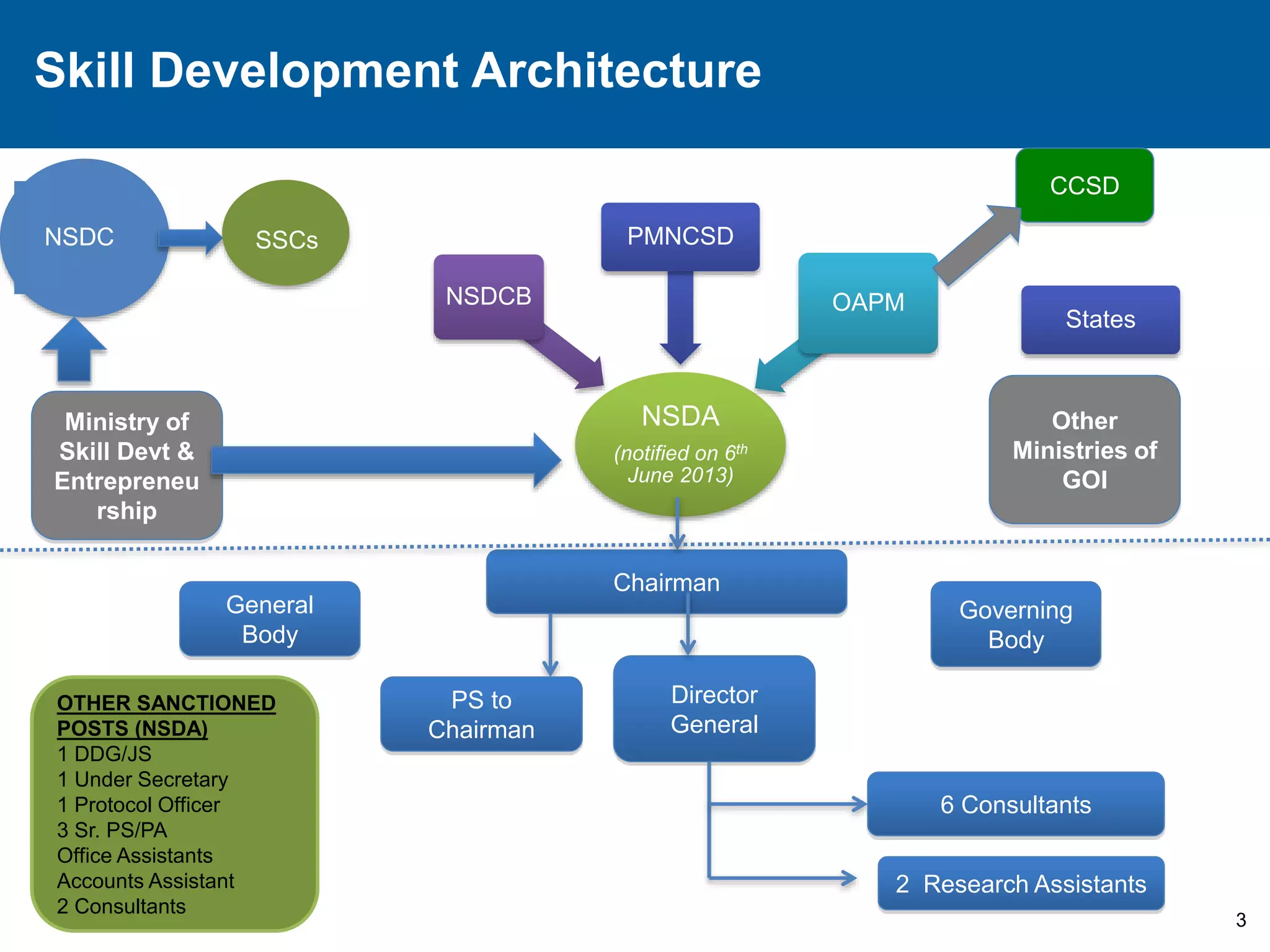
Skill Development Architecture 
NSDA 
(notified on 6th 
June 2013) 
NSDCB 
PMNCSD 
OAPM 
CCSD 
NSDC 
Chairman 
PS to 
Chairman 
Director 
General 
States 
Governing 
Body 
General 
Body 
6 Consultants 
2 Research Assistants 
SSCs 
Ministry of 
Skill Devt & 
Entrepreneu 
rship 
OTHER SANCTIONED 
POSTS (NSDA) 
1 DDG/JS 
1 Under Secretary 
1 Protocol Officer 
3 Sr. PS/PA 
Office Assistants 
Accounts Assistant 
2 Consultants 
Other 
Ministries of 
GOI
Functions of NSDA 
• Anchor and operationalize the National Skills Qualifications Framework (NSQF) 
• Create and maintain a national data base related to skill development including 
4 
development of a dynamic Labour Market Information System (LMIS) 
• Nodal agency for State Skill Development Missions (SSDMs) 
• Raise extra-budgetary resources for skill development 
• Evaluate existing skill development schemes to assess their efficacy, and to suggest 
corrective action 
• Affirmative action for advocacy 
• Take all possible steps to meet skilling targets as envisaged in the 12th Five Year 
Plan and beyond 
• Ensure that the skilling needs of the disadvantaged and the marginalized groups like 
SCs, STs, OBCs, minorities, women and differently abled persons are taken care of 
• Discharge any other function entrusted by the Government
5 
Issues
6 
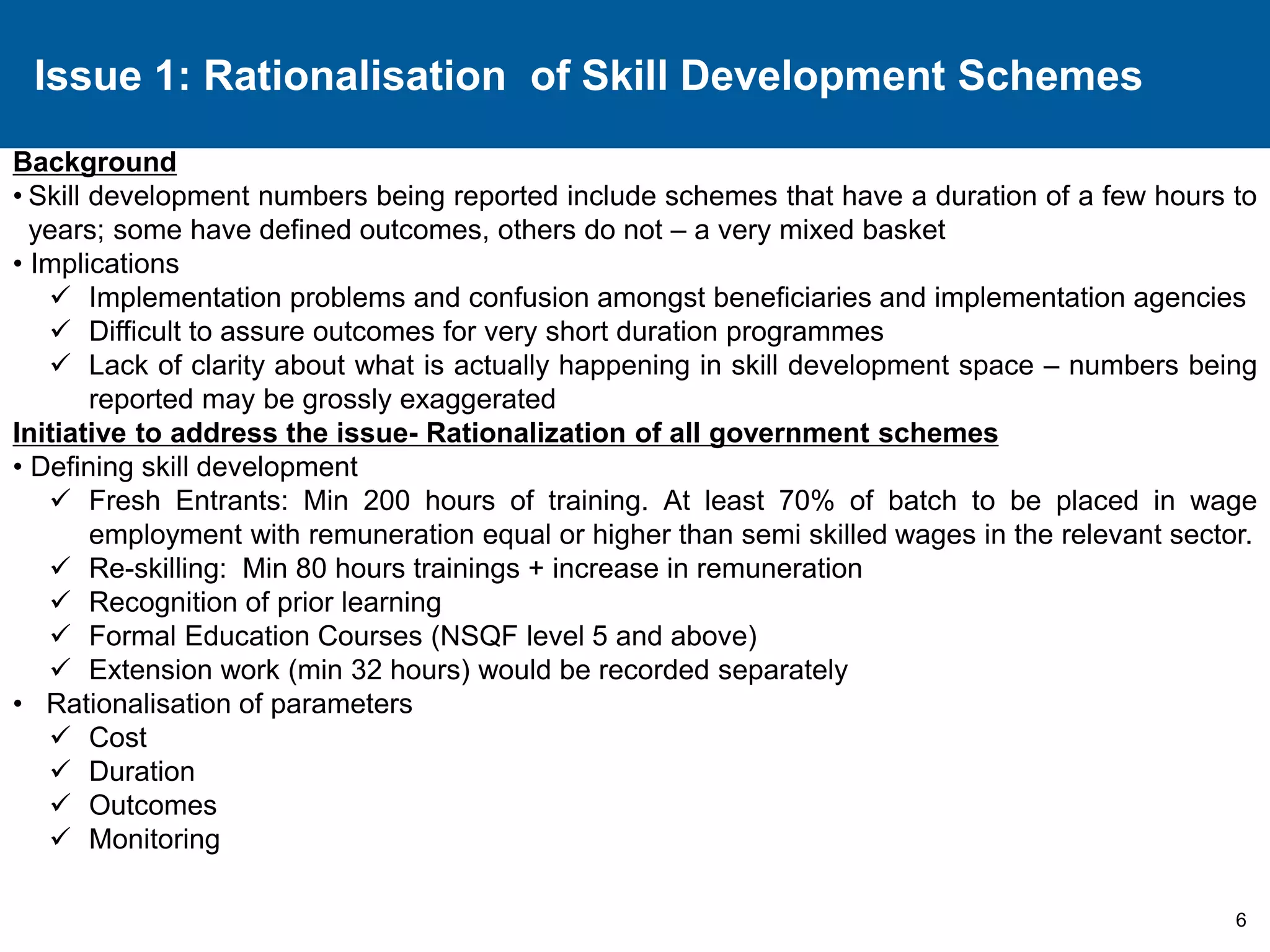
Issue 1: Rationalisation of Skill Development Schemes 
Background 
• Skill development numbers being reported include schemes that have a duration of a few hours to 
years; some have defined outcomes, others do not – a very mixed basket 
• Implications 
 Implementation problems and confusion amongst beneficiaries and implementation agencies 
 Difficult to assure outcomes for very short duration programmes 
 Lack of clarity about what is actually happening in skill development space – numbers being 
reported may be grossly exaggerated 
Initiative to address the issue- Rationalization of all government schemes 
• Defining skill development 
 Fresh Entrants: Min 200 hours of training. At least 70% of batch to be placed in wage 
employment with remuneration equal or higher than semi skilled wages in the relevant sector. 
 Re-skilling: Min 80 hours trainings + increase in remuneration 
 Recognition of prior learning 
 Formal Education Courses (NSQF level 5 and above) 
 Extension work (min 32 hours) would be recorded separately 
• Rationalisation of parameters 
 Cost 
 Duration 
 Outcomes 
 Monitoring
7 
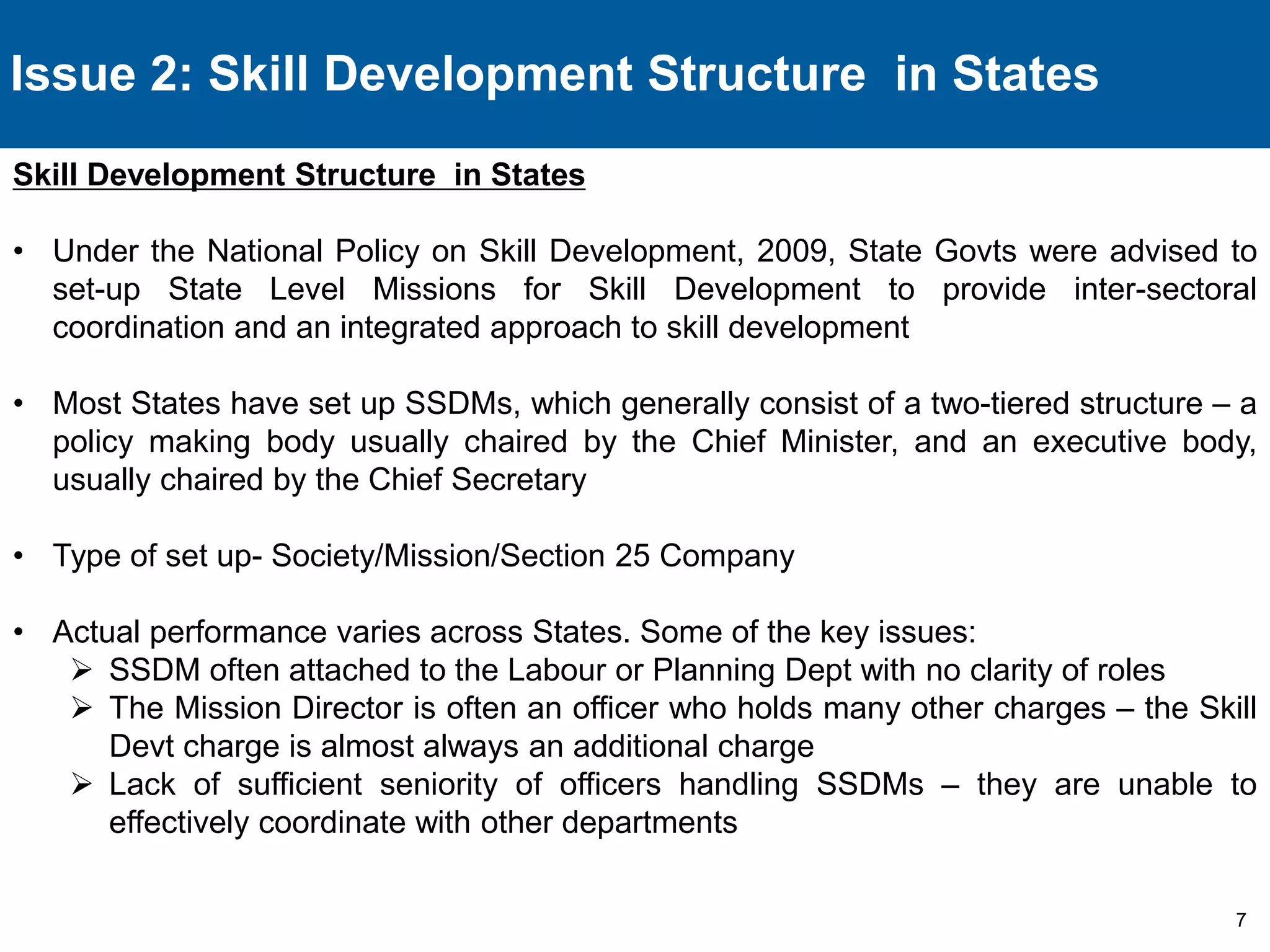
Issue 2: Skill Development Structure in States 
Skill Development Structure in States 
• Under the National Policy on Skill Development, 2009, State Govts were advised to 
set-up State Level Missions for Skill Development to provide inter-sectoral 
coordination and an integrated approach to skill development 
• Most States have set up SSDMs, which generally consist of a two-tiered structure – a 
policy making body usually chaired by the Chief Minister, and an executive body, 
usually chaired by the Chief Secretary 
• Type of set up- Society/Mission/Section 25 Company 
• Actual performance varies across States. Some of the key issues: 
 SSDM often attached to the Labour or Planning Dept with no clarity of roles 
 The Mission Director is often an officer who holds many other charges – the Skill 
Devt charge is almost always an additional charge 
 Lack of sufficient seniority of officers handling SSDMs – they are unable to 
effectively coordinate with other departments
8 
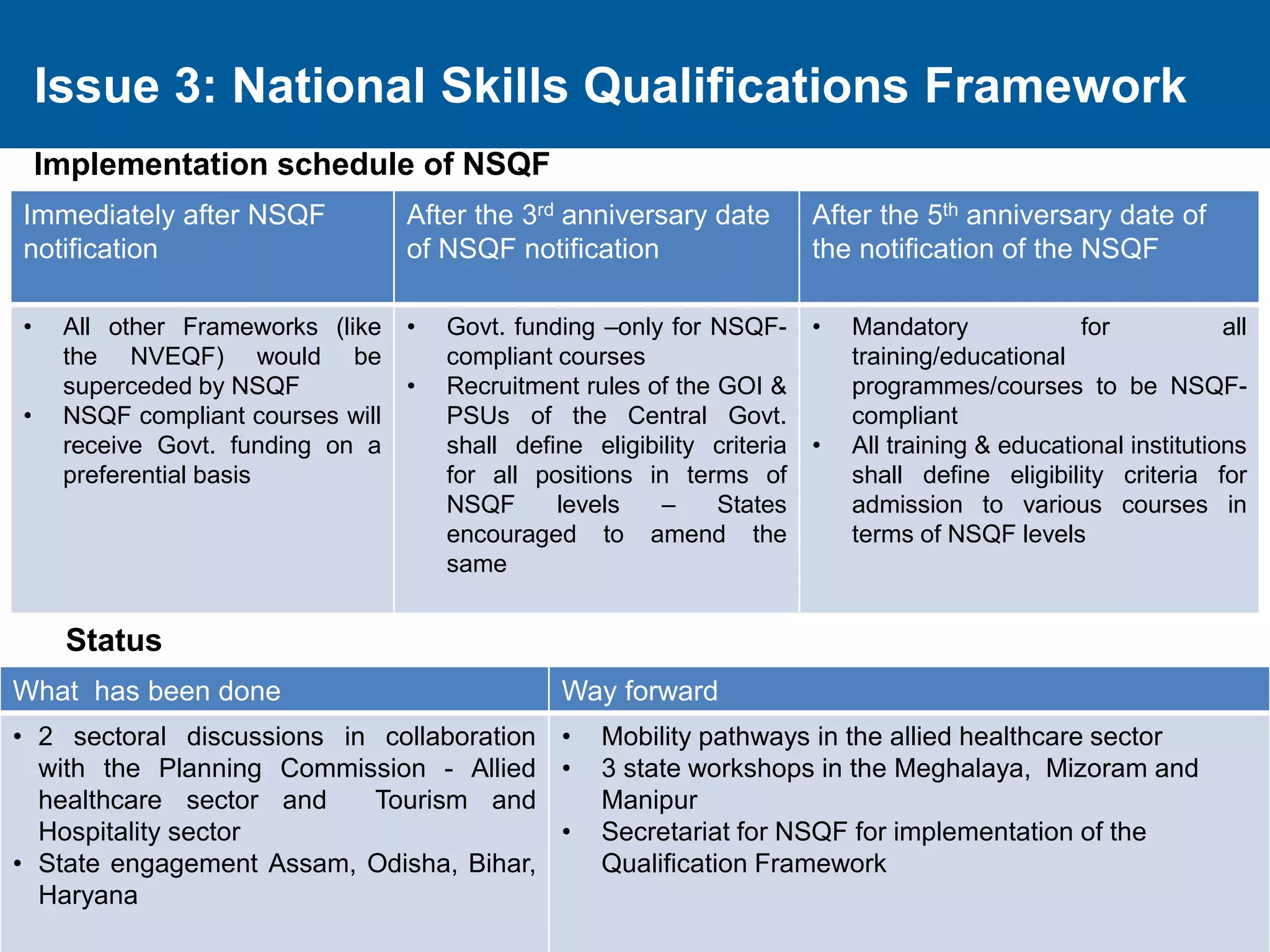
Issue 3: National Skills Qualifications Framework 
Immediately after NSQF 
notification 
After the 3rd anniversary date 
of NSQF notification 
After the 5th anniversary date of 
the notification of the NSQF 
• All other Frameworks (like 
the NVEQF) would be 
superceded by NSQF 
• NSQF compliant courses will 
receive Govt. funding on a 
preferential basis 
• Govt. funding –only for NSQF-compliant 
courses 
• Recruitment rules of the GOI & 
PSUs of the Central Govt. 
shall define eligibility criteria 
for all positions in terms of 
NSQF levels – States 
encouraged to amend the 
same 
• Mandatory for all 
training/educational 
programmes/courses to be NSQF-compliant 
• All training & educational institutions 
shall define eligibility criteria for 
admission to various courses in 
terms of NSQF levels 
Implementation schedule of NSQF 
Status 
What has been done Way forward 
• 2 sectoral discussions in collaboration 
with the Planning Commission - Allied 
healthcare sector and Tourism and 
Hospitality sector 
• State engagement Assam, Odisha, Bihar, 
Haryana 
• Mobility pathways in the allied healthcare sector 
• 3 state workshops in the Meghalaya, Mizoram and 
Manipur 
• Secretariat for NSQF for implementation of the 
Qualification Framework
9 
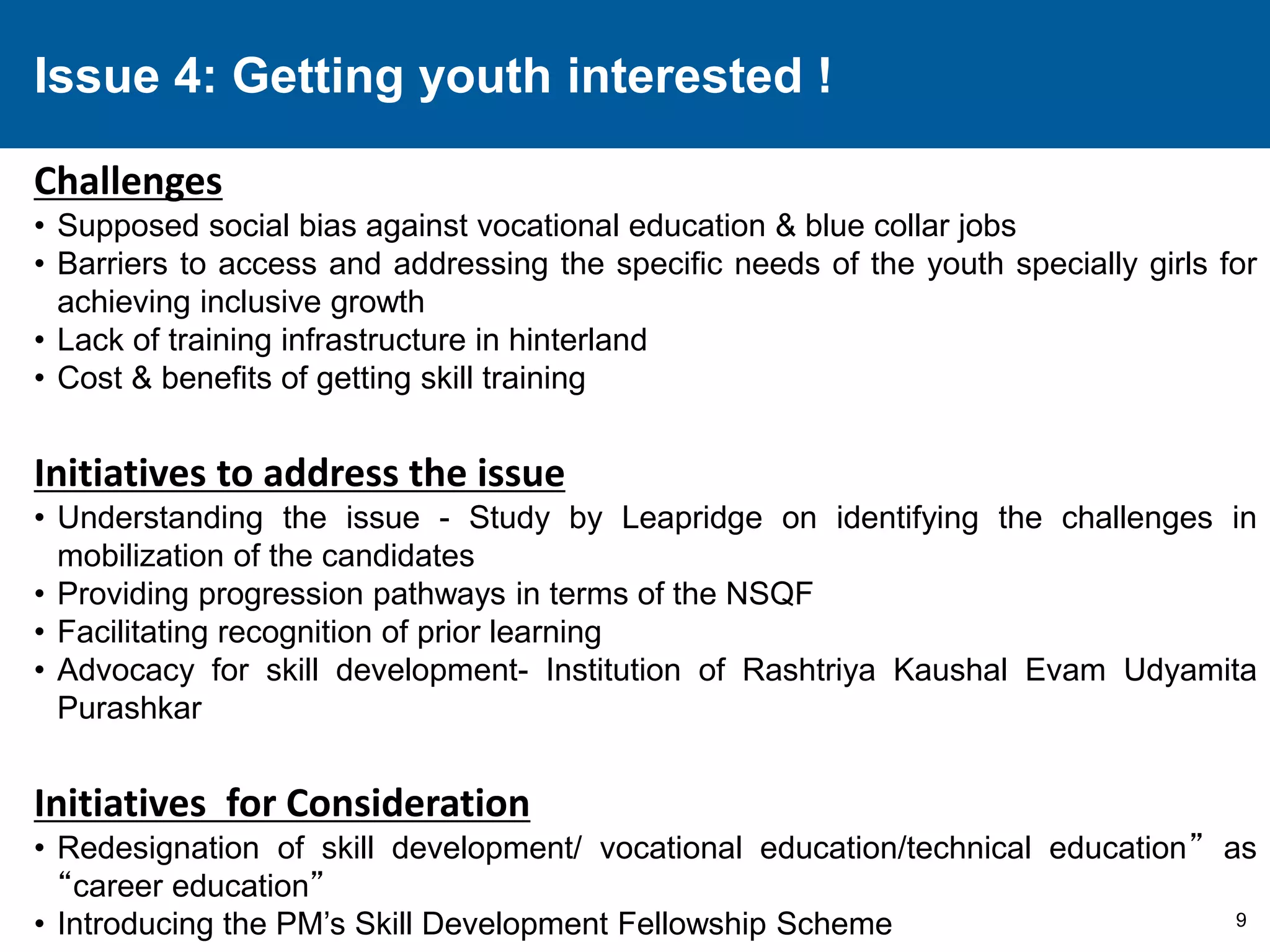
Issue 4: Getting youth interested ! 
Challenges 
• Supposed social bias against vocational education & blue collar jobs 
• Barriers to access and addressing the specific needs of the youth specially girls for 
achieving inclusive growth 
• Lack of training infrastructure in hinterland 
• Cost & benefits of getting skill training 
Initiatives to address the issue 
• Understanding the issue - Study by Leapridge on identifying the challenges in 
mobilization of the candidates 
• Providing progression pathways in terms of the NSQF 
• Facilitating recognition of prior learning 
• Advocacy for skill development- Institution of Rashtriya Kaushal Evam Udyamita 
Purashkar 
Initiatives for Consideration 
• Redesignation of skill development/ vocational education/technical education” as 
“career education” 
• Introducing the PM’s Skill Development Fellowship Scheme
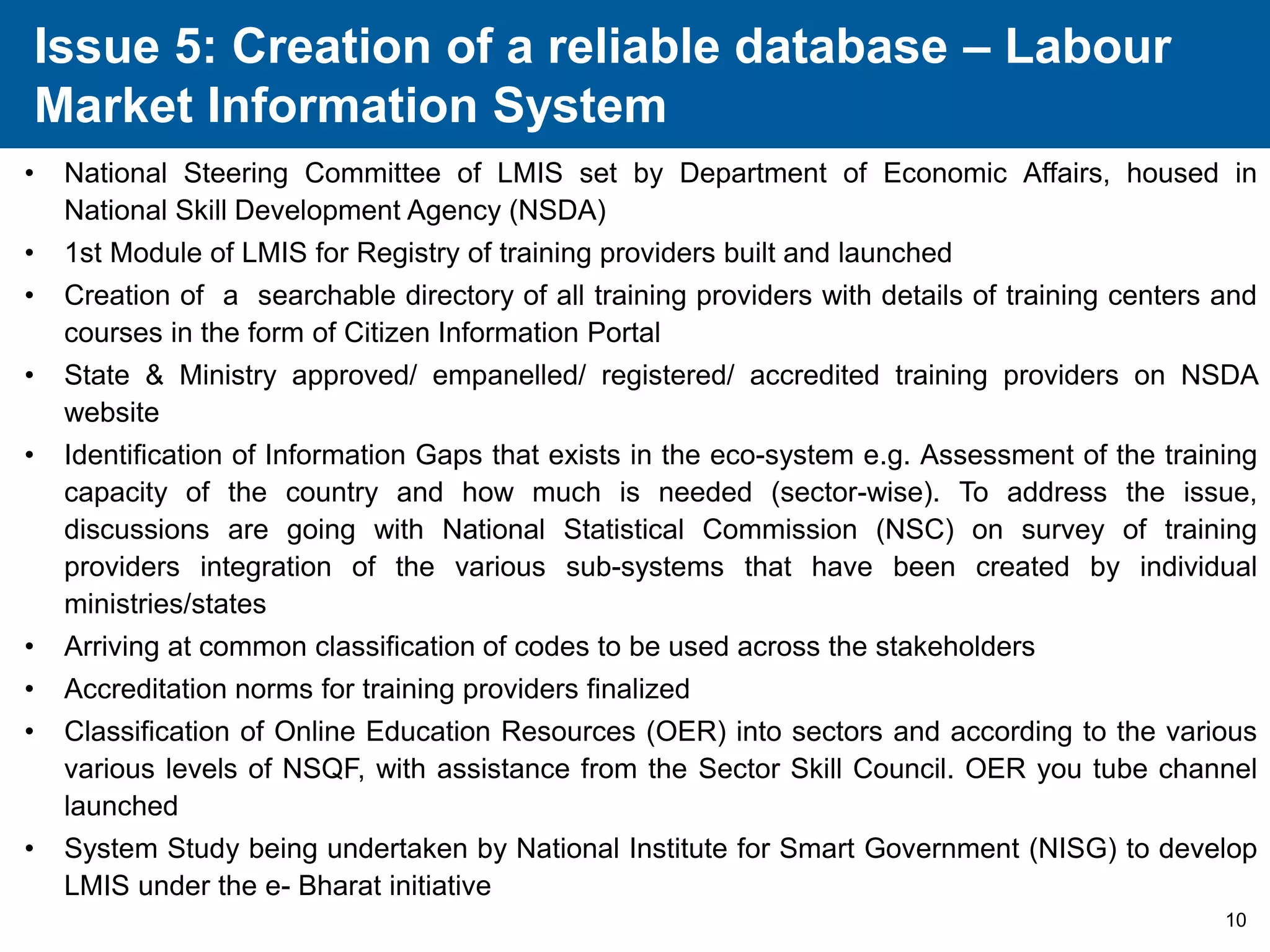
Issue 5: Creation of a reliable database – Labour 
Market Information System 
• National Steering Committee of LMIS set by Department of Economic Affairs, housed in 
10 
National Skill Development Agency (NSDA) 
• 1st Module of LMIS for Registry of training providers built and launched 
• Creation of a searchable directory of all training providers with details of training centers and 
courses in the form of Citizen Information Portal 
• State & Ministry approved/ empanelled/ registered/ accredited training providers on NSDA 
website 
• Identification of Information Gaps that exists in the eco-system e.g. Assessment of the training 
capacity of the country and how much is needed (sector-wise). To address the issue, 
discussions are going with National Statistical Commission (NSC) on survey of training 
providers integration of the various sub-systems that have been created by individual 
ministries/states 
• Arriving at common classification of codes to be used across the stakeholders 
• Accreditation norms for training providers finalized 
• Classification of Online Education Resources (OER) into sectors and according to the various 
various levels of NSQF, with assistance from the Sector Skill Council. OER you tube channel 
launched 
• System Study being undertaken by National Institute for Smart Government (NISG) to develop 
LMIS under the e- Bharat initiative
11 
NSDA & OER
12 
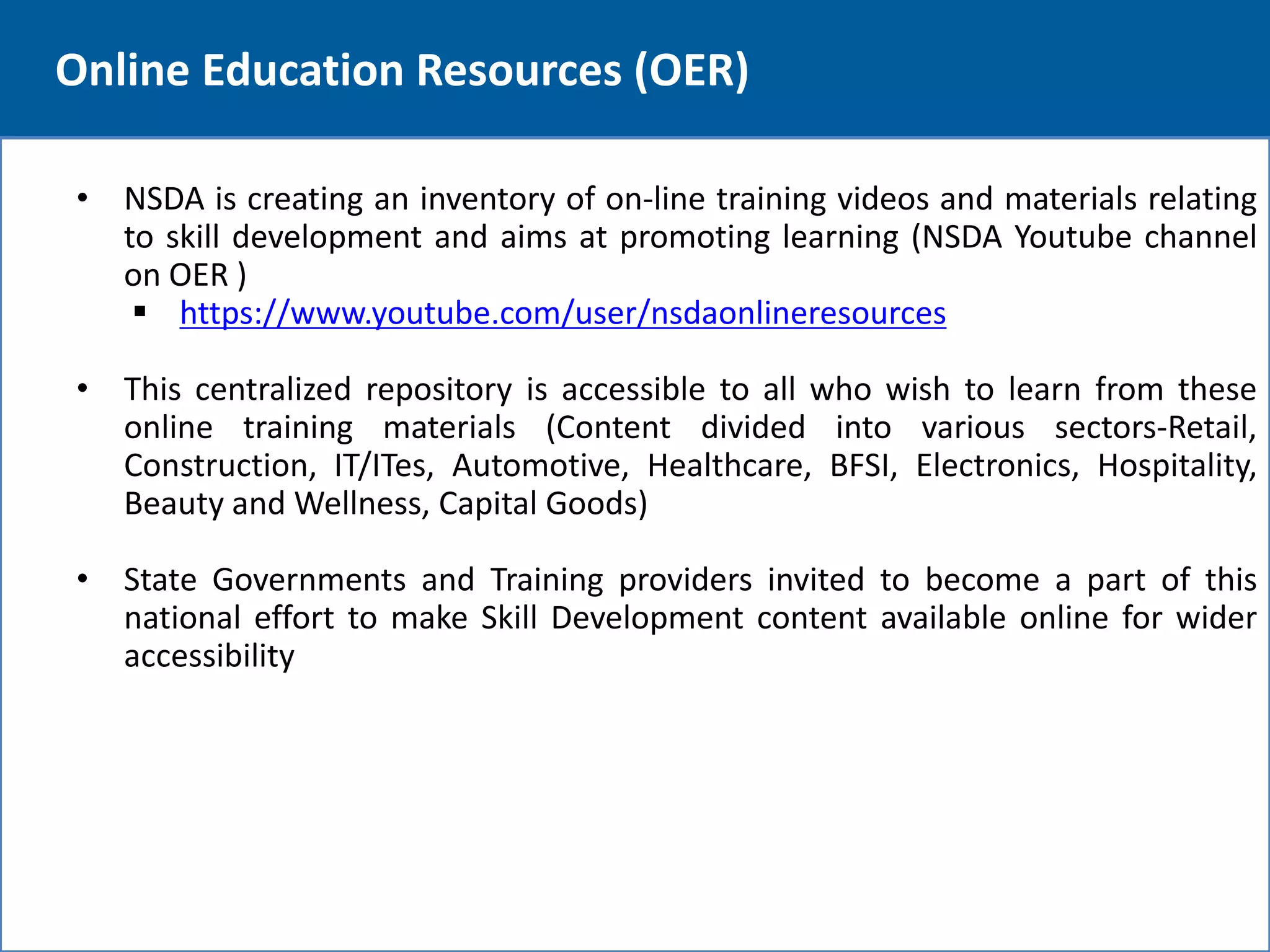
Online Education Resources (OER) 
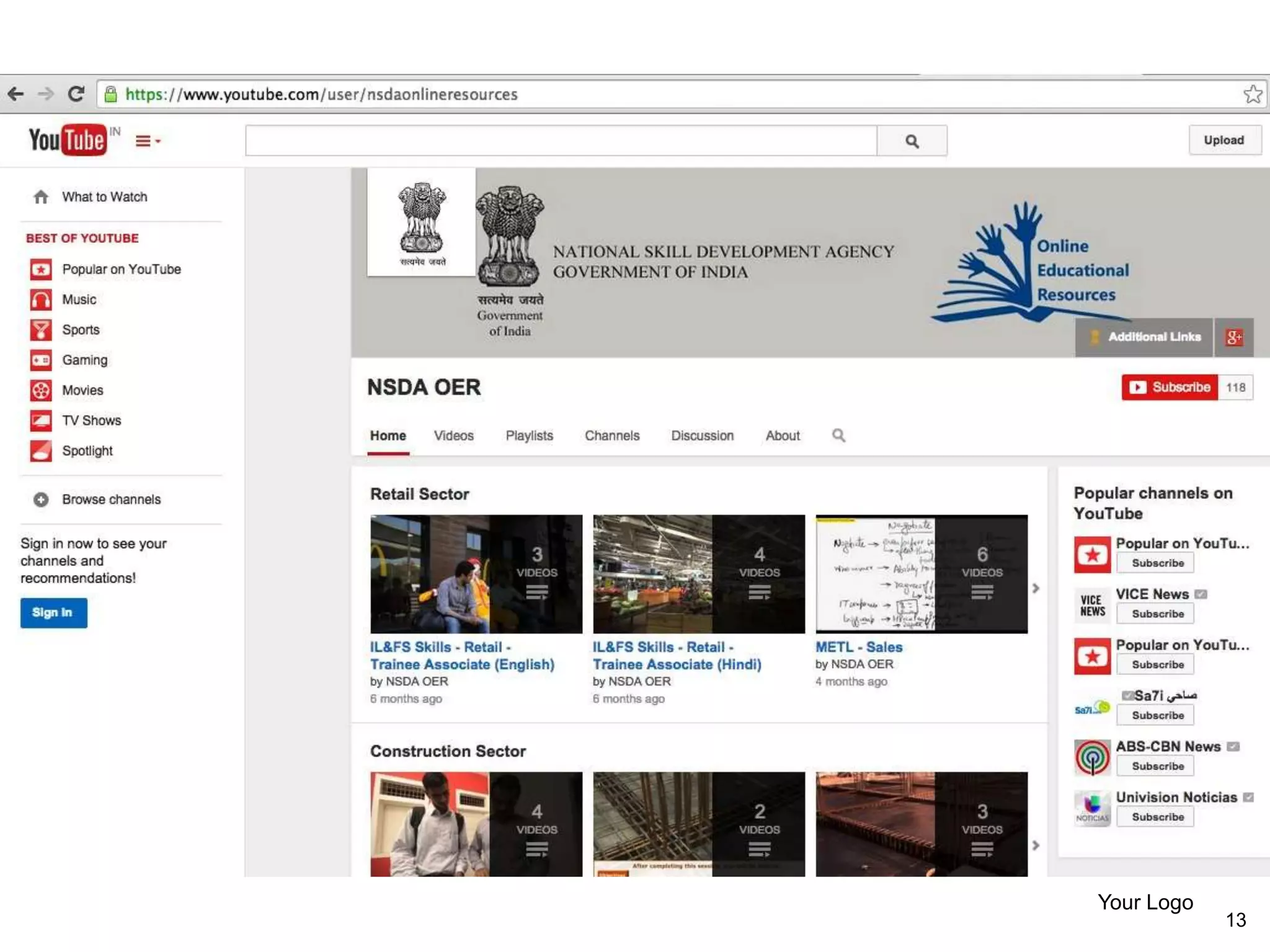
• NSDA is creating an inventory of on-line training videos and materials relating 
to skill development and aims at promoting learning (NSDA Youtube channel 
on OER ) 
 https://www.youtube.com/user/nsdaonlineresources 
• This centralized repository is accessible to all who wish to learn from these 
online training materials (Content divided into various sectors-Retail, 
Construction, IT/ITes, Automotive, Healthcare, BFSI, Electronics, Hospitality, 
Beauty and Wellness, Capital Goods) 
• State Governments and Training providers invited to become a part of this 
national effort to make Skill Development content available online for wider 
accessibility
13 
Your Logo
14 
Thank You 
National Skill Development Agency 
Phone: 011 23438001-05, Fax: 011 23438000 
Email: contact@nsda.in 
Website- www.nsda.gov.in

Role of NSDA in Skill Development by Ms. Ruchira Chandra

  • 1.
    1 Role ofNSDA in Skill Development Presented at National Consultation on Open Educational Resources for Skill Development Organised by Commonwealth Educational Media Centre for Asia (CEMCA), New Delhi In Collaboration with: KNI Trust, Gurgaon Venue: Hotel Royal Plaza, New Delhi Date: 28 November, 2014 By Ms. Ruchira Chandra Consultant, National Skill Development Agency, New Delhi
  • 2.
    2 Presentation Format 1. Introduction to NSDA 2. Issues 1) Rationalization of Skill Development Schemes 2) Engagement with States 3) NSQF 4) Getting youth interested 5) Leveraging techonology- Labour Market Information System 3. NSDA & OER
  • 3.
    3 Skill DevelopmentArchitecture NSDA (notified on 6th June 2013) NSDCB PMNCSD OAPM CCSD NSDC Chairman PS to Chairman Director General States Governing Body General Body 6 Consultants 2 Research Assistants SSCs Ministry of Skill Devt & Entrepreneu rship OTHER SANCTIONED POSTS (NSDA) 1 DDG/JS 1 Under Secretary 1 Protocol Officer 3 Sr. PS/PA Office Assistants Accounts Assistant 2 Consultants Other Ministries of GOI
  • 4.
    Functions of NSDA • Anchor and operationalize the National Skills Qualifications Framework (NSQF) • Create and maintain a national data base related to skill development including 4 development of a dynamic Labour Market Information System (LMIS) • Nodal agency for State Skill Development Missions (SSDMs) • Raise extra-budgetary resources for skill development • Evaluate existing skill development schemes to assess their efficacy, and to suggest corrective action • Affirmative action for advocacy • Take all possible steps to meet skilling targets as envisaged in the 12th Five Year Plan and beyond • Ensure that the skilling needs of the disadvantaged and the marginalized groups like SCs, STs, OBCs, minorities, women and differently abled persons are taken care of • Discharge any other function entrusted by the Government
  • 5.
  • 6.
    6 Issue 1:Rationalisation of Skill Development Schemes Background • Skill development numbers being reported include schemes that have a duration of a few hours to years; some have defined outcomes, others do not – a very mixed basket • Implications  Implementation problems and confusion amongst beneficiaries and implementation agencies  Difficult to assure outcomes for very short duration programmes  Lack of clarity about what is actually happening in skill development space – numbers being reported may be grossly exaggerated Initiative to address the issue- Rationalization of all government schemes • Defining skill development  Fresh Entrants: Min 200 hours of training. At least 70% of batch to be placed in wage employment with remuneration equal or higher than semi skilled wages in the relevant sector.  Re-skilling: Min 80 hours trainings + increase in remuneration  Recognition of prior learning  Formal Education Courses (NSQF level 5 and above)  Extension work (min 32 hours) would be recorded separately • Rationalisation of parameters  Cost  Duration  Outcomes  Monitoring
  • 7.
    7 Issue 2:Skill Development Structure in States Skill Development Structure in States • Under the National Policy on Skill Development, 2009, State Govts were advised to set-up State Level Missions for Skill Development to provide inter-sectoral coordination and an integrated approach to skill development • Most States have set up SSDMs, which generally consist of a two-tiered structure – a policy making body usually chaired by the Chief Minister, and an executive body, usually chaired by the Chief Secretary • Type of set up- Society/Mission/Section 25 Company • Actual performance varies across States. Some of the key issues:  SSDM often attached to the Labour or Planning Dept with no clarity of roles  The Mission Director is often an officer who holds many other charges – the Skill Devt charge is almost always an additional charge  Lack of sufficient seniority of officers handling SSDMs – they are unable to effectively coordinate with other departments
  • 8.
    8 Issue 3:National Skills Qualifications Framework Immediately after NSQF notification After the 3rd anniversary date of NSQF notification After the 5th anniversary date of the notification of the NSQF • All other Frameworks (like the NVEQF) would be superceded by NSQF • NSQF compliant courses will receive Govt. funding on a preferential basis • Govt. funding –only for NSQF-compliant courses • Recruitment rules of the GOI & PSUs of the Central Govt. shall define eligibility criteria for all positions in terms of NSQF levels – States encouraged to amend the same • Mandatory for all training/educational programmes/courses to be NSQF-compliant • All training & educational institutions shall define eligibility criteria for admission to various courses in terms of NSQF levels Implementation schedule of NSQF Status What has been done Way forward • 2 sectoral discussions in collaboration with the Planning Commission - Allied healthcare sector and Tourism and Hospitality sector • State engagement Assam, Odisha, Bihar, Haryana • Mobility pathways in the allied healthcare sector • 3 state workshops in the Meghalaya, Mizoram and Manipur • Secretariat for NSQF for implementation of the Qualification Framework
  • 9.
    9 Issue 4:Getting youth interested ! Challenges • Supposed social bias against vocational education & blue collar jobs • Barriers to access and addressing the specific needs of the youth specially girls for achieving inclusive growth • Lack of training infrastructure in hinterland • Cost & benefits of getting skill training Initiatives to address the issue • Understanding the issue - Study by Leapridge on identifying the challenges in mobilization of the candidates • Providing progression pathways in terms of the NSQF • Facilitating recognition of prior learning • Advocacy for skill development- Institution of Rashtriya Kaushal Evam Udyamita Purashkar Initiatives for Consideration • Redesignation of skill development/ vocational education/technical education” as “career education” • Introducing the PM’s Skill Development Fellowship Scheme
  • 10.
    Issue 5: Creationof a reliable database – Labour Market Information System • National Steering Committee of LMIS set by Department of Economic Affairs, housed in 10 National Skill Development Agency (NSDA) • 1st Module of LMIS for Registry of training providers built and launched • Creation of a searchable directory of all training providers with details of training centers and courses in the form of Citizen Information Portal • State & Ministry approved/ empanelled/ registered/ accredited training providers on NSDA website • Identification of Information Gaps that exists in the eco-system e.g. Assessment of the training capacity of the country and how much is needed (sector-wise). To address the issue, discussions are going with National Statistical Commission (NSC) on survey of training providers integration of the various sub-systems that have been created by individual ministries/states • Arriving at common classification of codes to be used across the stakeholders • Accreditation norms for training providers finalized • Classification of Online Education Resources (OER) into sectors and according to the various various levels of NSQF, with assistance from the Sector Skill Council. OER you tube channel launched • System Study being undertaken by National Institute for Smart Government (NISG) to develop LMIS under the e- Bharat initiative
  • 11.
  • 12.
    12 Online EducationResources (OER) • NSDA is creating an inventory of on-line training videos and materials relating to skill development and aims at promoting learning (NSDA Youtube channel on OER )  https://www.youtube.com/user/nsdaonlineresources • This centralized repository is accessible to all who wish to learn from these online training materials (Content divided into various sectors-Retail, Construction, IT/ITes, Automotive, Healthcare, BFSI, Electronics, Hospitality, Beauty and Wellness, Capital Goods) • State Governments and Training providers invited to become a part of this national effort to make Skill Development content available online for wider accessibility
  • 13.
  • 14.
    14 Thank You National Skill Development Agency Phone: 011 23438001-05, Fax: 011 23438000 Email: contact@nsda.in Website- www.nsda.gov.in

Editor's Notes