Without adequate skills, people languish
on the margins of society, technological
progress does not translate into economic
growth, countries can no longer compete in
an increasingly knowledge-based global
society.
Team Members
Masum Kumar Lodha Sarthak Agarwal Siddarth Goyal
Rahul Bansal Rahul Gupta
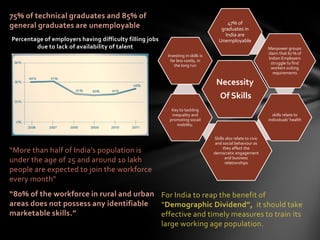
75% of technical graduates and 85% of
general graduates are unemployable
Percentage of employers having difficulty filling jobs
due to lack of availability of talent
“More than half of India’s population is
under the age of 25 and around 10 lakh
people are expected to join the workforce
every month”
“80% of the workforce in rural and urban
areas does not possess any identifiable
marketable skills.”
For India to reap the benefit of
“Demographic Dividend”, it should take
effective and timely measures to train its
large working age population.
Necessity
Of Skills
47% of
graduates in
India are
Unemployable
Manpower groups
claim that 67 % of
Indian Employers
struggle to find
workers suiting
requirements
skills relate to
individuals' health
Skills also relate to civic
and social behaviour as
they affect the
democratic engagement
and business
relationships
Key to tackling
inequality and
promoting socail
mobility.
Investing in skills is
far less costly, in
the long run
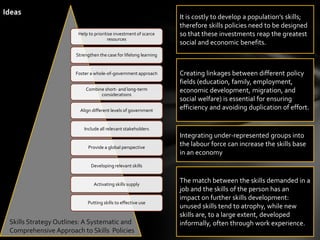
Help to prioritise investment of scarce
resources
Strengthen the case for lifelong learning
Foster a whole-of-government approach
Combine short- and long-term
considerations
Align different levels of government
Include all relevant stakeholders
Provide a global perspective
Developing relevant skills
Activating skills supply
Putting skills to effective use
Skills Strategy Outlines: A Systematic and
Comprehensive Approach to Skills Policies
It is costly to develop a population’s skills;
therefore skills policies need to be designed
so that these investments reap the greatest
social and economic benefits.
Creating linkages between different policy
fields (education, family, employment,
economic development, migration, and
social welfare) is essential for ensuring
efficiency and avoiding duplication of effort.
Integrating under-represented groups into
the labour force can increase the skills base
in an economy
The match between the skills demanded in a
job and the skills of the person has an
impact on further skills development:
unused skills tend to atrophy, while new
skills are, to a large extent, developed
informally, often through work experience.
Ideas
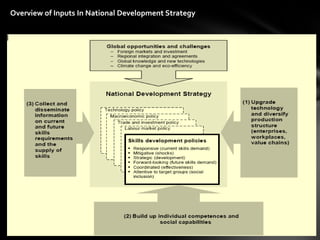
Overview of Inputs In National Development Strategy
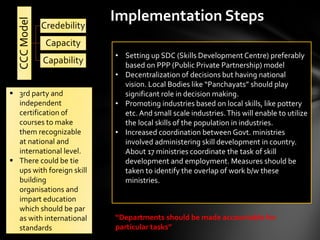
CCCModel Credebility
Capacity
Capability
• Setting up SDC (Skills Development Centre) preferably
based on PPP (Public Private Partnership) model
• Decentralization of decisions but having national
vision. Local Bodies like “Panchayats” should play
significant role in decision making.
• Promoting industries based on local skills, like pottery
etc. And small scale industries.This will enable to utilize
the local skills of the population in industries.
• Increased coordination between Govt. ministries
involved administering skill development in country.
About 17 ministries coordinate the task of skill
development and employment. Measures should be
taken to identify the overlap of work b/w these
ministries.
 3rd party and
independent
certification of
courses to make
them recognizable
at national and
international level.
 There could be tie
ups with foreign skill
building
organisations and
impart education
which should be par
as with international
standards
“Departments should be made accountable for
particular tasks”
Implementation Steps
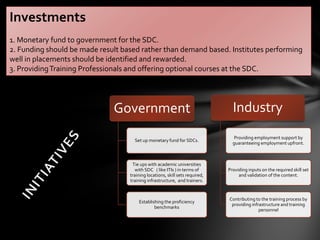
Government
Set up monetary fund for SDCs.
Tie ups with academic universities
with SDC ( like ITIs ) in terms of
training locations, skill sets required,
training infrastructure, and trainers.
Establishing the proficiency
benchmarks
Industry
Providing employment support by
guaranteeing employment upfront.
Providing inputs on the required skill set
and validation of the content.
Contributing to the training process by
providing infrastructure and training
personnel
Investments
1. Monetary fund to government for the SDC.
2. Funding should be made result based rather than demand based. Institutes performing
well in placements should be identified and rewarded.
3. ProvidingTraining Professionals and offering optional courses at the SDC.
Challenges And Mitigation
• Indian Population is 1.2 billiion and 47 % of the youth are unemployed and hence
require skill boosting. Providing infrastructure for such a large crowd is a
challenging problem
• Smooth running of SDCs requires a proper governed organisation
• Possible shortage of labours during harvesting periods.
• Saturation in long term.
• Corruption free channel
• Boosting Skills require more and more zeal and participation by the youth of the
country. Some form of moral attraction has to be provided.
Appendix
http://monitor.icef.com/2013/02/to-upskill-workforce-india-goes-international
http://www.ilo.org/wcmsp5/groups/public/@ed_norm/@relconf/documents/meeti
ngdocument/wcms_092054.pdf
http://www.studymode.com/essays/A-Report-On-Youth-Unemployability-In-
984407.html
http://monitor.icef.com/2013/02/to-upskill-workforce-india-goes-international/

teamiiith

  • 1.
    Without adequate skills,people languish on the margins of society, technological progress does not translate into economic growth, countries can no longer compete in an increasingly knowledge-based global society. Team Members Masum Kumar Lodha Sarthak Agarwal Siddarth Goyal Rahul Bansal Rahul Gupta
  • 2.
    75% of technicalgraduates and 85% of general graduates are unemployable Percentage of employers having difficulty filling jobs due to lack of availability of talent “More than half of India’s population is under the age of 25 and around 10 lakh people are expected to join the workforce every month” “80% of the workforce in rural and urban areas does not possess any identifiable marketable skills.” For India to reap the benefit of “Demographic Dividend”, it should take effective and timely measures to train its large working age population. Necessity Of Skills 47% of graduates in India are Unemployable Manpower groups claim that 67 % of Indian Employers struggle to find workers suiting requirements skills relate to individuals' health Skills also relate to civic and social behaviour as they affect the democratic engagement and business relationships Key to tackling inequality and promoting socail mobility. Investing in skills is far less costly, in the long run
  • 3.
    Help to prioritiseinvestment of scarce resources Strengthen the case for lifelong learning Foster a whole-of-government approach Combine short- and long-term considerations Align different levels of government Include all relevant stakeholders Provide a global perspective Developing relevant skills Activating skills supply Putting skills to effective use Skills Strategy Outlines: A Systematic and Comprehensive Approach to Skills Policies It is costly to develop a population’s skills; therefore skills policies need to be designed so that these investments reap the greatest social and economic benefits. Creating linkages between different policy fields (education, family, employment, economic development, migration, and social welfare) is essential for ensuring efficiency and avoiding duplication of effort. Integrating under-represented groups into the labour force can increase the skills base in an economy The match between the skills demanded in a job and the skills of the person has an impact on further skills development: unused skills tend to atrophy, while new skills are, to a large extent, developed informally, often through work experience. Ideas
  • 4.
    Overview of InputsIn National Development Strategy
  • 5.
    CCCModel Credebility Capacity Capability • Settingup SDC (Skills Development Centre) preferably based on PPP (Public Private Partnership) model • Decentralization of decisions but having national vision. Local Bodies like “Panchayats” should play significant role in decision making. • Promoting industries based on local skills, like pottery etc. And small scale industries.This will enable to utilize the local skills of the population in industries. • Increased coordination between Govt. ministries involved administering skill development in country. About 17 ministries coordinate the task of skill development and employment. Measures should be taken to identify the overlap of work b/w these ministries.  3rd party and independent certification of courses to make them recognizable at national and international level.  There could be tie ups with foreign skill building organisations and impart education which should be par as with international standards “Departments should be made accountable for particular tasks” Implementation Steps
  • 6.
    Government Set up monetaryfund for SDCs. Tie ups with academic universities with SDC ( like ITIs ) in terms of training locations, skill sets required, training infrastructure, and trainers. Establishing the proficiency benchmarks Industry Providing employment support by guaranteeing employment upfront. Providing inputs on the required skill set and validation of the content. Contributing to the training process by providing infrastructure and training personnel Investments 1. Monetary fund to government for the SDC. 2. Funding should be made result based rather than demand based. Institutes performing well in placements should be identified and rewarded. 3. ProvidingTraining Professionals and offering optional courses at the SDC.
  • 8.
    Challenges And Mitigation •Indian Population is 1.2 billiion and 47 % of the youth are unemployed and hence require skill boosting. Providing infrastructure for such a large crowd is a challenging problem • Smooth running of SDCs requires a proper governed organisation • Possible shortage of labours during harvesting periods. • Saturation in long term. • Corruption free channel • Boosting Skills require more and more zeal and participation by the youth of the country. Some form of moral attraction has to be provided.
  • 9.