Plenary	Session	1	:	Sustainable	Skill	Development
Ajay	Mohan	Goel
ajaymgoel@gmail.com
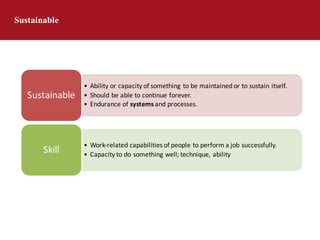
Sustainable
• Ability	or	capacity	of	something	to	be	maintained	or	to	sustain	itself.	
• Should	be	able	to	continue	forever.
• Endurance	of	systems and	processes.
Sustainable
• Work-related	capabilities	of	people	to	perform	a	job	successfully.	
• Capacity	to	do	something	well;	technique,	ability
Skill
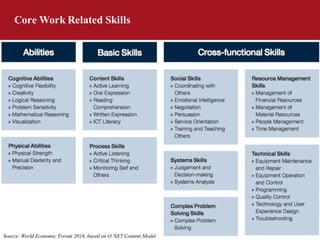
Core Work Related Skills
Source: World Economic Forum 2016, based on O’NET Content Model
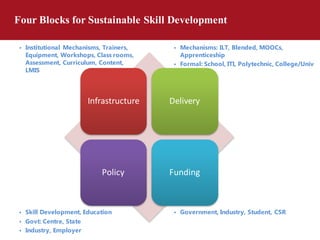
Four Blocks for Sustainable Skill Development
Infrastructure Delivery
Policy Funding
• Institutional Mechanisms, Trainers,
Equipment, Workshops, Class rooms,
Assessment, Curriculum, Content,
LMIS
• Skill Development, Education
• Govt: Centre, State
• Industry, Employer
• Mechanisms: ILT, Blended, MOOCs,
Apprenticeship
• Formal: School, ITI, Polytechnic, College/Univ
• Government, Industry, Student, CSR
Sustainable Skill Development
Key Aspects
Infrastru
cture
Delivery
Policy Funding
Skills	are	multi-layered
•Generic	&	Domain	specific
•Simple	tasks,	complex	tasks,	supervisory	 tasks
•Operational	&	Design
•Stable	&	Unstable
Changing	work	environments	 and	flexible	working	arrangements	
Disruptive	business	models
•Job	creation,	job	displacement,	new	skill	gaps
Continued	demographic	changes
•Longevity	&	ageing	societies,	young	population
Developments	in	previously	dis-jointed	fields
•AI	and	machine	learning,	robotics,	nanotechnology,	 3D	printing	and	genetics	and	
biotechnology,	 big	data	and	analytics
Need	for	continuous	re-skilling	&	up-skilling
•Same	domain,	new	domain,	multiple	domains,	new	technology
Sustainable Skill Development
Policy
Infrastru
cture
Delivery
Policy Funding
Central Government
• Formation of Ministry of Skill Development & Entrepreneurship
• National Policy for Skill Development and Entrepreneurship
(2015)
• Education Policy (1986) *
• National Skills Qualifications Framework (2013)
• The Apprenticeship (Amendment) Act (2014)
State Government
• State Skill Missions
• Convergence of multiple skill schemes
• Convergence of Skill, Employment (Labour) and
Entrepreneurship departments #
* New Education Policy in drafting stage
# In some states (e.g. Telangana, Rajasthan)
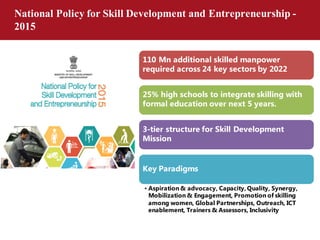
National Policy for Skill Development and Entrepreneurship -
2015
110 Mn additional skilled manpower
required across 24 key sectors by 2022
25% high schools to integrate skilling with
formal education over next 5 years.
3-tier structure for Skill Development
Mission
Key Paradigms
• Aspiration & advocacy, Capacity, Quality, Synergy,
Mobilization & Engagement, Promotion of skilling
among women, Global Partnerships, Outreach, ICT
enablement, Trainers & Assessors, Inclusivity
Sustainable Skill Development
Funding
Infrastru
cture
Delivery
Policy Funding
Central Government
• PMKVY
• Schemes of Individual Ministries (~20)
• Central Scheme for vocationalisation in class 9-12
• UGC scheme of Community Colleges, B.Voc., DDU-
KAUSHAL
Industry / Employer
• Internal Training Departments
• Sponsored Training
CSR / Philanthropy
Student
• Self-Funded
Sustainable Skill Development
Infrastructure
Infrastru
cture
Delivery
Policy Funding
Institutions
• MSDE, NSDA, NSDC, Sector Skill Councils, State Skill
Missions
• UGC, AICTE, Universities, Colleges, Polytechnics
• School Education Boards, NCERT, PSSCIVE,
• ITIs , NCVT, SCVT,
• Board of Apprenticeship Training
• Vocational Training providers
Standards, Curriculum, Content
Labour Management Information System
Teachers / Trainers
Sustainable Skill Development
Delivery
Infrastru
cture
Delivery
Policy Funding
Governance Structures
Technology
Delivery Mechanisms
Industry Interface, Internships, projects
Teacher / Trainer
Workshops / Equipment
Assessment, Evaluation and Certification
Student Placement
Sustainable Skill Development
Key Imperatives
Infrastru
cture
Delivery
Policy Funding
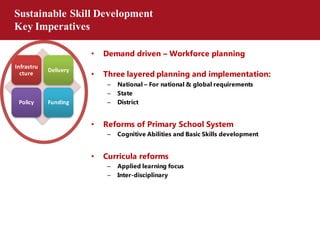
• Demand driven – Workforce planning
• Three layered planning and implementation:
– National – For national & global requirements
– State
– District
• Reforms of Primary School System
– Cognitive Abilities and Basic Skills development
• Curricula reforms
– Applied learning focus
– Inter-disciplinary
Thank You
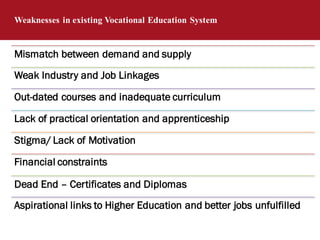
Weaknesses in existing Vocational Education System
Mismatch between demand and supply
Weak Industry and Job Linkages
Out-dated courses and inadequate curriculum
Lack of practical orientation and apprenticeship
Stigma/ Lack of Motivation
Financial constraints
Dead End – Certificates and Diplomas
Aspirational links to Higher Education and better jobs unfulfilled
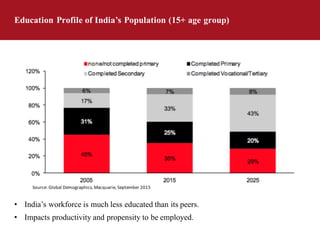
Education Profile of India’s Population (15+ age group)
Source:	Global	Demographics,	Macquarie,	September	2015
• India’s workforce is much less educated than its peers.
• Impacts productivity and propensity to be employed.
College and High School Graduates Ill-Equipped for Industry
Skilling needs to align with the Economic Growth
• Most	of	vocational	 education	focused	on	Manufacturing	 industry
• 58%	of	India’s	GDP	now	comes	from	Services	Sector
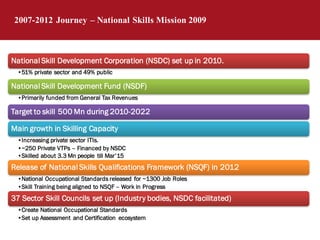
2007-2012 Journey – National Skills Mission 2009
National Skill Development Corporation (NSDC) set up in 2010.
•51% private sector and 49% public
National Skill Development Fund (NSDF)
•Primarily funded from General Tax Revenues
Target to skill 500 Mn during 2010-2022
Main growth in Skilling Capacity
•Increasing private sector ITIs.
•~250 Private VTPs – Financed by NSDC
•Skilled about 3.3 Mn people till Mar’15
Release of National Skills Qualifications Framework (NSQF) in 2012
•National Occupational Standards released for ~1300 Job Roles
•Skill Training being aligned to NSQF – Work in Progress
37 Sector Skill Councils set up (Industry bodies, NSDC facilitated)
•Create National Occupational Standards
•Set up Assessment and Certification ecosystem
Mainstreaming skills for Employment
ITI	Program
Year1
NSQF	
Diploma
Class12
Pass
Year2
NSQF
Adv.	Dip.
Year3
High	School
IX	|	X	|	XI	|	XII
Industry
Employment
NSQF L2 L3 L4
School	Program Community	College	
Program
L1
NSQF	
B.Voc.
National
Skills
Qualifications
Framework
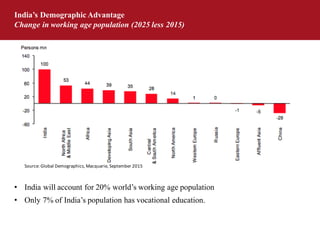
India’s Demographic Advantage
Change in working age population (2025 less 2015)
• India will account for 20% world’s working age population
• Only 7% of India’s population has vocational education.
Source:	Global	Demographics,	Macquarie,	September	2015
Key Drivers
• Energy Sector
• New energy supplies and
technologies
• Climate change, natural
resources
• Changing nature of work,
flexible work
• Geopolitical volatility
technological trends whose
potentially far-ranging
implications have not yet fully
materialized—such as 3D
• Infrastructure Sector
• Climate change, natural
resources
• Changing nature of work,
flexible work
• New energy supplies and
technologies
• Geopolitical volatility
Timeframes to impact industries, business models
Sustainable Skill Development
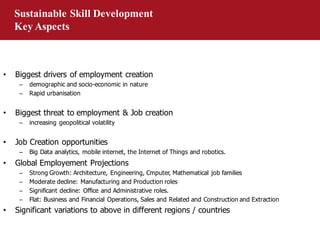
Key Aspects
• Biggest drivers of employment creation
– demographic and socio-economic in nature
– Rapid urbanisation
• Biggest threat to employment & Job creation
– increasing geopolitical volatility
• Job Creation opportunities
– Big Data analytics, mobile internet, the Internet of Things and robotics.
• Global Employement Projections
– Strong Growth: Architecture, Engineering, Cmputer, Mathematical job families
– Moderate decline: Manufacturing and Production roles
– Significant decline: Office and Administrative roles.
– Flat: Business and Financial Operations, Sales and Related and Construction and Extraction
• Significant variations to above in different regions / countries

Sustainable Skill Development

  • 1.
  • 2.
    Sustainable • Ability or capacity of something to be maintained or to sustain itself. • Should be able to continue forever. •Endurance of systems and processes. Sustainable • Work-related capabilities of people to perform a job successfully. • Capacity to do something well; technique, ability Skill
  • 3.
    Core Work RelatedSkills Source: World Economic Forum 2016, based on O’NET Content Model
  • 4.
    Four Blocks forSustainable Skill Development Infrastructure Delivery Policy Funding • Institutional Mechanisms, Trainers, Equipment, Workshops, Class rooms, Assessment, Curriculum, Content, LMIS • Skill Development, Education • Govt: Centre, State • Industry, Employer • Mechanisms: ILT, Blended, MOOCs, Apprenticeship • Formal: School, ITI, Polytechnic, College/Univ • Government, Industry, Student, CSR
  • 5.
    Sustainable Skill Development KeyAspects Infrastru cture Delivery Policy Funding Skills are multi-layered •Generic & Domain specific •Simple tasks, complex tasks, supervisory tasks •Operational & Design •Stable & Unstable Changing work environments and flexible working arrangements Disruptive business models •Job creation, job displacement, new skill gaps Continued demographic changes •Longevity & ageing societies, young population Developments in previously dis-jointed fields •AI and machine learning, robotics, nanotechnology, 3D printing and genetics and biotechnology, big data and analytics Need for continuous re-skilling & up-skilling •Same domain, new domain, multiple domains, new technology
  • 6.
    Sustainable Skill Development Policy Infrastru cture Delivery PolicyFunding Central Government • Formation of Ministry of Skill Development & Entrepreneurship • National Policy for Skill Development and Entrepreneurship (2015) • Education Policy (1986) * • National Skills Qualifications Framework (2013) • The Apprenticeship (Amendment) Act (2014) State Government • State Skill Missions • Convergence of multiple skill schemes • Convergence of Skill, Employment (Labour) and Entrepreneurship departments # * New Education Policy in drafting stage # In some states (e.g. Telangana, Rajasthan)
  • 7.
    National Policy forSkill Development and Entrepreneurship - 2015 110 Mn additional skilled manpower required across 24 key sectors by 2022 25% high schools to integrate skilling with formal education over next 5 years. 3-tier structure for Skill Development Mission Key Paradigms • Aspiration & advocacy, Capacity, Quality, Synergy, Mobilization & Engagement, Promotion of skilling among women, Global Partnerships, Outreach, ICT enablement, Trainers & Assessors, Inclusivity
  • 8.
    Sustainable Skill Development Funding Infrastru cture Delivery PolicyFunding Central Government • PMKVY • Schemes of Individual Ministries (~20) • Central Scheme for vocationalisation in class 9-12 • UGC scheme of Community Colleges, B.Voc., DDU- KAUSHAL Industry / Employer • Internal Training Departments • Sponsored Training CSR / Philanthropy Student • Self-Funded
  • 9.
    Sustainable Skill Development Infrastructure Infrastru cture Delivery PolicyFunding Institutions • MSDE, NSDA, NSDC, Sector Skill Councils, State Skill Missions • UGC, AICTE, Universities, Colleges, Polytechnics • School Education Boards, NCERT, PSSCIVE, • ITIs , NCVT, SCVT, • Board of Apprenticeship Training • Vocational Training providers Standards, Curriculum, Content Labour Management Information System Teachers / Trainers
  • 10.
    Sustainable Skill Development Delivery Infrastru cture Delivery PolicyFunding Governance Structures Technology Delivery Mechanisms Industry Interface, Internships, projects Teacher / Trainer Workshops / Equipment Assessment, Evaluation and Certification Student Placement
  • 11.
    Sustainable Skill Development KeyImperatives Infrastru cture Delivery Policy Funding • Demand driven – Workforce planning • Three layered planning and implementation: – National – For national & global requirements – State – District • Reforms of Primary School System – Cognitive Abilities and Basic Skills development • Curricula reforms – Applied learning focus – Inter-disciplinary
  • 12.
  • 13.
    Weaknesses in existingVocational Education System Mismatch between demand and supply Weak Industry and Job Linkages Out-dated courses and inadequate curriculum Lack of practical orientation and apprenticeship Stigma/ Lack of Motivation Financial constraints Dead End – Certificates and Diplomas Aspirational links to Higher Education and better jobs unfulfilled
  • 14.
    Education Profile ofIndia’s Population (15+ age group) Source: Global Demographics, Macquarie, September 2015 • India’s workforce is much less educated than its peers. • Impacts productivity and propensity to be employed.
  • 15.
    College and HighSchool Graduates Ill-Equipped for Industry
  • 16.
    Skilling needs toalign with the Economic Growth • Most of vocational education focused on Manufacturing industry • 58% of India’s GDP now comes from Services Sector
  • 17.
    2007-2012 Journey –National Skills Mission 2009 National Skill Development Corporation (NSDC) set up in 2010. •51% private sector and 49% public National Skill Development Fund (NSDF) •Primarily funded from General Tax Revenues Target to skill 500 Mn during 2010-2022 Main growth in Skilling Capacity •Increasing private sector ITIs. •~250 Private VTPs – Financed by NSDC •Skilled about 3.3 Mn people till Mar’15 Release of National Skills Qualifications Framework (NSQF) in 2012 •National Occupational Standards released for ~1300 Job Roles •Skill Training being aligned to NSQF – Work in Progress 37 Sector Skill Councils set up (Industry bodies, NSDC facilitated) •Create National Occupational Standards •Set up Assessment and Certification ecosystem
  • 18.
    Mainstreaming skills forEmployment ITI Program Year1 NSQF Diploma Class12 Pass Year2 NSQF Adv. Dip. Year3 High School IX | X | XI | XII Industry Employment NSQF L2 L3 L4 School Program Community College Program L1 NSQF B.Voc. National Skills Qualifications Framework
  • 19.
    India’s Demographic Advantage Changein working age population (2025 less 2015) • India will account for 20% world’s working age population • Only 7% of India’s population has vocational education. Source: Global Demographics, Macquarie, September 2015
  • 20.
    Key Drivers • EnergySector • New energy supplies and technologies • Climate change, natural resources • Changing nature of work, flexible work • Geopolitical volatility technological trends whose potentially far-ranging implications have not yet fully materialized—such as 3D • Infrastructure Sector • Climate change, natural resources • Changing nature of work, flexible work • New energy supplies and technologies • Geopolitical volatility
  • 21.
    Timeframes to impactindustries, business models
  • 22.
    Sustainable Skill Development KeyAspects • Biggest drivers of employment creation – demographic and socio-economic in nature – Rapid urbanisation • Biggest threat to employment & Job creation – increasing geopolitical volatility • Job Creation opportunities – Big Data analytics, mobile internet, the Internet of Things and robotics. • Global Employement Projections – Strong Growth: Architecture, Engineering, Cmputer, Mathematical job families – Moderate decline: Manufacturing and Production roles – Significant decline: Office and Administrative roles. – Flat: Business and Financial Operations, Sales and Related and Construction and Extraction • Significant variations to above in different regions / countries