ADOLESCENT AND YOUNG PEOPLE’S SPACES IN THE
CHANGING MEDIASCAPE
THE DIGITAL NATIVES
HAVE ARRIVED !!
Dr. Shahid Rasool,
Director, CEMCA
6th July 2018
srasool@col.org
3rd AIMEC -Jaipur
Agenda
India’s Demographic Dividend
Interesting Facts About Digital World
Interesting Facts About Digital India
Digital Natives - Characteristics
Opportunities for Media
Educators’ Tools in Digital India
Some relevant interventions by CEMCA/COL
Dr. APJ Abdul Kalam
“India 2020- a vision for the new millennium”
 Predicted: India will become a developed
country by 2020
 Identified: India’s human resource base as
one of its greatest core competencies
 Advocated: Indians at all skill levels can
excel in knowledge based service, if given the
right training and are placed in intellectually
challenging environment.
 Advantage: “With chosen few….IITs, IIMS,..”
 Challenge: To train “Ordinary Indian students,
engineers and scientists”
 Possibility: in
judicious use of media
technology for making
quality education
available to all
India’s Demographic Dividend
1.3
billion
Huge Population
15-65
years
48% Potentially
economically
productive
13–24
years
Digitally very
Active
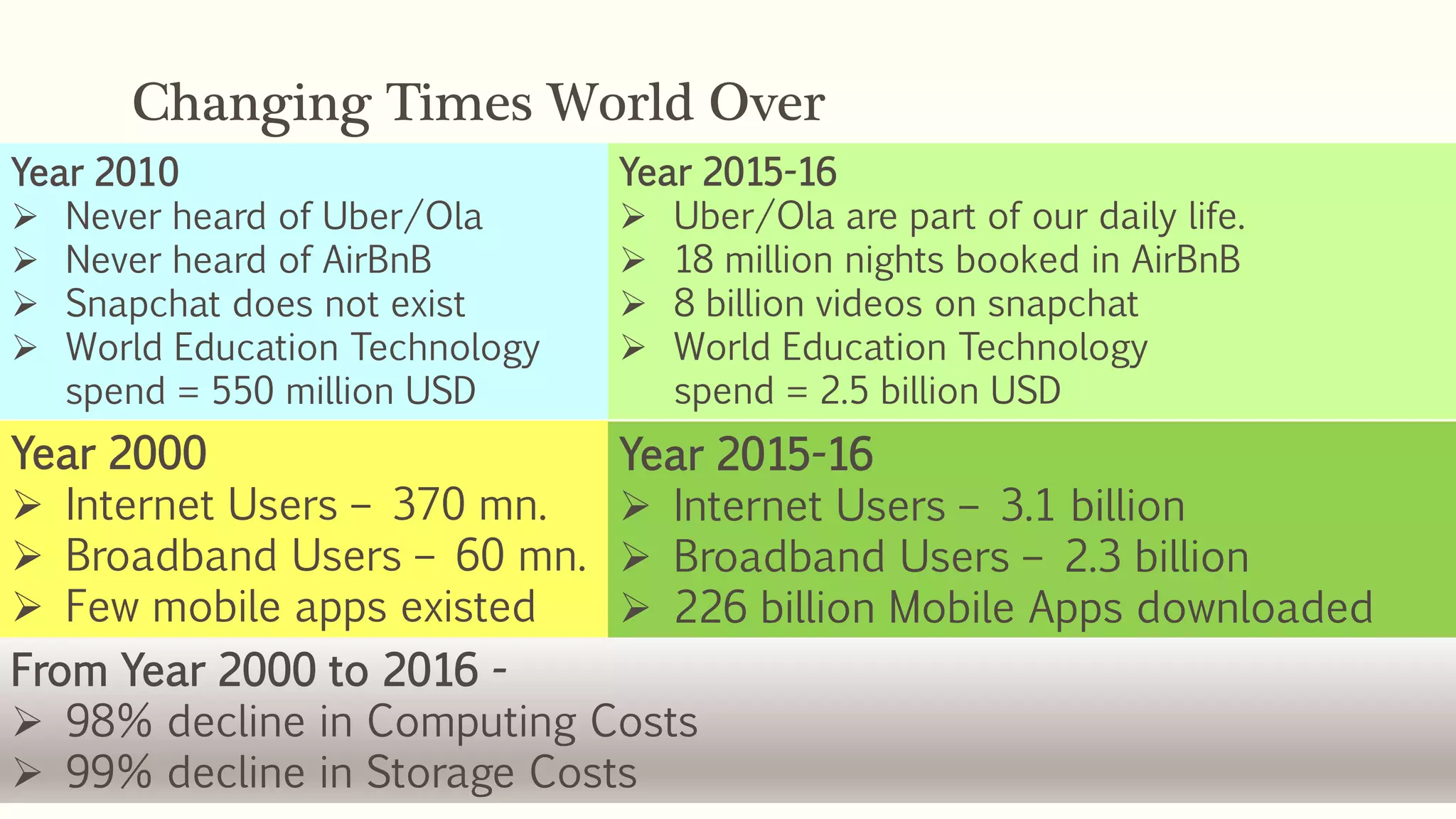
Changing Times World Over
Year 2010
 Never heard of Uber/Ola
 Never heard of AirBnB
 Snapchat does not exist
 World Education Technology
spend = 550 million USD
Year 2015-16
 Uber/Ola are part of our daily life.
 18 million nights booked in AirBnB
 8 billion videos on snapchat
 World Education Technology
spend = 2.5 billion USD
Year 2000
 Internet Users – 370 mn.
 Broadband Users – 60 mn.
 Few mobile apps existed
Year 2015-16
 Internet Users – 3.1 billion
 Broadband Users – 2.3 billion
 226 billion Mobile Apps downloaded
From Year 2000 to 2016 -
 98% decline in Computing Costs
 99% decline in Storage Costs
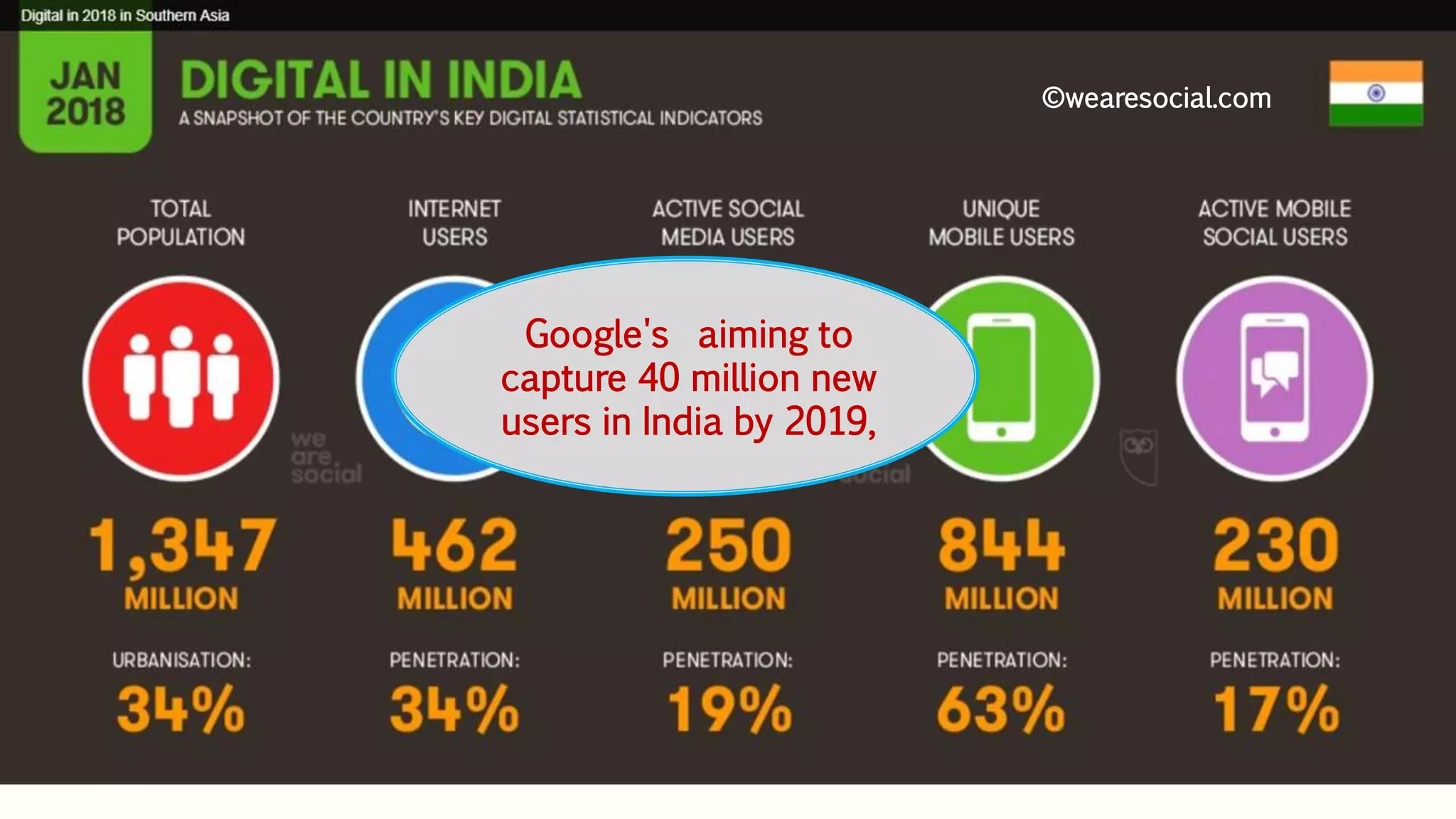
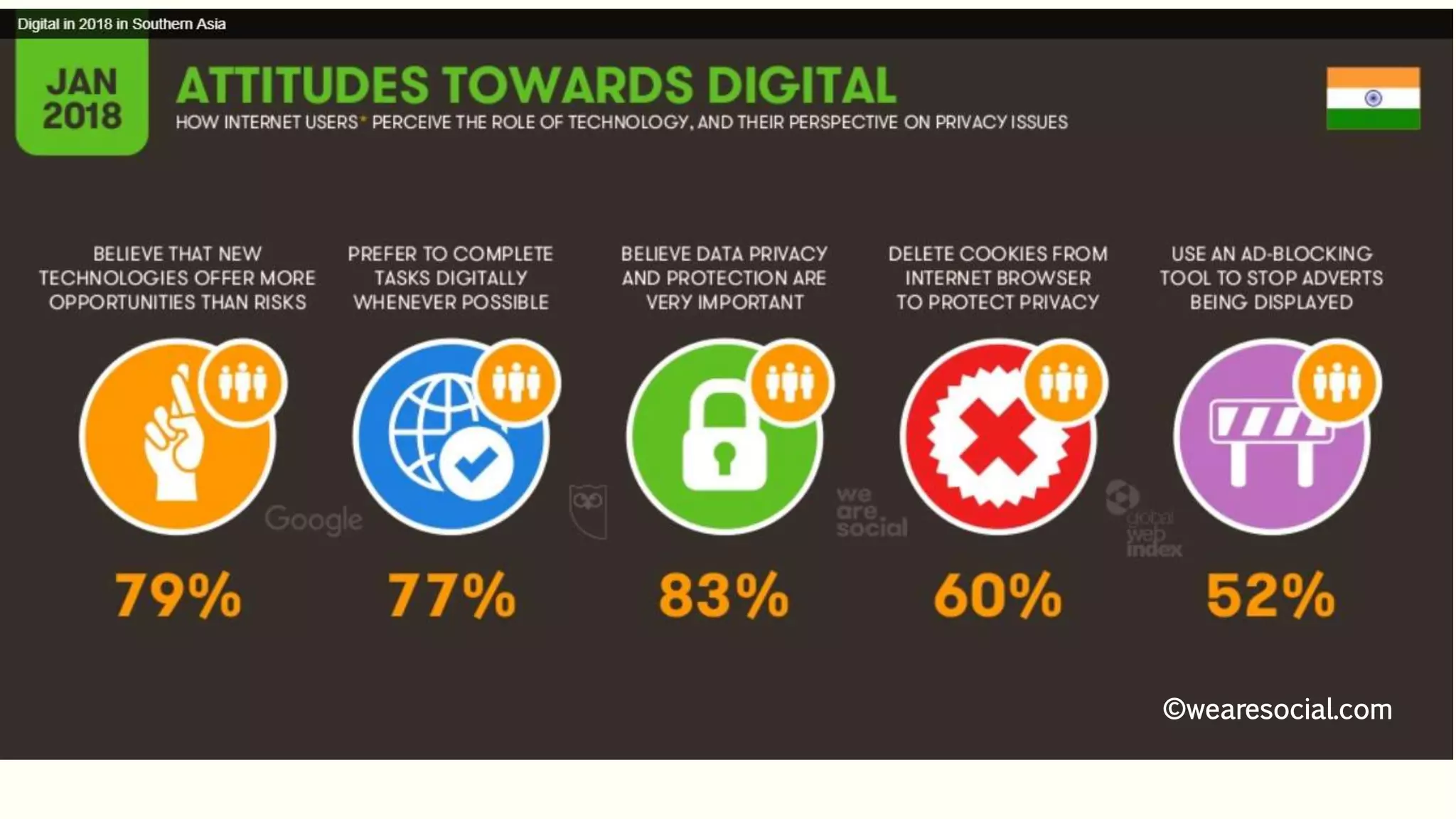
Title and Content Layout with Chart ©wearesocial.com
Google's aiming to
capture 40 million new
users in India by 2019,
©wearesocial.com
Digital Natives have Arrived!
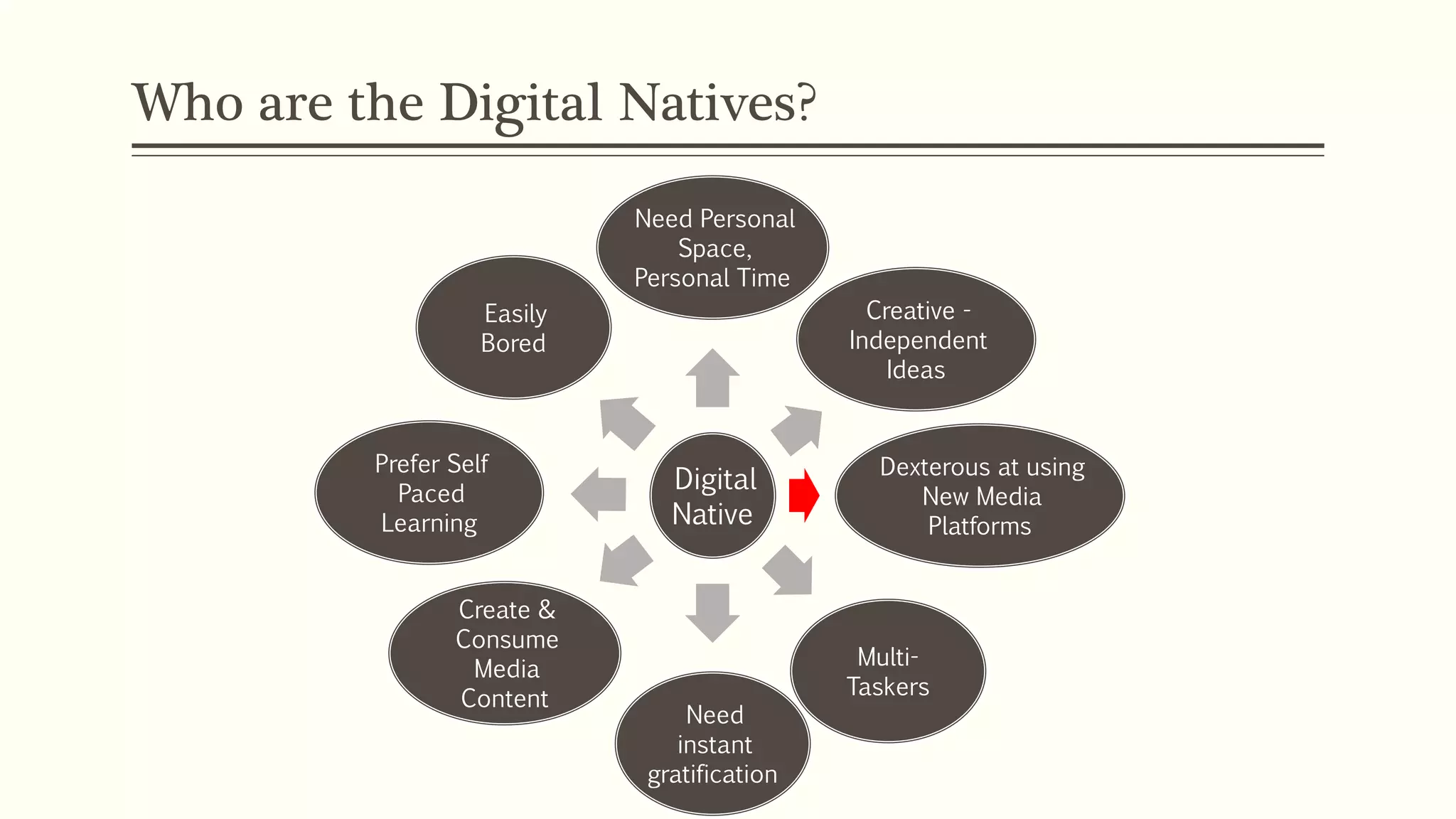
Who are the Digital Natives?
Digital
Native
Need Personal
Space,
Personal Time
Creative -
Independent
Ideas
Dexterous at using
New Media
Platforms
Multi-
Taskers
Need
instant
gratification
Create &
Consume
Media
Content
Prefer Self
Paced
Learning
Easily
Bored
©wearesocial.com
©wearesocial.com
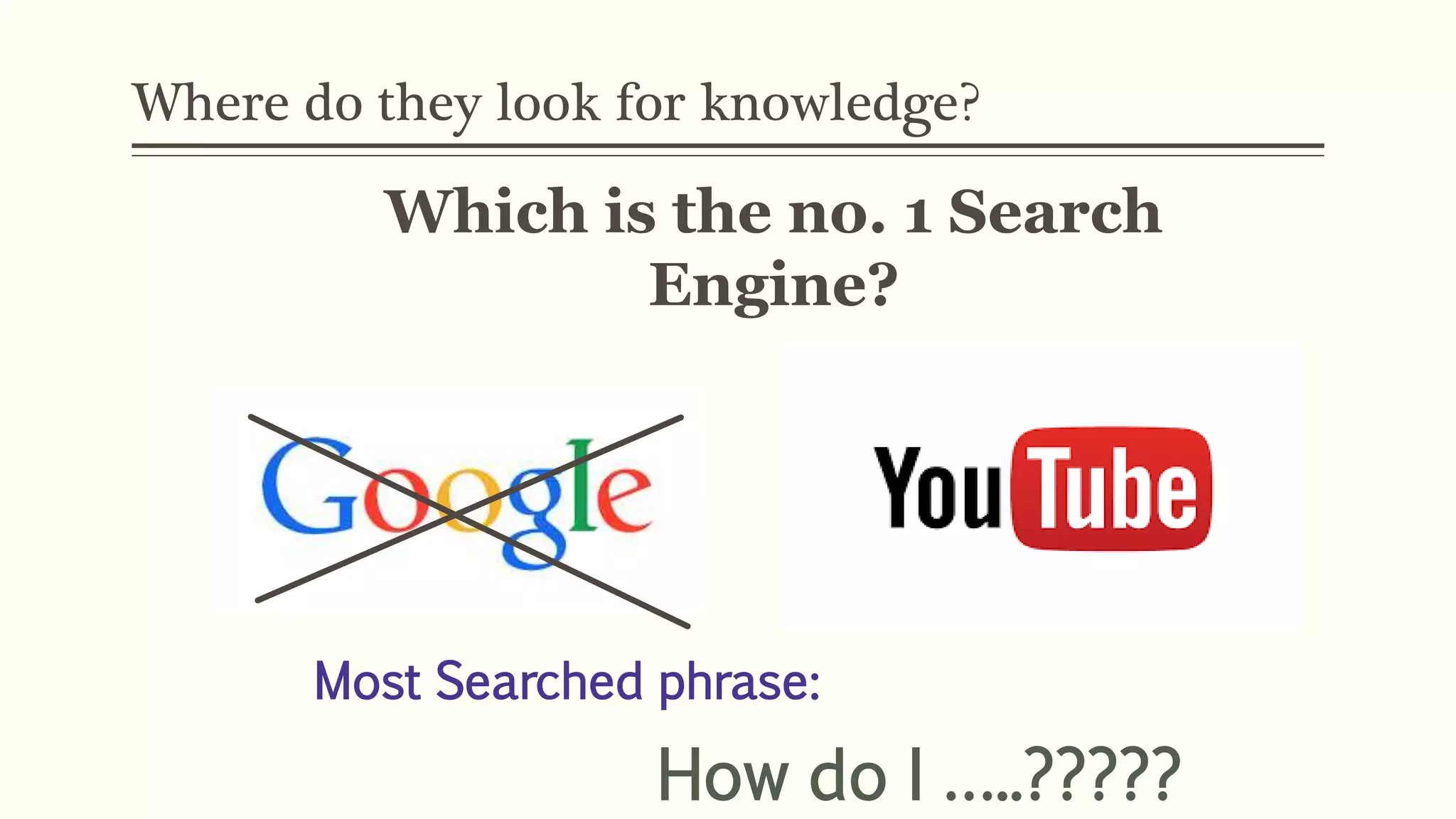
Where do they look for knowledge?
Which is the no. 1 Search
Engine?
Most Searched phrase:
How do I …..?????
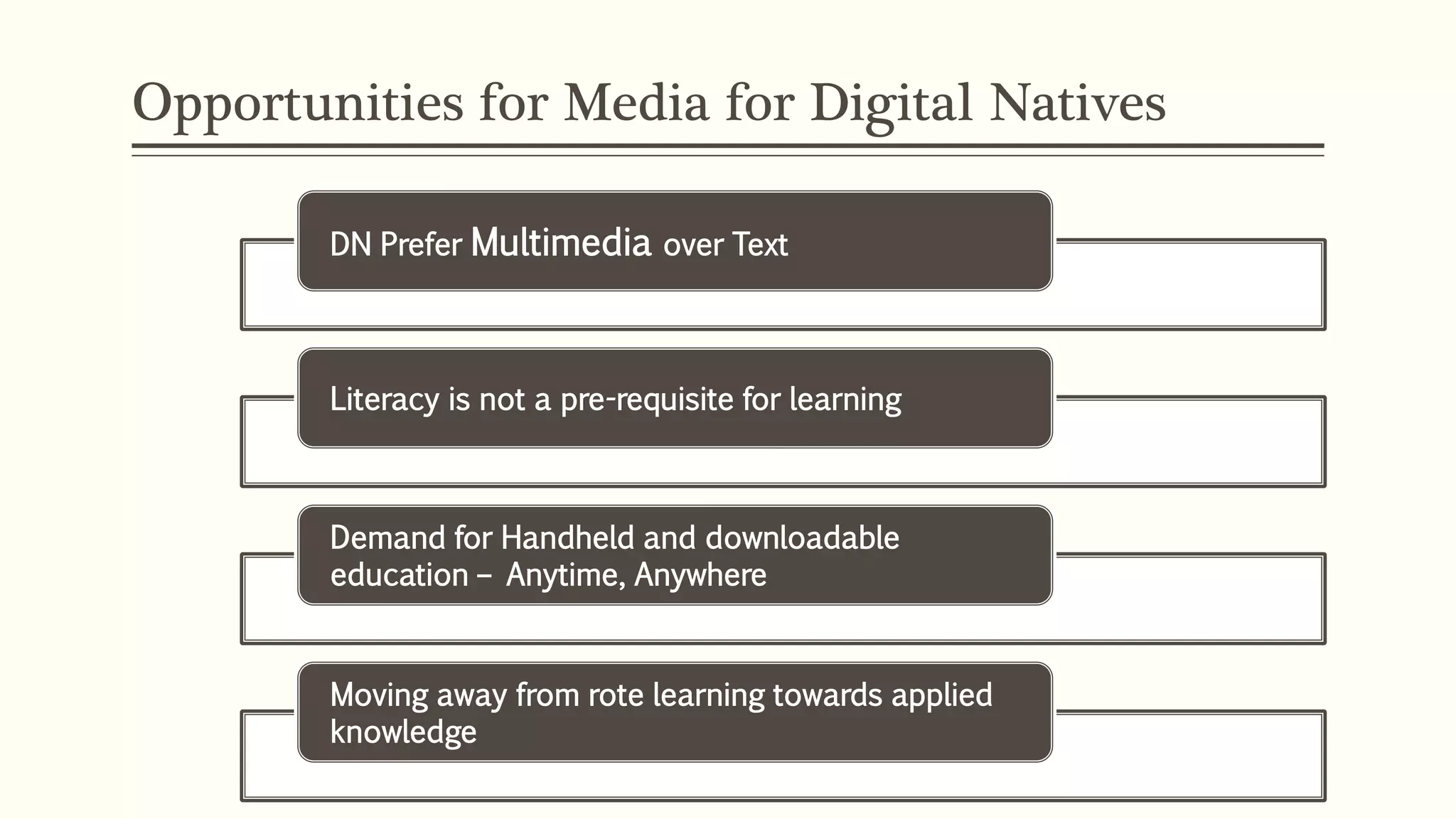
Opportunities for Media for Digital Natives
DN Prefer Multimedia over Text
Literacy is not a pre-requisite for learning
Demand for Handheld and downloadable
education – Anytime, Anywhere
Moving away from rote learning towards applied
knowledge
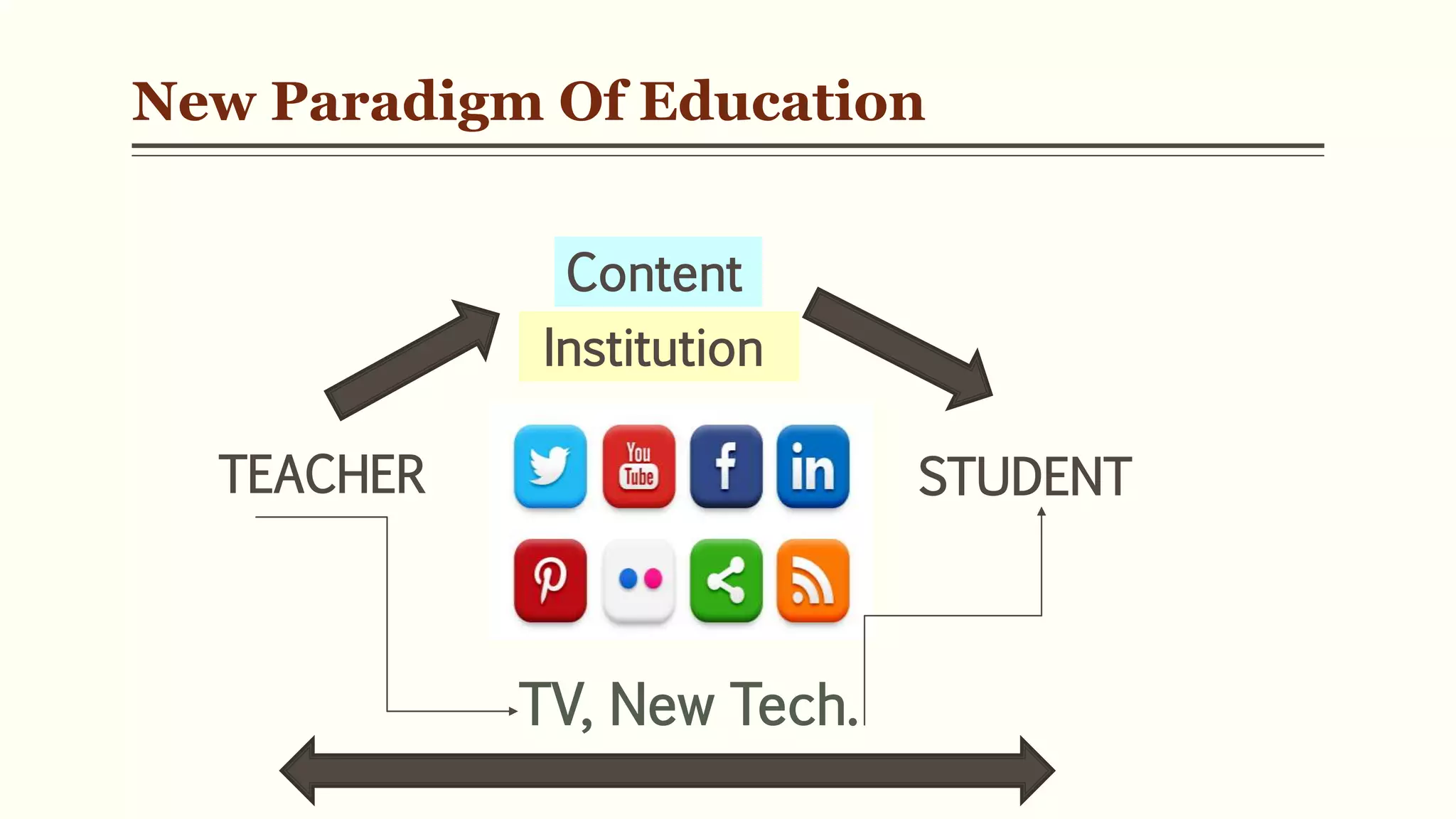
New Paradigm Of Education
TEACHER
Content
Institution
TV, New Tech.
STUDENT
Emerging Global Trend
Teaching and learning has
gone digital.
Computers/Notepads/Mobile
phones have become:
Virtual Classrooms,
Virtual Libraries and
Virtual Laboratories.
MOOCs –a new global reality
Launched only in 2008, today thousands of courses
are being offered globally with registration in millions
2017 Coursera had 24 million registrations for 2000 online courses.
2017 edX had more than 14 million students taking more than 1800
courses online
2017, Udacity had 1.6 million users in 12 full courses and 26 free
courseware
Breaking boundaries, scaling time, removing barriers
Students are shaping their degrees as per requirements of job market.
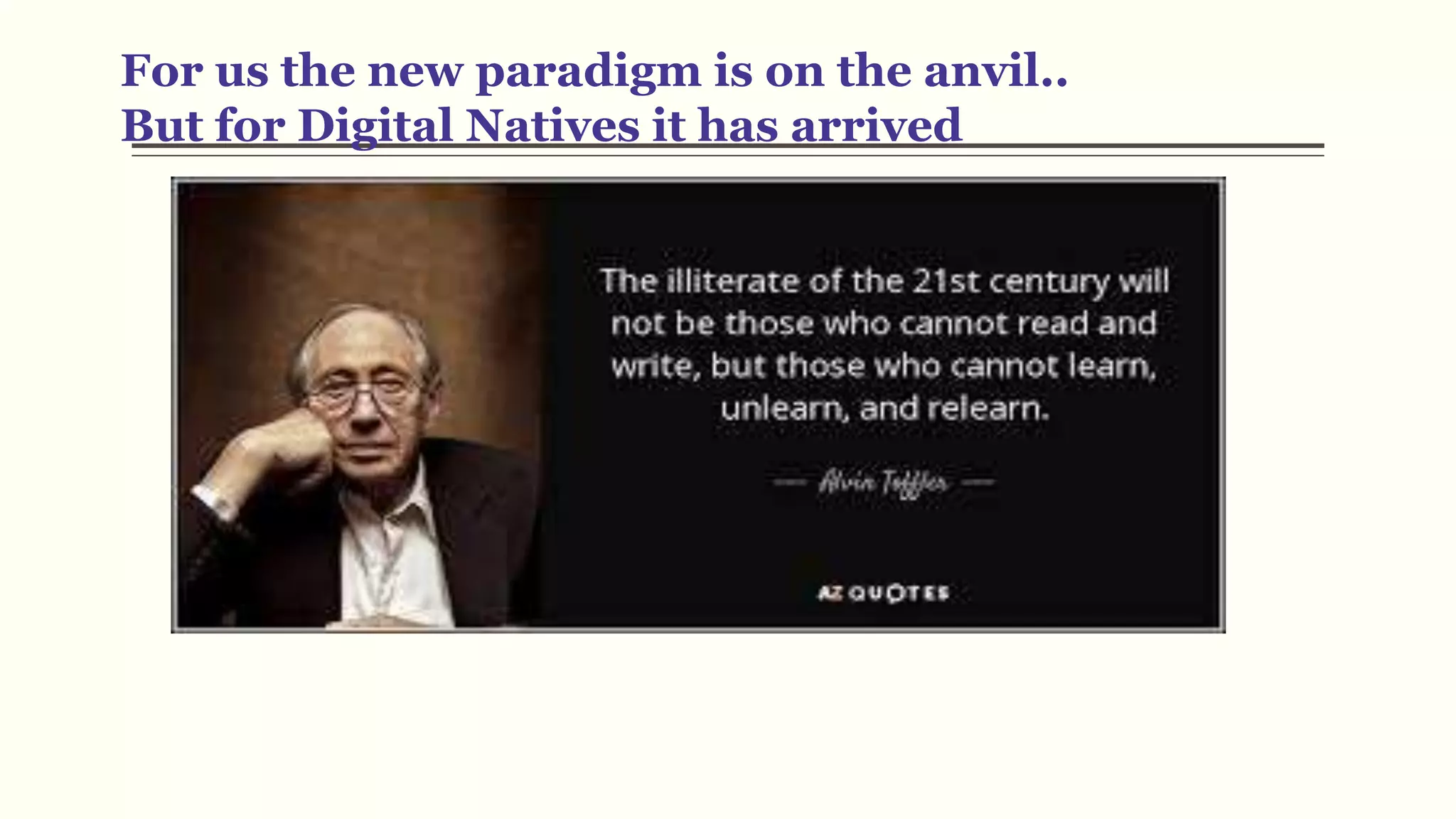
For us the new paradigm is on the anvil..
But for Digital Natives it has arrived
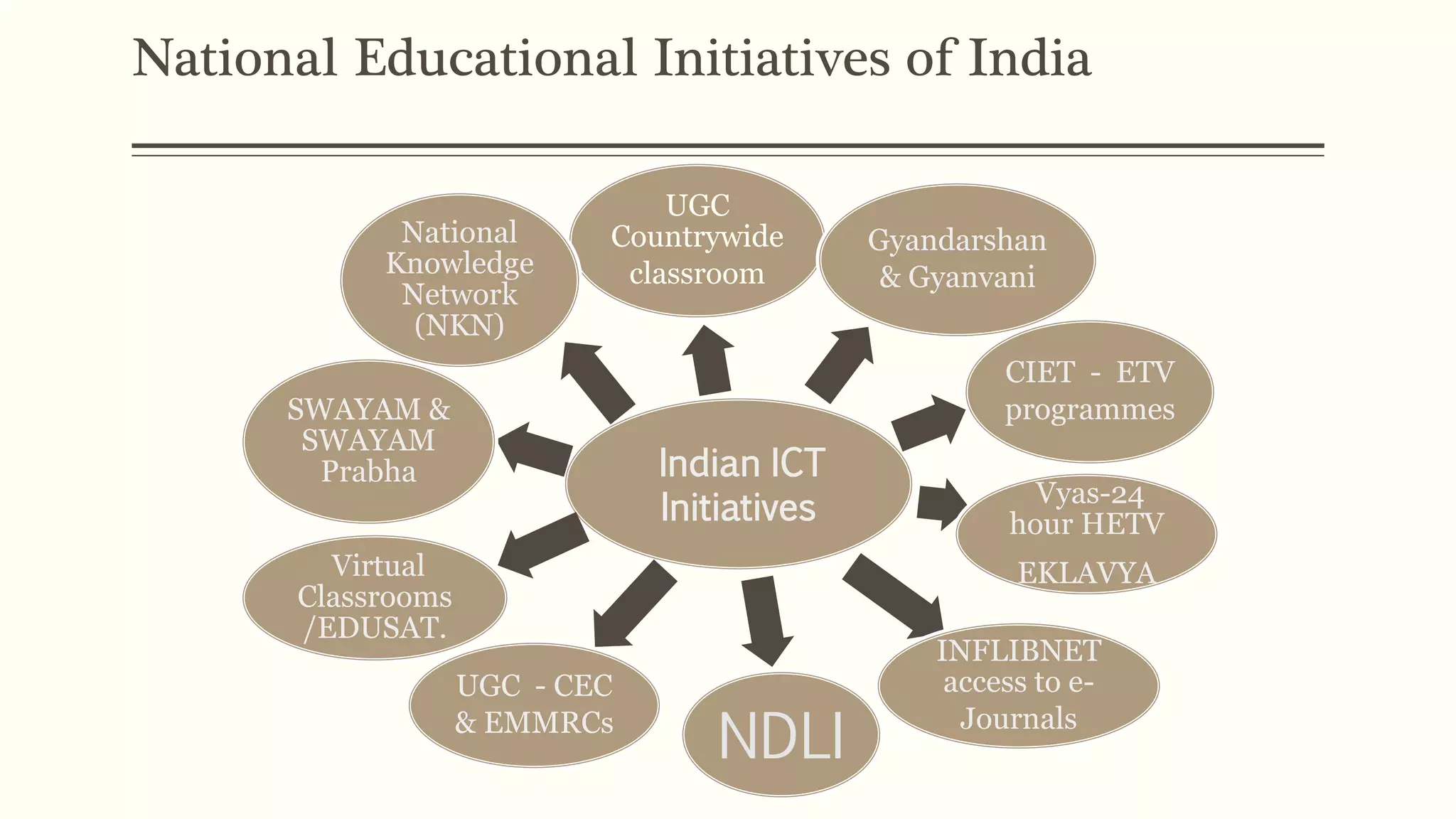
National Educational Initiatives of India
Indian ICT
Initiatives
UGC
Countrywide
classroom
Gyandarshan
& Gyanvani
CIET - ETV
programmes
Vyas-24
hour HETV
EKLAVYA
INFLIBNET
access to e-
Journals
NDLI
UGC - CEC
& EMMRCs
Virtual
Classrooms
/EDUSAT.
SWAYAM &
SWAYAM
Prabha
National
Knowledge
Network
(NKN)
Commonwealth Heads of Government Meeting
Vancouver, 1987
Commonwealth of Learning (COL) was created with
headquarter in Vancouver, Canada and regional office
- Commonwealth Educational Media Centre for Asia
(CEMCA) in New Delhi.
CEMCA
Educational media centre
for promoting media enabled learning for
sustainable development,
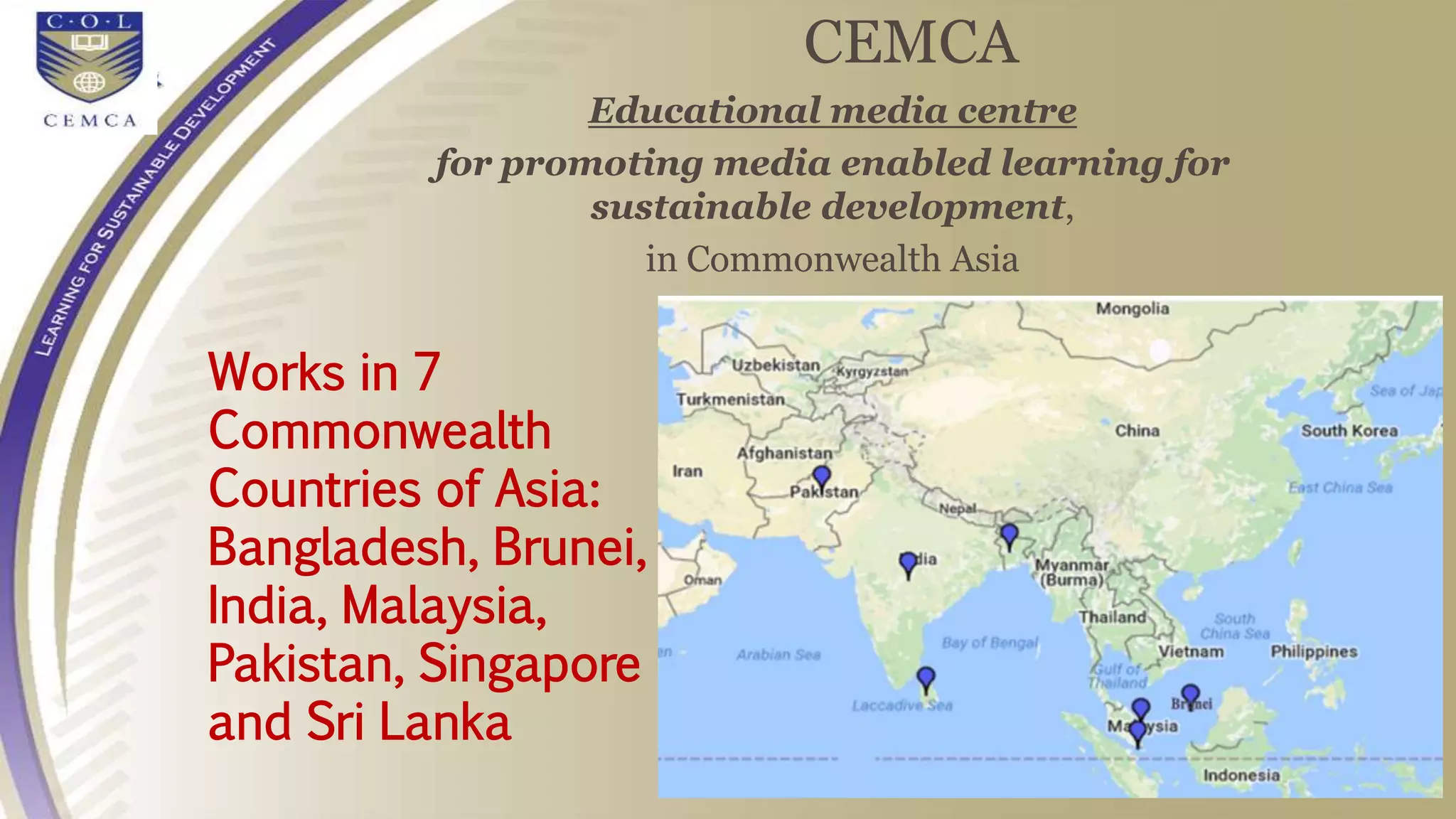
in Commonwealth Asia
Works in 7
Commonwealth
Countries of Asia:
Bangladesh, Brunei,
India, Malaysia,
Pakistan, Singapore
and Sri Lanka
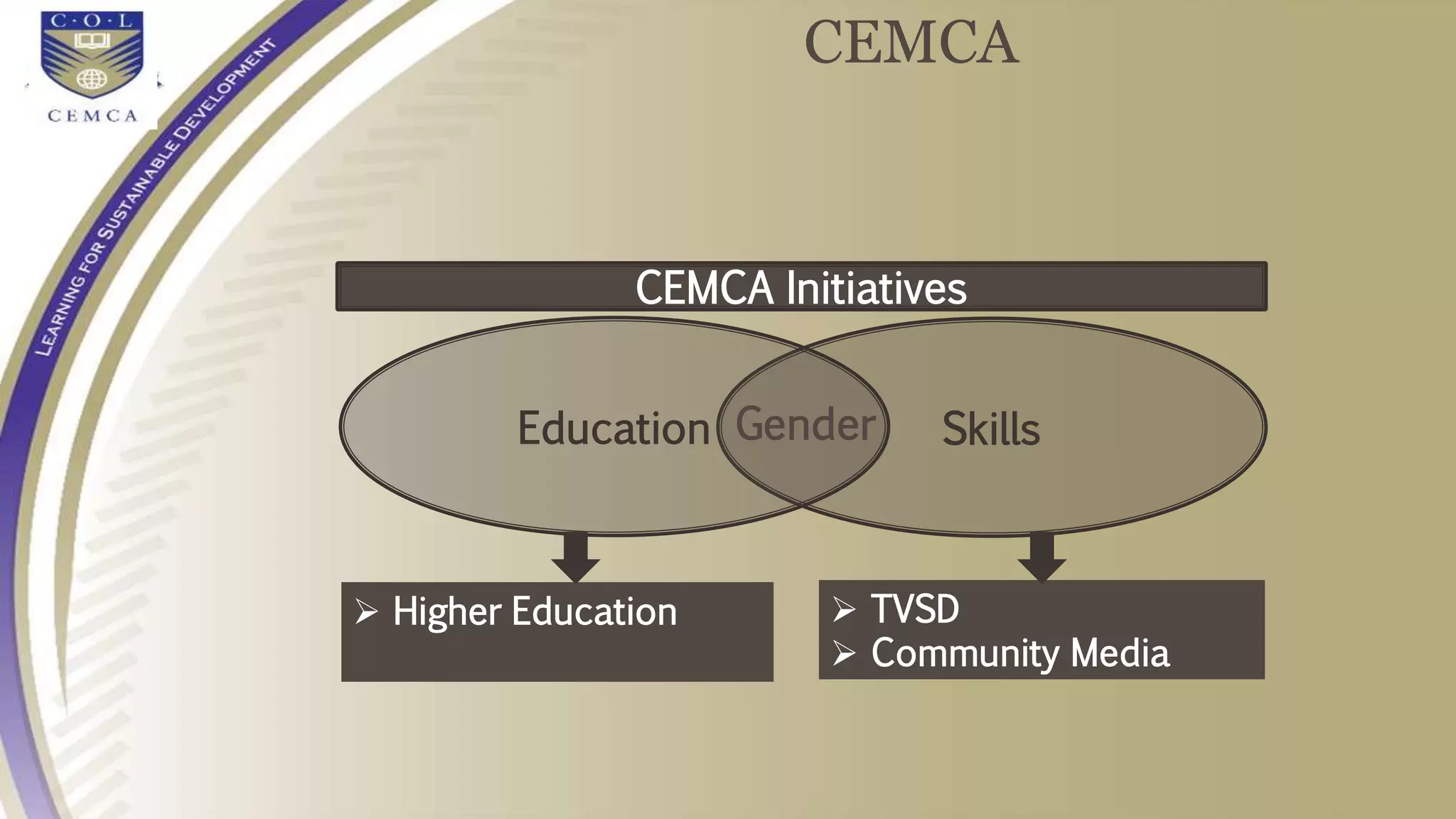
CEMCA Initiatives
SkillsEducation Gender
 Higher Education  TVSD
 Community Media
CEMCA
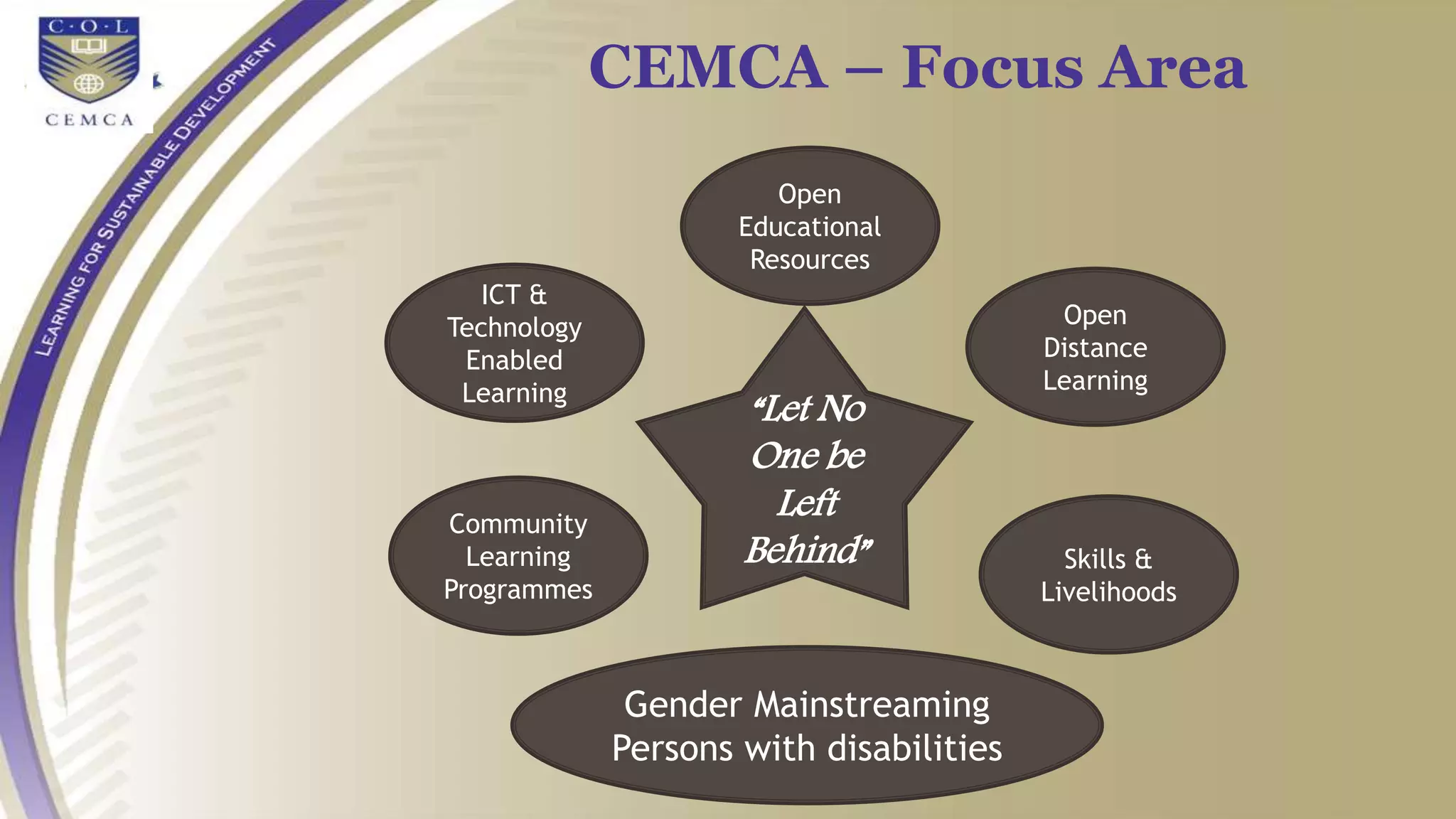
CEMCA – Focus Area
Open
Educational
Resources
Community
Learning
Programmes
Gender Mainstreaming
Persons with disabilities
ICT &
Technology
Enabled
Learning
Open
Distance
Learning
Skills &
Livelihoods
“Let No
One be
Left
Behind”
CEMCA – Core
Strategies
Core
Strategies
Partnerships
CapacityMaterials
Models
Policies
 Development of course
Curriculum and Syllabus
 (6 to 8 week progamme)
Training for Content
Experts on Video
content development
and online
facilitation
Offer through
mooKIT from
IITK/SWAYAM/an
y other platform
Development of
course Content
(Text, Video,
OERs, Activities,
Assessment, etc.)
Feedback, Output,
outcome and impact
will be measured
Advocacy for Course
and
enrolment/registration
(around 2000 learners)
CEMCA Model for Development of MOOCs
Scale up with other higher education
institutions through other platforms like
SWAYAM etc.
Identification
of Course
Coordinator/Co
ntent Experts
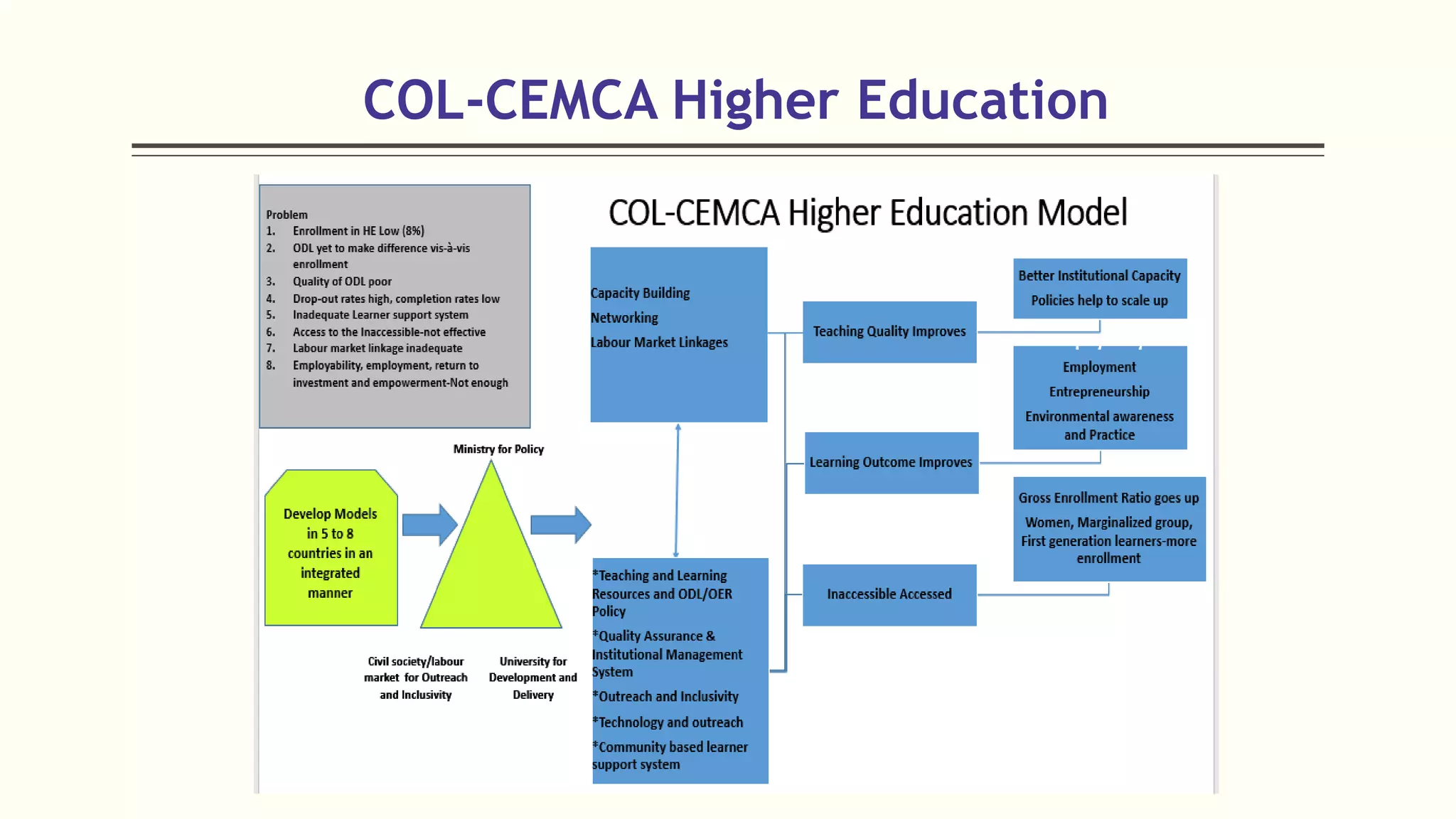
COL-CEMCA Higher Education
Commonwealth Digital Education Leadership Training in Action
• Digital skills
training at scale
• Focus on both
teachers and
students
• Creating
lifelong
learners
C-DELTA
©Sanjay Mishra
Power Sector (PSSC) 5
Job Roles – 32 videos
SKILLS – Recent Works
Technical Vocational Skill Development
Multimedia content creation for skill courses
Audio & Video Editing
2 courses by AIOU
Bamboo Workers
5 product lines – 20
videos
Tailoring & Dress Making
Book & 12 video lectures
Mobile Handset
Repairing
25 videos
Automobile Service
Technician
32 audio & 25
videos
SKILLS – Community Media
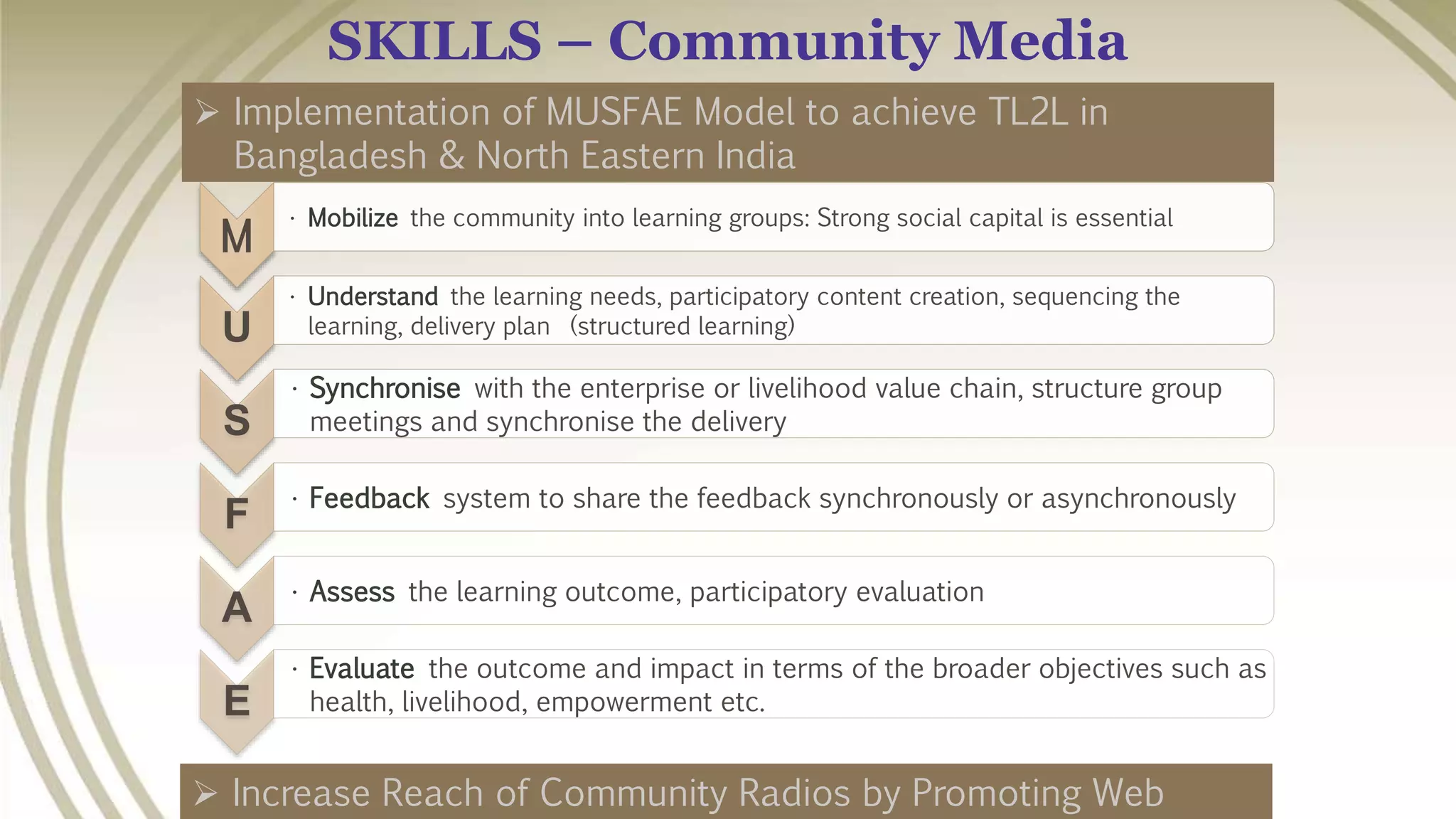
 Implementation of MUSFAE Model to achieve TL2L in
Bangladesh & North Eastern India
 Increase Reach of Community Radios by Promoting Web
M
• Mobilize the community into learning groups: Strong social capital is essential
U
• Understand the learning needs, participatory content creation, sequencing the
learning, delivery plan (structured learning)
S
• Synchronise with the enterprise or livelihood value chain, structure group
meetings and synchronise the delivery
F • Feedback system to share the feedback synchronously or asynchronously
A • Assess the learning outcome, participatory evaluation
E
• Evaluate the outcome and impact in terms of the broader objectives such as
health, livelihood, empowerment etc.
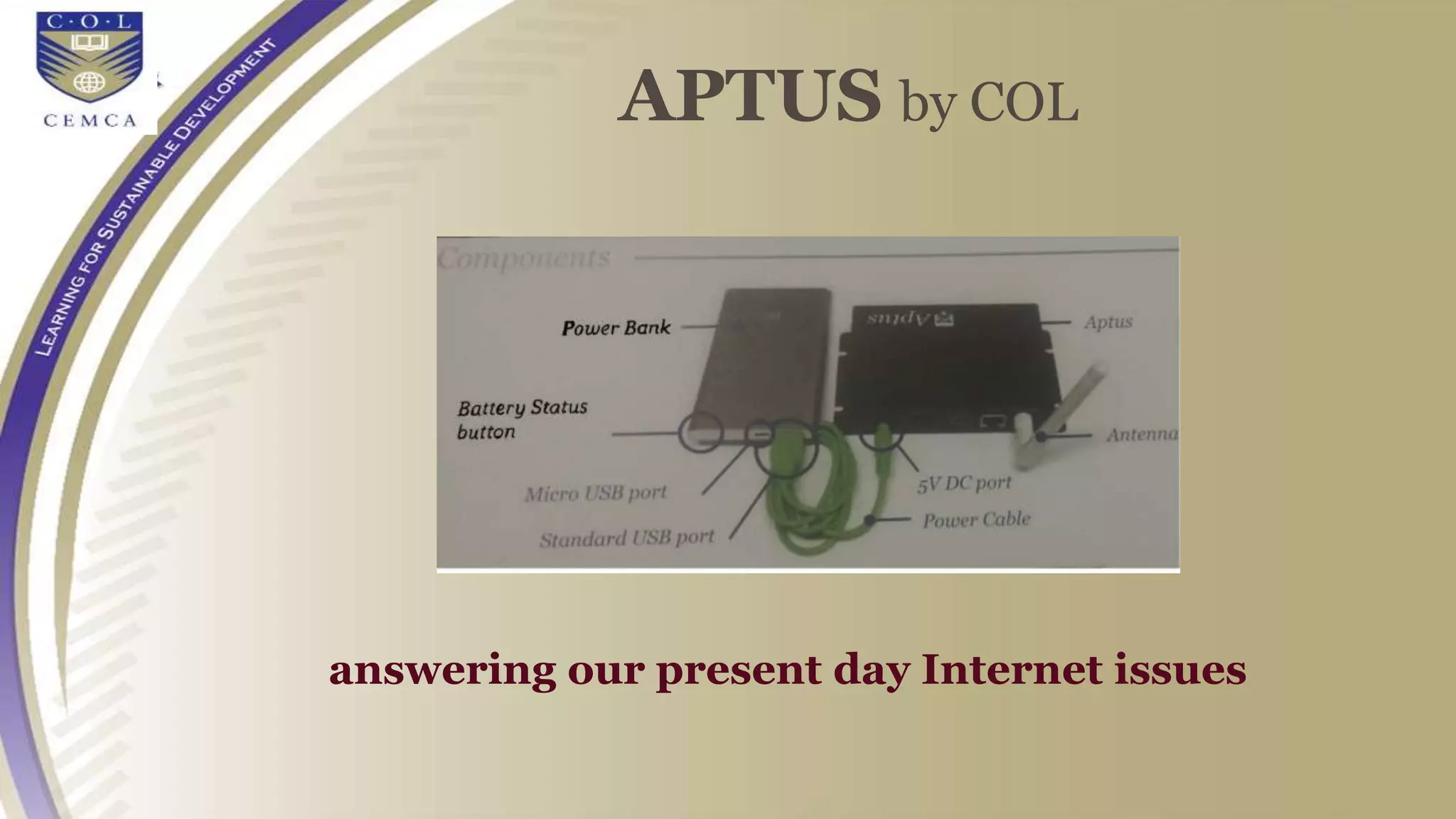
APTUS by COL
answering our present day Internet issues
Thank You
“Let No
One be
Left
Behind”
“When the world is ageing India’s advantage lies in its huge population of
youth, who can be trained to provide the skilled labour across the aging
globe.”
~ Nandan Nilekani in “Imagining India”

AIMEC18 Jaipur Presentation

  • 1.
    ADOLESCENT AND YOUNGPEOPLE’S SPACES IN THE CHANGING MEDIASCAPE THE DIGITAL NATIVES HAVE ARRIVED !! Dr. Shahid Rasool, Director, CEMCA 6th July 2018 srasool@col.org 3rd AIMEC -Jaipur
  • 2.
    Agenda India’s Demographic Dividend InterestingFacts About Digital World Interesting Facts About Digital India Digital Natives - Characteristics Opportunities for Media Educators’ Tools in Digital India Some relevant interventions by CEMCA/COL
  • 3.
    Dr. APJ AbdulKalam “India 2020- a vision for the new millennium”  Predicted: India will become a developed country by 2020  Identified: India’s human resource base as one of its greatest core competencies  Advocated: Indians at all skill levels can excel in knowledge based service, if given the right training and are placed in intellectually challenging environment.  Advantage: “With chosen few….IITs, IIMS,..”  Challenge: To train “Ordinary Indian students, engineers and scientists”  Possibility: in judicious use of media technology for making quality education available to all
  • 4.
    India’s Demographic Dividend 1.3 billion HugePopulation 15-65 years 48% Potentially economically productive 13–24 years Digitally very Active
  • 5.
    Changing Times WorldOver Year 2010  Never heard of Uber/Ola  Never heard of AirBnB  Snapchat does not exist  World Education Technology spend = 550 million USD Year 2015-16  Uber/Ola are part of our daily life.  18 million nights booked in AirBnB  8 billion videos on snapchat  World Education Technology spend = 2.5 billion USD Year 2000  Internet Users – 370 mn.  Broadband Users – 60 mn.  Few mobile apps existed Year 2015-16  Internet Users – 3.1 billion  Broadband Users – 2.3 billion  226 billion Mobile Apps downloaded From Year 2000 to 2016 -  98% decline in Computing Costs  99% decline in Storage Costs
  • 6.
    Title and ContentLayout with Chart ©wearesocial.com Google's aiming to capture 40 million new users in India by 2019,
  • 7.
  • 8.
  • 9.
    Who are theDigital Natives? Digital Native Need Personal Space, Personal Time Creative - Independent Ideas Dexterous at using New Media Platforms Multi- Taskers Need instant gratification Create & Consume Media Content Prefer Self Paced Learning Easily Bored
  • 10.
  • 11.
  • 12.
    Where do theylook for knowledge? Which is the no. 1 Search Engine? Most Searched phrase: How do I …..?????
  • 13.
    Opportunities for Mediafor Digital Natives DN Prefer Multimedia over Text Literacy is not a pre-requisite for learning Demand for Handheld and downloadable education – Anytime, Anywhere Moving away from rote learning towards applied knowledge
  • 14.
    New Paradigm OfEducation TEACHER Content Institution TV, New Tech. STUDENT
  • 15.
    Emerging Global Trend Teachingand learning has gone digital. Computers/Notepads/Mobile phones have become: Virtual Classrooms, Virtual Libraries and Virtual Laboratories.
  • 16.
    MOOCs –a newglobal reality Launched only in 2008, today thousands of courses are being offered globally with registration in millions 2017 Coursera had 24 million registrations for 2000 online courses. 2017 edX had more than 14 million students taking more than 1800 courses online 2017, Udacity had 1.6 million users in 12 full courses and 26 free courseware Breaking boundaries, scaling time, removing barriers Students are shaping their degrees as per requirements of job market.
  • 17.
    For us thenew paradigm is on the anvil.. But for Digital Natives it has arrived
  • 18.
    National Educational Initiativesof India Indian ICT Initiatives UGC Countrywide classroom Gyandarshan & Gyanvani CIET - ETV programmes Vyas-24 hour HETV EKLAVYA INFLIBNET access to e- Journals NDLI UGC - CEC & EMMRCs Virtual Classrooms /EDUSAT. SWAYAM & SWAYAM Prabha National Knowledge Network (NKN)
  • 19.
    Commonwealth Heads ofGovernment Meeting Vancouver, 1987 Commonwealth of Learning (COL) was created with headquarter in Vancouver, Canada and regional office - Commonwealth Educational Media Centre for Asia (CEMCA) in New Delhi.
  • 20.
    CEMCA Educational media centre forpromoting media enabled learning for sustainable development, in Commonwealth Asia Works in 7 Commonwealth Countries of Asia: Bangladesh, Brunei, India, Malaysia, Pakistan, Singapore and Sri Lanka
  • 21.
    CEMCA Initiatives SkillsEducation Gender Higher Education  TVSD  Community Media CEMCA
  • 22.
    CEMCA – FocusArea Open Educational Resources Community Learning Programmes Gender Mainstreaming Persons with disabilities ICT & Technology Enabled Learning Open Distance Learning Skills & Livelihoods “Let No One be Left Behind”
  • 23.
  • 24.
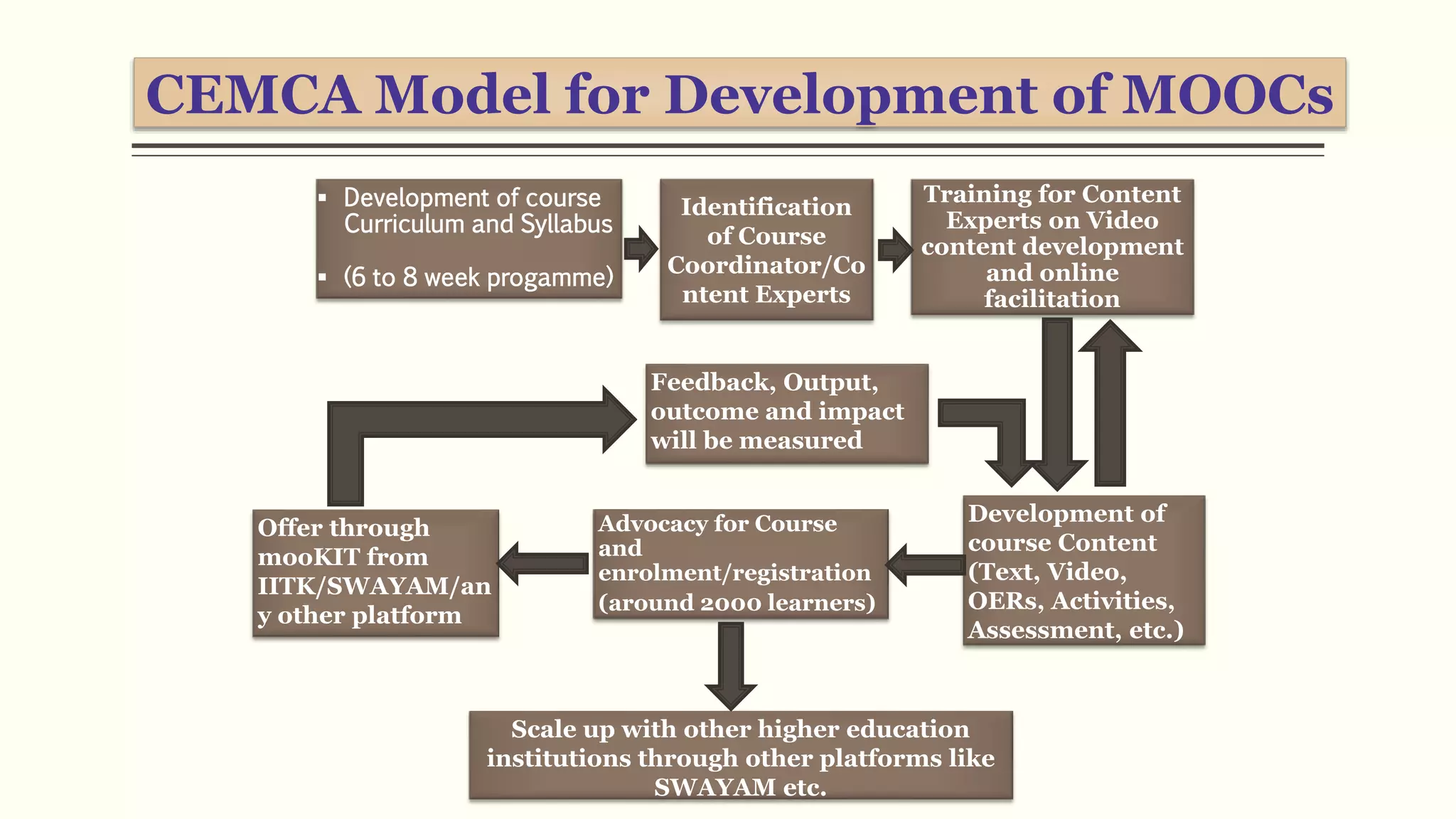
     Development ofcourse Curriculum and Syllabus  (6 to 8 week progamme) Training for Content Experts on Video content development and online facilitation Offer through mooKIT from IITK/SWAYAM/an y other platform Development of course Content (Text, Video, OERs, Activities, Assessment, etc.) Feedback, Output, outcome and impact will be measured Advocacy for Course and enrolment/registration (around 2000 learners) CEMCA Model for Development of MOOCs Scale up with other higher education institutions through other platforms like SWAYAM etc. Identification of Course Coordinator/Co ntent Experts
  • 25.
  • 26.
    Commonwealth Digital EducationLeadership Training in Action • Digital skills training at scale • Focus on both teachers and students • Creating lifelong learners C-DELTA ©Sanjay Mishra
  • 27.
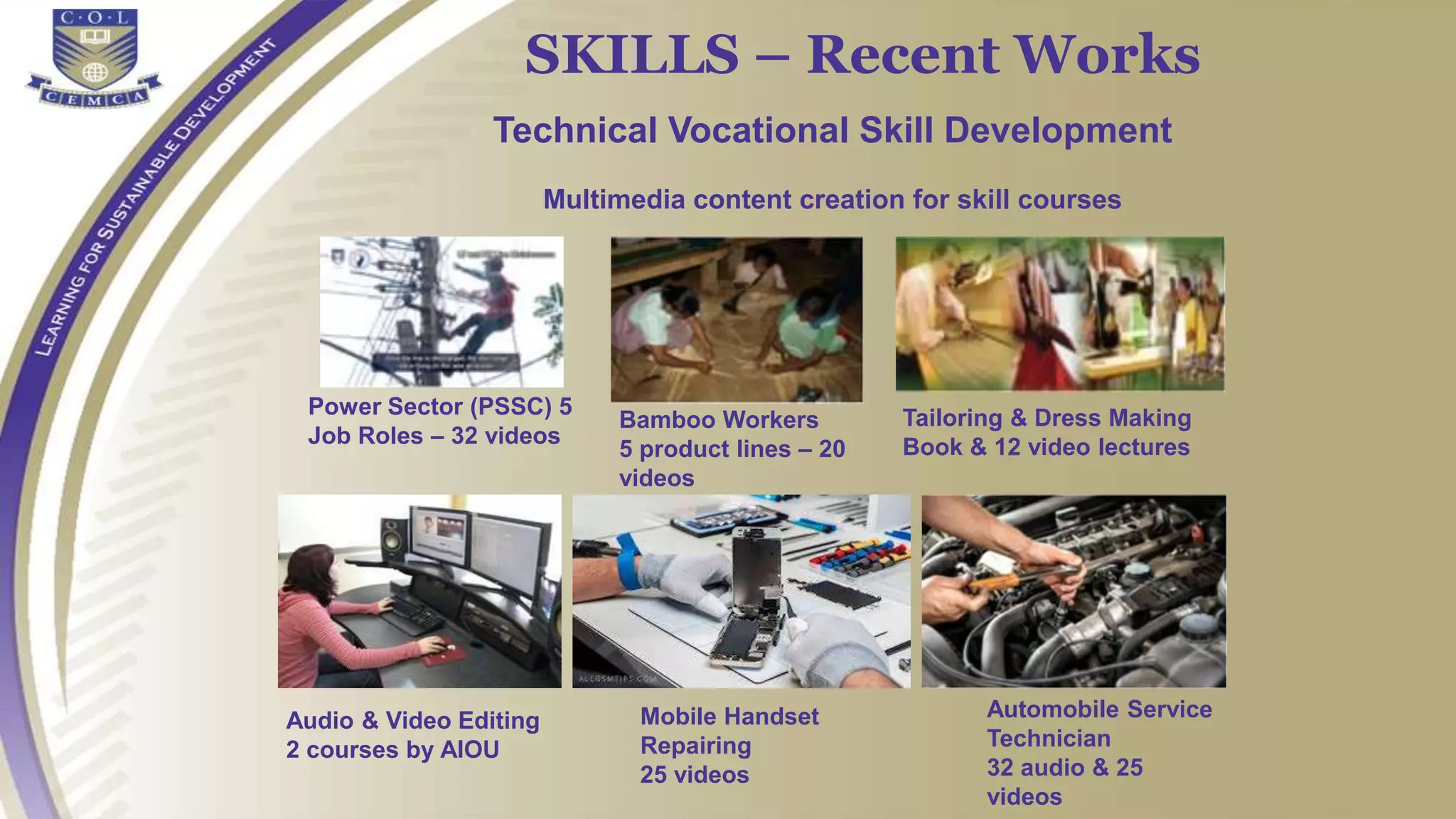
    Power Sector (PSSC)5 Job Roles – 32 videos SKILLS – Recent Works Technical Vocational Skill Development Multimedia content creation for skill courses Audio & Video Editing 2 courses by AIOU Bamboo Workers 5 product lines – 20 videos Tailoring & Dress Making Book & 12 video lectures Mobile Handset Repairing 25 videos Automobile Service Technician 32 audio & 25 videos
  • 28.
    SKILLS – CommunityMedia  Implementation of MUSFAE Model to achieve TL2L in Bangladesh & North Eastern India  Increase Reach of Community Radios by Promoting Web M • Mobilize the community into learning groups: Strong social capital is essential U • Understand the learning needs, participatory content creation, sequencing the learning, delivery plan (structured learning) S • Synchronise with the enterprise or livelihood value chain, structure group meetings and synchronise the delivery F • Feedback system to share the feedback synchronously or asynchronously A • Assess the learning outcome, participatory evaluation E • Evaluate the outcome and impact in terms of the broader objectives such as health, livelihood, empowerment etc.
  • 30.
    APTUS by COL answeringour present day Internet issues
  • 31.
    Thank You “Let No Onebe Left Behind” “When the world is ageing India’s advantage lies in its huge population of youth, who can be trained to provide the skilled labour across the aging globe.” ~ Nandan Nilekani in “Imagining India”

Editor's Notes

  • #2 NOTE: To change the image on this slide, select the picture and delete it. Then click the Pictures icon in the placeholder to insert your own image.