Skill Gap Analysis & HRD
Interventions
Presented by:- 1- NIKHIL SHARMA
2- SHIVAM KATIYAR
MBA FT 3rd sem (2014-16)
CSJMU KANPUR
1
Skill Gap Analysis
A skill gap analysis is an evaluation tool
for determining training needs of an
individual, group or organization. The
analysis reveals the differences between
the required and the existing skill
levels and the recommended strategies
for reducing the differences or closing
the gap.
Tools
Performance assessments
Questionnaires
Interviews and group discussions
Projections
Company goals and long-term plans
Evaluation
Comparing the two findings reveals the
gap in competencies.
Skill areas evaluated include
responsibilities, duties, tasks, functions
and knowledge.
Advantages
Identifying employees’ training needs
and the ways of meeting those needs
helps managers in planning, time
management and budget
considerations.
With targeted training, employees
receive job satisfaction, the company
optimizes its human resources and
production levels are likely to improve.
Causes of skill gap
Lack of soft skills such as:-
(communication, critical thinking,
collaboration)
Lack of technical skills
Lack of strong leadership skills
Lack of computer based technology
skills
Additional uses
A skill gap analysis may also reveal
employees; competencies or lack
thereof that could point to the need for
replacement, promotion or pursuit of
personal growth.
An employee may use the knowledge of
a skill gap to seek continuing education
at an external training facility.
HRD Interventions
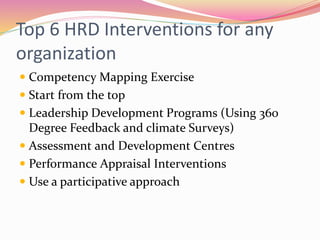
Top 6 HRD Interventions for any
organization
 Competency Mapping Exercise
 Start from the top
 Leadership Development Programs (Using 360
Degree Feedback and climate Surveys)
 Assessment and Development Centres
 Performance Appraisal Interventions
 Use a participative approach
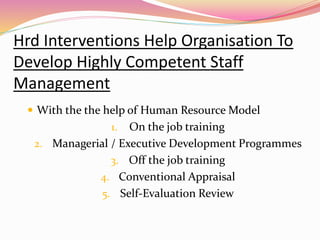
Hrd Interventions Help Organisation To
Develop Highly Competent Staff
Management
 With the the help of Human Resource Model
1. On the job training
2. Managerial / Executive Development Programmes
3. Off the job training
4. Conventional Appraisal
5. Self-Evaluation Review
Outcomes of Human Resource
Development Interventions
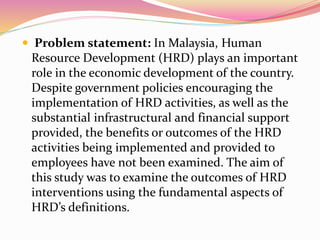
 Problem statement: In Malaysia, Human
Resource Development (HRD) plays an important
role in the economic development of the country.
Despite government policies encouraging the
implementation of HRD activities, as well as the
substantial infrastructural and financial support
provided, the benefits or outcomes of the HRD
activities being implemented and provided to
employees have not been examined. The aim of
this study was to examine the outcomes of HRD
interventions using the fundamental aspects of
HRD’s definitions.
 Approach: This study utilised a mixed method
approach, combining questionnaire surveys and
interviews with HR practitioners.
 Results: The findings suggested that HRD
programs and activities being implemented and
provided to employees in manufacturing firms in
Malaysia generate individual and team
development as well as work process
improvement, but do not support HRD strategic
planning for organizational change.
 Conclusion/Recommendations: This study
implied that HRD programs and activities
implemented had not been strategically planned
and aligned with organizational goals and
objectives. The limitations of the study and
recommendations for further research were
discussed.
 Key words: Outcomes of HRD, individual
development, work process improvement,
organizational change
Academia Industry Interface of
Lovely Professional University
 LPU has a separate department, namely
Department of Academia Industry Interface,
to monitor the Academia Industry
Interaction at the university level. The
department is responsible to enter into
academic alliances with different
Institutions, Industry Sectors, and
Consortiums with a view to develop, refine
or modify the Curricula etc. as per specific
needs.
WHY LPU STUDENTS STAND OUT
 Memberships
 Academic alliances
 Research and development
 Industrial consultancy
 Continuing Education Programme for
Industry
 Short Term Training Programmes
 Skill Up-gradation Courses
Strategy of reducing skill gap of TCS
in UK
• Tata Consultancy Services, India's leading IT
services, has unveiled a new initiative in the UK
designed to help encourage more young people
into digital careers.

• In partnership with The Tech Partnership and
MyKindaCrowd, has created a resource pack to
help teachers educate young people about possible
roles in the IT industry, and the steps they need to
take to achieve that ambition.
 "Digital technologies are playing a defining role in
all aspects of our lives and this trend will continue
to grow. As a result, there will be an increase in
demand for employees with digital skills, and
hence more young people need to choose the right
education, to give them the required future skills,"
said Nupur Singh Mallick, HR director, Tata
Consultancy Services UK & Ireland.
"At TCS, we believe that businesses must take action
to help educate and inspire young people about
the potential advantages of a digital-skills-based
career," she said.
 "The TechFutures Careers Resource Pack is a key
part of our IT Futures programme, a series of TCS-
led initiatives designed to foster enthusiasm and
engagement among young people and address the
long-term challenges limiting the growth of the
UK's digital talent pool.“
 "It is vital that we have a secure talent pipeline to
ensure the future success of the digital economy.
These employer created resources will help to
inspire the future tech workforce about the
fascinating careers that are available to them in the
tech industry," said Sue Nieland, director of
Education for The Tech Partnership.
• Currently, there are no teaching resource packs
of this kind available for this topic. The research,
which assessed the challenges and issues that
schools currently face found that although young
people are well-versed in using technology, there
is a lack of knowledge of how that technology is
created and little understanding of the breadth
of technology career.
 Bringing together industry insights, practical
lesson guides and activities, The TechFutures
materials are designed to address this deficit,
TCS said in a statement.
TCS volunteers will also be hosting a
number of sessions in schools in
partnership with MyKindaCrowd based
around the resources. TCS and
MyKindaCrowd have already run over
50 similar sessions.
Skill gap and hrd interventions

Skill gap and hrd interventions

  • 1.
    Skill Gap Analysis& HRD Interventions Presented by:- 1- NIKHIL SHARMA 2- SHIVAM KATIYAR MBA FT 3rd sem (2014-16) CSJMU KANPUR 1
  • 2.
    Skill Gap Analysis Askill gap analysis is an evaluation tool for determining training needs of an individual, group or organization. The analysis reveals the differences between the required and the existing skill levels and the recommended strategies for reducing the differences or closing the gap.
  • 3.
    Tools Performance assessments Questionnaires Interviews andgroup discussions Projections Company goals and long-term plans
  • 4.
    Evaluation Comparing the twofindings reveals the gap in competencies. Skill areas evaluated include responsibilities, duties, tasks, functions and knowledge.
  • 5.
    Advantages Identifying employees’ trainingneeds and the ways of meeting those needs helps managers in planning, time management and budget considerations. With targeted training, employees receive job satisfaction, the company optimizes its human resources and production levels are likely to improve.
  • 6.
    Causes of skillgap Lack of soft skills such as:- (communication, critical thinking, collaboration) Lack of technical skills Lack of strong leadership skills Lack of computer based technology skills
  • 7.
    Additional uses A skillgap analysis may also reveal employees; competencies or lack thereof that could point to the need for replacement, promotion or pursuit of personal growth. An employee may use the knowledge of a skill gap to seek continuing education at an external training facility.
  • 8.
  • 9.
    Top 6 HRDInterventions for any organization  Competency Mapping Exercise  Start from the top  Leadership Development Programs (Using 360 Degree Feedback and climate Surveys)  Assessment and Development Centres  Performance Appraisal Interventions  Use a participative approach
  • 10.
    Hrd Interventions HelpOrganisation To Develop Highly Competent Staff Management  With the the help of Human Resource Model 1. On the job training 2. Managerial / Executive Development Programmes 3. Off the job training 4. Conventional Appraisal 5. Self-Evaluation Review
  • 11.
    Outcomes of HumanResource Development Interventions
  • 12.
     Problem statement:In Malaysia, Human Resource Development (HRD) plays an important role in the economic development of the country. Despite government policies encouraging the implementation of HRD activities, as well as the substantial infrastructural and financial support provided, the benefits or outcomes of the HRD activities being implemented and provided to employees have not been examined. The aim of this study was to examine the outcomes of HRD interventions using the fundamental aspects of HRD’s definitions.
  • 13.
     Approach: Thisstudy utilised a mixed method approach, combining questionnaire surveys and interviews with HR practitioners.  Results: The findings suggested that HRD programs and activities being implemented and provided to employees in manufacturing firms in Malaysia generate individual and team development as well as work process improvement, but do not support HRD strategic planning for organizational change.
  • 14.
     Conclusion/Recommendations: Thisstudy implied that HRD programs and activities implemented had not been strategically planned and aligned with organizational goals and objectives. The limitations of the study and recommendations for further research were discussed.  Key words: Outcomes of HRD, individual development, work process improvement, organizational change
  • 15.
    Academia Industry Interfaceof Lovely Professional University
  • 16.
     LPU hasa separate department, namely Department of Academia Industry Interface, to monitor the Academia Industry Interaction at the university level. The department is responsible to enter into academic alliances with different Institutions, Industry Sectors, and Consortiums with a view to develop, refine or modify the Curricula etc. as per specific needs.
  • 17.
    WHY LPU STUDENTSSTAND OUT  Memberships  Academic alliances  Research and development  Industrial consultancy  Continuing Education Programme for Industry  Short Term Training Programmes  Skill Up-gradation Courses
  • 18.
    Strategy of reducingskill gap of TCS in UK • Tata Consultancy Services, India's leading IT services, has unveiled a new initiative in the UK designed to help encourage more young people into digital careers. • In partnership with The Tech Partnership and MyKindaCrowd, has created a resource pack to help teachers educate young people about possible roles in the IT industry, and the steps they need to take to achieve that ambition.
  • 19.
     "Digital technologiesare playing a defining role in all aspects of our lives and this trend will continue to grow. As a result, there will be an increase in demand for employees with digital skills, and hence more young people need to choose the right education, to give them the required future skills," said Nupur Singh Mallick, HR director, Tata Consultancy Services UK & Ireland. "At TCS, we believe that businesses must take action to help educate and inspire young people about the potential advantages of a digital-skills-based career," she said.
  • 20.
     "The TechFuturesCareers Resource Pack is a key part of our IT Futures programme, a series of TCS- led initiatives designed to foster enthusiasm and engagement among young people and address the long-term challenges limiting the growth of the UK's digital talent pool.“  "It is vital that we have a secure talent pipeline to ensure the future success of the digital economy. These employer created resources will help to inspire the future tech workforce about the fascinating careers that are available to them in the tech industry," said Sue Nieland, director of Education for The Tech Partnership.
  • 21.
    • Currently, thereare no teaching resource packs of this kind available for this topic. The research, which assessed the challenges and issues that schools currently face found that although young people are well-versed in using technology, there is a lack of knowledge of how that technology is created and little understanding of the breadth of technology career.  Bringing together industry insights, practical lesson guides and activities, The TechFutures materials are designed to address this deficit, TCS said in a statement.
  • 22.
    TCS volunteers willalso be hosting a number of sessions in schools in partnership with MyKindaCrowd based around the resources. TCS and MyKindaCrowd have already run over 50 similar sessions.