SKILL INDIA: MEETING THE CHALLENGES
Ministry of Skill Development & Entrepreneurship
21.07.2017
A National Perspective
Why Skill Development ?
Demographic dividend
0-4
5-9
10-14
15-19
20-24
25-29
30-34
35-39
40-44
45-49
50-54
55-59
60-64
Male
Female
5954
6661
Population MN, 2011
6963
6457
5854
5150
4544
4342
3835
3230
2623
1920
1919
Age Group
The Skills Challenge: Demand Side
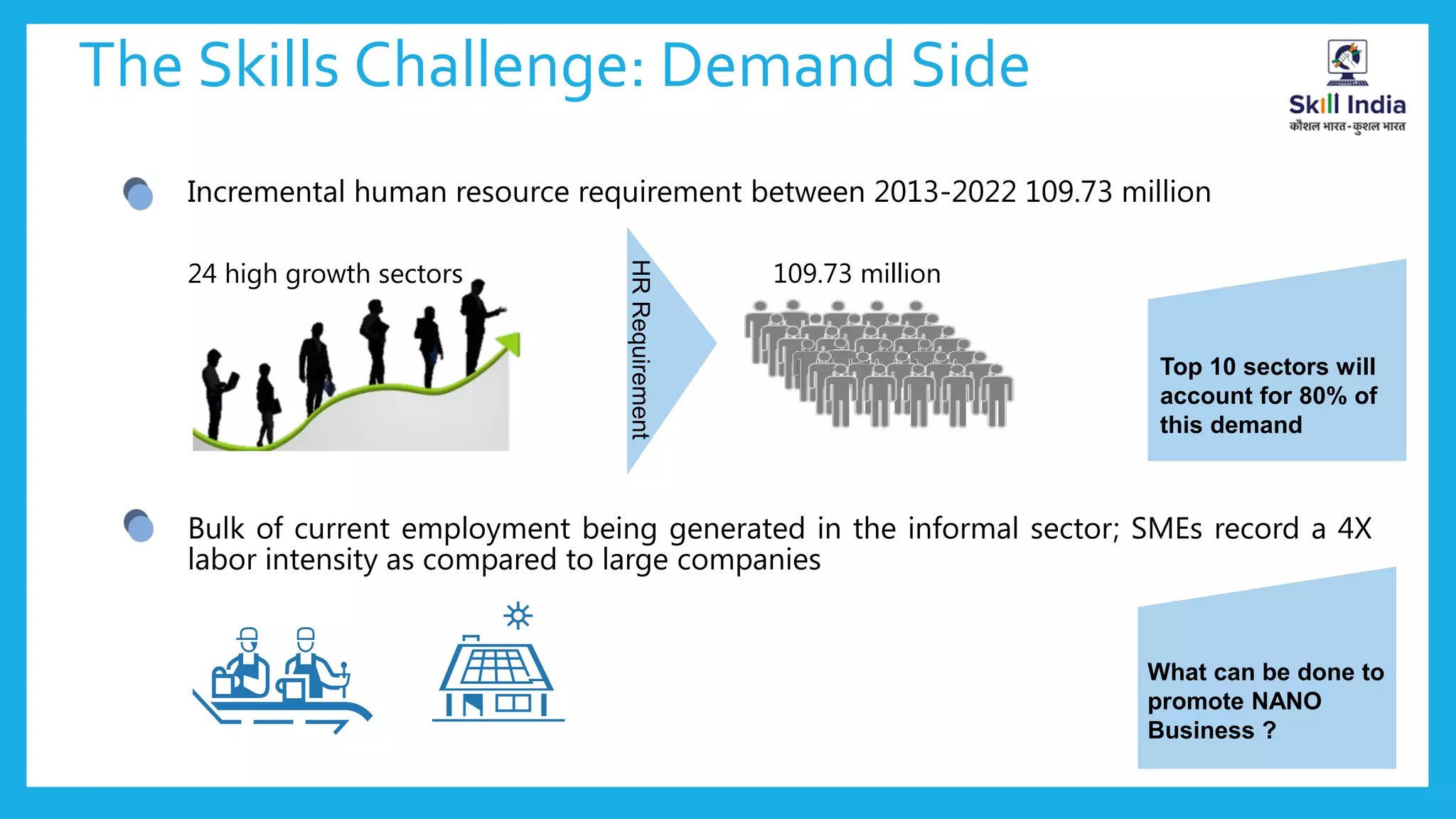
Incremental human resource requirement between 2013-2022 109.73 million
Bulk of current employment being generated in the informal sector; SMEs record a 4X
labor intensity as compared to large companies
24 high growth sectors
HRRequirement
109.73 million
What can be done to
promote NANO
Business ?
Top 10 sectors will
account for 80% of
this demand
The Skills Challenge: Supply Side
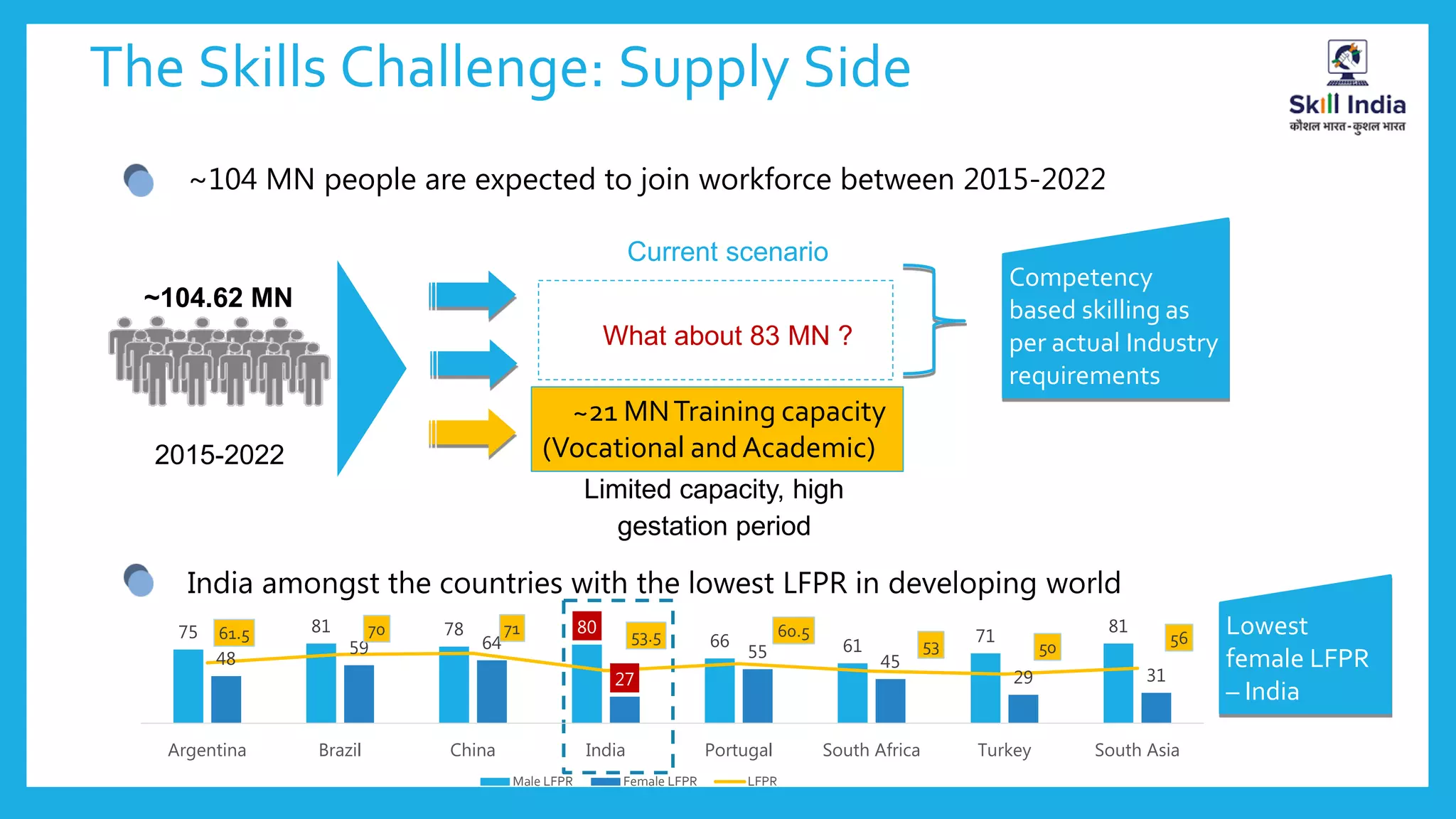
~104 MN people are expected to join workforce between 2015-2022
#####
~21 MNTraining capacity
(Vocational and Academic)2015-2022
What about 83 MN ?
India amongst the countries with the lowest LFPR in developing world
75 81 78 80
66 61
71
81
48
59 64
27
55
45
29 31
61.5 70 71 53.5 60.5
53 50
56
Argentina Brazil China India Portugal South Africa Turkey South Asia
Male LFPR Female LFPR LFPR
~104.62 MN
Current scenario
Lowest
female LFPR
– India
Limited capacity, high
gestation period
Competency
based skilling as
per actual Industry
requirements
Systemic Challenges
Organizational
Quality
Policy
Vocational training lacks aspiration and advocacy
Lack of synergy between education and skills
Limited funding opportunities
Non conformity to international standards
Acute shortage of training infrastructure
Lack of inclusivity and geographical inequity
How can MSDE address these challenges?
Should MSDE be an Implementer or Enabler?
Role of the State in Skill Development
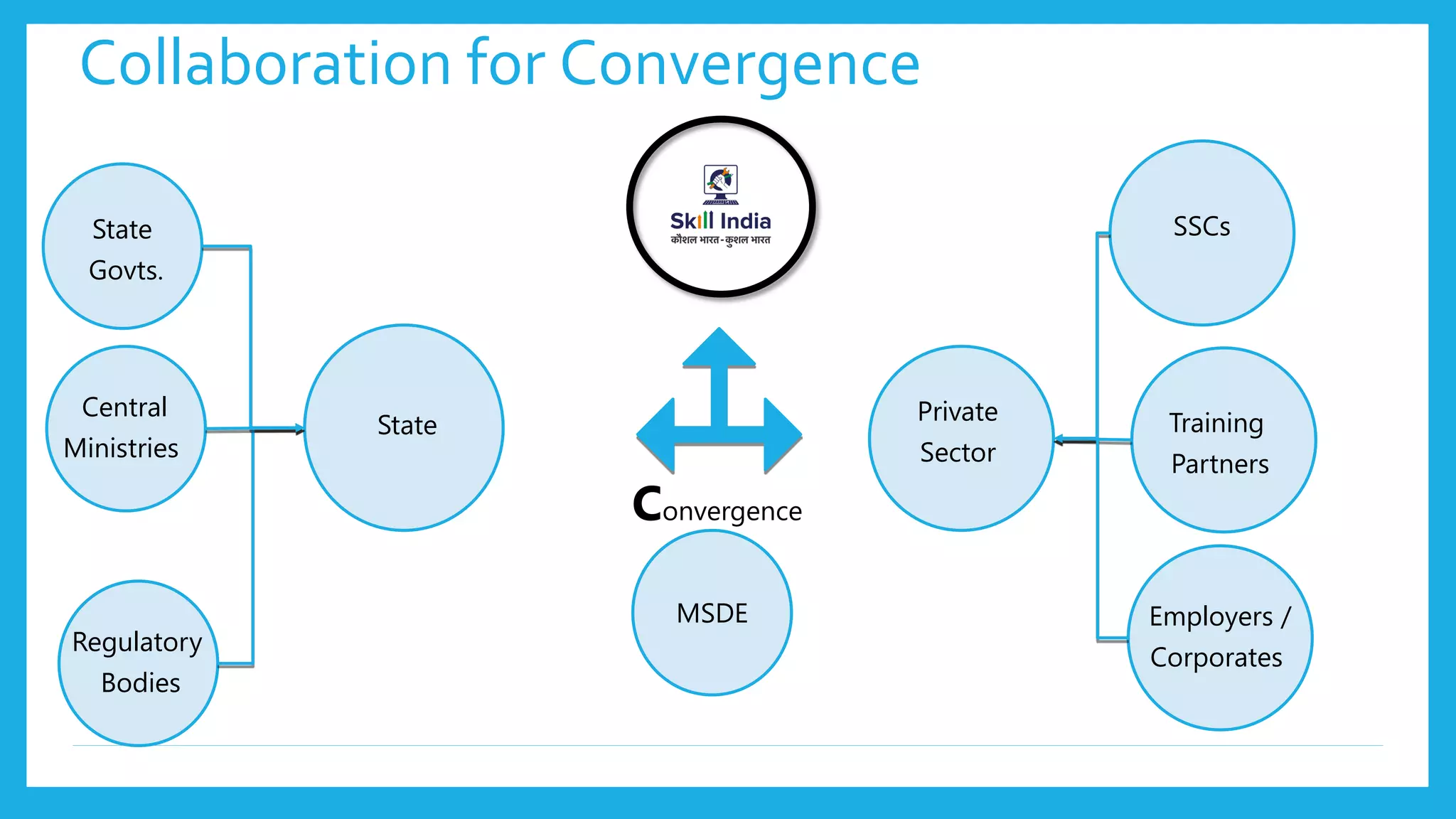
Collaboration for Convergence
2.Convergence
Convergence
State Private
Sector
SSCs
Training
Partners
Employers /
Corporates
Central
Ministries
MSDE
State
Govts.
Regulatory
Bodies
Policy
Institution
Strengthening –
Regulator,.
Assessment
Board
Institutions
Restructuring
Sector Skill Councils
2014 Amendments
to Apprenticeship
Act
Enabling Skill Development
Effective Competency Based Skill Development
Ecosystem
Learner Centricity – Quality of Opportunity (Credit Framework), Right Information &
Guidance (Mobilization & Counseling), Quality Outcomes (Placements)
1 2 3 4 5
National Skill
Development
Policy 2015
Funding
National Skill
Development
Fund
Implementation Industry
National Skill
Development
Mission
& Scheme
Convergence
Scheme
implementation &
monitoring,
innovation,
technology tools
6
State Partnership
Policy Interventions
National Policy for
Skill Development &
Entrepreneurship
National Skill Development
Mission
Amendments to
Apprenticeship Act
1
2
3
4 Common Norms
Policy Interventions in pipeline
Skills Acquisition and Knowledge
Awareness for Livelihood Promotion
(SANKALP)
5 Pillars of Skill Development
Industry Input
Industry
Assessment
&
Certification
Standard Quality Capacity
Placement
Linkages
Effective Competency Based Skill Development Ecosystem
Standards (1/2)
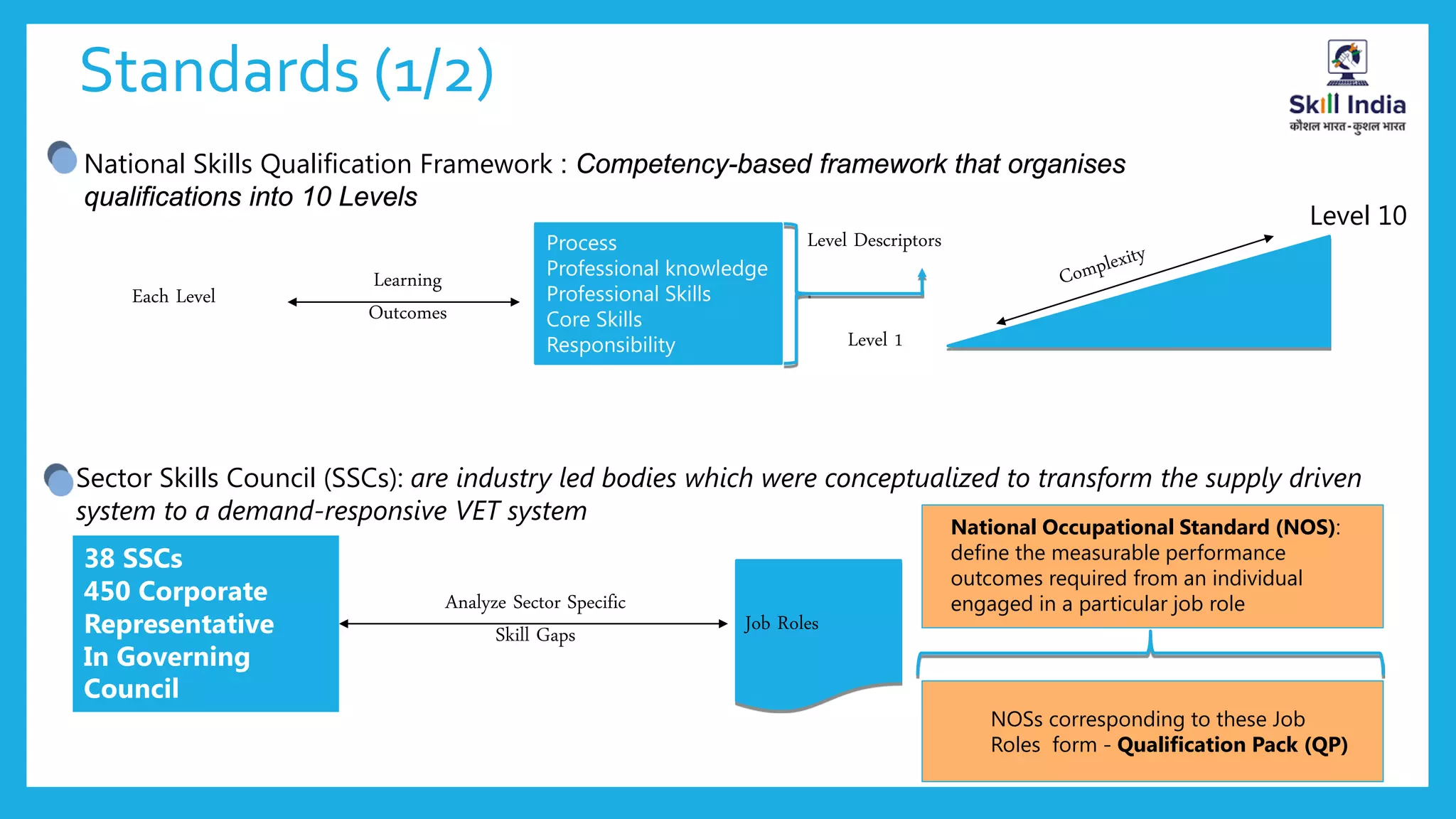
Sector Skills Council (SSCs): are industry led bodies which were conceptualized to transform the supply driven
system to a demand-responsive VET system
National Skills Qualification Framework : Competency-based framework that organises
qualifications into 10 Levels
Process
Professional knowledge
Professional Skills
Core Skills
Responsibility
Each Level
Learning
Outcomes
Level 10
Level 1
Level Descriptors
38 SSCs
450 Corporate
Representative
In Governing
Council
Analyze Sector Specific
Skill Gaps Job Roles
National Occupational Standard (NOS):
define the measurable performance
outcomes required from an individual
engaged in a particular job role
NOSs corresponding to these Job
Roles form - Qualification Pack (QP)
Standards (2/2)
Model Curriculum Content
(NSQF Guidelines )
Lab Guidelines
(Favorable Trainee Equipment Ratio)
Infrastructure Guidelines
(Area, Accessibility etc.)
Sector Skills Council
Total Number of NOS : 5093
Total Number of QP’s : 1930
Inputs
Model Curriculum Available For:
413
Common Norms : Set of guidelines for skill development which defines input standards, outcomes and funding
norms
Quality
Input Parameters
Infra guidelines
Lab Guidelines
Trainers Qualification
Assessors Qualification
Quality Assurance
Smart Portal: For streamlining
process of center accreditation
Training of Trainers : On Domain
Skills & Soft Skills made compulsory
Assessor development Prog. :
To train & create a pool of assessors
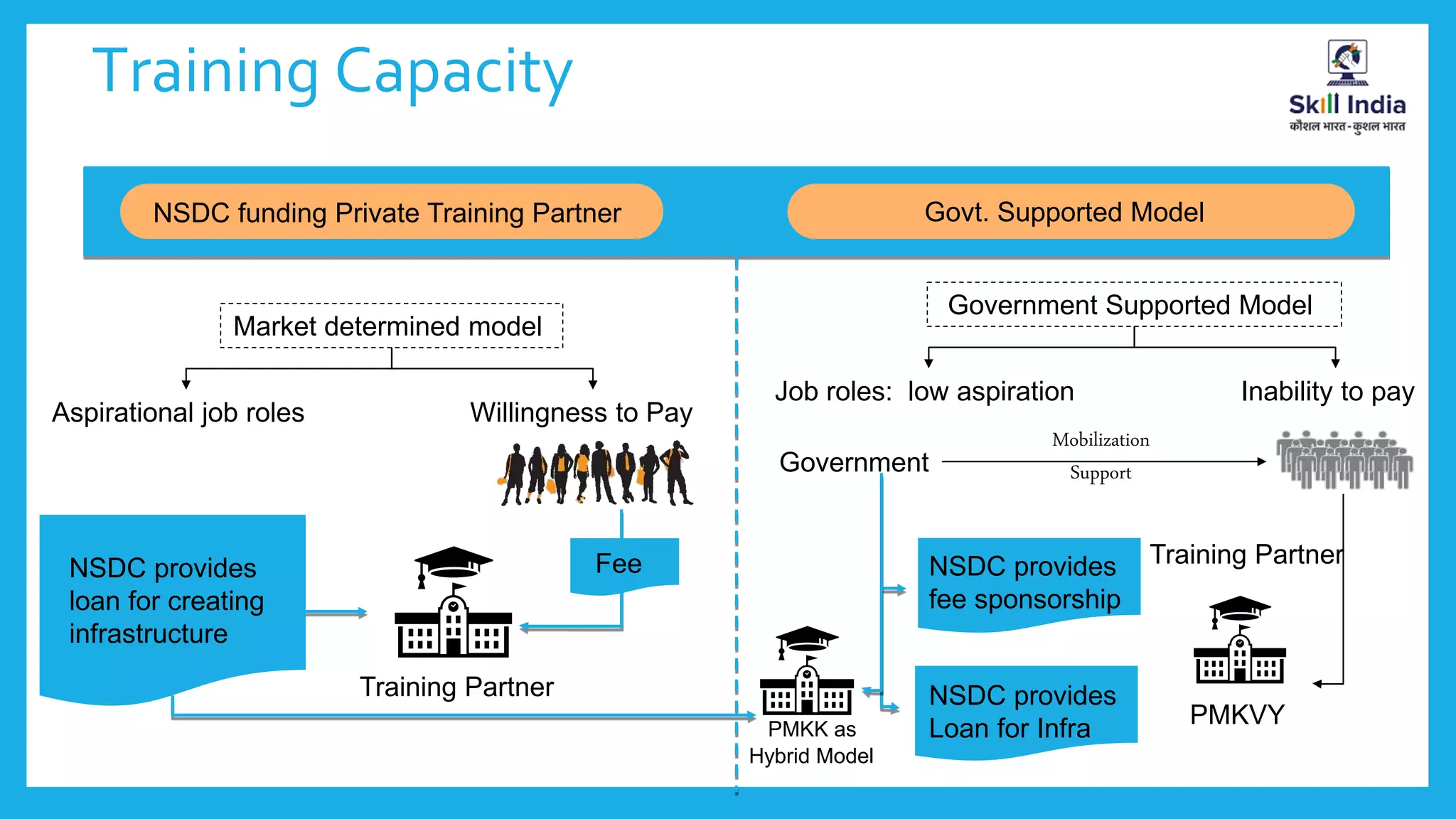
Training Capacity
NSDC funding Private Training Partner Govt. Supported Model
Market determined model
Aspirational job roles Willingness to Pay
NSDC provides
loan for creating
infrastructure
Training Partner
Fee
Government Supported Model
Job roles: low aspiration Inability to pay
Government
NSDC provides
fee sponsorship
NSDC provides
Loan for Infra
Training Partner
PMKVY
Mobilization
Support
PMKK as
Hybrid Model
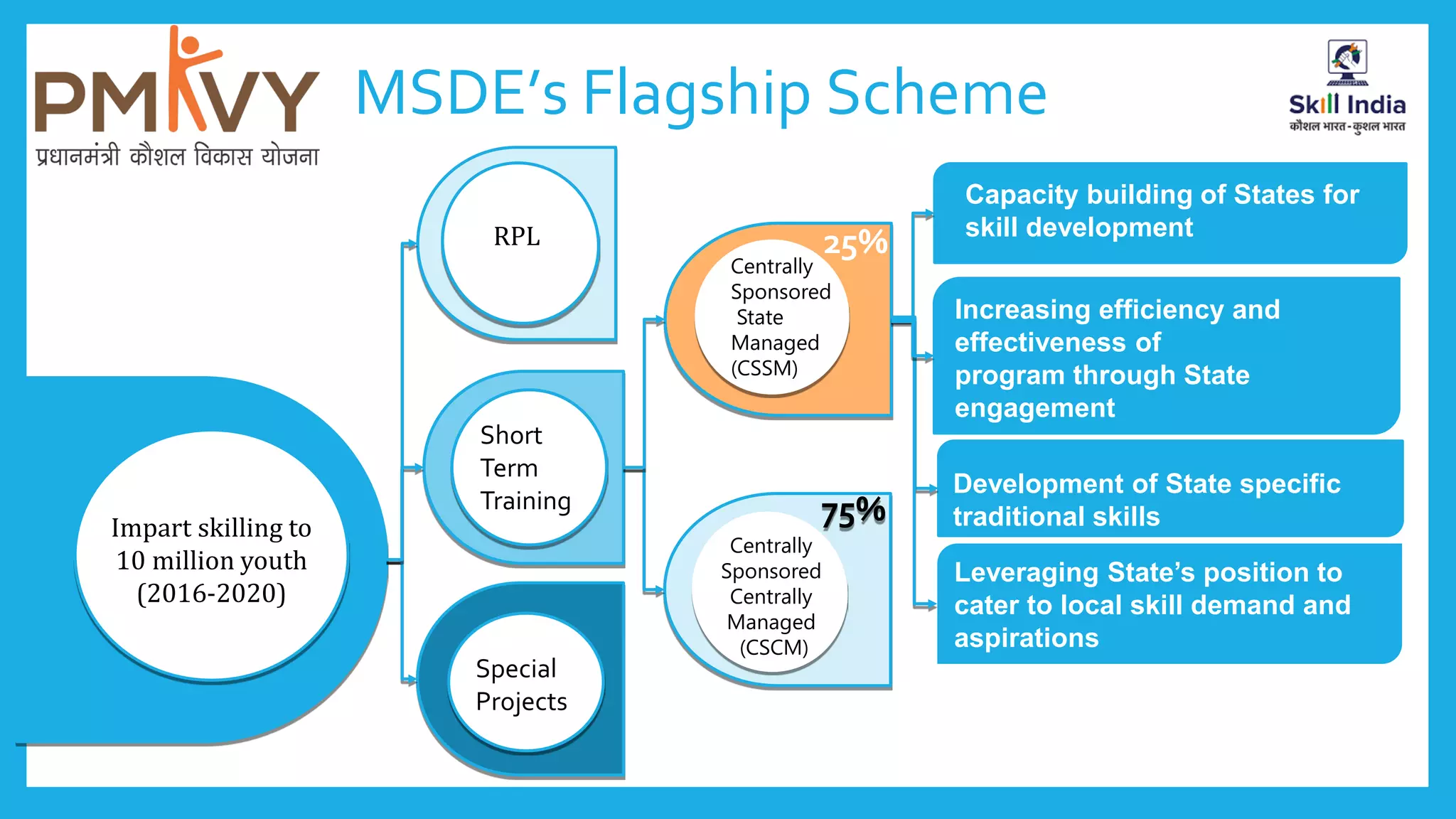
MSDE’s Flagship Scheme
Impart skilling to
10 million youth
(2016-2020)
Short
Term
Training
RPL
Special
Projects
Centrally
Sponsored
Centrally
Managed
(CSCM)
Centrally
Sponsored
State
Managed
(CSSM)
75%
25%
Special
Projects
Leveraging State’s position to
cater to local skill demand and
aspirations
Capacity building of States for
skill development
Increasing efficiency and
effectiveness of
program through State
engagement
Development of State specific
traditional skills
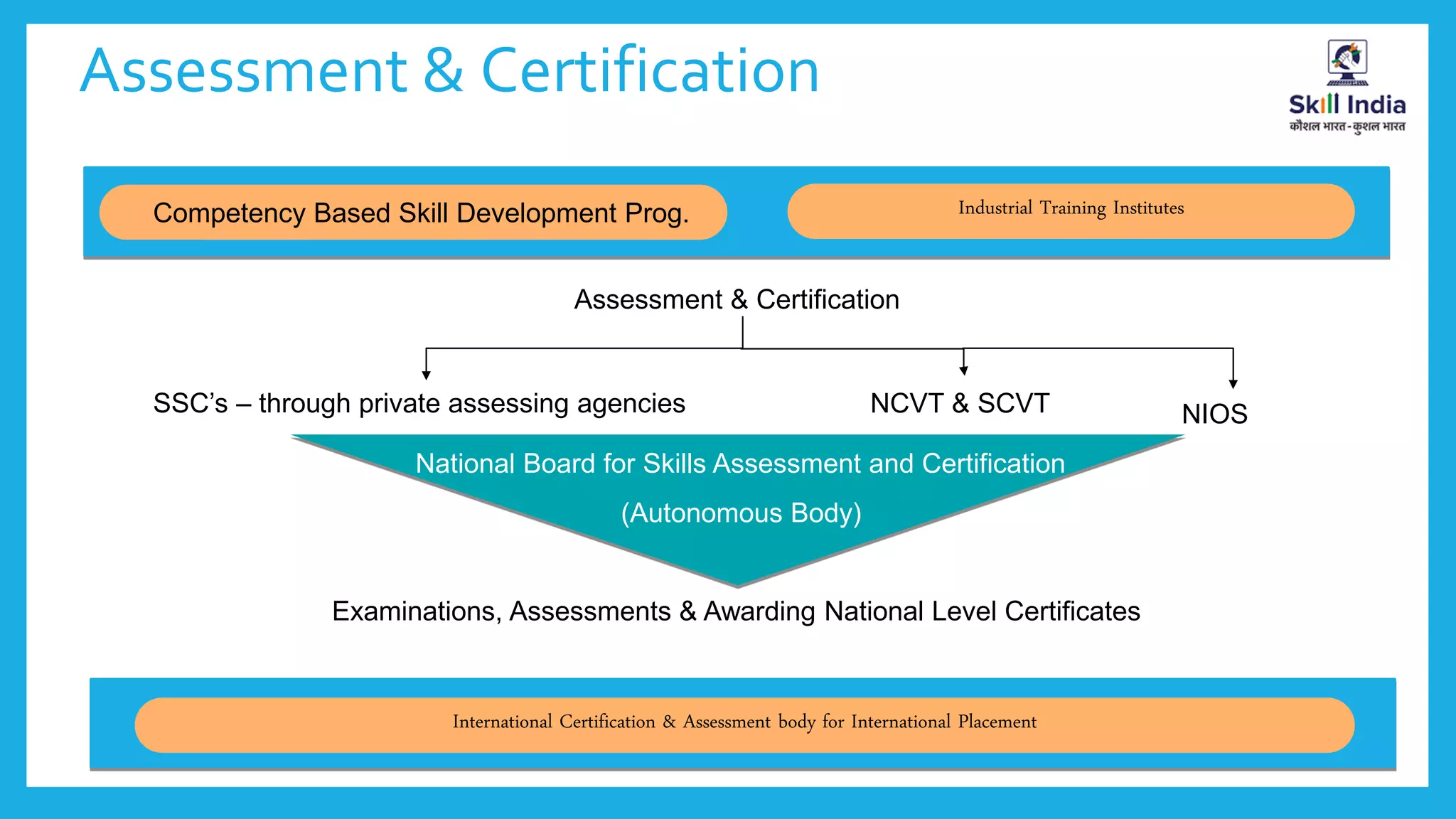
Assessment & Certification
Industrial Training InstitutesCompetency Based Skill Development Prog.
SSC’s – through private assessing agencies
Assessment & Certification
NCVT & SCVT
National Board for Skills Assessment and Certification
Examinations, Assessments & Awarding National Level Certificates
(Autonomous Body)
NIOS
International Certification & Assessment body for International Placement
Job Linkages
Industrial Training InstitutesCompetency Based Skill Development Prog.
Employment
Training Partners through SSCs
- Rozgar Mela/ Employer Portals
ITIs through Training & Placement Cells
and through Apprenticeship
Integration of Apprenticeship in Short Term Skilling
PMKVY – Apprenticeship Hybrid Model
LMIS – Labour Market Information System
Increasing role of states
District/Block level Skill Gap
Monitoring
Traditional
Local Youth Aspiration
Placement opportunity
Capacity building of states skill
development mission
Standardisation across accreditation,
assessment and certification process
Convergence
1
2
3
4
Development of mobility
pathways and LMIS
Monitoring of schemes
implementation
Identification of local youth and
support in placement opportunities
Identification of locally
relevant/traditional job roles
5
6
7
8
Support in organization of
Rozgar and Kaushal Mela
Thank You

SKILL INDIA: MEETING THE CHALLENGES

  • 1.
    SKILL INDIA: MEETINGTHE CHALLENGES Ministry of Skill Development & Entrepreneurship 21.07.2017 A National Perspective
  • 2.
    Why Skill Development? Demographic dividend 0-4 5-9 10-14 15-19 20-24 25-29 30-34 35-39 40-44 45-49 50-54 55-59 60-64 Male Female 5954 6661 Population MN, 2011 6963 6457 5854 5150 4544 4342 3835 3230 2623 1920 1919 Age Group
  • 3.
    The Skills Challenge:Demand Side Incremental human resource requirement between 2013-2022 109.73 million Bulk of current employment being generated in the informal sector; SMEs record a 4X labor intensity as compared to large companies 24 high growth sectors HRRequirement 109.73 million What can be done to promote NANO Business ? Top 10 sectors will account for 80% of this demand
  • 4.
    The Skills Challenge:Supply Side ~104 MN people are expected to join workforce between 2015-2022 ##### ~21 MNTraining capacity (Vocational and Academic)2015-2022 What about 83 MN ? India amongst the countries with the lowest LFPR in developing world 75 81 78 80 66 61 71 81 48 59 64 27 55 45 29 31 61.5 70 71 53.5 60.5 53 50 56 Argentina Brazil China India Portugal South Africa Turkey South Asia Male LFPR Female LFPR LFPR ~104.62 MN Current scenario Lowest female LFPR – India Limited capacity, high gestation period Competency based skilling as per actual Industry requirements
  • 5.
    Systemic Challenges Organizational Quality Policy Vocational traininglacks aspiration and advocacy Lack of synergy between education and skills Limited funding opportunities Non conformity to international standards Acute shortage of training infrastructure Lack of inclusivity and geographical inequity
  • 6.
    How can MSDEaddress these challenges? Should MSDE be an Implementer or Enabler? Role of the State in Skill Development
  • 7.
    Collaboration for Convergence 2.Convergence Convergence StatePrivate Sector SSCs Training Partners Employers / Corporates Central Ministries MSDE State Govts. Regulatory Bodies
  • 8.
    Policy Institution Strengthening – Regulator,. Assessment Board Institutions Restructuring Sector SkillCouncils 2014 Amendments to Apprenticeship Act Enabling Skill Development Effective Competency Based Skill Development Ecosystem Learner Centricity – Quality of Opportunity (Credit Framework), Right Information & Guidance (Mobilization & Counseling), Quality Outcomes (Placements) 1 2 3 4 5 National Skill Development Policy 2015 Funding National Skill Development Fund Implementation Industry National Skill Development Mission & Scheme Convergence Scheme implementation & monitoring, innovation, technology tools 6 State Partnership
  • 9.
    Policy Interventions National Policyfor Skill Development & Entrepreneurship National Skill Development Mission Amendments to Apprenticeship Act 1 2 3 4 Common Norms Policy Interventions in pipeline Skills Acquisition and Knowledge Awareness for Livelihood Promotion (SANKALP)
  • 10.
    5 Pillars ofSkill Development Industry Input Industry Assessment & Certification Standard Quality Capacity Placement Linkages Effective Competency Based Skill Development Ecosystem
  • 11.
    Standards (1/2) Sector SkillsCouncil (SSCs): are industry led bodies which were conceptualized to transform the supply driven system to a demand-responsive VET system National Skills Qualification Framework : Competency-based framework that organises qualifications into 10 Levels Process Professional knowledge Professional Skills Core Skills Responsibility Each Level Learning Outcomes Level 10 Level 1 Level Descriptors 38 SSCs 450 Corporate Representative In Governing Council Analyze Sector Specific Skill Gaps Job Roles National Occupational Standard (NOS): define the measurable performance outcomes required from an individual engaged in a particular job role NOSs corresponding to these Job Roles form - Qualification Pack (QP)
  • 12.
    Standards (2/2) Model CurriculumContent (NSQF Guidelines ) Lab Guidelines (Favorable Trainee Equipment Ratio) Infrastructure Guidelines (Area, Accessibility etc.) Sector Skills Council Total Number of NOS : 5093 Total Number of QP’s : 1930 Inputs Model Curriculum Available For: 413 Common Norms : Set of guidelines for skill development which defines input standards, outcomes and funding norms
  • 13.
    Quality Input Parameters Infra guidelines LabGuidelines Trainers Qualification Assessors Qualification Quality Assurance Smart Portal: For streamlining process of center accreditation Training of Trainers : On Domain Skills & Soft Skills made compulsory Assessor development Prog. : To train & create a pool of assessors
  • 14.
    Training Capacity NSDC fundingPrivate Training Partner Govt. Supported Model Market determined model Aspirational job roles Willingness to Pay NSDC provides loan for creating infrastructure Training Partner Fee Government Supported Model Job roles: low aspiration Inability to pay Government NSDC provides fee sponsorship NSDC provides Loan for Infra Training Partner PMKVY Mobilization Support PMKK as Hybrid Model
  • 15.
    MSDE’s Flagship Scheme Impartskilling to 10 million youth (2016-2020) Short Term Training RPL Special Projects Centrally Sponsored Centrally Managed (CSCM) Centrally Sponsored State Managed (CSSM) 75% 25% Special Projects Leveraging State’s position to cater to local skill demand and aspirations Capacity building of States for skill development Increasing efficiency and effectiveness of program through State engagement Development of State specific traditional skills
  • 16.
    Assessment & Certification IndustrialTraining InstitutesCompetency Based Skill Development Prog. SSC’s – through private assessing agencies Assessment & Certification NCVT & SCVT National Board for Skills Assessment and Certification Examinations, Assessments & Awarding National Level Certificates (Autonomous Body) NIOS International Certification & Assessment body for International Placement
  • 17.
    Job Linkages Industrial TrainingInstitutesCompetency Based Skill Development Prog. Employment Training Partners through SSCs - Rozgar Mela/ Employer Portals ITIs through Training & Placement Cells and through Apprenticeship Integration of Apprenticeship in Short Term Skilling PMKVY – Apprenticeship Hybrid Model LMIS – Labour Market Information System
  • 18.
    Increasing role ofstates District/Block level Skill Gap Monitoring Traditional Local Youth Aspiration Placement opportunity Capacity building of states skill development mission Standardisation across accreditation, assessment and certification process Convergence 1 2 3 4 Development of mobility pathways and LMIS Monitoring of schemes implementation Identification of local youth and support in placement opportunities Identification of locally relevant/traditional job roles 5 6 7 8 Support in organization of Rozgar and Kaushal Mela
  • 19.