4th March 2017
Presented By:
Shahid Rasool, Director, CEMCA, New Delhi
CEMCA and Community Media
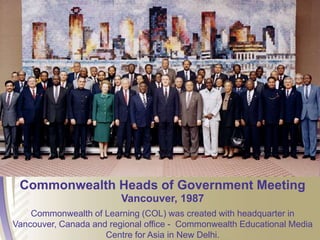
Commonwealth Heads of Government Meeting
Vancouver, 1987
Commonwealth of Learning (COL) was created with headquarter in
Vancouver, Canada and regional office - Commonwealth Educational Media
Centre for Asia in New Delhi.
CEMCA
Educational media centre
for promoting media enabled learning for
sustainable development,
among the Asian Countries, of the
Commonwealth
Corporate Outcome
Deliver quality lifelong learning
opportunities using suitable educational
media
for commonwealth Citizens of Asia,
Particularly marginalised groups & youth
leading to sustainable livelihood
Works in 8 Commonwealth Countries of Asia,
which include Bangladesh, Brunei, India,
Malaysia, Maldives, Pakistan, Singapore
and Sri Lanka.
CEMCA
CEMCA – Focus Area
Open
Educational
Resources
Community
Learning
Programmes
Gender Mainstreaming
Persons with disabilities
ICT &
Technology
Enabled
Learning
Open
Distance
Learning
Skills &
Livelihoods
“Let No
One be
Left
Behind”
Community Media
Community media is any form
of media that is created and
controlled by a community, either
a geographic community or
a community of identity or
interest.
Grassroots media is focused more
specifically on “media making” by and
for the local community that it
serves making the discussion more
narrow and precise.
Community Media
A subset focusing on small scale media projects
which aim to bring different visions and
perspectives to the "codes" that are so easily
embedded in the social psyche.
Community Radio
 Community radio is a radio service offering a
third model of radio broadcasting in addition
to commercial and public broadcasting.
 Community stations serve geographic
communities and communities of interest.
 They broadcast content that is popular and
relevant to a local, specific audience but is
often overlooked by commercial or mass-
media broadcasters.
 Community radio stations are operated, owned,
and influenced by the communities they serve.
 They are generally nonprofit and provide a
mechanism for enabling individuals, groups, and
communities to tell their own stories, to share
experiences and, in a media-rich world, to become
creators and contributors of media.
 In many parts of the world, community radio acts
as a vehicle for the community and voluntary
sector, civil society, agencies, NGOs and citizens
to work in partnership to further community
development aims, in addition to broadcasting.
Community Radio
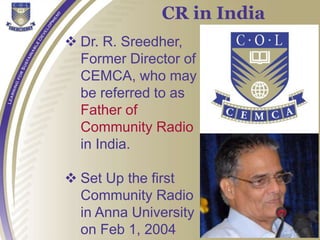
 Dr. R. Sreedher,
Former Director of
CEMCA, who may
be referred to as
Father of
Community Radio
in India.
 Set Up the first
Community Radio
in Anna University
on Feb 1, 2004
CR in India
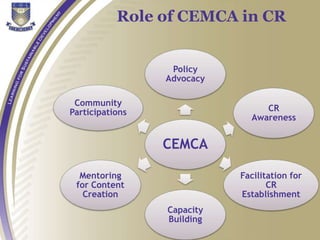
CEMCA
Policy
Advocacy
CR
Awareness
Facilitation for
CR
Establishment
Capacity
Building
Mentoring
for Content
Creation
Community
Participations
Role of CEMCA in CR
 CEMCA brought out two volumes of step-by
–step guidelines and manual to assist
interested organisations to apply for CR
License.
Facilitation for New CR Set
Up
 Community Radio Facilitation Centre (CCFC) was set –up
at CEMCA in July 2011 and a special project team
constituted.
 In Jan 2012, a facilitation unit was created at the MIB
premises that provided technical and administrative
assistance to visitors as well as to MIB CR Cell.
 The project ended in 2013, and CEMCA provided
assistance to 72 new applicants for setting up CR stations.
CR Advocacy & Awards
 CEMCA assisted follow up through various
line ministries to help civil society
organisations to get the various clearances
for setting up new CR Stations.
 CEMCA in collaboration with UNESCO conducts
Community Radio Video Challenge for students to
make them aware about the power of Community
Radios. 4th CRVC scheduled for April 2017.
 CEMCA assisted follow up through various line
ministries to help civil society organisations to get
clearances for setting up new CR Stations.
Policy Advocacy
 CEMCA designed an on-line application
process for MIB which has considerably
simplified and shortened the application
process for CR License.
 CEMCA has catalysed and raised advocacy issues
like improving sustainability of CR stations and in its
consultation held at Baramati in September 2008,
initiated a dialogue with the Directorate of Audio
Visual Publicity (DAVP), the agency responsible for
releasing Government Advertisements and
Sponsored Programmes for all media to consider
putting CRS on their panel.
 In 2011 and 2012, MIB and CEMCA co-hosted
the First and Second CR Sammelan and
Exhibition
 CEMCA instituted Awards to celebrate good functioning
CR stations.
 The 1st national workshop was facilitated by CEMCA in
February 2008 to help MIB understand the extent to which
CRS were catering to the needs of the community and to
provide an opportunity to all the CRS to interact with each
other and share their experiences.
CR Sammelans
 The 2nd National Capacity Building Workshop for Managers
of functional CR stations was held in February 2009 by
CEMCA on behalf of MIB.
 CEMCA has organized 37 consultations at
National, Regional and State level on
behalf of Ministry of Information and
Broadcasting.
CR Awareness Workshop
 CR Awareness workshops aim at making
potential organisation aware about the power of
community radios, urging them to set up CRS. In
these workshops, the participants are provided
knowledge about the process of setting up of a
CR.
 More than 1200 representatives of educational
institutions, civil society organisations, NGOs and
other institutions eligible and desirous of setting up a
CRS have been walked through the entire process.
Science for Women’s Health
& Nutrition by DST
2005: Project
Conceived,
Designed and
Implemented by
Dr. R. Sreedher
at Anna
University for
India’s first CRS
2007: Reviewed by DST
and offered via CEMCA
to all the 13
Community Radio
Stations in the country
2009: Project
extended to
another 15
stations again
through
CEMCA 2011: 9 CR
Stations
participated
through
CEMCA
2012 – 2015:
Project offered by
DST through other
agencies.
In 2016, DST through CEMCA offered the project to 14 CR
Stations, spread across the length and the breadth of the
country
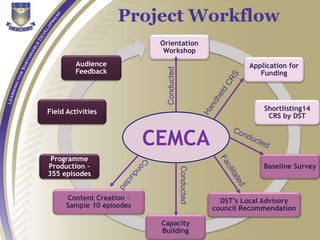
Orientation
Workshop
Application for
Funding
Shortlisting14
CRS by DST
Baseline Survey
DST’s Local Advisory
council Recommendation
Capacity
Building
Content Creation –
Sample 10 episodes
Programme
Production –
355 episodes
Field Activities
Audience
Feedback
Project Workflow
CEMCA
Conducted
Conducted
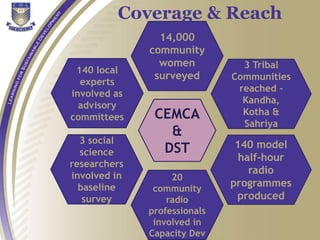
14,000
community
women
surveyed
140 local
experts
involved as
advisory
committees
3 social
science
researchers
involved in
baseline
survey
20
community
radio
professionals
involved in
Capacity Dev
140 model
half-hour
radio
programmes
produced
3 Tribal
Communities
reached –
Kandha,
Kotha &
Sahriya
CEMCA
&
DST
Coverage & Reach
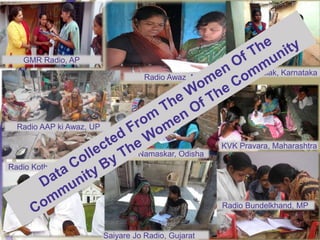
GMR Radio, AP
Radio Awaz, MP
Radio Kothagiri, Tamil Nadu
KVK Pravara, Maharashtra
Radio AAP ki Awaz, UP
Radio Bundelkhand, MP
Radio Namaskar, Odisha
Saiyare Jo Radio, Gujarat
Sarathi Jhalak, Karnataka
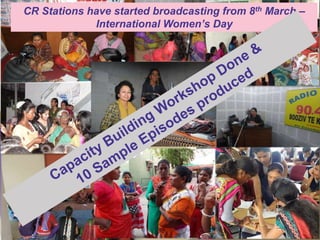
CR Stations have started broadcasting from 8th March –
International Women’s Day
Initiatives 2016-17
 To develop a framework to ensure that
listeners transform to being learners.
 Pre-PCF8 workshop in Kuala Lumpur to formulate
a model to Transition Listener to Learner TL2L
approach to Community Media
http://cemca.org.in/ckfinder/userfiles/files/Report%20on%20
Pre-PCF%208%20Workshop%20L2L.pdf
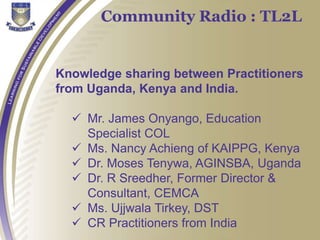
Knowledge sharing between Practitioners
from Uganda, Kenya and India.
 Mr. James Onyango, Education
Specialist COL
 Ms. Nancy Achieng of KAIPPG, Kenya
 Dr. Moses Tenywa, AGINSBA, Uganda
 Dr. R Sreedher, Former Director &
Consultant, CEMCA
 Ms. Ujjwala Tirkey, DST
 CR Practitioners from India
Community Radio : TL2L
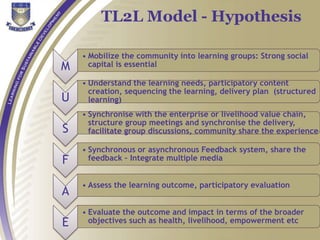
TL2L Model - Hypothesis
M
• Mobilize the community into learning groups: Strong social
capital is essential
U
• Understand the learning needs, participatory content
creation, sequencing the learning, delivery plan (structured
learning)
S
• Synchronise with the enterprise or livelihood value chain,
structure group meetings and synchronise the delivery,
facilitate group discussions, community share the experience
F
• Synchronous or asynchronous Feedback system, share the
feedback – Integrate multiple media
A
• Assess the learning outcome, participatory evaluation
E
• Evaluate the outcome and impact in terms of the broader
objectives such as health, livelihood, empowerment etc
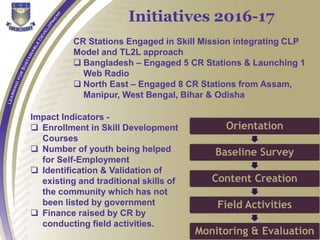
Initiatives 2016-17
Orientation
Baseline Survey
Content Creation
Field Activities
Monitoring & Evaluation
CR Stations Engaged in Skill Mission integrating CLP
Model and TL2L approach
 Bangladesh – Engaged 5 CR Stations & Launching 1
Web Radio
 North East – Engaged 8 CR Stations from Assam,
Manipur, West Bengal, Bihar & Odisha
Impact Indicators -
 Enrollment in Skill Development
Courses
 Number of youth being helped
for Self-Employment
 Identification & Validation of
existing and traditional skills of
the community which has not
been listed by government
 Finance raised by CR by
conducting field activities.
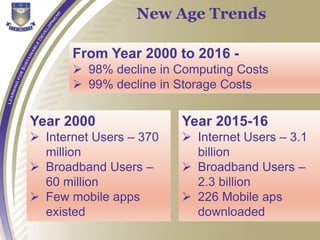
New Age Trends
From Year 2000 to 2016 -
 98% decline in Computing Costs
 99% decline in Storage Costs
Year 2000
 Internet Users – 370
million
 Broadband Users –
60 million
 Few mobile apps
existed
Year 2015-16
 Internet Users – 3.1
billion
 Broadband Users –
2.3 billion
 226 Mobile aps
downloaded
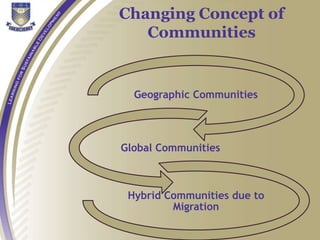
Geographic Communities
Global Communities
Hybrid Communities due to
Migration
Changing Concept of
Communities
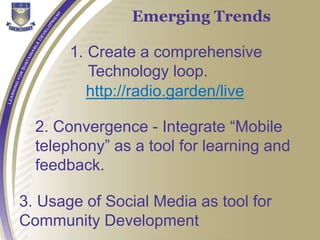
Emerging Trends
1. Create a comprehensive
Technology loop.
http://radio.garden/live
2. Convergence - Integrate “Mobile
telephony” as a tool for learning and
feedback.
3. Usage of Social Media as tool for
Community Development
Thank You
srasool@col.org
www.cemca.org.in

CEMCA Director's presentation on Community Media

  • 1.
    4th March 2017 PresentedBy: Shahid Rasool, Director, CEMCA, New Delhi CEMCA and Community Media
  • 2.
    Commonwealth Heads ofGovernment Meeting Vancouver, 1987 Commonwealth of Learning (COL) was created with headquarter in Vancouver, Canada and regional office - Commonwealth Educational Media Centre for Asia in New Delhi.
  • 3.
    CEMCA Educational media centre forpromoting media enabled learning for sustainable development, among the Asian Countries, of the Commonwealth Corporate Outcome Deliver quality lifelong learning opportunities using suitable educational media for commonwealth Citizens of Asia, Particularly marginalised groups & youth leading to sustainable livelihood
  • 4.
    Works in 8Commonwealth Countries of Asia, which include Bangladesh, Brunei, India, Malaysia, Maldives, Pakistan, Singapore and Sri Lanka. CEMCA
  • 5.
    CEMCA – FocusArea Open Educational Resources Community Learning Programmes Gender Mainstreaming Persons with disabilities ICT & Technology Enabled Learning Open Distance Learning Skills & Livelihoods “Let No One be Left Behind”
  • 6.
    Community Media Community mediais any form of media that is created and controlled by a community, either a geographic community or a community of identity or interest.
  • 7.
    Grassroots media isfocused more specifically on “media making” by and for the local community that it serves making the discussion more narrow and precise. Community Media A subset focusing on small scale media projects which aim to bring different visions and perspectives to the "codes" that are so easily embedded in the social psyche.
  • 8.
    Community Radio  Communityradio is a radio service offering a third model of radio broadcasting in addition to commercial and public broadcasting.  Community stations serve geographic communities and communities of interest.  They broadcast content that is popular and relevant to a local, specific audience but is often overlooked by commercial or mass- media broadcasters.
  • 9.
     Community radiostations are operated, owned, and influenced by the communities they serve.  They are generally nonprofit and provide a mechanism for enabling individuals, groups, and communities to tell their own stories, to share experiences and, in a media-rich world, to become creators and contributors of media.  In many parts of the world, community radio acts as a vehicle for the community and voluntary sector, civil society, agencies, NGOs and citizens to work in partnership to further community development aims, in addition to broadcasting. Community Radio
  • 10.
     Dr. R.Sreedher, Former Director of CEMCA, who may be referred to as Father of Community Radio in India.  Set Up the first Community Radio in Anna University on Feb 1, 2004 CR in India
  • 11.
  • 12.
     CEMCA broughtout two volumes of step-by –step guidelines and manual to assist interested organisations to apply for CR License. Facilitation for New CR Set Up  Community Radio Facilitation Centre (CCFC) was set –up at CEMCA in July 2011 and a special project team constituted.  In Jan 2012, a facilitation unit was created at the MIB premises that provided technical and administrative assistance to visitors as well as to MIB CR Cell.  The project ended in 2013, and CEMCA provided assistance to 72 new applicants for setting up CR stations.
  • 13.
    CR Advocacy &Awards  CEMCA assisted follow up through various line ministries to help civil society organisations to get the various clearances for setting up new CR Stations.  CEMCA in collaboration with UNESCO conducts Community Radio Video Challenge for students to make them aware about the power of Community Radios. 4th CRVC scheduled for April 2017.  CEMCA assisted follow up through various line ministries to help civil society organisations to get clearances for setting up new CR Stations.
  • 14.
    Policy Advocacy  CEMCAdesigned an on-line application process for MIB which has considerably simplified and shortened the application process for CR License.  CEMCA has catalysed and raised advocacy issues like improving sustainability of CR stations and in its consultation held at Baramati in September 2008, initiated a dialogue with the Directorate of Audio Visual Publicity (DAVP), the agency responsible for releasing Government Advertisements and Sponsored Programmes for all media to consider putting CRS on their panel.
  • 15.
     In 2011and 2012, MIB and CEMCA co-hosted the First and Second CR Sammelan and Exhibition  CEMCA instituted Awards to celebrate good functioning CR stations.  The 1st national workshop was facilitated by CEMCA in February 2008 to help MIB understand the extent to which CRS were catering to the needs of the community and to provide an opportunity to all the CRS to interact with each other and share their experiences. CR Sammelans  The 2nd National Capacity Building Workshop for Managers of functional CR stations was held in February 2009 by CEMCA on behalf of MIB.
  • 16.
     CEMCA hasorganized 37 consultations at National, Regional and State level on behalf of Ministry of Information and Broadcasting. CR Awareness Workshop  CR Awareness workshops aim at making potential organisation aware about the power of community radios, urging them to set up CRS. In these workshops, the participants are provided knowledge about the process of setting up of a CR.  More than 1200 representatives of educational institutions, civil society organisations, NGOs and other institutions eligible and desirous of setting up a CRS have been walked through the entire process.
  • 17.
    Science for Women’sHealth & Nutrition by DST 2005: Project Conceived, Designed and Implemented by Dr. R. Sreedher at Anna University for India’s first CRS 2007: Reviewed by DST and offered via CEMCA to all the 13 Community Radio Stations in the country 2009: Project extended to another 15 stations again through CEMCA 2011: 9 CR Stations participated through CEMCA 2012 – 2015: Project offered by DST through other agencies. In 2016, DST through CEMCA offered the project to 14 CR Stations, spread across the length and the breadth of the country
  • 18.
    Orientation Workshop Application for Funding Shortlisting14 CRS byDST Baseline Survey DST’s Local Advisory council Recommendation Capacity Building Content Creation – Sample 10 episodes Programme Production – 355 episodes Field Activities Audience Feedback Project Workflow CEMCA Conducted Conducted
  • 19.
    14,000 community women surveyed 140 local experts involved as advisory committees 3social science researchers involved in baseline survey 20 community radio professionals involved in Capacity Dev 140 model half-hour radio programmes produced 3 Tribal Communities reached – Kandha, Kotha & Sahriya CEMCA & DST Coverage & Reach
  • 21.
    GMR Radio, AP RadioAwaz, MP Radio Kothagiri, Tamil Nadu KVK Pravara, Maharashtra Radio AAP ki Awaz, UP Radio Bundelkhand, MP Radio Namaskar, Odisha Saiyare Jo Radio, Gujarat Sarathi Jhalak, Karnataka
  • 24.
    CR Stations havestarted broadcasting from 8th March – International Women’s Day
  • 25.
    Initiatives 2016-17  Todevelop a framework to ensure that listeners transform to being learners.  Pre-PCF8 workshop in Kuala Lumpur to formulate a model to Transition Listener to Learner TL2L approach to Community Media http://cemca.org.in/ckfinder/userfiles/files/Report%20on%20 Pre-PCF%208%20Workshop%20L2L.pdf
  • 26.
    Knowledge sharing betweenPractitioners from Uganda, Kenya and India.  Mr. James Onyango, Education Specialist COL  Ms. Nancy Achieng of KAIPPG, Kenya  Dr. Moses Tenywa, AGINSBA, Uganda  Dr. R Sreedher, Former Director & Consultant, CEMCA  Ms. Ujjwala Tirkey, DST  CR Practitioners from India Community Radio : TL2L
  • 27.
    TL2L Model -Hypothesis M • Mobilize the community into learning groups: Strong social capital is essential U • Understand the learning needs, participatory content creation, sequencing the learning, delivery plan (structured learning) S • Synchronise with the enterprise or livelihood value chain, structure group meetings and synchronise the delivery, facilitate group discussions, community share the experience F • Synchronous or asynchronous Feedback system, share the feedback – Integrate multiple media A • Assess the learning outcome, participatory evaluation E • Evaluate the outcome and impact in terms of the broader objectives such as health, livelihood, empowerment etc
  • 28.
    Initiatives 2016-17 Orientation Baseline Survey ContentCreation Field Activities Monitoring & Evaluation CR Stations Engaged in Skill Mission integrating CLP Model and TL2L approach  Bangladesh – Engaged 5 CR Stations & Launching 1 Web Radio  North East – Engaged 8 CR Stations from Assam, Manipur, West Bengal, Bihar & Odisha Impact Indicators -  Enrollment in Skill Development Courses  Number of youth being helped for Self-Employment  Identification & Validation of existing and traditional skills of the community which has not been listed by government  Finance raised by CR by conducting field activities.
  • 29.
    New Age Trends FromYear 2000 to 2016 -  98% decline in Computing Costs  99% decline in Storage Costs Year 2000  Internet Users – 370 million  Broadband Users – 60 million  Few mobile apps existed Year 2015-16  Internet Users – 3.1 billion  Broadband Users – 2.3 billion  226 Mobile aps downloaded
  • 30.
    Geographic Communities Global Communities HybridCommunities due to Migration Changing Concept of Communities
  • 31.
    Emerging Trends 1. Createa comprehensive Technology loop. http://radio.garden/live 2. Convergence - Integrate “Mobile telephony” as a tool for learning and feedback. 3. Usage of Social Media as tool for Community Development
  • 32.