Antimicrobial resistance and
the global livestock sector
Visit by Sir Mark Walport to ILRI, 15 July 2015
Timothy Robinson, Delia Grace, Eric Fèvre
Antimicrobial resistance
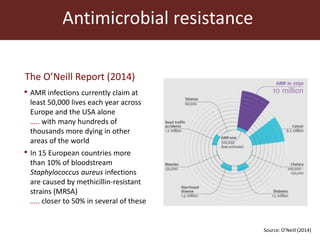
• AMR infections currently claim at
least 50,000 lives each year across
Europe and the USA alone
….. with many hundreds of
thousands more dying in other
areas of the world
• In 15 European countries more
than 10% of bloodstream
Staphylococcus aureus infections
are caused by methicillin-resistant
strains (MRSA)
….. closer to 50% in several of these
Source: O’Neill (2014)
The O’Neill Report (2014)
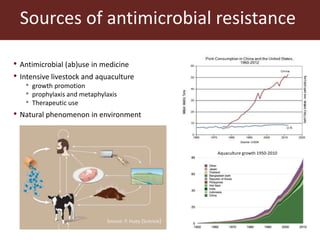
Sources of antimicrobial resistance
Source: P. Huey (Science)
• Antimicrobial (ab)use in medicine
• Intensive livestock and aquaculture
• growth promotion
• prophylaxis and metaphylaxis
• Therapeutic use
• Natural phenomenon in environment
Aquaculture growth 1950-2010
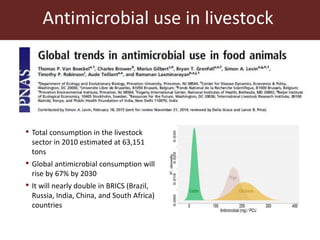
Antimicrobial use in livestock
• Total consumption in the livestock
sector in 2010 estimated at 63,151
tons
• Global antimicrobial consumption will
rise by 67% by 2030
• It will nearly double in BRICS (Brazil,
Russia, India, China, and South Africa)
countries
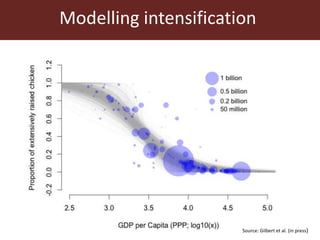
Source: Gilbert et al. (in press)
Modelling intensification
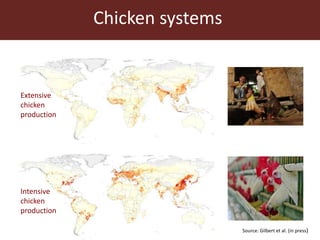
Chicken systems
Extensive
chicken
production
Intensive
chicken
production
Source: Gilbert et al. (in press)
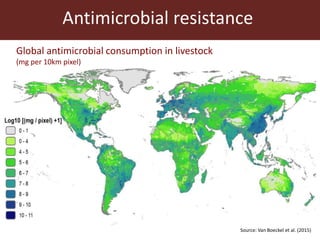
Antimicrobial resistance
Source: Van Boeckel et al. (2015)
Global antimicrobial consumption in livestock
(mg per 10km pixel)
Source: Gilbert et al. (in press)
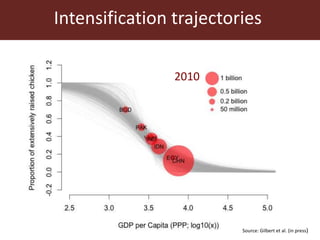
2010
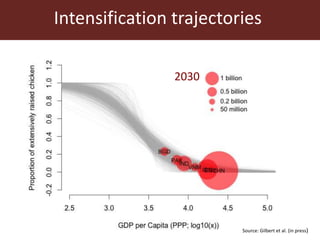
Intensification trajectories
Source: Gilbert et al. (in press)
2030
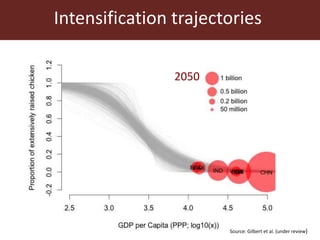
Intensification trajectories
Source: Gilbert et al. (under review)
2050
Intensification trajectories
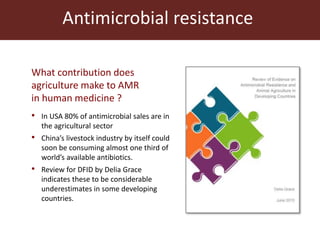
Antimicrobial resistance
• In USA 80% of antimicrobial sales are in
the agricultural sector
• China’s livestock industry by itself could
soon be consuming almost one third of
world’s available antibiotics.
• Review for DFID by Delia Grace
indicates these to be considerable
underestimates in some developing
countries.
What contribution does
agriculture make to AMR
in human medicine ?
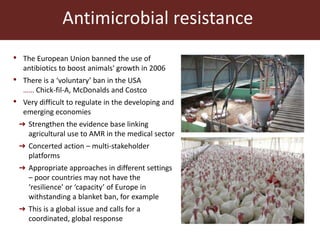
Antimicrobial resistance
• The European Union banned the use of
antibiotics to boost animals' growth in 2006
• There is a ‘voluntary’ ban in the USA
…… Chick-fil-A, McDonalds and Costco
• Very difficult to regulate in the developing and
emerging economies
➜ Strengthen the evidence base linking
agricultural use to AMR in the medical sector
➜ Concerted action – multi-stakeholder
platforms
➜ Appropriate approaches in different settings
– poor countries may not have the
‘resilience’ or ‘capacity’ of Europe in
withstanding a blanket ban, for example
➜ This is a global issue and calls for a
coordinated, global response
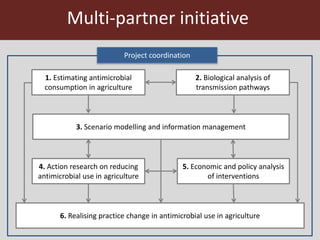
Project coordination
1. Estimating antimicrobial
consumption in agriculture
2. Biological analysis of
transmission pathways
4. Action research on reducing
antimicrobial use in agriculture
5. Economic and policy analysis
of interventions
3. Scenario modelling and information management
6. Realising practice change in antimicrobial use in agriculture
Multi-partner initiative
The presentation has a Creative Commons licence. You are free to re-use or distribute this work, provided credit is given to ILRI.
better lives through livestock
ilri.org

Antimicrobial resistance and the global livestock sector

  • 1.
    Antimicrobial resistance and theglobal livestock sector Visit by Sir Mark Walport to ILRI, 15 July 2015 Timothy Robinson, Delia Grace, Eric Fèvre
  • 2.
    Antimicrobial resistance • AMRinfections currently claim at least 50,000 lives each year across Europe and the USA alone ….. with many hundreds of thousands more dying in other areas of the world • In 15 European countries more than 10% of bloodstream Staphylococcus aureus infections are caused by methicillin-resistant strains (MRSA) ….. closer to 50% in several of these Source: O’Neill (2014) The O’Neill Report (2014)
  • 3.
    Sources of antimicrobialresistance Source: P. Huey (Science) • Antimicrobial (ab)use in medicine • Intensive livestock and aquaculture • growth promotion • prophylaxis and metaphylaxis • Therapeutic use • Natural phenomenon in environment Aquaculture growth 1950-2010
  • 4.
    Antimicrobial use inlivestock • Total consumption in the livestock sector in 2010 estimated at 63,151 tons • Global antimicrobial consumption will rise by 67% by 2030 • It will nearly double in BRICS (Brazil, Russia, India, China, and South Africa) countries
  • 5.
    Source: Gilbert etal. (in press) Modelling intensification
  • 6.
  • 7.
    Antimicrobial resistance Source: VanBoeckel et al. (2015) Global antimicrobial consumption in livestock (mg per 10km pixel)
  • 8.
    Source: Gilbert etal. (in press) 2010 Intensification trajectories
  • 9.
    Source: Gilbert etal. (in press) 2030 Intensification trajectories
  • 10.
    Source: Gilbert etal. (under review) 2050 Intensification trajectories
  • 11.
    Antimicrobial resistance • InUSA 80% of antimicrobial sales are in the agricultural sector • China’s livestock industry by itself could soon be consuming almost one third of world’s available antibiotics. • Review for DFID by Delia Grace indicates these to be considerable underestimates in some developing countries. What contribution does agriculture make to AMR in human medicine ?
  • 12.
    Antimicrobial resistance • TheEuropean Union banned the use of antibiotics to boost animals' growth in 2006 • There is a ‘voluntary’ ban in the USA …… Chick-fil-A, McDonalds and Costco • Very difficult to regulate in the developing and emerging economies ➜ Strengthen the evidence base linking agricultural use to AMR in the medical sector ➜ Concerted action – multi-stakeholder platforms ➜ Appropriate approaches in different settings – poor countries may not have the ‘resilience’ or ‘capacity’ of Europe in withstanding a blanket ban, for example ➜ This is a global issue and calls for a coordinated, global response
  • 13.
    Project coordination 1. Estimatingantimicrobial consumption in agriculture 2. Biological analysis of transmission pathways 4. Action research on reducing antimicrobial use in agriculture 5. Economic and policy analysis of interventions 3. Scenario modelling and information management 6. Realising practice change in antimicrobial use in agriculture Multi-partner initiative
  • 14.
    The presentation hasa Creative Commons licence. You are free to re-use or distribute this work, provided credit is given to ILRI. better lives through livestock ilri.org