• Vision for livestock genetics in Africa
• Steve Kemp, ILRI
Animal Genetic Research for Africa (Biosciences for Farming in
Africa), Nairobi, 10-11 September 2015
Genetic selection, interacting with
environment, drives
‘improvement’
-1000
0
1000
2000
3000
4000
5000
6000
7000
1950 1960 1970 1980 1990 2000 2010
Year
Changeinmilkyield(kg)
(Source:
http://aipl.arsusda.gov/eval/summary/trend.cfm)
Changes in milk yields of US Holstein cows
Mean phenotype (P), breeding value (A) and environmental effects (E = A - P).
Results relative to 1957 base (mean yield 5859kg).
A
P
E
In the industrial world
genetics has driven
dramatic improvements in
productivity
• Homogeneous
environments (systems,
markets, health,
regulations, policies…….)
• Homogeneous genetics (a
handful of well defined
breeds)
• Superb data recording
driving selection schemes
Achieving genetic gain in developing countries – the
same biological rules but different environments
We must take account of the
realities of small-scale
livestock producers.
Diversity of:
• Environment
• Climate
• Feeds available
• Endemic diseases
• Local market context
• Infrastructure
• Institutions
Achieving genetic gain in developing countries – the
same biological rules but different environments
We must take account of the
realities of small-scale
livestock producers.
Diversity of:
• Environment
• Climate
• Feeds available
• Endemic diseases
• Local market context
• Infrastructure
• Institutions
No data systems to
inform selection.
No infrastructure to
manage selection.
Genotype data is cheap and easy to obtain.
Phenotype data remains a problem.
Can we skip a generation of
technology?
• Fast, light, cheap
performance data
harvesting.
• Cheap sensors, mobile
platforms, crowd sensing…..
• Simultaneously providing
management information to
the farmer and
performance data to the
breeder.
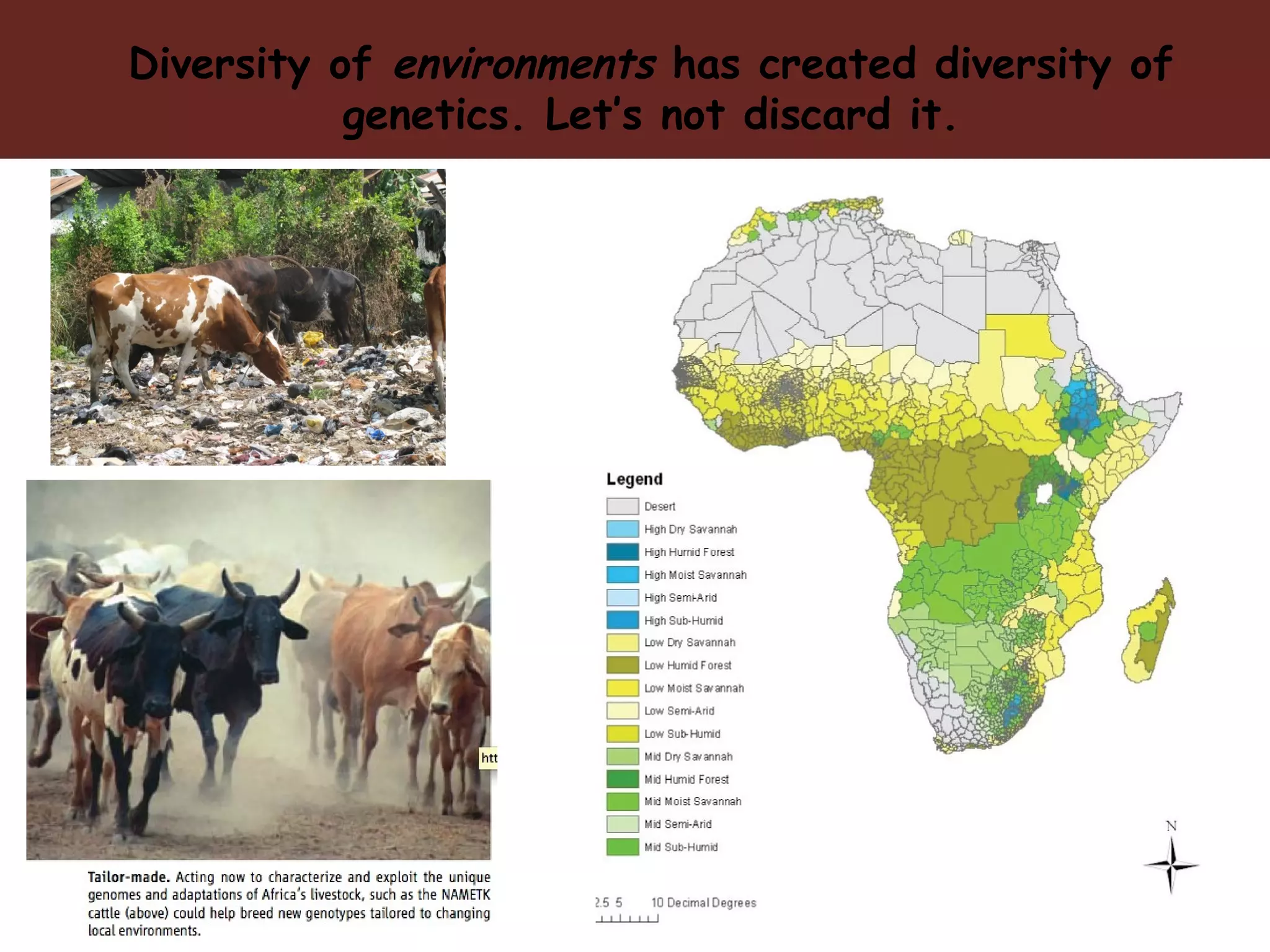
Diversity of environments has created diversity of
genetics. Let’s not discard it.
African Trypanosomiasis
• Caused by extracellular protozoan parasites –
Trypanosoma
• Transmitted between mammals by Tsetse
flies (Glossina sp.)
• Prevalent in 36 countries of sub-Sahara Africa.
In cattle
• A chronic debilitating and fatal disease.
• A major constraint on livestock and
agricultural production in Africa.
• Costs US$ 1 billion annually.
In human (Human Sleeping Sickness)
• Fatal
• 60,000 people die every year
• Both wild and domestic animals are the major
reservoir of the parasites for human infection.
African Trypanosomiasis
Control and Treatment options for African Trypanosomiasis
Vector Control (Tsetse Fly)
• Using toxic insecticide
• Not sustainable
• Negative impacts on environment
Vaccine
• Tryps periodically change the major surface antigen – variant
surface glycoprotein (VSG) and evade the host immune system.
• More than 2 decades, there is no effective vaccine developed.
Drug
• Drug toxicity and resistance
• Expensive
New tools allow us to look in new places for
sources of variation – including wildlife
Comparative gene network
and sequence analysis allows
to ask new kinds of questions
about genomes – eg “what is
different about this (group of)
species compared to all other
mammals”
“traditional” linkage mapping requires crosses – so initial discovery is
limited to variants within a species
Cow NDama KFITRRPSLKTLQEKGLIKDQIFGSPLHTLCEREKSTVPRFVKQCIEAVEK
Cow Boran KFITRRPSLKTLQEKGLIKDQIFGSHLHTLCEREKSTVPRFVKQCIEAVEK
Human KFISRRPSLKTLQEKGLIKDQIFGSHLHTVCEREHSTVPWFVKQCIEAVEK
Pig KFITRRPSLKTLQEKGLIKDQIFGSHLHTVCERENSTVPRFVKQCIEAVEK
Chicken KFISRRPSLKTLQEKGLIKDQIFGSHLHLVCEHENSTVPQFVRQCIKAVER
Salmon KFISRRPSMKTLQEKGIIKDRVFGCHLLALCEREGTTVPKFVRQCVEAVEK
Time for a new search for variation underlying
tropical adaptation and productivity
Identify and make use of the
genetics underlying natural
variation.
There has been no systematic
search for the genomic basis of
adaptation. Because until now
we have had no validation
tools and no delivery tools.
New Genome Editing tools
change the landscape.
Identify and deliver variants associated with adaptation
GenotypingPhenotyping
Adapted &
productive
livestock
Genome
editing
Targeting
Data systems
Delivery
systems
TLF
ApoL-I
• Apolipoprotein
• Trypanolytic component
Hpr
• Haptoglobin-related
protein
• Facilitates the uptake of TLF
by trypanosomes via
haptoglobin-hemoglobin
receptor.
ApoL-I released
Activated in acidic
lysosome
Form membrane
pores, resulting in
ion disregulation
and osmotic
imbalance
Trypanosomes lysis
Endocytosed into
lysosome by
Trypanosomes
ApoA-I
• Apolipoprotein
• Found in all HDL subclasses
Killing of Tryps by Trypanosome Lytic Factor (TLF)
Flagellar pocket of Tryp
Complete protection from Trypanosomes by baboon
ApoL-I in transiently transgenic mice
0 20 40 60 80 100 120 140
0
20
40
60
80
100
Vector (N=6)
apoL-I + Hpr (N=5)
apoL-I (N=5)
*
*
Days post infection
• P = < 0.01
• Vector vs. treatment
Thomson et al PNAS 2009 106:19509-19514
Project Strategy
Genomic locus of
Baboon apoL-I gene
Vector construction
Validate the construct in
transgenic mouse
Bovine embryonic fibroblasts
(BEF) primary culture
Transfection & screening
apoL-I Transgenic BEFs
Nuclear Transfer
Transgenic calves
Phenotyping
Trypanosome resistant
transgenic Boran bull
ILRI
ILRI
Kenya
Boran
Roslin
Institute
New York
University
Michigan
State
University
Tumaini
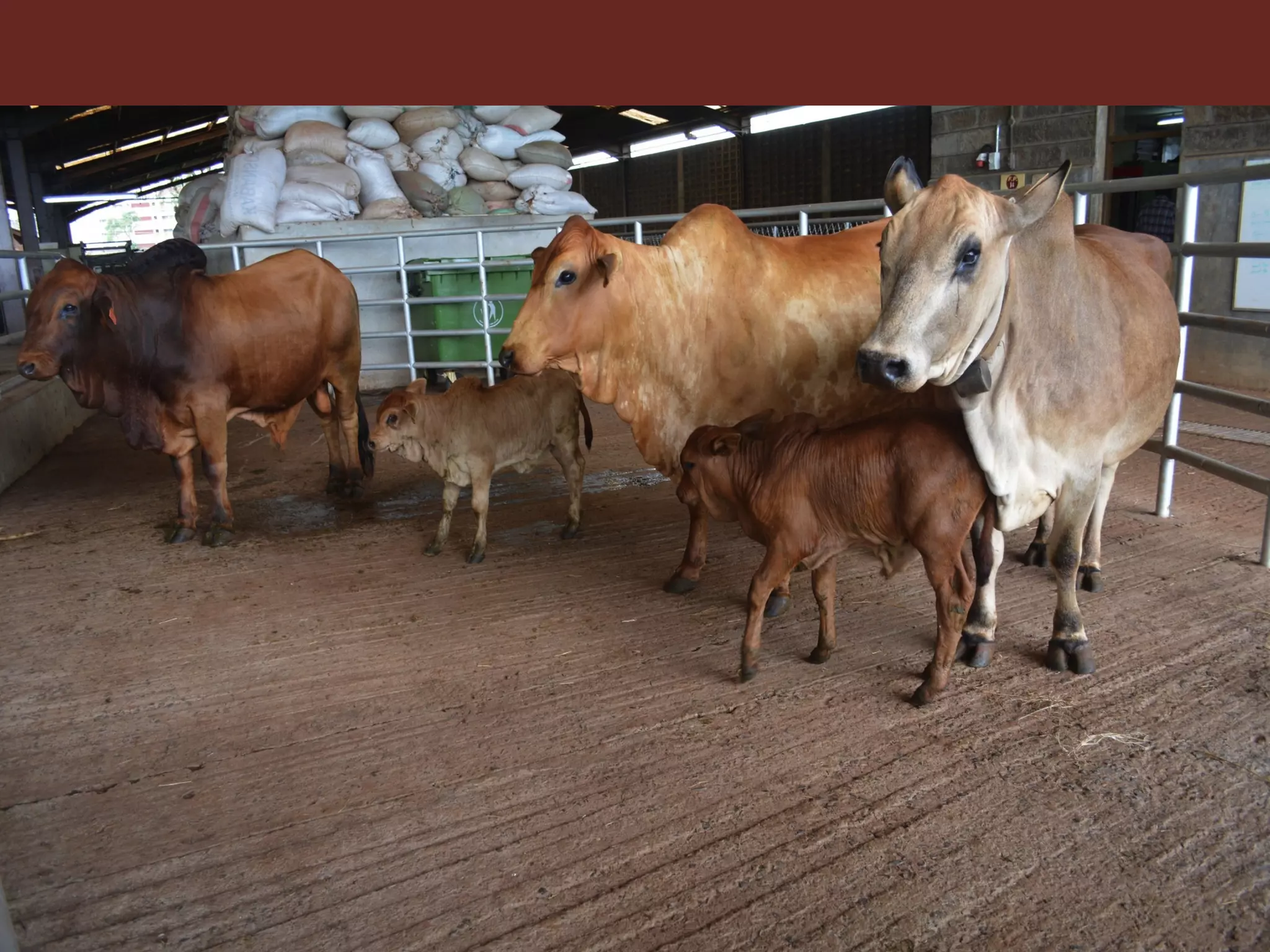
A cloned Kenya Boran calf
made by SCNT from a Boran
embryo fibroblast cell line
20
The presentation has a Creative Commons licence. You are free to re-use or distribute this work, provided credit is given to ILRI.
better lives through livestock
ilri.org
http://vimeo.com/74942619 11 minute version
Video ‘Developing disease-resistant cattle for Africa’
http://vimeo.com/74940697 3 minute version

Vision for livestock genetics in Africa

  • 1.
    • Vision forlivestock genetics in Africa • Steve Kemp, ILRI Animal Genetic Research for Africa (Biosciences for Farming in Africa), Nairobi, 10-11 September 2015
  • 2.
    Genetic selection, interactingwith environment, drives ‘improvement’ -1000 0 1000 2000 3000 4000 5000 6000 7000 1950 1960 1970 1980 1990 2000 2010 Year Changeinmilkyield(kg) (Source: http://aipl.arsusda.gov/eval/summary/trend.cfm) Changes in milk yields of US Holstein cows Mean phenotype (P), breeding value (A) and environmental effects (E = A - P). Results relative to 1957 base (mean yield 5859kg). A P E In the industrial world genetics has driven dramatic improvements in productivity • Homogeneous environments (systems, markets, health, regulations, policies…….) • Homogeneous genetics (a handful of well defined breeds) • Superb data recording driving selection schemes
  • 3.
    Achieving genetic gainin developing countries – the same biological rules but different environments We must take account of the realities of small-scale livestock producers. Diversity of: • Environment • Climate • Feeds available • Endemic diseases • Local market context • Infrastructure • Institutions
  • 4.
    Achieving genetic gainin developing countries – the same biological rules but different environments We must take account of the realities of small-scale livestock producers. Diversity of: • Environment • Climate • Feeds available • Endemic diseases • Local market context • Infrastructure • Institutions No data systems to inform selection. No infrastructure to manage selection.
  • 5.
    Genotype data ischeap and easy to obtain. Phenotype data remains a problem. Can we skip a generation of technology? • Fast, light, cheap performance data harvesting. • Cheap sensors, mobile platforms, crowd sensing….. • Simultaneously providing management information to the farmer and performance data to the breeder.
  • 6.
    Diversity of environmentshas created diversity of genetics. Let’s not discard it.
  • 7.
    African Trypanosomiasis • Causedby extracellular protozoan parasites – Trypanosoma • Transmitted between mammals by Tsetse flies (Glossina sp.) • Prevalent in 36 countries of sub-Sahara Africa. In cattle • A chronic debilitating and fatal disease. • A major constraint on livestock and agricultural production in Africa. • Costs US$ 1 billion annually. In human (Human Sleeping Sickness) • Fatal • 60,000 people die every year • Both wild and domestic animals are the major reservoir of the parasites for human infection. African Trypanosomiasis
  • 8.
    Control and Treatmentoptions for African Trypanosomiasis Vector Control (Tsetse Fly) • Using toxic insecticide • Not sustainable • Negative impacts on environment Vaccine • Tryps periodically change the major surface antigen – variant surface glycoprotein (VSG) and evade the host immune system. • More than 2 decades, there is no effective vaccine developed. Drug • Drug toxicity and resistance • Expensive
  • 9.
    New tools allowus to look in new places for sources of variation – including wildlife Comparative gene network and sequence analysis allows to ask new kinds of questions about genomes – eg “what is different about this (group of) species compared to all other mammals” “traditional” linkage mapping requires crosses – so initial discovery is limited to variants within a species Cow NDama KFITRRPSLKTLQEKGLIKDQIFGSPLHTLCEREKSTVPRFVKQCIEAVEK Cow Boran KFITRRPSLKTLQEKGLIKDQIFGSHLHTLCEREKSTVPRFVKQCIEAVEK Human KFISRRPSLKTLQEKGLIKDQIFGSHLHTVCEREHSTVPWFVKQCIEAVEK Pig KFITRRPSLKTLQEKGLIKDQIFGSHLHTVCERENSTVPRFVKQCIEAVEK Chicken KFISRRPSLKTLQEKGLIKDQIFGSHLHLVCEHENSTVPQFVRQCIKAVER Salmon KFISRRPSMKTLQEKGIIKDRVFGCHLLALCEREGTTVPKFVRQCVEAVEK
  • 10.
    Time for anew search for variation underlying tropical adaptation and productivity Identify and make use of the genetics underlying natural variation. There has been no systematic search for the genomic basis of adaptation. Because until now we have had no validation tools and no delivery tools. New Genome Editing tools change the landscape.
  • 11.
    Identify and delivervariants associated with adaptation GenotypingPhenotyping Adapted & productive livestock Genome editing Targeting Data systems Delivery systems
  • 12.
    TLF ApoL-I • Apolipoprotein • Trypanolyticcomponent Hpr • Haptoglobin-related protein • Facilitates the uptake of TLF by trypanosomes via haptoglobin-hemoglobin receptor. ApoL-I released Activated in acidic lysosome Form membrane pores, resulting in ion disregulation and osmotic imbalance Trypanosomes lysis Endocytosed into lysosome by Trypanosomes ApoA-I • Apolipoprotein • Found in all HDL subclasses Killing of Tryps by Trypanosome Lytic Factor (TLF) Flagellar pocket of Tryp
  • 13.
    Complete protection fromTrypanosomes by baboon ApoL-I in transiently transgenic mice 0 20 40 60 80 100 120 140 0 20 40 60 80 100 Vector (N=6) apoL-I + Hpr (N=5) apoL-I (N=5) * * Days post infection • P = < 0.01 • Vector vs. treatment Thomson et al PNAS 2009 106:19509-19514
  • 14.
    Project Strategy Genomic locusof Baboon apoL-I gene Vector construction Validate the construct in transgenic mouse Bovine embryonic fibroblasts (BEF) primary culture Transfection & screening apoL-I Transgenic BEFs Nuclear Transfer Transgenic calves Phenotyping Trypanosome resistant transgenic Boran bull ILRI ILRI Kenya Boran Roslin Institute New York University Michigan State University
  • 15.
    Tumaini A cloned KenyaBoran calf made by SCNT from a Boran embryo fibroblast cell line
  • 16.
  • 17.
    The presentation hasa Creative Commons licence. You are free to re-use or distribute this work, provided credit is given to ILRI. better lives through livestock ilri.org http://vimeo.com/74942619 11 minute version Video ‘Developing disease-resistant cattle for Africa’ http://vimeo.com/74940697 3 minute version

Editor's Notes

  • #11 Overlay diversity of disease, culture, market access, market demands, policy……..
  • #12 Trypanosomes live and multiply extracellularly in blood and tissue fluids Distribution corresponds to the distribution of Tsetse flies
  • #13 Antigenic variation is transcriptional switching from one VSG gene to another.
  • #14 ‘old fashioned’ genome mapping identified variants – slow and costly. But nowhere to go with it New big data approaches allow us to look in new ways. And now we have genome editing to validate and deliver. TIME FOR A NEW ROUND OF FUNCTIONAL GENOMICS TO UNDERSTAND ADAPTATION