Global food safety
Delia Grace
Professor, Food Safety Systems, Natural Resources Institute, Chatham, UK
Scientist, International Livestock Research Institute, Nairobi, Kenya
Food safety for low- and middle-income countries eCourse launch
20 October 2021
2
3
Overview
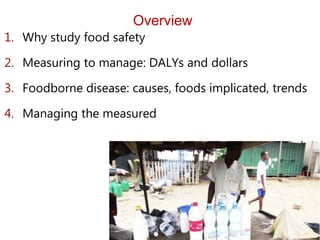
1. Why study food safety
2. Measuring to manage: DALYs and dollars
3. Foodborne disease: causes, foods implicated, trends
4. Managing the measured
5
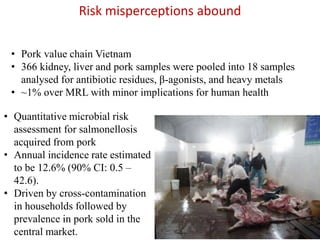
Risk misperceptions abound
• Quantitative microbial risk
assessment for salmonellosis
acquired from pork
• Annual incidence rate estimated
to be 12.6% (90% CI: 0.5 –
42.6).
• Driven by cross-contamination
in households followed by
prevalence in pork sold in the
central market.
• Pork value chain Vietnam
• 366 kidney, liver and pork samples were pooled into 18 samples
analysed for antibiotic residues, β-agonists, and heavy metals
• ~1% over MRL with minor implications for human health
6
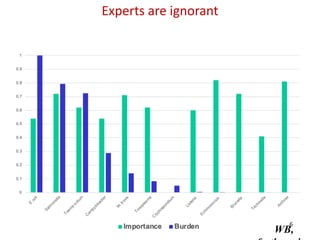
Experts are ignorant
WB,
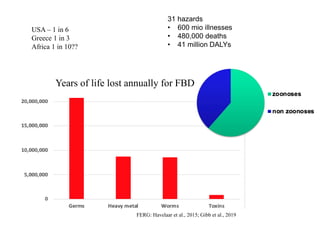
Years of life lost annually for FBD
FERG: Havelaar et al., 2015; Gibb et al., 2019
Health impact of FBD comparable to
that of malaria, HIV/AIDs or TB
31 hazards
• 600 mio illnesses
• 480,000 deaths
• 41 million DALYs
USA – 1 in 6
Greece 1 in 3
Africa 1 in 10??
Food safety & nutrition
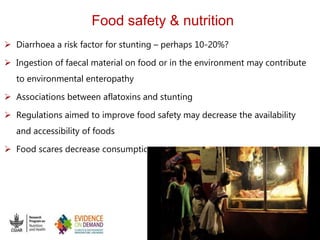
 Diarrhoea a risk factor for stunting – perhaps 10-20%?
 Ingestion of faecal material on food or in the environment may contribute
to environmental enteropathy
 Associations between aflatoxins and stunting
 Regulations aimed to improve food safety may decrease the availability
and accessibility of foods
 Food scares decrease consumption
Food safety & market access
 Food safety standards often exclude small firms and farms from export
markets
– Kenya and Uganda saw major declines (60% and 40%) in small farmers participating in
export of fruit and vegetables to Europe under Global GAP
 Farmers supplying supermarkets are richer, better educated, more likely to
be male and located near cities
 When markets differentiate by quality, substandard food is targeted to the
poor
But
 Quality-demanding markets still a small share
 With support smallholders can participate in demanding markets
The public health and domestic economic costs
of unsafe food may be 20 times the trade-
related costs for developing countries
Cost estimates 2016 (US$ billion)
Productivity loss 95
Illness treatment 15
Trade loss or cost 5 to 7
‘Productivity Loss’ =
Foodborne Disease DALYs x Per Capita GNI
Based on WHO/FERG & WDI Indicators Database Illness treatment =
US$27 x # of Estimated foodborne illnesses
Trade loss or costs =
2% of developing country high value food exports
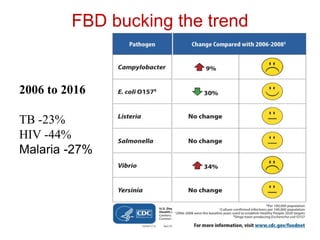
FBD bucking the trend
2006 to 2016
TB -23%
HIV -44%
Malaria -27%
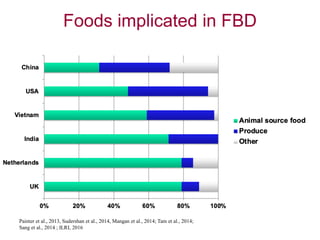
Foods implicated in FBD
Painter et al., 2013, Sudershan et al., 2014, Mangan et al., 2014; Tam et al., 2014;
Sang et al., 2014 ; ILRI, 2016
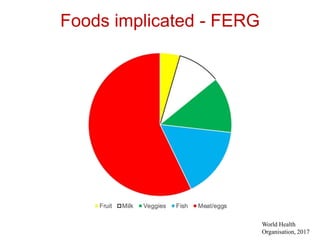
Foods implicated - FERG
World Health
Organisation, 2017
Can we regulate our way to food safety?
 100% of milk in Assam doesn’t meet standards
 98% of beef in Ibadan, 52% pork in Ha Noi, unacceptable
bacteria counts
 92% of Addis milk and 46% of Nairobi milk had aflatoxins
over EU standards
 36% of farmed fish from Kafrelsheikh exceed one or more
MPL
 30% of chicken from commercial broilers in Pretoria
unacceptable for S. aureus
 24% of boiled milk in Abidjan unacceptable S. aureus
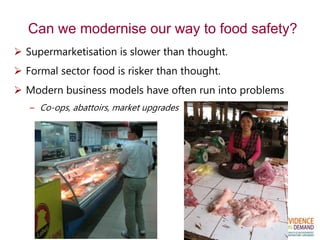
Can we modernise our way to food safety?
 Supermarketisation is slower than thought.
 Formal sector food is risker than thought.
 Modern business models have often run into problems
– Co-ops, abattoirs, market upgrades
16
0
10
20
30
40
50
60
70
80
90
100
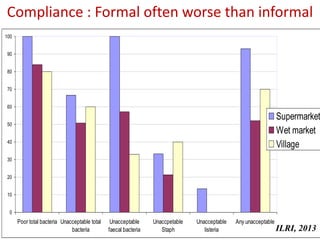
Poor total bacteria Unacceptable total
bacteria
Unacceptable
faecal bacteria
Unaccpetable
Staph
Unacceptable
listeria
Any unacceptable
Supermarket
Wet market
Village
Compliance : Formal often worse than informal
ILRI, 2013
17
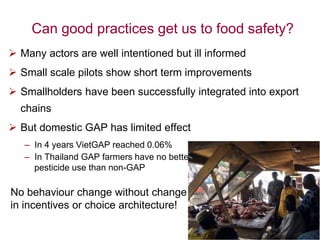
Can good practices get us to food safety?
 Many actors are well intentioned but ill informed
 Small scale pilots show short term improvements
 Smallholders have been successfully integrated into export
chains
 But domestic GAP has limited effect
– In 4 years VietGAP reached 0.06%
– In Thailand GAP farmers have no better
pesticide use than non-GAP
No behaviour change without change
in incentives or choice architecture!
19
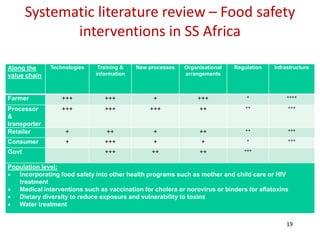
Systematic literature review – Food safety
interventions in SS Africa
Along the
value chain
Technologies Training &
information
New processes Organisational
arrangements
Regulation Infrastructure
Farmer +++ +++ + +++ + ++++
Processor
&
transporter
+++ +++ +++ ++ ++ +++
Retailer + ++ + ++ ++ +++
Consumer + +++ + + + +++
Govt +++ ++ ++ +++
Population level:
 Incorporating food safety into other health programs such as mother and child care or HIV
treatment
 Medical interventions such as vaccination for cholera or norovirus or binders for aflatoxins
 Dietary diversity to reduce exposure and vulnerability to toxins
 Water treatment
Effective interventions
 Methodological: prioritisation, risk based approaches, HACCP
 Appropriate Technology: milk cans, boilers, disinfectants
 Novel Technology: Aflasafe
 Programmatic: street traders, T&C
 Zoonoses: control in reservoir hosts
 Policies: enabling environment
 Market based solutions - WTP
• Branding & certification of milk
vendors in Kenya & Guwahti,
Assam led to improved milk safety.
• It benefited the national economy
by $33 million per year in Kenyan
and $6 million in Assam
• 70% of traders in Assam and 24%
in Kenya are currently registered
• 6 milllion consumers in Kenya and
1.5 million in Assam are benefiting
from safer milk
Towards impact at scale
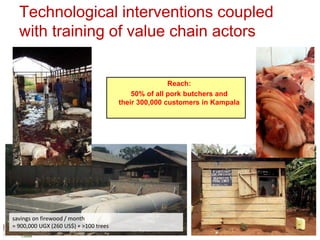
Technological interventions coupled
with training of value chain actors
savings on firewood / month
= 900,000 UGX (260 US$) + >100 trees
Reach:
50% of all pork butchers and
their 300,000 customers in Kampala
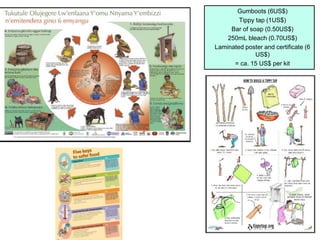
Gumboots (6US$)
Tippy tap (1US$)
Bar of soap (0.50US$)
250mL bleach (0.70US$)
Laminated poster and certificate (6
US$)
= ca. 15 US$ per kit
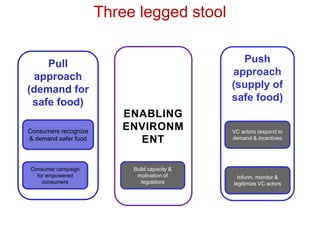
Pull
approach
(demand for
safe food)
Push
approach
(supply of
safe food)
ENABLING
ENVIRONM
ENT
Consumers recognize
& demand safer food
VC actors respond to
demand & incentives
Inform, monitor &
legitimize VC actors
Build capacity &
motivation of
regulators
Consumer campaign
for empowered
consumers
Three legged stool
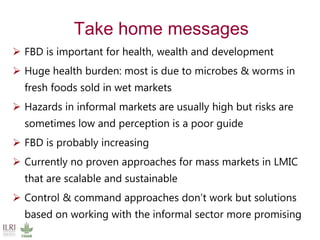
Take home messages
 FBD is important for health, wealth and development
 Huge health burden: most is due to microbes & worms in
fresh foods sold in wet markets
 Hazards in informal markets are usually high but risks are
sometimes low and perception is a poor guide
 FBD is probably increasing
 Currently no proven approaches for mass markets in LMIC
that are scalable and sustainable
 Control & command approaches don’t work but solutions
based on working with the informal sector more promising
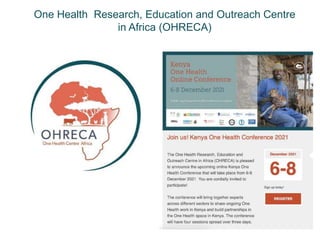
One Health Research, Education and Outreach Centre
in Africa (OHRECA)
THANK YOU

Global food safety

  • 1.
    Global food safety DeliaGrace Professor, Food Safety Systems, Natural Resources Institute, Chatham, UK Scientist, International Livestock Research Institute, Nairobi, Kenya Food safety for low- and middle-income countries eCourse launch 20 October 2021
  • 2.
  • 3.
  • 4.
    Overview 1. Why studyfood safety 2. Measuring to manage: DALYs and dollars 3. Foodborne disease: causes, foods implicated, trends 4. Managing the measured
  • 5.
    5 Risk misperceptions abound •Quantitative microbial risk assessment for salmonellosis acquired from pork • Annual incidence rate estimated to be 12.6% (90% CI: 0.5 – 42.6). • Driven by cross-contamination in households followed by prevalence in pork sold in the central market. • Pork value chain Vietnam • 366 kidney, liver and pork samples were pooled into 18 samples analysed for antibiotic residues, β-agonists, and heavy metals • ~1% over MRL with minor implications for human health
  • 6.
  • 7.
    Years of lifelost annually for FBD FERG: Havelaar et al., 2015; Gibb et al., 2019 Health impact of FBD comparable to that of malaria, HIV/AIDs or TB 31 hazards • 600 mio illnesses • 480,000 deaths • 41 million DALYs USA – 1 in 6 Greece 1 in 3 Africa 1 in 10??
  • 8.
    Food safety &nutrition  Diarrhoea a risk factor for stunting – perhaps 10-20%?  Ingestion of faecal material on food or in the environment may contribute to environmental enteropathy  Associations between aflatoxins and stunting  Regulations aimed to improve food safety may decrease the availability and accessibility of foods  Food scares decrease consumption
  • 9.
    Food safety &market access  Food safety standards often exclude small firms and farms from export markets – Kenya and Uganda saw major declines (60% and 40%) in small farmers participating in export of fruit and vegetables to Europe under Global GAP  Farmers supplying supermarkets are richer, better educated, more likely to be male and located near cities  When markets differentiate by quality, substandard food is targeted to the poor But  Quality-demanding markets still a small share  With support smallholders can participate in demanding markets
  • 10.
    The public healthand domestic economic costs of unsafe food may be 20 times the trade- related costs for developing countries Cost estimates 2016 (US$ billion) Productivity loss 95 Illness treatment 15 Trade loss or cost 5 to 7 ‘Productivity Loss’ = Foodborne Disease DALYs x Per Capita GNI Based on WHO/FERG & WDI Indicators Database Illness treatment = US$27 x # of Estimated foodborne illnesses Trade loss or costs = 2% of developing country high value food exports
  • 11.
    FBD bucking thetrend 2006 to 2016 TB -23% HIV -44% Malaria -27%
  • 12.
    Foods implicated inFBD Painter et al., 2013, Sudershan et al., 2014, Mangan et al., 2014; Tam et al., 2014; Sang et al., 2014 ; ILRI, 2016
  • 13.
    Foods implicated -FERG World Health Organisation, 2017
  • 14.
    Can we regulateour way to food safety?  100% of milk in Assam doesn’t meet standards  98% of beef in Ibadan, 52% pork in Ha Noi, unacceptable bacteria counts  92% of Addis milk and 46% of Nairobi milk had aflatoxins over EU standards  36% of farmed fish from Kafrelsheikh exceed one or more MPL  30% of chicken from commercial broilers in Pretoria unacceptable for S. aureus  24% of boiled milk in Abidjan unacceptable S. aureus
  • 15.
    Can we moderniseour way to food safety?  Supermarketisation is slower than thought.  Formal sector food is risker than thought.  Modern business models have often run into problems – Co-ops, abattoirs, market upgrades
  • 16.
    16 0 10 20 30 40 50 60 70 80 90 100 Poor total bacteriaUnacceptable total bacteria Unacceptable faecal bacteria Unaccpetable Staph Unacceptable listeria Any unacceptable Supermarket Wet market Village Compliance : Formal often worse than informal ILRI, 2013
  • 17.
  • 18.
    Can good practicesget us to food safety?  Many actors are well intentioned but ill informed  Small scale pilots show short term improvements  Smallholders have been successfully integrated into export chains  But domestic GAP has limited effect – In 4 years VietGAP reached 0.06% – In Thailand GAP farmers have no better pesticide use than non-GAP No behaviour change without change in incentives or choice architecture!
  • 19.
    19 Systematic literature review– Food safety interventions in SS Africa Along the value chain Technologies Training & information New processes Organisational arrangements Regulation Infrastructure Farmer +++ +++ + +++ + ++++ Processor & transporter +++ +++ +++ ++ ++ +++ Retailer + ++ + ++ ++ +++ Consumer + +++ + + + +++ Govt +++ ++ ++ +++ Population level:  Incorporating food safety into other health programs such as mother and child care or HIV treatment  Medical interventions such as vaccination for cholera or norovirus or binders for aflatoxins  Dietary diversity to reduce exposure and vulnerability to toxins  Water treatment
  • 20.
    Effective interventions  Methodological:prioritisation, risk based approaches, HACCP  Appropriate Technology: milk cans, boilers, disinfectants  Novel Technology: Aflasafe  Programmatic: street traders, T&C  Zoonoses: control in reservoir hosts  Policies: enabling environment  Market based solutions - WTP
  • 21.
    • Branding &certification of milk vendors in Kenya & Guwahti, Assam led to improved milk safety. • It benefited the national economy by $33 million per year in Kenyan and $6 million in Assam • 70% of traders in Assam and 24% in Kenya are currently registered • 6 milllion consumers in Kenya and 1.5 million in Assam are benefiting from safer milk Towards impact at scale
  • 22.
    Technological interventions coupled withtraining of value chain actors savings on firewood / month = 900,000 UGX (260 US$) + >100 trees Reach: 50% of all pork butchers and their 300,000 customers in Kampala
  • 23.
    Gumboots (6US$) Tippy tap(1US$) Bar of soap (0.50US$) 250mL bleach (0.70US$) Laminated poster and certificate (6 US$) = ca. 15 US$ per kit
  • 24.
    Pull approach (demand for safe food) Push approach (supplyof safe food) ENABLING ENVIRONM ENT Consumers recognize & demand safer food VC actors respond to demand & incentives Inform, monitor & legitimize VC actors Build capacity & motivation of regulators Consumer campaign for empowered consumers Three legged stool
  • 25.
    Take home messages FBD is important for health, wealth and development  Huge health burden: most is due to microbes & worms in fresh foods sold in wet markets  Hazards in informal markets are usually high but risks are sometimes low and perception is a poor guide  FBD is probably increasing  Currently no proven approaches for mass markets in LMIC that are scalable and sustainable  Control & command approaches don’t work but solutions based on working with the informal sector more promising
  • 26.
    One Health Research,Education and Outreach Centre in Africa (OHRECA)
  • 27.