Food safety in low- and middle-income countries:
What works, what doesn't and why
Delia Grace, Fred Unger, Hung Nguyen-Viet, Johanna Lindahl, Kohei Makita, Kristina Roesel,
Michael Taylor, Ram Deka, Sinh Dang Xuan, Steve Jaffee and Silvia Alonso
The 15th International Symposium of Veterinary Epidemiology and Economics
Chiang Mai, Thailand
13 November 2018
Presentation
 Why food safety in low-and middle-income countries
(LMIC) matters
 New findings on food safety
 Systematic Literature Review on food safety
interventions
 What doesn’t work
 What may work
 Conclusions
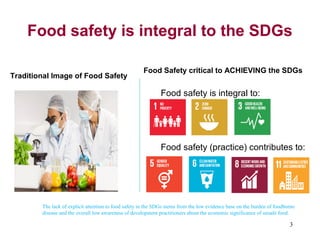
Traditional Image of Food Safety
Food Safety critical to ACHIEVING the SDGs
 Food safety is integral to:
 Food safety (practice) contributes to:
3
Food safety is integral to the SDGs
The lack of explicit attention to food safety in the SDGs stems from the low evidence base on the burden of foodborne
disease and the overall low awareness of development practitioners about the economic significance of unsafe food.
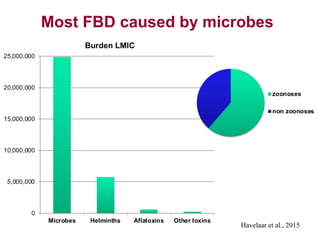
Most FBD caused by microbes
Havelaar et al., 2015
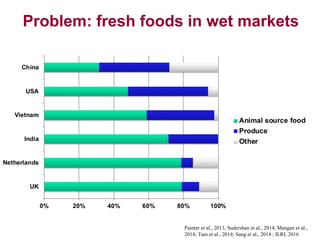
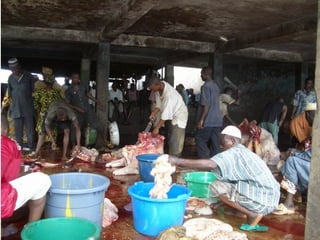
Problem: fresh foods in wet markets
Painter et al., 2013, Sudershan et al., 2014, Mangan et al.,
2014; Tam et al., 2014; Sang et al., 2014 ; ILRI, 2016
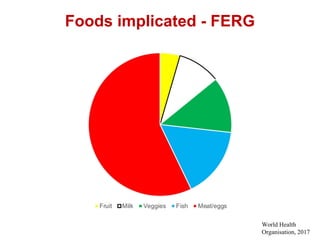
Foods implicated - FERG
World Health
Organisation, 2017
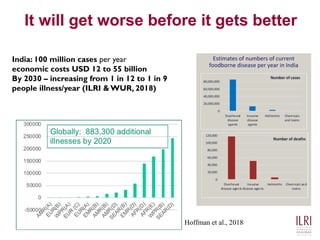
India: 100 million cases per year
economic costs USD 12 to 55 billion
By 2030 – increasing from 1 in 12 to 1 in 9
people illness/year (ILRI & WUR, 2018)
Estimates of numbers of current
foodborne disease per year in India
It will get worse before it gets better
Hoffman et al., 2018
8
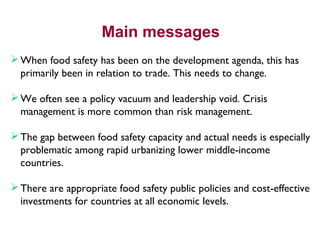
Main messages
When food safety has been on the development agenda, this has
primarily been in relation to trade. This needs to change.
We often see a policy vacuum and leadership void. Crisis
management is more common than risk management.
The gap between food safety capacity and actual needs is especially
problematic among rapid urbanizing lower middle-income
countries.
There are appropriate food safety public policies and cost-effective
investments for countries at all economic levels.
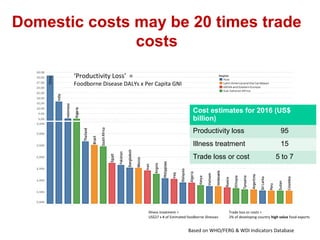
Domestic costs may be 20 times trade
costs
Cost estimates for 2016 (US$
billion)
Productivity loss 95
Illness treatment 15
Trade loss or cost 5 to 7
‘Productivity Loss’ =
Foodborne Disease DALYs x Per Capita GNI
Based on WHO/FERG & WDI Indicators Database
Illness treatment =
US$27 x # of Estimated foodborne illnesses
Trade loss or costs =
2% of developing country high value food exports
• Donor investment since 2010 less than $40 million a year. Small in
relation to burden and investments in other health areas
• Substantial focus on:
• National control systems
• Exports and other formal markets
• Chemical hazards
•
• Little focus on:
• Market-based and demand-led approaches
• Informal sector where most foods are sold
• Biological hazards and risks to human health
Main messages
1. Health first: Better address the health of domestic
consumers dependent on informal markets.
2. Risk-based: Build capacity for well-governed,
evidence- and risk-based food safety systems.
3. Market-led: Harness marketplace drivers of
progress on food safety.
Call to action!
We can’t regulate our way to food safety
Regulations are needed but not enough
 100% of milk in Assam doesn’t meet standards
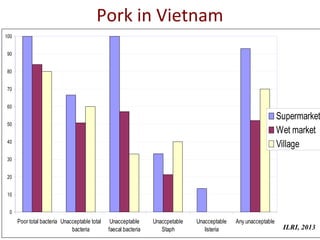
 98% of beef in Ibadan, 52% pork in Ha Noi, unacceptable
bacteria counts
 92% of Addis milk and 46% of Nairobi milk had aflatoxins over
EU standards
 36% of farmed fish from Kafr El Sheikh exceed one or more MPL
 30% of chicken from commercial broilers in Pretoria
unacceptable for S. aureus
 24% of boiled milk in Abidjan unacceptable S. aureus
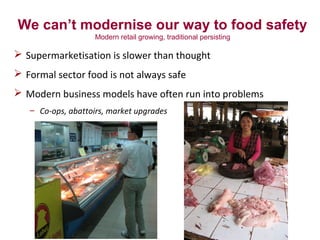
We can’t modernise our way to food safety
Modern retail growing, traditional persisting
 Supermarketisation is slower than thought
 Formal sector food is not always safe
 Modern business models have often run into problems
– Co-ops, abattoirs, market upgrades
16
17
0
10
20
30
40
50
60
70
80
90
100
Poor total bacteria Unacceptable total
bacteria
Unacceptable
faecal bacteria
Unaccpetable
Staph
Unacceptable
listeria
Any unacceptable
Supermarket
Wet market
Village
Pork in Vietnam
ILRI, 2013
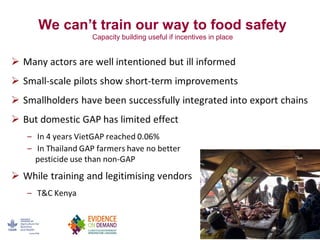
We can’t train our way to food safety
Capacity building useful if incentives in place
19
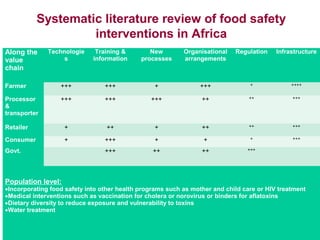
Along the
value
chain
Technologie
s
Training &
information
New
processes
Organisational
arrangements
Regulation Infrastructure
Farmer +++ +++ + +++ + ++++
Processor
&
transporter
+++ +++ +++ ++ ++ +++
Retailer + ++ + ++ ++ +++
Consumer + +++ + + + +++
Govt. +++ ++ ++ +++
Population level:
•Incorporating food safety into other health programs such as mother and child care or HIV treatment
•Medical interventions such as vaccination for cholera or norovirus or binders for aflatoxins
•Dietary diversity to reduce exposure and vulnerability to toxins
•Water treatment
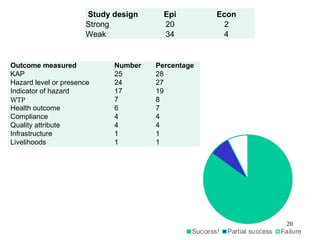
Systematic literature review of food safety
interventions in Africa
20
Outcome measured Number Percentage
KAP 25 28
Hazard level or presence 24 27
Indicator of hazard 17 19
WTP 7 8
Health outcome 6 7
Compliance 4 4
Quality attribute 4 4
Infrastructure 1 1
Livelihoods 1 1
Study design Epi Econ
Strong 20 2
Weak 34 4
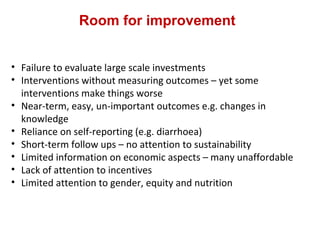
Room for improvement
• Failure to evaluate large scale investments
• Interventions without measuring outcomes – yet some
interventions make things worse
• Near-term, easy, un-important outcomes e.g. changes in
knowledge
• Reliance on self-reporting (e.g. diarrhoea)
• Short-term follow ups – no attention to sustainability
• Limited information on economic aspects – many unaffordable
• Lack of attention to incentives
• Limited attention to gender, equity and nutrition
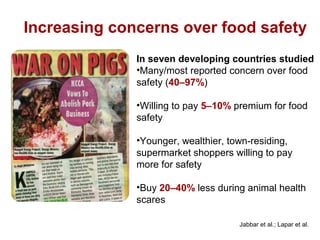
Increasing concerns over food safety
Jabbar et al.; Lapar et al.
In seven developing countries studied
•Many/most reported concern over food
safety (40–97%)
•Willing to pay 5–10% premium for food
safety
•Younger, wealthier, town-residing,
supermarket shoppers willing to pay
more for safety
•Buy 20–40% less during animal health
scares
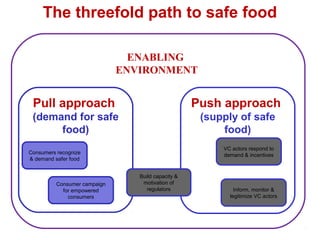
Pull approach
(demand for safe
food)
Push approach
(supply of safe
food)
Consumers recognize
& demand safer food
VC actors respond to
demand & incentives
Inform, monitor &
legitimize VC actors
Build capacity &
motivation of
regulators
Consumer campaign
for empowered
consumers
The threefold path to safe food
ENABLING
ENVIRONMENT
24
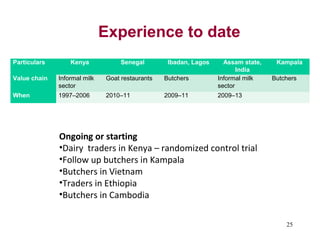
Experience to date
25
Particulars Kenya Senegal Ibadan, Lagos Assam state,
India
Kampala
Value chain Informal milk
sector
Goat restaurants Butchers Informal milk
sector
Butchers
When 1997–2006 2010–11 2009–11 2009–13
Ongoing or starting
•Dairy traders in Kenya – randomized control trial
•Follow up butchers in Kampala
•Butchers in Vietnam
•Traders in Ethiopia
•Butchers in Cambodia
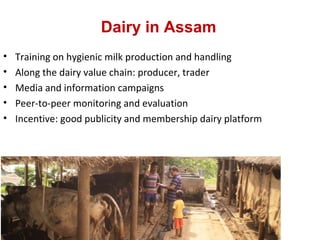
Dairy in Assam
• Training on hygienic milk production and handling
• Along the dairy value chain: producer, trader
• Media and information campaigns
• Peer-to-peer monitoring and evaluation
• Incentive: good publicity and membership dairy platform
26
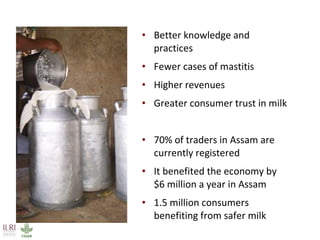
• Better knowledge and
practices
• Fewer cases of mastitis
• Higher revenues
• Greater consumer trust in milk
• 70% of traders in Assam are
currently registered
• It benefited the economy by
$6 million a year in Assam
• 1.5 million consumers
benefiting from safer milk
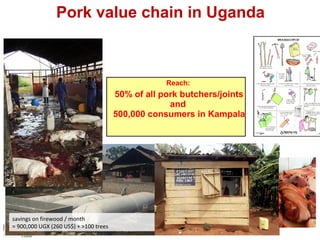
Pork value chain in Uganda
savings on firewood / month
= 900,000 UGX (260 US$) + >100 trees
Reach:
50% of all pork butchers/joints
and
500,000 consumers in Kampala
Take-home messages
 Huge health burden of foodborne disease
– Most due to microbes in fresh foods in wet markets
– Will get worse before it gets better
 Huge economic burden of foodborne disease
 Previous investments not in line with modern understanding
 Interventions successful in the short term
 Long-term, wide-reaching impacts likely require
 Training and technology
 Incentives
 Enabling environment
Thank you to our donors!
 BMZ: First donor to support food safety in informal markets
 Australian Centre for International Agricultural Research: Safe
pork in Vietnam
 USAID Feed the Future Innovation Lab for Livestock Systems
 World Bank: Policy and projects
 Bill & Melinda Gates Foundation and the UK Department for
International Development: Evidence and now projects
This presentation is licensed for use under the Creative Commons Attribution 4.0 International Licence.
better lives through livestock
ilri.org
ILRI thanks all donors and organizations who globally supported its work through their contributions
to the CGIAR system

Food safety in low- and middle-income countries: What works, what doesn't and why

  • 1.
    Food safety inlow- and middle-income countries: What works, what doesn't and why Delia Grace, Fred Unger, Hung Nguyen-Viet, Johanna Lindahl, Kohei Makita, Kristina Roesel, Michael Taylor, Ram Deka, Sinh Dang Xuan, Steve Jaffee and Silvia Alonso The 15th International Symposium of Veterinary Epidemiology and Economics Chiang Mai, Thailand 13 November 2018
  • 2.
    Presentation  Why foodsafety in low-and middle-income countries (LMIC) matters  New findings on food safety  Systematic Literature Review on food safety interventions  What doesn’t work  What may work  Conclusions
  • 3.
    Traditional Image ofFood Safety Food Safety critical to ACHIEVING the SDGs  Food safety is integral to:  Food safety (practice) contributes to: 3 Food safety is integral to the SDGs The lack of explicit attention to food safety in the SDGs stems from the low evidence base on the burden of foodborne disease and the overall low awareness of development practitioners about the economic significance of unsafe food.
  • 4.
    Most FBD causedby microbes Havelaar et al., 2015
  • 5.
    Problem: fresh foodsin wet markets Painter et al., 2013, Sudershan et al., 2014, Mangan et al., 2014; Tam et al., 2014; Sang et al., 2014 ; ILRI, 2016
  • 6.
    Foods implicated -FERG World Health Organisation, 2017
  • 7.
    India: 100 millioncases per year economic costs USD 12 to 55 billion By 2030 – increasing from 1 in 12 to 1 in 9 people illness/year (ILRI & WUR, 2018) Estimates of numbers of current foodborne disease per year in India It will get worse before it gets better Hoffman et al., 2018
  • 8.
  • 9.
    Main messages When foodsafety has been on the development agenda, this has primarily been in relation to trade. This needs to change. We often see a policy vacuum and leadership void. Crisis management is more common than risk management. The gap between food safety capacity and actual needs is especially problematic among rapid urbanizing lower middle-income countries. There are appropriate food safety public policies and cost-effective investments for countries at all economic levels.
  • 10.
    Domestic costs maybe 20 times trade costs Cost estimates for 2016 (US$ billion) Productivity loss 95 Illness treatment 15 Trade loss or cost 5 to 7 ‘Productivity Loss’ = Foodborne Disease DALYs x Per Capita GNI Based on WHO/FERG & WDI Indicators Database Illness treatment = US$27 x # of Estimated foodborne illnesses Trade loss or costs = 2% of developing country high value food exports
  • 12.
    • Donor investmentsince 2010 less than $40 million a year. Small in relation to burden and investments in other health areas • Substantial focus on: • National control systems • Exports and other formal markets • Chemical hazards • • Little focus on: • Market-based and demand-led approaches • Informal sector where most foods are sold • Biological hazards and risks to human health Main messages
  • 13.
    1. Health first:Better address the health of domestic consumers dependent on informal markets. 2. Risk-based: Build capacity for well-governed, evidence- and risk-based food safety systems. 3. Market-led: Harness marketplace drivers of progress on food safety. Call to action!
  • 14.
    We can’t regulateour way to food safety Regulations are needed but not enough  100% of milk in Assam doesn’t meet standards  98% of beef in Ibadan, 52% pork in Ha Noi, unacceptable bacteria counts  92% of Addis milk and 46% of Nairobi milk had aflatoxins over EU standards  36% of farmed fish from Kafr El Sheikh exceed one or more MPL  30% of chicken from commercial broilers in Pretoria unacceptable for S. aureus  24% of boiled milk in Abidjan unacceptable S. aureus
  • 15.
    We can’t moderniseour way to food safety Modern retail growing, traditional persisting  Supermarketisation is slower than thought  Formal sector food is not always safe  Modern business models have often run into problems – Co-ops, abattoirs, market upgrades
  • 16.
  • 17.
    17 0 10 20 30 40 50 60 70 80 90 100 Poor total bacteriaUnacceptable total bacteria Unacceptable faecal bacteria Unaccpetable Staph Unacceptable listeria Any unacceptable Supermarket Wet market Village Pork in Vietnam ILRI, 2013
  • 18.
    We can’t trainour way to food safety Capacity building useful if incentives in place
  • 19.
    19 Along the value chain Technologie s Training & information New processes Organisational arrangements RegulationInfrastructure Farmer +++ +++ + +++ + ++++ Processor & transporter +++ +++ +++ ++ ++ +++ Retailer + ++ + ++ ++ +++ Consumer + +++ + + + +++ Govt. +++ ++ ++ +++ Population level: •Incorporating food safety into other health programs such as mother and child care or HIV treatment •Medical interventions such as vaccination for cholera or norovirus or binders for aflatoxins •Dietary diversity to reduce exposure and vulnerability to toxins •Water treatment Systematic literature review of food safety interventions in Africa
  • 20.
    20 Outcome measured NumberPercentage KAP 25 28 Hazard level or presence 24 27 Indicator of hazard 17 19 WTP 7 8 Health outcome 6 7 Compliance 4 4 Quality attribute 4 4 Infrastructure 1 1 Livelihoods 1 1 Study design Epi Econ Strong 20 2 Weak 34 4
  • 21.
    Room for improvement •Failure to evaluate large scale investments • Interventions without measuring outcomes – yet some interventions make things worse • Near-term, easy, un-important outcomes e.g. changes in knowledge • Reliance on self-reporting (e.g. diarrhoea) • Short-term follow ups – no attention to sustainability • Limited information on economic aspects – many unaffordable • Lack of attention to incentives • Limited attention to gender, equity and nutrition
  • 22.
    Increasing concerns overfood safety Jabbar et al.; Lapar et al. In seven developing countries studied •Many/most reported concern over food safety (40–97%) •Willing to pay 5–10% premium for food safety •Younger, wealthier, town-residing, supermarket shoppers willing to pay more for safety •Buy 20–40% less during animal health scares
  • 23.
    Pull approach (demand forsafe food) Push approach (supply of safe food) Consumers recognize & demand safer food VC actors respond to demand & incentives Inform, monitor & legitimize VC actors Build capacity & motivation of regulators Consumer campaign for empowered consumers The threefold path to safe food ENABLING ENVIRONMENT
  • 24.
  • 25.
    Experience to date 25 ParticularsKenya Senegal Ibadan, Lagos Assam state, India Kampala Value chain Informal milk sector Goat restaurants Butchers Informal milk sector Butchers When 1997–2006 2010–11 2009–11 2009–13 Ongoing or starting •Dairy traders in Kenya – randomized control trial •Follow up butchers in Kampala •Butchers in Vietnam •Traders in Ethiopia •Butchers in Cambodia
  • 26.
    Dairy in Assam •Training on hygienic milk production and handling • Along the dairy value chain: producer, trader • Media and information campaigns • Peer-to-peer monitoring and evaluation • Incentive: good publicity and membership dairy platform 26
  • 27.
    • Better knowledgeand practices • Fewer cases of mastitis • Higher revenues • Greater consumer trust in milk • 70% of traders in Assam are currently registered • It benefited the economy by $6 million a year in Assam • 1.5 million consumers benefiting from safer milk
  • 28.
    Pork value chainin Uganda savings on firewood / month = 900,000 UGX (260 US$) + >100 trees Reach: 50% of all pork butchers/joints and 500,000 consumers in Kampala
  • 29.
    Take-home messages  Hugehealth burden of foodborne disease – Most due to microbes in fresh foods in wet markets – Will get worse before it gets better  Huge economic burden of foodborne disease  Previous investments not in line with modern understanding  Interventions successful in the short term  Long-term, wide-reaching impacts likely require  Training and technology  Incentives  Enabling environment
  • 30.
    Thank you toour donors!  BMZ: First donor to support food safety in informal markets  Australian Centre for International Agricultural Research: Safe pork in Vietnam  USAID Feed the Future Innovation Lab for Livestock Systems  World Bank: Policy and projects  Bill & Melinda Gates Foundation and the UK Department for International Development: Evidence and now projects
  • 31.
    This presentation islicensed for use under the Creative Commons Attribution 4.0 International Licence. better lives through livestock ilri.org ILRI thanks all donors and organizations who globally supported its work through their contributions to the CGIAR system

Editor's Notes

  • #4 The lack of explicit attention to food safety in the SDGs stems from the low evidence base on the burden of foodborne disease and the overall low awareness of development practitioners about the economic significance of unsafe food.
  • #6 Two-thirds of human pathogens are zoonotic – many of these transmitted via animal source food (salmonellosis, EHEC, cryptosporidium) Animal source food single most important cause of food-borne disease Many food-borne diseases cause few symptoms in animal host (chicken and S. enteritidis, calf and E. coli O157:H7, oysters and V. vulnificus) Many zoonotic diseases controlled most effectively in animal host/reservoir Recent studies shown pre- ‘harvest’ stage most important for controlling food-borne pathogens
  • #7 Two-thirds of human pathogens are zoonotic – many of these transmitted via animal source food (salmonellosis, EHEC, cryptosporidium) Animal source food single most important cause of food-borne disease Many food-borne diseases cause few symptoms in animal host (chicken and S. enteritidis, calf and E. coli O157:H7, oysters and V. vulnificus) Many zoonotic diseases controlled most effectively in animal host/reservoir Recent studies shown pre- ‘harvest’ stage most important for controlling food-borne pathogens
  • #18 Pathogens in pig meat in Vietnam – similar findings for milk in India, milk in Kenya, meat in Nigeria, meat in Gambia
  • #20 Pathogens in pig meat in Vietnam – similar findings for milk in India, milk in Kenya, meat in Nigeria, meat in Gambia
  • #28 s/h participation in markets Risk rather than regulatory