1 of 42 © Boardworks Ltd 2008
2 of 42 © Boardworks Ltd 2008
Useful substances from rocks 
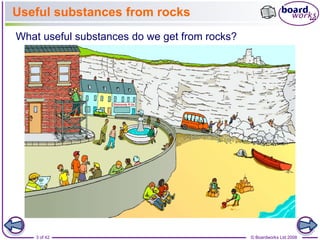
What useful substances do we get from rocks? 
3 of 42 © Boardworks Ltd 2008
Where do the rocks come from? 
We get many useful substances from rocks, such as building 
materials, metals, pigments and jewels. But where do we get 
the rocks themselves from? 
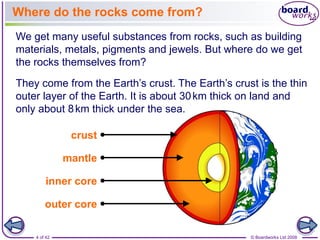
They come from the Earth’s crust. The Earth’s crust is the thin 
outer layer of the Earth. It is about 30km thick on land and 
only about 8km thick under the sea. 
crust 
mantle 
inner core 
outer core 
4 of 42 © Boardworks Ltd 2008
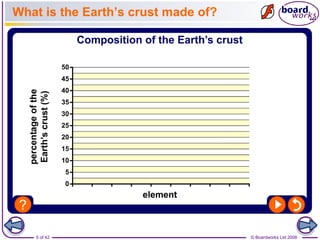
What is the Earth’s crust made of? 
5 of 42 © Boardworks Ltd 2008
Minerals and metals 
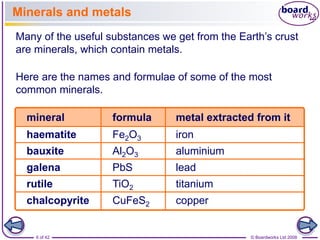
Many of the useful substances we get from the Earth’s crust 
are minerals, which contain metals. 
Here are the names and formulae of some of the most 
common minerals. 
mineral formula metal extracted from it 
Fe2O3 
Al2O3 
PbS 
TiO2 
CuFeS2 
haematite 
bauxite 
galena 
rutile 
chalcopyrite 
iron 
aluminium 
lead 
titanium 
copper 
6 of 42 © Boardworks Ltd 2008
Identifying rocks: summary 
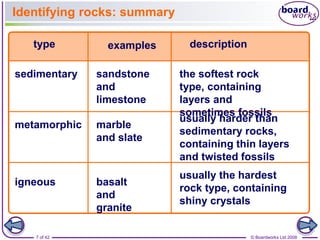
type examples description 
sedimentary 
metamorphic 
igneous 
sandstone 
and 
limestone 
marble 
and slate 
basalt 
and 
granite 
the softest rock 
type, containing 
layers and 
sometimes fossils 
usually harder than 
sedimentary rocks, 
containing thin layers 
and twisted fossils 
usually the hardest 
rock type, containing 
shiny crystals 
7 of 42 © Boardworks Ltd 2008
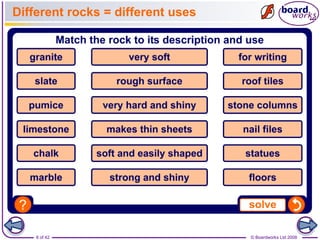
Different rocks = different uses 
8 of 42 © Boardworks Ltd 2008
9 of 42 © Boardworks Ltd 2008
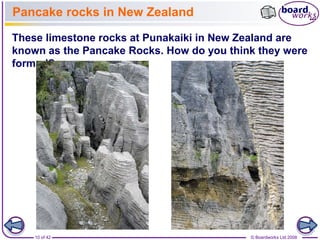
Pancake rocks in New Zealand 
These limestone rocks at Punakaiki in New Zealand are 
known as the Pancake Rocks. How do you think they were 
formed? 
10 of 42 © Boardworks Ltd 2008
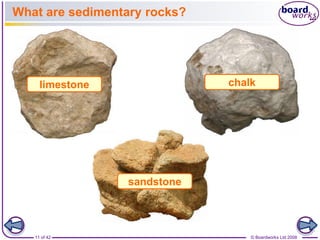
What are sedimentary rocks? 
limestone chalk 
sandstone 
11 of 42 © Boardworks Ltd 2008
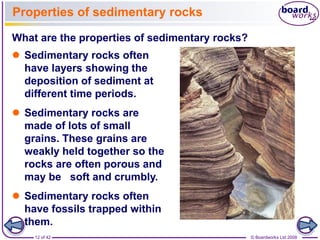
Properties of sedimentary rocks 
What are the properties of sedimentary rocks? 
 Sedimentary rocks often 
have layers showing the 
deposition of sediment at 
different time periods. 
 Sedimentary rocks are 
made of lots of small 
grains. These grains are 
weakly held together so the 
rocks are often porous and 
may be soft and crumbly. 
 Sedimentary rocks often 
have fossils trapped within 
them. 
12 of 42 © Boardworks Ltd 2008
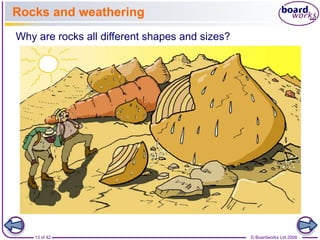
Rocks and weathering 
Why are rocks all different shapes and sizes? 
13 of 42 © Boardworks Ltd 2008
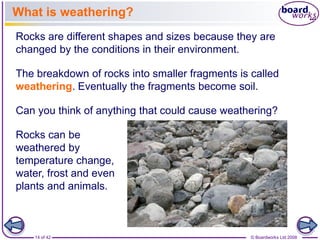
What is weathering? 
Rocks are different shapes and sizes because they are 
changed by the conditions in their environment. 
The breakdown of rocks into smaller fragments is called 
weathering. Eventually the fragments become soil. 
Can you think of anything that could cause weathering? 
Rocks can be 
weathered by 
temperature change, 
water, frost and even 
plants and animals. 
14 of 42 © Boardworks Ltd 2008
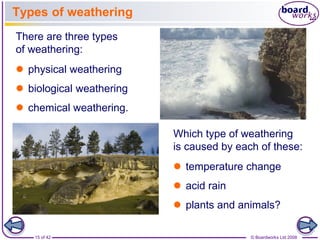
Types of weathering 
Which type of weathering 
is caused by each of these: 
 temperature change 
 acid rain 
 plants and animals? 
There are three types 
of weathering: 
 physical weathering 
 biological weathering 
 chemical weathering. 
15 of 42 © Boardworks Ltd 2008
What is chemical weathering? 
Slow chemical weathering 
 Rainwater is naturally a weak acid because carbon dioxide 
in the air reacts with rainwater to form carbonic acid. 
 This weakly acidic rain reacts with minerals in rocks and 
slowly wears them away. 
Rapid chemical weathering 
 The burning of fossil fuels produces oxides of sulphur 
and nitrogen, which make rainwater more acidic. 
 Acid rain reacts quickly with minerals, so the rocks get 
weathered more rapidly. 
16 of 42 © Boardworks Ltd 2008
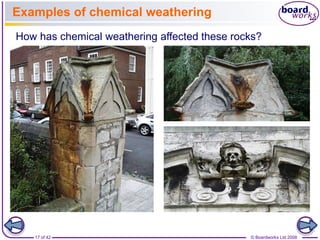
Examples of chemical weathering 
How has chemical weathering affected these rocks? 
17 of 42 © Boardworks Ltd 2008
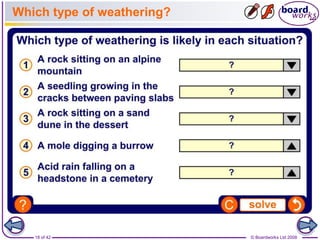
Which type of weathering? 
18 of 42 © Boardworks Ltd 2008
Acid and carbonate 
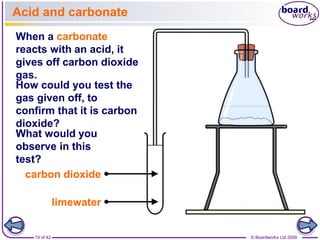
When a carbonate 
reacts with an acid, it 
gives off carbon dioxide 
gas. 
How could you test the 
gas given off, to 
confirm that it is carbon 
dioxide? 
What would you 
observe in this 
test? 
carbon dioxide 
limewater 
19 of 42 © Boardworks Ltd 2008
Acid and carbonate 
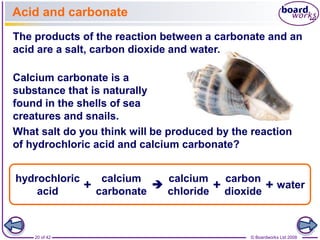
The products of the reaction between a carbonate and an 
acid are a salt, carbon dioxide and water. 
Calcium carbonate is a 
substance that is naturally 
found in the shells of sea 
creatures and snails. 
What salt do you think will be produced by the reaction 
of hydrochloric acid and calcium carbonate? 
calcium 
carbonate 
calcium 
chloride 
hydrochloric 
acid 
carbon 
dioxide + 
+  + water 
20 of 42 © Boardworks Ltd 2008
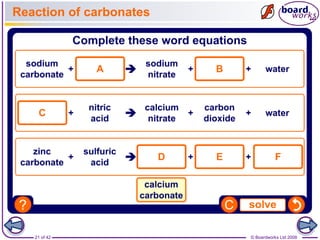
Reaction of carbonates 
21 of 42 © Boardworks Ltd 2008
22 of 42 © Boardworks Ltd 2008
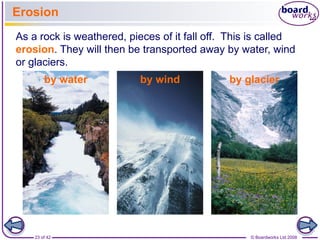
Erosion 
As a rock is weathered, pieces of it fall off. This is called 
erosion. They will then be transported away by water, wind 
or glaciers. 
by water by wind by glacier 
23 of 42 © Boardworks Ltd 2008
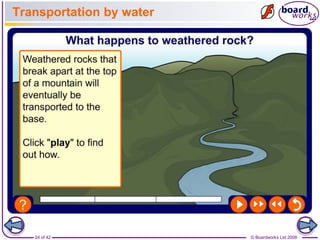
Transportation by water 
24 of 42 © Boardworks Ltd 2008
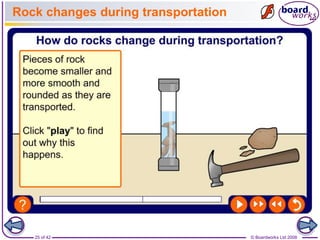
Rock changes during transportation 
25 of 42 © Boardworks Ltd 2008
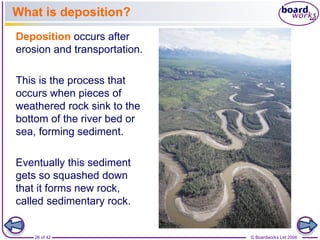
What is deposition? 
Deposition occurs after 
erosion and transportation. 
This is the process that 
occurs when pieces of 
weathered rock sink to the 
bottom of the river bed or 
sea, forming sediment. 
Eventually this sediment 
gets so squashed down 
that it forms new rock, 
called sedimentary rock. 
26 of 42 © Boardworks Ltd 2008
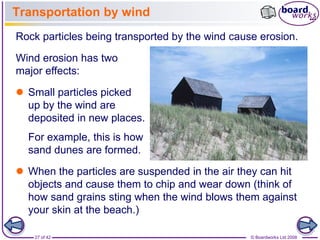
Transportation by wind 
Rock particles being transported by the wind cause erosion. 
Wind erosion has two 
major effects: 
 Small particles picked 
up by the wind are 
deposited in new places. 
For example, this is how 
sand dunes are formed. 
 When the particles are suspended in the air they can hit 
objects and cause them to chip and wear down (think of 
how sand grains sting when the wind blows them against 
your skin at the beach.) 
27 of 42 © Boardworks Ltd 2008
Transportation by glacier 
A glacier is a mass of ice that gradually moves overland. 
As the glacier moves, the stones 
and rocks in its path become 
incorporated into the base. The 
forward motion of the glacier 
causes the trapped rocks to rotate, 
scrape and grind along the ground. 
This friction weathers the landscape 
and causes valleys and fjords to form. 
Over time the smaller pieces of rock 
are carried into the melt water streams 
that surround the glacier, where they 
are redeposited on the ground. 
28 of 42 © Boardworks Ltd 2008
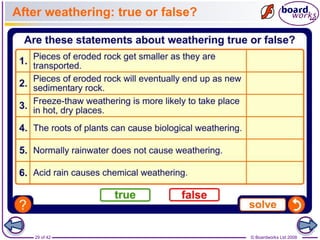
After weathering: true or false? 
29 of 42 © Boardworks Ltd 2008
30 of 42 © Boardworks Ltd 2008
Glossary 
31 of 42 © Boardworks Ltd 2008
Anagrams 
32 of 42 © Boardworks Ltd 2008
Multiple-choice quiz 
33 of 42 © Boardworks Ltd 2008

Rocks and weathering

  • 1.
    1 of 42© Boardworks Ltd 2008
  • 2.
    2 of 42© Boardworks Ltd 2008
  • 3.
    Useful substances fromrocks What useful substances do we get from rocks? 3 of 42 © Boardworks Ltd 2008
  • 4.
    Where do therocks come from? We get many useful substances from rocks, such as building materials, metals, pigments and jewels. But where do we get the rocks themselves from? They come from the Earth’s crust. The Earth’s crust is the thin outer layer of the Earth. It is about 30km thick on land and only about 8km thick under the sea. crust mantle inner core outer core 4 of 42 © Boardworks Ltd 2008
  • 5.
    What is theEarth’s crust made of? 5 of 42 © Boardworks Ltd 2008
  • 6.
    Minerals and metals Many of the useful substances we get from the Earth’s crust are minerals, which contain metals. Here are the names and formulae of some of the most common minerals. mineral formula metal extracted from it Fe2O3 Al2O3 PbS TiO2 CuFeS2 haematite bauxite galena rutile chalcopyrite iron aluminium lead titanium copper 6 of 42 © Boardworks Ltd 2008
  • 7.
    Identifying rocks: summary type examples description sedimentary metamorphic igneous sandstone and limestone marble and slate basalt and granite the softest rock type, containing layers and sometimes fossils usually harder than sedimentary rocks, containing thin layers and twisted fossils usually the hardest rock type, containing shiny crystals 7 of 42 © Boardworks Ltd 2008
  • 8.
    Different rocks =different uses 8 of 42 © Boardworks Ltd 2008
  • 9.
    9 of 42© Boardworks Ltd 2008
  • 10.
    Pancake rocks inNew Zealand These limestone rocks at Punakaiki in New Zealand are known as the Pancake Rocks. How do you think they were formed? 10 of 42 © Boardworks Ltd 2008
  • 11.
    What are sedimentaryrocks? limestone chalk sandstone 11 of 42 © Boardworks Ltd 2008
  • 12.
    Properties of sedimentaryrocks What are the properties of sedimentary rocks?  Sedimentary rocks often have layers showing the deposition of sediment at different time periods.  Sedimentary rocks are made of lots of small grains. These grains are weakly held together so the rocks are often porous and may be soft and crumbly.  Sedimentary rocks often have fossils trapped within them. 12 of 42 © Boardworks Ltd 2008
  • 13.
    Rocks and weathering Why are rocks all different shapes and sizes? 13 of 42 © Boardworks Ltd 2008
  • 14.
    What is weathering? Rocks are different shapes and sizes because they are changed by the conditions in their environment. The breakdown of rocks into smaller fragments is called weathering. Eventually the fragments become soil. Can you think of anything that could cause weathering? Rocks can be weathered by temperature change, water, frost and even plants and animals. 14 of 42 © Boardworks Ltd 2008
  • 15.
    Types of weathering Which type of weathering is caused by each of these:  temperature change  acid rain  plants and animals? There are three types of weathering:  physical weathering  biological weathering  chemical weathering. 15 of 42 © Boardworks Ltd 2008
  • 16.
    What is chemicalweathering? Slow chemical weathering  Rainwater is naturally a weak acid because carbon dioxide in the air reacts with rainwater to form carbonic acid.  This weakly acidic rain reacts with minerals in rocks and slowly wears them away. Rapid chemical weathering  The burning of fossil fuels produces oxides of sulphur and nitrogen, which make rainwater more acidic.  Acid rain reacts quickly with minerals, so the rocks get weathered more rapidly. 16 of 42 © Boardworks Ltd 2008
  • 17.
    Examples of chemicalweathering How has chemical weathering affected these rocks? 17 of 42 © Boardworks Ltd 2008
  • 18.
    Which type ofweathering? 18 of 42 © Boardworks Ltd 2008
  • 19.
    Acid and carbonate When a carbonate reacts with an acid, it gives off carbon dioxide gas. How could you test the gas given off, to confirm that it is carbon dioxide? What would you observe in this test? carbon dioxide limewater 19 of 42 © Boardworks Ltd 2008
  • 20.
    Acid and carbonate The products of the reaction between a carbonate and an acid are a salt, carbon dioxide and water. Calcium carbonate is a substance that is naturally found in the shells of sea creatures and snails. What salt do you think will be produced by the reaction of hydrochloric acid and calcium carbonate? calcium carbonate calcium chloride hydrochloric acid carbon dioxide + +  + water 20 of 42 © Boardworks Ltd 2008
  • 21.
    Reaction of carbonates 21 of 42 © Boardworks Ltd 2008
  • 22.
    22 of 42© Boardworks Ltd 2008
  • 23.
    Erosion As arock is weathered, pieces of it fall off. This is called erosion. They will then be transported away by water, wind or glaciers. by water by wind by glacier 23 of 42 © Boardworks Ltd 2008
  • 24.
    Transportation by water 24 of 42 © Boardworks Ltd 2008
  • 25.
    Rock changes duringtransportation 25 of 42 © Boardworks Ltd 2008
  • 26.
    What is deposition? Deposition occurs after erosion and transportation. This is the process that occurs when pieces of weathered rock sink to the bottom of the river bed or sea, forming sediment. Eventually this sediment gets so squashed down that it forms new rock, called sedimentary rock. 26 of 42 © Boardworks Ltd 2008
  • 27.
    Transportation by wind Rock particles being transported by the wind cause erosion. Wind erosion has two major effects:  Small particles picked up by the wind are deposited in new places. For example, this is how sand dunes are formed.  When the particles are suspended in the air they can hit objects and cause them to chip and wear down (think of how sand grains sting when the wind blows them against your skin at the beach.) 27 of 42 © Boardworks Ltd 2008
  • 28.
    Transportation by glacier A glacier is a mass of ice that gradually moves overland. As the glacier moves, the stones and rocks in its path become incorporated into the base. The forward motion of the glacier causes the trapped rocks to rotate, scrape and grind along the ground. This friction weathers the landscape and causes valleys and fjords to form. Over time the smaller pieces of rock are carried into the melt water streams that surround the glacier, where they are redeposited on the ground. 28 of 42 © Boardworks Ltd 2008
  • 29.
    After weathering: trueor false? 29 of 42 © Boardworks Ltd 2008
  • 30.
    30 of 42© Boardworks Ltd 2008
  • 31.
    Glossary 31 of42 © Boardworks Ltd 2008
  • 32.
    Anagrams 32 of42 © Boardworks Ltd 2008
  • 33.
    Multiple-choice quiz 33of 42 © Boardworks Ltd 2008