© OUP: To be used solely in purchaser’s school or college
8H The Rock Cycle
Rock types
Changing rocks
The rock cycle
8H The Rock Cycle
© OUP: To be used solely in purchaser’s school or college
Rock types
8H The Rock Cycle
© OUP: To be used solely in purchaser’s school or college
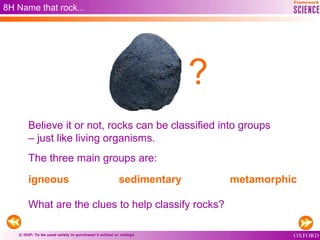
8H Name that rock...
Believe it or not, rocks can be classified into groups
– just like living organisms.
The three main groups are:
igneous sedimentary metamorphic
What are the clues to help classify rocks?
?
© OUP: To be used solely in purchaser’s school or college
8H Sedimentary
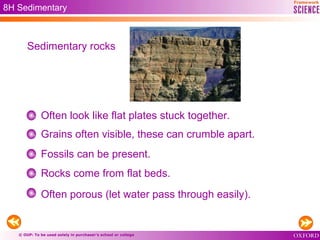
Often look like flat plates stuck together.
Grains often visible, these can crumble apart.
Fossils can be present.
Rocks come from flat beds.
Often porous (let water pass through easily).
Sedimentary rocks
© OUP: To be used solely in purchaser’s school or college
8H Rock factory
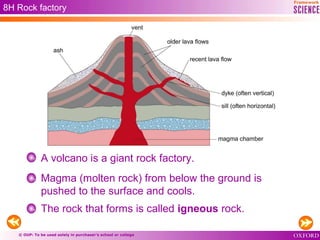
A volcano is a giant rock factory.
Magma (molten rock) from below the ground is
pushed to the surface and cools.
The rock that forms is called igneous rock.
© OUP: To be used solely in purchaser’s school or college
8H Igneous rocks
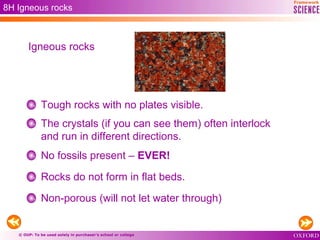
Tough rocks with no plates visible.
The crystals (if you can see them) often interlock
and run in different directions.
No fossils present – EVER!
Rocks do not form in flat beds.
Non-porous (will not let water through)
Igneous rocks
© OUP: To be used solely in purchaser’s school or college
8H Metamorphic rock
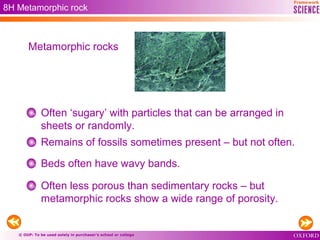
Often ‘sugary’ with particles that can be arranged in
sheets or randomly.
Remains of fossils sometimes present – but not often.
Beds often have wavy bands.
Often less porous than sedimentary rocks – but
metamorphic rocks show a wide range of porosity.
Metamorphic rocks
© OUP: To be used solely in purchaser’s school or college
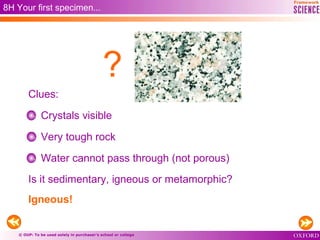
8H Your first specimen...
Crystals visible
Very tough rock
Water cannot pass through (not porous)
Is it sedimentary, igneous or metamorphic?
Igneous!
Clues:
?
© OUP: To be used solely in purchaser’s school or college
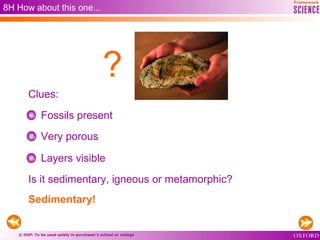
8H How about this one...
Fossils present
Very porous
Layers visible
Sedimentary!
Clues:
?
Is it sedimentary, igneous or metamorphic?
© OUP: To be used solely in purchaser’s school or college
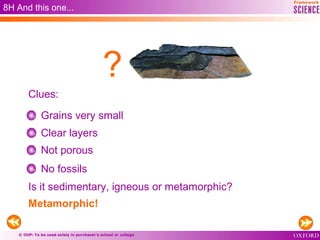
8H And this one...
Grains very small
Clear layers
Not porous
No fossils
Metamorphic!
Clues:
?
Is it sedimentary, igneous or metamorphic?
© OUP: To be used solely in purchaser’s school or college
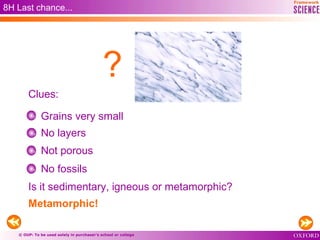
8H Last chance...
Grains very small
No layers
Not porous
No fossils
Metamorphic!
Clues:
?
Is it sedimentary, igneous or metamorphic?
© OUP: To be used solely in purchaser’s school or college
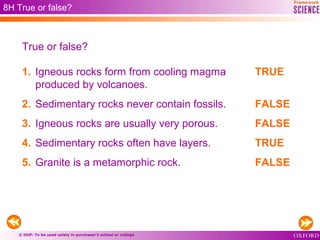
1. Igneous rocks form from cooling magma
produced by volcanoes.
2. Sedimentary rocks never contain fossils.
3. Igneous rocks are usually very porous.
4. Sedimentary rocks often have layers.
5. Granite is a metamorphic rock.
8H True or false?
True or false?
TRUE
FALSE
FALSE
TRUE
FALSE
© OUP: To be used solely in purchaser’s school or college
Changing rocks
8H The rock cycle
© OUP: To be used solely in purchaser’s school or college
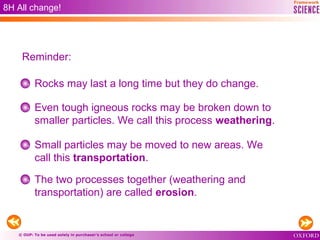
8H All change!
The two processes together (weathering and
transportation) are called erosion.
Reminder:
Rocks may last a long time but they do change.
Even tough igneous rocks may be broken down to
smaller particles. We call this process weathering.
Small particles may be moved to new areas. We
call this transportation.
© OUP: To be used solely in purchaser’s school or college
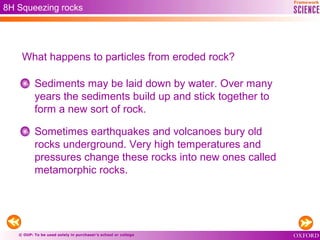
8H Squeezing rocks
What happens to particles from eroded rock?
Sediments may be laid down by water. Over many
years the sediments build up and stick together to
form a new sort of rock.
Sometimes earthquakes and volcanoes bury old
rocks underground. Very high temperatures and
pressures change these rocks into new ones called
metamorphic rocks.
© OUP: To be used solely in purchaser’s school or college
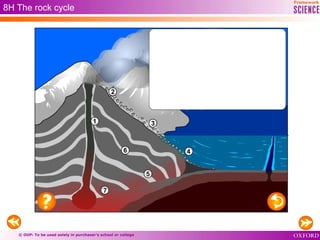
The rock cycle
8H The rock cycle
© OUP: To be used solely in purchaser’s school or college
8H The rock cycle
© OUP: To be used solely in purchaser’s school or college
1. Metamorphic rocks are made by…
a) heat and pressure acting on other rocks
b) particles dropping out of suspension in streams and
rivers
c) a small factory outside Manchester.
2. Which of these would you NOT find in sedimentary
rocks…
a) fossils
b) layered structure
c) interlocking crystals of minerals.
8H Rock cycle quiz
© OUP: To be used solely in purchaser’s school or college
3. The rock cycle is…
a) a way to explain how types of rocks are converted
to other forms
b) an explanation of how heating and cooling can
break down rocks
c) a musical by Andrew Lloyd Webber.
4. You could find the density of a rock sample by…
a) dividing its mass by its volume
b) dividing its volume by its mass
c) multiplying its volume by its mass.
8H Rock cycle quiz
© OUP: To be used solely in purchaser’s school or college
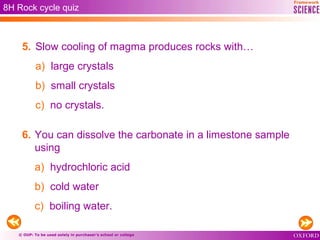
5. Slow cooling of magma produces rocks with…
a) large crystals
b) small crystals
c) no crystals.
6. You can dissolve the carbonate in a limestone sample
using
a) hydrochloric acid
b) cold water
c) boiling water.
8H Rock cycle quiz

8 h the_rock_cycle

  • 1.
    © OUP: Tobe used solely in purchaser’s school or college 8H The Rock Cycle Rock types Changing rocks The rock cycle 8H The Rock Cycle
  • 2.
    © OUP: Tobe used solely in purchaser’s school or college Rock types 8H The Rock Cycle
  • 3.
    © OUP: Tobe used solely in purchaser’s school or college 8H Name that rock... Believe it or not, rocks can be classified into groups – just like living organisms. The three main groups are: igneous sedimentary metamorphic What are the clues to help classify rocks? ?
  • 4.
    © OUP: Tobe used solely in purchaser’s school or college 8H Sedimentary Often look like flat plates stuck together. Grains often visible, these can crumble apart. Fossils can be present. Rocks come from flat beds. Often porous (let water pass through easily). Sedimentary rocks
  • 5.
    © OUP: Tobe used solely in purchaser’s school or college 8H Rock factory A volcano is a giant rock factory. Magma (molten rock) from below the ground is pushed to the surface and cools. The rock that forms is called igneous rock.
  • 6.
    © OUP: Tobe used solely in purchaser’s school or college 8H Igneous rocks Tough rocks with no plates visible. The crystals (if you can see them) often interlock and run in different directions. No fossils present – EVER! Rocks do not form in flat beds. Non-porous (will not let water through) Igneous rocks
  • 7.
    © OUP: Tobe used solely in purchaser’s school or college 8H Metamorphic rock Often ‘sugary’ with particles that can be arranged in sheets or randomly. Remains of fossils sometimes present – but not often. Beds often have wavy bands. Often less porous than sedimentary rocks – but metamorphic rocks show a wide range of porosity. Metamorphic rocks
  • 8.
    © OUP: Tobe used solely in purchaser’s school or college 8H Your first specimen... Crystals visible Very tough rock Water cannot pass through (not porous) Is it sedimentary, igneous or metamorphic? Igneous! Clues: ?
  • 9.
    © OUP: Tobe used solely in purchaser’s school or college 8H How about this one... Fossils present Very porous Layers visible Sedimentary! Clues: ? Is it sedimentary, igneous or metamorphic?
  • 10.
    © OUP: Tobe used solely in purchaser’s school or college 8H And this one... Grains very small Clear layers Not porous No fossils Metamorphic! Clues: ? Is it sedimentary, igneous or metamorphic?
  • 11.
    © OUP: Tobe used solely in purchaser’s school or college 8H Last chance... Grains very small No layers Not porous No fossils Metamorphic! Clues: ? Is it sedimentary, igneous or metamorphic?
  • 12.
    © OUP: Tobe used solely in purchaser’s school or college 1. Igneous rocks form from cooling magma produced by volcanoes. 2. Sedimentary rocks never contain fossils. 3. Igneous rocks are usually very porous. 4. Sedimentary rocks often have layers. 5. Granite is a metamorphic rock. 8H True or false? True or false? TRUE FALSE FALSE TRUE FALSE
  • 13.
    © OUP: Tobe used solely in purchaser’s school or college Changing rocks 8H The rock cycle
  • 14.
    © OUP: Tobe used solely in purchaser’s school or college 8H All change! The two processes together (weathering and transportation) are called erosion. Reminder: Rocks may last a long time but they do change. Even tough igneous rocks may be broken down to smaller particles. We call this process weathering. Small particles may be moved to new areas. We call this transportation.
  • 15.
    © OUP: Tobe used solely in purchaser’s school or college 8H Squeezing rocks What happens to particles from eroded rock? Sediments may be laid down by water. Over many years the sediments build up and stick together to form a new sort of rock. Sometimes earthquakes and volcanoes bury old rocks underground. Very high temperatures and pressures change these rocks into new ones called metamorphic rocks.
  • 16.
    © OUP: Tobe used solely in purchaser’s school or college The rock cycle 8H The rock cycle
  • 17.
    © OUP: Tobe used solely in purchaser’s school or college 8H The rock cycle
  • 18.
    © OUP: Tobe used solely in purchaser’s school or college 1. Metamorphic rocks are made by… a) heat and pressure acting on other rocks b) particles dropping out of suspension in streams and rivers c) a small factory outside Manchester. 2. Which of these would you NOT find in sedimentary rocks… a) fossils b) layered structure c) interlocking crystals of minerals. 8H Rock cycle quiz
  • 19.
    © OUP: Tobe used solely in purchaser’s school or college 3. The rock cycle is… a) a way to explain how types of rocks are converted to other forms b) an explanation of how heating and cooling can break down rocks c) a musical by Andrew Lloyd Webber. 4. You could find the density of a rock sample by… a) dividing its mass by its volume b) dividing its volume by its mass c) multiplying its volume by its mass. 8H Rock cycle quiz
  • 20.
    © OUP: Tobe used solely in purchaser’s school or college 5. Slow cooling of magma produces rocks with… a) large crystals b) small crystals c) no crystals. 6. You can dissolve the carbonate in a limestone sample using a) hydrochloric acid b) cold water c) boiling water. 8H Rock cycle quiz