
SEDIMENTARYSEDIMENTARY
ROCKSROCKS
Dr. P. Sarathbabu M.Sc. B.Ed. Ph.D.
Department of Geology
Acharya Nagarjuna University
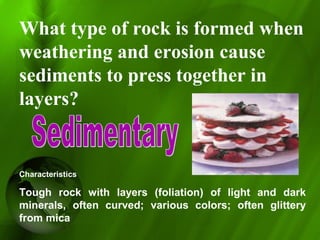
What type of rock is formed when
weathering and erosion cause
sediments to press together in
layers?
Characteristics
Tough rock with layers (foliation) of light and dark
minerals, often curved; various colors; often glittery
from mica
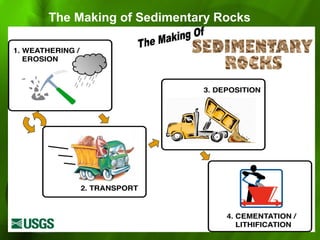
The Making of Sedimentary Rocks
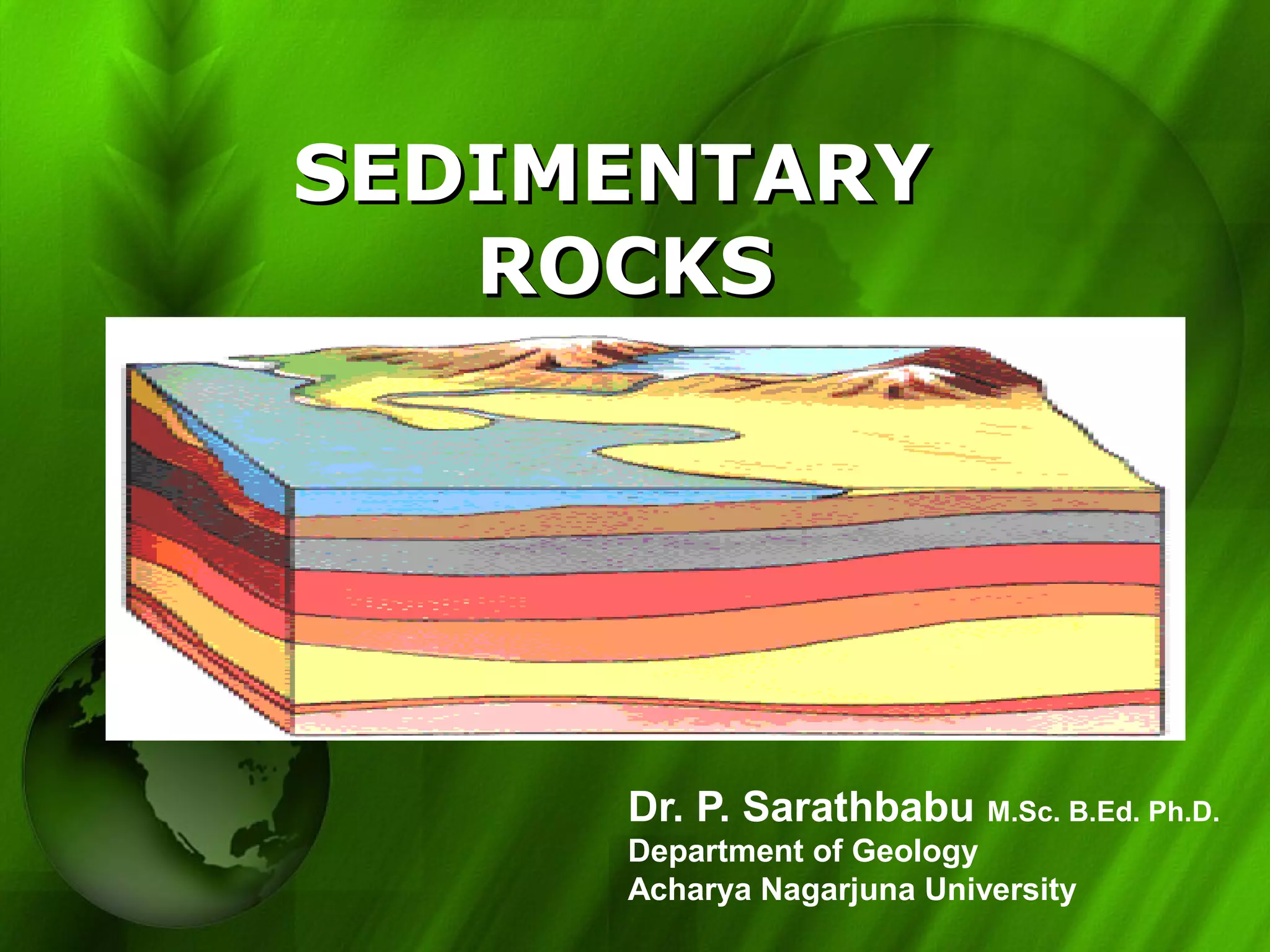
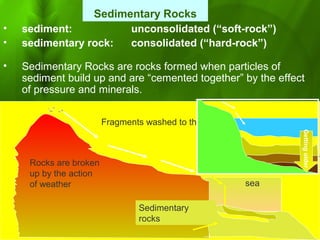
Sedimentary Rocks
• sediment: unconsolidated (“soft-rock”)
• sedimentary rock: consolidated (“hard-rock”)
• Sedimentary Rocks are rocks formed when particles of
sediment build up and are “cemented together” by the effect
of pressure and minerals.
sea
Fragments washed to the sea
Sedimentary
rocks
Rocks are broken
up by the action
of weather
Gettingolder
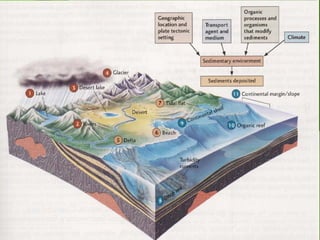
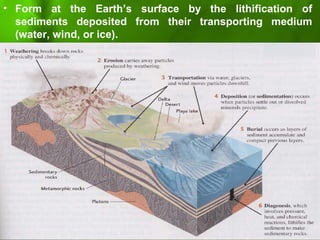
• Form at the Earth’s surface by the lithification of
sediments deposited from their transporting medium
(water, wind, or ice).
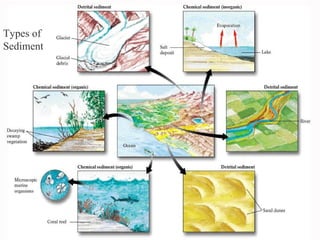
Types of
Sediment
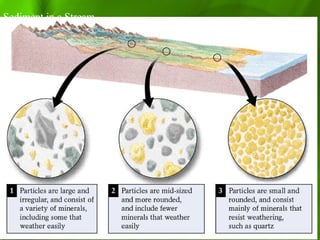
Sediment in a Stream
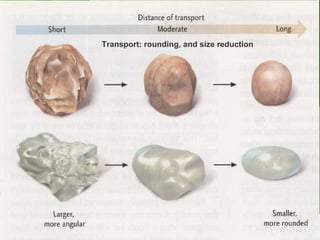
Transport: rounding, and size reduction
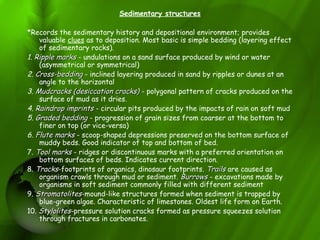
Sedimentary structures
*Records the sedimentary history and depositional environment; provides
valuable clues as to deposition. Most basic is simple bedding (layering effect
of sedimentary rocks). 
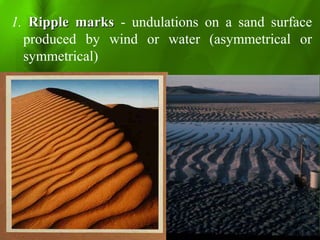
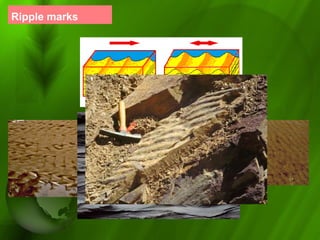
1. Ripple marksRipple marks - undulations on a sand surface produced by wind or water
(asymmetrical or symmetrical)
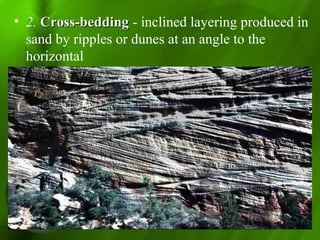
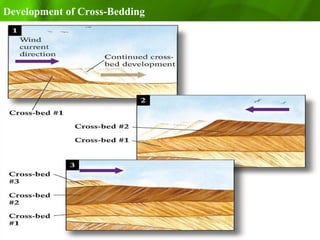
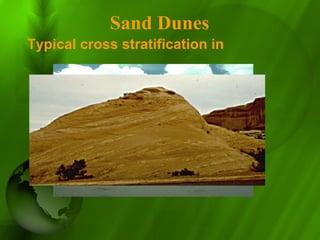
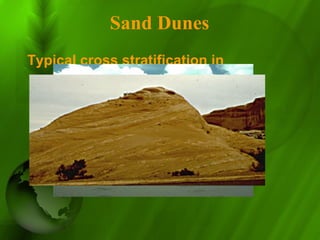
2. Cross-beddingCross-bedding - inclined layering produced in sand by ripples or dunes at an
angle to the horizontal
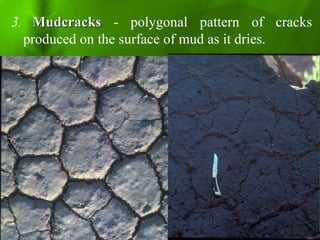
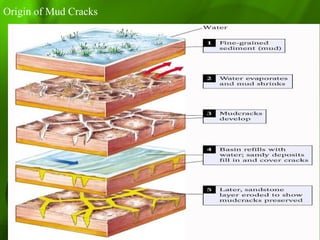
3. Mudcracks (desiccation cracks)Mudcracks (desiccation cracks) - polygonal pattern of cracks produced on the
surface of mud as it dries.
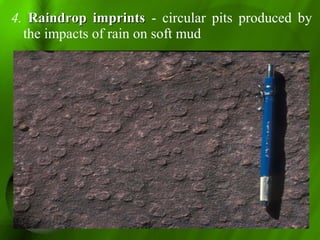
4. Raindrop imprintsRaindrop imprints - circular pits produced by the impacts of rain on soft mud
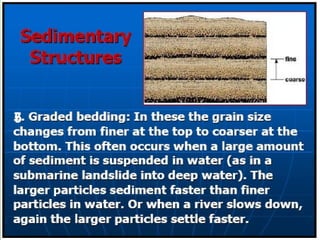
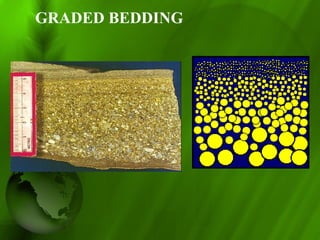
5. Graded beddingGraded bedding - progression of grain sizes from coarser at the bottom to
finer on top (or vice-versa)
6. Flute marksFlute marks - scoop-shaped depressions preserved on the bottom surface of
muddy beds. Good indicator of top and bottom of bed.
7. Tool marksTool marks - ridges or discontinuous marks with a preferred orientation on
bottom surfaces of beds. Indicates current direction.
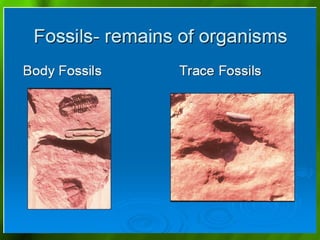
8. TracksTracks-footprints of organics, dinosaur footprints. TrailsTrails are caused as
organism crawls through mud or sediment. BurrowsBurrows - excavations made by
organisms in soft sediment commonly filled with different sediment
9. StromatolitesStromatolites-mound-like structures formed when sediment is trapped by
blue-green algae. Characteristic of limestones. Oldest life form on Earth.
10. StylolitesStylolites-pressure solution cracks formed as pressure squeezes solution
through fractures in carbonates.
1. Ripple marksRipple marks - undulations on a sand surface
produced by wind or water (asymmetrical or
symmetrical)
Ripple marks
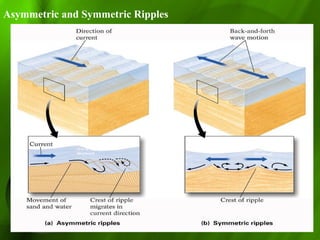
Asymmetric and Symmetric Ripples
river or wind currents (uni-
directional)
tidal currents (bi-
directional)
• 2. Cross-beddingCross-bedding - inclined layering produced in
sand by ripples or dunes at an angle to the
horizontal
Development of Cross-Bedding
Typical cross stratification in
Sand Dunes
3. MudcracksMudcracks - polygonal pattern of cracks
produced on the surface of mud as it dries.
Origin of Mud Cracks
4. Raindrop imprintsRaindrop imprints - circular pits produced by
the impacts of rain on soft mud
5
GRADED BEDDING
Typical cross stratification in
Sand Dunes
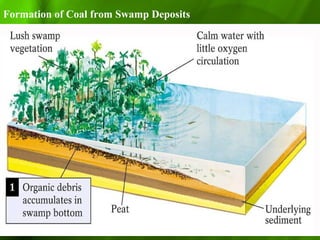
Formation of Coal from Swamp Deposits
6. Flute marksFlute marks - scoop-shaped depressions preserved on the
bottom surface of muddy beds. Good indicator of top and
bottom of bed.
7. Tool marksTool marks - ridges or discontinuous marks with a preferred
orientation on bottom surfaces of beds. Indicates current
direction.
8. TracksTracks-footprints of organics, dinosaur footprints. TrailsTrails are
caused as organism crawls through mud or sediment. BurrowsBurrows -
excavations made by organisms in soft sediment commonly
filled with different sediment
9. StromatolitesStromatolites-mound-like structures formed when sediment is
trapped by blue-green algae. Characteristic of limestones.
Oldest life form on Earth.
10. StylolitesStylolites-pressure solution cracks formed as pressure squeezes
solution through fractures in carbonates.
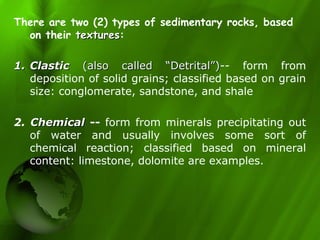
There are two (2) types of sedimentary rocks, based
on their texturestextures:
1.1. ClasticClastic (also called “Detrital”)(also called “Detrital”)-- form from
deposition of solid grains; classified based on grain
size: conglomerate, sandstone, and shale
2. ChemicalChemical -- form from minerals precipitating out
of water and usually involves some sort of
chemical reaction; classified based on mineral
content: limestone, dolomite are examples.
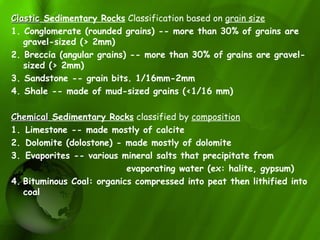
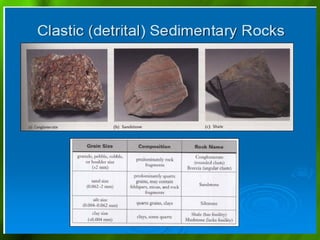
ClasticClastic Sedimentary Rocks Classification based on grain size
1. Conglomerate (rounded grains) -- more than 30% of grains are
gravel-sized (> 2mm)
2. Breccia (angular grains) -- more than 30% of grains are gravel-
sized (> 2mm)
3. Sandstone -- grain bits. 1/16mm-2mm
4. Shale -- made of mud-sized grains (<1/16 mm)
 
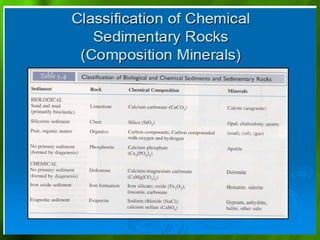
ChemicalChemical Sedimentary Rocks classified by composition
1.  Limestone -- made mostly of calcite
2.  Dolomite (dolostone) - made mostly of dolomite
3.  Evaporites -- various mineral salts that precipitate from
evaporating water (ex: halite, gypsum)
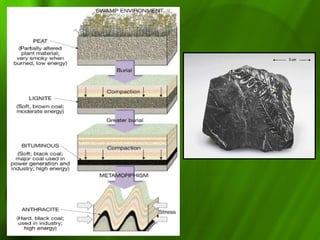
4. Bituminous Coal: organics compressed into peat then lithified into
coal
 
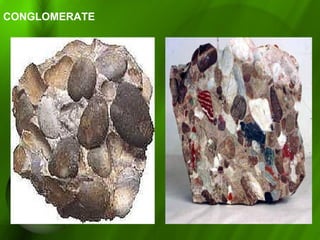
CONGLOMERATE
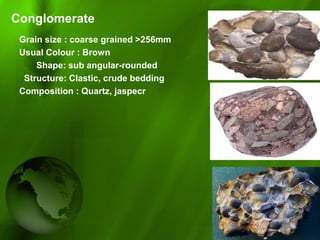
Conglomerate
Grain size : coarse grained >256mm
Usual Colour : Brown
       Shape: sub angular-rounded
  Structure: Clastic, crude bedding
Composition : Quartz, jaspecr
                         
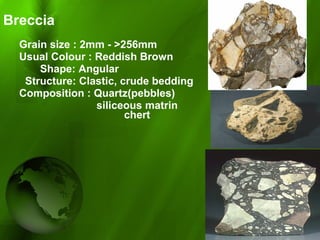
Breccia
Grain size : 2mm - >256mm
Usual Colour : Reddish Brown
       Shape: Angular
  Structure: Clastic, crude bedding
Composition : Quartz(pebbles)
                         siliceous matrin        
   chert
Sedimentary rocks
There are 5 main kinds of sedimentary rocks, depending 
on the mix of minerals in the rocks. 
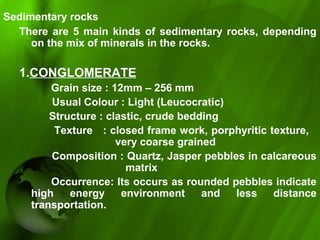
1.CONGLOMERATE 
             Grain size : 12mm – 256 mm
           Usual Colour : Light (Leucocratic)
          Structure : clastic, crude bedding
          Texture   : closed frame work, porphyritic texture, 
very coarse grained 
          Composition : Quartz, Jasper pebbles in calcareous 
                         matrix
Occurrence: Its occurs as rounded pebbles indicate 
high  energy  environment  and  less  distance 
transportation.
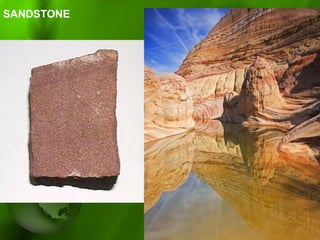
SANDSTONE
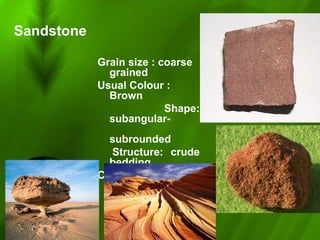
Sandstone
Grain size : coarse
grained
Usual Colour :
Brown
Shape:
subangular-
subrounded
Structure: crude
bedding
Composition :
Quartz, feldspar
Sedimentary rocks
2.SANDSTONE
Grain size : 1 – 2mm
Usual Colour : Light brown
Structure : stratification, current bedding, ripples
marks, rain prints
Texture : well sorted grains, >2mm-coarse
0.5 – 0.25- medium
0.25-0.1- fine
Composition : quartz as chief mineral, feldspars,
mica,garnet as minor amount.
Occurrence: fine grains indicate high energy of
deposition and rounded shape indicate long
transportation
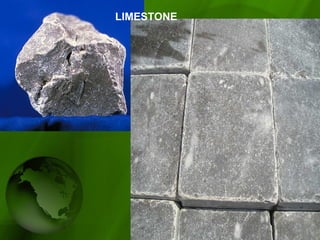
LIMESTONE
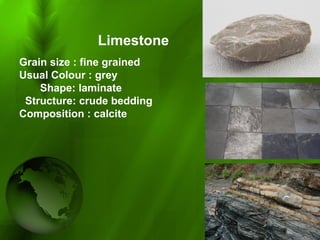
Limestone
Grain size : fine grained
Usual Colour : grey
Shape: laminate
Structure: crude bedding
Composition : calcite
Sedimentary rocks
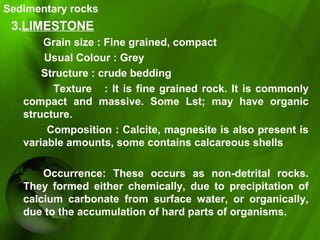
3.LIMESTONE
Grain size : Fine grained, compact
Usual Colour : Grey
Structure : crude bedding
Texture : It is fine grained rock. It is commonly
compact and massive. Some Lst; may have organic
structure.
Composition : Calcite, magnesite is also present is
variable amounts, some contains calcareous shells
Occurrence: These occurs as non-detrital rocks.
They formed either chemically, due to precipitation of
calcium carbonate from surface water, or organically,
due to the accumulation of hard parts of organisms.
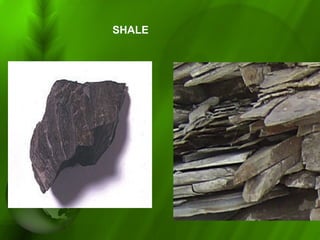
SHALE
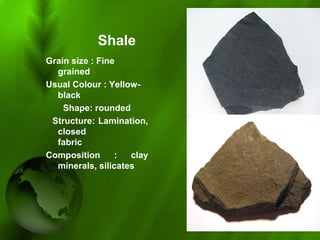
Shale
Grain size : Fine
grained
Usual Colour : Yellow-
black
Shape: rounded
Structure: Lamination,
closed
fabric
Composition : clay
minerals, silicates
Sedimentary rocks
4.SHALE
Grain size : Fine grained
Usual Colour : variables
Structure : Lamination, ripple marks and organic
structures
Texture : very fine grained <0.01mm
Composition : Its composed of kaolinite,
montmorillonite and
illite,qtz,mica,chlorite are in minor
amount
Occurrence: Shales formed out of mechanically
transported and deposited sediments. These are made up
of fine grained i.e; silty and clay, and occurrs as
laminated structures.
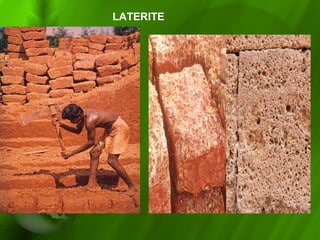
LATERITE
Sedimentary rocks
5.LATERITE
Grain size : Fine grained
Usual Colour : Red
Structure : Lamination, ripple marks and organic
structures
Texture : porus and concretionary
Composition : These are essentially clay rich in
alluminium and iron hydroxides with minor amounts of
silica, alluminimum hydroxides are called
bauxites(pisolitic texture).
Occurrence: Its occurs as residual deposits due
weathering in hot humid climate, and occurs as mantle
over bed rocks.
Sedimentary rocks

Sedimentary rocks

Editor's Notes

  • #5 Every rock has a history, and we saw that many rocks are made of smaller pieces of other rocks that we called “grains.” Rocks that are made up of other rocks are part of a class of rocks called “sedimentary rocks.” Each of those grains goes through its own adventure on its way to becoming part of the final rock that we pick up. It starts off as part of another rock. Wind, rain, and other agents break the rock down into smaller pieces. They often move the pieces far away from the original rock, until eventually they settle down somewhere else. Eventually, a pile of individual grains will get cemented together into one solid rock. Each of these stages affects the way the final rock looks. Let’s focus on a few of them.