Weathering
Presented by Paleozoic Group
Table of Contents
•What is Weathering?
•Types of Weathering
•Products of Weathering
•Mechanical Weathering
•Biological Activity
•Chemical Weathering
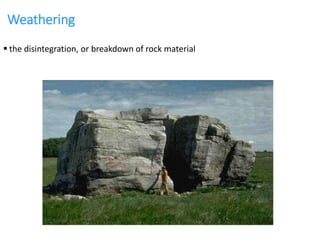
Weathering
 the disintegration, or breakdown of rock material
Types of Weathering
•Chemical Weathering
•Mechanical Weathering
•Biological Weathering
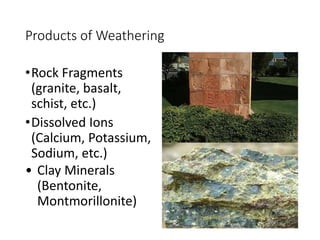
Products of Weathering
•Rock Fragments
(granite, basalt,
schist, etc.)
•Dissolved Ions
(Calcium, Potassium,
Sodium, etc.)
• Clay Minerals
(Bentonite,
Montmorillonite)
Mechanical weathering
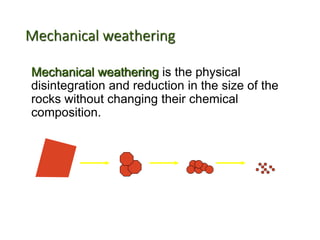
Mechanical weathering is the physical
disintegration and reduction in the size of the
rocks without changing their chemical
composition.
Mechanical Weathering
Types of Mechanical Weathering:
•Exfoliation
•Frost Wedging
•Temperature Changes
•Abrasion
•Biological Activity
• Root Wedging
• Burrowing
• Decaying Organisms
• Human Activities
Mechanical weathering
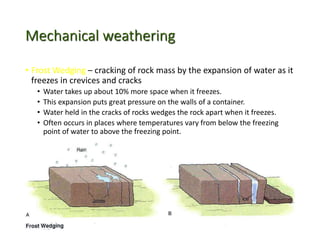
• Frost Wedging – cracking of rock mass by the expansion of water as it
freezes in crevices and cracks
• Water takes up about 10% more space when it freezes.
• This expansion puts great pressure on the walls of a container.
• Water held in the cracks of rocks wedges the rock apart when it freezes.
• Often occurs in places where temperatures vary from below the freezing
point of water to above the freezing point.
Mechanical weathering
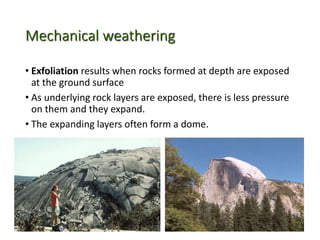
• Exfoliation results when rocks formed at depth are exposed
at the ground surface
• As underlying rock layers are exposed, there is less pressure
on them and they expand.
• The expanding layers often form a dome.
Mechanical weathering
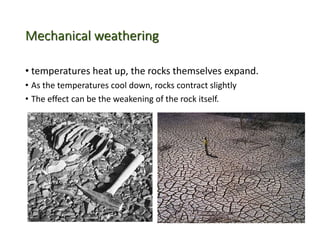
• temperatures heat up, the rocks themselves expand.
• As the temperatures cool down, rocks contract slightly
• The effect can be the weakening of the rock itself.
Abarsion
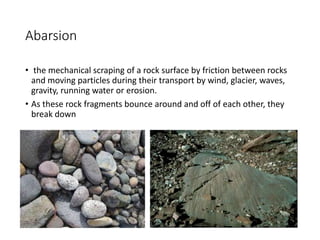
• the mechanical scraping of a rock surface by friction between rocks
and moving particles during their transport by wind, glacier, waves,
gravity, running water or erosion.
• As these rock fragments bounce around and off of each other, they
break down
Biological Activity
Weathering accomplished by the activities of organisms
including:
• plants,
• burrowing animals,
• decaying organisms, and
• humans.
Biological Activity
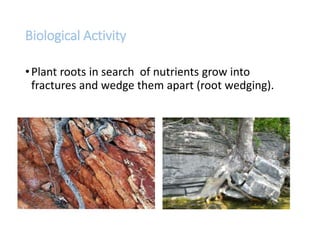
•Plant roots in search of nutrients grow into
fractures and wedge them apart (root wedging).
Biological Activity
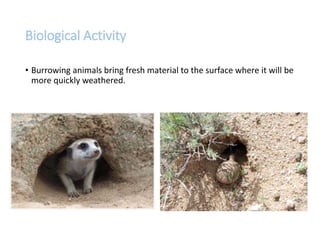
• Burrowing animals bring fresh material to the surface where it will be
more quickly weathered.
Biological Activity
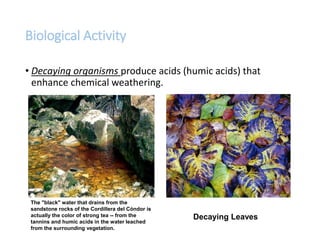
• Decaying organisms produce acids (humic acids) that
enhance chemical weathering.
Decaying Leaves
The "black" water that drains from the
sandstone rocks of the Cordillera del Cóndor is
actually the color of strong tea -- from the
tannins and humic acids in the water leached
from the surrounding vegetation.
Biological Activity
• Humans have affected the rate of acid rain through the huge
amounts of pollutants that we dispose of every year
• also affect the rates of weathering through mass removal of
vegetation. Vegetation around the world is constantly being
uprooted, especially in rainforest areas where logging goes on every
day.
• Human manually dug out rocks for construction
• Humans manually move or change rocks when they mine
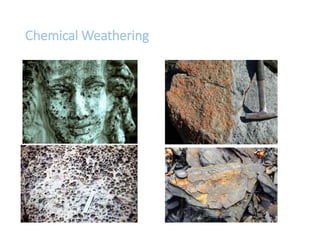
Chemical Weathering
• caused by rain water reacting with the mineral grains in
rocks to form new minerals (clays) and soluble salts.
• These reactions occur particularly when the water is
slightly acidic.
• These changes either break down the rock or weaken
the rock to allow for physical weathering.
• Most important agent is water
• Responsible for transport of ions and molecules
involved in chemical processes.
Chemical Weathering
Chemical Weathering
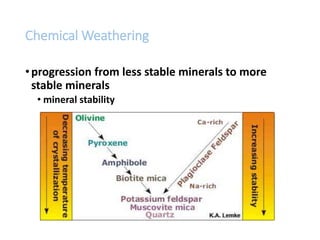
•progression from less stable minerals to more
stable minerals
• mineral stability
Chemical Weathering
•Types of chemical weathering
1. Dissolution
2. Oxidation
3. Hydrolysis
Dissolution
• Dissolution
• Many ionic and organic compounds dissolve in
water
• Silica, K, Na, Mg, Ca, Cl, CO3, SO4
• Acid Reactions
• Water + carbon dioxide <---> carbonic acid
• Water + sulfur <---> sulfuric acid
• H+ effective at breaking down minerals
Dissolution
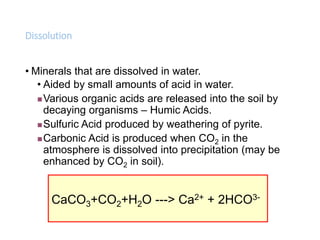
• Minerals that are dissolved in water.
• Aided by small amounts of acid in water.
Various organic acids are released into the soil by
decaying organisms – Humic Acids.
Sulfuric Acid produced by weathering of pyrite.
Carbonic Acid is produced when CO2 in the
atmosphere is dissolved into precipitation (may be
enhanced by CO2 in soil).
CaCO3+CO2+H2O ---> Ca2+ + 2HCO3-
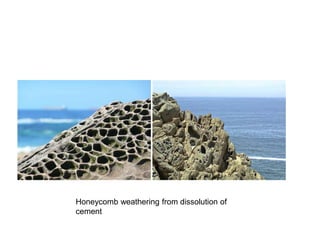
Honeycomb weathering from dissolution of
cement
Oxidation
• Oxidation
• Oxygen dissolved in water promotes oxidation of
sulfides, ferrous oxides, native metals
• Organic Activity
• Plant material makes H+ ions available
Oxidation
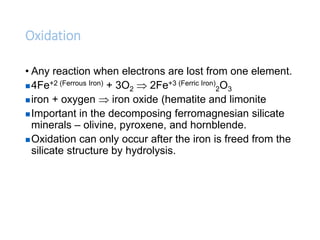
• Any reaction when electrons are lost from one element.
4Fe+2 (Ferrous Iron) + 3O2  2Fe+3 (Ferric Iron)
2O3
iron + oxygen  iron oxide (hematite and limonite
Important in the decomposing ferromagnesian silicate
minerals – olivine, pyroxene, and hornblende.
Oxidation can only occur after the iron is freed from the
silicate structure by hydrolysis.
Oxidation
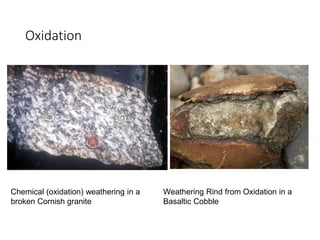
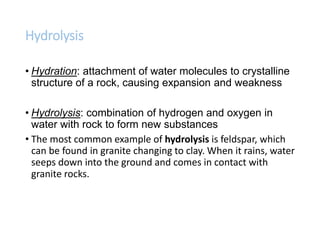
Chemical (oxidation) weathering in a
broken Cornish granite
Weathering Rind from Oxidation in a
Basaltic Cobble
Hydrolysis
• Hydration: attachment of water molecules to crystalline
structure of a rock, causing expansion and weakness
• Hydrolysis: combination of hydrogen and oxygen in
water with rock to form new substances
• The most common example of hydrolysis is feldspar, which
can be found in granite changing to clay. When it rains, water
seeps down into the ground and comes in contact with
granite rocks.
Hydrolysis
• The reaction of any substance with water.
• Water molecules dissociate to form hydrogen (H-)
and hydroxyl (OH-) ions.
• Hydrogen ion attacks and replaces other ions.
• Silicates are decomposed primarily by this process.
• 2KAlSi3O8 + 2(H+ + HCO3
-) + H2O  Al2Si2O5(OH)4
+2K+ + 2HCO3
- + 4SiO2
• Potassium Feldspar + carbonic acid + water 
kaolinite (residual clay) + [potassium ion + bicarbonate
ion + silica (in solution)]
Hydrolosis
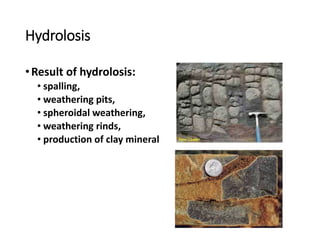
•Result of hydrolosis:
• spalling,
• weathering pits,
• spheroidal weathering,
• weathering rinds,
• production of clay mineral
Hydrolysis
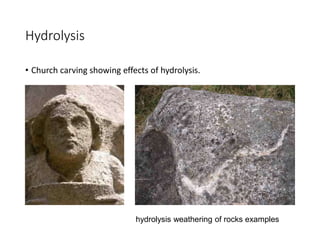
• Church carving showing effects of hydrolysis.
hydrolysis weathering of rocks examples
THE END

Rock Weathering

  • 1.
  • 2.
    Table of Contents •Whatis Weathering? •Types of Weathering •Products of Weathering •Mechanical Weathering •Biological Activity •Chemical Weathering
  • 3.
    Weathering  the disintegration,or breakdown of rock material
  • 4.
    Types of Weathering •ChemicalWeathering •Mechanical Weathering •Biological Weathering
  • 5.
    Products of Weathering •RockFragments (granite, basalt, schist, etc.) •Dissolved Ions (Calcium, Potassium, Sodium, etc.) • Clay Minerals (Bentonite, Montmorillonite)
  • 6.
    Mechanical weathering Mechanical weatheringis the physical disintegration and reduction in the size of the rocks without changing their chemical composition.
  • 7.
    Mechanical Weathering Types ofMechanical Weathering: •Exfoliation •Frost Wedging •Temperature Changes •Abrasion •Biological Activity • Root Wedging • Burrowing • Decaying Organisms • Human Activities
  • 8.
    Mechanical weathering • FrostWedging – cracking of rock mass by the expansion of water as it freezes in crevices and cracks • Water takes up about 10% more space when it freezes. • This expansion puts great pressure on the walls of a container. • Water held in the cracks of rocks wedges the rock apart when it freezes. • Often occurs in places where temperatures vary from below the freezing point of water to above the freezing point.
  • 9.
    Mechanical weathering • Exfoliationresults when rocks formed at depth are exposed at the ground surface • As underlying rock layers are exposed, there is less pressure on them and they expand. • The expanding layers often form a dome.
  • 10.
    Mechanical weathering • temperaturesheat up, the rocks themselves expand. • As the temperatures cool down, rocks contract slightly • The effect can be the weakening of the rock itself.
  • 11.
    Abarsion • the mechanicalscraping of a rock surface by friction between rocks and moving particles during their transport by wind, glacier, waves, gravity, running water or erosion. • As these rock fragments bounce around and off of each other, they break down
  • 12.
    Biological Activity Weathering accomplishedby the activities of organisms including: • plants, • burrowing animals, • decaying organisms, and • humans.
  • 13.
    Biological Activity •Plant rootsin search of nutrients grow into fractures and wedge them apart (root wedging).
  • 14.
    Biological Activity • Burrowinganimals bring fresh material to the surface where it will be more quickly weathered.
  • 15.
    Biological Activity • Decayingorganisms produce acids (humic acids) that enhance chemical weathering. Decaying Leaves The "black" water that drains from the sandstone rocks of the Cordillera del Cóndor is actually the color of strong tea -- from the tannins and humic acids in the water leached from the surrounding vegetation.
  • 16.
    Biological Activity • Humanshave affected the rate of acid rain through the huge amounts of pollutants that we dispose of every year • also affect the rates of weathering through mass removal of vegetation. Vegetation around the world is constantly being uprooted, especially in rainforest areas where logging goes on every day. • Human manually dug out rocks for construction • Humans manually move or change rocks when they mine
  • 17.
    Chemical Weathering • causedby rain water reacting with the mineral grains in rocks to form new minerals (clays) and soluble salts. • These reactions occur particularly when the water is slightly acidic. • These changes either break down the rock or weaken the rock to allow for physical weathering. • Most important agent is water • Responsible for transport of ions and molecules involved in chemical processes.
  • 18.
  • 19.
    Chemical Weathering •progression fromless stable minerals to more stable minerals • mineral stability
  • 20.
    Chemical Weathering •Types ofchemical weathering 1. Dissolution 2. Oxidation 3. Hydrolysis
  • 21.
    Dissolution • Dissolution • Manyionic and organic compounds dissolve in water • Silica, K, Na, Mg, Ca, Cl, CO3, SO4 • Acid Reactions • Water + carbon dioxide <---> carbonic acid • Water + sulfur <---> sulfuric acid • H+ effective at breaking down minerals
  • 22.
    Dissolution • Minerals thatare dissolved in water. • Aided by small amounts of acid in water. Various organic acids are released into the soil by decaying organisms – Humic Acids. Sulfuric Acid produced by weathering of pyrite. Carbonic Acid is produced when CO2 in the atmosphere is dissolved into precipitation (may be enhanced by CO2 in soil). CaCO3+CO2+H2O ---> Ca2+ + 2HCO3-
  • 23.
    Honeycomb weathering fromdissolution of cement
  • 24.
    Oxidation • Oxidation • Oxygendissolved in water promotes oxidation of sulfides, ferrous oxides, native metals • Organic Activity • Plant material makes H+ ions available
  • 25.
    Oxidation • Any reactionwhen electrons are lost from one element. 4Fe+2 (Ferrous Iron) + 3O2  2Fe+3 (Ferric Iron) 2O3 iron + oxygen  iron oxide (hematite and limonite Important in the decomposing ferromagnesian silicate minerals – olivine, pyroxene, and hornblende. Oxidation can only occur after the iron is freed from the silicate structure by hydrolysis.
  • 26.
    Oxidation Chemical (oxidation) weatheringin a broken Cornish granite Weathering Rind from Oxidation in a Basaltic Cobble
  • 27.
    Hydrolysis • Hydration: attachmentof water molecules to crystalline structure of a rock, causing expansion and weakness • Hydrolysis: combination of hydrogen and oxygen in water with rock to form new substances • The most common example of hydrolysis is feldspar, which can be found in granite changing to clay. When it rains, water seeps down into the ground and comes in contact with granite rocks.
  • 28.
    Hydrolysis • The reactionof any substance with water. • Water molecules dissociate to form hydrogen (H-) and hydroxyl (OH-) ions. • Hydrogen ion attacks and replaces other ions. • Silicates are decomposed primarily by this process. • 2KAlSi3O8 + 2(H+ + HCO3 -) + H2O  Al2Si2O5(OH)4 +2K+ + 2HCO3 - + 4SiO2 • Potassium Feldspar + carbonic acid + water  kaolinite (residual clay) + [potassium ion + bicarbonate ion + silica (in solution)]
  • 29.
    Hydrolosis •Result of hydrolosis: •spalling, • weathering pits, • spheroidal weathering, • weathering rinds, • production of clay mineral
  • 30.
    Hydrolysis • Church carvingshowing effects of hydrolysis. hydrolysis weathering of rocks examples
  • 31.