Geology 3
 PART 1
ANDREINA LOPEZ
Metamorphism Rock
Gneissic
 Gneissic rock come from the Metamorphism
  rock.
 Metamorphism rock change their form.
 The changes are in the mineralogy, texture, and
  sometimes the chemical composition of rocks
 Metamorphism rocks takes place usually in
  elevate temperatures and pressures.
 These rocks gradually change until state of
  equilibrium with the new environment.
 The Agents of metamorphism include
  heat, pressure, and chemically active fluids.
Gneissic

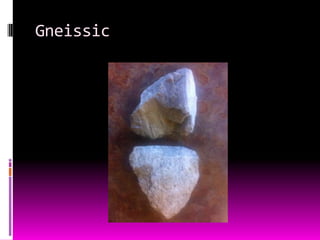
 Gneissic rock is a common and widely
    distributed type of rock.
   The rocks with a banded appearance are call
    gneissic.
   Foliated gneissic will not usually split as easily
    as slates and some schist.
   I found this gneissic rock in Turlock lake .
   The place can be found along the side of Lake
    Street in the county of Stanislaus.
Gneissic

 I identify the rock for its texture, it has little
  dark biotite flakes, and the light silicate
  minerals.
 Given the rock a banded or layered
  appearance.
 Gneissic has a foliated texture
Gneissic
Quartz

 Quartz is a very hard metamorphism rock.
 The Changes on Metamorphism rocks
  increased the density, change in
  size, reorientation of mineral grains
 The transformation of low temperature
  minerals into high temperature minerals.
 Metamorphism rocks can be broadly
  classified in foliation exhibited and to lesser
  extend on the chemical composition.
Quartz

 The quartz is a non foliated texture
 Fused quartz grains, massive, very hard
 We can find this type of rock in the water or near
  to it.
 The quartz are formed in sandstone.
 Quartz formed under moderate to high grade
  and the grains in sandstone fuse together.
 The quartz ridges are often bare or covered only
  with very thin layer of soil and a little vegetation.
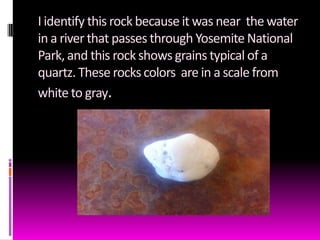
I identify this rock because it was near the water
in a river that passes through Yosemite National
Park, and this rock shows grains typical of a
quartz. These rocks colors are in a scale from
white to gray.
Sedimentary Rocks


 About 75 percent of the land areas are
  covered by sediments and sedimentary rocks.
 Across the ocean floor the earth solid
  surface, virtually everything is covered by
  sediment.
 These rocks are mostly located in mid
  ocean, water and at some volcanic areas.
 The particles of the sedimentary rocks by
  accumulating is call sediment.
Sedimentary Rocks

 The sediment are formed by weathering and
  erosion in a source area, and then they are
  transported to the place of deposition by
  water, winds mass movement or glaciers.
 This group of rocks provides geologists with
  much of the basic information they need to
  reconstruct the details of Earth history.
Sandstone

 The name of this rock in which the sand size
  grain dominate
 Sandstone is the most abundant sedimentary
  rock, accounting for approximately 20 percent of
  the entire group.
 Sandstone form in a variety of environment and
  often contain significant clues about their origin.
 The shapes of the sand can also help decipher
  the history of sandstone.
 The sandstone also containing significant
  amount of feldspar and angular grain of the
  ferromagnesian minerals.
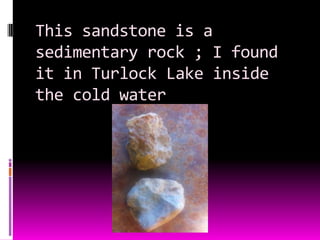
This sandstone is a
sedimentary rock ; I found
it in Turlock Lake inside
the cold water
Igneous

 The igneous rocks are composed or interlocking
  crystals.
 Igneous are form in two basic settings Magma
  and Crystallizes.
 When magna loses its mobility before reaching
  the surface it eventually crystallizes to form an
  igneous rocks.
 They are also known as plutonic rocks.
 Igneous rocks are abundant in western portions
  of the american like volcanic peak cascades and
  mountains .
Granite Rock

 This rock is dominated by minerals.
 The geologist also refers to granite rock as
  being felsic.
 Granitic rocks are rich in silica they contain
  about 70 percent of it.
Granite Rock

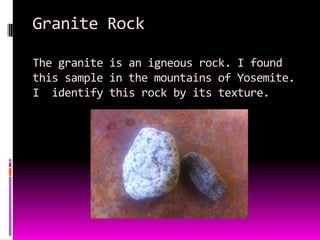
The granite is an igneous rock. I found
this sample in the mountains of Yosemite.
I identify this rock by its texture.
Mafic Basaltic Rock

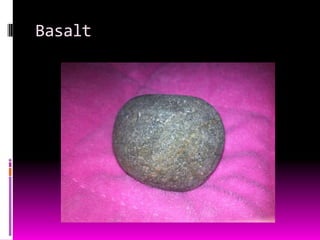
 Basalt is a very dark green to black.
 This rock is composed primarily of pyroxene
  and calcium.
 Basalt is the most common extrusive igneous
  rock.
 Many volcanic island and Iceland are
  composed mainly of Basalt rocks/
 I found that this rock is a Basaltic based on
  the color, texture and the upper layers.
Basalt
GEOLOGY
PART II
FAULT
The San Andreas Fault
San Andreas Fault
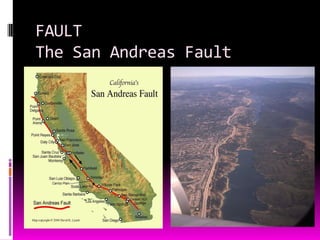
 I was not able to take an actual picture of the San Andreas fault; I
   found these pictures in the internet, and they show a clear view
   of the fault near the San Francisco Bay. A fault is an area where
   ground pushing in different directions meet. The pressure of the
   opposing movements eventually becomes too much, resulting in
   an earthquake. The San Andreas Fault is a large fault running
   underneath California, including many heavily populated areas.
   Many geologists predict a devastating earthquake along that
   fault in California running from San Diego to San Francisco. It is a
   fault line where major quakes have occurred along. There are
   plates that rest on top of each other and at the point of the fault
   there is a lot of pressure. If these tectonic plates move there
   could possibly be a quake as powerful as the last one to hit Japan
   or worse. The power in these plates measure in the range of
   hundreds of a-bombs going off at once - that is the kind of
   pressure that would be released.
weathering processes
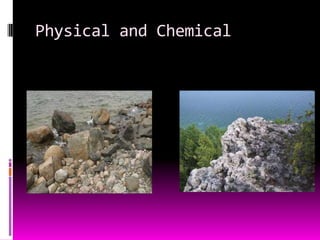
   Physical and Chemical weathering
   Physical disintegration and chemical decomposition of rocks, minerals, and
    immature soils at or near the Earth's surface. Physical, chemical, and biological
    processes induced or modified by wind, water, and climate cause the changes.
    Weathering is distinguished from erosion in that no transportation of material is
    involved. A broader application of erosion, however, includes weathering as a
    component
    Chemical is the process of chemically altering a rock, but not by heat and
    pressure metamorphism, simply by chemical constituents changing the rock.
    This is most famously seen in the case where dilute solutions of hydrochloric acid
    , runs across limestone, which is calcite, dissolves it, and leaves behind caves, or
    sink holes, or karst topography,
   Physical weathering is the breaking down of rock without changing its
    composition. The filling of cracks with water which then freezes and expands
    breaking the rock apart is one type of physical (also called mechanical
    weathering) called ice wedging or frost action. Gravity causing rock to fall and
    break apart is another example of physical weathering. Plant roots growing in
    cracks and breaking the rock apart is another example of physical weathering.
Physical and Chemical
Mass wasting and erosion
events
 erosion is an action causing large bodies of rock to become
  much smaller. The mechanisms for this are
  wind/weather, chemical and mechanical. Wind erosion can
  be seen in deserts where the wind Caries small particles of
  sand the scrubs larger bodies into weird twisted shapes.
  Chemical erosion is seen in acid rain and such. This leaches
  or alters chemicals in the rock causing it to alter or dissolve.

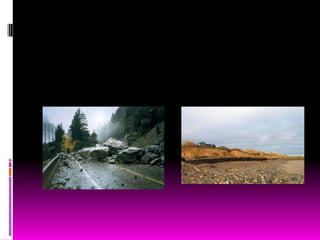
 Mass erosion is by which soil, regolith, and rock move down
  slope under the force of gravity. Types of mass wasting
  include creep, slides, flows, topples, and falls, each with its
  own characteristic features, and taking place over
  timescales from seconds to years.
sedimentary environments


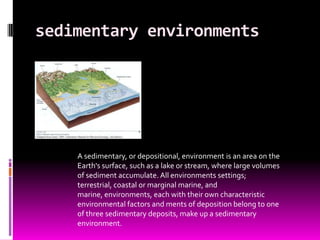
    A sedimentary, or depositional, environment is an area on the
    Earth's surface, such as a lake or stream, where large volumes
    of sediment accumulate. All environments settings;
    terrestrial, coastal or marginal marine, and
    marine, environments, each with their own characteristic
    environmental factors and ments of deposition belong to one
    of three sedimentary deposits, make up a sedimentary
    environment.
practical use of geology
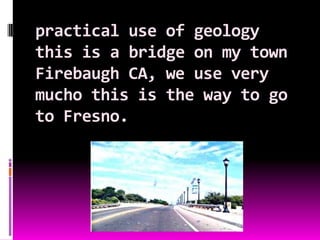
this is a bridge on my town
Firebaugh CA, we use very
mucho this is the way to go
to Fresno.
Resources

 www.geology.com
 www.geol.umd.edu/~tholtz/G102/102terr.htm
 http://science.jrank.org
 Texbook Tarbuck Lutgens Tasa, An
  introduction to Physical geology Tenth
  Edition.

Rocks geol 1

  • 1.
    Geology 3 PART1 ANDREINA LOPEZ
  • 2.
    Metamorphism Rock Gneissic  Gneissicrock come from the Metamorphism rock.  Metamorphism rock change their form.  The changes are in the mineralogy, texture, and sometimes the chemical composition of rocks  Metamorphism rocks takes place usually in elevate temperatures and pressures.  These rocks gradually change until state of equilibrium with the new environment.  The Agents of metamorphism include heat, pressure, and chemically active fluids.
  • 3.
    Gneissic  Gneissic rockis a common and widely distributed type of rock.  The rocks with a banded appearance are call gneissic.  Foliated gneissic will not usually split as easily as slates and some schist.  I found this gneissic rock in Turlock lake .  The place can be found along the side of Lake Street in the county of Stanislaus.
  • 4.
    Gneissic  I identifythe rock for its texture, it has little dark biotite flakes, and the light silicate minerals.  Given the rock a banded or layered appearance.  Gneissic has a foliated texture
  • 5.
  • 6.
    Quartz  Quartz isa very hard metamorphism rock.  The Changes on Metamorphism rocks increased the density, change in size, reorientation of mineral grains  The transformation of low temperature minerals into high temperature minerals.  Metamorphism rocks can be broadly classified in foliation exhibited and to lesser extend on the chemical composition.
  • 7.
    Quartz  The quartzis a non foliated texture  Fused quartz grains, massive, very hard  We can find this type of rock in the water or near to it.  The quartz are formed in sandstone.  Quartz formed under moderate to high grade and the grains in sandstone fuse together.  The quartz ridges are often bare or covered only with very thin layer of soil and a little vegetation.
  • 8.
    I identify thisrock because it was near the water in a river that passes through Yosemite National Park, and this rock shows grains typical of a quartz. These rocks colors are in a scale from white to gray.
  • 9.
    Sedimentary Rocks  About75 percent of the land areas are covered by sediments and sedimentary rocks.  Across the ocean floor the earth solid surface, virtually everything is covered by sediment.  These rocks are mostly located in mid ocean, water and at some volcanic areas.  The particles of the sedimentary rocks by accumulating is call sediment.
  • 10.
    Sedimentary Rocks  Thesediment are formed by weathering and erosion in a source area, and then they are transported to the place of deposition by water, winds mass movement or glaciers.  This group of rocks provides geologists with much of the basic information they need to reconstruct the details of Earth history.
  • 11.
    Sandstone  The nameof this rock in which the sand size grain dominate  Sandstone is the most abundant sedimentary rock, accounting for approximately 20 percent of the entire group.  Sandstone form in a variety of environment and often contain significant clues about their origin.  The shapes of the sand can also help decipher the history of sandstone.  The sandstone also containing significant amount of feldspar and angular grain of the ferromagnesian minerals.
  • 12.
    This sandstone isa sedimentary rock ; I found it in Turlock Lake inside the cold water
  • 13.
    Igneous  The igneousrocks are composed or interlocking crystals.  Igneous are form in two basic settings Magma and Crystallizes.  When magna loses its mobility before reaching the surface it eventually crystallizes to form an igneous rocks.  They are also known as plutonic rocks.  Igneous rocks are abundant in western portions of the american like volcanic peak cascades and mountains .
  • 14.
    Granite Rock  Thisrock is dominated by minerals.  The geologist also refers to granite rock as being felsic.  Granitic rocks are rich in silica they contain about 70 percent of it.
  • 15.
    Granite Rock The graniteis an igneous rock. I found this sample in the mountains of Yosemite. I identify this rock by its texture.
  • 16.
    Mafic Basaltic Rock Basalt is a very dark green to black.  This rock is composed primarily of pyroxene and calcium.  Basalt is the most common extrusive igneous rock.  Many volcanic island and Iceland are composed mainly of Basalt rocks/  I found that this rock is a Basaltic based on the color, texture and the upper layers.
  • 17.
  • 18.
  • 19.
  • 20.
    San Andreas Fault I was not able to take an actual picture of the San Andreas fault; I found these pictures in the internet, and they show a clear view of the fault near the San Francisco Bay. A fault is an area where ground pushing in different directions meet. The pressure of the opposing movements eventually becomes too much, resulting in an earthquake. The San Andreas Fault is a large fault running underneath California, including many heavily populated areas. Many geologists predict a devastating earthquake along that fault in California running from San Diego to San Francisco. It is a fault line where major quakes have occurred along. There are plates that rest on top of each other and at the point of the fault there is a lot of pressure. If these tectonic plates move there could possibly be a quake as powerful as the last one to hit Japan or worse. The power in these plates measure in the range of hundreds of a-bombs going off at once - that is the kind of pressure that would be released.
  • 21.
    weathering processes  Physical and Chemical weathering  Physical disintegration and chemical decomposition of rocks, minerals, and immature soils at or near the Earth's surface. Physical, chemical, and biological processes induced or modified by wind, water, and climate cause the changes. Weathering is distinguished from erosion in that no transportation of material is involved. A broader application of erosion, however, includes weathering as a component  Chemical is the process of chemically altering a rock, but not by heat and pressure metamorphism, simply by chemical constituents changing the rock. This is most famously seen in the case where dilute solutions of hydrochloric acid , runs across limestone, which is calcite, dissolves it, and leaves behind caves, or sink holes, or karst topography,  Physical weathering is the breaking down of rock without changing its composition. The filling of cracks with water which then freezes and expands breaking the rock apart is one type of physical (also called mechanical weathering) called ice wedging or frost action. Gravity causing rock to fall and break apart is another example of physical weathering. Plant roots growing in cracks and breaking the rock apart is another example of physical weathering.
  • 22.
  • 23.
    Mass wasting anderosion events  erosion is an action causing large bodies of rock to become much smaller. The mechanisms for this are wind/weather, chemical and mechanical. Wind erosion can be seen in deserts where the wind Caries small particles of sand the scrubs larger bodies into weird twisted shapes. Chemical erosion is seen in acid rain and such. This leaches or alters chemicals in the rock causing it to alter or dissolve.  Mass erosion is by which soil, regolith, and rock move down slope under the force of gravity. Types of mass wasting include creep, slides, flows, topples, and falls, each with its own characteristic features, and taking place over timescales from seconds to years.
  • 25.
    sedimentary environments A sedimentary, or depositional, environment is an area on the Earth's surface, such as a lake or stream, where large volumes of sediment accumulate. All environments settings; terrestrial, coastal or marginal marine, and marine, environments, each with their own characteristic environmental factors and ments of deposition belong to one of three sedimentary deposits, make up a sedimentary environment.
  • 26.
    practical use ofgeology this is a bridge on my town Firebaugh CA, we use very mucho this is the way to go to Fresno.
  • 27.
    Resources  www.geology.com  www.geol.umd.edu/~tholtz/G102/102terr.htm http://science.jrank.org  Texbook Tarbuck Lutgens Tasa, An introduction to Physical geology Tenth Edition.