KS3 Physics

7J Electrical Circuits
1 of 41
20

© Boardworks Ltd 2004
2005
Contents

7J Electrical Circuits
Introducing circuits
Series circuits
Parallel circuits
Energy in circuits
Summary activities
1 of 41
20
2

© Boardworks Ltd 2004
2005
What is an electrical circuit?
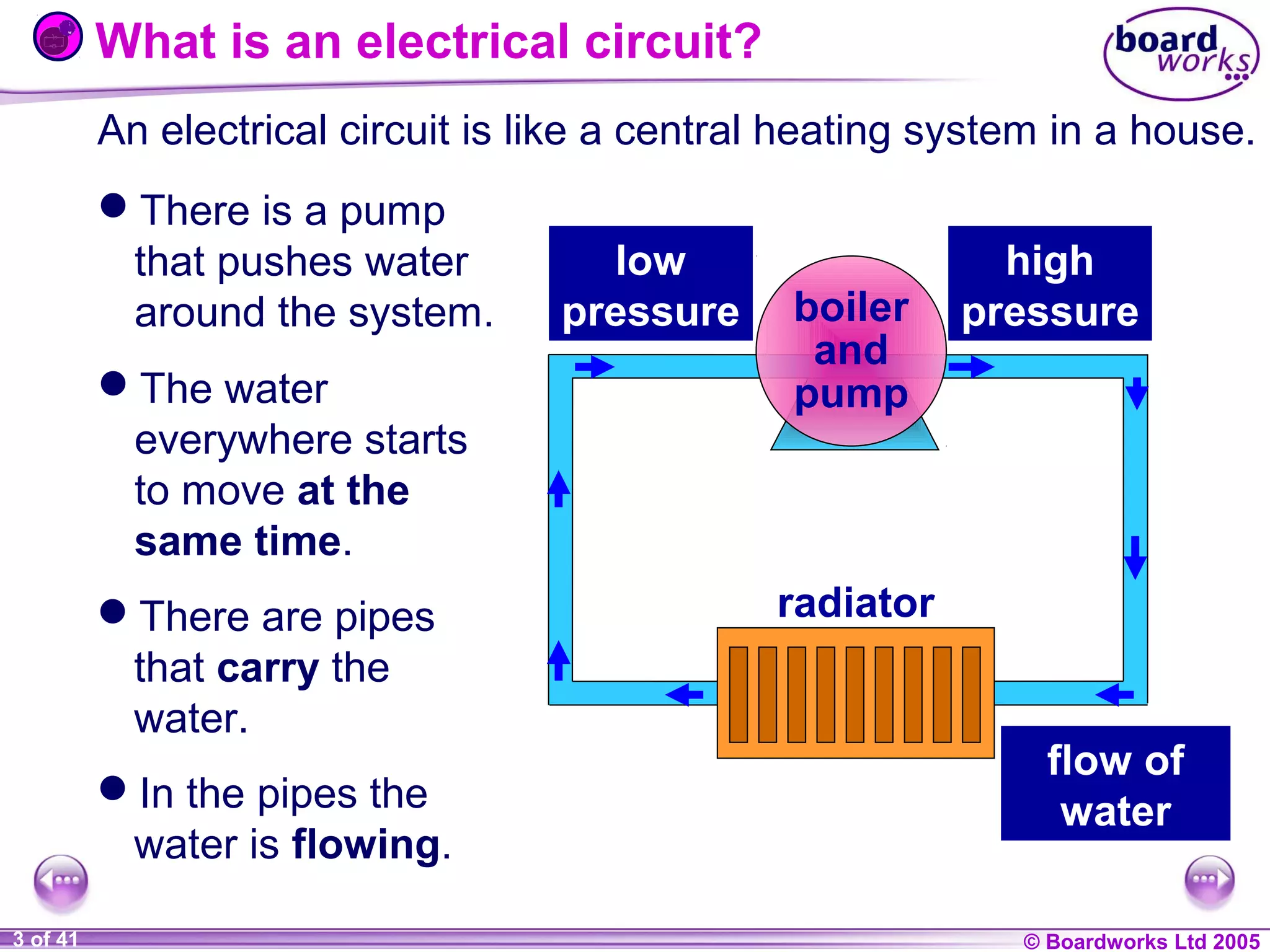
An electrical circuit is like a central heating system in a house.
There is a pump
that pushes water
around the system.
The water
everywhere starts
to move at the
same time.
There are pipes
that carry the
water.
In the pipes the
water is flowing.
1 of 41
20
3

low
pressure

boiler
and
pump

high
pressure

radiator
radiator

flow of
water
© Boardworks Ltd 2004
2005
What is an electrical circuit?
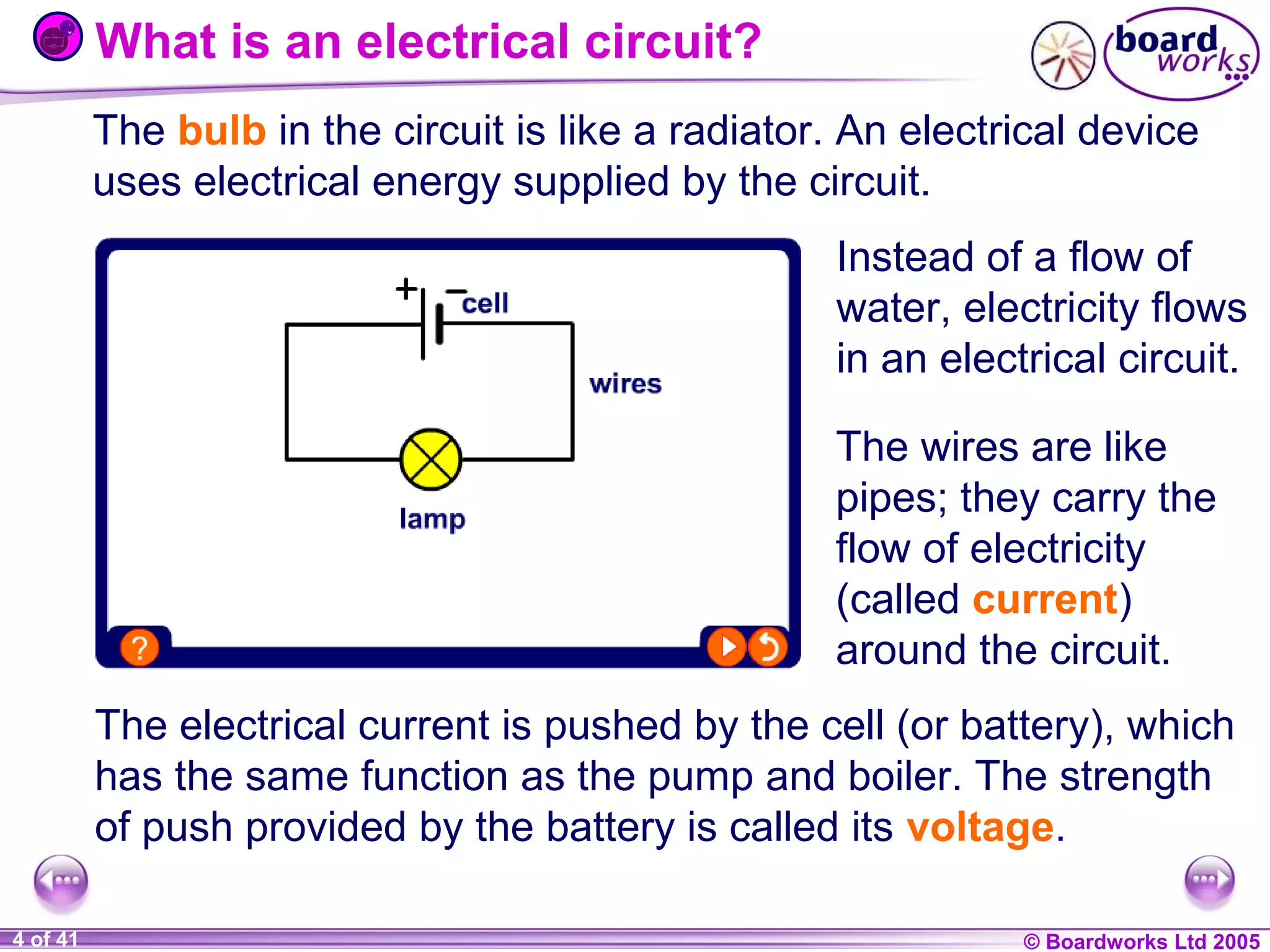
The bulb in the circuit is like a radiator. An electrical device
uses electrical energy supplied by the circuit.
Instead of a flow of
water, electricity flows
in an electrical circuit.
The wires are like
pipes; they carry the
flow of electricity
(called current)
around the circuit.
The electrical current is pushed by the cell (or battery), which
has the same function as the pump and boiler. The strength
of push provided by the battery is called its voltage.
1 of 41
20
4

© Boardworks Ltd 2004
2005
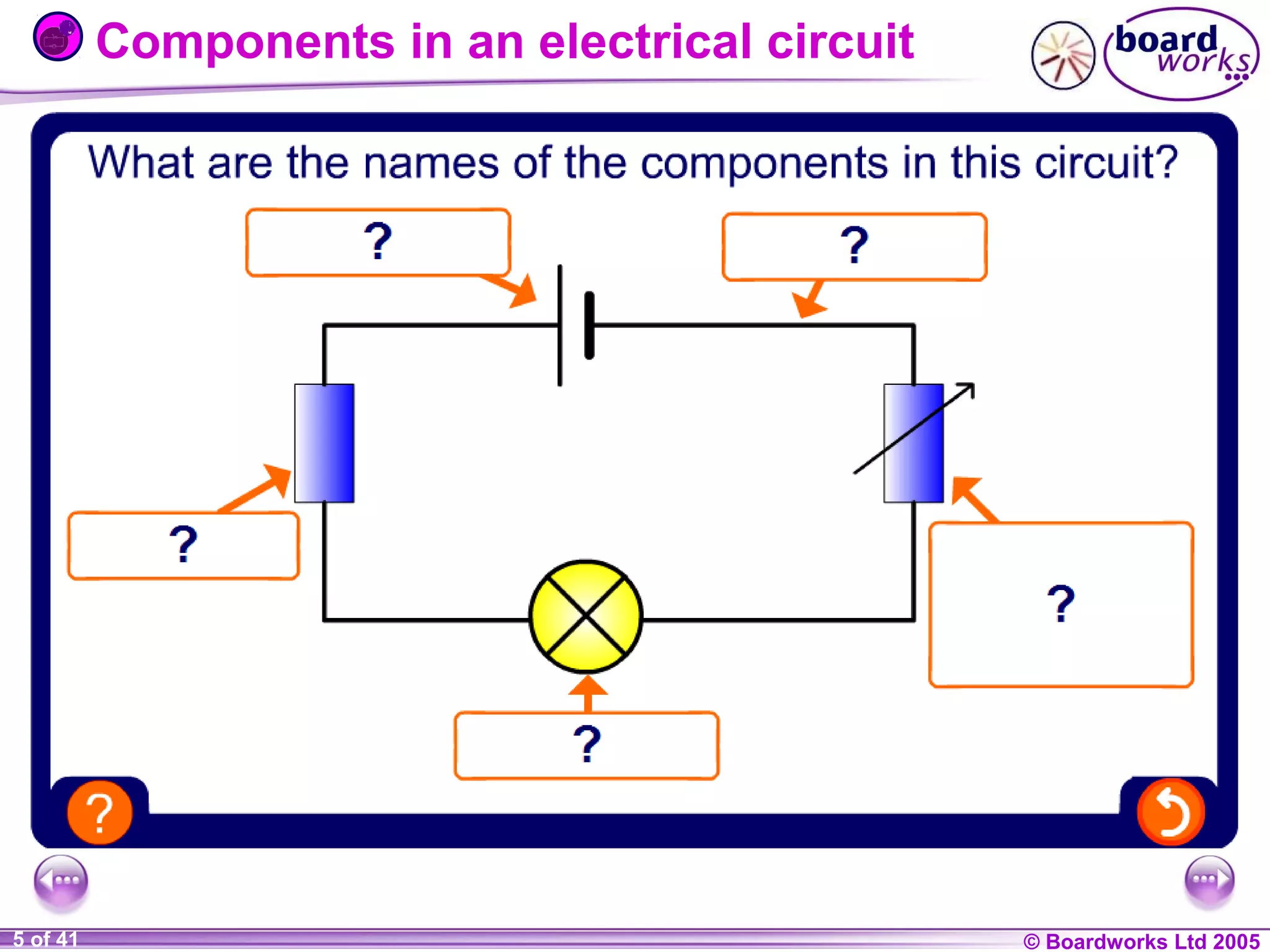
Components in an electrical circuit

1 of 41
20
5

© Boardworks Ltd 2004
2005
Contents

7J Electrical Circuits
Introducing circuits
Series circuits
Parallel circuits
Energy in circuits
Summary activities
1 of 41
20
6

© Boardworks Ltd 2004
2005
What is a series circuit?

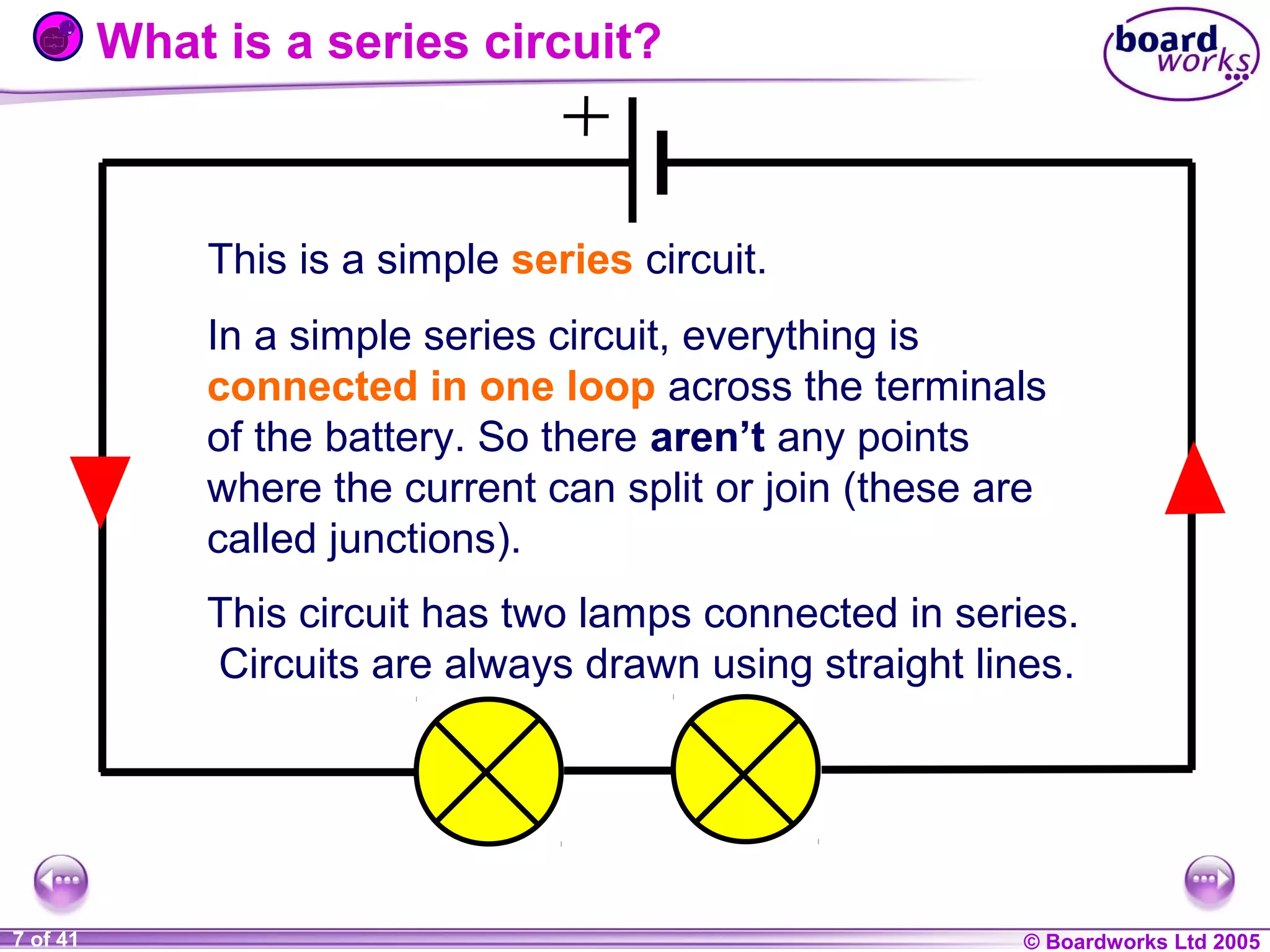
This is a simple series circuit.
In a simple series circuit, everything is
connected in one loop across the terminals
of the battery. So there aren’t any points
where the current can split or join (these are
called junctions).
This circuit has two lamps connected in series.
Circuits are always drawn using straight lines.

1 of 41
20
7

© Boardworks Ltd 2004
2005
Examples of series circuits
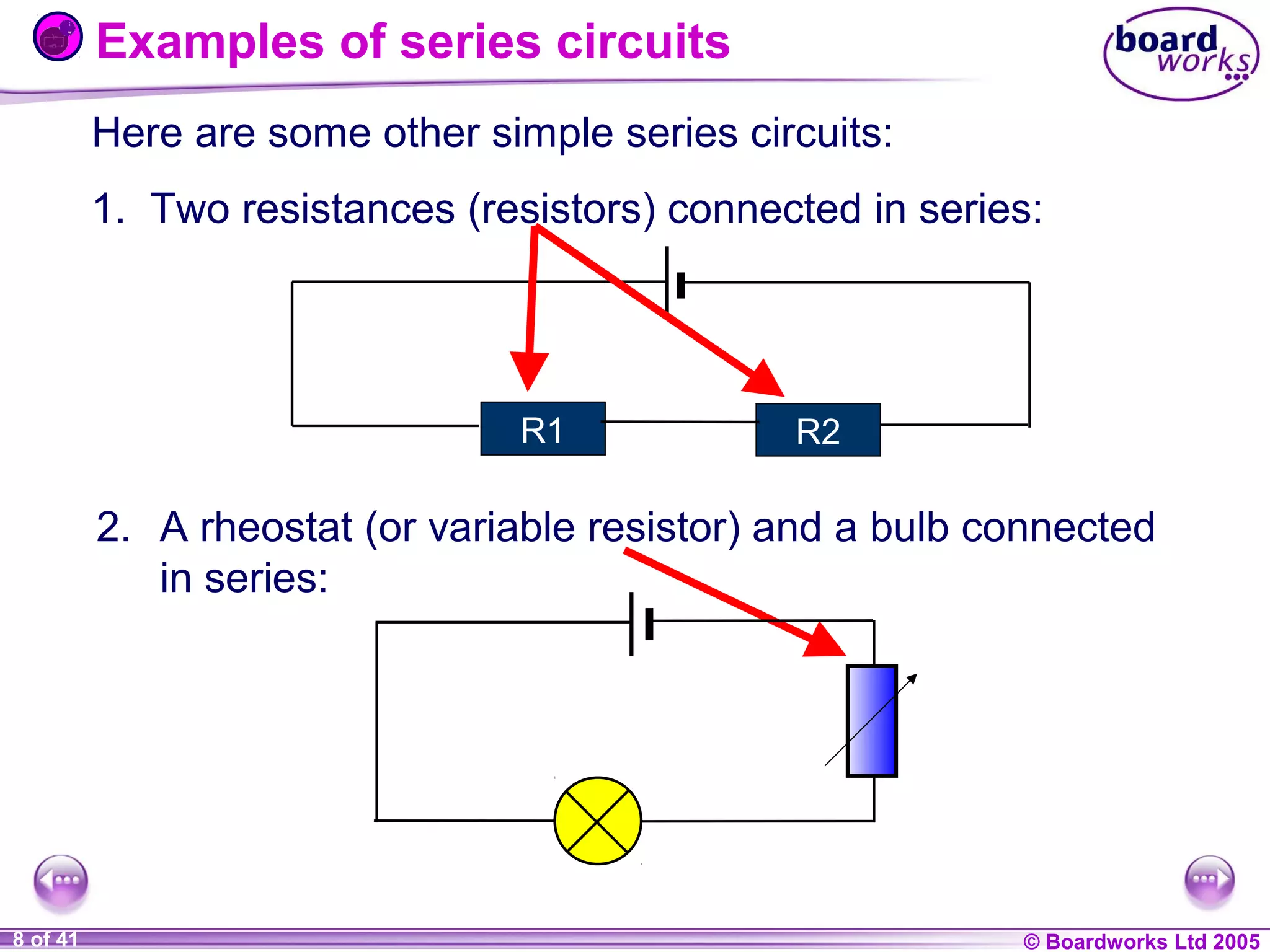
Here are some other simple series circuits:
1. Two resistances (resistors) connected in series:

R1

R2

2. A rheostat (or variable resistor) and a bulb connected
in series:

1 of 41
20
8

© Boardworks Ltd 2004
2005
Measuring current
The unit of measure for current is the amp, which has the
symbol A.
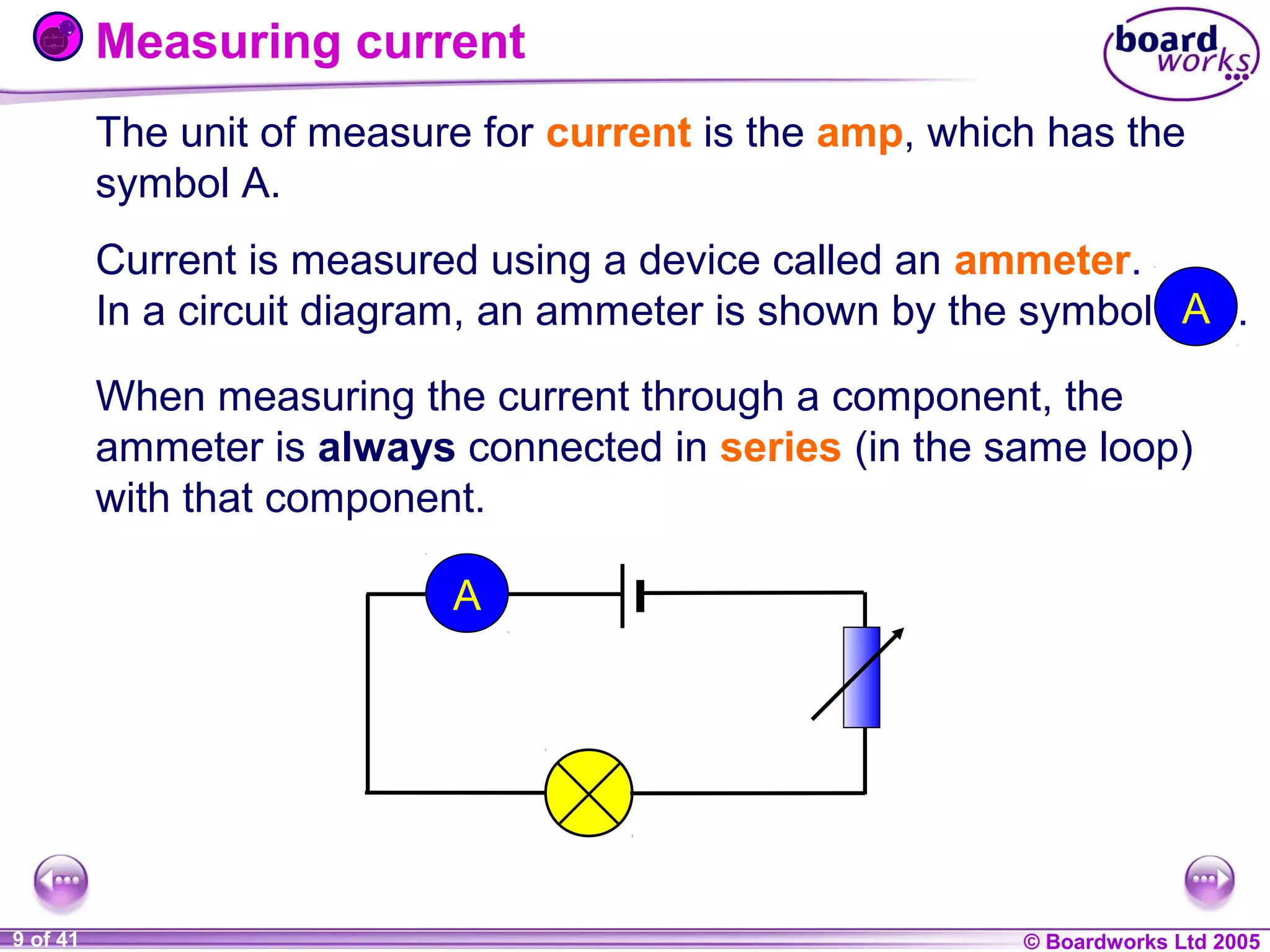
Current is measured using a device called an ammeter.
In a circuit diagram, an ammeter is shown by the symbol A .
When measuring the current through a component, the
ammeter is always connected in series (in the same loop)
with that component.
A

1 of 41
20
9

© Boardworks Ltd 2004
2005
Experiment 1: Current in series circuit
Circuit 1
1

A
R1

A
2

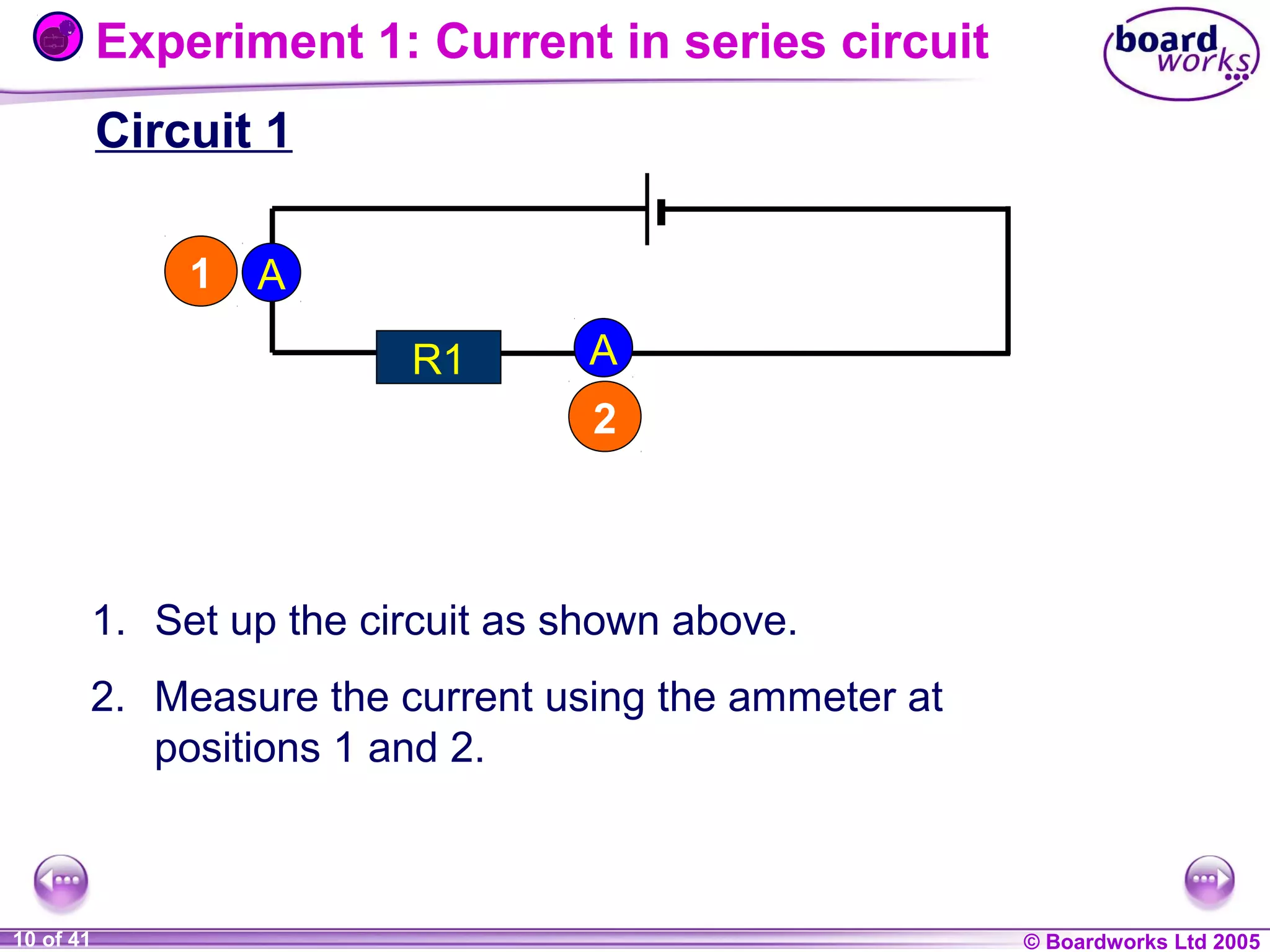
1. Set up the circuit as shown above.
2. Measure the current using the ammeter at
positions 1 and 2.

1 of 20
10 of 41

© Boardworks Ltd 2004
2005
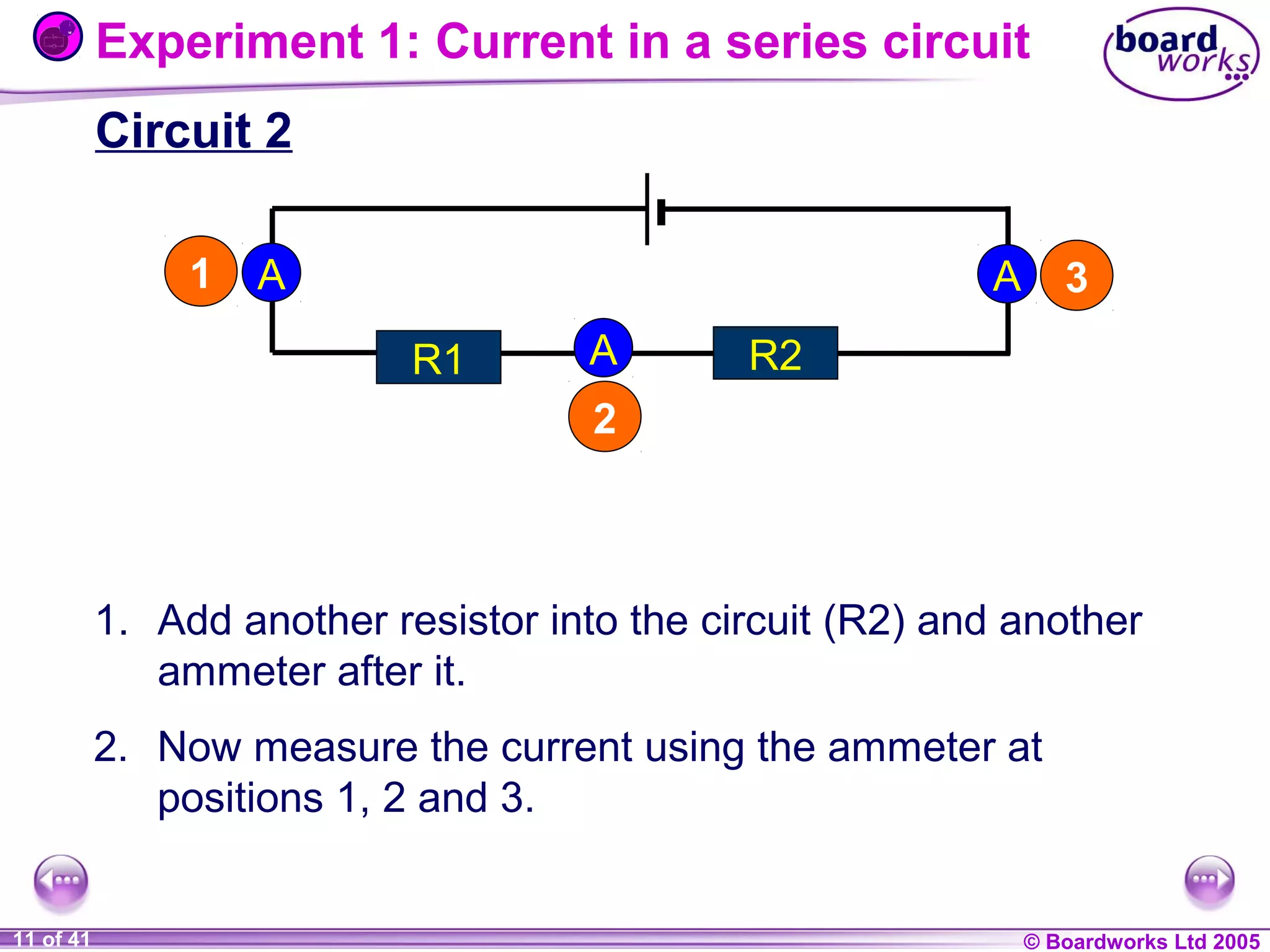
Experiment 1: Current in a series circuit
Circuit 2
1

A

A
R1

A

3

R2

2

1. Add another resistor into the circuit (R2) and another
ammeter after it.
2. Now measure the current using the ammeter at
positions 1, 2 and 3.
1 of 20
11 of 41

© Boardworks Ltd 2004
2005
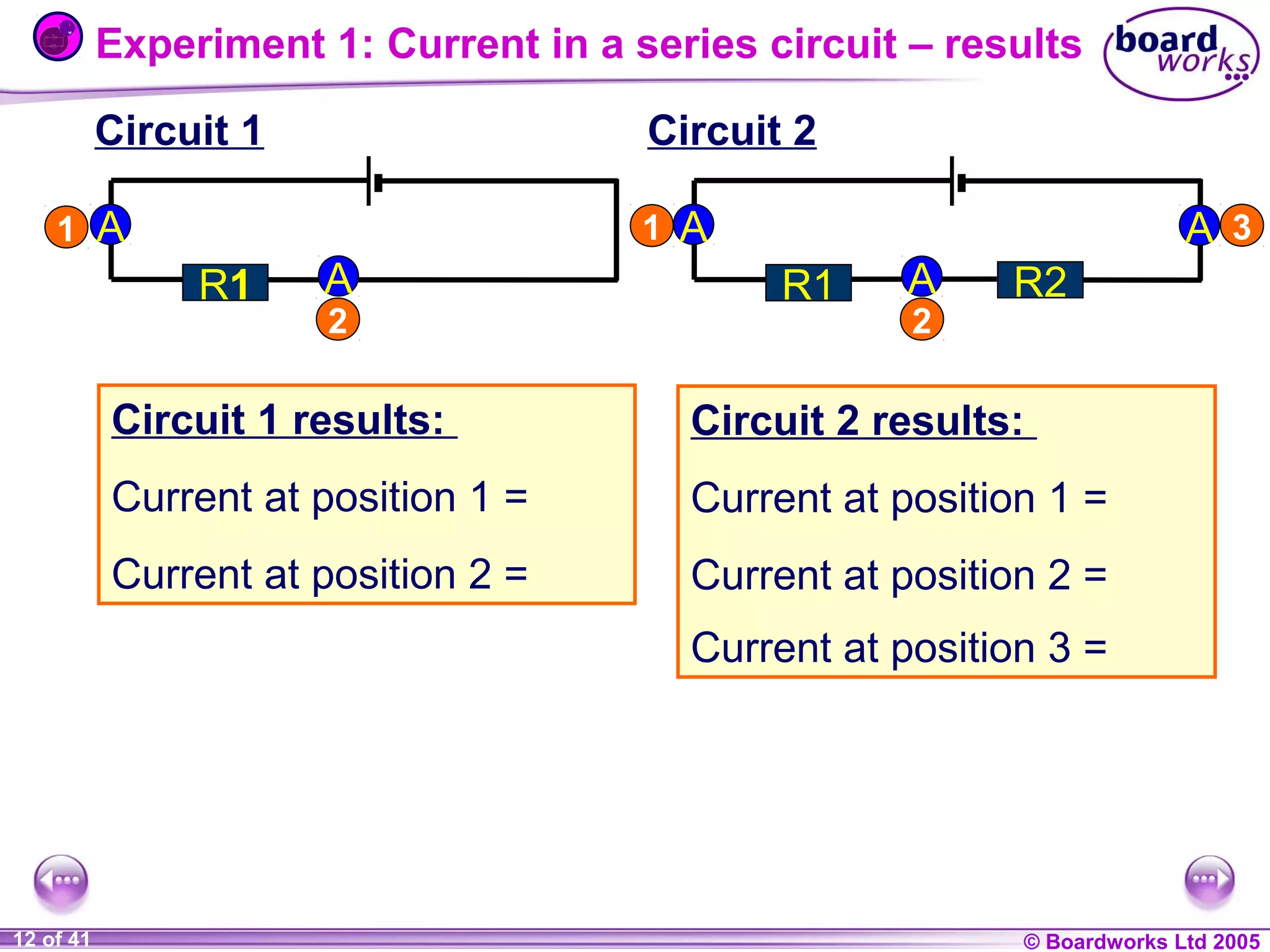
Experiment 1: Current in a series circuit – results
Circuit 1
1

Circuit 2

A

1

R1

A
2

A

A 3
R1

A
2

R2

Circuit 1 results:

Circuit 2 results:

Current at position 1 =

Current at position 1 =

Current at position 2 =

Current at position 2 =
Current at position 3 =

1 of 20
12 of 41

© Boardworks Ltd 2004
2005
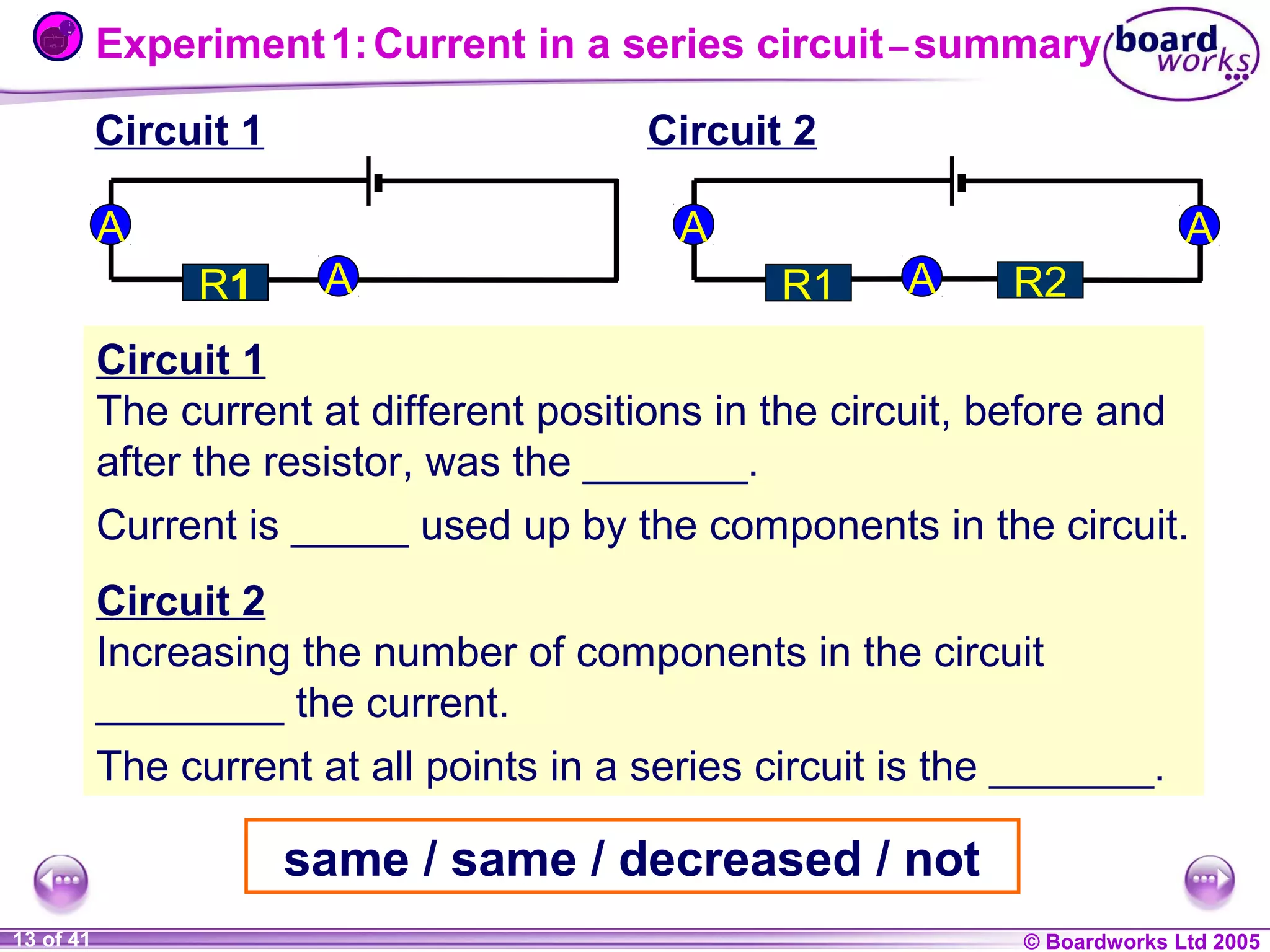
Experiment 1: Current in a series circuit – summary
Circuit 1

Circuit 2

A

A
R1

A

A
R1

A

R2

Circuit 1
The current at different positions in the circuit, before and
after the resistor, was the _______.
Current is _____ used up by the components in the circuit.
Circuit 2
Increasing the number of components in the circuit
________ the current.
The current at all points in a series circuit is the _______.

same / same / decreased / not
1 of 20
13 of 41

© Boardworks Ltd 2004
2005
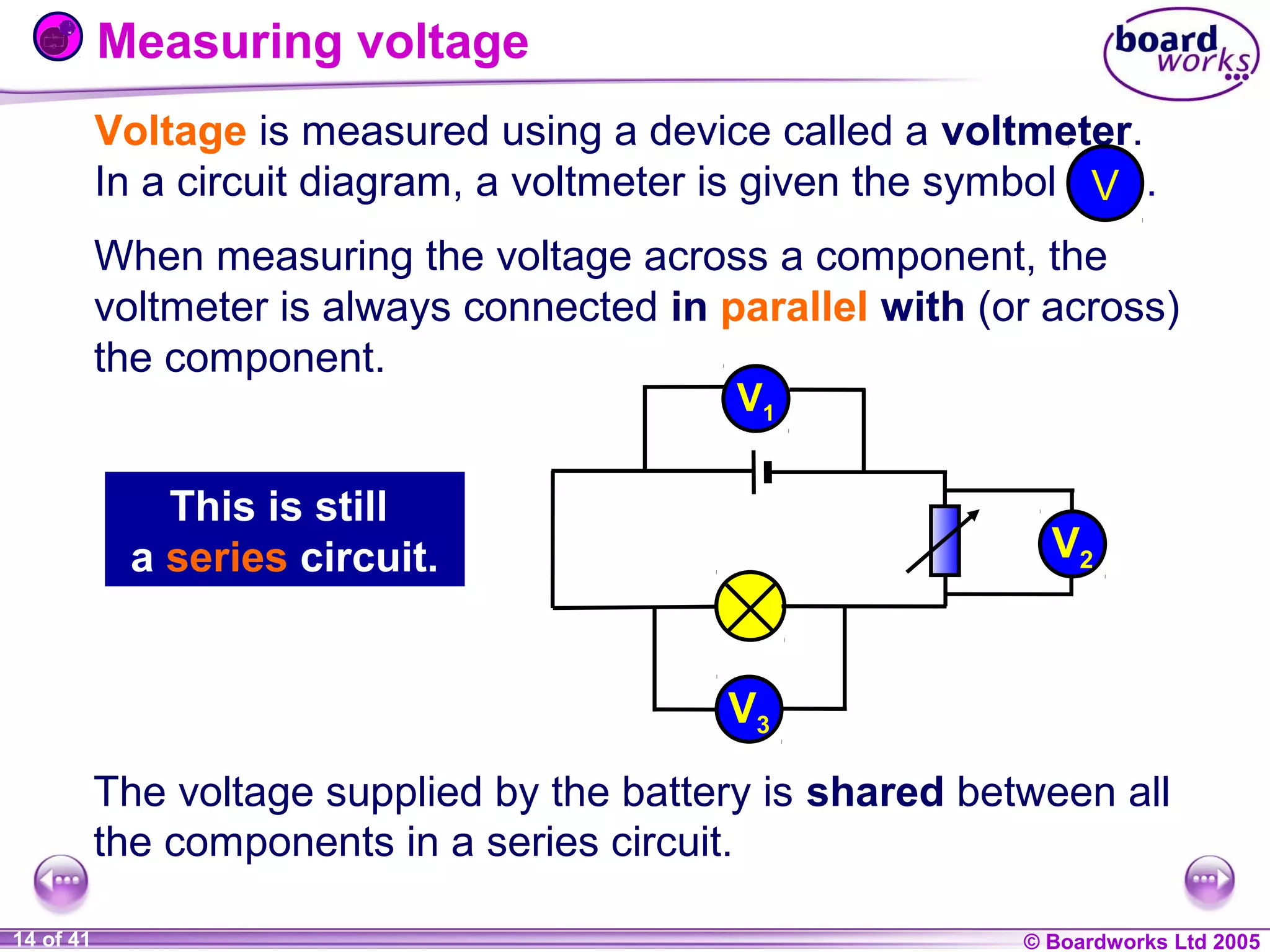
Measuring voltage
Voltage is measured using a device called a voltmeter.
In a circuit diagram, a voltmeter is given the symbol V .
When measuring the voltage across a component, the
voltmeter is always connected in parallel with (or across)
the component.
V1

This is still
a series circuit.

V2

V3
The voltage supplied by the battery is shared between all
the components in a series circuit.
1 of 20
14 of 41

© Boardworks Ltd 2004
2005
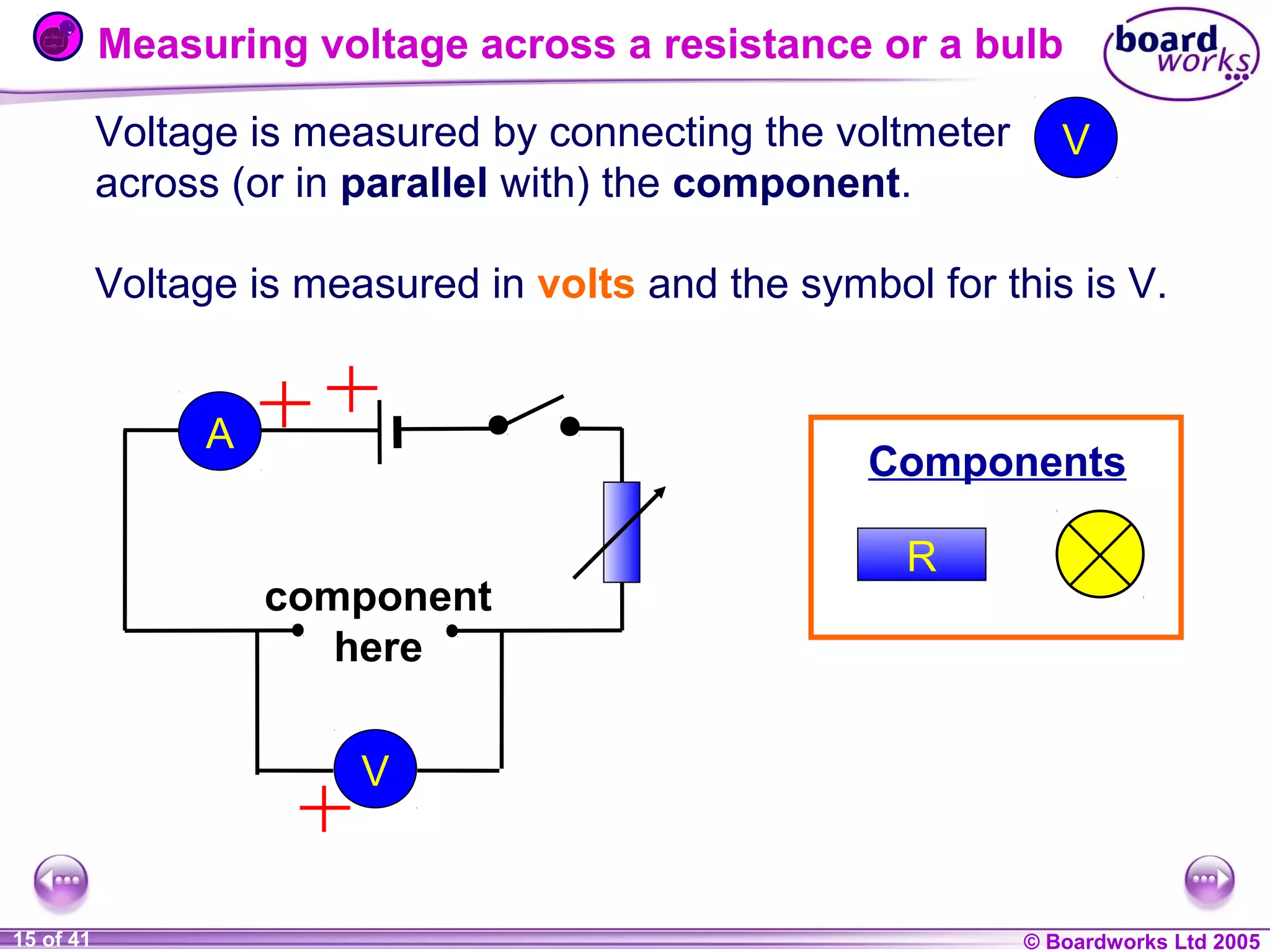
Measuring voltage across a resistance or a bulb
Voltage is measured by connecting the voltmeter
across (or in parallel with) the component.

V

Voltage is measured in volts and the symbol for this is V.
A

Components
component
here

R

V

1 of 20
15 of 41

© Boardworks Ltd 2004
2005
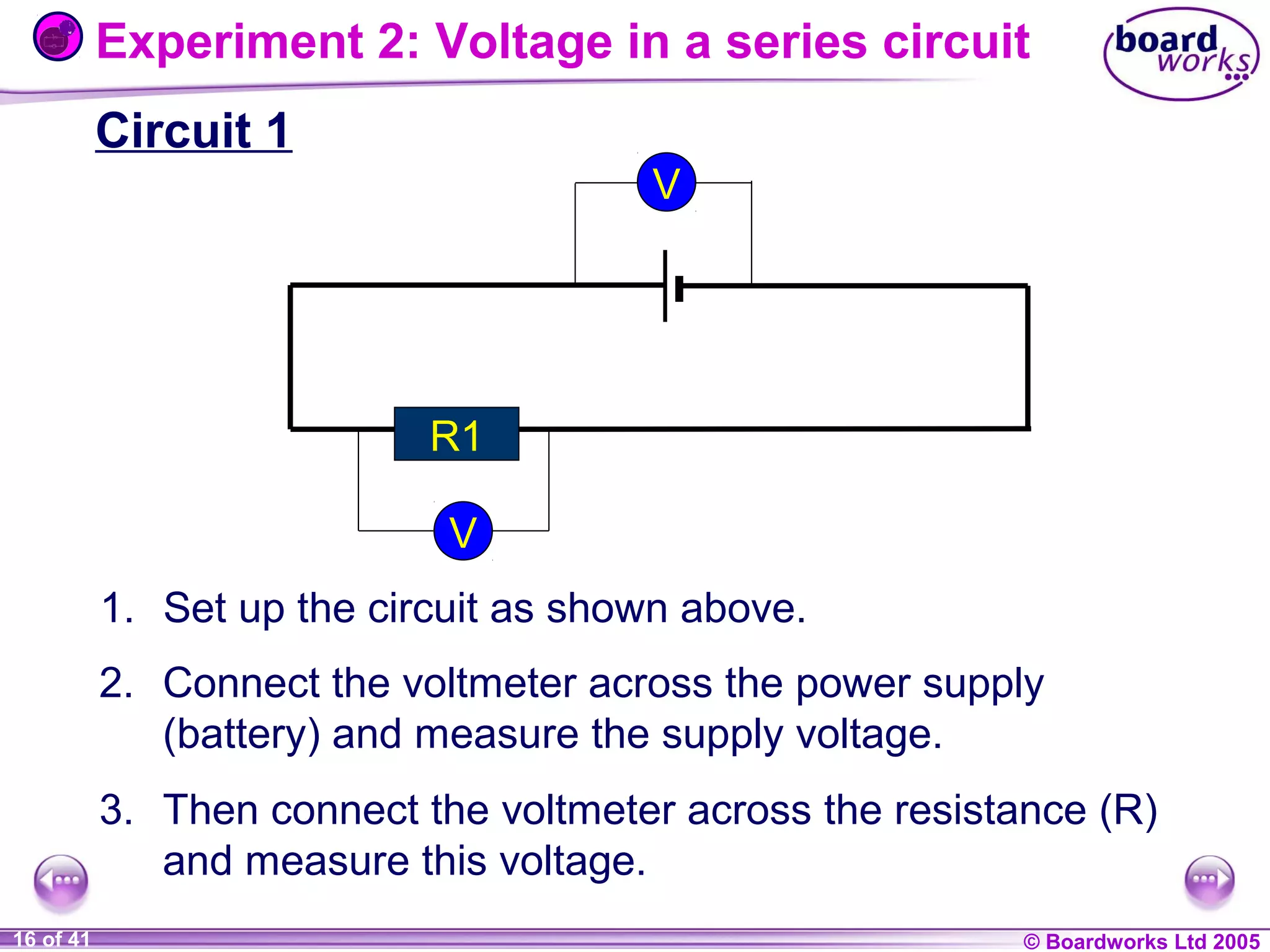
Experiment 2: Voltage in a series circuit
Circuit 1
V

R1
V
1. Set up the circuit as shown above.
2. Connect the voltmeter across the power supply
(battery) and measure the supply voltage.
3. Then connect the voltmeter across the resistance (R)
and measure this voltage.
1 of 20
16 of 41

© Boardworks Ltd 2004
2005
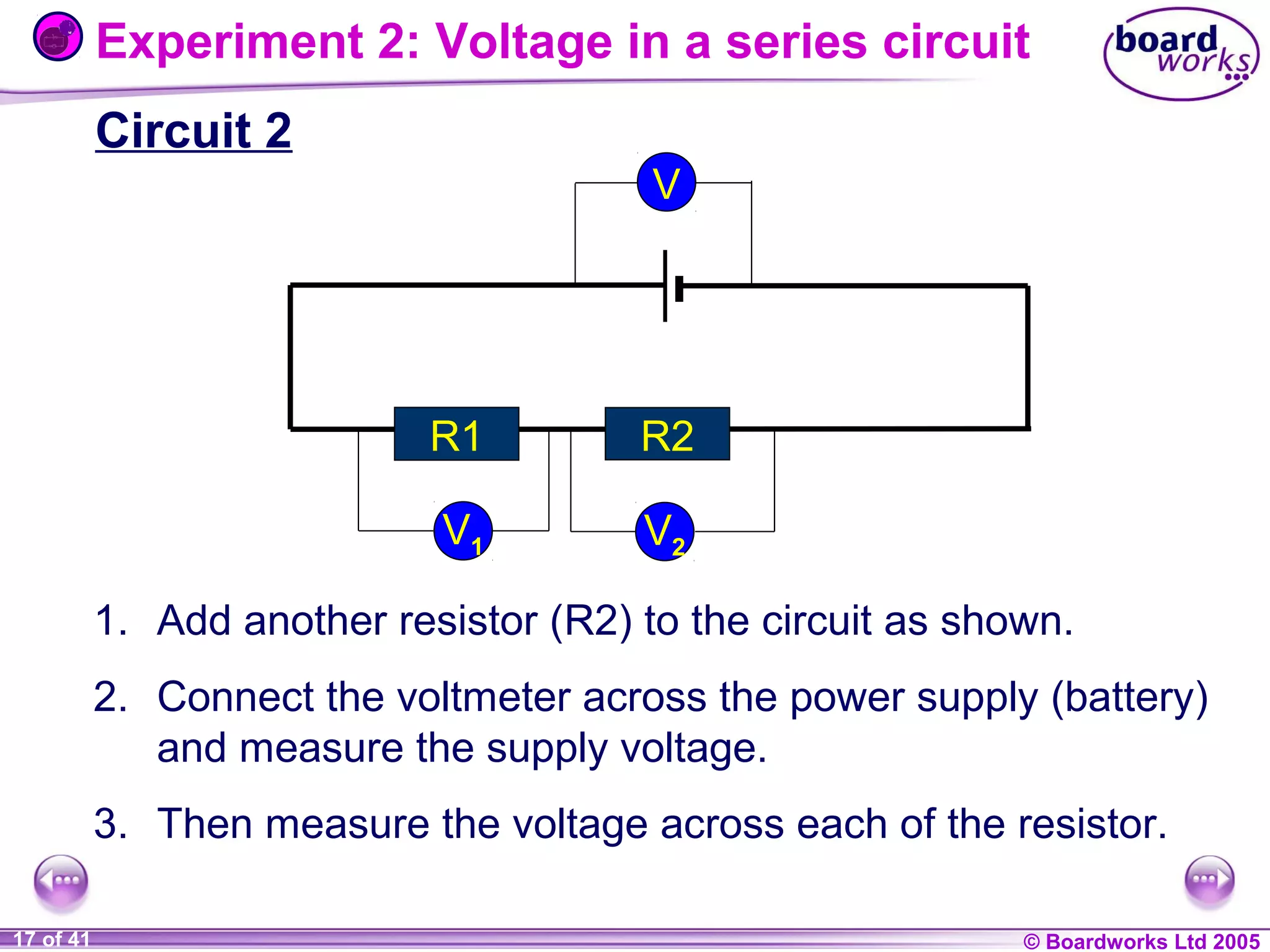
Experiment 2: Voltage in a series circuit
Circuit 2
V

R1

R2

V1

V2

1. Add another resistor (R2) to the circuit as shown.
2. Connect the voltmeter across the power supply (battery)
and measure the supply voltage.
3. Then measure the voltage across each of the resistor.
1 of 20
17 of 41

© Boardworks Ltd 2004
2005
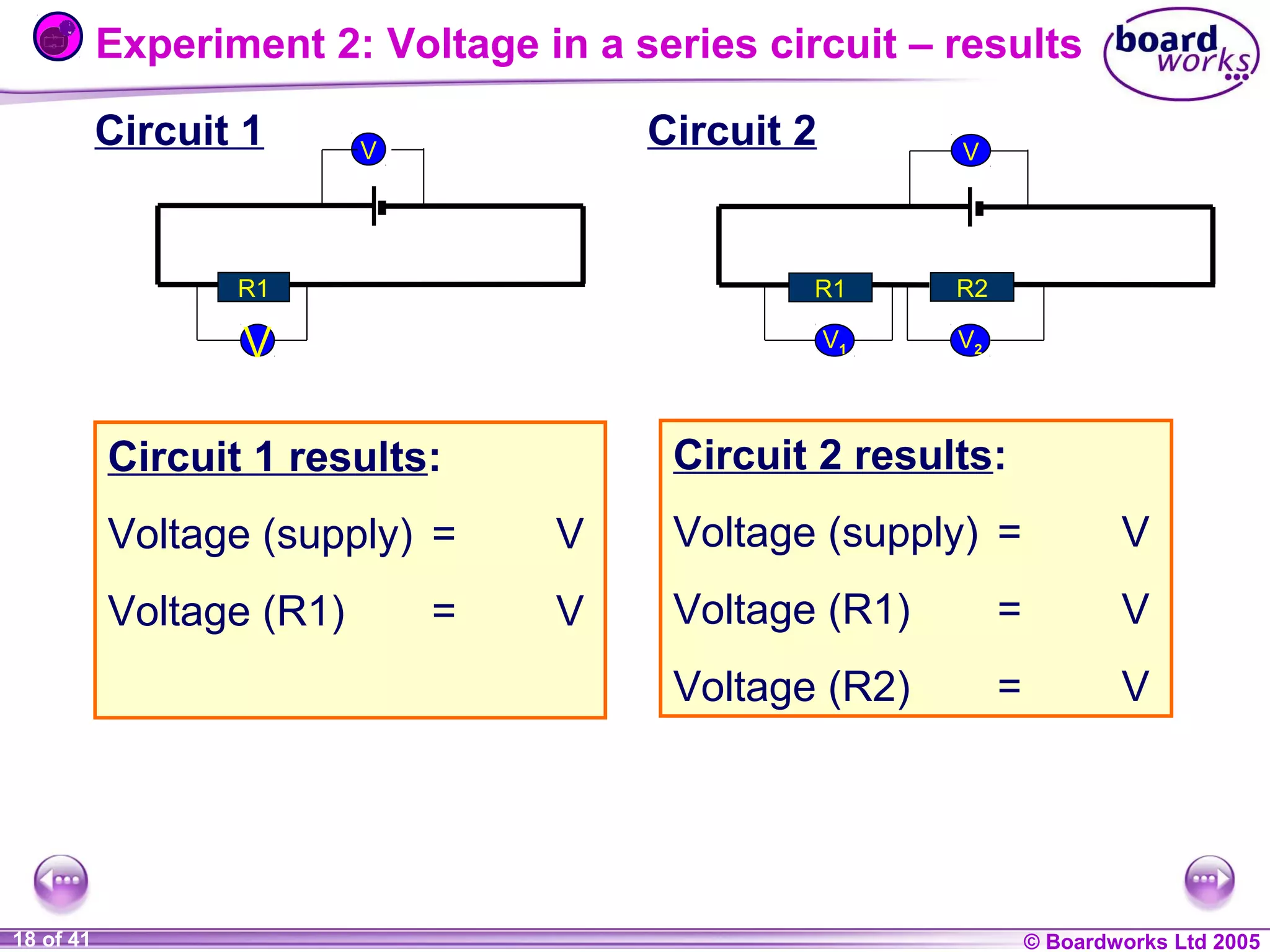
Experiment 2: Voltage in a series circuit – results
Circuit 1

Circuit 2

V

V

R1

R1

R2

V

V1

V2

Circuit 2 results:

Circuit 1 results:
Voltage (supply) =

Voltage (supply) =

V

Voltage (R1)

V

Voltage (R1)

=

V

Voltage (R2)

1 of 20
18 of 41

V

=

V

=

© Boardworks Ltd 2004
2005
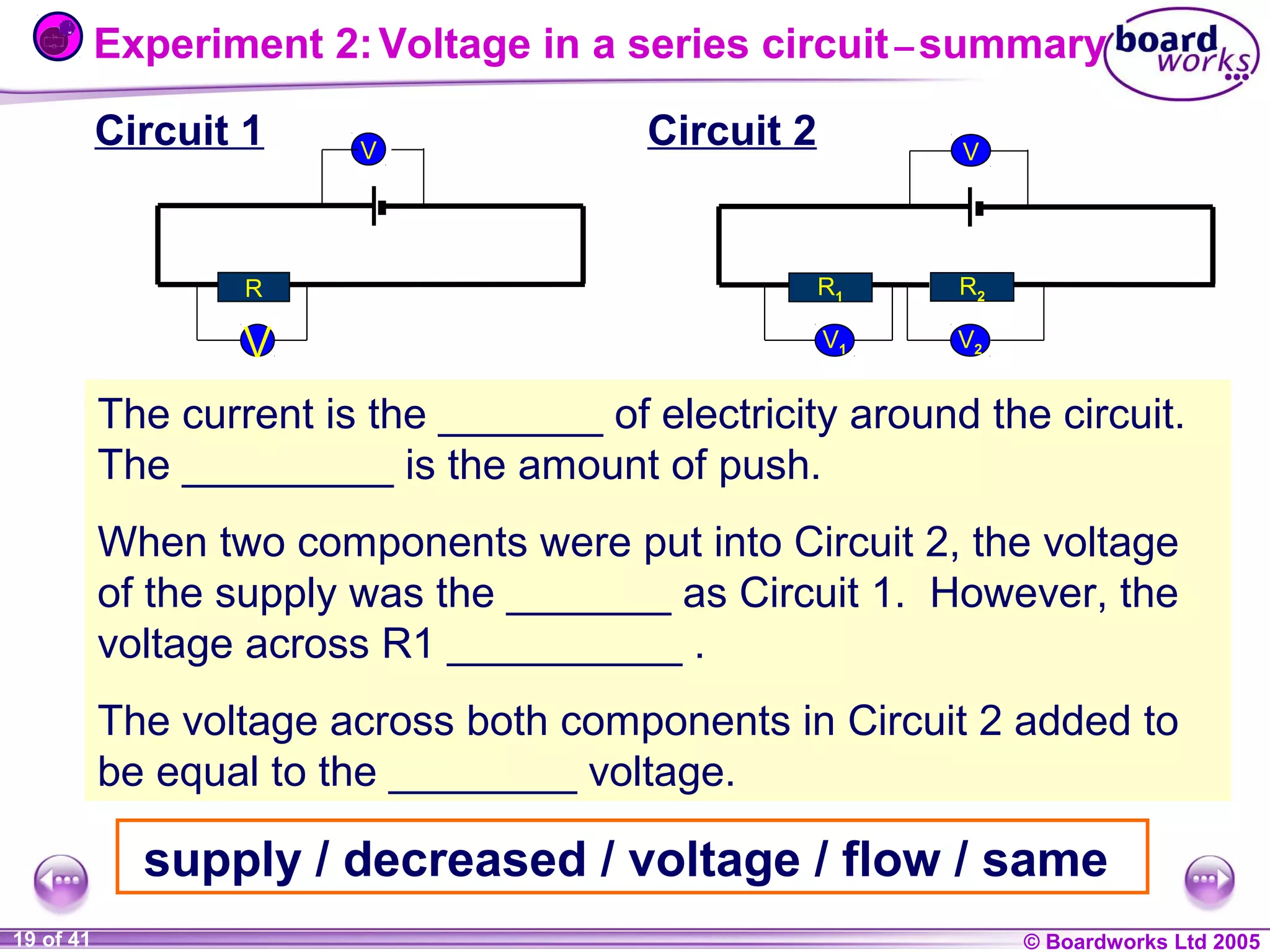
Experiment 2: Voltage in a series circuit – summary
Circuit 1

V

Circuit 2

V

R

R1

R2

V

V1

V2

The current is the _______ of electricity around the circuit.
The _________ is the amount of push.
When two components were put into Circuit 2, the voltage
of the supply was the _______ as Circuit 1. However, the
voltage across R1 __________ .
The voltage across both components in Circuit 2 added to
be equal to the ________ voltage.

supply / decreased / voltage / flow / same
1 of 20
19 of 41

© Boardworks Ltd 2004
2005
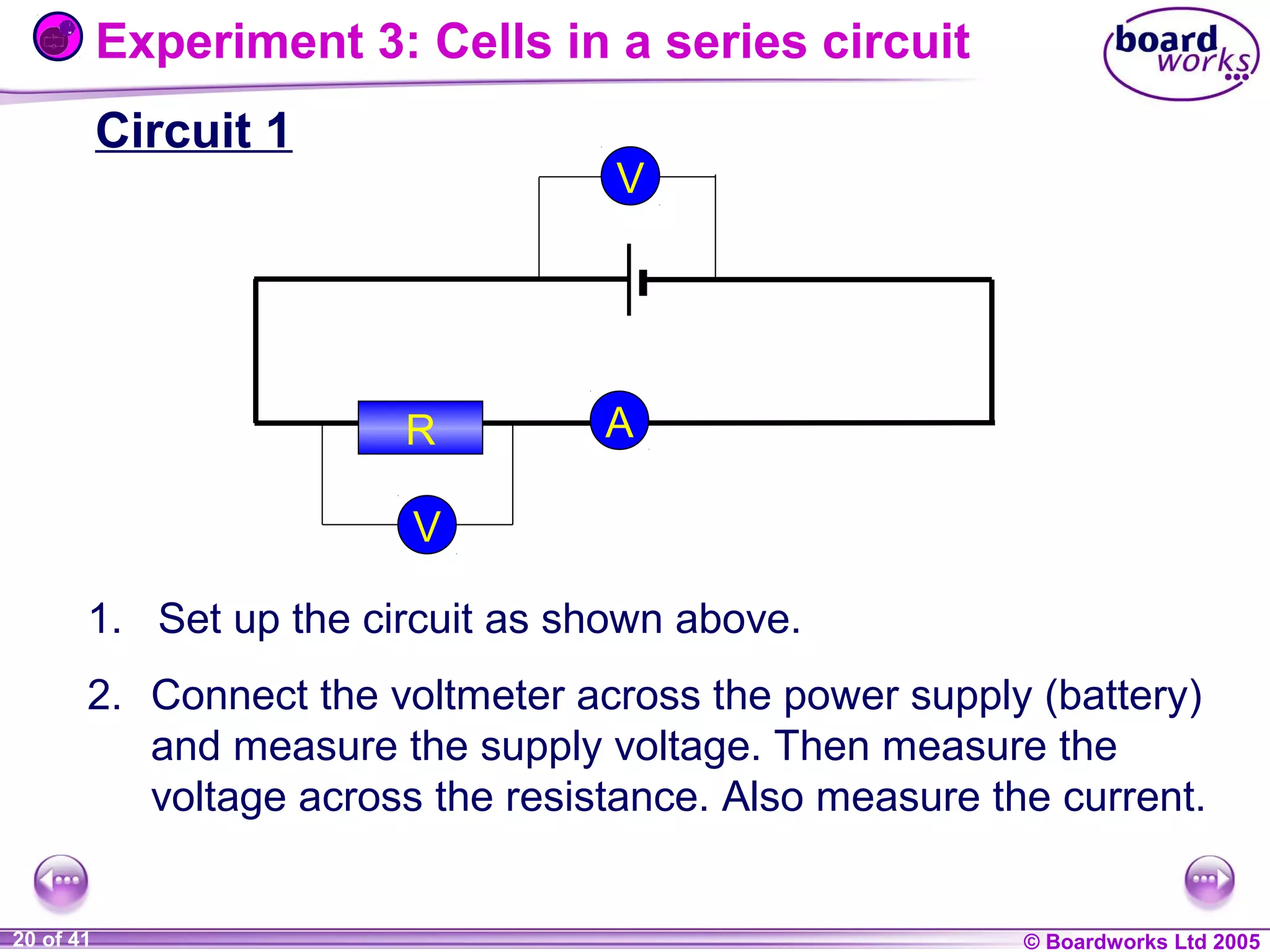
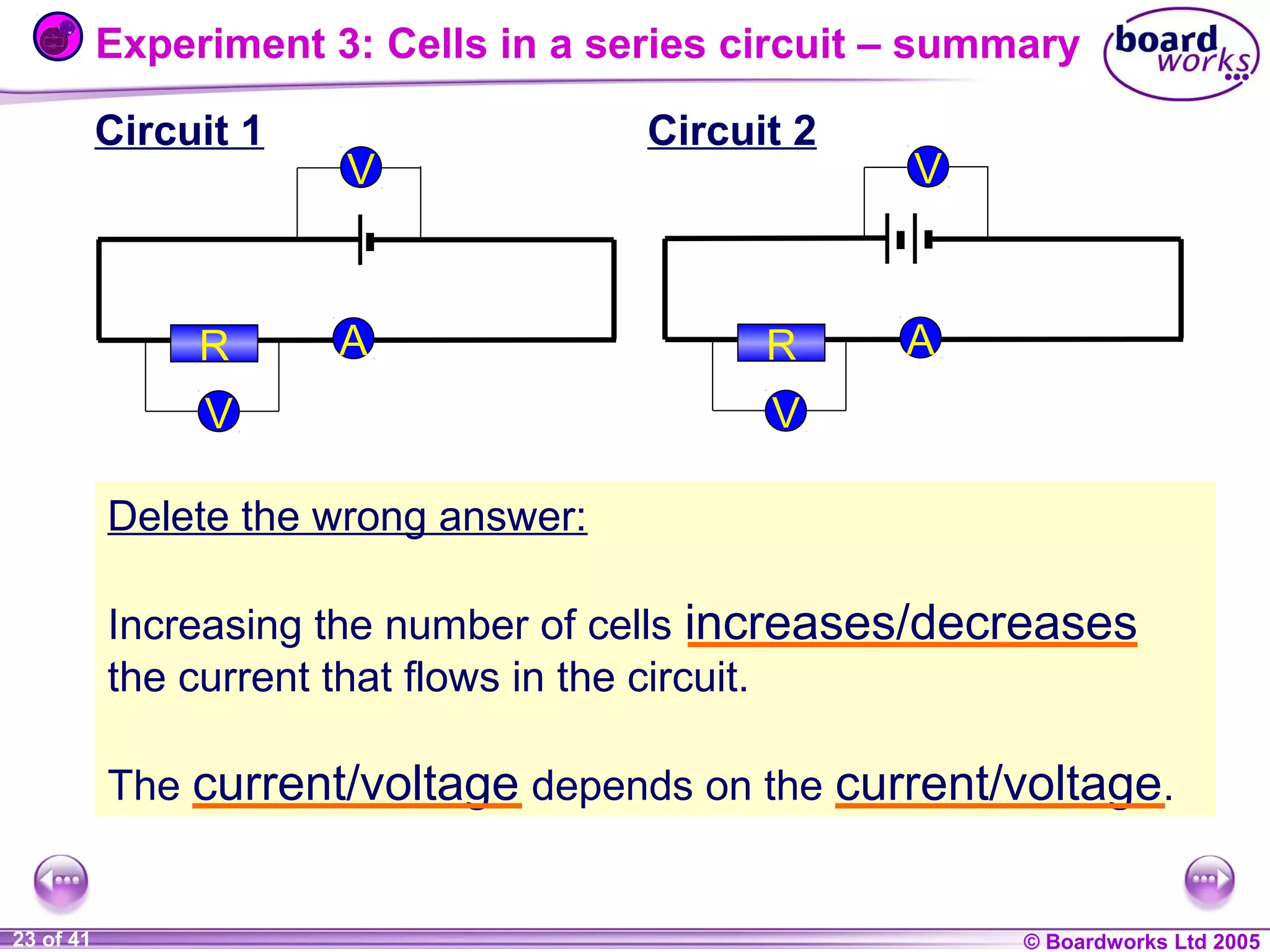
Experiment 3: Cells in a series circuit
Circuit 1

V

R

A

V
1. Set up the circuit as shown above.
2. Connect the voltmeter across the power supply (battery)
and measure the supply voltage. Then measure the
voltage across the resistance. Also measure the current.

1 of 20
20 of 41

© Boardworks Ltd 2004
2005
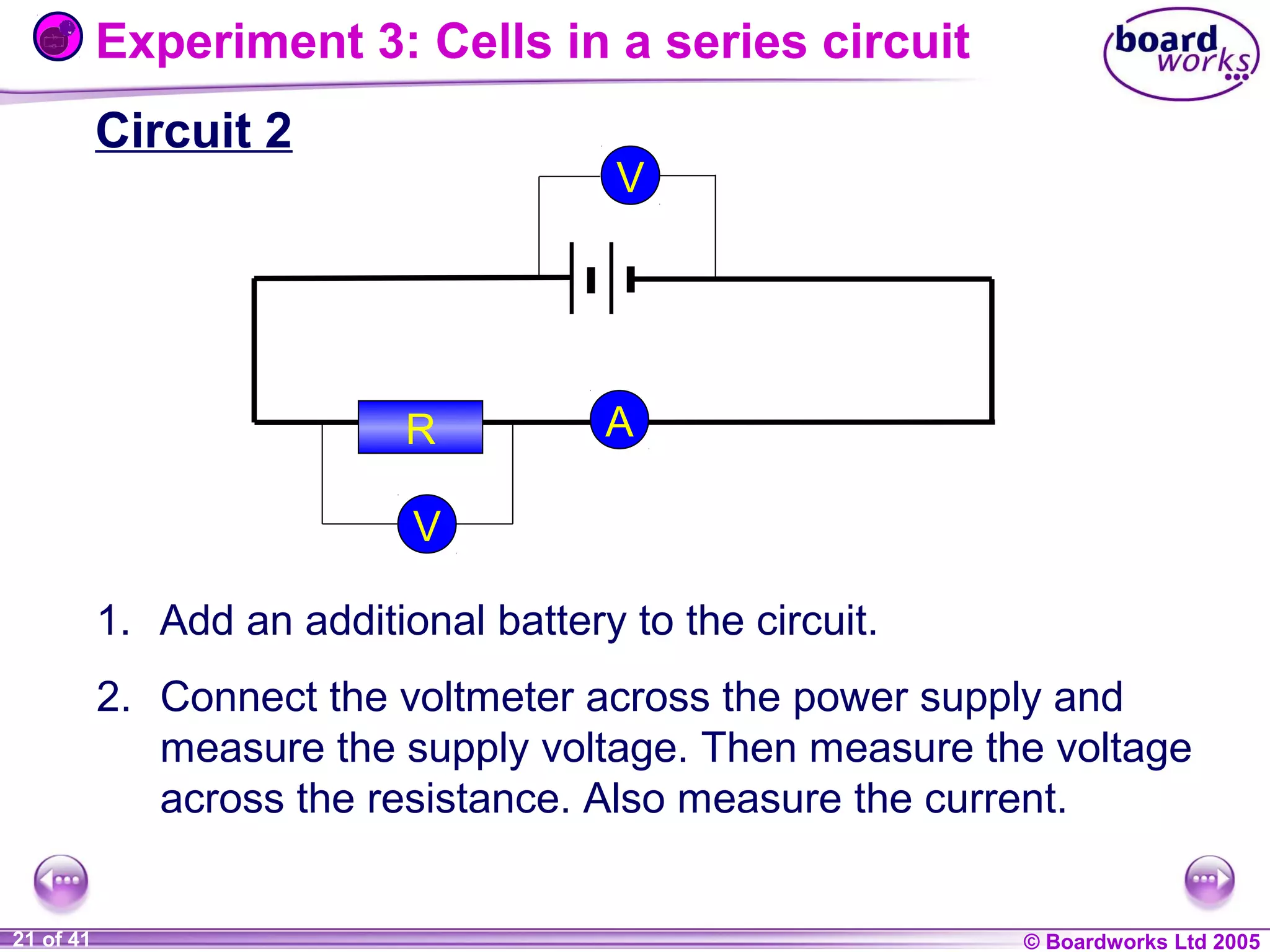
Experiment 3: Cells in a series circuit
Circuit 2

V

R

A

V
1. Add an additional battery to the circuit.
2. Connect the voltmeter across the power supply and
measure the supply voltage. Then measure the voltage
across the resistance. Also measure the current.
1 of 20
21 of 41

© Boardworks Ltd 2004
2005
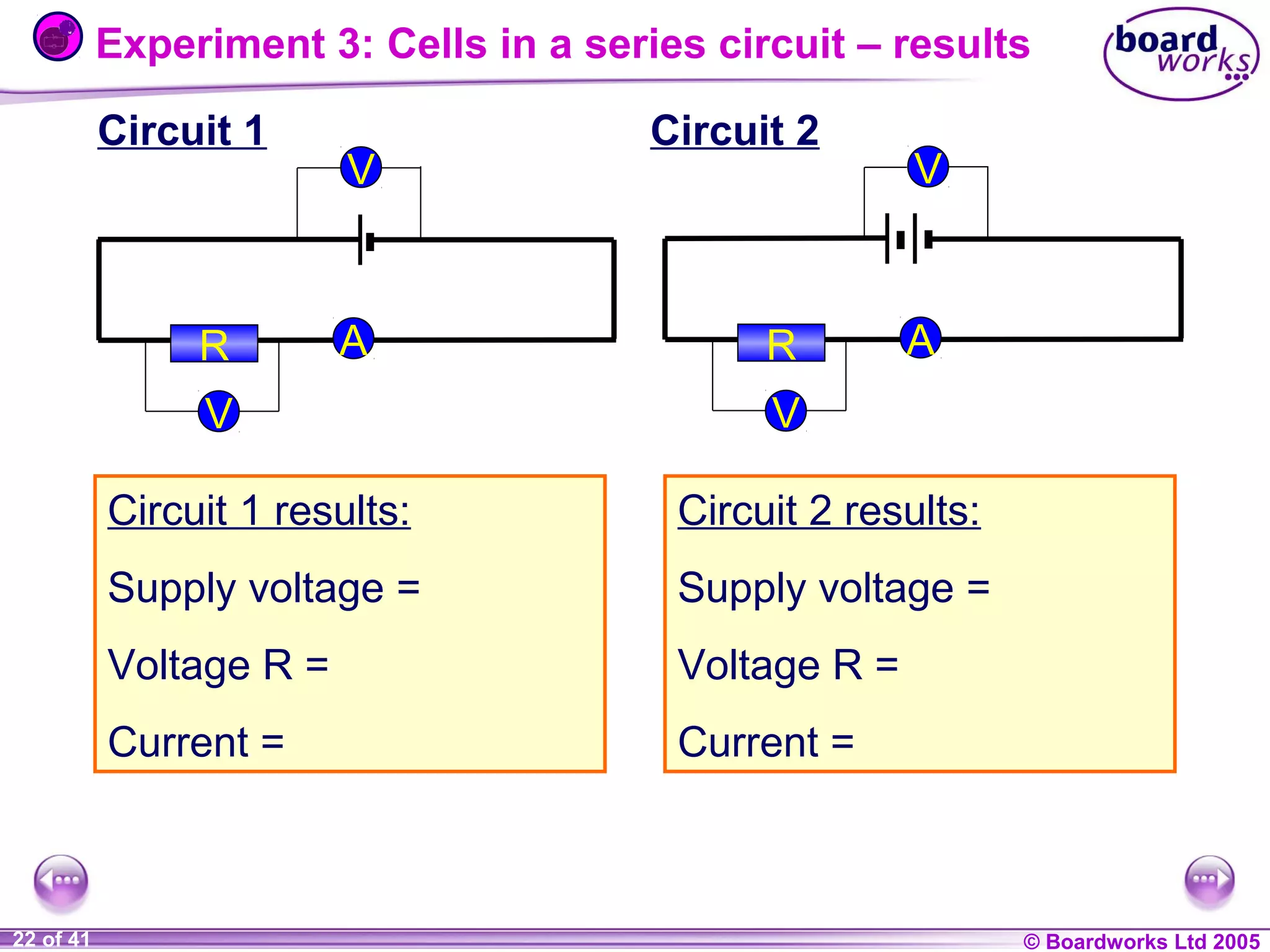
Experiment 3: Cells in a series circuit – results
Circuit 1

R

V

A

V

Circuit 2

R

V

A

V

Circuit 1 results:
Supply voltage =

Supply voltage =

Voltage R =

Voltage R =

Current =

1 of 20
22 of 41

Circuit 2 results:

Current =

© Boardworks Ltd 2004
2005
Experiment 3: Cells in a series circuit – summary
Circuit 1

R

V

A

V

Circuit 2

R

V

A

V

Delete the wrong answer:
Increasing the number of cells increases/decreases
the current that flows in the circuit.
The current/voltage depends on the current/voltage.

1 of 20
23 of 41

© Boardworks Ltd 2004
2005
Series circuits – key ideas
1. In a series circuit the current is the same in all parts
of the circuit.

2. The supply voltage is shared between the components
in a series circuit. (The sum of the voltage across each
component is the same as the total supply voltage.)

3. The current depends on the voltage in any circuit.

1 of 20
24 of 41

© Boardworks Ltd 2004
2005
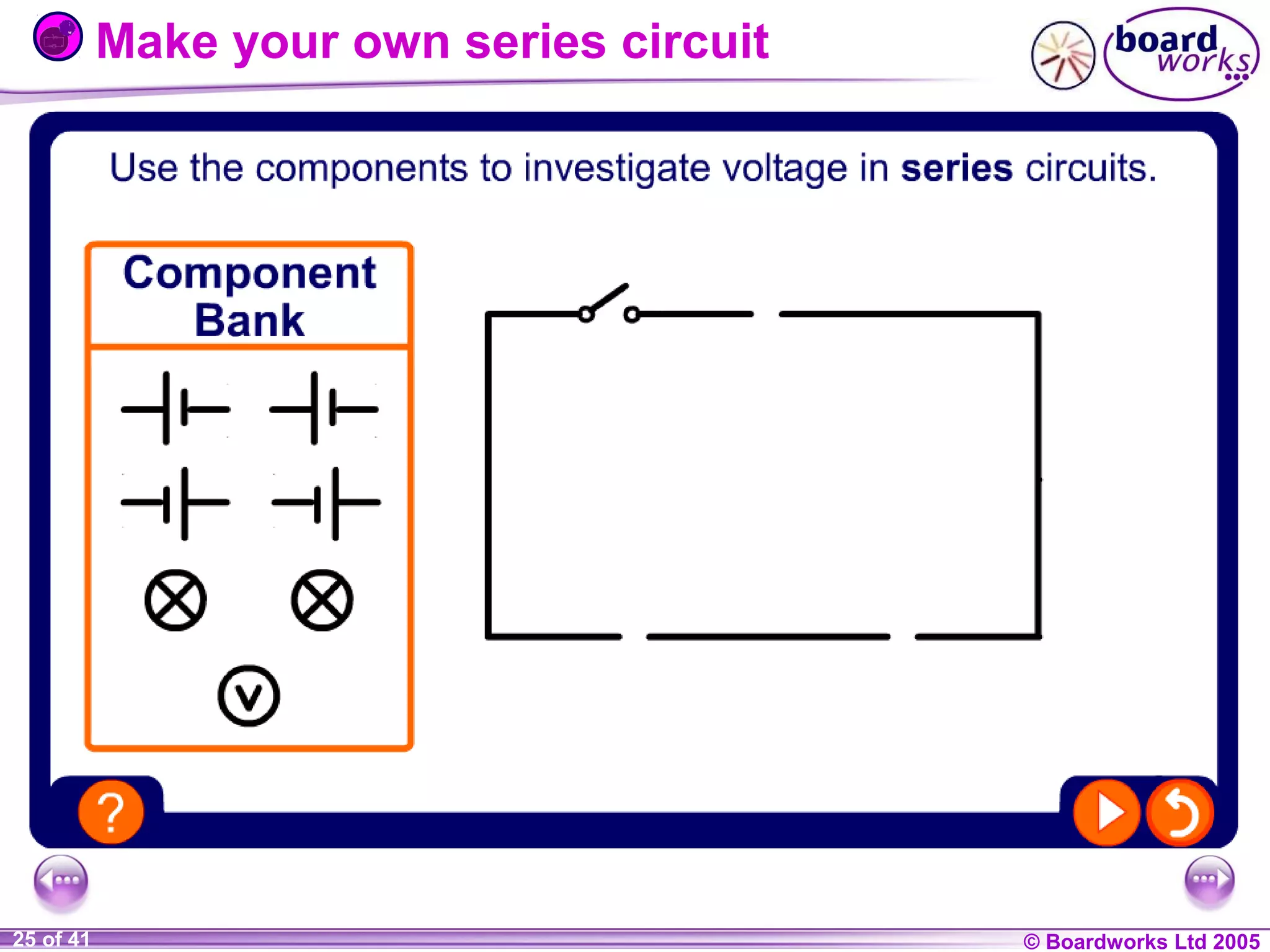
Make your own series circuit

1 of 20
25 of 41

© Boardworks Ltd 2004
2005
Contents

7J Electrical Circuits
Introducing circuits
Series circuits
Parallel circuits
Energy in circuits
Summary activities
1 of 20
26 of 41

© Boardworks Ltd 2004
2005
What is a parallel circuit?
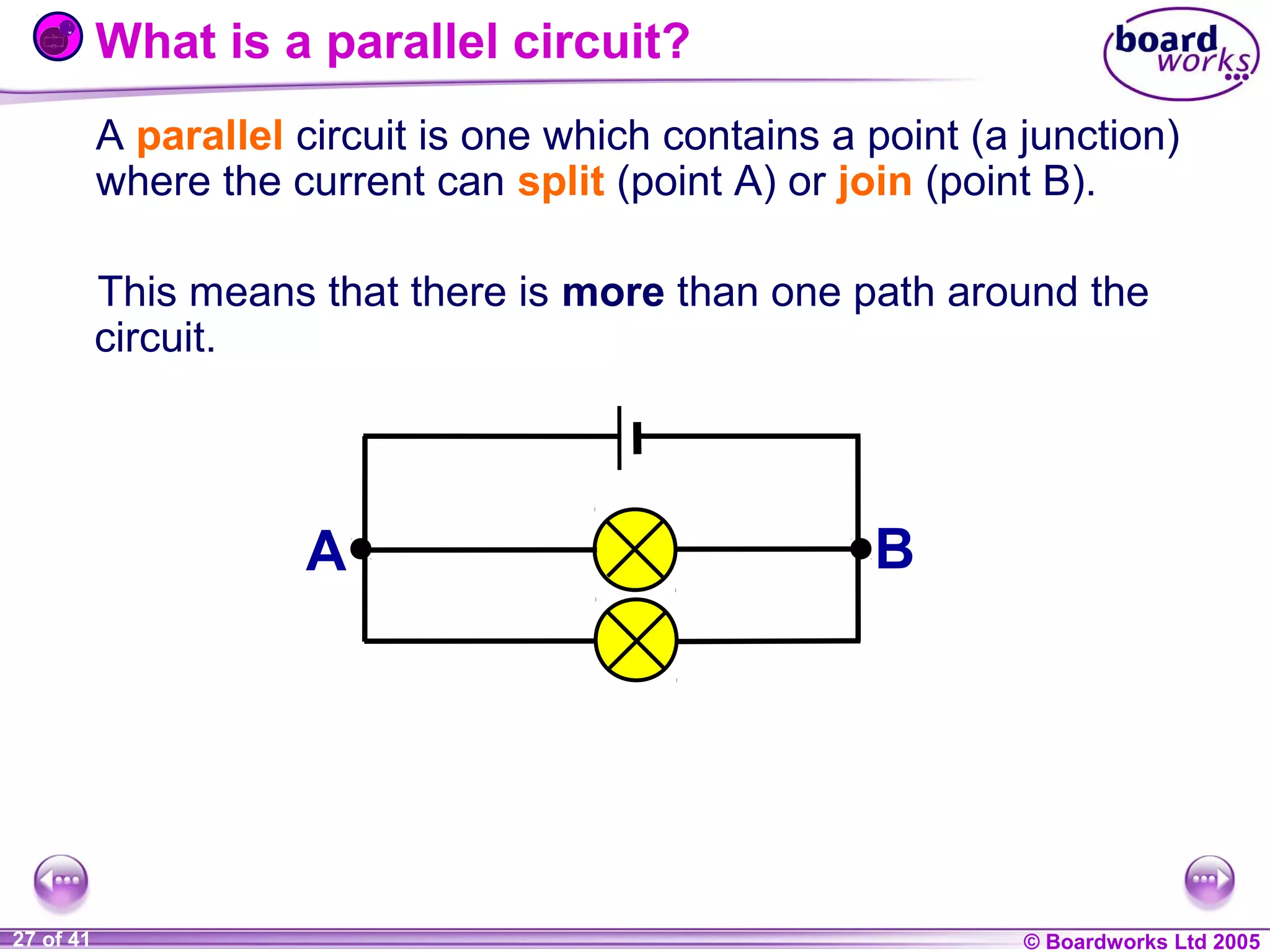
A parallel circuit is one which contains a point (a junction)
where the current can split (point A) or join (point B).
This means that there is more than one path around the
circuit.

A

1 of 20
27 of 41

B

© Boardworks Ltd 2004
2005
Measuring current in a parallel circuit
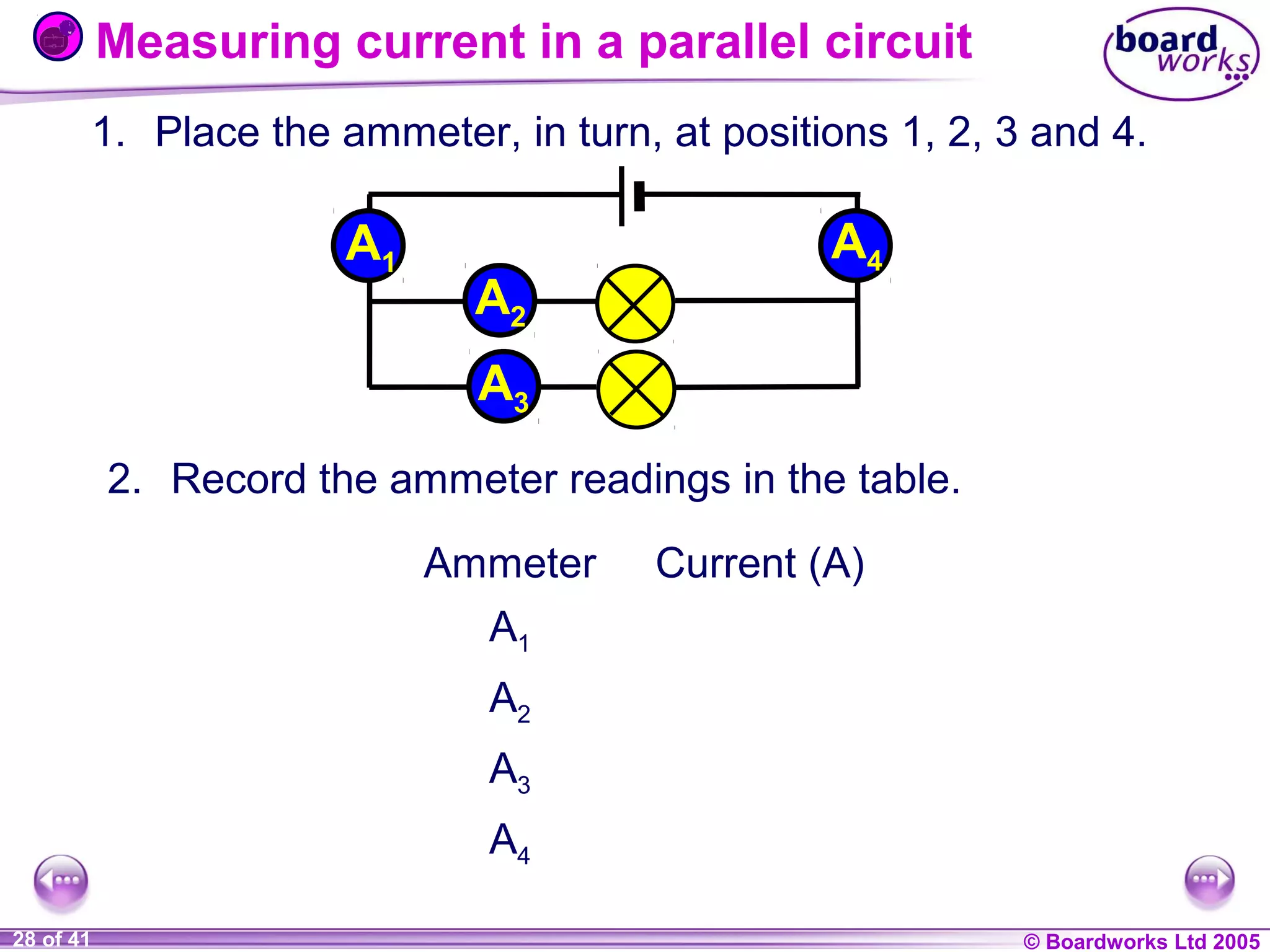
1. Place the ammeter, in turn, at positions 1, 2, 3 and 4.

A1

A2

A4

A3
2. Record the ammeter readings in the table.
Ammeter

Current (A)

A1
A2
A3
A4
1 of 20
28 of 41

© Boardworks Ltd 2004
2005
Current in a parallel circuit
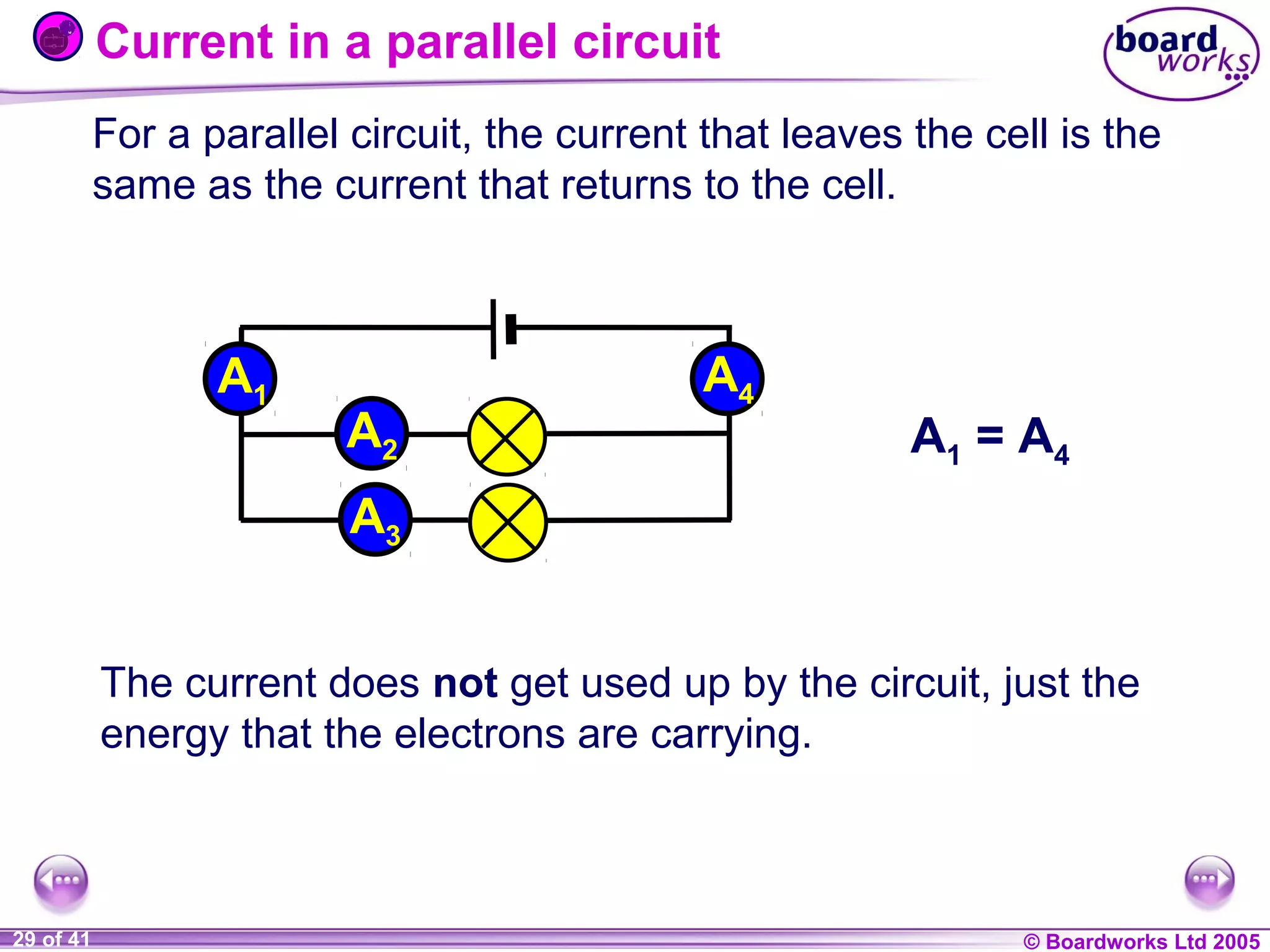
For a parallel circuit, the current that leaves the cell is the
same as the current that returns to the cell.

A1

A2

A4

A1 = A4

A3
The current does not get used up by the circuit, just the
energy that the electrons are carrying.

1 of 20
29 of 41

© Boardworks Ltd 2004
2005
Current in a parallel circuit
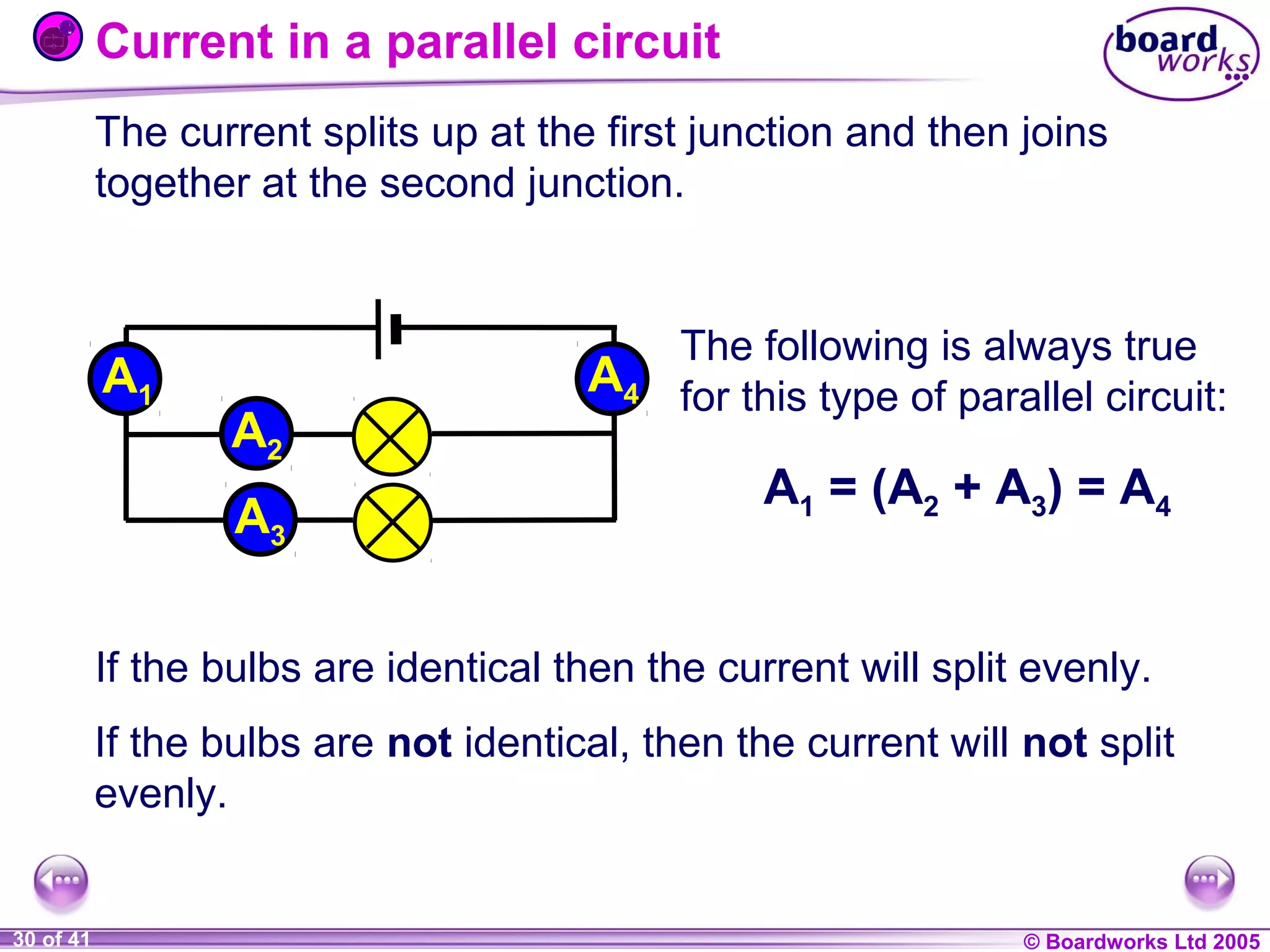
The current splits up at the first junction and then joins
together at the second junction.

A1

A2
A3

A4

The following is always true
for this type of parallel circuit:

A1 = (A2 + A3) = A4

If the bulbs are identical then the current will split evenly.
If the bulbs are not identical, then the current will not split
evenly.

1 of 20
30 of 41

© Boardworks Ltd 2004
2005
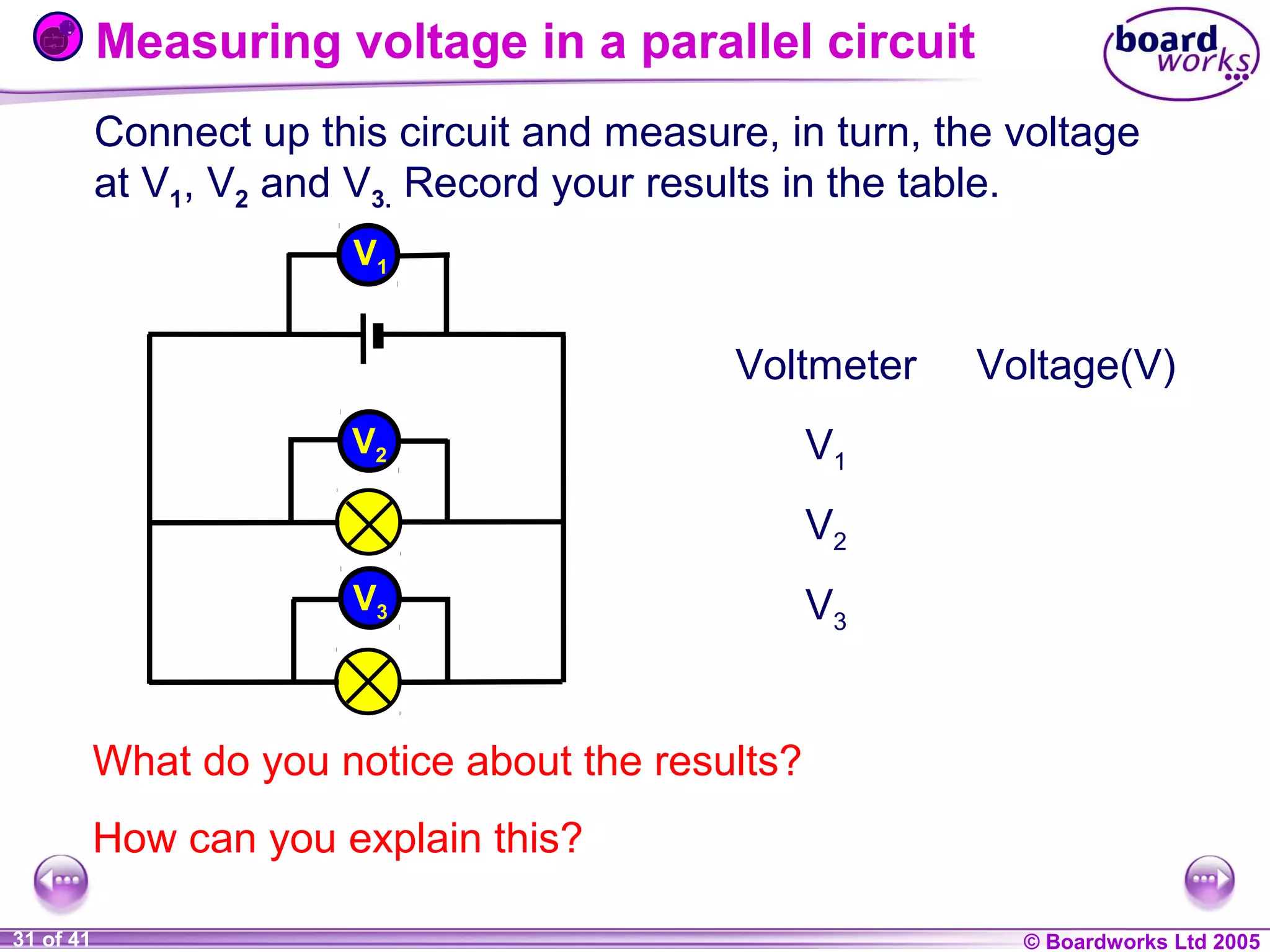
Measuring voltage in a parallel circuit
Connect up this circuit and measure, in turn, the voltage
at V1, V2 and V3. Record your results in the table.
V1

Voltmeter
V2

Voltage(V)

V1
V2

V3

V3

What do you notice about the results?
How can you explain this?
1 of 20
31 of 41

© Boardworks Ltd 2004
2005
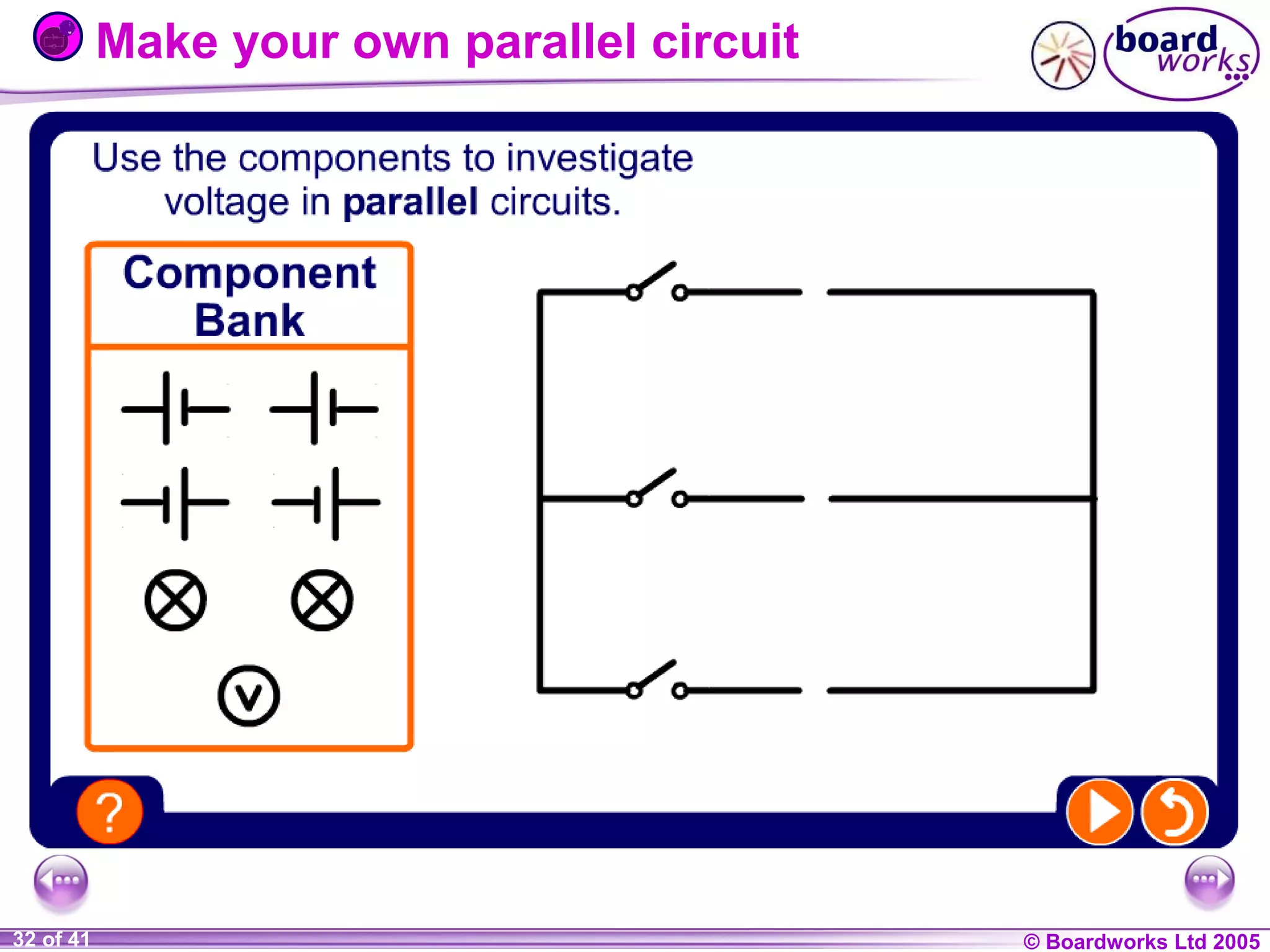
Make your own parallel circuit

1 of 20
32 of 41

© Boardworks Ltd 2004
2005
Contents

7J Electrical Circuits
Introducing circuits
Series circuits
Parallel circuits
Energy in circuits
Summary activities
1 of 20
33 of 41

© Boardworks Ltd 2004
2005
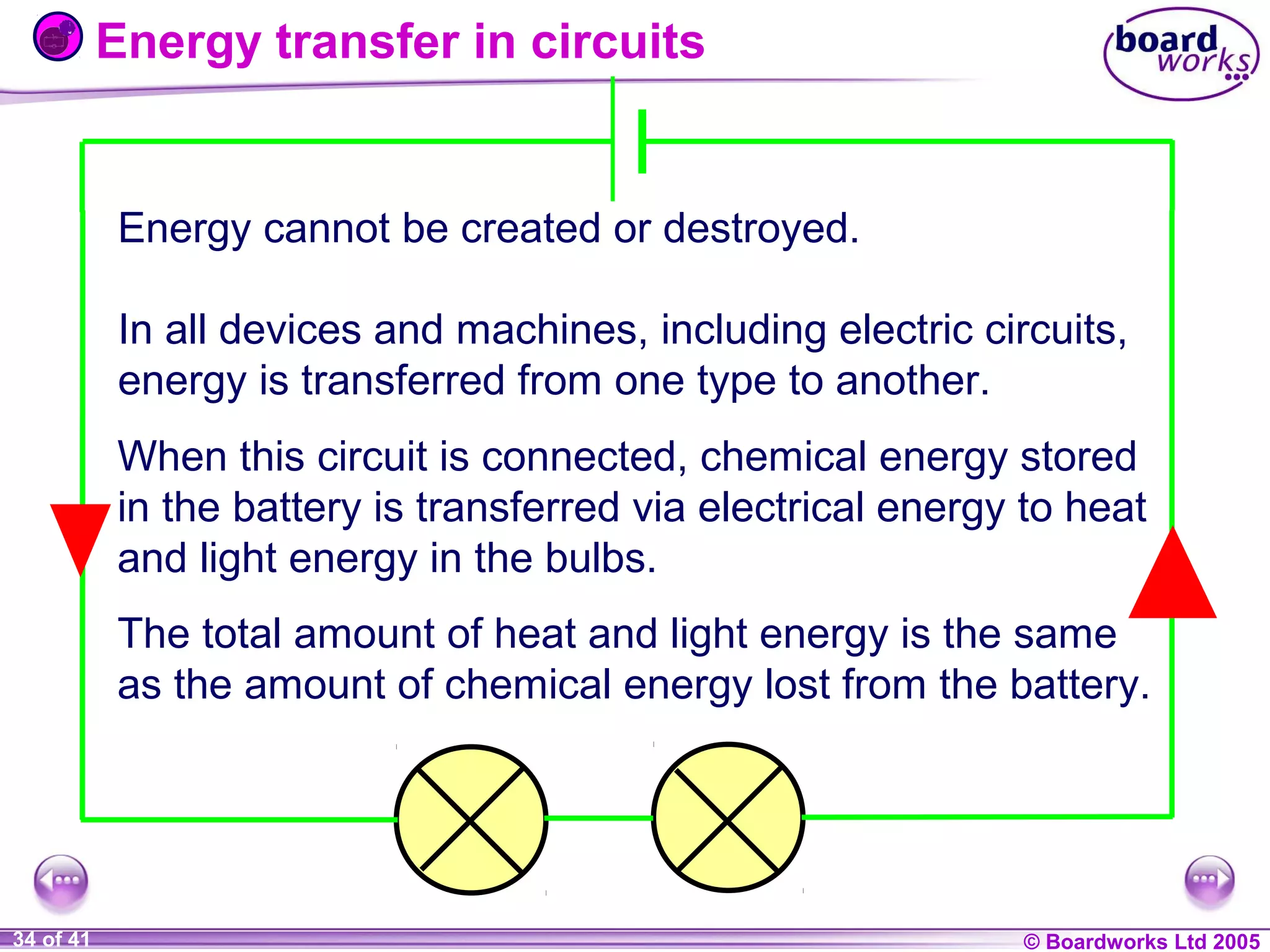
Energy transfer in circuits

Energy cannot be created or destroyed.
In all devices and machines, including electric circuits,
energy is transferred from one type to another.
When this circuit is connected, chemical energy stored
in the battery is transferred via electrical energy to heat
and light energy in the bulbs.
The total amount of heat and light energy is the same
as the amount of chemical energy lost from the battery.
1 of 20
34 of 41

© Boardworks Ltd 2004
2005
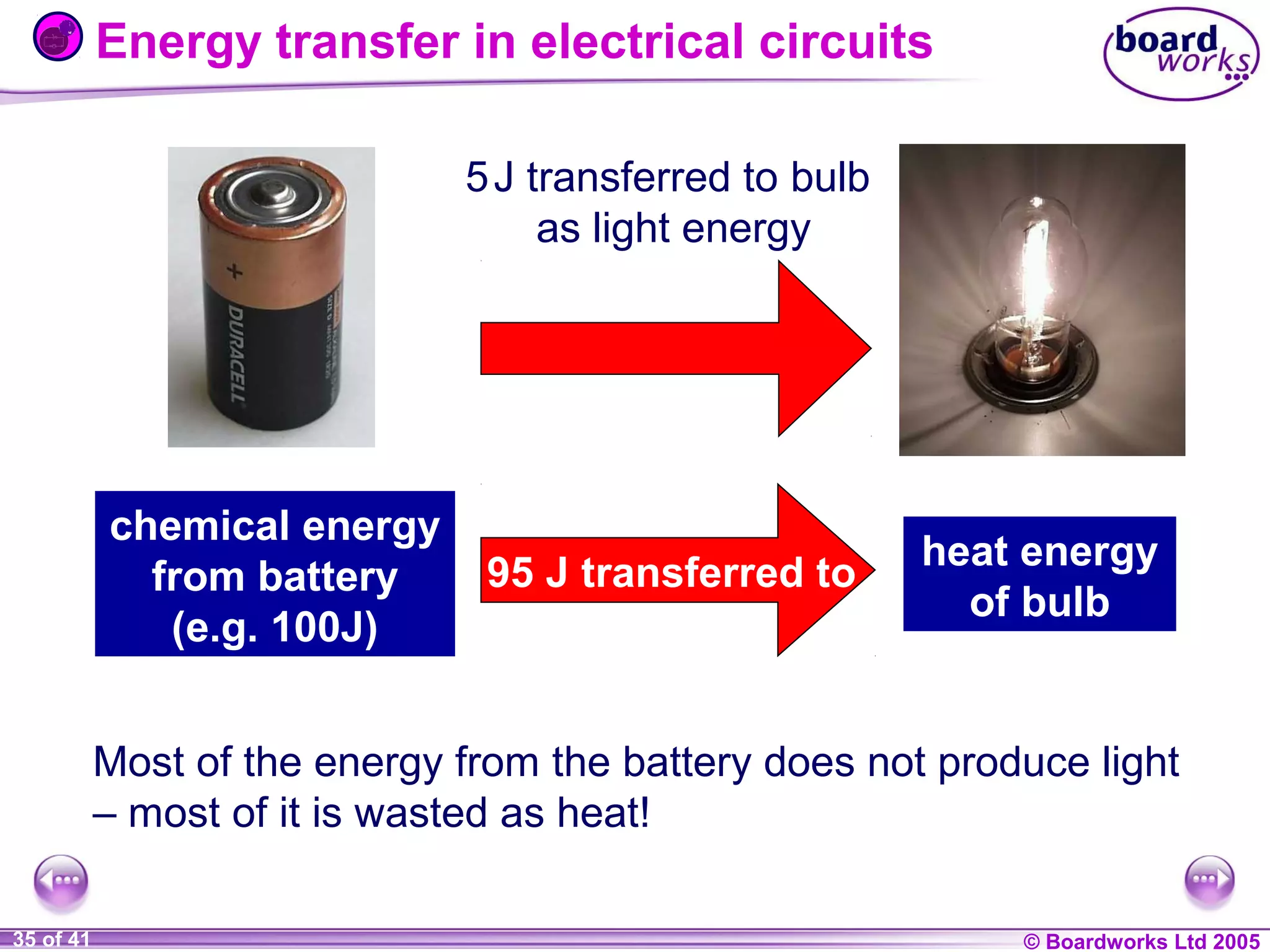
Energy transfer in electrical circuits
5 J transferred to bulb
as light energy

chemical energy
from battery
(e.g. 100J)

95 J transferred to

heat energy
of bulb

Most of the energy from the battery does not produce light
– most of it is wasted as heat!
1 of 20
35 of 41

© Boardworks Ltd 2004
2005
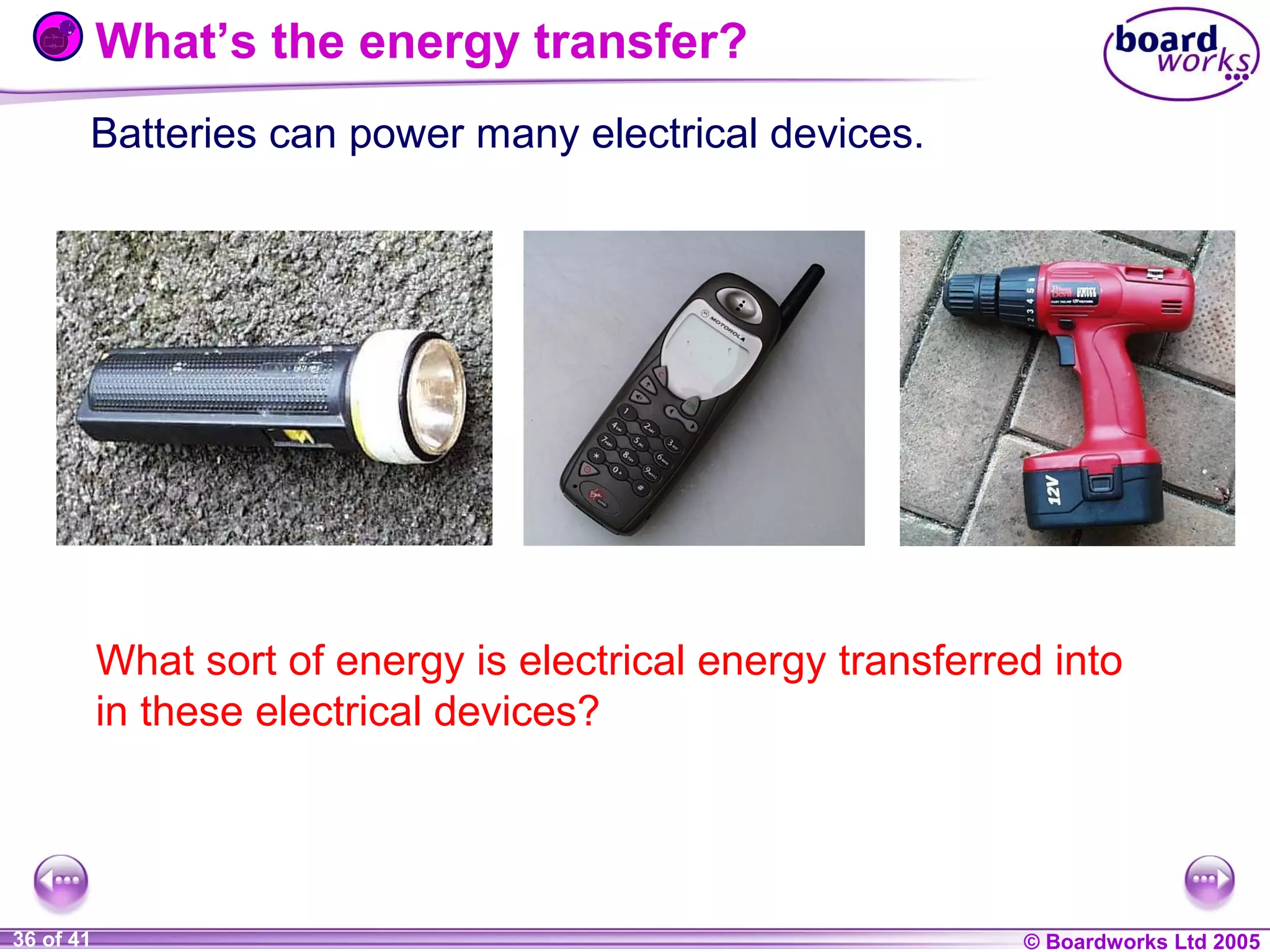
What’s the energy transfer?
Batteries can power many electrical devices.

What sort of energy is electrical energy transferred into
in these electrical devices?

1 of 20
36 of 41

© Boardworks Ltd 2004
2005
Contents

7J Electrical Circuits
Introducing circuits
Series circuits
Parallel circuits
Energy in circuits
Summary activities
1 of 20
37 of 41

© Boardworks Ltd 2004
2005
Glossary
ammeter – A device that measures electric current.
circuit – A complete loop of conducting components that
electricity flows around.

current – The flow of electricity, measured in amps (A).
parallel – A branched circuit – it has components
connected on separate branches.

resistor – A component that makes it difficult for electricity
to flow and so reduces the current.

series – A circuit without any branches – it has
components connected in a row.

voltage – The amount of ‘push’ that a cell gives a circuit,
measured in volts (V).

voltage – A device that measures voltage.
1 of 20
38 of 41

© Boardworks Ltd 2004
2005
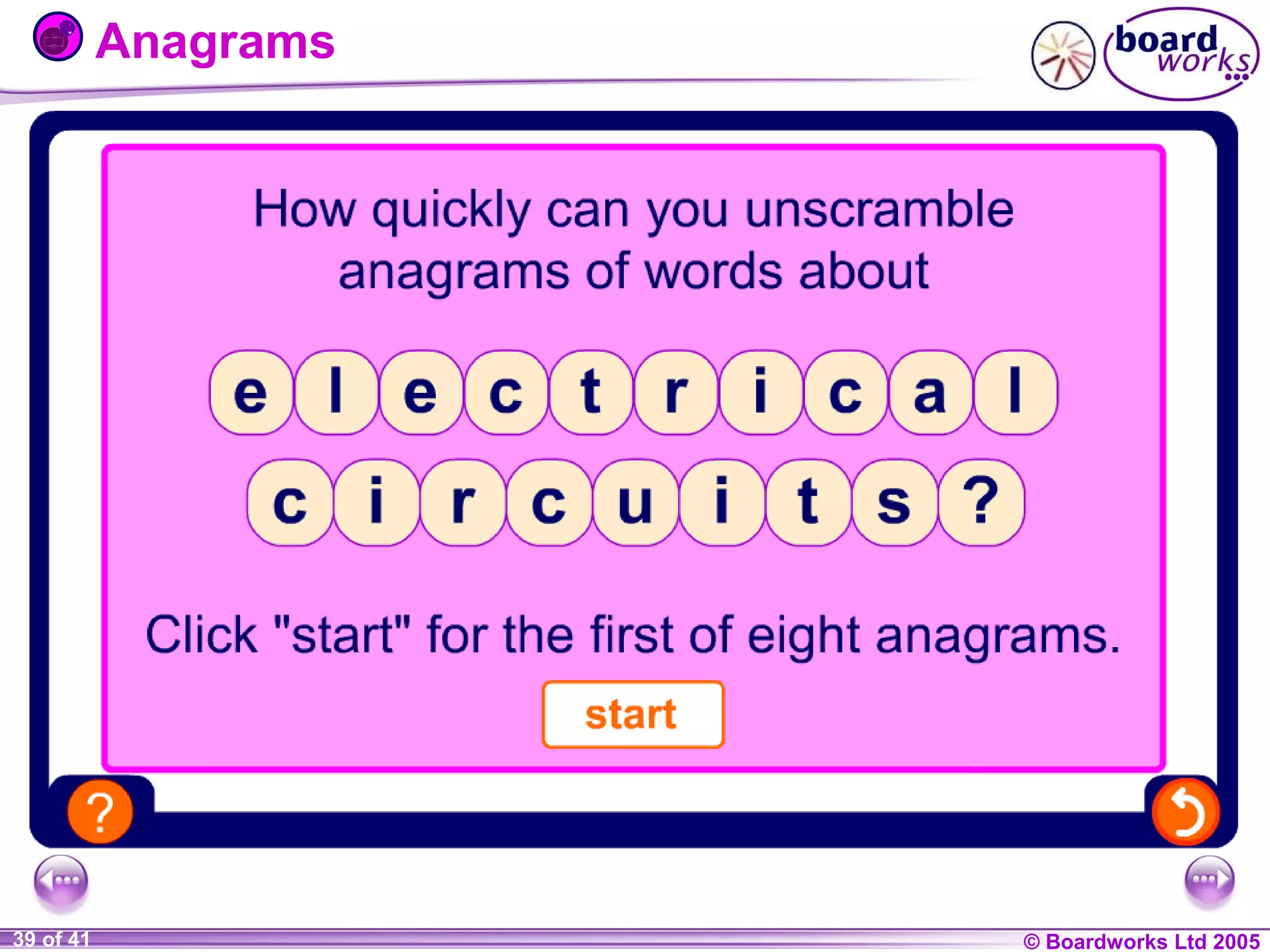
Anagrams

1 of 20
39 of 41

© Boardworks Ltd 2004
2005
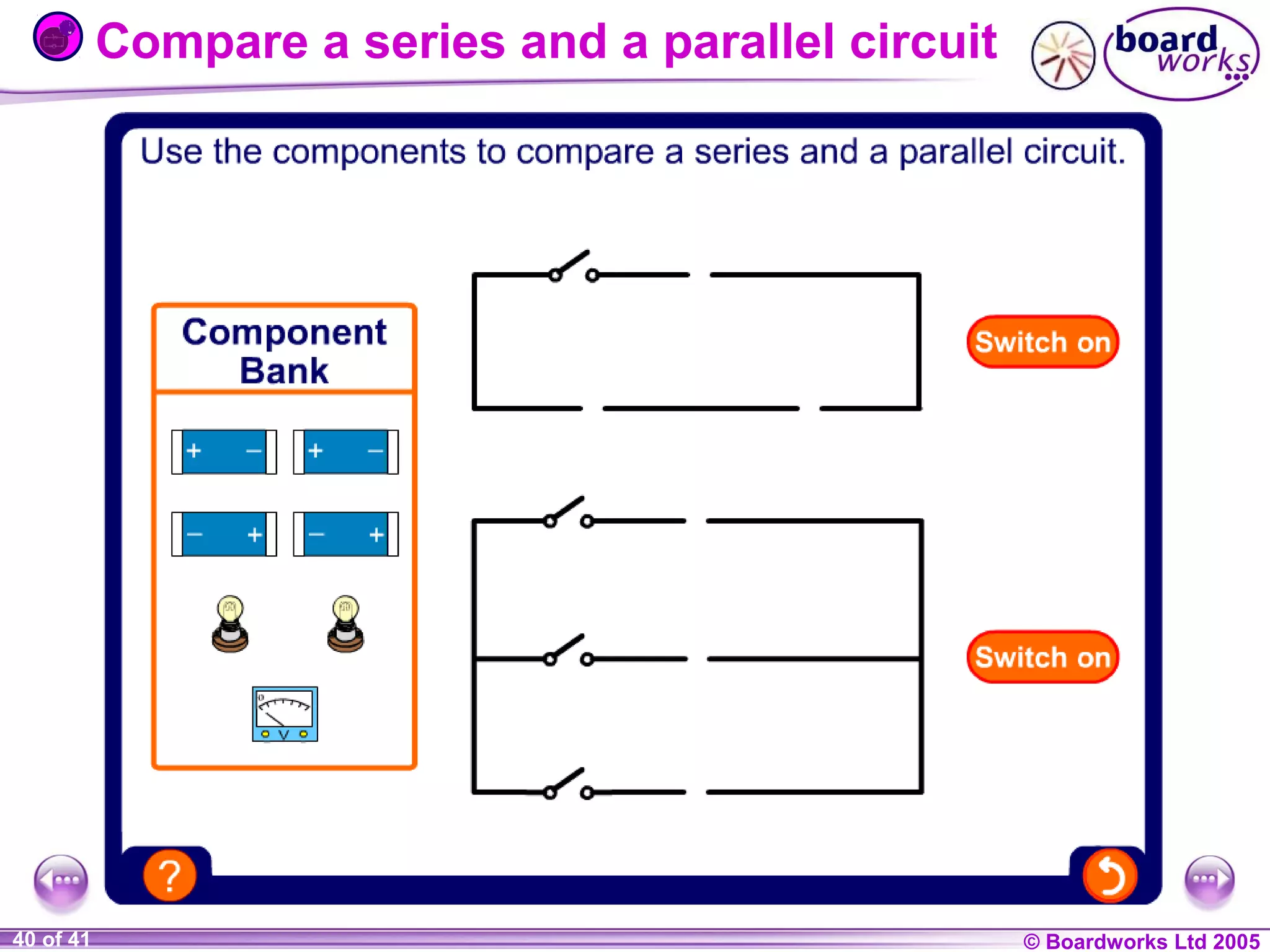
Compare a series and a parallel circuit

1 of 20
40 of 41

© Boardworks Ltd 2004
2005
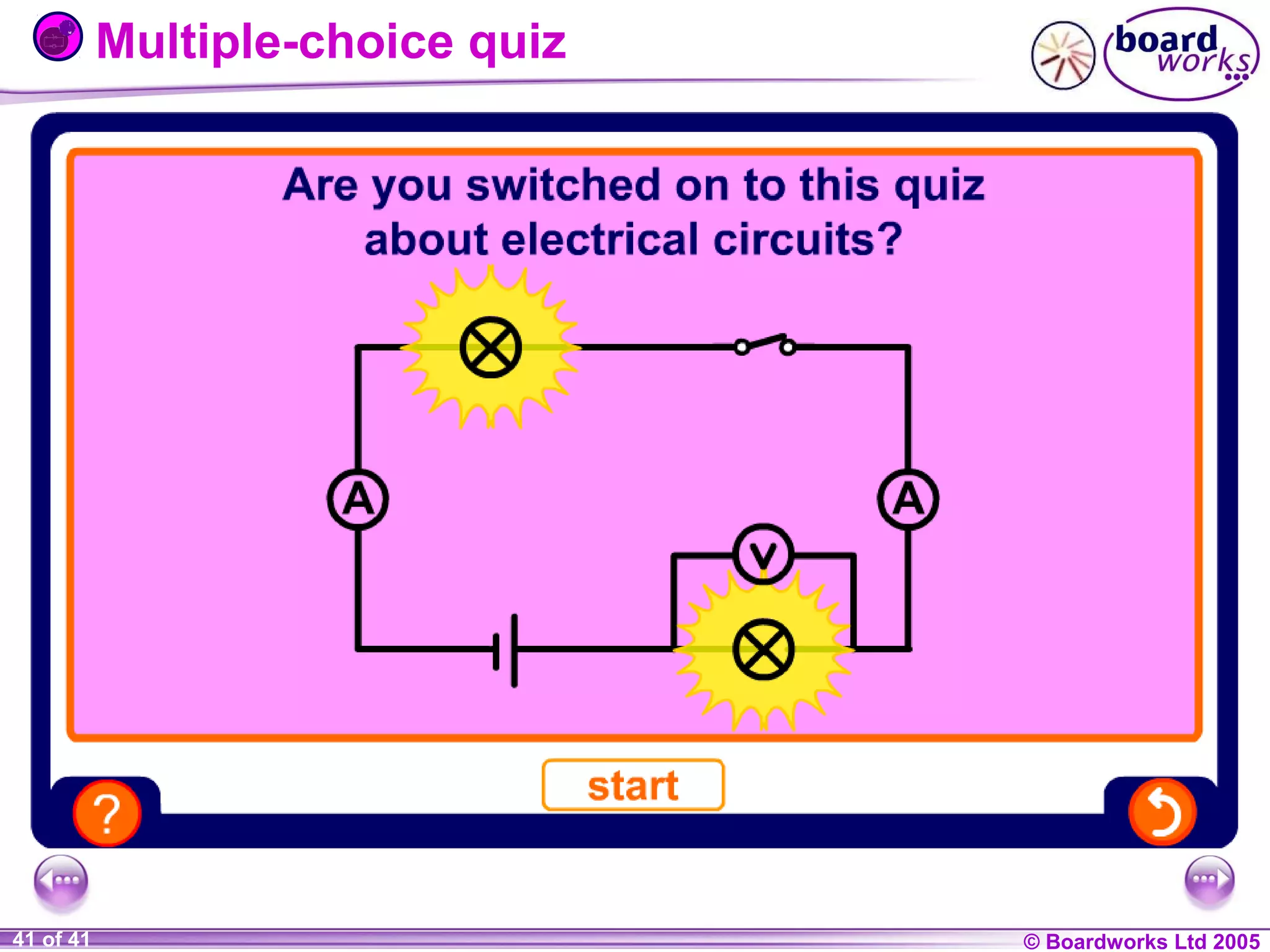
Multiple-choice quiz

1 of 20
41 of 41

© Boardworks Ltd 2004
2005

7 j electrical circuits (boardworks)

  • 1.
    KS3 Physics 7J ElectricalCircuits 1 of 41 20 © Boardworks Ltd 2004 2005
  • 2.
    Contents 7J Electrical Circuits Introducingcircuits Series circuits Parallel circuits Energy in circuits Summary activities 1 of 41 20 2 © Boardworks Ltd 2004 2005
  • 3.
    What is anelectrical circuit? An electrical circuit is like a central heating system in a house. There is a pump that pushes water around the system. The water everywhere starts to move at the same time. There are pipes that carry the water. In the pipes the water is flowing. 1 of 41 20 3 low pressure boiler and pump high pressure radiator radiator flow of water © Boardworks Ltd 2004 2005
  • 4.
    What is anelectrical circuit? The bulb in the circuit is like a radiator. An electrical device uses electrical energy supplied by the circuit. Instead of a flow of water, electricity flows in an electrical circuit. The wires are like pipes; they carry the flow of electricity (called current) around the circuit. The electrical current is pushed by the cell (or battery), which has the same function as the pump and boiler. The strength of push provided by the battery is called its voltage. 1 of 41 20 4 © Boardworks Ltd 2004 2005
  • 5.
    Components in anelectrical circuit 1 of 41 20 5 © Boardworks Ltd 2004 2005
  • 6.
    Contents 7J Electrical Circuits Introducingcircuits Series circuits Parallel circuits Energy in circuits Summary activities 1 of 41 20 6 © Boardworks Ltd 2004 2005
  • 7.
    What is aseries circuit? This is a simple series circuit. In a simple series circuit, everything is connected in one loop across the terminals of the battery. So there aren’t any points where the current can split or join (these are called junctions). This circuit has two lamps connected in series. Circuits are always drawn using straight lines. 1 of 41 20 7 © Boardworks Ltd 2004 2005
  • 8.
    Examples of seriescircuits Here are some other simple series circuits: 1. Two resistances (resistors) connected in series: R1 R2 2. A rheostat (or variable resistor) and a bulb connected in series: 1 of 41 20 8 © Boardworks Ltd 2004 2005
  • 9.
    Measuring current The unitof measure for current is the amp, which has the symbol A. Current is measured using a device called an ammeter. In a circuit diagram, an ammeter is shown by the symbol A . When measuring the current through a component, the ammeter is always connected in series (in the same loop) with that component. A 1 of 41 20 9 © Boardworks Ltd 2004 2005
  • 10.
    Experiment 1: Currentin series circuit Circuit 1 1 A R1 A 2 1. Set up the circuit as shown above. 2. Measure the current using the ammeter at positions 1 and 2. 1 of 20 10 of 41 © Boardworks Ltd 2004 2005
  • 11.
    Experiment 1: Currentin a series circuit Circuit 2 1 A A R1 A 3 R2 2 1. Add another resistor into the circuit (R2) and another ammeter after it. 2. Now measure the current using the ammeter at positions 1, 2 and 3. 1 of 20 11 of 41 © Boardworks Ltd 2004 2005
  • 12.
    Experiment 1: Currentin a series circuit – results Circuit 1 1 Circuit 2 A 1 R1 A 2 A A 3 R1 A 2 R2 Circuit 1 results: Circuit 2 results: Current at position 1 = Current at position 1 = Current at position 2 = Current at position 2 = Current at position 3 = 1 of 20 12 of 41 © Boardworks Ltd 2004 2005
  • 13.
    Experiment 1: Currentin a series circuit – summary Circuit 1 Circuit 2 A A R1 A A R1 A R2 Circuit 1 The current at different positions in the circuit, before and after the resistor, was the _______. Current is _____ used up by the components in the circuit. Circuit 2 Increasing the number of components in the circuit ________ the current. The current at all points in a series circuit is the _______. same / same / decreased / not 1 of 20 13 of 41 © Boardworks Ltd 2004 2005
  • 14.
    Measuring voltage Voltage ismeasured using a device called a voltmeter. In a circuit diagram, a voltmeter is given the symbol V . When measuring the voltage across a component, the voltmeter is always connected in parallel with (or across) the component. V1 This is still a series circuit. V2 V3 The voltage supplied by the battery is shared between all the components in a series circuit. 1 of 20 14 of 41 © Boardworks Ltd 2004 2005
  • 15.
    Measuring voltage acrossa resistance or a bulb Voltage is measured by connecting the voltmeter across (or in parallel with) the component. V Voltage is measured in volts and the symbol for this is V. A Components component here R V 1 of 20 15 of 41 © Boardworks Ltd 2004 2005
  • 16.
    Experiment 2: Voltagein a series circuit Circuit 1 V R1 V 1. Set up the circuit as shown above. 2. Connect the voltmeter across the power supply (battery) and measure the supply voltage. 3. Then connect the voltmeter across the resistance (R) and measure this voltage. 1 of 20 16 of 41 © Boardworks Ltd 2004 2005
  • 17.
    Experiment 2: Voltagein a series circuit Circuit 2 V R1 R2 V1 V2 1. Add another resistor (R2) to the circuit as shown. 2. Connect the voltmeter across the power supply (battery) and measure the supply voltage. 3. Then measure the voltage across each of the resistor. 1 of 20 17 of 41 © Boardworks Ltd 2004 2005
  • 18.
    Experiment 2: Voltagein a series circuit – results Circuit 1 Circuit 2 V V R1 R1 R2 V V1 V2 Circuit 2 results: Circuit 1 results: Voltage (supply) = Voltage (supply) = V Voltage (R1) V Voltage (R1) = V Voltage (R2) 1 of 20 18 of 41 V = V = © Boardworks Ltd 2004 2005
  • 19.
    Experiment 2: Voltagein a series circuit – summary Circuit 1 V Circuit 2 V R R1 R2 V V1 V2 The current is the _______ of electricity around the circuit. The _________ is the amount of push. When two components were put into Circuit 2, the voltage of the supply was the _______ as Circuit 1. However, the voltage across R1 __________ . The voltage across both components in Circuit 2 added to be equal to the ________ voltage. supply / decreased / voltage / flow / same 1 of 20 19 of 41 © Boardworks Ltd 2004 2005
  • 20.
    Experiment 3: Cellsin a series circuit Circuit 1 V R A V 1. Set up the circuit as shown above. 2. Connect the voltmeter across the power supply (battery) and measure the supply voltage. Then measure the voltage across the resistance. Also measure the current. 1 of 20 20 of 41 © Boardworks Ltd 2004 2005
  • 21.
    Experiment 3: Cellsin a series circuit Circuit 2 V R A V 1. Add an additional battery to the circuit. 2. Connect the voltmeter across the power supply and measure the supply voltage. Then measure the voltage across the resistance. Also measure the current. 1 of 20 21 of 41 © Boardworks Ltd 2004 2005
  • 22.
    Experiment 3: Cellsin a series circuit – results Circuit 1 R V A V Circuit 2 R V A V Circuit 1 results: Supply voltage = Supply voltage = Voltage R = Voltage R = Current = 1 of 20 22 of 41 Circuit 2 results: Current = © Boardworks Ltd 2004 2005
  • 23.
    Experiment 3: Cellsin a series circuit – summary Circuit 1 R V A V Circuit 2 R V A V Delete the wrong answer: Increasing the number of cells increases/decreases the current that flows in the circuit. The current/voltage depends on the current/voltage. 1 of 20 23 of 41 © Boardworks Ltd 2004 2005
  • 24.
    Series circuits –key ideas 1. In a series circuit the current is the same in all parts of the circuit. 2. The supply voltage is shared between the components in a series circuit. (The sum of the voltage across each component is the same as the total supply voltage.) 3. The current depends on the voltage in any circuit. 1 of 20 24 of 41 © Boardworks Ltd 2004 2005
  • 25.
    Make your ownseries circuit 1 of 20 25 of 41 © Boardworks Ltd 2004 2005
  • 26.
    Contents 7J Electrical Circuits Introducingcircuits Series circuits Parallel circuits Energy in circuits Summary activities 1 of 20 26 of 41 © Boardworks Ltd 2004 2005
  • 27.
    What is aparallel circuit? A parallel circuit is one which contains a point (a junction) where the current can split (point A) or join (point B). This means that there is more than one path around the circuit. A 1 of 20 27 of 41 B © Boardworks Ltd 2004 2005
  • 28.
    Measuring current ina parallel circuit 1. Place the ammeter, in turn, at positions 1, 2, 3 and 4. A1 A2 A4 A3 2. Record the ammeter readings in the table. Ammeter Current (A) A1 A2 A3 A4 1 of 20 28 of 41 © Boardworks Ltd 2004 2005
  • 29.
    Current in aparallel circuit For a parallel circuit, the current that leaves the cell is the same as the current that returns to the cell. A1 A2 A4 A1 = A4 A3 The current does not get used up by the circuit, just the energy that the electrons are carrying. 1 of 20 29 of 41 © Boardworks Ltd 2004 2005
  • 30.
    Current in aparallel circuit The current splits up at the first junction and then joins together at the second junction. A1 A2 A3 A4 The following is always true for this type of parallel circuit: A1 = (A2 + A3) = A4 If the bulbs are identical then the current will split evenly. If the bulbs are not identical, then the current will not split evenly. 1 of 20 30 of 41 © Boardworks Ltd 2004 2005
  • 31.
    Measuring voltage ina parallel circuit Connect up this circuit and measure, in turn, the voltage at V1, V2 and V3. Record your results in the table. V1 Voltmeter V2 Voltage(V) V1 V2 V3 V3 What do you notice about the results? How can you explain this? 1 of 20 31 of 41 © Boardworks Ltd 2004 2005
  • 32.
    Make your ownparallel circuit 1 of 20 32 of 41 © Boardworks Ltd 2004 2005
  • 33.
    Contents 7J Electrical Circuits Introducingcircuits Series circuits Parallel circuits Energy in circuits Summary activities 1 of 20 33 of 41 © Boardworks Ltd 2004 2005
  • 34.
    Energy transfer incircuits Energy cannot be created or destroyed. In all devices and machines, including electric circuits, energy is transferred from one type to another. When this circuit is connected, chemical energy stored in the battery is transferred via electrical energy to heat and light energy in the bulbs. The total amount of heat and light energy is the same as the amount of chemical energy lost from the battery. 1 of 20 34 of 41 © Boardworks Ltd 2004 2005
  • 35.
    Energy transfer inelectrical circuits 5 J transferred to bulb as light energy chemical energy from battery (e.g. 100J) 95 J transferred to heat energy of bulb Most of the energy from the battery does not produce light – most of it is wasted as heat! 1 of 20 35 of 41 © Boardworks Ltd 2004 2005
  • 36.
    What’s the energytransfer? Batteries can power many electrical devices. What sort of energy is electrical energy transferred into in these electrical devices? 1 of 20 36 of 41 © Boardworks Ltd 2004 2005
  • 37.
    Contents 7J Electrical Circuits Introducingcircuits Series circuits Parallel circuits Energy in circuits Summary activities 1 of 20 37 of 41 © Boardworks Ltd 2004 2005
  • 38.
    Glossary ammeter – Adevice that measures electric current. circuit – A complete loop of conducting components that electricity flows around. current – The flow of electricity, measured in amps (A). parallel – A branched circuit – it has components connected on separate branches. resistor – A component that makes it difficult for electricity to flow and so reduces the current. series – A circuit without any branches – it has components connected in a row. voltage – The amount of ‘push’ that a cell gives a circuit, measured in volts (V). voltage – A device that measures voltage. 1 of 20 38 of 41 © Boardworks Ltd 2004 2005
  • 39.
    Anagrams 1 of 20 39of 41 © Boardworks Ltd 2004 2005
  • 40.
    Compare a seriesand a parallel circuit 1 of 20 40 of 41 © Boardworks Ltd 2004 2005
  • 41.
    Multiple-choice quiz 1 of20 41 of 41 © Boardworks Ltd 2004 2005