What are Rocks?
• Most rocks are an aggregate of one or more minerals and
a few rocks are composed of non-mineral matter.
• There are three major rock types:
– 1. Igneous
– 2. Metamorphic
– 3. Sedimentary
Table of Contents
1
Major Rock Types
– Igneous rocks are formed by the cooling of molten magma
or lava near, at, or below the Earth’s surface.
– Sedimentary rocks are formed by the lithification of
inorganic and organic sediments deposited at or near the
Earth’s surface.
– Metamorphic rocks are formed when preexisting rocks are
transformed into new rocks by elevated heat and pressure
below the Earth’s surface.
2
Table of Contents
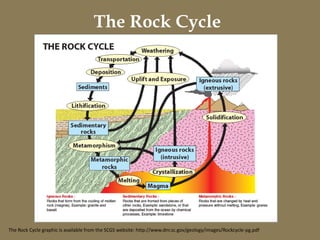
The Rock Cycle
The Rock Cycle graphic is available from the SCGS website: http://www.dnr.sc.gov/geology/images/Rockcycle-pg.pdf
• Weathering, erosion, mass-wasting, and depositional
processes occur at or near the Earth’s surface and produce
changes to the landscape that influence surface and
subsurface topography and landform development.
– Weathering is the physical disintegration or chemical alteration
of rocks at or near the Earth’s surface.
– Erosion is the physical removal and transportation of weathered
material by water, wind, ice, or gravity.
– Mass wasting is the transfer or movement of rock or soil down
slope primarily by gravity.
– Deposition is the process by which weathered and eroded
materials are laid down or placed in a location that is different
from their source.
• These processes are all very important to the rock cycle
because over geologic time weathering, erosion, and mass
wasting transform solid rock into sediments and soil that
result in the re deposition of material forming new
sedimentary rocks.
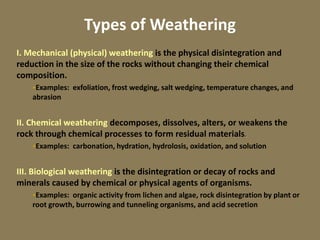
Types of Weathering
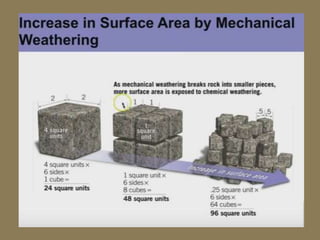
I. Mechanical (physical) weathering is the physical disintegration and
reduction in the size of the rocks without changing their chemical
composition.
Examples: exfoliation, frost wedging, salt wedging, temperature changes, and
abrasion
II. Chemical weathering decomposes, dissolves, alters, or weakens the
rock through chemical processes to form residual materials.
Examples: carbonation, hydration, hydrolosis, oxidation, and solution
III. Biological weathering is the disintegration or decay of rocks and
minerals caused by chemical or physical agents of organisms.
Examples: organic activity from lichen and algae, rock disintegration by plant or
root growth, burrowing and tunneling organisms, and acid secretion
I. Mechanical Weathering
Mechanical weathering is the physical disintegration and reduction in the
size of the rocks without changing their chemical composition.
– Exfoliation
– Frost Wedging
– Salt Wedging
– Temperature Changes
– Abrasion
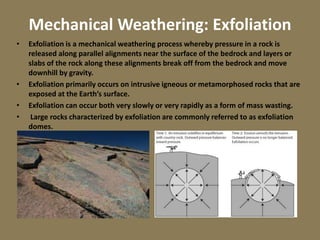
Mechanical Weathering: Exfoliation
• Exfoliation is a mechanical weathering process whereby pressure in a rock is
released along parallel alignments near the surface of the bedrock and layers or
slabs of the rock along these alignments break off from the bedrock and move
downhill by gravity.
• Exfoliation primarily occurs on intrusive igneous or metamorphosed rocks that are
exposed at the Earth’s surface.
• Exfoliation can occur both very slowly or very rapidly as a form of mass wasting.
• Large rocks characterized by exfoliation are commonly referred to as exfoliation
domes.
• Frost wedging is a mechanical
weathering process caused by the
freeze-thaw action of water that is
trapped between cracks in the
rock.
• When water freezes, it expands
and applies pressure to the
surrounding rock forcing the rock
to accommodate the expansion of
the ice.
• This process gradually weakens,
cracks, and breaks the rock
through repetitive freeze-thaw
weathering cycles.
• Frost wedging generally produces
angular blocks and talus material.
Talus is a term used to describe
weathered rock fragments
deposited at the base of a hill
slope or mountain.
Mechanical Weathering: Frost
Wedging
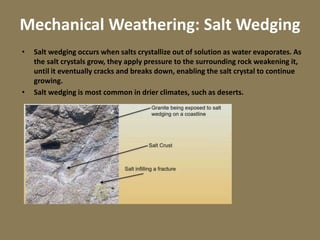
Mechanical Weathering: Salt Wedging
• Salt wedging occurs when salts crystallize out of solution as water evaporates. As
the salt crystals grow, they apply pressure to the surrounding rock weakening it,
until it eventually cracks and breaks down, enabling the salt crystal to continue
growing.
• Salt wedging is most common in drier climates, such as deserts.
Mechanical Weathering: Abrasion
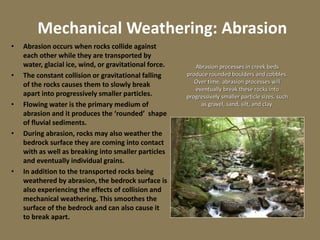
• Abrasion occurs when rocks collide against
each other while they are transported by
water, glacial ice, wind, or gravitational force.
• The constant collision or gravitational falling
of the rocks causes them to slowly break
apart into progressively smaller particles.
• Flowing water is the primary medium of
abrasion and it produces the ‘rounded’ shape
of fluvial sediments.
• During abrasion, rocks may also weather the
bedrock surface they are coming into contact
with as well as breaking into smaller particles
and eventually individual grains.
• In addition to the transported rocks being
weathered by abrasion, the bedrock surface is
also experiencing the effects of collision and
mechanical weathering. This smoothes the
surface of the bedrock and can also cause it
to break apart.
Photo Source: SCGS
Abrasion processes in creek beds
produce rounded boulders and cobbles.
Over time, abrasion processes will
eventually break these rocks into
progressively smaller particle sizes, such
as gravel, sand, silt, and clay.
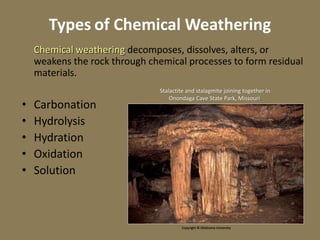
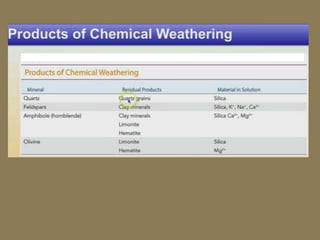
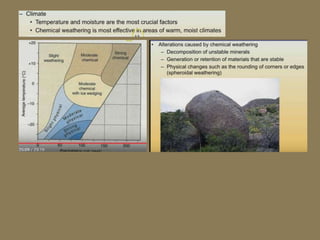
Types of Chemical Weathering
Chemical weathering decomposes, dissolves, alters, or
weakens the rock through chemical processes to form residual
materials.
• Carbonation
• Hydrolysis
• Hydration
• Oxidation
• Solution
Copyright © Oklahoma University
Stalactite and stalagmite joining together in
Onondaga Cave State Park, Missouri.
Chemical Weathering: Hydration
• Hydration is a process where mineral structure in the rock forms a weak bond with H20 which
causes the mineral grains to expand, creating stress which causes the disintegration of the
rock.
• Hydration often produces a new mineral compound that is larger than the original
compound. The increased size expanse the rock and can lead to decay.
• Hydration can also lead to color changes in the weathered rock surface.
• Once hydration begins, it accelerates other weathering processes and may also be
accompanied by hydrolysis and oxidation.
• An example of hydrolosis: Anhydrite (CaSO4) can absorb two water molecules to become
gypsum (CaSO4·2H2O).
• Hydration in granite transforms feldspar minerals to clay and accelerates the physical
weathering of buried or exposed rocks.
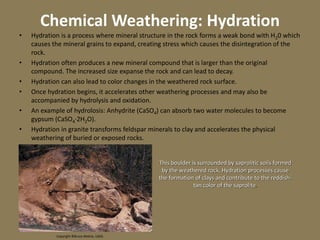
Copyright ©Bruce Molnia, USGS
This boulder is surrounded by saprolitic soils formed
by the weathered rock. Hydration processes cause
the formation of clays and contribute to the reddish-
tan color of the saprolite.
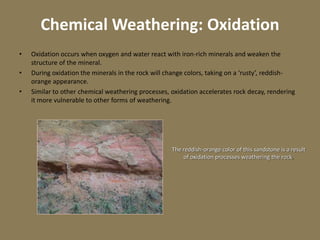
Chemical Weathering: Oxidation
• Oxidation occurs when oxygen and water react with iron-rich minerals and weaken the
structure of the mineral.
• During oxidation the minerals in the rock will change colors, taking on a ‘rusty’, reddish-
orange appearance.
• Similar to other chemical weathering processes, oxidation accelerates rock decay, rendering
it more vulnerable to other forms of weathering.
The reddish-orange color of this sandstone is a result
of oxidation processes weathering the rock.
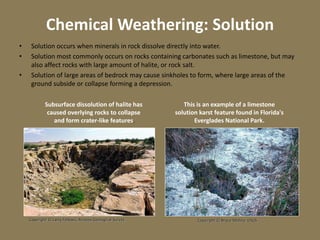
Chemical Weathering: Solution
• Solution occurs when minerals in rock dissolve directly into water.
• Solution most commonly occurs on rocks containing carbonates such as limestone, but may
also affect rocks with large amount of halite, or rock salt.
• Solution of large areas of bedrock may cause sinkholes to form, where large areas of the
ground subside or collapse forming a depression.
Copyright © Larry Fellows, Arizona Geological Survey
Subsurface dissolution of halite has
caused overlying rocks to collapse
and form crater-like features.
Copyright © Bruce Molina, USGS
This is an example of a limestone
solution karst feature found in Florida's
Everglades National Park.
Biological Weathering
Biological weathering is the disintegration or decay of rocks and
minerals caused by chemical or physical agents of organisms.
• Organic activity from lichen and algae
• Rock disintegration by plant growth
• Burrowing and tunneling organisms
• Secretion of acids
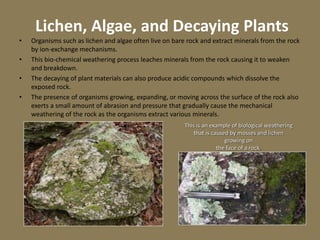
Lichen, Algae, and Decaying Plants
• Organisms such as lichen and algae often live on bare rock and extract minerals from the rock
by ion-exchange mechanisms.
• This bio-chemical weathering process leaches minerals from the rock causing it to weaken
and breakdown.
• The decaying of plant materials can also produce acidic compounds which dissolve the
exposed rock.
• The presence of organisms growing, expanding, or moving across the surface of the rock also
exerts a small amount of abrasion and pressure that gradually cause the mechanical
weathering of the rock as the organisms extract various minerals.
This is an example of biological weathering
that is caused by mosses and lichen
growing on
the face of a rock.
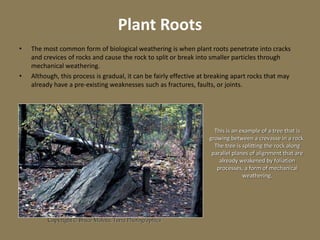
Plant Roots
• The most common form of biological weathering is when plant roots penetrate into cracks
and crevices of rocks and cause the rock to split or break into smaller particles through
mechanical weathering.
• Although, this process is gradual, it can be fairly effective at breaking apart rocks that may
already have a pre-existing weaknesses such as fractures, faults, or joints.
Copyright © Bruce Molnia, Terra Photographics
This is an example of a tree that is
growing between a crevasse in a rock.
The tree is splitting the rock along
parallel planes of alignment that are
already weakened by foliation
processes, a form of mechanical
weathering.
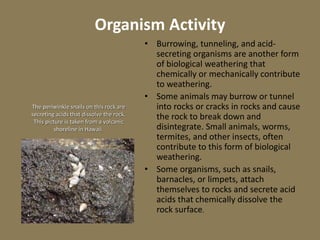
Organism Activity
• Burrowing, tunneling, and acid-
secreting organisms are another form
of biological weathering that
chemically or mechanically contribute
to weathering.
• Some animals may burrow or tunnel
into rocks or cracks in rocks and cause
the rock to break down and
disintegrate. Small animals, worms,
termites, and other insects, often
contribute to this form of biological
weathering.
• Some organisms, such as snails,
barnacles, or limpets, attach
themselves to rocks and secrete acid
acids that chemically dissolve the
rock surface.
The periwinkle snails on this rock are
secreting acids that dissolve the rock.
This picture is taken from a volcanic
shoreline in Hawaii.
Differential Weathering
 Weathering rates will not only vary
depending on the type of weathering
process, whether it is mechanical,
chemical, or biological, but they will also
vary depending on the rock material that
is being weathered.
 Some rocks are harder than other rocks,
and will weather slower than softer rocks.
 The differences in rates of weathering
due to different types of rocks, textures,
or other characteristics is referred to as
differential weathering.
 Differential weathering processes
contribute to the unique formation of
many landforms, including pedestals,
waterfalls, and monadnocks.
 Climate can also produce differential
weathering responses for the same rock
type. For example, limestone weathers
more quickly in wet climates than dry
climates.
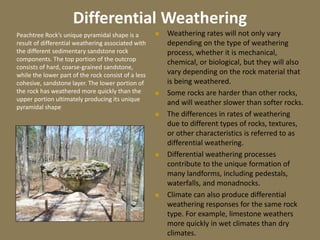
Peachtree Rock’s unique pyramidal shape is a
result of differential weathering associated with
the different sedimentary sandstone rock
components. The top portion of the outcrop
consists of hard, coarse-grained sandstone,
while the lower part of the rock consist of a less
cohesive, sandstone layer. The lower portion of
the rock has weathered more quickly than the
upper portion ultimately producing its unique
pyramidal shape
Erosion
 Water erodes rocks and the landscapes by transporting weathered materials from
their source to another location where they are deposited.
 Wind erodes materials by picking them up and temporarily transporting them
from their source to another location where they are deposited, and either stored
or re-mobilized and transported to another location.
 Ice erosion occurs when particles are plucked up or incorporated by moving ice,
such as a glaciers, and are transported downhill, or when friction between the ice
and bedrock erodes materials and then transports them downhill.
 Gravity facilitates the down slope transportation of loosened, weathered materials
and enables them to move without the aid of water, wind, or ice. Gravity related
erosion is a major component of mass-wasting events.
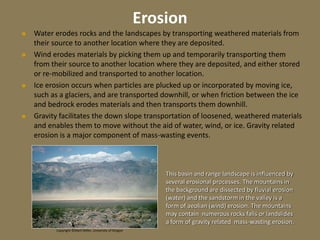
Copyright ©Marli Miller, University of Oregon
This basin and range landscape is influenced by
several erosional processes. The mountains in
the background are dissected by fluvial erosion
(water) and the sandstorm in the valley is a
form of aeolian (wind) erosion. The mountains
may contain numerous rocks falls or landslides
a form of gravity related mass-wasting erosion.
Erosion: Water (Fluvial)
 Water erodes rocks and shapes the landscapes by removing and transporting weathered materials from
their source to another location where they are deposited and either stored or transported to another
location.
 Fluvial erosion is often broken into 3 distinct categories: rain-splash erosion, sheet erosion, and rill/gully
erosion.
 Rain splash erosion occurs when the impact of a rain drop loosens and mobilizes particles.
 Sheet erosion is a process where particles loosened buy rain-splash erosion are transported by
runoff water down the slope of a surface.
 Rill erosion occurs when water concentrates during sheet erosion and erodes small rills or gullys
into the surface that channel flow down slope.
 Fluvial erosion can occur during rainfall events, from melt-water runoff, or ground water percolation.
Materials being eroded and transported are either suspended in the water, bounced by saltation, or
rolled along the ground by traction depending on a variety of conditions.
 The accumulation of fluvial erosion and associated processes over a large area forms pathways for
surface and groundwater flow and carves v-shaped river valleys that continue to erode, transport, and
deposit weathered sediments across the landscape.
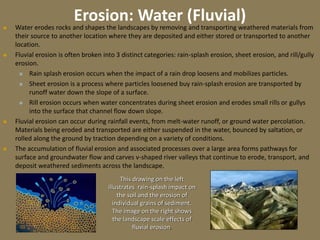
This drawing on the left
illustrates rain-splash impact on
the soil and the erosion of
individual grains of sediment.
The image on the right shows
the landscape scale effects of
fluvial erosion.
Erosion: Wind (Aeolian)
 Wind erodes weathered rocks by picking them up and temporarily transporting
them from their source to another location where they are deposited, and either
stored or re-mobilized and transported to another location
 Erosion by wind is divided into two different categories: Deflation and Abrasion
 Deflation is the movement or transport of particles through the air or along
the ground
 Abrasion is the process that occurs when wind-transported particles sculpt
features in the landscape through a “sand-blasting” like process
 Aeolian erosion and deposition processes create a diversity of landforms including
sand dunes, loess deposits, and yardangs.
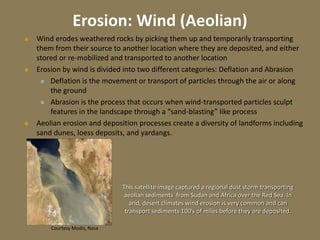
Courtesy Modis, Nasa
This satellite image captured a regional dust storm transporting
aeolian sediments from Sudan and Africa over the Red Sea. In
arid, desert climates wind erosion is very common and can
transport sediments 100’s of miles before they are deposited.
Erosion: Ice (Periglacial and Glacial)
 Ice erosion occurs in combination with periglacial and glacial processes
 Glacial erosion occurs when particles are incorporated into the glacial ice through a
process referred to as plucking, and they are transported downslope within the
glacier.
 The friction and abrasion of the ice and rock moving across the bedrock, erodes the
surface of the bedrock and often leaves scrapes, grooves, striae, or polished rock
surfaces.
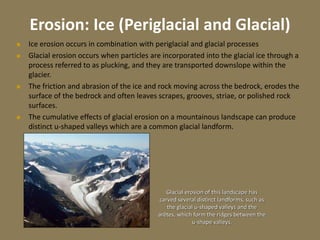
 The cumulative effects of glacial erosion on a mountainous landscape can produce
distinct u-shaped valleys which are a common glacial landform.
Glacial erosion of this landscape has
carved several distinct landforms, such as
the glacial u-shaped valleys and the
arêtes, which form the ridges between the
u-shape valleys.
Erosion: Gravity
 Gravity facilitates the down slope transportation of loosened, weathered materials
and enables them to move without the aid of water, wind, or ice. However, these
agents can act as catalysts for gravity related erosion.
 Movements by gravity may be very slow or very abrupt.
 Gravity related erosion can be coherent or incoherent. Coherent refers to the erosion
of a consolidated mass of materials that erode or move as a single unit, incoherent
refers to the erosion or movement of a mass of unconsolidated individual fragments
of materials.
 Unconsolidated materials tend to stabilize near an angle of 35° (referred to as the
angle of repose) however this balance is easily disrupted by changes in
environmental conditions, addition of weathered materials, and or other
adjustments that may cause mass wasting.
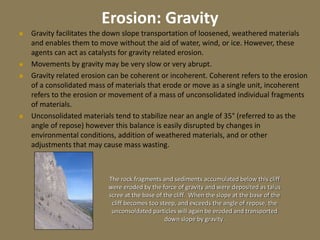
The rock fragments and sediments accumulated below this cliff
were eroded by the force of gravity and were deposited as talus
scree at the base of the cliff. When the slope at the base of the
cliff becomes too steep, and exceeds the angle of repose, the
unconsoldated particles will again be eroded and transported
down slope by gravity.
Mass Wasting
 Rock Falls
 Landslides
 Debris / Mud Flows
 Slumps
 Creep
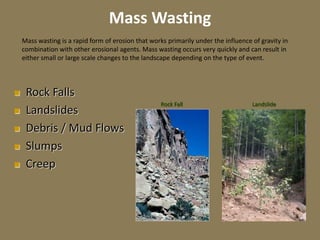
Landslide
Rock Fall
Mass wasting is a rapid form of erosion that works primarily under the influence of gravity in
combination with other erosional agents. Mass wasting occurs very quickly and can result in
either small or large scale changes to the landscape depending on the type of event.
Rock Falls
 Rock falls occur when rocks become dislodged, because their change in potential energy
becomes to great to maintain, and the potential energy becomes kinetic energy which causes
the rock fragment to fall, restoring equilibrium. As a result the rocks fall, roll, or bounce
downhill.
 The rocks may be loosened by a recent rainfall or snow melt-water event that facilitates the
movement of the rock before they fall from the force of gravity.
 Rock falls often form piles of loose rock below their source and are sometimes referred to as
talus or scree.
 Large volumes of talus may form a talus slope, talus apron, or talus cone depending on its
shape. Talus tends to stabilize near an angle of 35° (referred to as the angle of repose), or the
steepest angle maintained before changes in energy lead to gravitational erosion. This balance
is easily disrupted by changes in environmental conditions, addition of weathered materials, or
other factors that lead to mass wasting.
Photo courtesy of SCGS
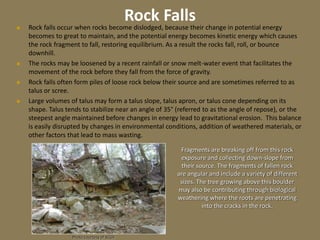
Fragments are breaking off from this rock
exposure and collecting down-slope from
their source. The fragments of fallen rock
are angular and include a variety of different
sizes. The tree growing above this boulder
may also be contributing through biological
weathering where the roots are penetrating
into the cracks in the rock.
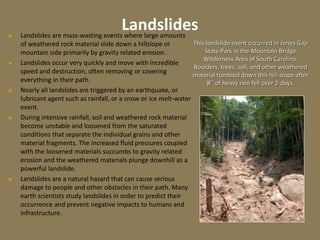
Landslides
 Landslides are mass-wasting events where large amounts
of weathered rock material slide down a hillslope or
mountain side primarily by gravity related erosion.
 Landslides occur very quickly and move with incredible
speed and destruction, often removing or covering
everything in their path.
 Nearly all landslides are triggered by an earthquake, or
lubricant agent such as rainfall, or a snow or ice melt-water
event.
 During intensive rainfall, soil and weathered rock material
become unstable and loosened from the saturated
conditions that separate the individual grains and other
material fragments. The increased fluid pressures coupled
with the loosened materials succumbs to gravity related
erosion and the weathered materials plunge downhill as a
powerful landslide.
 Landslides are a natural hazard that can cause serious
damage to people and other obstacles in their path. Many
earth scientists study landslides in order to predict their
occurrence and prevent negative impacts to humans and
infrastructure.
This landslide event occurred in Jones Gap
State Park in the Mountain Bridge
Wilderness Area of South Carolina.
Boulders, trees, soil, and other weathered
material tumbled down this hill-slope after
8’’ of heavy rain fell over 2-days.
Debris and Mud Flows
 Debris and mudflows are mass-wasting events that form when heavy rainfalls produce large
amounts of runoff that transport eroded soils, sediments, and plant debris down slope where
the flows eventually spreads out across valley bottoms.
 Sometimes the debris and mudflows follow existing drainage paths and other times they
carve out new paths as they flow downhill
 Debris and mudflows can carry particles of a range of sizes from clays (mud) to large debris
and boulders; however, debris flows consists primarily of coarse-grained materials and
mudflows consist primarily of fine-grained materials.
 The consistency of a debris or mudflow is representative of a thick, muddy sludge carrying
rocks, twigs, branches, trees, and other available debris
 Debris flows are natural hazards that pose a threat to communities in their path
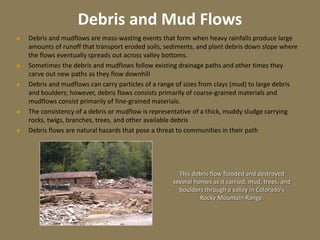
This debris flow flooded and destroyed
several homes as it carried, mud, trees, and
boulders through a valley in Colorado’s
Rocky Mountain Range.
Deposition
 Deposition is a constructive process that lays down or places weathered and eroded
materials in a location that is different from their source.
 Deposition is not specific to a single weathering, erosion, or mass wasting event, but is
applied to any consolidated or unconsolidated materials that have accumulated as a result of
some natural process or agent. Deposits can result from mechanical, chemical, or biological
weathering, and water, wind, ice, or gravity-related erosional processes.
 The accumulation of deposited materials alters the landscapes and builds various landform
features. For example, floodplains are large depositional landforms built by the accumulation
of fluvial deposits, and sand dunes are depositional landforms built by wind-related
processes.
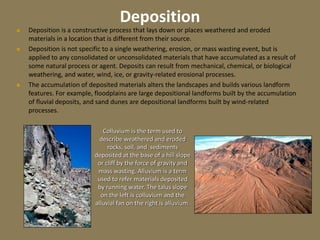
Colluvium is the term used to
describe weathered and eroded
rocks, soil, and sediments
deposited at the base of a hill slope
or cliff by the force of gravity and
mass wasting. Alluvium is a term
used to refer materials deposited
by running water. The talus slope
on the left is colluvium and the
alluvial fan on the right is alluvium.
 Sedimentary rocks are formed by the lithification of inorganic and/or organic sediments, or as
chemical precipitates.
 There are two types of sedimentary rocks: Clastic and Chemical
 Clastic sedimentary rocks form when existing parent rock material is weathered,
fragmented, transported, and deposited in layers that compact, cement, and lithify to
form sedimentary rocks.
 Chemical sedimentary rocks are formed by a variety of processes and are divided into
sub-categories including inorganic, and biochemical or organic chemical sedimentary
rocks.
 Inorganic chemical rocks form from chemicals that are dissolved in a solution,
transported, and chemically precipitated out of solution.
 Biochemical or Organic sedimentary rocks form when plant or animal material is
deposited and lithified. Those classified as biochemical chemical generally involve
some form of fossilization or the accumulation of fossilized organism or organism
remains, such as shell fragments. Organic rocks that are classified as clastic, involve
the deposition of plant material and formation of peat and coal deposits.
 The physical, chemical, or biological changes that occur during the lithification of sedimentary
rocks are described by process collectively referred to as diagenesis.
Sedimentary Rocks
Naming and Classifying
Sedimentary Rocks
 Geologists name and classify sedimentary rocks based on their mineral composition
and texture
 Mineral composition refers to the specific minerals in the rock. For example sandstone
will contain predominantly quartz, while limestone will contain mainly calcite (calcium
carbonate).
 Texture includes the grain size and shape, sorting, and rounding of the sediments that
form the rock.
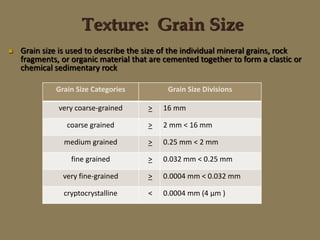
Texture: Grain Size
 Grain size is used to describe the size of the individual mineral grains, rock
fragments, or organic material that are cemented together to form a clastic or
chemical sedimentary rock
Grain Size Categories Grain Size Divisions
very coarse-grained > 16 mm
coarse grained > 2 mm < 16 mm
medium grained > 0.25 mm < 2 mm
fine grained > 0.032 mm < 0.25 mm
very fine-grained > 0.0004 mm < 0.032 mm
cryptocrystalline < 0.0004 mm (4 μm )
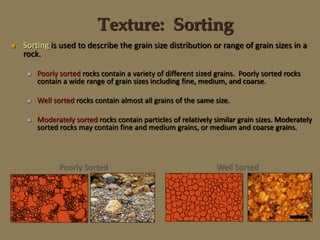
Texture: Sorting
 Sorting is used to describe the grain size distribution or range of grain sizes in a
rock.
 Poorly sorted rocks contain a variety of different sized grains. Poorly sorted rocks
contain a wide range of grain sizes including fine, medium, and coarse.
 Well sorted rocks contain almost all grains of the same size.
 Moderately sorted rocks contain particles of relatively similar grain sizes. Moderately
sorted rocks may contain fine and medium grains, or medium and coarse grains.
Poorly Sorted Well Sorted
Texture and Weathering
 The texture of a sedimentary rock can provide a lot of information about the types of
environments that the sediments were weathered in, transported by, and deposited in prior to
their lithification into sedimentary rocks.
 Most sedimentary rocks consist of grains that weathered from a parent rock and were transported
by water, wind, or ice before being deposited.
 Grain size is a good indicator of the energy or force required to move a grain of a given size.
Large sediments such as gravel, cobbles, and boulders require more energy to move than
smaller sand, silt, and clay sized sediments. Grain size is also an indicator of the distance or
length of time the sediments may have traveled. Smaller grain sizes generally indicate greater
transport distances and duration than larger grains.
 Sorting will generally improve with the constant or persistent moving of particles, and thus
can indicate if particles were transported over a long distance or for a long time period.
Sorting can also indicate selective transport of a particular grain size.
 Rounding is a good indicator for the amount of abrasion experienced by sediments. In
general, sediments that have been transported longer distances will be more rounded than
those which have traveled shorter distances.
 An example based on these principles, is that sediments deposited by rapid mass wasting events,
such as landlsides are expected to be coarse grained, poorly sorted, and poorly rounded; and
sediments deposited by slower, more gradual processes, such as dune formation, are expected to
be fine grained, well sorted, and well rounded.
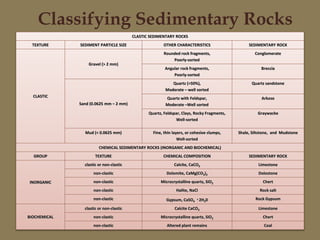
Classifying Sedimentary Rocks
CLASTIC SEDIMENTARY ROCKS
TEXTURE SEDIMENT PARTICLE SIZE OTHER CHARACTERISTICS SEDIMENTARY ROCK
CLASTIC
Gravel (> 2 mm)
Rounded rock fragments,
Poorly-sorted
Conglomerate
Angular rock fragments,
Poorly-sorted
Breccia
Sand (0.0625 mm – 2 mm)
Quartz (>50%),
Moderate – well sorted
Quartz sandstone
Quartz with Feldspar,
Moderate –Well sorted
Arkose
Quartz, Feldspar, Clays, Rocky Fragments,
Well-sorted
Graywacke
Mud (< 0.0625 mm) Fine, thin layers, or cohesive clumps,
Well-sorted
Shale, Siltstone, and Mudstone
CHEMICAL SEDIMENTARY ROCKS (INORGANIC AND BIOCHEMICAL)
GROUP TEXTURE CHEMICAL COMPOSITION SEDIMENTARY ROCK
INORGANIC
clastic or non-clastic Calcite, CaCO3 Limestone
non-clastic Dolomite, CaMg(CO3)2 Dolostone
non-clastic Microcrystalline quartz, SiO2 Chert
non-clastic Halite, NaCl Rock salt
non-clastic Gypsum, CaSO4 ۰2H20 Rock Gypsum
BIOCHEMICAL
clastic or non-clastic Calcite CaCO3 Limestone
non-clastic Microcrystalline quartz, SiO2 Chert
non-clastic Altered plant remains Coal
Sedimentary Rocks
 Clastic
 Sandstone
 Siltstone
 Shale
 Mudstone
 Conglomerate
 Breccia
 Kaolin
 Chemical Inorganic
Sedimentary Rocks
 Dolostone
 Evaporites
 Chemical / Biochemical
Sedimentary Rocks
 Limestone
 Coral Reefs
 Coquina and Chalk
 Inorganic Limestone
 Travertine
 Oolitic
 Chert
 Flint, Jasper, Agate
Sandstone
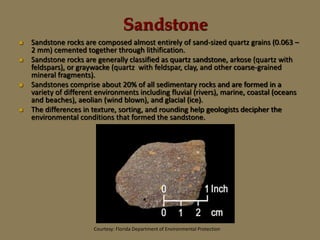
 Sandstone rocks are composed almost entirely of sand-sized quartz grains (0.063 –
2 mm) cemented together through lithification.
 Sandstone rocks are generally classified as quartz sandstone, arkose (quartz with
feldspars), or graywacke (quartz with feldspar, clay, and other coarse-grained
mineral fragments).
 Sandstones comprise about 20% of all sedimentary rocks and are formed in a
variety of different environments including fluvial (rivers), marine, coastal (oceans
and beaches), aeolian (wind blown), and glacial (ice).
 The differences in texture, sorting, and rounding help geologists decipher the
environmental conditions that formed the sandstone.
Courtesy: Florida Department of Environmental Protection
Shale
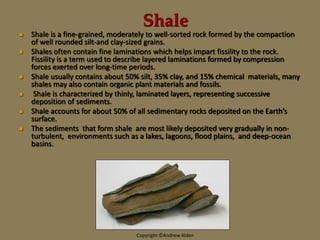
 Shale is a fine-grained, moderately to well-sorted rock formed by the compaction
of well rounded silt-and clay-sized grains.
 Shales often contain fine laminations which helps impart fissility to the rock.
Fissility is a term used to describe layered laminations formed by compression
forces exerted over long-time periods.
 Shale usually contains about 50% silt, 35% clay, and 15% chemical materials, many
shales may also contain organic plant materials and fossils.
 Shale is characterized by thinly, laminated layers, representing successive
deposition of sediments.
 Shale accounts for about 50% of all sedimentary rocks deposited on the Earth’s
surface.
 The sediments that form shale are most likely deposited very gradually in non-
turbulent, environments such as a lakes, lagoons, flood plains, and deep-ocean
basins.
Copyright ©Andrew Alden
Siltstone
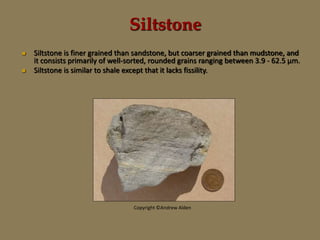
 Siltstone is finer grained than sandstone, but coarser grained than mudstone, and
it consists primarily of well-sorted, rounded grains ranging between 3.9 - 62.5 μm.
 Siltstone is similar to shale except that it lacks fissility.
Copyright ©Andrew Alden
Conglomerate
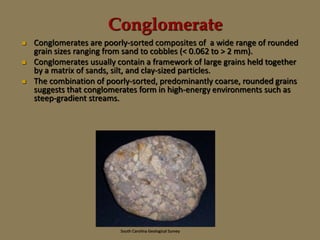
 Conglomerates are poorly-sorted composites of a wide range of rounded
grain sizes ranging from sand to cobbles (< 0.062 to > 2 mm).
 Conglomerates usually contain a framework of large grains held together
by a matrix of sands, silt, and clay-sized particles.
 The combination of poorly-sorted, predominantly coarse, rounded grains
suggests that conglomerates form in high-energy environments such as
steep-gradient streams.
South Carolina Geological Survey
Breccia
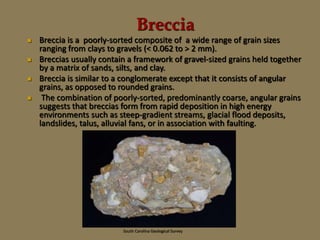
 Breccia is a poorly-sorted composite of a wide range of grain sizes
ranging from clays to gravels (< 0.062 to > 2 mm).
 Breccias usually contain a framework of gravel-sized grains held together
by a matrix of sands, silts, and clay.
 Breccia is similar to a conglomerate except that it consists of angular
grains, as opposed to rounded grains.
 The combination of poorly-sorted, predominantly coarse, angular grains
suggests that breccias form from rapid deposition in high energy
environments such as steep-gradient streams, glacial flood deposits,
landslides, talus, alluvial fans, or in association with faulting.
South Carolina Geological Survey
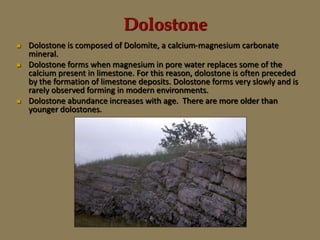
Dolostone
 Dolostone is composed of Dolomite, a calcium-magnesium carbonate
mineral.
 Dolostone forms when magnesium in pore water replaces some of the
calcium present in limestone. For this reason, dolostone is often preceded
by the formation of limestone deposits. Dolostone forms very slowly and is
rarely observed forming in modern environments.
 Dolostone abundance increases with age. There are more older than
younger dolostones.
Evaporites
 Evaporites are chemical deposits formed when restricted bodies of saline
water evaporate, precipitating out a range of minerals.
 Evaporite deposits do not involve a single chemical precipitate, instead they
consist of chlorides, sulfides, carbonates, and borates.
 Halite and gypsum are two common examples of mineral precipitates.
Utah’s Bonneville Salt Flats
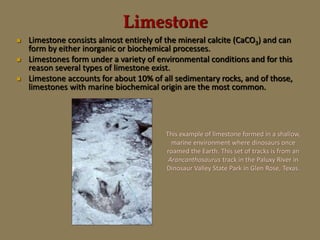
 Limestone consists almost entirely of the mineral calcite (CaCO3) and can
form by either inorganic or biochemical processes.
 Limestones form under a variety of environmental conditions and for this
reason several types of limestone exist.
 Limestone accounts for about 10% of all sedimentary rocks, and of those,
limestones with marine biochemical origin are the most common.
This example of limestone formed in a shallow,
marine environment where dinosaurs once
roamed the Earth. This set of tracks is from an
Arancanthosaurus track in the Paluxy River in
Dinosaur Valley State Park in Glen Rose, Texas.
Limestone
Coral Reefs
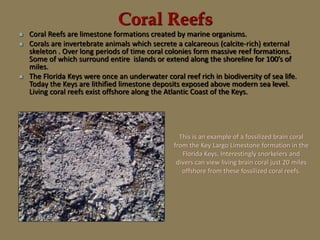
 Coral Reefs are limestone formations created by marine organisms.
 Corals are invertebrate animals which secrete a calcareous (calcite-rich) external
skeleton . Over long periods of time coral colonies form massive reef formations.
Some of which surround entire islands or extend along the shoreline for 100’s of
miles.
 The Florida Keys were once an underwater coral reef rich in biodiversity of sea life.
Today the Keys are lithified limestone deposits exposed above modern sea level.
Living coral reefs exist offshore along the Atlantic Coast of the Keys.
This is an example of a fossilized brain coral
from the Key Largo Limestone formation in the
Florida Keys. Interestingly snorkelers and
divers can view living brain coral just 20 miles
offshore from these fossilized coral reefs.
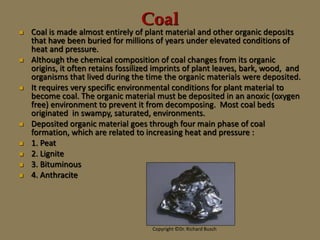
Coal
 Coal is made almost entirely of plant material and other organic deposits
that have been buried for millions of years under elevated conditions of
heat and pressure.
 Although the chemical composition of coal changes from its organic
origins, it often retains fossilized imprints of plant leaves, bark, wood, and
organisms that lived during the time the organic materials were deposited.
 It requires very specific environmental conditions for plant material to
become coal. The organic material must be deposited in an anoxic (oxygen
free) environment to prevent it from decomposing. Most coal beds
originated in swampy, saturated, environments.
 Deposited organic material goes through four main phase of coal
formation, which are related to increasing heat and pressure :
 1. Peat
 2. Lignite
 3. Bituminous
 4. Anthracite
Copyright ©Dr. Richard Busch
Stratigraphy
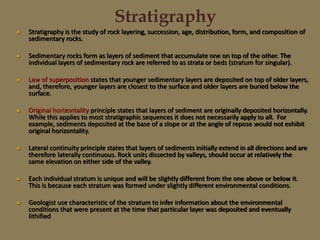
 Stratigraphy is the study of rock layering, succession, age, distribution, form, and composition of
sedimentary rocks.
 Sedimentary rocks form as layers of sediment that accumulate one on top of the other. The
individual layers of sedimentary rock are referred to as strata or beds (stratum for singular).
 Law of superposition states that younger sedimentary layers are deposited on top of older layers,
and, therefore, younger layers are closest to the surface and older layers are buried below the
surface.
 Original horizontality principle states that layers of sediment are originally deposited horizontally.
While this applies to most stratigraphic sequences it does not necessarily apply to all. For
example, sediments deposited at the base of a slope or at the angle of repose would not exhibit
original horizontality.
 Lateral continuity principle states that layers of sediments initially extend in all directions and are
therefore laterally continuous. Rock units dissected by valleys, should occur at relatively the
same elevation on either side of the valley.
 Each individual stratum is unique and will be slightly different from the one above or below it.
This is because each stratum was formed under slightly different environmental conditions.
 Geologist use characteristic of the stratum to infer information about the environmental
conditions that were present at the time that particular layer was deposited and eventually
lithified
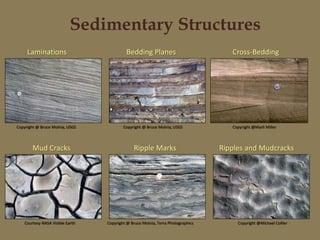
Sedimentary Structures
Cross-Bedding
Copyright @Marli Miller
Ripple Marks
Copyright @ Bruce Molnia, Terra Photographics
Mud Cracks
Courtesy NASA Visible Earth
Ripples and Mudcracks
Copyright @Michael Collier
Copyright @ Bruce Molnia, USGS
Bedding Planes
Laminations
Copyright @ Bruce Molnia, USGS

geo 4.pptx

  • 1.
    What are Rocks? •Most rocks are an aggregate of one or more minerals and a few rocks are composed of non-mineral matter. • There are three major rock types: – 1. Igneous – 2. Metamorphic – 3. Sedimentary Table of Contents 1
  • 2.
    Major Rock Types –Igneous rocks are formed by the cooling of molten magma or lava near, at, or below the Earth’s surface. – Sedimentary rocks are formed by the lithification of inorganic and organic sediments deposited at or near the Earth’s surface. – Metamorphic rocks are formed when preexisting rocks are transformed into new rocks by elevated heat and pressure below the Earth’s surface. 2 Table of Contents
  • 3.
    The Rock Cycle TheRock Cycle graphic is available from the SCGS website: http://www.dnr.sc.gov/geology/images/Rockcycle-pg.pdf
  • 4.
    • Weathering, erosion,mass-wasting, and depositional processes occur at or near the Earth’s surface and produce changes to the landscape that influence surface and subsurface topography and landform development. – Weathering is the physical disintegration or chemical alteration of rocks at or near the Earth’s surface. – Erosion is the physical removal and transportation of weathered material by water, wind, ice, or gravity. – Mass wasting is the transfer or movement of rock or soil down slope primarily by gravity. – Deposition is the process by which weathered and eroded materials are laid down or placed in a location that is different from their source. • These processes are all very important to the rock cycle because over geologic time weathering, erosion, and mass wasting transform solid rock into sediments and soil that result in the re deposition of material forming new sedimentary rocks.
  • 5.
    Types of Weathering I.Mechanical (physical) weathering is the physical disintegration and reduction in the size of the rocks without changing their chemical composition. Examples: exfoliation, frost wedging, salt wedging, temperature changes, and abrasion II. Chemical weathering decomposes, dissolves, alters, or weakens the rock through chemical processes to form residual materials. Examples: carbonation, hydration, hydrolosis, oxidation, and solution III. Biological weathering is the disintegration or decay of rocks and minerals caused by chemical or physical agents of organisms. Examples: organic activity from lichen and algae, rock disintegration by plant or root growth, burrowing and tunneling organisms, and acid secretion
  • 6.
    I. Mechanical Weathering Mechanicalweathering is the physical disintegration and reduction in the size of the rocks without changing their chemical composition. – Exfoliation – Frost Wedging – Salt Wedging – Temperature Changes – Abrasion
  • 7.
    Mechanical Weathering: Exfoliation •Exfoliation is a mechanical weathering process whereby pressure in a rock is released along parallel alignments near the surface of the bedrock and layers or slabs of the rock along these alignments break off from the bedrock and move downhill by gravity. • Exfoliation primarily occurs on intrusive igneous or metamorphosed rocks that are exposed at the Earth’s surface. • Exfoliation can occur both very slowly or very rapidly as a form of mass wasting. • Large rocks characterized by exfoliation are commonly referred to as exfoliation domes.
  • 8.
    • Frost wedgingis a mechanical weathering process caused by the freeze-thaw action of water that is trapped between cracks in the rock. • When water freezes, it expands and applies pressure to the surrounding rock forcing the rock to accommodate the expansion of the ice. • This process gradually weakens, cracks, and breaks the rock through repetitive freeze-thaw weathering cycles. • Frost wedging generally produces angular blocks and talus material. Talus is a term used to describe weathered rock fragments deposited at the base of a hill slope or mountain. Mechanical Weathering: Frost Wedging
  • 9.
    Mechanical Weathering: SaltWedging • Salt wedging occurs when salts crystallize out of solution as water evaporates. As the salt crystals grow, they apply pressure to the surrounding rock weakening it, until it eventually cracks and breaks down, enabling the salt crystal to continue growing. • Salt wedging is most common in drier climates, such as deserts.
  • 10.
    Mechanical Weathering: Abrasion •Abrasion occurs when rocks collide against each other while they are transported by water, glacial ice, wind, or gravitational force. • The constant collision or gravitational falling of the rocks causes them to slowly break apart into progressively smaller particles. • Flowing water is the primary medium of abrasion and it produces the ‘rounded’ shape of fluvial sediments. • During abrasion, rocks may also weather the bedrock surface they are coming into contact with as well as breaking into smaller particles and eventually individual grains. • In addition to the transported rocks being weathered by abrasion, the bedrock surface is also experiencing the effects of collision and mechanical weathering. This smoothes the surface of the bedrock and can also cause it to break apart. Photo Source: SCGS Abrasion processes in creek beds produce rounded boulders and cobbles. Over time, abrasion processes will eventually break these rocks into progressively smaller particle sizes, such as gravel, sand, silt, and clay.
  • 12.
    Types of ChemicalWeathering Chemical weathering decomposes, dissolves, alters, or weakens the rock through chemical processes to form residual materials. • Carbonation • Hydrolysis • Hydration • Oxidation • Solution Copyright © Oklahoma University Stalactite and stalagmite joining together in Onondaga Cave State Park, Missouri.
  • 13.
    Chemical Weathering: Hydration •Hydration is a process where mineral structure in the rock forms a weak bond with H20 which causes the mineral grains to expand, creating stress which causes the disintegration of the rock. • Hydration often produces a new mineral compound that is larger than the original compound. The increased size expanse the rock and can lead to decay. • Hydration can also lead to color changes in the weathered rock surface. • Once hydration begins, it accelerates other weathering processes and may also be accompanied by hydrolysis and oxidation. • An example of hydrolosis: Anhydrite (CaSO4) can absorb two water molecules to become gypsum (CaSO4·2H2O). • Hydration in granite transforms feldspar minerals to clay and accelerates the physical weathering of buried or exposed rocks. Copyright ©Bruce Molnia, USGS This boulder is surrounded by saprolitic soils formed by the weathered rock. Hydration processes cause the formation of clays and contribute to the reddish- tan color of the saprolite.
  • 14.
    Chemical Weathering: Oxidation •Oxidation occurs when oxygen and water react with iron-rich minerals and weaken the structure of the mineral. • During oxidation the minerals in the rock will change colors, taking on a ‘rusty’, reddish- orange appearance. • Similar to other chemical weathering processes, oxidation accelerates rock decay, rendering it more vulnerable to other forms of weathering. The reddish-orange color of this sandstone is a result of oxidation processes weathering the rock.
  • 15.
    Chemical Weathering: Solution •Solution occurs when minerals in rock dissolve directly into water. • Solution most commonly occurs on rocks containing carbonates such as limestone, but may also affect rocks with large amount of halite, or rock salt. • Solution of large areas of bedrock may cause sinkholes to form, where large areas of the ground subside or collapse forming a depression. Copyright © Larry Fellows, Arizona Geological Survey Subsurface dissolution of halite has caused overlying rocks to collapse and form crater-like features. Copyright © Bruce Molina, USGS This is an example of a limestone solution karst feature found in Florida's Everglades National Park.
  • 18.
    Biological Weathering Biological weatheringis the disintegration or decay of rocks and minerals caused by chemical or physical agents of organisms. • Organic activity from lichen and algae • Rock disintegration by plant growth • Burrowing and tunneling organisms • Secretion of acids
  • 19.
    Lichen, Algae, andDecaying Plants • Organisms such as lichen and algae often live on bare rock and extract minerals from the rock by ion-exchange mechanisms. • This bio-chemical weathering process leaches minerals from the rock causing it to weaken and breakdown. • The decaying of plant materials can also produce acidic compounds which dissolve the exposed rock. • The presence of organisms growing, expanding, or moving across the surface of the rock also exerts a small amount of abrasion and pressure that gradually cause the mechanical weathering of the rock as the organisms extract various minerals. This is an example of biological weathering that is caused by mosses and lichen growing on the face of a rock.
  • 20.
    Plant Roots • Themost common form of biological weathering is when plant roots penetrate into cracks and crevices of rocks and cause the rock to split or break into smaller particles through mechanical weathering. • Although, this process is gradual, it can be fairly effective at breaking apart rocks that may already have a pre-existing weaknesses such as fractures, faults, or joints. Copyright © Bruce Molnia, Terra Photographics This is an example of a tree that is growing between a crevasse in a rock. The tree is splitting the rock along parallel planes of alignment that are already weakened by foliation processes, a form of mechanical weathering.
  • 21.
    Organism Activity • Burrowing,tunneling, and acid- secreting organisms are another form of biological weathering that chemically or mechanically contribute to weathering. • Some animals may burrow or tunnel into rocks or cracks in rocks and cause the rock to break down and disintegrate. Small animals, worms, termites, and other insects, often contribute to this form of biological weathering. • Some organisms, such as snails, barnacles, or limpets, attach themselves to rocks and secrete acid acids that chemically dissolve the rock surface. The periwinkle snails on this rock are secreting acids that dissolve the rock. This picture is taken from a volcanic shoreline in Hawaii.
  • 22.
    Differential Weathering  Weatheringrates will not only vary depending on the type of weathering process, whether it is mechanical, chemical, or biological, but they will also vary depending on the rock material that is being weathered.  Some rocks are harder than other rocks, and will weather slower than softer rocks.  The differences in rates of weathering due to different types of rocks, textures, or other characteristics is referred to as differential weathering.  Differential weathering processes contribute to the unique formation of many landforms, including pedestals, waterfalls, and monadnocks.  Climate can also produce differential weathering responses for the same rock type. For example, limestone weathers more quickly in wet climates than dry climates. Peachtree Rock’s unique pyramidal shape is a result of differential weathering associated with the different sedimentary sandstone rock components. The top portion of the outcrop consists of hard, coarse-grained sandstone, while the lower part of the rock consist of a less cohesive, sandstone layer. The lower portion of the rock has weathered more quickly than the upper portion ultimately producing its unique pyramidal shape
  • 23.
    Erosion  Water erodesrocks and the landscapes by transporting weathered materials from their source to another location where they are deposited.  Wind erodes materials by picking them up and temporarily transporting them from their source to another location where they are deposited, and either stored or re-mobilized and transported to another location.  Ice erosion occurs when particles are plucked up or incorporated by moving ice, such as a glaciers, and are transported downhill, or when friction between the ice and bedrock erodes materials and then transports them downhill.  Gravity facilitates the down slope transportation of loosened, weathered materials and enables them to move without the aid of water, wind, or ice. Gravity related erosion is a major component of mass-wasting events. Copyright ©Marli Miller, University of Oregon This basin and range landscape is influenced by several erosional processes. The mountains in the background are dissected by fluvial erosion (water) and the sandstorm in the valley is a form of aeolian (wind) erosion. The mountains may contain numerous rocks falls or landslides a form of gravity related mass-wasting erosion.
  • 24.
    Erosion: Water (Fluvial) Water erodes rocks and shapes the landscapes by removing and transporting weathered materials from their source to another location where they are deposited and either stored or transported to another location.  Fluvial erosion is often broken into 3 distinct categories: rain-splash erosion, sheet erosion, and rill/gully erosion.  Rain splash erosion occurs when the impact of a rain drop loosens and mobilizes particles.  Sheet erosion is a process where particles loosened buy rain-splash erosion are transported by runoff water down the slope of a surface.  Rill erosion occurs when water concentrates during sheet erosion and erodes small rills or gullys into the surface that channel flow down slope.  Fluvial erosion can occur during rainfall events, from melt-water runoff, or ground water percolation. Materials being eroded and transported are either suspended in the water, bounced by saltation, or rolled along the ground by traction depending on a variety of conditions.  The accumulation of fluvial erosion and associated processes over a large area forms pathways for surface and groundwater flow and carves v-shaped river valleys that continue to erode, transport, and deposit weathered sediments across the landscape. This drawing on the left illustrates rain-splash impact on the soil and the erosion of individual grains of sediment. The image on the right shows the landscape scale effects of fluvial erosion.
  • 25.
    Erosion: Wind (Aeolian) Wind erodes weathered rocks by picking them up and temporarily transporting them from their source to another location where they are deposited, and either stored or re-mobilized and transported to another location  Erosion by wind is divided into two different categories: Deflation and Abrasion  Deflation is the movement or transport of particles through the air or along the ground  Abrasion is the process that occurs when wind-transported particles sculpt features in the landscape through a “sand-blasting” like process  Aeolian erosion and deposition processes create a diversity of landforms including sand dunes, loess deposits, and yardangs. Courtesy Modis, Nasa This satellite image captured a regional dust storm transporting aeolian sediments from Sudan and Africa over the Red Sea. In arid, desert climates wind erosion is very common and can transport sediments 100’s of miles before they are deposited.
  • 26.
    Erosion: Ice (Periglacialand Glacial)  Ice erosion occurs in combination with periglacial and glacial processes  Glacial erosion occurs when particles are incorporated into the glacial ice through a process referred to as plucking, and they are transported downslope within the glacier.  The friction and abrasion of the ice and rock moving across the bedrock, erodes the surface of the bedrock and often leaves scrapes, grooves, striae, or polished rock surfaces.  The cumulative effects of glacial erosion on a mountainous landscape can produce distinct u-shaped valleys which are a common glacial landform. Glacial erosion of this landscape has carved several distinct landforms, such as the glacial u-shaped valleys and the arêtes, which form the ridges between the u-shape valleys.
  • 27.
    Erosion: Gravity  Gravityfacilitates the down slope transportation of loosened, weathered materials and enables them to move without the aid of water, wind, or ice. However, these agents can act as catalysts for gravity related erosion.  Movements by gravity may be very slow or very abrupt.  Gravity related erosion can be coherent or incoherent. Coherent refers to the erosion of a consolidated mass of materials that erode or move as a single unit, incoherent refers to the erosion or movement of a mass of unconsolidated individual fragments of materials.  Unconsolidated materials tend to stabilize near an angle of 35° (referred to as the angle of repose) however this balance is easily disrupted by changes in environmental conditions, addition of weathered materials, and or other adjustments that may cause mass wasting. The rock fragments and sediments accumulated below this cliff were eroded by the force of gravity and were deposited as talus scree at the base of the cliff. When the slope at the base of the cliff becomes too steep, and exceeds the angle of repose, the unconsoldated particles will again be eroded and transported down slope by gravity.
  • 28.
    Mass Wasting  RockFalls  Landslides  Debris / Mud Flows  Slumps  Creep Landslide Rock Fall Mass wasting is a rapid form of erosion that works primarily under the influence of gravity in combination with other erosional agents. Mass wasting occurs very quickly and can result in either small or large scale changes to the landscape depending on the type of event.
  • 29.
    Rock Falls  Rockfalls occur when rocks become dislodged, because their change in potential energy becomes to great to maintain, and the potential energy becomes kinetic energy which causes the rock fragment to fall, restoring equilibrium. As a result the rocks fall, roll, or bounce downhill.  The rocks may be loosened by a recent rainfall or snow melt-water event that facilitates the movement of the rock before they fall from the force of gravity.  Rock falls often form piles of loose rock below their source and are sometimes referred to as talus or scree.  Large volumes of talus may form a talus slope, talus apron, or talus cone depending on its shape. Talus tends to stabilize near an angle of 35° (referred to as the angle of repose), or the steepest angle maintained before changes in energy lead to gravitational erosion. This balance is easily disrupted by changes in environmental conditions, addition of weathered materials, or other factors that lead to mass wasting. Photo courtesy of SCGS Fragments are breaking off from this rock exposure and collecting down-slope from their source. The fragments of fallen rock are angular and include a variety of different sizes. The tree growing above this boulder may also be contributing through biological weathering where the roots are penetrating into the cracks in the rock.
  • 30.
    Landslides  Landslides aremass-wasting events where large amounts of weathered rock material slide down a hillslope or mountain side primarily by gravity related erosion.  Landslides occur very quickly and move with incredible speed and destruction, often removing or covering everything in their path.  Nearly all landslides are triggered by an earthquake, or lubricant agent such as rainfall, or a snow or ice melt-water event.  During intensive rainfall, soil and weathered rock material become unstable and loosened from the saturated conditions that separate the individual grains and other material fragments. The increased fluid pressures coupled with the loosened materials succumbs to gravity related erosion and the weathered materials plunge downhill as a powerful landslide.  Landslides are a natural hazard that can cause serious damage to people and other obstacles in their path. Many earth scientists study landslides in order to predict their occurrence and prevent negative impacts to humans and infrastructure. This landslide event occurred in Jones Gap State Park in the Mountain Bridge Wilderness Area of South Carolina. Boulders, trees, soil, and other weathered material tumbled down this hill-slope after 8’’ of heavy rain fell over 2-days.
  • 31.
    Debris and MudFlows  Debris and mudflows are mass-wasting events that form when heavy rainfalls produce large amounts of runoff that transport eroded soils, sediments, and plant debris down slope where the flows eventually spreads out across valley bottoms.  Sometimes the debris and mudflows follow existing drainage paths and other times they carve out new paths as they flow downhill  Debris and mudflows can carry particles of a range of sizes from clays (mud) to large debris and boulders; however, debris flows consists primarily of coarse-grained materials and mudflows consist primarily of fine-grained materials.  The consistency of a debris or mudflow is representative of a thick, muddy sludge carrying rocks, twigs, branches, trees, and other available debris  Debris flows are natural hazards that pose a threat to communities in their path This debris flow flooded and destroyed several homes as it carried, mud, trees, and boulders through a valley in Colorado’s Rocky Mountain Range.
  • 32.
    Deposition  Deposition isa constructive process that lays down or places weathered and eroded materials in a location that is different from their source.  Deposition is not specific to a single weathering, erosion, or mass wasting event, but is applied to any consolidated or unconsolidated materials that have accumulated as a result of some natural process or agent. Deposits can result from mechanical, chemical, or biological weathering, and water, wind, ice, or gravity-related erosional processes.  The accumulation of deposited materials alters the landscapes and builds various landform features. For example, floodplains are large depositional landforms built by the accumulation of fluvial deposits, and sand dunes are depositional landforms built by wind-related processes. Colluvium is the term used to describe weathered and eroded rocks, soil, and sediments deposited at the base of a hill slope or cliff by the force of gravity and mass wasting. Alluvium is a term used to refer materials deposited by running water. The talus slope on the left is colluvium and the alluvial fan on the right is alluvium.
  • 33.
     Sedimentary rocksare formed by the lithification of inorganic and/or organic sediments, or as chemical precipitates.  There are two types of sedimentary rocks: Clastic and Chemical  Clastic sedimentary rocks form when existing parent rock material is weathered, fragmented, transported, and deposited in layers that compact, cement, and lithify to form sedimentary rocks.  Chemical sedimentary rocks are formed by a variety of processes and are divided into sub-categories including inorganic, and biochemical or organic chemical sedimentary rocks.  Inorganic chemical rocks form from chemicals that are dissolved in a solution, transported, and chemically precipitated out of solution.  Biochemical or Organic sedimentary rocks form when plant or animal material is deposited and lithified. Those classified as biochemical chemical generally involve some form of fossilization or the accumulation of fossilized organism or organism remains, such as shell fragments. Organic rocks that are classified as clastic, involve the deposition of plant material and formation of peat and coal deposits.  The physical, chemical, or biological changes that occur during the lithification of sedimentary rocks are described by process collectively referred to as diagenesis. Sedimentary Rocks
  • 35.
    Naming and Classifying SedimentaryRocks  Geologists name and classify sedimentary rocks based on their mineral composition and texture  Mineral composition refers to the specific minerals in the rock. For example sandstone will contain predominantly quartz, while limestone will contain mainly calcite (calcium carbonate).  Texture includes the grain size and shape, sorting, and rounding of the sediments that form the rock.
  • 36.
    Texture: Grain Size Grain size is used to describe the size of the individual mineral grains, rock fragments, or organic material that are cemented together to form a clastic or chemical sedimentary rock Grain Size Categories Grain Size Divisions very coarse-grained > 16 mm coarse grained > 2 mm < 16 mm medium grained > 0.25 mm < 2 mm fine grained > 0.032 mm < 0.25 mm very fine-grained > 0.0004 mm < 0.032 mm cryptocrystalline < 0.0004 mm (4 μm )
  • 37.
    Texture: Sorting  Sortingis used to describe the grain size distribution or range of grain sizes in a rock.  Poorly sorted rocks contain a variety of different sized grains. Poorly sorted rocks contain a wide range of grain sizes including fine, medium, and coarse.  Well sorted rocks contain almost all grains of the same size.  Moderately sorted rocks contain particles of relatively similar grain sizes. Moderately sorted rocks may contain fine and medium grains, or medium and coarse grains. Poorly Sorted Well Sorted
  • 38.
    Texture and Weathering The texture of a sedimentary rock can provide a lot of information about the types of environments that the sediments were weathered in, transported by, and deposited in prior to their lithification into sedimentary rocks.  Most sedimentary rocks consist of grains that weathered from a parent rock and were transported by water, wind, or ice before being deposited.  Grain size is a good indicator of the energy or force required to move a grain of a given size. Large sediments such as gravel, cobbles, and boulders require more energy to move than smaller sand, silt, and clay sized sediments. Grain size is also an indicator of the distance or length of time the sediments may have traveled. Smaller grain sizes generally indicate greater transport distances and duration than larger grains.  Sorting will generally improve with the constant or persistent moving of particles, and thus can indicate if particles were transported over a long distance or for a long time period. Sorting can also indicate selective transport of a particular grain size.  Rounding is a good indicator for the amount of abrasion experienced by sediments. In general, sediments that have been transported longer distances will be more rounded than those which have traveled shorter distances.  An example based on these principles, is that sediments deposited by rapid mass wasting events, such as landlsides are expected to be coarse grained, poorly sorted, and poorly rounded; and sediments deposited by slower, more gradual processes, such as dune formation, are expected to be fine grained, well sorted, and well rounded.
  • 39.
    Classifying Sedimentary Rocks CLASTICSEDIMENTARY ROCKS TEXTURE SEDIMENT PARTICLE SIZE OTHER CHARACTERISTICS SEDIMENTARY ROCK CLASTIC Gravel (> 2 mm) Rounded rock fragments, Poorly-sorted Conglomerate Angular rock fragments, Poorly-sorted Breccia Sand (0.0625 mm – 2 mm) Quartz (>50%), Moderate – well sorted Quartz sandstone Quartz with Feldspar, Moderate –Well sorted Arkose Quartz, Feldspar, Clays, Rocky Fragments, Well-sorted Graywacke Mud (< 0.0625 mm) Fine, thin layers, or cohesive clumps, Well-sorted Shale, Siltstone, and Mudstone CHEMICAL SEDIMENTARY ROCKS (INORGANIC AND BIOCHEMICAL) GROUP TEXTURE CHEMICAL COMPOSITION SEDIMENTARY ROCK INORGANIC clastic or non-clastic Calcite, CaCO3 Limestone non-clastic Dolomite, CaMg(CO3)2 Dolostone non-clastic Microcrystalline quartz, SiO2 Chert non-clastic Halite, NaCl Rock salt non-clastic Gypsum, CaSO4 ۰2H20 Rock Gypsum BIOCHEMICAL clastic or non-clastic Calcite CaCO3 Limestone non-clastic Microcrystalline quartz, SiO2 Chert non-clastic Altered plant remains Coal
  • 40.
    Sedimentary Rocks  Clastic Sandstone  Siltstone  Shale  Mudstone  Conglomerate  Breccia  Kaolin  Chemical Inorganic Sedimentary Rocks  Dolostone  Evaporites  Chemical / Biochemical Sedimentary Rocks  Limestone  Coral Reefs  Coquina and Chalk  Inorganic Limestone  Travertine  Oolitic  Chert  Flint, Jasper, Agate
  • 41.
    Sandstone  Sandstone rocksare composed almost entirely of sand-sized quartz grains (0.063 – 2 mm) cemented together through lithification.  Sandstone rocks are generally classified as quartz sandstone, arkose (quartz with feldspars), or graywacke (quartz with feldspar, clay, and other coarse-grained mineral fragments).  Sandstones comprise about 20% of all sedimentary rocks and are formed in a variety of different environments including fluvial (rivers), marine, coastal (oceans and beaches), aeolian (wind blown), and glacial (ice).  The differences in texture, sorting, and rounding help geologists decipher the environmental conditions that formed the sandstone. Courtesy: Florida Department of Environmental Protection
  • 42.
    Shale  Shale isa fine-grained, moderately to well-sorted rock formed by the compaction of well rounded silt-and clay-sized grains.  Shales often contain fine laminations which helps impart fissility to the rock. Fissility is a term used to describe layered laminations formed by compression forces exerted over long-time periods.  Shale usually contains about 50% silt, 35% clay, and 15% chemical materials, many shales may also contain organic plant materials and fossils.  Shale is characterized by thinly, laminated layers, representing successive deposition of sediments.  Shale accounts for about 50% of all sedimentary rocks deposited on the Earth’s surface.  The sediments that form shale are most likely deposited very gradually in non- turbulent, environments such as a lakes, lagoons, flood plains, and deep-ocean basins. Copyright ©Andrew Alden
  • 43.
    Siltstone  Siltstone isfiner grained than sandstone, but coarser grained than mudstone, and it consists primarily of well-sorted, rounded grains ranging between 3.9 - 62.5 μm.  Siltstone is similar to shale except that it lacks fissility. Copyright ©Andrew Alden
  • 44.
    Conglomerate  Conglomerates arepoorly-sorted composites of a wide range of rounded grain sizes ranging from sand to cobbles (< 0.062 to > 2 mm).  Conglomerates usually contain a framework of large grains held together by a matrix of sands, silt, and clay-sized particles.  The combination of poorly-sorted, predominantly coarse, rounded grains suggests that conglomerates form in high-energy environments such as steep-gradient streams. South Carolina Geological Survey
  • 45.
    Breccia  Breccia isa poorly-sorted composite of a wide range of grain sizes ranging from clays to gravels (< 0.062 to > 2 mm).  Breccias usually contain a framework of gravel-sized grains held together by a matrix of sands, silts, and clay.  Breccia is similar to a conglomerate except that it consists of angular grains, as opposed to rounded grains.  The combination of poorly-sorted, predominantly coarse, angular grains suggests that breccias form from rapid deposition in high energy environments such as steep-gradient streams, glacial flood deposits, landslides, talus, alluvial fans, or in association with faulting. South Carolina Geological Survey
  • 46.
    Dolostone  Dolostone iscomposed of Dolomite, a calcium-magnesium carbonate mineral.  Dolostone forms when magnesium in pore water replaces some of the calcium present in limestone. For this reason, dolostone is often preceded by the formation of limestone deposits. Dolostone forms very slowly and is rarely observed forming in modern environments.  Dolostone abundance increases with age. There are more older than younger dolostones.
  • 47.
    Evaporites  Evaporites arechemical deposits formed when restricted bodies of saline water evaporate, precipitating out a range of minerals.  Evaporite deposits do not involve a single chemical precipitate, instead they consist of chlorides, sulfides, carbonates, and borates.  Halite and gypsum are two common examples of mineral precipitates. Utah’s Bonneville Salt Flats
  • 48.
     Limestone consistsalmost entirely of the mineral calcite (CaCO3) and can form by either inorganic or biochemical processes.  Limestones form under a variety of environmental conditions and for this reason several types of limestone exist.  Limestone accounts for about 10% of all sedimentary rocks, and of those, limestones with marine biochemical origin are the most common. This example of limestone formed in a shallow, marine environment where dinosaurs once roamed the Earth. This set of tracks is from an Arancanthosaurus track in the Paluxy River in Dinosaur Valley State Park in Glen Rose, Texas. Limestone
  • 49.
    Coral Reefs  CoralReefs are limestone formations created by marine organisms.  Corals are invertebrate animals which secrete a calcareous (calcite-rich) external skeleton . Over long periods of time coral colonies form massive reef formations. Some of which surround entire islands or extend along the shoreline for 100’s of miles.  The Florida Keys were once an underwater coral reef rich in biodiversity of sea life. Today the Keys are lithified limestone deposits exposed above modern sea level. Living coral reefs exist offshore along the Atlantic Coast of the Keys. This is an example of a fossilized brain coral from the Key Largo Limestone formation in the Florida Keys. Interestingly snorkelers and divers can view living brain coral just 20 miles offshore from these fossilized coral reefs.
  • 50.
    Coal  Coal ismade almost entirely of plant material and other organic deposits that have been buried for millions of years under elevated conditions of heat and pressure.  Although the chemical composition of coal changes from its organic origins, it often retains fossilized imprints of plant leaves, bark, wood, and organisms that lived during the time the organic materials were deposited.  It requires very specific environmental conditions for plant material to become coal. The organic material must be deposited in an anoxic (oxygen free) environment to prevent it from decomposing. Most coal beds originated in swampy, saturated, environments.  Deposited organic material goes through four main phase of coal formation, which are related to increasing heat and pressure :  1. Peat  2. Lignite  3. Bituminous  4. Anthracite Copyright ©Dr. Richard Busch
  • 51.
    Stratigraphy  Stratigraphy isthe study of rock layering, succession, age, distribution, form, and composition of sedimentary rocks.  Sedimentary rocks form as layers of sediment that accumulate one on top of the other. The individual layers of sedimentary rock are referred to as strata or beds (stratum for singular).  Law of superposition states that younger sedimentary layers are deposited on top of older layers, and, therefore, younger layers are closest to the surface and older layers are buried below the surface.  Original horizontality principle states that layers of sediment are originally deposited horizontally. While this applies to most stratigraphic sequences it does not necessarily apply to all. For example, sediments deposited at the base of a slope or at the angle of repose would not exhibit original horizontality.  Lateral continuity principle states that layers of sediments initially extend in all directions and are therefore laterally continuous. Rock units dissected by valleys, should occur at relatively the same elevation on either side of the valley.  Each individual stratum is unique and will be slightly different from the one above or below it. This is because each stratum was formed under slightly different environmental conditions.  Geologist use characteristic of the stratum to infer information about the environmental conditions that were present at the time that particular layer was deposited and eventually lithified
  • 52.
    Sedimentary Structures Cross-Bedding Copyright @MarliMiller Ripple Marks Copyright @ Bruce Molnia, Terra Photographics Mud Cracks Courtesy NASA Visible Earth Ripples and Mudcracks Copyright @Michael Collier Copyright @ Bruce Molnia, USGS Bedding Planes Laminations Copyright @ Bruce Molnia, USGS