V. Hari Krishna, R111794,
Civil Engineering 4th Year,
RGUKT, RK Valley, Idupulapaya.
CONTENTS
2
History of Indian Railways
What is track ?
Definition of Track Maintenance
Need of track maintenance
Advantages of track Maintenance
Characteristics of good track
Annual programme of regular track maintenances
Different systems of track maintenance
Conclusion
About Indian Railways
3
 It is one of the world's largest railway networks comprising 1,15,000 km
of track over a route of 67,312 km and 7,112 stations.
 Indian Railways is the world‘s largest commercial or utility employers,
by number of employees, with over 1.376 million employees.
 India’s First train ran between Mumbai and Thane in 1853.
 It’s tag line is “Lifeline to the Nation”
 It is headquartered in Delhi.
About South Central Railway, Vijayawada
 I did my internship at South Central Railway, Vijayawada
 It is one of the six railway divisions under SCR.
 It is the second busiest railway junction next to Mumbai
Central.
 It has 10 platforms with 22 track lines.
 Everyday more than 250 passenger trains and 150 freight trains
utilize this station.
4
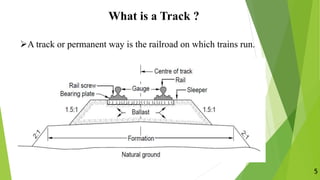
What is a Track ?
5
A track or permanent way is the railroad on which trains run.
Definition of Track Maintenance
6
It is the overhauling of track periodically with the object of
restoring it to its best possible condition in which it can serve all
the requirements of a good track.
Need of Track Maintenance
7
1. Due to the constant movement of heavy and high-speed trains, the
packing under the sleepers becomes loose and track geometry gets
disturbed. The gauge, alignment, and longitudinal as well as cross
levels of the track thus get affected adversely.
2. Due to the vibrations and impact of high-speed trains, the fittings of
the track come undone and there is heavy wear and tear of the track
and its components.
3. The track and its components get worn out as a result typical
climatic conditions.
Advantages of Track Maintenance
8
 Life Time of track increases.
 Reduces operational costs and fuel consumption up to 20 – 30 %.
 Provides safe and smooth running of trains.
 Gives pleasant ride to passengers without giving any noisy
sounds.
 Higher speed of trains is achieved.
Characteristics of Good Track
9
 The gauge should be correct or within the specified limits.
 There should be no difference in cross levels except on curves.
 The alignment should be straight and kink-free.
 Longitudinal levels should be uniform.
 The ballast should be adequate and the sleepers should be well
packed.
 Track drainage should be good
 Fittings and Fastenings must be firmly fixed.
Annual Programme of Regular Track
Maintenances
10
S.No Period Work
1 Post monsoon
attention: For about
six months after end
of monsoon
Have to check everything
2 Pre monsoon attention
for about 2 months prior to break
of monsoon.
Mainly Focusses on drainage
3 Attention during monsoon for
about four months
Mainly focuses on drainage and also daily
patrolling in case heavy rain
Different Systems of Track Maintenance
11
1. Conventional System of Track Maintenance
2. 3 – Tier System of Track Maintenance
In India Conventional system of track maintenance
is adopted. We will discuss about it.
12
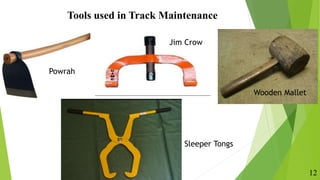
Powrah
Jim Crow
Sleeper Tongs
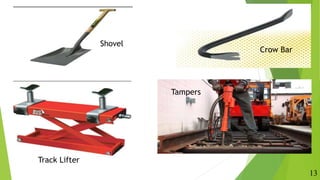
Tools used in Track Maintenance
Wooden Mallet
13
Shovel
Crow Bar
Track Lifter
Tampers
1. Through Packing (Conventional Beater Packing)
The length track opened in day should not be more than the efficient
maintenance to be done to that track at the end of the day.
It consists the following operations in sequence.
a) Opening of the road.
b) Examination of rails, sleepers and fastenings.
c) Squaring of sleepers.
d) Slewing of track to correct alignment.
e) Gauging.
f) Packing of sleepers.
h) Boxing of ballast section and tidying.
14
a)Opening of the road
Ballast should be opened on either sides of rail seats, depth
upto 50 mm
They should not disturb cores under sleeper.
Opening length on either sides is different for different
gauges
For B.G 45 cm
For M.G 35 cm
For N.G 25 cm
It is done with the help of shovels and powrahs
15
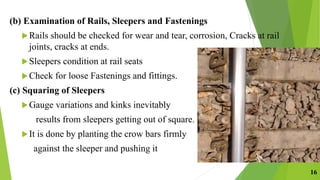
(b) Examination of Rails, Sleepers and Fastenings
Rails should be checked for wear and tear, corrosion, Cracks at rail
joints, cracks at ends.
Sleepers condition at rail seats
Check for loose Fastenings and fittings.
(c) Squaring of Sleepers
Gauge variations and kinks inevitably
results from sleepers getting out of square.
It is done by planting the crow bars firmly
against the sleeper and pushing it
16
(d) Slewing of Track to Correct Alignment
It is to ensure the correct alignment of track.
It will be checked for alignment from a distance 25-30 metres.
(e) Gauging
It is to maintain uniform gauge distance.
For B.G. 1676 mm, M.G. 1000 mm and 762 mm for N.G
It is done only if the sleepers are truly square.
Because of aging and different conditions of sleeper it is not
possible to maintain exact gauge distance.
17
(f) Packing of sleepers
It is to check whether each sleeper is fixed firmly and
uniformly with the ballast.
It is done with respect of one fixed sleeper to others.
Each sleeper should be packed at a time by 4 members.
After packing they will be blown by a wooden mallet.
A hollow sound will indicate defective packing.
18
(g) Boxing to Ballast section and Tidying
After all the operations done in sequence a clean
ballast should be made with ballast forks or rakes.
Ballast should be dressed with hemp cord of 6 mm
dia.
Ballast should be fully filled, at inadequate sections.
19
Conventional System of Track Maintenance
Continued ….
20
2. Track Maintenance by Machines
3.Measured Shovel Packing
4. Systematic Overhauling
(a) Shallow screening and making up of ballast.
(b) All items attended to, while doing through packing.
(c) Making up the cess.
5. Deep Screening of Ballast
6. Lubrication of Joints
7. Picking up Slacks
8. Using of Bio Toilets
Conclusion
21
From this topic I came to know that track maintenance is
essential for safe, economic and smooth running of a rail.
Indian Railways is taking special care about track
maintenance, introducing new ideas to do track maintenance
more efficiently.
Any Queries ….?
22
REFERENCES
 [1] Railway Track Engineering by J.S.Mundrey
 [2] http://www.indianrailways.gov.in
 [3] http://www.wikipedia.com
 [4] Railway Engineering by Satish Chandra and MM
Agarwal
 [5] https://www.google.co.in
23
Railway Track  Maintenance

Railway Track Maintenance

  • 1.
    V. Hari Krishna,R111794, Civil Engineering 4th Year, RGUKT, RK Valley, Idupulapaya.
  • 2.
    CONTENTS 2 History of IndianRailways What is track ? Definition of Track Maintenance Need of track maintenance Advantages of track Maintenance Characteristics of good track Annual programme of regular track maintenances Different systems of track maintenance Conclusion
  • 3.
    About Indian Railways 3 It is one of the world's largest railway networks comprising 1,15,000 km of track over a route of 67,312 km and 7,112 stations.  Indian Railways is the world‘s largest commercial or utility employers, by number of employees, with over 1.376 million employees.  India’s First train ran between Mumbai and Thane in 1853.  It’s tag line is “Lifeline to the Nation”  It is headquartered in Delhi.
  • 4.
    About South CentralRailway, Vijayawada  I did my internship at South Central Railway, Vijayawada  It is one of the six railway divisions under SCR.  It is the second busiest railway junction next to Mumbai Central.  It has 10 platforms with 22 track lines.  Everyday more than 250 passenger trains and 150 freight trains utilize this station. 4
  • 5.
    What is aTrack ? 5 A track or permanent way is the railroad on which trains run.
  • 6.
    Definition of TrackMaintenance 6 It is the overhauling of track periodically with the object of restoring it to its best possible condition in which it can serve all the requirements of a good track.
  • 7.
    Need of TrackMaintenance 7 1. Due to the constant movement of heavy and high-speed trains, the packing under the sleepers becomes loose and track geometry gets disturbed. The gauge, alignment, and longitudinal as well as cross levels of the track thus get affected adversely. 2. Due to the vibrations and impact of high-speed trains, the fittings of the track come undone and there is heavy wear and tear of the track and its components. 3. The track and its components get worn out as a result typical climatic conditions.
  • 8.
    Advantages of TrackMaintenance 8  Life Time of track increases.  Reduces operational costs and fuel consumption up to 20 – 30 %.  Provides safe and smooth running of trains.  Gives pleasant ride to passengers without giving any noisy sounds.  Higher speed of trains is achieved.
  • 9.
    Characteristics of GoodTrack 9  The gauge should be correct or within the specified limits.  There should be no difference in cross levels except on curves.  The alignment should be straight and kink-free.  Longitudinal levels should be uniform.  The ballast should be adequate and the sleepers should be well packed.  Track drainage should be good  Fittings and Fastenings must be firmly fixed.
  • 10.
    Annual Programme ofRegular Track Maintenances 10 S.No Period Work 1 Post monsoon attention: For about six months after end of monsoon Have to check everything 2 Pre monsoon attention for about 2 months prior to break of monsoon. Mainly Focusses on drainage 3 Attention during monsoon for about four months Mainly focuses on drainage and also daily patrolling in case heavy rain
  • 11.
    Different Systems ofTrack Maintenance 11 1. Conventional System of Track Maintenance 2. 3 – Tier System of Track Maintenance In India Conventional system of track maintenance is adopted. We will discuss about it.
  • 12.
    12 Powrah Jim Crow Sleeper Tongs Toolsused in Track Maintenance Wooden Mallet
  • 13.
  • 14.
    1. Through Packing(Conventional Beater Packing) The length track opened in day should not be more than the efficient maintenance to be done to that track at the end of the day. It consists the following operations in sequence. a) Opening of the road. b) Examination of rails, sleepers and fastenings. c) Squaring of sleepers. d) Slewing of track to correct alignment. e) Gauging. f) Packing of sleepers. h) Boxing of ballast section and tidying. 14
  • 15.
    a)Opening of theroad Ballast should be opened on either sides of rail seats, depth upto 50 mm They should not disturb cores under sleeper. Opening length on either sides is different for different gauges For B.G 45 cm For M.G 35 cm For N.G 25 cm It is done with the help of shovels and powrahs 15
  • 16.
    (b) Examination ofRails, Sleepers and Fastenings Rails should be checked for wear and tear, corrosion, Cracks at rail joints, cracks at ends. Sleepers condition at rail seats Check for loose Fastenings and fittings. (c) Squaring of Sleepers Gauge variations and kinks inevitably results from sleepers getting out of square. It is done by planting the crow bars firmly against the sleeper and pushing it 16
  • 17.
    (d) Slewing ofTrack to Correct Alignment It is to ensure the correct alignment of track. It will be checked for alignment from a distance 25-30 metres. (e) Gauging It is to maintain uniform gauge distance. For B.G. 1676 mm, M.G. 1000 mm and 762 mm for N.G It is done only if the sleepers are truly square. Because of aging and different conditions of sleeper it is not possible to maintain exact gauge distance. 17
  • 18.
    (f) Packing ofsleepers It is to check whether each sleeper is fixed firmly and uniformly with the ballast. It is done with respect of one fixed sleeper to others. Each sleeper should be packed at a time by 4 members. After packing they will be blown by a wooden mallet. A hollow sound will indicate defective packing. 18
  • 19.
    (g) Boxing toBallast section and Tidying After all the operations done in sequence a clean ballast should be made with ballast forks or rakes. Ballast should be dressed with hemp cord of 6 mm dia. Ballast should be fully filled, at inadequate sections. 19
  • 20.
    Conventional System ofTrack Maintenance Continued …. 20 2. Track Maintenance by Machines 3.Measured Shovel Packing 4. Systematic Overhauling (a) Shallow screening and making up of ballast. (b) All items attended to, while doing through packing. (c) Making up the cess. 5. Deep Screening of Ballast 6. Lubrication of Joints 7. Picking up Slacks 8. Using of Bio Toilets
  • 21.
    Conclusion 21 From this topicI came to know that track maintenance is essential for safe, economic and smooth running of a rail. Indian Railways is taking special care about track maintenance, introducing new ideas to do track maintenance more efficiently.
  • 22.
  • 23.
    REFERENCES  [1] RailwayTrack Engineering by J.S.Mundrey  [2] http://www.indianrailways.gov.in  [3] http://www.wikipedia.com  [4] Railway Engineering by Satish Chandra and MM Agarwal  [5] https://www.google.co.in 23