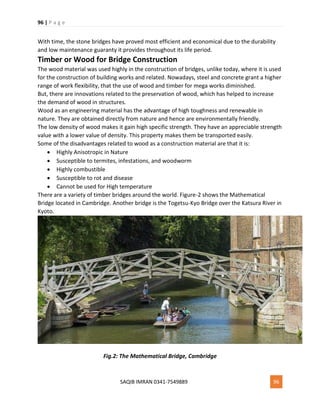
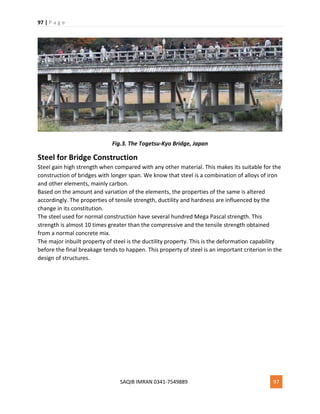
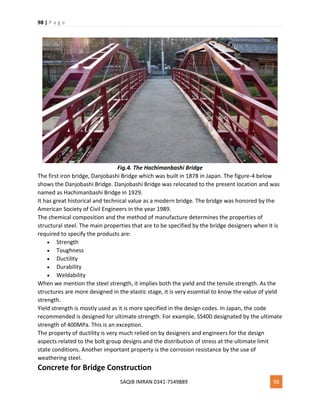
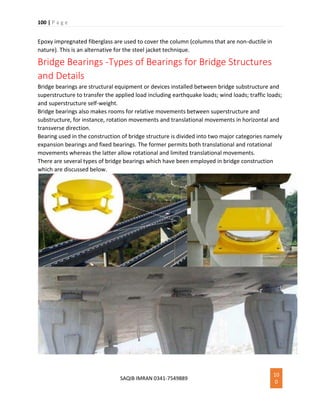
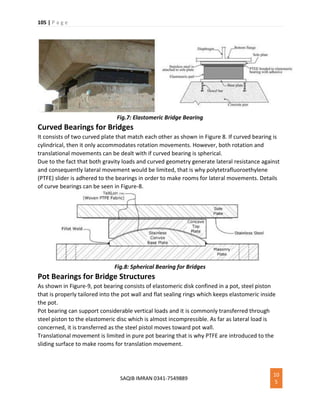
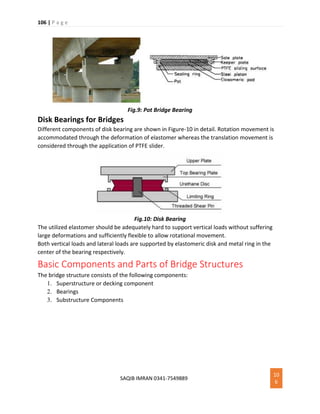
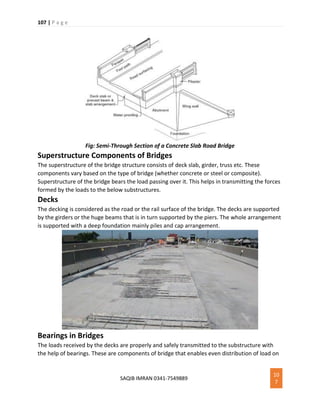
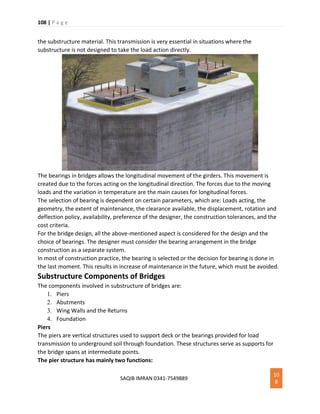
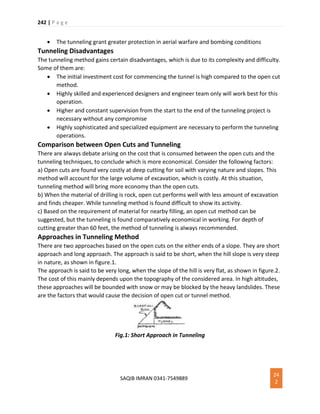
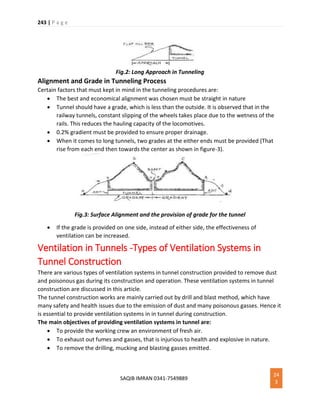
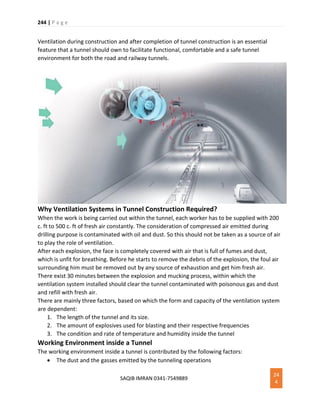
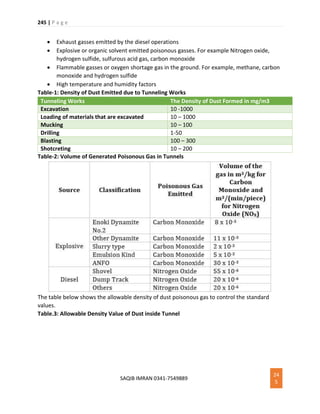
1 | P a g e
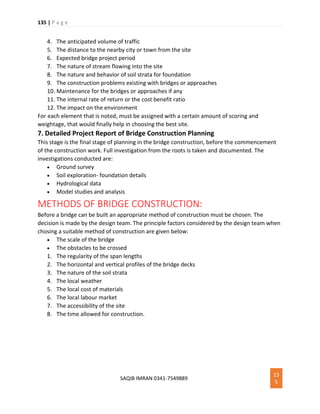
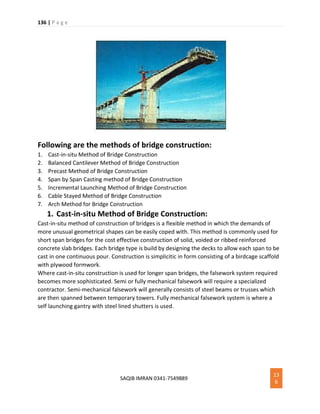
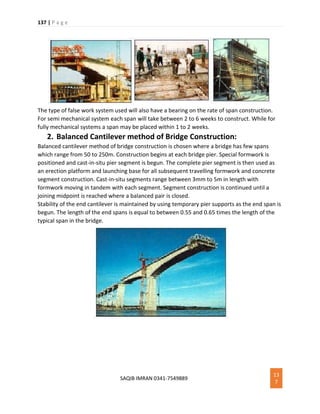
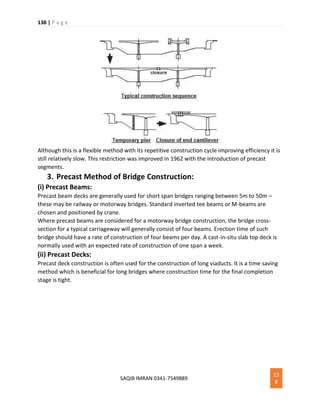
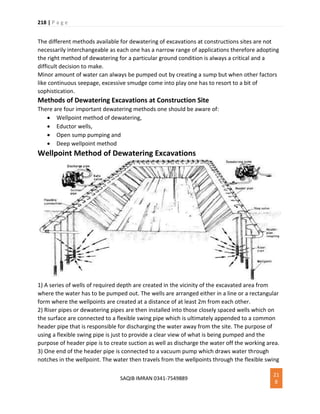
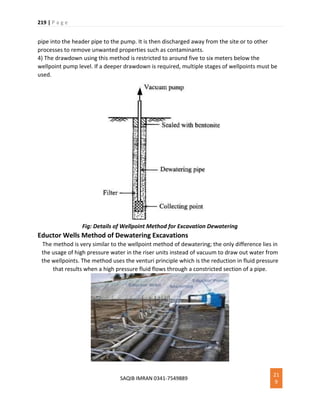
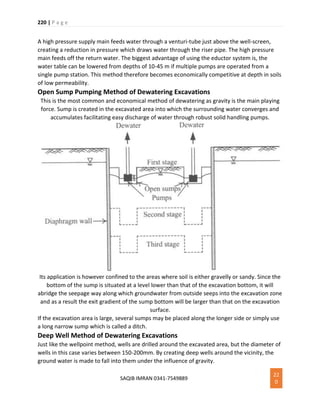
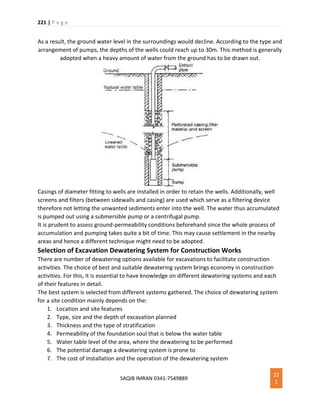
SAQIB IMRAN 0341-7549889 1
Assala mu alykum My Name is saqib imran and I am the
student of b.tech (civil) in sarhad univeristy of
science and technology peshawer.
I have written this notes by different websites and
some by self and prepare it for the student and also
for engineer who work on field to get some knowledge
from it.
I hope you all students may like it.
Remember me in your pray, allah bless me and all of
you friends.
If u have any confusion in this notes contact me on my
gmail id: Saqibimran43@gmail.com
or text me on 0341-7549889.
Saqib imran.
2 | P a g e
SAQIB IMRAN 0341-7549889 2
Roads & Railway Construction
6 BASIC STEPS COMPRISING WBM ROAD
CONSTRUCTION PROCEDURE
WBM ROAD CONSTRUCTION PROCEDURE
Construction of water bound macadam road involves the following 6 basic steps as given below.
1. Preparation of sub-grade
2. Preparation of sub-base
3. Preparation of base
4. Preparation of wearing course
5. Preparation of shoulders
6. Opening to traffic
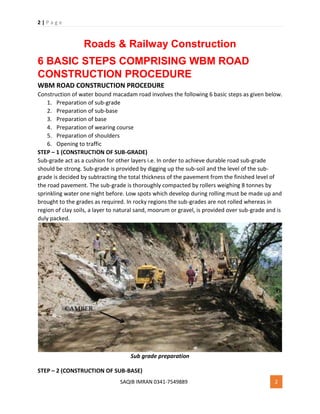
STEP – 1 (CONSTRUCTION OF SUB-GRADE)
Sub-grade act as a cushion for other layers i.e. In order to achieve durable road sub-grade
should be strong. Sub-grade is provided by digging up the sub-soil and the level of the sub-
grade is decided by subtracting the total thickness of the pavement from the finished level of
the road pavement. The sub-grade is thoroughly compacted by rollers weighing 8 tonnes by
sprinkling water one night before. Low spots which develop during rolling must be made up and
brought to the grades as required. In rocky regions the sub-grades are not rolled whereas in
region of clay soils, a layer to natural sand, moorum or gravel, is provided over sub-grade and is
duly packed.
Sub grade preparation
STEP – 2 (CONSTRUCTION OF SUB-BASE)
3 | P a g e
SAQIB IMRAN 0341-7549889 3
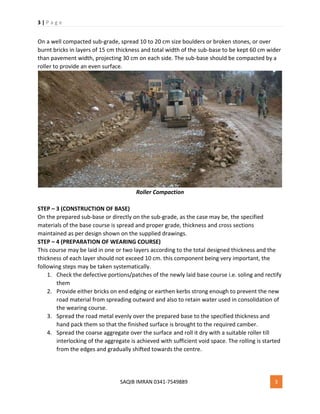
On a well compacted sub-grade, spread 10 to 20 cm size boulders or broken stones, or over
burnt bricks in layers of 15 cm thickness and total width of the sub-base to be kept 60 cm wider
than pavement width, projecting 30 cm on each side. The sub-base should be compacted by a
roller to provide an even surface.
Roller Compaction
STEP – 3 (CONSTRUCTION OF BASE)
On the prepared sub-base or directly on the sub-grade, as the case may be, the specified
materials of the base course is spread and proper grade, thickness and cross sections
maintained as per design shown on the supplied drawings.
STEP – 4 (PREPARATION OF WEARING COURSE)
This course may be laid in one or two layers according to the total designed thickness and the
thickness of each layer should not exceed 10 cm. this component being very important, the
following steps may be taken systematically.
1. Check the defective portions/patches of the newly laid base course i.e. soling and rectify
them
2. Provide either bricks on end edging or earthen kerbs strong enough to prevent the new
road material from spreading outward and also to retain water used in consolidation of
the wearing course.
3. Spread the road metal evenly over the prepared base to the specified thickness and
hand pack them so that the finished surface is brought to the required camber.
4. Spread the coarse aggregate over the surface and roll it dry with a suitable roller till
interlocking of the aggregate is achieved with sufficient void space. The rolling is started
from the edges and gradually shifted towards the centre.
4 | P a g e
SAQIB IMRAN 0341-7549889 4
5. After dry rolling, spread the screening materials (stones upto 12 mm size) with uniform
rate so that voids of coarse aggregates get filled properly. This is achieved by dry rolling
and brooming alternatively, till the voids of the coarse aggregates are filled.
6. After spreading the screening material, sprinkle sufficient quantity of water, sweep the
surface and roll it with roller again.
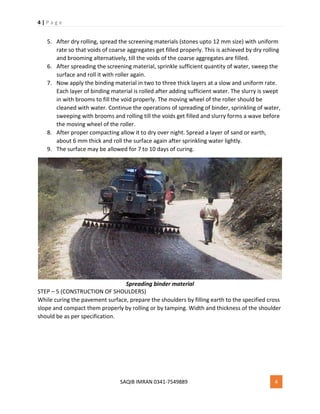
7. Now apply the binding material in two to three thick layers at a slow and uniform rate.
Each layer of binding material is rolled after adding sufficient water. The slurry is swept
in with brooms to fill the void properly. The moving wheel of the roller should be
cleaned with water. Continue the operations of spreading of binder, sprinkling of water,
sweeping with brooms and rolling till the voids get filled and slurry forms a wave before
the moving wheel of the roller.
8. After proper compacting allow it to dry over night. Spread a layer of sand or earth,
about 6 mm thick and roll the surface again after sprinkling water lightly.
9. The surface may be allowed for 7 to 10 days of curing.
Spreading binder material
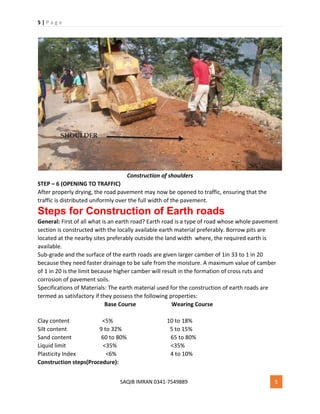
STEP – 5 (CONSTRUCTION OF SHOULDERS)
While curing the pavement surface, prepare the shoulders by filling earth to the specified cross
slope and compact them properly by rolling or by tamping. Width and thickness of the shoulder
should be as per specification.
5 | P a g e
SAQIB IMRAN 0341-7549889 5
Construction of shoulders
STEP – 6 (OPENING TO TRAFFIC)
After properly drying, the road pavement may now be opened to traffic, ensuring that the
traffic is distributed uniformly over the full width of the pavement.
Steps for Construction of Earth roads
General: First of all what is an earth road? Earth road is a type of road whose whole pavement
section is constructed with the locally available earth material preferably. Borrow pits are
located at the nearby sites preferably outside the land width where, the required earth is
available.
Sub-grade and the surface of the earth roads are given larger camber of 1in 33 to 1 in 20
because they need faster drainage to be safe from the moisture. A maximum value of camber
of 1 in 20 is the limit because higher camber will result in the formation of cross ruts and
corrosion of pavement soils.
Specifications of Materials: The earth material used for the construction of earth roads are
termed as satisfactory if they possess the following properties:
Base Course Wearing Course
Clay content <5% 10 to 18%
Silt content 9 to 32% 5 to 15%
Sand content 60 to 80% 65 to 80%
Liquid limit <35% <35%
Plasticity Index <6% 4 to 10%
Construction steps(Procedure):
6 | P a g e
SAQIB IMRAN 0341-7549889 6
Material: Suitable borrow pits are located by doing the survey of the adjacent land which are
easy to reach and at economical haulage distance. The various organic materials like trees,
shrubs and grass roots are removed before the excavation of the earth.
Location of the centerline: The centerline and the road boundaries are marked on the ground
by driving the wooden pegs. To follow the desired vertical profile of the road, reference pegs
are also driven at a certain spacing which depends upon the estimated length of the road
construction per day.
Preparation of the subgrade: Following steps are necessary for the preparation of the sub-
grade:
(a) Clearing site
(b) Excavation and construction of fills
(c) Shaping of sub-grade.
The site clearance may be done manually using appliances like spade, pick and hand shovel or
using the mechanical equipment like Bulldozer and scraper etc.
Excavation and construction of fills may also be done manually or using theexcavation, hauling
and compaction equipment. Dozers are considered very useful for haulage of short distances.
If the compaction is done manually it will not be sufficient and proper, it should be left to get
consolidated under atmospheric conditions.
Various equipment used by manual labor are shovel, spade, pick-axe, baskets, rammers and
hand rollers. The subgrade should be compacted to the desired grade, camber and longitudinal
profile.
Pavement construction: The soil is dumped on the prepared sub-grade and pulverized. The soil
may be a mixture of more than one soil to get the desired properties. The moisture content is
checked and if extra moisture is needed, is added to bring it to OMC. The soil is mixed, spread
and rolled in layers such that the compaction thickness of each layer does not exceed 10 cm.
The type of roller for compaction is decided based on soil type, desired amount of compaction
and availability of equipment. At Least 95% of dry density of I.S. light compaction is considered
desirable. The camber of the finished surface is checked and corrected when necessary.
Opening to traffic: The compacted earth surface is allowed to dry out for few days and then is
opened to traffic.
4. COMPONENTS OF ROAD DRAINAGE SYSTEM
4.1. General
The primary purpose of a road drainage system is to remove the water from the road
and its surroundings. The road drainage system consists of two parts: dewatering and
drainage. “Dewatering” means the removal of rainwater from the surface of the road.
“Drainage” on the other hand covers all the different infrastructural elements to keep the
road structure dry. In Sweden “dewatering” is further divided into two parts: runoff
7 | P a g e
SAQIB IMRAN 0341-7549889 7
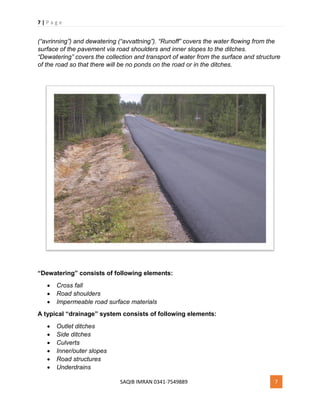
(“avrinning”) and dewatering (“avvattning”). “Runoff” covers the water flowing from the
surface of the pavement via road shoulders and inner slopes to the ditches.
“Dewatering” covers the collection and transport of water from the surface and structure
of the road so that there will be no ponds on the road or in the ditches.
“Dewatering” consists of following elements:
 Cross fall
 Road shoulders
 Impermeable road surface materials
A typical “drainage” system consists of following elements:
 Outlet ditches
 Side ditches
 Culverts
 Inner/outer slopes
 Road structures
 Underdrains
8 | P a g e
SAQIB IMRAN 0341-7549889 8
The general score of road drainage system is dependent on its “weakest link”. This
means that if any of its elements is out of order, the whole system will not operate as
planned and the road will be damaged. On the other hand a well built and maintained
road drainage system is a very sustainable investment policy. The main advantages of
a good drainage system are: effective removal of rainwater out of the road surface and
its surroundings, road structures that stay dry, good bearing capacity, and a road that is
nice and safe to drive.
4.2 Pavement and wearing course
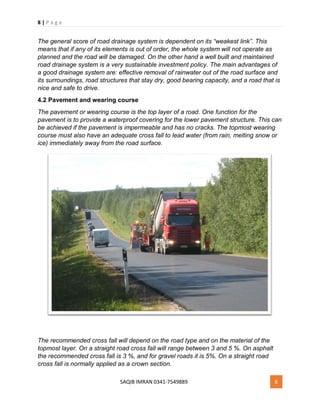
The pavement or wearing course is the top layer of a road. One function for the
pavement is to provide a waterproof covering for the lower pavement structure. This can
be achieved if the pavement is impermeable and has no cracks. The topmost wearing
course must also have an adequate cross fall to lead water (from rain, melting snow or
ice) immediately away from the road surface.
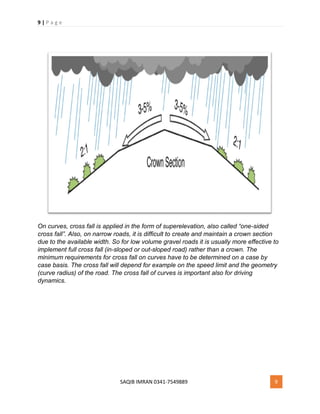
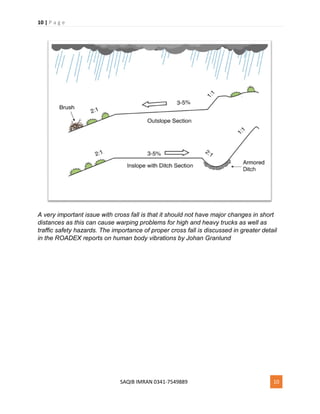
The recommended cross fall will depend on the road type and on the material of the
topmost layer. On a straight road cross fall will range between 3 and 5 %. On asphalt
the recommended cross fall is 3 %, and for gravel roads it is 5%. On a straight road
cross fall is normally applied as a crown section.
9 | P a g e
SAQIB IMRAN 0341-7549889 9
On curves, cross fall is applied in the form of superelevation, also called “one-sided
cross fall”. Also, on narrow roads, it is difficult to create and maintain a crown section
due to the available width. So for low volume gravel roads it is usually more effective to
implement full cross fall (in-sloped or out-sloped road) rather than a crown. The
minimum requirements for cross fall on curves have to be determined on a case by
case basis. The cross fall will depend for example on the speed limit and the geometry
(curve radius) of the road. The cross fall of curves is important also for driving
dynamics.
10 | P a g e
SAQIB IMRAN 0341-7549889 10
A very important issue with cross fall is that it should not have major changes in short
distances as this can cause warping problems for high and heavy trucks as well as
traffic safety hazards. The importance of proper cross fall is discussed in greater detail
in the ROADEX reports on human body vibrations by Johan Granlund
11 | P a g e
SAQIB IMRAN 0341-7549889 11
12 | P a g e
SAQIB IMRAN 0341-7549889 12
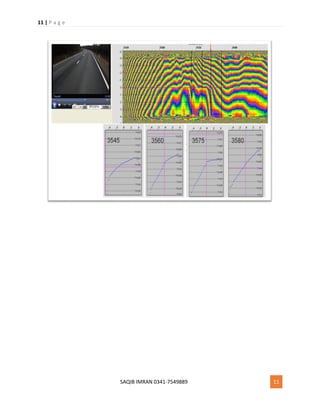
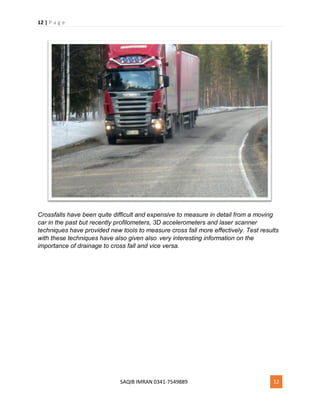
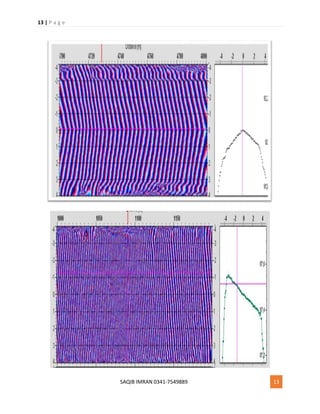
Crossfalls have been quite difficult and expensive to measure in detail from a moving
car in the past but recently profilometers, 3D accelerometers and laser scanner
techniques have provided new tools to measure cross fall more effectively. Test results
with these techniques have also given also very interesting information on the
importance of drainage to cross fall and vice versa.
13 | P a g e
SAQIB IMRAN 0341-7549889 13
14 | P a g e
SAQIB IMRAN 0341-7549889 14
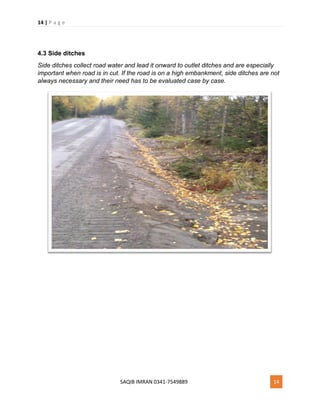
4.3 Side ditches
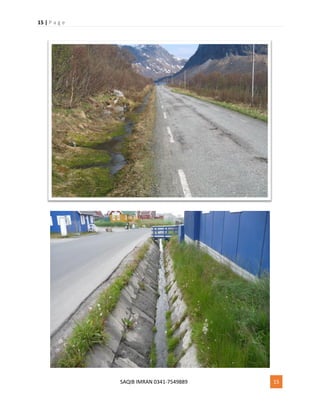
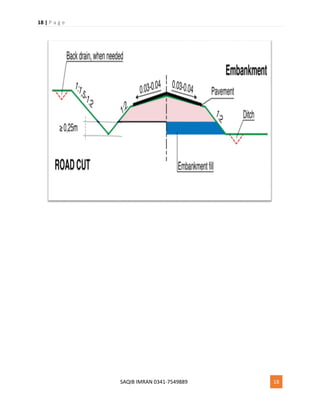
Side ditches collect road water and lead it onward to outlet ditches and are especially
important when road is in cut. If the road is on a high embankment, side ditches are not
always necessary and their need has to be evaluated case by case.
15 | P a g e
SAQIB IMRAN 0341-7549889 15
16 | P a g e
SAQIB IMRAN 0341-7549889 16
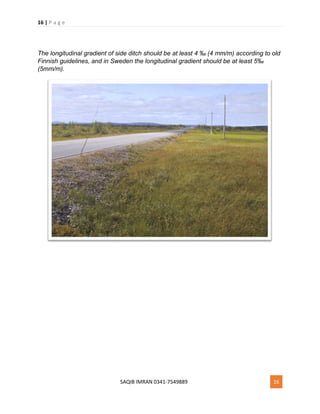
The longitudinal gradient of side ditch should be at least 4 ‰ (4 mm/m) according to old
Finnish guidelines, and in Sweden the longitudinal gradient should be at least 5‰
(5mm/m).
17 | P a g e
SAQIB IMRAN 0341-7549889 17
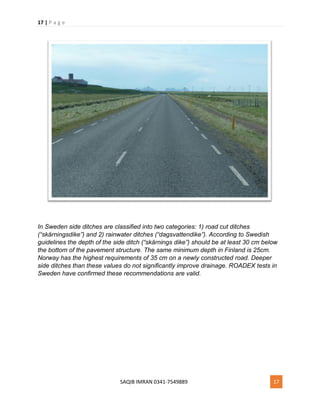
In Sweden side ditches are classified into two categories: 1) road cut ditches
(“skärningsdike”) and 2) rainwater ditches (“dagsvattendike”). According to Swedish
guidelines the depth of the side ditch (“skärnings dike”) should be at least 30 cm below
the bottom of the pavement structure. The same minimum depth in Finland is 25cm.
Norway has the highest requirements of 35 cm on a newly constructed road. Deeper
side ditches than these values do not significantly improve drainage. ROADEX tests in
Sweden have confirmed these recommendations are valid.
18 | P a g e
SAQIB IMRAN 0341-7549889 18
19 | P a g e
SAQIB IMRAN 0341-7549889 19
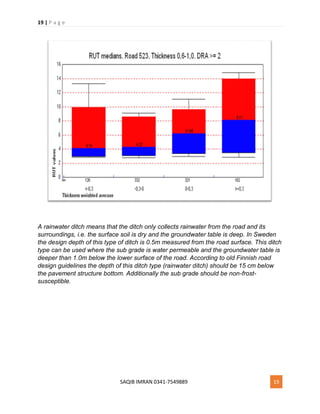
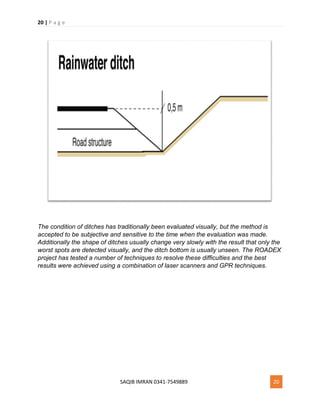
A rainwater ditch means that the ditch only collects rainwater from the road and its
surroundings, i.e. the surface soil is dry and the groundwater table is deep. In Sweden
the design depth of this type of ditch is 0.5m measured from the road surface. This ditch
type can be used where the sub grade is water permeable and the groundwater table is
deeper than 1.0m below the lower surface of the road. According to old Finnish road
design guidelines the depth of this ditch type (rainwater ditch) should be 15 cm below
the pavement structure bottom. Additionally the sub grade should be non-frost-
susceptible.
20 | P a g e
SAQIB IMRAN 0341-7549889 20
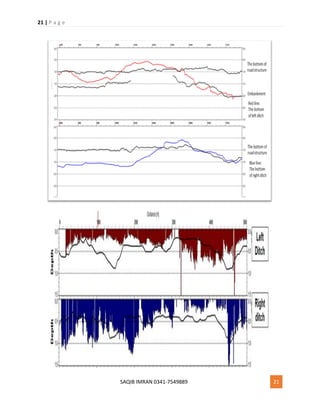
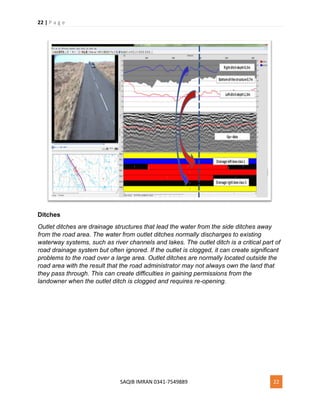
The condition of ditches has traditionally been evaluated visually, but the method is
accepted to be subjective and sensitive to the time when the evaluation was made.
Additionally the shape of ditches usually change very slowly with the result that only the
worst spots are detected visually, and the ditch bottom is usually unseen. The ROADEX
project has tested a number of techniques to resolve these difficulties and the best
results were achieved using a combination of laser scanners and GPR techniques.
21 | P a g e
SAQIB IMRAN 0341-7549889 21
22 | P a g e
SAQIB IMRAN 0341-7549889 22
Ditches
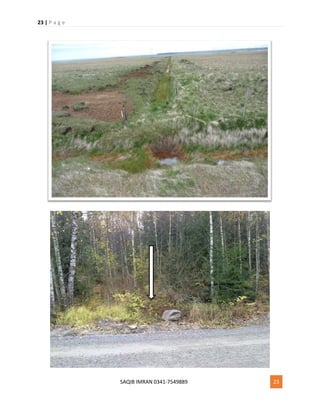
Outlet ditches are drainage structures that lead the water from the side ditches away
from the road area. The water from outlet ditches normally discharges to existing
waterway systems, such as river channels and lakes. The outlet ditch is a critical part of
road drainage system but often ignored. If the outlet is clogged, it can create significant
problems to the road over a large area. Outlet ditches are normally located outside the
road area with the result that the road administrator may not always own the land that
they pass through. This can create difficulties in gaining permissions from the
landowner when the outlet ditch is clogged and requires re-opening.
23 | P a g e
SAQIB IMRAN 0341-7549889 23
24 | P a g e
SAQIB IMRAN 0341-7549889 24
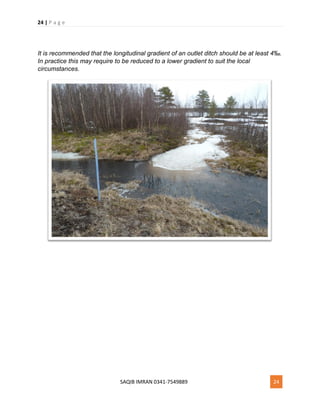
It is recommended that the longitudinal gradient of an outlet ditch should be at least 4‰.
In practice this may require to be reduced to a lower gradient to suit the local
circumstances.
25 | P a g e
SAQIB IMRAN 0341-7549889 25
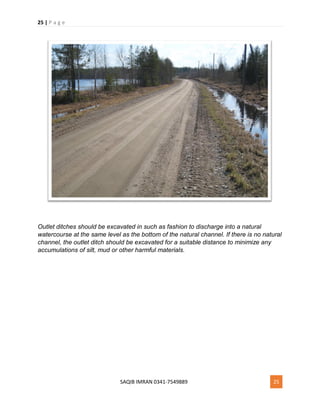
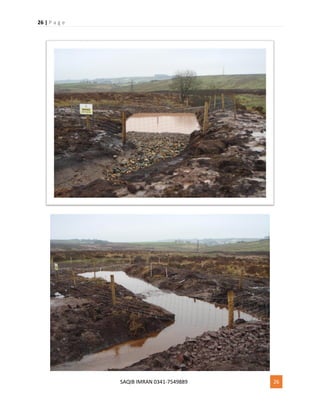
Outlet ditches should be excavated in such as fashion to discharge into a natural
watercourse at the same level as the bottom of the natural channel. If there is no natural
channel, the outlet ditch should be excavated for a suitable distance to minimize any
accumulations of silt, mud or other harmful materials.
26 | P a g e
SAQIB IMRAN 0341-7549889 26
27 | P a g e
SAQIB IMRAN 0341-7549889 27
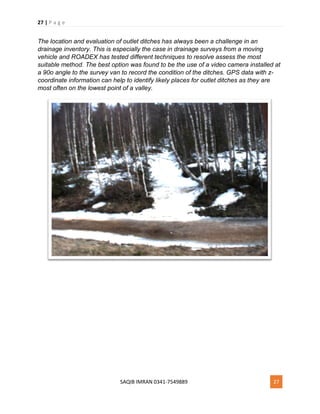
The location and evaluation of outlet ditches has always been a challenge in an
drainage inventory. This is especially the case in drainage surveys from a moving
vehicle and ROADEX has tested different techniques to resolve assess the most
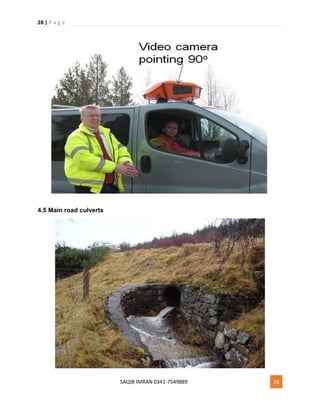
suitable method. The best option was found to be the use of a video camera installed at
a 90o angle to the survey van to record the condition of the ditches. GPS data with z-
coordinate information can help to identify likely places for outlet ditches as they are
most often on the lowest point of a valley.
28 | P a g e
SAQIB IMRAN 0341-7549889 28
4.5 Main road culverts
29 | P a g e
SAQIB IMRAN 0341-7549889 29
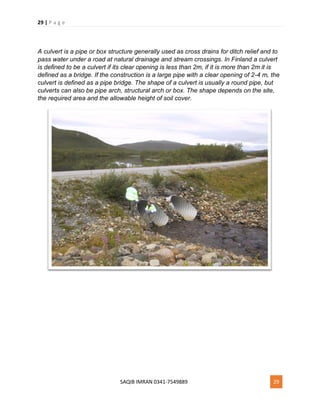
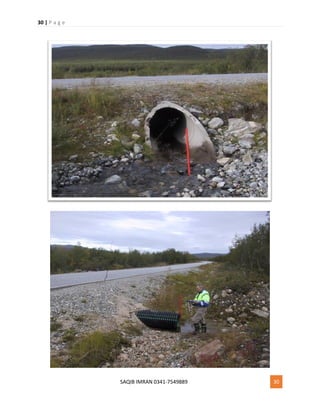
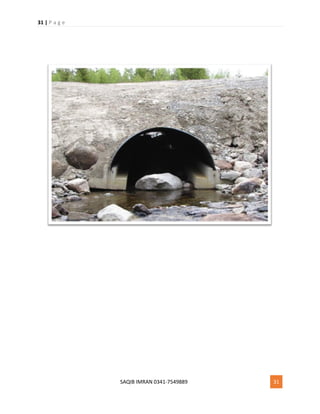
A culvert is a pipe or box structure generally used as cross drains for ditch relief and to
pass water under a road at natural drainage and stream crossings. In Finland a culvert
is defined to be a culvert if its clear opening is less than 2m, if it is more than 2m it is
defined as a bridge. If the construction is a large pipe with a clear opening of 2-4 m, the
culvert is defined as a pipe bridge. The shape of a culvert is usually a round pipe, but
culverts can also be pipe arch, structural arch or box. The shape depends on the site,
the required area and the allowable height of soil cover.
30 | P a g e
SAQIB IMRAN 0341-7549889 30
31 | P a g e
SAQIB IMRAN 0341-7549889 31
32 | P a g e
SAQIB IMRAN 0341-7549889 32
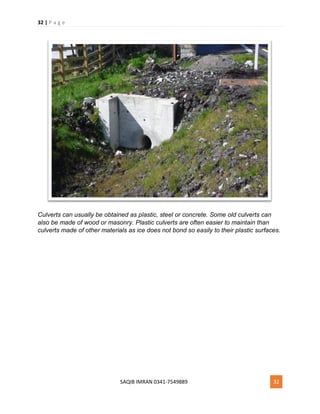
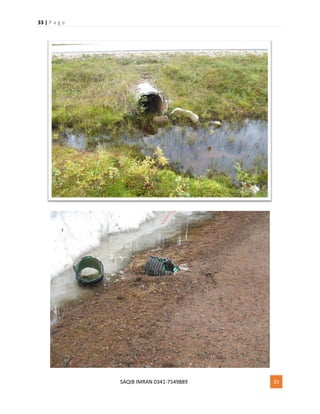
Culverts can usually be obtained as plastic, steel or concrete. Some old culverts can
also be made of wood or masonry. Plastic culverts are often easier to maintain than
culverts made of other materials as ice does not bond so easily to their plastic surfaces.
33 | P a g e
SAQIB IMRAN 0341-7549889 33
34 | P a g e
SAQIB IMRAN 0341-7549889 34
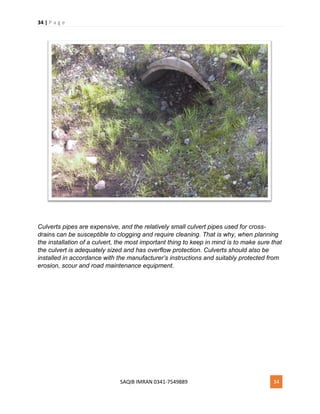
Culverts pipes are expensive, and the relatively small culvert pipes used for cross-
drains can be susceptible to clogging and require cleaning. That is why, when planning
the installation of a culvert, the most important thing to keep in mind is to make sure that
the culvert is adequately sized and has overflow protection. Culverts should also be
installed in accordance with the manufacturer’s instructions and suitably protected from
erosion, scour and road maintenance equipment.
35 | P a g e
SAQIB IMRAN 0341-7549889 35
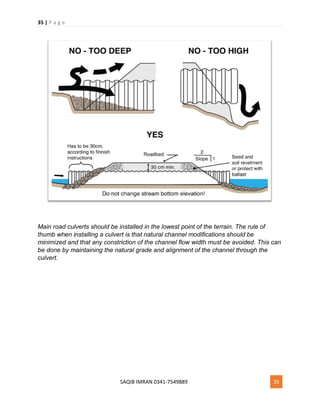
Main road culverts should be installed in the lowest point of the terrain. The rule of
thumb when installing a culvert is that natural channel modifications should be
minimized and that any constriction of the channel flow width must be avoided. This can
be done by maintaining the natural grade and alignment of the channel through the
culvert.
36 | P a g e
SAQIB IMRAN 0341-7549889 36
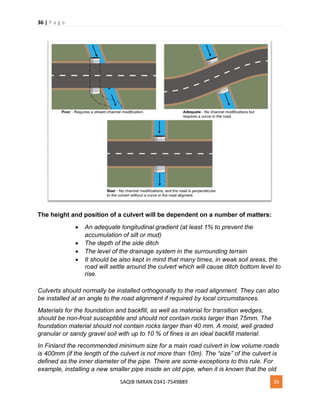
The height and position of a culvert will be dependent on a number of matters:
 An adequate longitudinal gradient (at least 1% to prevent the
accumulation of silt or mud)
 The depth of the side ditch
 The level of the drainage system in the surrounding terrain
 It should be also kept in mind that many times, in weak soil areas, the
road will settle around the culvert which will cause ditch bottom level to
rise.
Culverts should normally be installed orthogonally to the road alignment. They can also
be installed at an angle to the road alignment if required by local circumstances.
Materials for the foundation and backfill, as well as material for transition wedges,
should be non-frost susceptible and should not contain rocks larger than 75mm. The
foundation material should not contain rocks larger than 40 mm. A moist, well graded
granular or sandy gravel soil with up to 10 % of fines is an ideal backfill material.
In Finland the recommended minimum size for a main road culvert in low volume roads
is 400mm (if the length of the culvert is not more than 10m). The “size” of the culvert is
defined as the inner diameter of the pipe. There are some exceptions to this rule. For
example, installing a new smaller pipe inside an old pipe, when it is known that the old
37 | P a g e
SAQIB IMRAN 0341-7549889 37
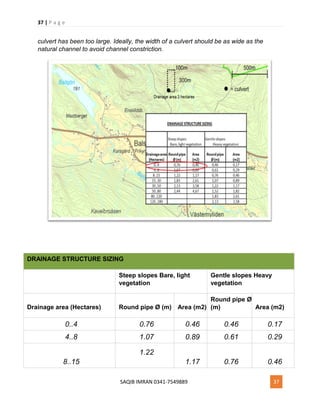
culvert has been too large. Ideally, the width of a culvert should be as wide as the
natural channel to avoid channel constriction.
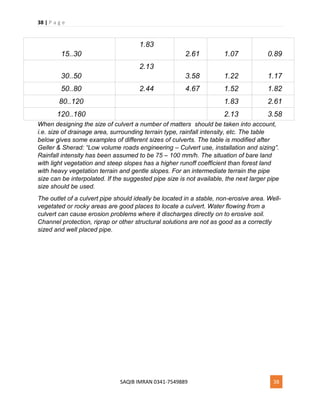
DRAINAGE STRUCTURE SIZING
Steep slopes Bare, light
vegetation
Gentle slopes Heavy
vegetation
Drainage area (Hectares) Round pipe Ø (m) Area (m2)
Round pipe Ø
(m) Area (m2)
0..4 0.76 0.46 0.46 0.17
4..8 1.07 0.89 0.61 0.29
8..15
1.22
1.17 0.76 0.46
38 | P a g e
SAQIB IMRAN 0341-7549889 38
15..30
1.83
2.61 1.07 0.89
30..50
2.13
3.58 1.22 1.17
50..80 2.44 4.67 1.52 1.82
80..120 1.83 2.61
120..180 2.13 3.58
When designing the size of culvert a number of matters should be taken into account,
i.e. size of drainage area, surrounding terrain type, rainfall intensity, etc. The table
below gives some examples of different sizes of culverts. The table is modified after
Geller & Sherad: “Low volume roads engineering – Culvert use, installation and sizing”.
Rainfall intensity has been assumed to be 75 – 100 mm/h. The situation of bare land
with light vegetation and steep slopes has a higher runoff coefficient than forest land
with heavy vegetation terrain and gentle slopes. For an intermediate terrain the pipe
size can be interpolated. If the suggested pipe size is not available, the next larger pipe
size should be used.
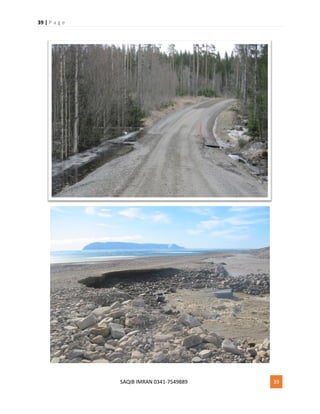
The outlet of a culvert pipe should ideally be located in a stable, non-erosive area. Well-
vegetated or rocky areas are good places to locate a culvert. Water flowing from a
culvert can cause erosion problems where it discharges directly on to erosive soil.
Channel protection, riprap or other structural solutions are not as good as a correctly
sized and well placed pipe.
39 | P a g e
SAQIB IMRAN 0341-7549889 39
40 | P a g e
SAQIB IMRAN 0341-7549889 40
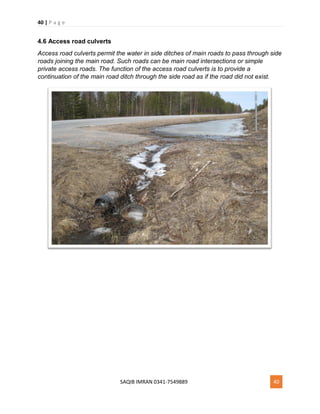
4.6 Access road culverts
Access road culverts permit the water in side ditches of main roads to pass through side
roads joining the main road. Such roads can be main road intersections or simple
private access roads. The function of the access road culverts is to provide a
continuation of the main road ditch through the side road as if the road did not exist.
41 | P a g e
SAQIB IMRAN 0341-7549889 41
42 | P a g e
SAQIB IMRAN 0341-7549889 42
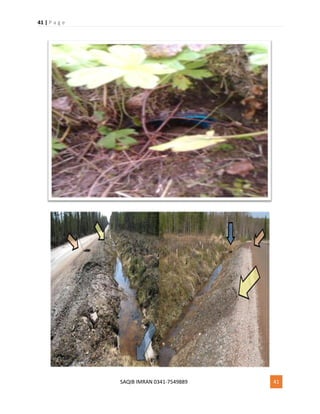
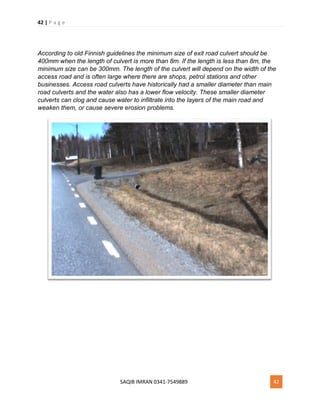
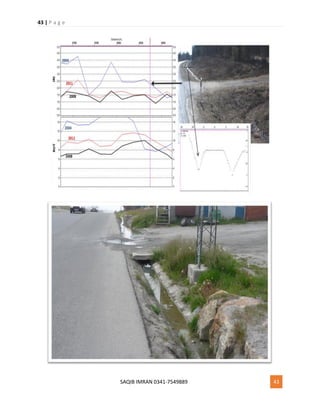
According to old Finnish guidelines the minimum size of exit road culvert should be
400mm when the length of culvert is more than 8m. If the length is less than 8m, the
minimum size can be 300mm. The length of the culvert will depend on the width of the
access road and is often large where there are shops, petrol stations and other
businesses. Access road culverts have historically had a smaller diameter than main
road culverts and the water also has a lower flow velocity. These smaller diameter
culverts can clog and cause water to infiltrate into the layers of the main road and
weaken them, or cause severe erosion problems.
43 | P a g e
SAQIB IMRAN 0341-7549889 43
44 | P a g e
SAQIB IMRAN 0341-7549889 44
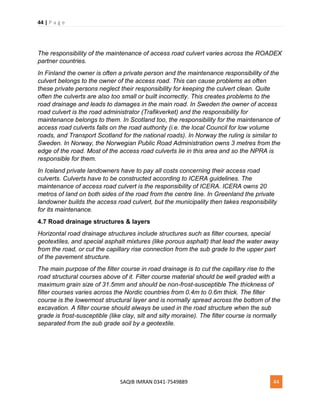
The responsibility of the maintenance of access road culvert varies across the ROADEX
partner countries.
In Finland the owner is often a private person and the maintenance responsibility of the
culvert belongs to the owner of the access road. This can cause problems as often
these private persons neglect their responsibility for keeping the culvert clean. Quite
often the culverts are also too small or built incorrectly. This creates problems to the
road drainage and leads to damages in the main road. In Sweden the owner of access
road culvert is the road administrator (Trafikverket) and the responsibility for
maintenance belongs to them. In Scotland too, the responsibility for the maintenance of
access road culverts falls on the road authority (i.e. the local Council for low volume
roads, and Transport Scotland for the national roads). In Norway the ruling is similar to
Sweden. In Norway, the Norwegian Public Road Administration owns 3 metres from the
edge of the road. Most of the access road culverts lie in this area and so the NPRA is
responsible for them.
In Iceland private landowners have to pay all costs concerning their access road
culverts. Culverts have to be constructed according to ICERA guidelines. The
maintenance of access road culvert is the responsibility of ICERA. ICERA owns 20
metros of land on both sides of the road from the centre line. In Greenland the private
landowner builds the access road culvert, but the municipality then takes responsibility
for its maintenance.
4.7 Road drainage structures & layers
Horizontal road drainage structures include structures such as filter courses, special
geotextiles, and special asphalt mixtures (like porous asphalt) that lead the water away
from the road, or cut the capillary rise connection from the sub grade to the upper part
of the pavement structure.
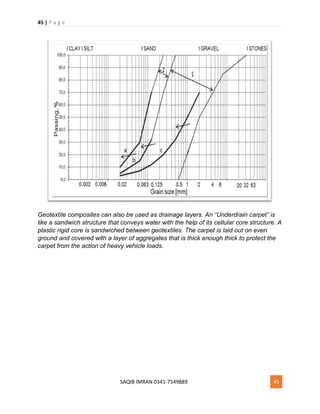
The main purpose of the filter course in road drainage is to cut the capillary rise to the
road structural courses above of it. Filter course material should be well graded with a
maximum grain size of 31.5mm and should be non-frost-susceptible The thickness of
filter courses varies across the Nordic countries from 0.4m to 0.6m thick. The filter
course is the lowermost structural layer and is normally spread across the bottom of the
excavation. A filter course should always be used in the road structure when the sub
grade is frost-susceptible (like clay, silt and silty moraine). The filter course is normally
separated from the sub grade soil by a geotextile.
45 | P a g e
SAQIB IMRAN 0341-7549889 45
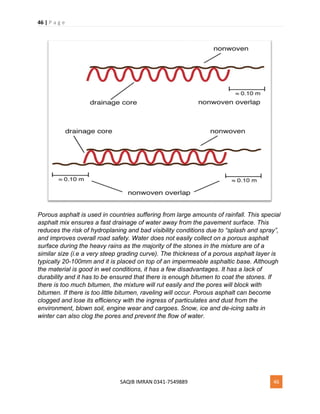
Geotextile composites can also be used as drainage layers. An “Underdrain carpet” is
like a sandwich structure that conveys water with the help of its cellular core structure. A
plastic rigid core is sandwiched between geotextiles. The carpet is laid out on even
ground and covered with a layer of aggregates that is thick enough thick to protect the
carpet from the action of heavy vehicle loads.
46 | P a g e
SAQIB IMRAN 0341-7549889 46
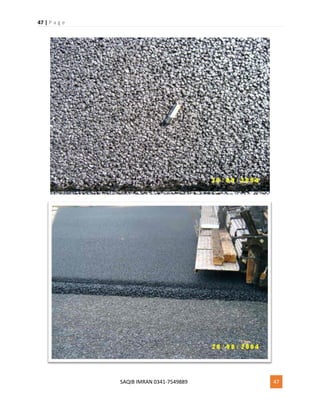
Porous asphalt is used in countries suffering from large amounts of rainfall. This special
asphalt mix ensures a fast drainage of water away from the pavement surface. This
reduces the risk of hydroplaning and bad visibility conditions due to “splash and spray”,
and improves overall road safety. Water does not easily collect on a porous asphalt
surface during the heavy rains as the majority of the stones in the mixture are of a
similar size (i.e a very steep grading curve). The thickness of a porous asphalt layer is
typically 20-100mm and it is placed on top of an impermeable asphaltic base. Although
the material is good in wet conditions, it has a few disadvantages. It has a lack of
durability and it has to be ensured that there is enough bitumen to coat the stones. If
there is too much bitumen, the mixture will rut easily and the pores will block with
bitumen. If there is too little bitumen, raveling will occur. Porous asphalt can become
clogged and lose its efficiency with the ingress of particulates and dust from the
environment, blown soil, engine wear and cargoes. Snow, ice and de-icing salts in
winter can also clog the pores and prevent the flow of water.
47 | P a g e
SAQIB IMRAN 0341-7549889 47
48 | P a g e
SAQIB IMRAN 0341-7549889 48
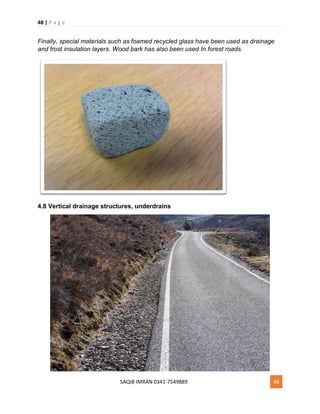
Finally, special materials such as foamed recycled glass have been used as drainage
and frost insulation layers. Wood bark has also been used In forest roads.
4.8 Vertical drainage structures, underdrains
49 | P a g e
SAQIB IMRAN 0341-7549889 49
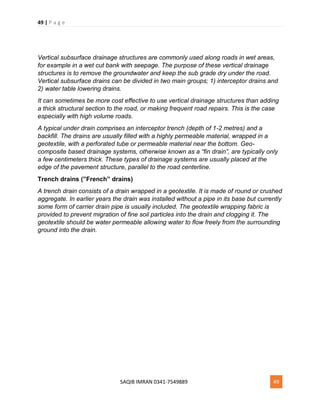
Vertical subsurface drainage structures are commonly used along roads in wet areas,
for example in a wet cut bank with seepage. The purpose of these vertical drainage
structures is to remove the groundwater and keep the sub grade dry under the road.
Vertical subsurface drains can be divided in two main groups; 1) interceptor drains and
2) water table lowering drains.
It can sometimes be more cost effective to use vertical drainage structures than adding
a thick structural section to the road, or making frequent road repairs. This is the case
especially with high volume roads.
A typical under drain comprises an interceptor trench (depth of 1-2 metres) and a
backfill. The drains are usually filled with a highly permeable material, wrapped in a
geotextile, with a perforated tube or permeable material near the bottom. Geo-
composite based drainage systems, otherwise known as a “fin drain”, are typically only
a few centimeters thick. These types of drainage systems are usually placed at the
edge of the pavement structure, parallel to the road centerline.
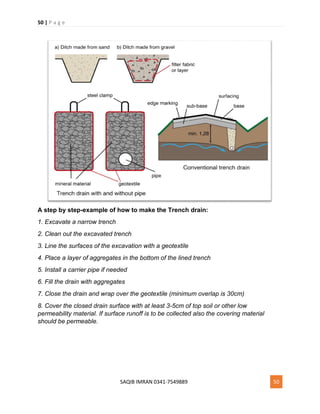
Trench drains (”French” drains)
A trench drain consists of a drain wrapped in a geotextile. It is made of round or crushed
aggregate. In earlier years the drain was installed without a pipe in its base but currently
some form of carrier drain pipe is usually included. The geotextile wrapping fabric is
provided to prevent migration of fine soil particles into the drain and clogging it. The
geotextile should be water permeable allowing water to flow freely from the surrounding
ground into the drain.
50 | P a g e
SAQIB IMRAN 0341-7549889 50
A step by step-example of how to make the Trench drain:
1. Excavate a narrow trench
2. Clean out the excavated trench
3. Line the surfaces of the excavation with a geotextile
4. Place a layer of aggregates in the bottom of the lined trench
5. Install a carrier pipe if needed
6. Fill the drain with aggregates
7. Close the drain and wrap over the geotextile (minimum overlap is 30cm)
8. Cover the closed drain surface with at least 3-5cm of top soil or other low
permeability material. If surface runoff is to be collected also the covering material
should be permeable.
51 | P a g e
SAQIB IMRAN 0341-7549889 51
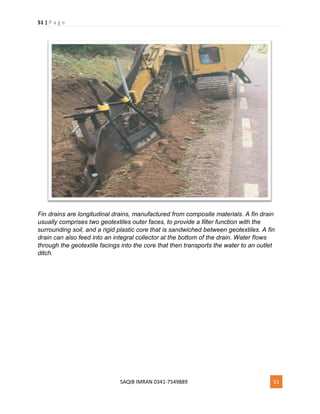
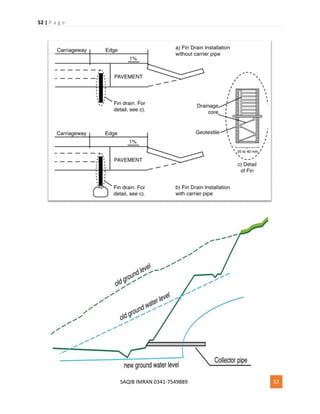
Fin drains are longitudinal drains, manufactured from composite materials. A fin drain
usually comprises two geotextiles outer faces, to provide a filter function with the
surrounding soil, and a rigid plastic core that is sandwiched between geotextiles. A fin
drain can also feed into an integral collector at the bottom of the drain. Water flows
through the geotextile facings into the core that then transports the water to an outlet
ditch.
52 | P a g e
SAQIB IMRAN 0341-7549889 52
53 | P a g e
SAQIB IMRAN 0341-7549889 53
4.9 Inner and outer slope drainage structures
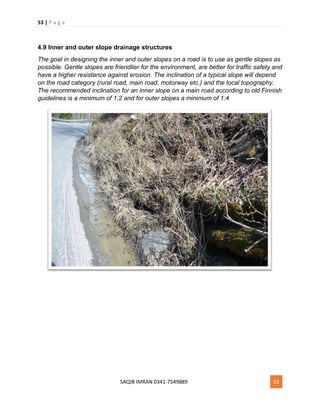
The goal in designing the inner and outer slopes on a road is to use as gentle slopes as
possible. Gentle slopes are friendlier for the environment, are better for traffic safety and
have a higher resistance against erosion. The inclination of a typical slope will depend
on the road category (rural road, main road, motorway etc.) and the local topography.
The recommended inclination for an inner slope on a main road according to old Finnish
guidelines is a minimum of 1:2 and for outer slopes a minimum of 1:4
54 | P a g e
SAQIB IMRAN 0341-7549889 54
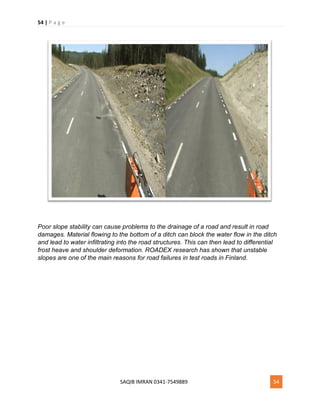
Poor slope stability can cause problems to the drainage of a road and result in road
damages. Material flowing to the bottom of a ditch can block the water flow in the ditch
and lead to water infiltrating into the road structures. This can then lead to differential
frost heave and shoulder deformation. ROADEX research has shown that unstable
slopes are one of the main reasons for road failures in test roads in Finland.
55 | P a g e
SAQIB IMRAN 0341-7549889 55
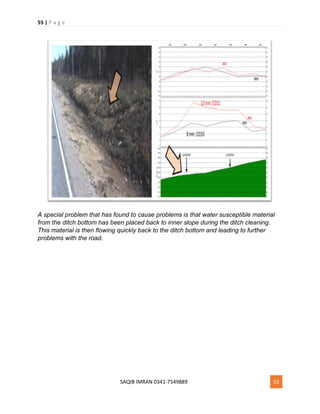
A special problem that has found to cause problems is that water susceptible material
from the ditch bottom has been placed back to inner slope during the ditch cleaning.
This material is then flowing quickly back to the ditch bottom and leading to further
problems with the road.
56 | P a g e
SAQIB IMRAN 0341-7549889 56
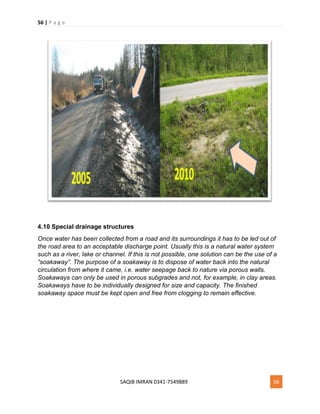
4.10 Special drainage structures
Once water has been collected from a road and its surroundings it has to be led out of
the road area to an acceptable discharge point. Usually this is a natural water system
such as a river, lake or channel. If this is not possible, one solution can be the use of a
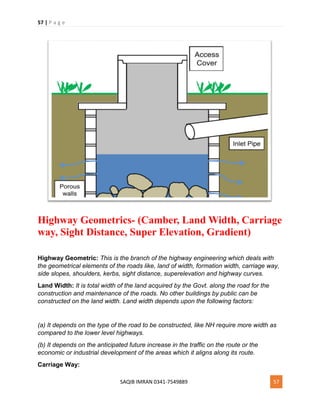
“soakaway”. The purpose of a soakaway is to dispose of water back into the natural
circulation from where it came, i.e. water seepage back to nature via porous walls.
Soakaways can only be used in porous subgrades and not, for example, in clay areas.
Soakaways have to be individually designed for size and capacity. The finished
soakaway space must be kept open and free from clogging to remain effective.
57 | P a g e
SAQIB IMRAN 0341-7549889 57
Highway Geometrics- (Camber, Land Width, Carriage
way, Sight Distance, Super Elevation, Gradient)
Highway Geometric: This is the branch of the highway engineering which deals with
the geometrical elements of the roads like, land of width, formation width, carriage way,
side slopes, shoulders, kerbs, sight distance, superelevation and highway curves.
Land Width: It is total width of the land acquired by the Govt. along the road for the
construction and maintenance of the roads. No other buildings by public can be
constructed on the land width. Land width depends upon the following factors:
(a) It depends on the type of the road to be constructed, like NH require more width as
compared to the lower level highways.
(b) It depends on the anticipated future increase in the traffic on the route or the
economic or industrial development of the areas which it aligns along its route.
Carriage Way:
58 | P a g e
SAQIB IMRAN 0341-7549889 58
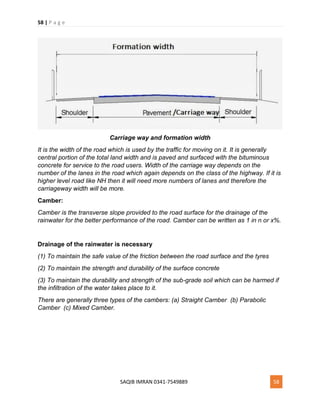
Carriage way and formation width
It is the width of the road which is used by the traffic for moving on it. It is generally
central portion of the total land width and is paved and surfaced with the bituminous
concrete for service to the road users. Width of the carriage way depends on the
number of the lanes in the road which again depends on the class of the highway. If it is
higher level road like NH then it will need more numbers of lanes and therefore the
carriageway width will be more.
Camber:
Camber is the transverse slope provided to the road surface for the drainage of the
rainwater for the better performance of the road. Camber can be written as 1 in n or x%.
Drainage of the rainwater is necessary
(1) To maintain the safe value of the friction between the road surface and the tyres
(2) To maintain the strength and durability of the surface concrete
(3) To maintain the durability and strength of the sub-grade soil which can be harmed if
the infiltration of the water takes place to it.
There are generally three types of the cambers: (a) Straight Camber (b) Parabolic
Camber (c) Mixed Camber.
59 | P a g e
SAQIB IMRAN 0341-7549889 59
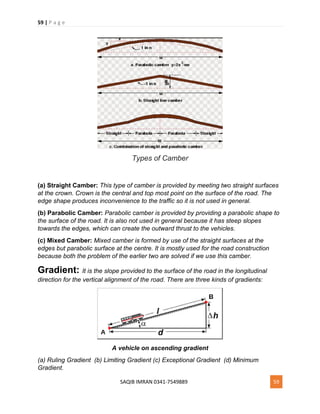
Types of Camber
(a) Straight Camber: This type of camber is provided by meeting two straight surfaces
at the crown. Crown is the central and top most point on the surface of the road. The
edge shape produces inconvenience to the traffic so it is not used in general.
(b) Parabolic Camber: Parabolic camber is provided by providing a parabolic shape to
the surface of the road. It is also not used in general because it has steep slopes
towards the edges, which can create the outward thrust to the vehicles.
(c) Mixed Camber: Mixed camber is formed by use of the straight surfaces at the
edges but parabolic surface at the centre. It is mostly used for the road construction
because both the problem of the earlier two are solved if we use this camber.
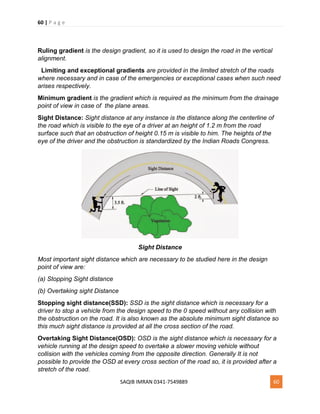
Gradient: It is the slope provided to the surface of the road in the longitudinal
direction for the vertical alignment of the road. There are three kinds of gradients:
A vehicle on ascending gradient
(a) Ruling Gradient (b) Limiting Gradient (c) Exceptional Gradient (d) Minimum
Gradient.
60 | P a g e
SAQIB IMRAN 0341-7549889 60
Ruling gradient is the design gradient, so it is used to design the road in the vertical
alignment.
Limiting and exceptional gradients are provided in the limited stretch of the roads
where necessary and in case of the emergencies or exceptional cases when such need
arises respectively.
Minimum gradient is the gradient which is required as the minimum from the drainage
point of view in case of the plane areas.
Sight Distance: Sight distance at any instance is the distance along the centerline of
the road which is visible to the eye of a driver at an height of 1.2 m from the road
surface such that an obstruction of height 0.15 m is visible to him. The heights of the
eye of the driver and the obstruction is standardized by the Indian Roads Congress.
Sight Distance
Most important sight distance which are necessary to be studied here in the design
point of view are:
(a) Stopping Sight distance
(b) Overtaking sight Distance
Stopping sight distance(SSD): SSD is the sight distance which is necessary for a
driver to stop a vehicle from the design speed to the 0 speed without any collision with
the obstruction on the road. It is also known as the absolute minimum sight distance so
this much sight distance is provided at all the cross section of the road.
Overtaking Sight Distance(OSD): OSD is the sight distance which is necessary for a
vehicle running at the design speed to overtake a slower moving vehicle without
collision with the vehicles coming from the opposite direction. Generally It is not
possible to provide the OSD at every cross section of the road so, it is provided after a
stretch of the road.
61 | P a g e
SAQIB IMRAN 0341-7549889 61
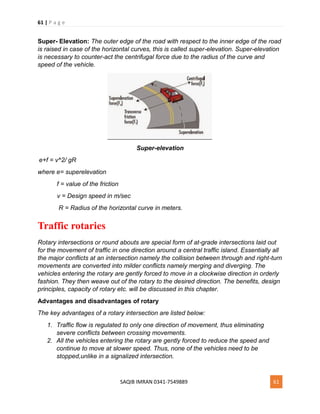
Super- Elevation: The outer edge of the road with respect to the inner edge of the road
is raised in case of the horizontal curves, this is called super-elevation. Super-elevation
is necessary to counter-act the centrifugal force due to the radius of the curve and
speed of the vehicle.
Super-elevation
e+f = v^2/ gR
where e= superelevation
f = value of the friction
v = Design speed in m/sec
R = Radius of the horizontal curve in meters.
Traffic rotaries
Rotary intersections or round abouts are special form of at-grade intersections laid out
for the movement of traffic in one direction around a central traffic island. Essentially all
the major conflicts at an intersection namely the collision between through and right-turn
movements are converted into milder conflicts namely merging and diverging. The
vehicles entering the rotary are gently forced to move in a clockwise direction in orderly
fashion. They then weave out of the rotary to the desired direction. The benefits, design
principles, capacity of rotary etc. will be discussed in this chapter.
Advantages and disadvantages of rotary
The key advantages of a rotary intersection are listed below:
1. Traffic flow is regulated to only one direction of movement, thus eliminating
severe conflicts between crossing movements.
2. All the vehicles entering the rotary are gently forced to reduce the speed and
continue to move at slower speed. Thus, none of the vehicles need to be
stopped,unlike in a signalized intersection.
62 | P a g e
SAQIB IMRAN 0341-7549889 62
3. Because of lower speed of negotiation and elimination of severe conflicts,
accidents and their severity are much less in rotaries.
4. Rotaries are self governing and do not need practically any control by police or
traffic signals.
5. They are ideally suited for moderate traffic, especially with irregular geometry, or
intersections with more than three or four approaches.
6. Although rotaries offer some distinct advantages, there are few specific
limitations for rotaries which are listed below.
7. All the vehicles are forced to slow down and negotiate the intersection.
Therefore, the cumulative delay will be much higher than channelized
intersection.
8. Even when there is relatively low traffic, the vehicles are forced to reduce their
speed.
9. Rotaries require large area of relatively flat land making them costly at urban
areas.
10. The vehicles do not usually stop at a rotary. They accelerate and exit the rotary
at relatively high speed. Therefore, they are not suitable when there is high
pedestrian movements.
Guidelines for the selection of rotaries
Because of the above limitation, rotaries are not suitable for every location. There are
few guidelines that help in deciding the suitability of a rotary. They are listed below.
1. Rotaries are suitable when the traffic entering from all the four approaches are
relatively equal.
2. A total volume of about 3000 vehicles per hour can be considered as the upper
limiting case and a volume of 500 vehicles per hour is the lower limit.
3. A rotary is very beneficial when the proportion of the right-turn traffic is very high;
typically if it is more than 30 percent.
4. Rotaries are suitable when there are more than four approaches or if there is no
separate lanes available for right-turn traffic. Rotaries are ideally suited if the
intersection geometry is complex.
Traffic operations in a rotary
As noted earlier, the traffic operations at a rotary are three; diverging, merging and
weaving. All the other conflicts are converted into these three less severe conflicts.
1. Diverging: It is a traffic operation when the vehicles moving in one direction is
separated into different streams according to their destinations.
2. Merging: Merging is the opposite of diverging. Merging is referred to as the
process of joining the traffic coming from different approaches and going to a
common destination into a single stream.
3. Weaving: Weaving is the combined movement of both merging and diverging
movements in the same direction.
63 | P a g e
SAQIB IMRAN 0341-7549889 63
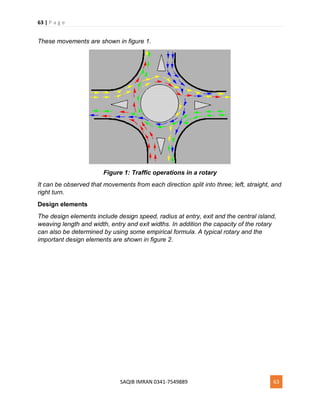
These movements are shown in figure 1.
Figure 1: Traffic operations in a rotary
It can be observed that movements from each direction split into three; left, straight, and
right turn.
Design elements
The design elements include design speed, radius at entry, exit and the central island,
weaving length and width, entry and exit widths. In addition the capacity of the rotary
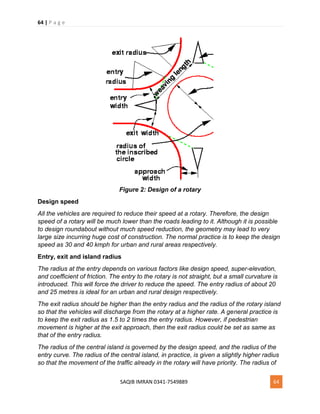
can also be determined by using some empirical formula. A typical rotary and the
important design elements are shown in figure 2.
64 | P a g e
SAQIB IMRAN 0341-7549889 64
Figure 2: Design of a rotary
Design speed
All the vehicles are required to reduce their speed at a rotary. Therefore, the design
speed of a rotary will be much lower than the roads leading to it. Although it is possible
to design roundabout without much speed reduction, the geometry may lead to very
large size incurring huge cost of construction. The normal practice is to keep the design
speed as 30 and 40 kmph for urban and rural areas respectively.
Entry, exit and island radius
The radius at the entry depends on various factors like design speed, super-elevation,
and coefficient of friction. The entry to the rotary is not straight, but a small curvature is
introduced. This will force the driver to reduce the speed. The entry radius of about 20
and 25 metres is ideal for an urban and rural design respectively.
The exit radius should be higher than the entry radius and the radius of the rotary island
so that the vehicles will discharge from the rotary at a higher rate. A general practice is
to keep the exit radius as 1.5 to 2 times the entry radius. However, if pedestrian
movement is higher at the exit approach, then the exit radius could be set as same as
that of the entry radius.
The radius of the central island is governed by the design speed, and the radius of the
entry curve. The radius of the central island, in practice, is given a slightly higher radius
so that the movement of the traffic already in the rotary will have priority. The radius of
65 | P a g e
SAQIB IMRAN 0341-7549889 65
the central island which is about 1.3 times that of the entry curve is adequate for all
practical purposes.
Width of the rotary
The entry width and exit width of the rotary is governed by the traffic entering and
leaving the intersection and the width of the approaching road. The width of the
carriageway at entry and exit will be lower than the width of the carriageway at the
approaches to enable reduction of speed. IRC suggests that a two lane road of 7 m
width should be kept as 7 m for urban roads and 6.5 m for rural roads. Further, a three
lane road of 10.5 m is to be reduced to 7 m and 7.5 m respectively for urban and rural
roads.
The width of the weaving section should be higher than the width at entry and exit.
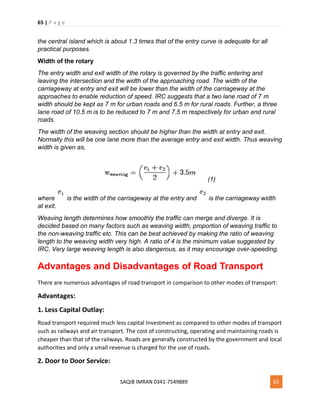
Normally this will be one lane more than the average entry and exit width. Thus weaving
width is given as,
(1)
where is the width of the carriageway at the entry and is the carriageway width
at exit.
Weaving length determines how smoothly the traffic can merge and diverge. It is
decided based on many factors such as weaving width, proportion of weaving traffic to
the non-weaving traffic etc. This can be best achieved by making the ratio of weaving
length to the weaving width very high. A ratio of 4 is the minimum value suggested by
IRC. Very large weaving length is also dangerous, as it may encourage over-speeding.
Advantages and Disadvantages of Road Transport
There are numerous advantages of road transport in comparison to other modes of transport:
Advantages:
1. Less Capital Outlay:
Road transport required much less capital Investment as compared to other modes of transport
such as railways and air transport. The cost of constructing, operating and maintaining roads is
cheaper than that of the railways. Roads are generally constructed by the government and local
authorities and only a small revenue is charged for the use of roads.
2. Door to Door Service:
66 | P a g e
SAQIB IMRAN 0341-7549889 66
The outstanding advantage of road transport is that it provides door to door or warehouse to
warehouse service. This reduces cartage, loading and unloading expenses.
3. Service in Rural Areas:
Road transport is most suited for carrying goods and people to and from rural areas which are
not served by rail, water or air transport. Exchange of goods, between large towns and small
villages is made possible only through road transport.
4. Flexible Service:
Road transport has a great advantage over other modes of transport for its flexible service, its
routes and timings can be adjusted and changed to individual requirements without much
inconvenience.
5. Suitable for Short Distance:
It is more economic and quicker for carrying goods and people over short distances. Delays in
transit of goods on account of intermediate loading and handling are avoided. Goods can be
loaded direct into a road vehicle and transported straight to their place of destination.
6. Lesser Risk of Damage in Transit:
As the intermediate loading and handling is avoided, there is lesser risk of damage, breakage
etc. of the goods in transit. Thus, road transport is most suited for transporting delicate goods
like chinaware and glassware, which are likely to be damaged in the process of loading and
unloading.
7. Saving in Packing Cost:
As compared to other modes of transport, the process of packing in motor transport is less
complicated. Goods transported by motor transport require less packing or no packing in
several cases.
8. Rapid Speed:
If the goods are to be sent immediately or quickly, motor transport is more suited than the
railways or water transport. Water transport is very slow. Also much time is wasted in booking
the goods and taking delivery of the goods in case of railway and water transport.
9. Less Cost:
Road transport not only requires less initial capital investment, the cost of operation and
maintenance is also comparatively less. Even if the rate charged by motor transport is a little
higher than that by the railways, the actual effective cost of transporting goods by motor
67 | P a g e
SAQIB IMRAN 0341-7549889 67
transport is less. The actual cost is less because the motor transport saves in packing costs and
the expenses of intermediate loading, unloading and handling charges.
10. Private Owned Vehicles:
Another advantage of road transport is that big businessmen can afford to have their own
motor vehicles and initiate their own road services to market their products without causing
any delay.
11. Feeder to other Modes of Transport:
The movement of goods begins and ultimately ends by making use of roads. Road and motor
transport act as a feeder to the other modes of transport such as railways, ships and airways.
Disadvantages:
In spite of various merits, road/motor has some serious limitations:
1. Seasonal Nature:
Motor transport is not as reliable as rail transport. During rainy or flood season, roads become
unfit and unsafe for use.
2. Accidents and Breakdowns:
There are more chances of accidents and breakdowns in case of motor transport. Thus, motor
transport is not as safe as rail transport.
3. Unsuitable for Long Distance and Bulky Traffic:
This mode of transport is unsuitable and costly for transporting cheap and bulky goods over
long distances.
4. Slow Speed:
The speed of motor transport is comparatively slow and limited.
5. Lack of Organisation:
The road transport is comparatively less organised. More often, it is irregular and
undependable. The rates charged for transportation are also unstable and unequal.
Suitability and Problems of Road Transport
The road transport is one of the most important means of transport and is indispensable to the
development of commerce and industry. All the movement of goods begins and ultimately ends
68 | P a g e
SAQIB IMRAN 0341-7549889 68
by making use of roads. Roads act as an important feeder to the other modes of transport such
as railways, ships and airway.
Suitability of Road or Motor Transport:
Though road transport has certain limitations, it is indispensable to the development of
commerce and industry. It plays a very significant role in the economic development of a
country.
The road transport is particularly suited:
1. For carrying goods which are very cheap, heavy or bulky;
2. For transporting goods of perishable nature such as vegetables, fruits, eggs, milk, etc.;
3. For carrying goods and people over short distances;
4. For transporting delicate goods such as chinaware or glassware.
5. For forests, hilly and rural areas where the other modern modes of transport are not
available.
Problems of Road Transport:
Road transport in India suffers from the following problems:
1. Bad Roads:
The roads in India are in bad shape. The link roads are not properly metaled and many are even
Kucha Roads. The vehicles have to bear more wear and tear and the cost of operating them is
unreasonably high.
2. Slow Growth of Vehicles:
The growth of commercial vehicles has been very slow because of higher operation costs. The
rates of fuel are growing up every now and then. The prices of vehicles are very high due to
heavy excise duties. The taxes on commercial vehicles are also exorbitant. All these factors are
responsible for the slow growth of commercial vehicles.
3. Lack of Co-ordination:
There is a lack of co-ordination between the centre and the states. The states want the centre
to construct and maintain main highways but on the other hand centre is trying to shift this
burden on the states. It has resulted in the blocking of rapid development of roads in India.
4. Competition among Different Modes:
There is a competition among different modes of transport. The transport policies of different
states are different. Some highways have more traffic while on others there are not sufficient
transport services.
69 | P a g e
SAQIB IMRAN 0341-7549889 69
Factors to Consider while choosing the most Suitable
Mode of Transport
1. Cost of Service:
The cost of transportation adds to the cost of the goods so it should always be kept in mind.
Rail transport is comparatively a cheaper mode of transport for carrying heavy and bulky traffic
over long distances. Motor transport is best suited and economical to carry small traffic over
short distances. Motor transport saves packing and handling costs.
Water transport is the cheapest mode of transport. It is suitable to carry only heavy and bulky
goods over long distances where time is not an important factor. Air transport is the most
costly means of transport but is particularly suited for carrying perishable, light and valuable
goods which require quick delivery.
2. Speed of Transport:
Air transport is the quickest mode of transport but it is costliest of all. Motor transport is
quicker than railways over short distances. However, the speed of railways over long distances
is more than that of other modes of transport except air transport and is most suitable for long
distances. Water transport is very slow and thus unsuitable where time is an important factor.
3. Flexibility:
Railways, water and air transport are inflexible modes of transport. They operate services on
fixed routes and at preplanned time schedules. The goods have to be carried to the stations,
ports and airports and then taken from there. Motor transport provides the most flexible
service because it is not tied to fixed routes or time schedules. It can operate at any time and
can reach the business premises for loading and unloading.
4. Regularity of Service:
Railway service is more certain, uniform and regular as compared to any other mode of
transport. It is not much affected by weather conditions. On the other hand, motor transport,
ocean transport and air transport are affected by bad weather such as heavy rains, snow, fog,
storms etc.
5. Safety:
Safety and security of goods in transit also influence the choice of a suitable means of
transport. Motor transport may be preferred to railway transport because losses are generally
less in motor transport. Water transport exposes the goods to the perils of sea and, hence from
safety point of view, sea transport is thought of as a last resort.
70 | P a g e
SAQIB IMRAN 0341-7549889 70
6. Nature of Commodity:
Rail transport is most suitable for carrying cheap, bulk and heavy goods. Perishable goods which
require quick delivery may be carried through motor transport or air transport keeping in mind
the cost and distance.
7. Other Considerations:
A number of special services such as warehousing, packing, loading and unloading are also
taken into consideration while deciding about a mode of transport. From the above discussion
it is clear that each mode of transport is suited for a particular type of traffic.
The rail transport is particularly suited for carrying heavy and bulky goods over long distances.
Motor transport is suitable for carrying small consignments over short distances. Air transport
is suited to light and precious articles which are to be delivered quickly. Ocean transport is
appropriate for carrying heavy bulky goods over long distances at the cheapest possible cost.
Water Transport: Kinds, Advantages and
Disadvantages of Water Transport
Water transport is the cheapest and the oldest mode of transport. It operates on a natural track
and hence does not require huge capital investment in the construction and maintenance of its
track except in case of canals. The cost of operation of water transport is also very less. It has
the largest carrying capacity and is most suitable for carrying bulky goods over long distances. It
has played a very significant role in bringing different parts of the world closer and is
indispensable to foreign trade.
Kinds of Water Transport:
Water transport consists of:
(i) Inland water transport
(ii) Ocean-transport
71 | P a g e
SAQIB IMRAN 0341-7549889 71
Inland Water Transport:
As shown in the chart, inland water transport consists of transport by rivers, canals and lakes.
Rivers:
Rivers are a natural waterway which can be used as a means of transport. They are suitable for
small boats as well as big barrages. River transport played a very important role prior to the
development of modern means of land transport. Their importance has gradually declined on
account of more reliable and cheaper transport services offered by the railways.
Canals:
They are artificial waterways made for the purpose of irrigation or navigation or both. Canal
transport requires a huge amount of capital investment in construction and maintenance of its
track i.e., the artificial waterways. The cost of the canal transport is, therefore, higher than that
of river transport. To add to it, the cost of providing water for the canals is also a very big
problem of canal transport.
Lakes:
Lakes can be either natural like rivers or artificial like canals.
Advantages:
1. Low Cost:
Rivers are a natural highway which does not require any cost of construction and maintenance.
Even the cost of construction and maintenance of canals is much less or they are used, not only
for transport purposes but also for irrigation, etc. Moreover, the cost of operation of the inland
water transport is very low. Thus, it is the cheapest mode of transport for carrying goods from
one place to another.
72 | P a g e
SAQIB IMRAN 0341-7549889 72
2. Larger Capacity:
It can carry much larger quantities of heavy and bulky goods such as coal, and, timber etc.
3. Flexible Service:
It provides much more flexible service than railways and can be adjusted to individual
requirements.
4. Safety:
The risks of accidents and breakdowns, in this form of transport, are minimum as compared to
any other form of transport.
Disadvantages:
1. Slow:
Speed of Inland water transport is very slow and therefore this mode of transport is unsuitable
where time is an important factor.
2. Limited Area of Operation:
It can be used only in a limited area which is served by deep canals and rivers.
3. Seasonal Character:
Rivers and canals cannot be operated for transportation throughout the year as water may
freeze during winter or water level may go very much down during summer.
4. Unreliable:
The inland water transport by rivers is unreliable. Sometimes the river changes its course which
causes dislocation in the normal route of the trade.
5. Unsuitable for Small Business:
Inland water transport by rivers and canals is not suitable for small traders, as it takes normally
a longer time to carry goods from one place to another through this form of transport.
Ocean transport:
Ocean transport is indispensable for foreign trade. It has brought the different parts of the
world closer and has knitted together all the nations of the world into one big world market. It
operates on a natural track, i.e., the sea and does not require any investment in the
construction and maintenance of its track. It is, obviously, the cheapest mode of transport.
Ocean transport includes:
73 | P a g e
SAQIB IMRAN 0341-7549889 73
1. Coastal Shipping
2. Overseas Shipping
1. Coastal Shipping:
It is one of the most important means of transport for carrying goods from one part to another
in a country. It is a cheaper and quicker mode of transport and is most suitable for carrying
heavy, bulky and cheap traffic like coal, iron ore, etc. to distant places. But it can serve only
limited areas. Earlier, coastal shipping in India was mainly in the hands of foreign shipping
companies. But now from 1951 onwards, it is exclusively reserved for Indian ships.
2. Overseas Shipping:
There are three types of vessels employed in the overseas shipping:
(i) Liners,
(ii) Tramps,
(iii) Tankers.
(i) Liners:
Liners are the ships which have regular fixed routes, time and charges. They are, usually, a
collection of vessels under one ownership, i.e., a fleet. They provide a uniform and regular
service. Liners sail on scheduled dates and time, whether full of cargo or not.
(ii) Tramps:
Tramps are ships which have no fixed routes. They have no set rules or rate schedule. Usually,
they do not sail till they have full cargo. They can be chartered by exporters and are ready to
sail anywhere and at any time. They are not as fast in speed as liners. Tramps are more suitable
to carry seasonal and bulky goods.
(iii) Tankers:
Tankers are the vessels which are specially designed to carry oil, petrol and such other liquids.
They have a large capacity, 2 to 3 lakh tons of oil, and very shortly, we may have super tankers
with a capacity of about 10 lakh tons of oil.
Advantages:
1. It operates on a natural track as sea provides a readymade ‘road bed’ for the ships to sail.
Hence, it does not require huge amount of capital investment in the construction and
maintenance of its track.
74 | P a g e
SAQIB IMRAN 0341-7549889 74
2. Due to the smooth surface of sea, comparatively less tractive power is required for its
operation which results in a lesser cost of operation. Thus, it is the cheapest mode of transport.
3. It has the largest carrying capacity as compared to any other transport.
4. The risk of damage in transit of the goods is also less as compared to other modes of
transport. But the goods are exposed to the ‘perils of sea’.
5. It is the only suitable mode of transport for carrying heavy and bulky goods to distant places.
6. It is indispensable to foreign trade.
Air Transport: Characteristics, Advantages and
Disadvantages
Air transport is the most recent mode of transport. It is the gift of the 20th century to the
world. The two world wars gave a great impetus to the development of air transport in almost
all the countries of the world. The peculiar characteristic of air transport is that is does not need
a specific surface track for its operations.
It has no physical barriers as in the case of other mode of transport. Political boundaries are
also immaterial although it has to observe the requirements of the International Law. The
supreme advantage of air transport lies in its quickness.
It is the fastest mode of transport. But the cost of its operation is very high and thus it is
suitable for only rich passengers, mails and light and costly cargo. However, in advanced
countries like U.S.A., Germany, etc. it offers a tough competition to the railways.
Characteristics:
Air transport has the following characteristics:
1. Unbroken Journey:
Air transport provides unbroken journey over land and sea. It is the fastest and quickest means
of transport.
2. Rapidity:
Air transport had the highest speed among all the modes of transport.
3. Expensive:
Air transport is the most expensive means of transport. There is huge investment in purchasing
aero planes and constructing of aerodromes.
75 | P a g e
SAQIB IMRAN 0341-7549889 75
4. Special Preparations:
Air transport requires special preparations like wheelers links, meteorological stations, flood
lights, searchlights etc.
Fastest Mode of Transport:
Advantages:
1. High Speed:
The supreme advantage of air transport is its high speed. It is the fastest mode of transport and
thus it is the most suitable mean where time is an important factor.
2. Comfortable and Quick Services:
It provides a regular, comfortable, efficient and quick service.
3. No Investment in Construction of Track:
It does not require huge capital investment in the construction and maintenance of surface
track.
4. No Physical Barriers:
It follows the shortest and direct route as seas, mountains or forests do not come in the way of
air transport.
5. Easy Access:
Air transport can be used to carry goods and people to the areas which are not accessible by
other means of transport.
6. Emergency Services:
It can operate even when all other means of transport cannot be operated due to the floods or
other natural calamities. Thus, at that time, it is the only mode of transport which can be
employed to do the relief work and provide the essential commodities of life.
7. Quick Clearance:
In air transport, custom formalities can be very quickly complied with and thus it avoids delay in
obtaining clearance.
8. Most Suitable for Carrying Light Goods of High Value:
It is most suitable for carrying goods of perishable nature which require quick delivery and light
goods of high value such as diamonds, bullion etc. over long distances.
76 | P a g e
SAQIB IMRAN 0341-7549889 76
9. National Defence:
Air transport plays a very important role in the defence of a country. Modern wars have been
fought mainly by aeroplanes. It has upper hand in destroying the enemy in a very short period
of time. It also supports over wings of defence of a country.
10. Space Exploration:
Air transport has helped the world in the exploration of space.
Disadvantages:
In spite of many advantages, air transport has the following limitations:
1. Very Costly:
It is the costliest means of transport. The fares of air transport are so high that it is beyond the
reach of the common man.
2. Small Carrying Capacity:
Its carrying capacity is very small and hence it is not suitable to carry cheap and bulky goods.
3. Uncertain and Unreliable:
Air transport is uncertain and unreliable as it is controlled to a great extent by weather
conditions. Unfavourable weather such as fog, snow or heavy rain etc. may cause cancellation
of scheduled flights and suspension of air service.
4. Breakdowns and Accidents:
The chances of breakdowns and accidents are high as compared to other modes of transport.
Hence, it involves comparatively greater risk.
5. Large Investment:
It requires a large amount of capital investment in the construction and maintenance of
aeroplanes. Further, very trained and skilled persons are required for operating air service.
6. Specialised Skill:
Air transport requires a specialised skill and high degree of training for its operation.
7. Unsuitable for Cheap and Bulky Goods:
Air transport is unsuitable for carrying cheap, bulky and heavy goods because of its limited
capacity and high cost.
77 | P a g e
SAQIB IMRAN 0341-7549889 77
8. Legal Restrictions:
There are many legal restrictions imposed by various countries in the interest of their own
national unity and peace.
Advantages and Disadvantages of Railway Transport
Advantages:
1. Dependable:
The greatest advantage of the railway transport is that it is the most dependable mode of
transport as it is the least affected by weather conditions such as rains, fog etc. compared to
other modes of transport.
2. Better Organised:
The rail transport is better organised than any other form of transport. It has fixed routes and
schedules. Its service is more certain, uniform and regular as compared to other modes of
transport.
3. High Speed over Long Distances:
Its speed over long distances is more than any other mode of transport, except airways. Thus, it
is the best choice for long distance traffic.
4. Suitable for Bulky and Heavy Goods:
Railway transport is economical, quicker and best suited for carrying heavy and bulky goods
over long distances.
5. Cheaper Transport:
It is a cheaper mode of transport as compared to other modes of transport. Most of the
working expenses of railways are in the nature of fixed costs. Every increase in the railway
traffic is followed by a decrease in the average cost. Rail transport is economical in the use of
labour also as one driver and one guard are sufficient to carry much more load than the motor
transport.
6. Safety:
Railway is the safest form of transport. The chances of accidents and breakdowns of railways
are minimum as compared to other modes of transport. Moreover, the traffic can be protected
from the exposure to sun, rains, snow etc.
7. Larger Capacity:
78 | P a g e
SAQIB IMRAN 0341-7549889 78
The carrying capacity of the railways is extremely large. Moreover, its capacity is elastic which
can easily be increased by adding more wagons.
8. Public Welfare:
It is the largest public undertaking in the country. Railways perform many public utility services.
Their charges are based on ‘charge what the traffic can bear’ principle which helps the poor. In
fact, it is national necessity.
9. Administrative Facilities of Government:
Railways provide administrative facilities to the Government. The defence forces and the public
servants drive their mobility primarily from the railways.
10. Employment Opportunities:
The railways provide greater employment opportunities for both skilled and unskilled labour.
Over 16 lakh persons are depending upon railways for their livelihood.
Disadvantages:
Although railway transport has many advantages, it suffers from certain serious limitations:
1. Huge Capital Outlay:
The railway requires is large investment of capital. The cost of construction, maintenance and
overhead expenses are very high as compared to other modes of transport. Moreover, the
investments are specific and immobile. In case the traffic is not sufficient, the investments may
mean wastage of huge resources.
2. Lack of Flexibility:
Another disadvantage of railway transport is its inflexibility. Its routes and timings cannot be
adjusted to individual requirements.
3. Lack of Door to Door Service:
Rail transport cannot provide door to door service as it is tied to a particular track. Intermediate
loading or unloading involves greater cost, more wear and tear and wastage of time.
The time and cost of terminal operations are a great disadvantage of rail transport.
4. Monopoly:
As railways require huge capital outlay, they may give rise to monopolies and work against
public interest at large. Even if controlled and managed by the government, lack of competition
may breed inefficiency and high costs.
79 | P a g e
SAQIB IMRAN 0341-7549889 79
5. Unsuitable for Short Distance and Small Loads:
Railway transport is unsuitable and uneconomical for short distance and small traffic of goods.
6. Booking Formalities:
It involves much time and labour in booking and taking delivery of goods through railways as
compared to motor transport.
7. No Rural Service:
Because of huge capital requirements and traffic, railways cannot be operated economically in
rural areas. Thus, large rural areas have no railway service even today. This causes much
inconvenience to the people living in rural areas.
8. Under-utilised Capacity:
The railway must have full load for its ideal and economic operation. As it has a very large
carrying capacity, under-utilisation of its capacity, in most of the regions, is a great financial
problem and loss to the economy.
9. Centralised Administration:
Being the public utility service railways have monopoly position and as such there is centralised
administration. Local authorities fail to meet the personal requirements of the people as
compared to roadways.
Bridges
The five major parts of Bridges – Concrete Span Bridge
Even though there are various types of bridges to be discussed, in this post we will stick to
major parts of Bridges – Concrete span bridges. Every bridge engineer should have a clear
knowledge of the various terminologies used during the Bridge design process. During the
design process, every bridge can be divided broadly into three parts.
1. Superstructure
2. Substructure
3. Foundation
Superstructure
Superstructure that part of the structure which supports traffic and includes deck, slab and
girders. All the parts of the bridge which is mounted on a supporting system can be classified as
a Super structure.
Substructure
Substructure that part of the structure, ie piers and abutments, which supports the
superstructure and which transfers the structural load to the foundations.
Foundation
80 | P a g e
SAQIB IMRAN 0341-7549889 80
Foundation is the component which transfers loads from the substructure to the bearing strata.
Depending on the geotechnical properties of the bearing strata, shallow or deep foundations
are adopted. Usually, piles and well foundations are adopted for bridge foundations.
Now let us discuss the five major parts of a RC bridge
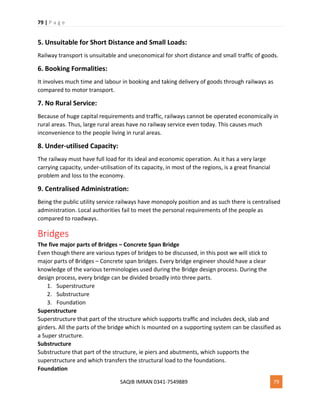
Prestressed I girders
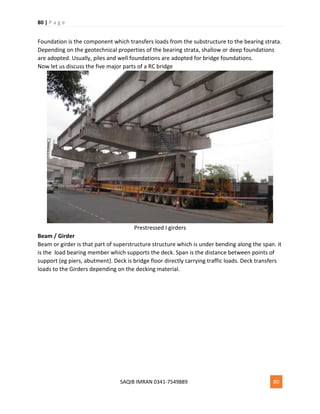
Beam / Girder
Beam or girder is that part of superstructure structure which is under bending along the span. it
is the load bearing member which supports the deck. Span is the distance between points of
support (eg piers, abutment). Deck is bridge floor directly carrying traffic loads. Deck transfers
loads to the Girders depending on the decking material.
81 | P a g e
SAQIB IMRAN 0341-7549889 81
Bridge Beam girders
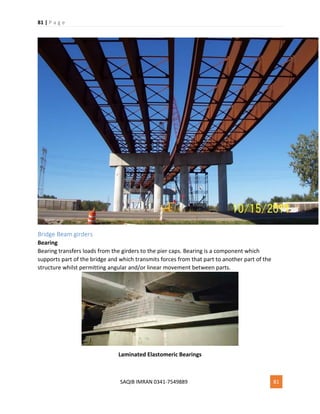
Bearing
Bearing transfers loads from the girders to the pier caps. Bearing is a component which
supports part of the bridge and which transmits forces from that part to another part of the
structure whilst permitting angular and/or linear movement between parts.
Laminated Elastomeric Bearings
82 | P a g e
SAQIB IMRAN 0341-7549889 82
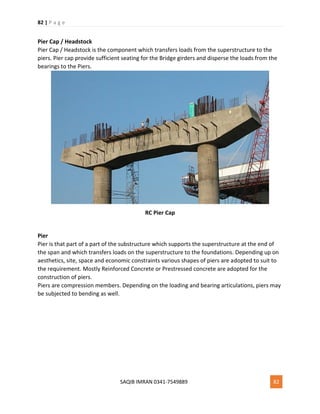
Pier Cap / Headstock
Pier Cap / Headstock is the component which transfers loads from the superstructure to the
piers. Pier cap provide sufficient seating for the Bridge girders and disperse the loads from the
bearings to the Piers.
RC Pier Cap
Pier
Pier is that part of a part of the substructure which supports the superstructure at the end of
the span and which transfers loads on the superstructure to the foundations. Depending up on
aesthetics, site, space and economic constraints various shapes of piers are adopted to suit to
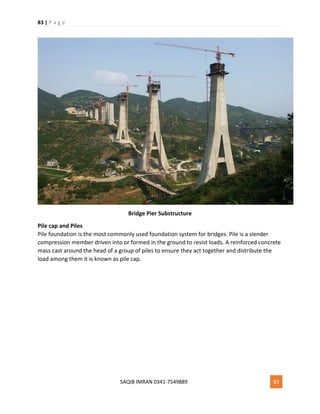
the requirement. Mostly Reinforced Concrete or Prestressed concrete are adopted for the
construction of piers.
Piers are compression members. Depending on the loading and bearing articulations, piers may
be subjected to bending as well.
83 | P a g e
SAQIB IMRAN 0341-7549889 83
Bridge Pier Substructure
Pile cap and Piles
Pile foundation is the most commonly used foundation system for bridges. Pile is a slender
compression member driven into or formed in the ground to resist loads. A reinforced concrete
mass cast around the head of a group of piles to ensure they act together and distribute the
load among them it is known as pile cap.
84 | P a g e
SAQIB IMRAN 0341-7549889 84
Completed pile cap rebar framing
12 Types of Loads Considered for Design of Bridge
Structures
Various types of loads are considered for design of bridge structures. These loads and their
combinations decides the safety of the bridge construction during its use under all
circumstances. The design loads should be considered properly for perfect design of bridge.
Different design loads acting on bridges are explained below.
Types of Loads for Design of Bridge Structures
Various design loads to be considered in the design of bridges are:
1. Dead load
2. Live load
3. Impact load
4. Wind load
85 | P a g e
SAQIB IMRAN 0341-7549889 85
5. Longitudinal forces
6. Centrifugal forces
7. Buoyancy effect
8. Effect of water current
9. Thermal effects
10. Deformation and horizontal effects
11. Erection stresses
12. Seismic loads
1. Dead Load
The dead load is nothing but a self-weight of the bridge elements. The different elements of
bridge are deck slab, wearing coat, railings, parapet, stiffeners and other utilities. It is the first
design load to be calculated in the design of bridge.
2. Live Load
The live load on the bridge, is moving load on the bridge throughout its length. The moving
loads are vehicles, Pedestrians etc. but it is difficult to select one vehicle or a group of vehicles
to design a safe bridge.
So, IRC recommended some imaginary vehicles as live loads which will give safe results against
the any type of vehicle moving on the bridge. The vehicle loadings are categorized in to three
types and they are
 IRC class AA loading
 IRC class A loading
 IRC class B loading
IRC Class AA Loading
86 | P a g e
SAQIB IMRAN 0341-7549889 86
This type of loading is considered for the design of new bridge especially heavy loading bridges
like bridges on highways, in cities, industrial areas etc. In class AA loading generally two types of
vehicles considered, and they are
 Tracked type
 Wheeled type
e
87 | P a g e
SAQIB IMRAN 0341-7549889 87
IRC Class A Loading
This type of loading is used in the design of all permanent bridges. It is considered as standard
live load of bridge. When we design a bridge using class AA type loading, then it must be
checked for class A loading also.
IRC Class B Loading
This type of loading is used to design temporary bridges like Timber Bridge etc. It is considered
as light loading. Both IRC class A and Class B are shown in below figure.
88 | P a g e
SAQIB IMRAN 0341-7549889 88
3. Impact Loads
The Impact load on bridge is due to sudden loads which are caused when the vehicle is moving
on the bridge. When the wheel is in movement, the live load will change periodically from one
wheel to another which results the impact load on bridge.
To consider impact loads on bridges, an impact factor is used. Impact factor is a multiplying
factor which depends upon many factors such as weight of vehicle, span of bridge, velocity of
vehicle etc. The impact factors for different IRC loadings are given below.
For IRC Class AA Loading and 70R Loading
Span Vehicle type Impact factor
Less than 9 meters Tracked vehicle 25% up to 5m and linearly reducing to 10%
from 5 m to 9 m.
Wheeled vehicle 25% up to 9 m
Greater than 9
meters
Tracked vehicle (RCC bridge) 10% up to 40 m
Wheeled vehicle (RCC
bridge)
25% up to 12m
Tracked vehicle (steel
bridge)
10% for all spans
89 | P a g e
SAQIB IMRAN 0341-7549889 89
Wheeled vehicle (steel
bridge)
25% up to 23 m
If the length exceeds in any of the above limits, the impact factor should be considered from
the graph given by IRC which is shown below.
For IRC class A and class B loadings
Impact factor If = A/(B+L)
Where L = span in meters
A and B are constants
Bridge type A B
RCC 4.5 6.0
Steel 9.0 13.50
Apart from the super structure impact factor is also considered for substructures
For bed blocks, If = 0.5
For substructure up to the depth of 3 meters If = 0.5 to 0
For substructure greater than 3 m depth If = 0
4. Wind Loads
Wind load also an important factor in the bridge design. For short span bridges, wind load can
be negligible. But for medium span bridges, wind load should be considered for substructure
design. For long span bridges, wind load is considered in the design of super structure.
90 | P a g e
SAQIB IMRAN 0341-7549889 90
5. Longitudinal Forces
The longitudinal forces are caused by braking or accelerating of vehicle on the bridge. When the
vehicle stops suddenly or accelerates suddenly it induces longitudinal forces on the bridge
structure especially on the substructure. So, IRC recommends 20% of live load should be
considered as longitudinal force on the bridges.
6. Centrifugal Forces
If bridge is to be built on horizontal curves, then the movement of vehicle along curves will
cause centrifugal force on to the super structure. Hence, in this case design should be done for
centrifugal forces also.
Centrifugal force can be calculated by C (kN/m) = (WV2)/(12.7R)
Where
W = live load (kN)
V = Design speed (kmph)
R = Radius of curve (m)
91 | P a g e
SAQIB IMRAN 0341-7549889 91
7. Buoyancy Effect
Buoyancy effect is considered for substructures of large bridges submerged under deep water
bodies. Is the depth of submergence is less it can be negligible.
8. Forces by Water Current
When the bridge is to be constructed across a river, some part of the substructure is under
submergence of water. The water current induces horizontal forces on submerged portion. The
forces caused by water currents are maximum at the top of water level and zero at the bottom
water level or at the bed level.
The pressure by water current is P = KW [V2/2g]
Where P = pressure (kN/m2)
K = constant (value depending upon shape of pier)
W = unit weight of water
V = water current velocity (m/s)
G = acceleration due to gravity (m/s2)
9. Thermal Stresses
Thermal stresses are caused due to temperature. When the temperature is very high or very
low they induce stresses in the bridge elements especially at bearings and deck joints. These
stresses are tensile in nature so, concrete cannot withstand against this and cracks are formed.
To resist this, additional steel reinforcement perpendicular to main reinforcement should be
provided. Expansion joints are also provided.
92 | P a g e
SAQIB IMRAN 0341-7549889 92
10. Seismic Loads
When the bridge is to be built in seismic zone or earthquake zone, earthquake loads must be
considered. They induce both vertical and horizontal forces during earthquake. The amount of
forces exerted is mainly depends on the self-weight of the structure. If weight of structure is
more, larger forces will be exerted.
11. Deformation and Horizontal Effects
Deformation stresses are occurred due to change is material properties either internally or
externally. The change may be creep, shrinkage of concrete etc. similarly horizontal forces will
develop due to temperature changes, braking of vehicles, earthquakes etc. Hence, these are
also be considered as design loads in bridge design.
12. Erection Stresses
Erection stress are induced by the construction equipment during the bridge construction.
These can be resisted by providing suitable supports for the members.
Common Causes of Failure of Bridge Structures
Different modes of failures of bridge structures under different stages of load either man-made
or natural cause, is necessary to develop strong and highly sustainable structures.
Cause of Failure of Bridge Structures
93 | P a g e
SAQIB IMRAN 0341-7549889 93
Bridges are vast and heavy structures whose design is complicated and sophisticated similar to
the way it is constructed. It can consume large time period and a huge investment. Any failure
to this will affect the economy in terms of life safety and wealth.
The main factors that will affect the bridge failure are:
1. The span length of the bridge
2. The heavy load pattern acting on the structure with both the impact and the cyclic
loads.
3. Chances of load increasing for lifetime.
4. The structure is subjected to extreme weather conditions without any form of cladding.
They are subjected to aggressive climate changes, wind and moisture conditions.
5. Foundations subjected to different changes based on different soil conditions. This is
also subjected to various hydraulic effects.
6. Heavy vehicle movements create damage to different structural elements of the bridge.
94 | P a g e
SAQIB IMRAN 0341-7549889 94
Fig: Failure of Bridge due to the scouring
The bridge use and function are mainly dependent on the loading of the bridge and the object
over which the bridge must span.
From past histories and studies, major failures in the bridge is recorded due to
the following issues:
1. Foundation scouring causing overall collapse of the structure
2. Steel members of the structure subjected to brittle, stress and fatigue corrosion
cracking.
3. Collision of vehicles with the girders and the piers, collision of the vehicles with the truss
members or guides, shifting of the train loads, derailment of the train.
4. Salting of the surface of the deck, resulting in the corrosion of the structure
reinforcement. This results in the distress of the deck surface.
5. Floor system subjected to corrosion damaging the roadway or the deck.
6. Flood at the bottom of the bridge will result in horizontal loads on the bottom.
Materials Used in Bridge Construction
Stones, Timber, Concrete and Steel are the traditional materials that are used to carry out
bridge construction. During the initial period, timber and stones were used in the construction,
as they are directly obtained from nature and easily available.
Brick was used as a subgroup construction material along with stone construction. Stones as
construction materials were very popular because of its durable properties. Many historic
bridges made from stones are still present as a symbol of past architectural culture.
But some of the timber bridge have been washed away or are in the stage of degradation due
to their exposure to the environmental conditions.
As time passed, the bridge construction has undergone more development in terms of
materials used for construction than based on the bridge technology.
The concrete and steel are manmade refined materials. The bridge construction with these
artificial materials can be called the second period of the bridge engineering. This hence was
the start of modern bridge engineering technology.
95 | P a g e
SAQIB IMRAN 0341-7549889 95
Modern bridges make use of concrete or steel or in combination. Different other innovative
materials are being developed so that they can well suit with the bridge terminologies.
Incorporation of fibers which comes in the category of high strength gaining materials is now
incorporated for the construction of bridges. These materials are also used in order to
strengthen the existing bridges.
Stones for Bridge Construction
For a long time in the history, the stone has been used in and as a single form. They are mainly
used in the form of arches. This is because they possess higher compressive strength.
The use of stones gave the engineers ease of constructing bridges that are aesthetically top and
high in durability.
When considering the history of bridge construction with stones, the Romans were the greatest
builders of bridges with stones. They had a clear idea and understanding of the load over
bridge, the geometry as well as the material properties. This made them construct very larger
span bridges when compared with any other bridge construction during that period.
The period was also competitive for Chinese. China had also developed large bridge called the
famous Zhuzhou Bridge. The Zhuzhou bridge is the world’s known oldest open-spandrel, stone
and segmental arch bridge. Nihonbashi is the most famous stone bridge in Japan. This is called
as the Japan Bridge.
Fig.1: The Zhuzhou bridge, China
96 | P a g e
SAQIB IMRAN 0341-7549889 96
With time, the stone bridges have proved most efficient and economical due to the durability
and low maintenance guaranty it provides throughout its life period.
Timber or Wood for Bridge Construction
The wood material was used highly in the construction of bridges, unlike today, where it is used
for the construction of building works and related. Nowadays, steel and concrete grant a higher
range of work flexibility, that the use of wood and timber for mega works diminished.
But, there are innovations related to the preservation of wood, which has helped to increase
the demand of wood in structures.
Wood as an engineering material has the advantage of high toughness and renewable in
nature. They are obtained directly from nature and hence are environmentally friendly.
The low density of wood makes it gain high specific strength. They have an appreciable strength
value with a lower value of density. This property makes them be transported easily.
Some of the disadvantages related to wood as a construction material are that it is:
 Highly Anisotropic in Nature
 Susceptible to termites, infestations, and woodworm
 Highly combustible
 Susceptible to rot and disease
 Cannot be used for High temperature
There are a variety of timber bridges around the world. Figure-2 shows the Mathematical
Bridge located in Cambridge. Another bridge is the Togetsu-Kyo Bridge over the Katsura River in
Kyoto.
Fig.2: The Mathematical Bridge, Cambridge
97 | P a g e
SAQIB IMRAN 0341-7549889 97
Fig.3. The Togetsu-Kyo Bridge, Japan
Steel for Bridge Construction
Steel gain high strength when compared with any other material. This makes its suitable for the
construction of bridges with longer span. We know that steel is a combination of alloys of iron
and other elements, mainly carbon.
Based on the amount and variation of the elements, the properties of the same is altered
accordingly. The properties of tensile strength, ductility and hardness are influenced by the
change in its constitution.
The steel used for normal construction have several hundred Mega Pascal strength. This
strength is almost 10 times greater than the compressive and the tensile strength obtained
from a normal concrete mix.
The major inbuilt property of steel is the ductility property. This is the deformation capability
before the final breakage tends to happen. This property of steel is an important criterion in the
design of structures.
98 | P a g e
SAQIB IMRAN 0341-7549889 98
Fig.4. The Hachimanbashi Bridge
The first iron bridge, Danjobashi Bridge which was built in 1878 in Japan. The figure-4 below
shows the Danjobashi Bridge. Danjobashi Bridge was relocated to the present location and was
named as Hachimanbashi Bridge in 1929.
It has great historical and technical value as a modern bridge. The bridge was honored by the
American Society of Civil Engineers in the year 1989.
The chemical composition and the method of manufacture determines the properties of
structural steel. The main properties that are to be specified by the bridge designers when it is
required to specify the products are:
 Strength
 Toughness
 Ductility
 Durability
 Weldability
When we mention the steel strength, it implies both the yield and the tensile strength. As the
structures are more designed in the elastic stage, it is very essential to know the value of yield
strength.
Yield strength is mostly used as it is more specified in the design codes. In Japan, the code
recommended is designed for ultimate strength. For example, SS400 designated by the ultimate
strength of 400MPa. This is an exception.
The property of ductility is very much relied on by designers and engineers for the design
aspects related to the bolt group designs and the distribution of stress at the ultimate limit
state conditions. Another important property is the corrosion resistance by the use of
weathering steel.
Concrete for Bridge Construction
99 | P a g e
SAQIB IMRAN 0341-7549889 99
Most of the modern bridge construction make use of concrete as the primary material. The
concrete is good in compression and weak in tensile strength. The reinforced concrete
structures are the remedy put forward for this problem.
The concrete tends to have a constant value of modulus of elasticity at lower stress levels. But
this value decreases at a higher stress condition. This will welcome the formation of cracks and
later their propagation.
Other factors to which concrete is susceptible are the thermal expansion and shrinkage effects.
Creep is formed in concrete due to long time stress on it.
The mechanical properties of concrete are determined by the compressive strength of
concrete.
The reinforced or the prestressed concrete is used for the construction of bridges. The
reinforcement in R.C.C provides the ductility property to the structure. Nowadays, ductility
reinforcement is provided as an additional requirement mainly in the earthquake resistant
construction.
RCC is nowadays made from steel, polymer or other combination of composite materials. Much
sustainable materials is available that can take the role of cement. This is a new innovation in
sustainable bridge construction.
When compared with RCC bridge construction, prestressed concrete is the most preferred and
employed. A pre-compressive force is induced in the concrete with the help of high strength
steel tendons before the actual service load.
Hence this compressive stress will resist the tensile stress that is coming during the actual load
conditions. The prestress is induced in concrete either by means of post tensioning or by means
of pretensioning the steel reinforcement.
Many disadvantages of normal reinforced concrete like strength limitations, heavy structures,
building difficulty is solved using prestressed concrete.
Composite Materials in Bridge Construction
Composite materials are developed and used for both the construction of new bridges as well
as for the rehabilitation purposes.
Fiber reinforced plastic is one such material which is a polymer matrix. This is reinforced with
fibers which can be either glass or carbon. These materials are light in weight, durable, high
strength giving and ductile in nature.
New solution and materials are encouraged due to the problems of deterioration the steel and
concrete bridges are facing.
Another material is the reactive powder concrete (RPC ) that was developed in Korea. This
material is a form of high performance concrete that is reinforced with steel fibers. This mix will
help to make slender columns for bridges of a longer span. This also guarantees durability
extensively.
Composite materials are used in the repair of bridge columns and any other supporting
elements to improve the ductility and the resistance against the seismic force.
100 | P a g e
SAQIB IMRAN 0341-7549889
10
0
Epoxy impregnated fiberglass are used to cover the column (columns that are non-ductile in
nature). This is an alternative for the steel jacket technique.
Bridge Bearings -Types of Bearings for Bridge Structures
and Details
Bridge bearings are structural equipment or devices installed between bridge substructure and
superstructure to transfer the applied load including earthquake loads; wind loads; traffic loads;
and superstructure self-weight.
Bridge bearings also makes rooms for relative movements between superstructure and
substructure, for instance, rotation movements and translational movements in horizontal and
transverse direction.
Bearing used in the construction of bridge structure is divided into two major categories namely
expansion bearings and fixed bearings. The former permits both translational and rotational
movements whereas the latter allow rotational and limited translational movements.
There are several types of bridge bearings which have been employed in bridge construction
which are discussed below.
101 | P a g e
SAQIB IMRAN 0341-7549889
10
1
Types of Bridge Bearings and their Details
Different types of bearings for bridges include:
 Sliding bearings
 Rocker and pin bearings
 Roller bearings
 Elastomeric bearings
 Curved bearings
 Pot bearings
 Disk bearings
Sliding Bearings for Bridges
Sliding bearing consist of two metal plates, commonly stainless-steel plates, that slide relative
to each other and hence makes room for translational movement and lubricating material
between them as illustrated in Figure-1.
Fig.1: Sliding Bridge Bearing
A friction force is generated in sliding bearing and it is imposed on substructure, superstructure
and sliding bearing itself. So, it may be required to provide lubricant such as
polytetrafluoroethylene (PTFE) to decline generated friction.
It is specified by ASSHTO that sliding bearing cannot be used unless the bridge span is smaller
than 15m. This is because sliding bearing cannot be purely used if the bridge experiences
rotation movement.
However, the span restriction for sliding bearing utilization can be disregarded when it is used
in combination with other bearing types.
Rocker and Pin Bearings for Bridge Structures
Rocker is an expansion bearing composed of curved surface at the bottom, which
accommodate translational movement and a pin at the top makes room for rotation movement
as illustrated Figure-2 and Figure-3 in detail.
102 | P a g e
SAQIB IMRAN 0341-7549889
10
2
Fig.2: Rocker Bridge Bearing
Fig.3: Rocker Bridge Bearing
Pin bearing is a fixed bearing that make room for rotation movement through the application of
steel pin. It has similar structure and component like rocker bearing apart from the bottom of
pin bearing which is flat and fixed to the concrete pier, as can be observed in Figure-4.
103 | P a g e
SAQIB IMRAN 0341-7549889
10
3
Fig.4: Pin Bearing for Bridges
Both rocker and pin bearings are mainly employed in steel bridge structure. Rocker and pin
bearing should be considered when the bridge movement is adequately known and described,
since such bearings can make rooms for both translational and rotational movements in one
direction only.
These bearings are likely to suffer deterioration and corrosion, so it is necessary to conduct
regular inspection and maintenance.
Roller Bearings for Bridges
Roller bearing can be used in the construction of reinforced concrete and steel bridge structure.
There are two main configurations including single roller bearing which is composed of one
roller placed between two plates and multiple roller bearing that consist of several rollers
installed between two plates.
The former as shown in Figure-5 can accommodate both rotation and translation movement in
longitudinal direction and it is cheap to manufacture but its vertical load capacity is limited.
In contrary, the latter as shown in Figure-6 can make room for translation movement only and
rotation movement can be accommodated if rollers are combined with pin bearing. Multiple
roller bearings are expensive and support considerably large vertical loads.
Regular inspection and rehabilitation should be conducted since roller bearing are susceptible
to corrosion and damages.
104 | P a g e
SAQIB IMRAN 0341-7549889
10
4
Fig.5: Single Roller Bridge Bearing
Fig.6: Multiple Roller Bridge Bearing
Elastomeric Bearings for Bridge Structures
It consists of elastomer manufactured from synthetic or natural rubber and can take both
translation and rotation movements through elastomer deformation. The ability of elastomer
to carry large vertical loads is because of reinforcement provision that prevents lateral bulging
of elastomer.
There are number of elastomeric bearing pads classified based on types of reinforcements
used. For example, steel reinforced, plain, fiberglass reinforced and cotton duck reinforced
elastomeric bearing pads.
Strength and response of each type is different, steel reinforced elastomeric bearing is the
strongest one and plain elastomeric pad is the weakest.
Elastomeric bearing is neither expensive nor requires considerable maintenance, that is why it
the most desired bearing type. Figure-7 show details of elastomeric bearing and its application
in bridge structure.
105 | P a g e
SAQIB IMRAN 0341-7549889
10
5
Fig.7: Elastomeric Bridge Bearing
Curved Bearings for Bridges
It consists of two curved plate that match each other as shown in Figure 8. If curved bearing is
cylindrical, then it only accommodates rotation movements. However, both rotation and
translational movements can be dealt with if curved bearing is spherical.
Due to the fact that both gravity loads and curved geometry generate lateral resistance against
and consequently lateral movement would be limited, that is why polytetrafluoroethylene
(PTFE) slider is adhered to the bearings in order to make rooms for lateral movements. Details
of curve bearings can be seen in Figure-8.
Fig.8: Spherical Bearing for Bridges
Pot Bearings for Bridge Structures
As shown in Figure-9, pot bearing consists of elastomeric disk confined in a pot, steel piston
that is properly tailored into the pot wall and flat sealing rings which keeps elastomeric inside
the pot.
Pot bearing can support considerable vertical loads and it is commonly transferred through
steel piston to the elastomeric disc which is almost incompressible. As far as lateral load is
concerned, it is transferred as the steel pistol moves toward pot wall.
Translational movement is limited in pure pot bearing that is why PTFE are introduced to the
sliding surface to make rooms for translation movement.
106 | P a g e
SAQIB IMRAN 0341-7549889
10
6
Fig.9: Pot Bridge Bearing
Disk Bearings for Bridges
Different components of disk bearing are shown in Figure-10 in detail. Rotation movement is
accommodated through the deformation of elastomer whereas the translation movement is
considered through the application of PTFE slider.
Fig.10: Disk Bearing
The utilized elastomer should be adequately hard to support vertical loads without suffering
large deformations and sufficiently flexible to allow rotational movement.
Both vertical loads and lateral loads are supported by elastomeric disk and metal ring in the
center of the bearing respectively.
Basic Components and Parts of Bridge Structures
The bridge structure consists of the following components:
1. Superstructure or decking component
2. Bearings
3. Substructure Components
107 | P a g e
SAQIB IMRAN 0341-7549889
10
7
Fig: Semi-Through Section of a Concrete Slab Road Bridge
Superstructure Components of Bridges
The superstructure of the bridge structure consists of deck slab, girder, truss etc. These
components vary based on the type of bridge (whether concrete or steel or composite).
Superstructure of the bridge bears the load passing over it. This helps in transmitting the forces
formed by the loads to the below substructures.
Decks
The decking is considered as the road or the rail surface of the bridge. The decks are supported
by the girders or the huge beams that is in turn supported by the piers. The whole arrangement
is supported with a deep foundation mainly piles and cap arrangement.
Bearings in Bridges
The loads received by the decks are properly and safely transmitted to the substructure with
the help of bearings. These are components of bridge that enables even distribution of load on
108 | P a g e
SAQIB IMRAN 0341-7549889
10
8
the substructure material. This transmission is very essential in situations where the
substructure is not designed to take the load action directly.
The bearings in bridges allows the longitudinal movement of the girders. This movement is
created due to the forces acting on the longitudinal direction. The forces due to the moving
loads and the variation in temperature are the main causes for longitudinal forces.
The selection of bearing is dependent on certain parameters, which are: Loads acting, the
geometry, the extent of maintenance, the clearance available, the displacement, rotation and
deflection policy, availability, preference of the designer, the construction tolerances, and the
cost criteria.
For the bridge design, all the above-mentioned aspect is considered for the design and the
choice of bearings. The designer must consider the bearing arrangement in the bridge
construction as a separate system.
In most of construction practice, the bearing is selected or the decision for bearing is done in
the last moment. This results in increase of maintenance in the future, which must be avoided.
Substructure Components of Bridges
The components involved in substructure of bridges are:
1. Piers
2. Abutments
3. Wing Walls and the Returns
4. Foundation
Piers
The piers are vertical structures used to support deck or the bearings provided for load
transmission to underground soil through foundation. These structures serve as supports for
the bridge spans at intermediate points.
The pier structure has mainly two functions:
109 | P a g e
SAQIB IMRAN 0341-7549889
10
9
1. Load transmission to the Foundation
2. Resistance to the horizontal forces
Most of the cases, piers are designed to resist the vertical loads alone. In areas which lie in the
seismic zone, it is recommended to design the pier for lateral loads also.
Most of the piers are constructed using concrete. Steel for the construction of pier is used in
very few cases till now. Use of composite columns i.e. steel columns filled with concrete is used
as new technology of pier construction.
The pier is a vertical member that resist the forces by means of shear mechanism. These forces
are mainly lateral forces. The pier that consist of multiple columns are called as bent.
Types of Piers in Bridge Construction
There are different types of piers based on the structural connectivity, the shape of the section
and the framing configuration.
Based on the structural connectivity, the pier can be classified as monolithic or cantilevered.
Based on the shape of the section pier can be classified as solid or hollow, hexagonal, round or
octagonal or rectangular.
Based on the framing configuration the pier can be classified as single or multiple column bent,
hammerhead or pier wall type.
Abutments
Abutments are vertical structures used to retain the earth behind the structure. The dead and
the live loads from the bridge superstructure is supported by the bridge abutments.
110 | P a g e
SAQIB IMRAN 0341-7549889
11
0
The abutments are also subjected to lateral pressures mainly from the approach embankment.
The design loads on the abutment is mainly dependent on the:
 Type of abutment selected
 The sequence of construction
The figure below shows the primary functions carried out by an abutment.
Fig: Abutments in Bridge Construction- Primary Functions
111 | P a g e
SAQIB IMRAN 0341-7549889
11
1
As seen from the above figure, the abutments have the design requirements similar to retaining
walls as well as in pier construction. The abutments are primarily designed to resists the
overturning and sliding. More focus is on the stability of the whole system.
The special care has to be provided for the foundations of abutments. The abutment
foundation must overcome the problems of differential settlement and excessive movements
caused due to lateral forces or loads.
The below figure shows the components of abutments.
Fig: Abutments Components
Wing Walls and Returns
Structures constructed as an extension of the abutments to retain the earth present in the
approach bank are called wing walls. This portion will otherwise have a natural angle of repose.
These are retaining walls constructed adjacent to the abutments. This wall can be constructed
either integrally or independent with the abutment wall.
The rear of the wall must consider three design loads while designing. This includes:
 The earth pressure from the backfill
 The surcharge from the live loads or the compacting plant
 The hydraulic loads from the saturated soil conditions
The stability of the wing wall is mainly based on its resistance against the active earth
pressures. The structural elements of the bridges are hereby designed and constructed to resist
the earth pressures at rest.
112 | P a g e
SAQIB IMRAN 0341-7549889
11
2
Parapets and Handrails/ Guard Rails or Curbs
These components of bridges are not of structural importance, but provided for the safety
concerns. These are provided above the decks. This will help in prevention of the vehicle from
falling off the bridge into the water body below or as a means for the separation of traffic
streams.
Foundation of Bridges
Foundation are structures constructed to transmit the load from the piers, abutments, wing
walls and the returns evenly on the strata.
113 | P a g e
SAQIB IMRAN 0341-7549889
11
3
The foundation provided for bridge structures are deep in sufficient manner to avoid scouring
due to the water movement or to reduce the chances of undermining.
Types of Bridges Based on Span, Materials, Structures,
Functions, Utility etc.
There are various types of bridges classified based on span, materials, types of bridge
structures, functions, utility and position etc.
A bridge is structure which allows passage over an obstruction. The obstructions may be river,
valley, rail route or road way etc.
Types of Bridges
Bridges are classified into so many types based on different criteria’s. They are explained below.
Types of Bridges based on Type of Super Structure
 Arch bridge
 Girder bridge
 Truss bridge
 Suspension bridge
Arch Bridge
Arch bridge is curve shaped bridge, in which horizontal thrust is developed and is restrained by
the abutments at each end of the bridge. There are many types of arch bridges are there. In
some cases, the arch may be under the deck slab also.
114 | P a g e
SAQIB IMRAN 0341-7549889
11
4
Girder Bridge
In case of Girder Bridge, the deck slab is supported by means of girders. The girder may be of
rolled steel girder or plate girder or box girder. Load coming from the deck are taken by girder
and transferred them to the piers and abutments.
Truss Bridge
Truss is member consisting connected elements to form triangular units. In case of truss bridge
the super structure is provided with trusses. Generally, trusses are made of steel. There are
several types of trusses are available.
115 | P a g e
SAQIB IMRAN 0341-7549889
11
5
Suspension Bridge
In case of Suspension bridge, deck slab is suspended with the help of cables and suspenders.
These will give good appearance. For long span bridges, this type of suspension is suitable.
Types of Bridges based on Materials
 Timber bridge
116 | P a g e
SAQIB IMRAN 0341-7549889
11
6
 Masonry bridge
 Steel bridge
 R.C.C bridge
 Pre stressed concrete bridge
Timber Bridge
Bridges constructed using timber are called timber bridges. These are generally constructed for
short spans or as temporary bridges. They are not useful for heavy loads.
Masonry Bridge
Masonry Bridge constructed by using bricks or stones. These are generally constructed for short
spans and in low depth canals.
117 | P a g e
SAQIB IMRAN 0341-7549889
11
7
Steel Bridge
Steel bridges are constructed using steel bars or trusses or steel cables. These are more durable
and bear heavy loads.
R.C.C Bridge
R.C.C bridges are constructed using reinforced cement concrete. These are more stable and
durable. They can bear heavy loads and are widely using nowadays.
Prestressed Concrete Bridge
If concrete material is placed under compression before applying the loads, then it is called as
prestressed concrete. To construct pre stressed concrete bridge, pre-stressed concrete blocks
118 | P a g e
SAQIB IMRAN 0341-7549889
11
8
are arranged as deck slab with the help of girders. These blocks are suitable for shorter span to
longer span bridges.
Types of Bridges based on Span
 Culvert bridge
 Minor bridge
 Major bridge
 Long span bridge
Culvert Bridge
When the bridge span length is below 6meters then it is called as Culvert Bridge.
119 | P a g e
SAQIB IMRAN 0341-7549889
11
9
Minor Bridge
If the bridge span length is in between 8 to 30 meters, then it is called minor bridge.
Major Bridge
For major bridge, the span is generally about 30 to 120 meters.
120 | P a g e
SAQIB IMRAN 0341-7549889
12
0
Long Span Bridge
When the span of bridge is more than 120 meters then it is termed as long span bridge.
Types of Bridges based on Level of Crossing
 Over bridge
 Under bridge
Over Bridge
To pass over another route (railway or highway), a bridge is constructed to allow traffic. This is
called over bridge or fly over bridge.
121 | P a g e
SAQIB IMRAN 0341-7549889
12
1
Under Bridge
If over bridge is not possible, an underground type bridge is constructed to pass another route.
This is called under bridge.
Types of Bridges based on Function
122 | P a g e
SAQIB IMRAN 0341-7549889
12
2
 Foot bridge
 Highway bridge
 Rail way bridge
 Aqueduct bridge
 Road cum railway bridge
Foot Bridge
Foot Bridge is generally constructed for humans to cross the roads or rail route or any canal by
foot. Vehicles are not allowed in this bridge.
Highway Bridge
High way or road Way Bridge is used for road transportation. These are constructed over rivers
or another routes to allow road way traffic. Girder type bridges are used as highway bridges
over rivers or canals.
123 | P a g e
SAQIB IMRAN 0341-7549889
12
3
Railway Bridge
Rail bridges are constructed for rail transportation. Truss type bridges are preferred for railways
but how ever r.c.c bridges are also used.
Aqueduct Bridge
Aqueduct bridges are nothing but water carrying bridges which are constructed to0 transport
water from source to system.
124 | P a g e
SAQIB IMRAN 0341-7549889
12
4
Road cum Railway Bridge
This type of bridge is useful for both road way and railway transport. It may be of one floor or
two floors. If one floor is there then, rail and road way are arranged side by side. Otherwise
roadway on top deck and railway in bottom deck is preferred.
Types of Bridges based on Inter Span Relation
 Simple bridge
 Continuous bridge
 Cantilever bridge
Simple Bridge
Simple bridge is like simply supported beam type which consist two supports at its ends. For
shorter spans, simple bridges are suitable.
125 | P a g e
SAQIB IMRAN 0341-7549889
12
5
Continuous Bridge
If the bridge span is very long, then we have to build more supports in between end supports.
This type of bridge is termed as continuous bridge.
Cantilever Bridge
126 | P a g e
SAQIB IMRAN 0341-7549889
12
6
Cantilever type of bridge have only supported at one end and another end is free to space.
Generally, two cantilever portions are joined to make way to the vehicles or humans.
Types of Bridges based on Utility
 Temporary bridge
 Permanent bridge
Temporary Bridge
During construction of dams or bridges or during floods, temporary bridges are constructed at
low cost for temporary usage. These bridges are maintained at low cost. After construction of
original structure temporary bridges are dismantled. Generally timber is used to construct
temporary bridges.
Permanent Bridge
These bridges are constructed for long term use and maintained at high level. Steel or R.C.C
bridges are come under this category.
127 | P a g e
SAQIB IMRAN 0341-7549889
12
7
Types of Bridges based on Position of Floor
 Deck bridge
 Through bridge
 Semi-through bridge
Deck Bridge
In case of Deck Bridge, super structure or floor of bridge is positioned in between the high flood
level and formation level.
Through Bridge
In case of through bridge, Super structure of bridge is completely above the formation level.
128 | P a g e
SAQIB IMRAN 0341-7549889
12
8
Semi-Through Bridge
If the super structure of bridge is partly above and partly below the formation level, then it is
called as semi-through bridge.
Types of Bridges based on High Flood Level (HFL)
 Low level bridge
 High level bridge
Low Level Bridge
The super structure of bridge is generally below high flood level. So, whenever floods occurred
these are submersed in water. So, these are also called as submersible bridges. These are
generally constructed for unimportant routes with low cost.
129 | P a g e
SAQIB IMRAN 0341-7549889
12
9
High Level Bridge
High level bridge is non submersible against floods. It is well above the high flood level and
constructed in important routes.
Planning for Bridge Construction including Sequence and
Steps of Planning
Planning for bridge construction is required as it has huge impact on life of people. Social,
scientific and technological dimensions for bridge construction must be considered.
The decision of providing a bridge across any barrier is to facilitate the community residing on
either side of the project. Some major bridges bring benefits to the whole country; for example,
the bridges constructed across the river Ganga or the Brahmaputra in India. Another example is
the Honshu-shikoku connection, that has bridges across many islands in Japan. This unique
structure construction also benefits more than one country, as in the case of the Oresund link,
that is constructed across the Baltic ocean.
130 | P a g e
SAQIB IMRAN 0341-7549889
13
0
Three Dimensions of Planning for Bridge Construction
There are three dimensions that are involved in the planning of any mega project like a bridge.
This is considered as an initial step towards the planning of structures, that would finally bring
up with a project that would be advantageous to the community in all aspects. The three
dimensions are:
1. Scientific Dimension
2. Social Dimension
3. Technological Dimension
Scientific Dimensions for Bridge Construction
There exist certain laws for nature, based on which every structure constructed must perform.
Scientists explain these natural forms and the existence of these laws with the help of
certain inter-relations between certain elements.
In one or the other form, the scientists or the engineers make use of pre-existing technologies
in nature, that the only difference is the method they used to undergo.
Various scientific developments that are made by the engineers based on these; like bringing
different alternative materials by chemical analysis, physics – to observe and analyze the
dynamic behavior of the structure; Mathematics – used to analyze and determine the forces
and the stresses. Hence efficient structures are evolved with the help of the scientific
dimension.
Social Dimension for Bridge Construction
131 | P a g e
SAQIB IMRAN 0341-7549889
13
1
Enhancement of quality of life of the people, are greatly facilitated by the bridge construction.
These structures improve the mobility of people as well as the material. This dimension helps to
realize the pros and cons of such construction and their related precautions.
Such a huge construction brings changes to the society and the people, but also bring adverse
changes to the environment. It is not only required for the bridges to satisfy the need of
mobility and the future demands but also must satisfy the problems related to noise, pollution,
during and after construction.
As the structure is the for the welfare of the whole community, the people are also committed
and responsible for bringing their contribution to this welfare in the form of taxes, levies or in
the forms of tolls. This would help in looking the construction as a cost benefited work and as a
means of economic development.
The above considerations come under the social dimension. There are also chances for the
incorporation of political dimension with the social dimension. This arises in the situation of
choice of location or the facility, or in prioritizing the needs for the welfare of the economy.
The social dimension has a direct close connection with the scientific and the technological
dimension.
Technological Dimensions for Bridge Construction
There have been many technological developments over decades in the field of new structures,
methods of construction and materials, as an alternative for rare ones and in bringing new
machinery that works over human workers.
This technology has helped in bringing and refining alternatives in the bridge construction. Now
instead of bricks, steel, cement etc., construction are carried out by glass fibers, carbon fibers
etc.
Going through such innovations in technologies, the first FRP material constructed bridge was
in China in the year 1982. It composed of five box girders with a clear span of 20.4m.
The development of carbon fiber reinforced polymer i.e. CFRP cables, that gain a strength of
3300Mpa and modulus of elasticity of 165GPa, was also made. The Winterthur Bridge in
Switzerland, make use of such cables. Two cables out of twenty-two are made of this material.
The steel is available with higher capabilities, like high strength varying from 60MPa to 100MPa,
that have remarkable ductility and corrosion resistance. These had led to the new construction
choices in arches, cable supported structures, slender structures and longer spans.
The accurate behavior of structures is clearly analyzed with the help of new techniques of scale
models, computers for huge analysis and aerodynamic studies.
With the development of new heavy vehicles with huge capacities, the engineers are forced to
construct the bridges with higher capacity. This will influence the strength and the dimensions
of the bridge and affect the maintenance related to the same.
All these bring up a higher impact on the environment, in the form of air pollution, higher
depletion of natural resources. These massive structures make use of huge amount of concrete,
which in turn make use of aggregates from nature.
132 | P a g e
SAQIB IMRAN 0341-7549889
13
2
When it comes to the concern of a structural engineer, the scientific dimension comes to be the
primary criteria. But he must balance with the other two dimensions i.e. the social and the
technological dimension.
This concludes that he must evolve a structure that is acceptable socially at the same time
economic, durable and efficient. This depends on how he chooses the technological dimension,
which must be conducted at the conceptual stage of the project.
Planning Sequence for Bridge Construction
The planning sequence for the construction of a new highway or a railway project is a major
part of the project planning. Based on the complexity of the barrier across which the bridge
must be constructed, the detailing of the project planning increases, because more
investigation must be carried out. In general, the major steps that are involved in the planning
for the construction of a new project is mentioned below:
1. Identifying the need for the bridge
2. Assessment of traffic possible and required in the area proposed to construct the bridge
3. Study the location
4. Study of all possible alternatives
5. Refining and short listing all possible alternatives
6. Identifying conceptual plans for the alternatives. This involves finding the materials, the
arrangement of the span and the form.
7. Preliminary design and the cost estimation
8. Evaluating the alternatives, its risk and the final choice of decision
9. Resource source identification by detailed surveying
10. Implementation with the help of bidding documents. This is followed by carrying out by
fixing the agency, the construction details, and their commissioning.
Different Stages of Planning in Bridge Construction
The major steps that are involved in the planning for bridge construction are:
1. Study on Need for Bridge
2. Traffic Assessment
3. Location study
4. Reconnaissance Study
a) Study of alternatives
b) Feasible alternative study
5. Preliminary Engineering
a) Developing plans
b) Preliminary design and costing
c) Evaluation of alternatives, risk analysis, and final choice
6. Detailed Project Report
7. Implementation
133 | P a g e
SAQIB IMRAN 0341-7549889
13
3
A brief idea on each stage is explained in the following section.
1. Study on need for Bridge
The decision of having a new bridge in an area is taken as a part of development of the society.
This facilitates the feasibility of linking the cities and towns, which gain more importance in the
overall growth of a nation. Their need is studied based on the socio-economic viabilities.
2. Traffic Assessment for Bridge Construction
An assessment of the traffic type and its quantum is necessary to decide the following factors:
 Number of lanes on the road or the railway tracks
 The geometric design parameters
 Benefits acquired by the society
The data collection for this must be done carefully so that a proper idea on how the traffic
pattern, the growth strategies such as agricultural, industrial as well commercial developments
are influenced. The bridge construction has a huge investment at the initial stages. Once
completed, a small variation or renovation is not recommended.
So, it is advised to bring a design that considers the future capacity requirements and traffic
factors. The traffic assessment study should be considered the following factors into
consideration. This mainly is carried out with the help of a traffic planner or an Economist.
 The traffic composition, in terms of light and the heavy vehicles
 The maximum and the minimum speed requirements
 The annual growth rate and their variations
 The design life of the bridge
3. Location Study for Bridge Construction
While having a location study and fixing the location of the bridge, it is very essential to
consider the need and the location of cross drainage works if any. The cross-drainage work is
said to have 15 to 20 % of the overall project cost if it must be implemented. Hence before
choosing the alignment for bridge construction, it is necessary to determine all the possible CD
works and its effect. The following factors are considered reliable in fixing the location of the
bridge.
 Location chosen over a stream with no bends or meanders. It will be straight in reach.
 A stream with no branches or tributaries
 The location being confined with properly defined banks
 If the bridge or the culvert is with the road approach, on either side having maximum
extent
 If the crossing is normal to the alignment of the road and angle of skew is necessary,
limit it.
Other than the above-specified conditions, the major river crossings of the bridge construction
should satisfy the following conditions:
a) River regime
134 | P a g e
SAQIB IMRAN 0341-7549889
13
4
The river upstream must be straight. If there is bend in the downstream, it must be avoided.
The river in the reach must be free from whirls, excess current due to eddies. The channel in
reach must is narrow and well defined. The river regime should have inerodable banks that are
firm. If there are no inerodable banks, over gorging, guide banks in dry locations also must be
provided.
b) Approaches
During floods, the approaches must be secure from flood attacks or any major spills. High
expensive approach construction must be avoided. It is recommended to pass through built-up
areas, or high hills or through major basin or religious structures.
The approaches have a reasonable proximity to the main road. It should not let construction of
costly connecting link.
The ideal approach will avoid the construction under water that is highly costly and
uneconomical. They should help in a way to bring lesser maintenance to the whole system,
hence increasing the life period of the bridges.
4. Reconnaissance Survey for Bridge Construction
This is a pre-feasibility study, which studies the entire reach of the river, that must be crossed;
to find out best and suitable position for bridge location. The factors each site satisfies are
taken as lists and each is analyzed individually, from which the best consideration is chosen.
The final number of feasible sites must be refined down to three or four, this can be done only
by going in detail of each site and refining the most suitable ones.
During this stage, maps are used to locate theses feasible sites. The direct assessment of the
site is made to understand the location features (local criteria), studying the existing and
growth of traffic with the help of surveys, knowing information from the people residing, simple
routes and short cuts in the area, river flow and its spread are also studied.
A feasibility study on the economy of cost, the duration of construction, the sources of
resources are also assessed. Now the whole information is gathered and a comparison is made.
Based on the discussion and refinement, the best feasible site for implementation is chosen.
5. Preliminary Engineering for Bridge Construction
This stage of planning can be called as a techno-economic feasibility study. Here, the technical
details related to the bridge construction is studied in a detailed manner, to bring all possible
alternatives to proceed the construction.
Mainly it is found that the total cost of the project is plus or minus 15% of the cost that is
estimated at this stage of planning. To process the technical study, minimum level of field study
and measurements, the location study, and related parameters must be done.
This study carried out at the bridge construction site should bring the following tabulated
content details:
1. The total length of the bridge
2. The length of approaches
3. If detours are present, their respective savings
135 | P a g e
SAQIB IMRAN 0341-7549889
13
5
4. The anticipated volume of traffic
5. The distance to the nearby city or town from the site
6. Expected bridge project period
7. The nature of stream flowing into the site
8. The nature and behavior of soil strata for foundation
9. The construction problems existing with bridges or approaches
10. Maintenance for the bridges or approaches if any
11. The internal rate of return or the cost benefit ratio
12. The impact on the environment
For each element that is noted, must be assigned with a certain amount of scoring and
weightage, that would finally help in choosing the best site.
7. Detailed Project Report of Bridge Construction Planning
This stage is the final stage of planning in the bridge construction, before the commencement
of the construction work. Full investigation from the roots is taken and documented. The
investigations conducted are:
 Ground survey
 Soil exploration- foundation details
 Hydrological data
 Model studies and analysis
METHODS OF BRIDGE CONSTRUCTION:
Before a bridge can be built an appropriate method of construction must be chosen. The
decision is made by the design team. The principle factors considered by the design team when
chosing a suitable method of construction are given below:
 The scale of the bridge
 The obstacles to be crossed
1. The regularity of the span lengths
2. The horizontal and vertical profiles of the bridge decks
3. The nature of the soil strata
4. The local weather
5. The local cost of materials
6. The local labour market
7. The accessibility of the site
8. The time allowed for construction.
136 | P a g e
SAQIB IMRAN 0341-7549889
13
6
Following are the methods of bridge construction:
1. Cast-in-situ Method of Bridge Construction
2. Balanced Cantilever Method of Bridge Construction
3. Precast Method of Bridge Construction
4. Span by Span Casting method of Bridge Construction
5. Incremental Launching Method of Bridge Construction
6. Cable Stayed Method of Bridge Construction
7. Arch Method for Bridge Construction
1. Cast-in-situ Method of Bridge Construction:
Cast-in-situ method of construction of bridges is a flexible method in which the demands of
more unusual geometrical shapes can be easily coped with. This method is commonly used for
short span bridges for the cost effective construction of solid, voided or ribbed reinforced
concrete slab bridges. Each bridge type is build by designing the decks to allow each span to be
cast in one continuous pour. Construction is simplicitic in form consisting of a birdcage scaffold
with plywood formwork.
Where cast-in-situ construction is used for longer span bridges, the falsework system required
becomes more sophisticated. Semi or fully mechanical falsework will require a specialized
contractor. Semi-mechanical falsework will generally consists of steel beams or trusses which
are then spanned between temporary towers. Fully mechanical falsework system is where a
self launching gantry with steel lined shutters is used.
137 | P a g e
SAQIB IMRAN 0341-7549889
13
7
The type of false work system used will also have a bearing on the rate of span construction.
For semi mechanical system each span will take between 2 to 6 weeks to construct. While for
fully mechanical systems a span may be placed within 1 to 2 weeks.
2. Balanced Cantilever method of Bridge Construction:
Balanced cantilever method of bridge construction is chosen where a bridge has few spans
which range from 50 to 250m. Construction begins at each bridge pier. Special formwork is
positioned and cast-in-situ pier segment is begun. The complete pier segment is then used as
an erection platform and launching base for all subsequent travelling formwork and concrete
segment construction. Cast-in-situ segments range between 3mm to 5m in length with
formwork moving in tandem with each segment. Segment construction is continued until a
joining midpoint is reached where a balanced pair is closed.
Stability of the end cantilever is maintained by using temporary pier supports as the end span is
begun. The length of the end spans is equal to between 0.55 and 0.65 times the length of the
typical span in the bridge.
138 | P a g e
SAQIB IMRAN 0341-7549889
13
8
Although this is a flexible method with its repetitive construction cycle improving efficiency it is
still relatively slow. This restriction was improved in 1962 with the introduction of precast
segments.
3. Precast Method of Bridge Construction:
(i) Precast Beams:
Precast beam decks are generally used for short span bridges ranging between 5m to 50m –
these may be railway or motorway bridges. Standard inverted tee beams or M-beams are
chosen and positioned by crane.
Where precast beams are considered for a motorway bridge construction, the bridge cross-
section for a typical carriageway will generally consist of four beams. Erection time of such
bridge should have a rate of construction of four beams per day. A cast-in-situ slab top deck is
normally used with an expected rate of construction of one span a week.
(ii) Precast Decks:
Precast deck construction is often used for the construction of long viaducts. It is a time saving
method which is beneficial for long bridges where construction time for the final completion
stage is tight.
139 | P a g e
SAQIB IMRAN 0341-7549889
13
9
A long viaduct can have a complete precast deck speedily placed with this method. The decks
are positioned using either a large crane or purpose made gantry. A rate of construction of two
spans per day is considered normal where a gantry system is in use, if this pace is maintained a
one kilometer deck can be placed in three weeks.
However, if this method of construction is chosen it is imperative that the engineer has clearly
organized the deck construction schedule. The speed of this method depends on the timely
delivery of prefabricated decks, the engineer and deck contractor must set out a rate of
construction which allows the supplier to produce a sufficient decks to time while the deck
contractor must be ready to place and store decks on receipt of delivery.
(iii) Precast segmental decks:
Precast segmental deck construction is used for long bridges where the deck depth is difficult
for cast in situ construction. Box girder deck segments are generally used where the segment
can be 2m or less deep, between 2.5m and 4m long carrying a deck upto 15m wide are
generally used.
140 | P a g e
SAQIB IMRAN 0341-7549889
14
0
Where in-situ post-tensioning is favoured the segments can be prestressed either internally or
externally. Internal tendons must be protected from moisture attack.
The repetitive nature of this method allows for a variety of modern placement techniques to be
used, though balanced or free cantilever about a pier is a preferred choice. With this method a
crane or self launching gantry system can place upto six segments per day.
The rate of construction for internally prestressed segments is considered to be a span per
week. If externally prestressed tendons are used it should be feasible to complete three spans
per week.
4. Span by Span Casting method of Bridge Construction:
Span by span is a relatively new construction technique historically associated with cantilever
construction but the advancement in external prestressing has enabled its own potential use to
grow. Today it is considered to be the most economic and rapid method of construction
available for long bridges and viaducts with individual spans upto 60m.
141 | P a g e
SAQIB IMRAN 0341-7549889
14
1
Decks are begun at one abutment and constructed continuously by placing segments to the
other end of the bridge. Segments can be positioned by either a temporary staying mast system
through more commonly using an assembly truss.
Before segments are placed the truss with sliding pads is braced over two piers. Depending on
the bridge location the segments are then transported by lorry or barge to the span under
construction. Each segment is then placed on the sliding pads and slid into its position. Once all
segments are in position the pier segment is then placed.
The final stage is then begun by running longitudinal prestressing tendons through segments
ducts and prestressing entire span. Deck joints are then cast and closed and ducts grouted.
When the span is complete the assembly truss is lowered and moved to the next span where
construction cycle begins until the bridge is complete.
5. Incremental Launching Method of Bridge Construction:
For bridge decks greater than 250m in length, the method of incremental launching can be
considered. With this method of construction the bridge deck is built in sections by pushing the
structure outwards from an abutments towards the pier. It is most suited to the rapid
construction of bridges with a constant radius of curvature such as constant depth of box girder
segments.
142 | P a g e
SAQIB IMRAN 0341-7549889
14
2
The construction sequence begins behind one abutment where a highly mechanized
prefabrication deck mould is set up removing the need for temporary supports with this
method. A rigid framework is then attached enabling the production of cast-in-situ segments.
In-situ deck segments range in length from 5m to 30m. when each segment is complete it is
placed on sliding bearings and pushed through into the span.
A steel nose is also positioned at the front of the first span formwork. This allows for the
necessary deck cantilever length as the span approaches the first pier.
6. Cable Stayed Method of Bridge Construction:
The technique of cable-stayed construction has been used and continually developed over the
last 50years. It is the most common construction choice today when a bridge is required to
span more than 300. Cable-stayed bridges can be either concrete or steel though a combination
of both materials is often chosen.
Fig: Stay cable anchorages on a concrete deck
For concrete cable stayed bridges free cantilever construction is considered economical. With
this method the deck segments can be either precast or cast-in-situ by travelling shutter
arrangement.
In ca cable stayed bridge, depending on its design, the cables carry the bridge deck from one or
both sides of the supporting tower. The stay cables carry the deck and transfer all bridge loads
to the foundations. This is done by transmitting the cable stay forces, through its extremeties,
at it anchorage points. Stay cables are firmly attached to the anchorages which are designed to
resist the buckling forces of the loads.
Detailing of all anchorages should allow for their safe construction and accessibility for
inspection and maintenance on completion. In concrete stay-cabled anchorages are placed
under the deck.
7. Arch Method of Bridge Construction:
143 | P a g e
SAQIB IMRAN 0341-7549889
14
3
The arch is the most natural bridge shape in nature. Originally constructed of stone, today such
bridges are built of reinforced or precast concrete. They are often the most economical choice
where a bridge is required to cross over inaccessible landscapes.
The development of modern arch construction methods has made the use of arch construction
more economical by removing the need of expensive centring formwork. Though abutments
still must be well founded on rock or soild ground.
Two construction techniques are most commonly used today.
(i) Cast-in-situ free cantilever method
This method involves the partially built arch tied back to rock anchors in the valley side slopes.
(ii) Slip formed sections
This method involves half arch sections being held vertically over each abutment and then
rotating each arch section into position.
Tee-beams are generally used for arch bridge decks for their functionality and self weight.
Methods of Bridge Column Casing -Properties, Details and
Uses
The purpose of providing bridge column casing is to improve ductility, shear and flexural
capacity of the column and occasionally restricting bridge column radial dilating strain at plastic
hinge areas.
There are different methods employed for bridge column casing such as steel casing, concrete
casing, fiber reinforced plastic composite casing, and wire wrap casing.
144 | P a g e
SAQIB IMRAN 0341-7549889
14
4
Methods of Bridge Column Casing
 Steel casing
 Bridge concrete column casing
 Fiber reinforced plastic composite casings
 Wire wrap casings
Steel Casing of Bridge Columns
Generally, there are three classes of steel casing which is being practiced and used to improve
seismic performance of bridge columns. The first type termed as class F type of column casing is
completely grouted and it covers up the entire height of the column.
Not only does it utilized to enhance flexural capacity of the column but also improves shear
capacity. Therefore, it is suitable for column with shear and flexural deficiency.
It almost completely prevents slippage of column lap splice and decline radial dilating strain to
less than 0.001.
So important is the class F steel casing that increase confinement and improve shear strength
considerably. Figure-1 and Figure-2 show detailing and execution of Class F type of steel casing
of bridge column.
145 | P a g e
SAQIB IMRAN 0341-7549889
14
5
Fig.1: Detail of Class F Type of Column Casing
Fig.2: Bridge Column Steel Casing
As far as the partial height column casing is concerned, it is the second category of column
casing that covers part of column height. The main difference between class F and class P type
is a layer of polyethylene which is not provided in the former type as it is shown in Figure-3.
146 | P a g e
SAQIB IMRAN 0341-7549889
14
6
It should be bore in mind that, this class of steel casing is not suitable for improving shear
capacity of the member. Added to that, the class P type allows dilating strain greater than 0.001
and a pin would be created at the base of the column.
It is allowed to extended partial casing to the full height of the column for aesthetic purposes in
locations where the column is highly visible.
Fig.3: Details of Class P Type of Bridge Column Steel Casing
147 | P a g e
SAQIB IMRAN 0341-7549889
14
7
Fig.4: Application of Class P Type of Column Casing
The third class of the column bridge steel casing is composed of the combination of the two
aforementioned classes. The third class of bridge casing can be employed to improve column
that does not have adequate shear strength. The details of third class steel casing is provided in
Figure-5.
148 | P a g e
SAQIB IMRAN 0341-7549889
14
8
Fig.5: Details of Third Class Bridge Column Casing
Bridge Concrete Column Casing
Concrete casing of bridge column is considered to be a suitable option when the column shape
is not common and it needs to be maintained after the retrofit for aesthetic purposes.
The requirements of new column design are employed for the design of bridge column jacking.
Not only does this method increase flexural capacity of the bridge column but also enhance its
shear strength in addition to improve column confinement.
The practical work includes the placement stirrups or hoop reinforcement around the column
followed by drilling and bonding bars into the column as it can be seen from Figure-6.
Finally, concrete will be placed and the aesthetic appearance of the column will be maintained.
It should be remembered that the practical works is messy and could be costly.
149 | P a g e
SAQIB IMRAN 0341-7549889
14
9
Fig.6: Placing and Bonding of Reinforcement Bars around Concrete Column
Fiber Reinforced Plastic Composite Casings of Columns
This method can be used to increase shear capacity and confinement of bridge column. it could
be an economic approach for enhancing bridge column apart from the cases where the
restriction the of lap splice slippage inside the anticipated plastic hinge areas is needed.
Fiber reinforced plastic composite is flexible and can be wrapped around bridge column which
means the original shape of the column would be maintained. This is especially significant when
the aesthetic appeal of the element is intended to be kept.
150 | P a g e
SAQIB IMRAN 0341-7549889
15
0
Fig.7: Bride Column Casing using Fiber Reinforced Plastic Composite
Wire Wrap Casings of Bridge Columns
This technique includes hand wrapping of prestressing strands onto the column and placing
wedges between strand column interface. This system can be employed to various column
shapes similar to fiber reinforced plastic composite casing.
It should be mentioned that, the wire wrap technique need extensive labor work to execute
and it currently adopted for circular columns.
Types of Movable Bridges and their Construction Details
Movable bridges are designed and constructed to change its position and occasionally its
shapes to permit the passage of vessels and boats in the waterway. This type of bridge is
generally cost effective since the utilization of long approaches and high piers are not required.
When the waterway is opened to vessels and ships, traffics over the bridge would be stopped
and vice-versa.
There are different types of movable bridges and many of them are not construct nowadays
while some of them are still considered as a movable bridge.
Different types of movable bridges which are still desirable and applicable are discussed.
151 | P a g e
SAQIB IMRAN 0341-7549889
15
1
Fig.1: One Type of Movable Bridge in London, UK
Fig.2: Movable Bridge in Chicago, USA
Types of Movable Bridges
Various types of movable bridge are available, but three of them are significantly desirable and
practical are discussed in the following sections and number of special types of movable bridge
will be discussed as well:
 Bascule bridge
 Swing bridge
152 | P a g e
SAQIB IMRAN 0341-7549889
15
2
 Vertical lifting bridge
 Special types of movable bridge
Bascule Bridge
Bascule bridge, which is also called as drawbridge, is fixed and supported on an axis which is
perpendicular to the bridge longitudinal centerline axis.
The horizontal line on which the bridge is pivoted is commonly located at the center of gravity
of the bridge to create a balance between the weight of the bridge on either side of the
horizontal pivotal axis.
It should be known that the weight balance is not accurate and slight inaccuracies are provided
based on the future utilization of the bridge, for example, if the tendency is to open the
waterway, then the weight is distributed to help opening the bridge and this weight distribution
is termed as counterweight heavy, but if the trend is to employ the weight for closing the
bridge, then it is called heavy span.
There are two major types of bascule bridges including single leaf and double leaf bascule
bridge. In addition to tripe and quadrable types which are occasionally constructed. The term
leaf is used for the part of the bridge that moves and opens the waterway consequently.
Fig.3: Single Leaf Bascule Bridge
153 | P a g e
SAQIB IMRAN 0341-7549889
15
3
Fig.4: Double Leaf Bascule Bridge
Bascule bridge is a suitable type of movable bridge for most situations. Not only does it
structurally sound and reliable but also both construction and operation can be carried out
economically.
Vertical Lifting Bridge
It is one of the most widely constructed and used type of movable bridge. It is composed of a
span commonly truss type span which is supported by towers at the end of the span or at each
corner of the span.
Counterweight is usually used to balance the weight of the span. Ropes, which travels over
counterweight rotating sheaves fixed on towers, are utilized to connect the end of the span to
the counter weight. Added to that, waterway is opened by moving the span up exactly in
vertical direction.
Types of vertical lifting bridge includes double, triple and quadrable and the last two types are
suitable for crowded areas such as in front of terminals.
If the machinery used to open and close the water way is fixed on the span, then the bridge is
called span drive vertical lift bridge, whereas the bridge is termed as tower drive vertical lift
bridge if machineries applied to lift and down the lift span is fixed on towers, in addition to
many other variations of vertical lift bridges.
This type of bridge is considerably suitable for locations or cases where long spans are required
because vertical lift bridges are substantially stable.
154 | P a g e
SAQIB IMRAN 0341-7549889
15
4
Fig.5: Vertical Lifting Bridge
Fig.6: Details of Lifting Bridges
Swing Bridge
Swing bridge is fixed on horizontal plane that turns around vertical axis to provide ways for
vessels and ships to travel through the bridge. The horizontal plane is on a bearing installed on
a pier which is termed as pivotal pier.
When the swing bridge is closed, the end of the span should be supported by resting piers or
abutments if the total length of the bridge span is not very long. Machineries used to open and
155 | P a g e
SAQIB IMRAN 0341-7549889
15
5
close swing bridge is more complicated compared to other types of movable bridges. The end
of its span should be free during opening and closing that is why retractable rollers, wedges,
shoe or jacks are introduced to lift the end of swing span.
Therefore, swing bridge moves horizontally around vertical axis to provide water way and
vertical movement is not involved whereas other types of movable bridges need to move
vertically to provide passage spaces for vessels.
From this discussion, one can conclude that the influence of wind force in swing bridge is less
than that of bascule and vertical lifting bridge. However, the effect of wind force cannot be
neglected since it can increase overturning moment significantly especially if the bridge is fixed
on a bearing at its center.
The swing bridge should be supported both horizontally and vertically to carry traffics and
prevent overstressing. This is because bridge stabilization due to gravity is not available as in
the case of bascule and vertical lifting bridges
The span of swing bridge can be either truss or plate girder which is developed in latter times.
The latter is more desired to be used since it is cost effective.
Fig.7: Swing Bridge
156 | P a g e
SAQIB IMRAN 0341-7549889
15
6
Fig.8: Swing Bridge
Special Types of Movable Bridge
Bridges that fall into this category are rarely constructed and uncommon. The decline in the
application of such movable bridges is due to some factors such as the increase of applied
loads, newly developed materials and safety precautions and concerns.
Retractile, pontoon retractile, pontoon swing, shear pole swing, Folding, Curling, removable
spans, Submersible bridge, Tilt bridge, Transporter bridge, Jet bridge etc. are the special types
of movable bridges.
Fig.9: Folding Bridge
157 | P a g e
SAQIB IMRAN 0341-7549889
15
7
Fig.10: Transporter Bridge
Fig.11: Pontoon Bridge
Advantages and Disadvantages of Different Types of Movable Bridges
Movable bridges are used to provide both waterway for vessels and ships to pass though the
bridge and provide traffic way for cars, trains, and other forms of transportation.
There are different types of movable bridges which can be constructed based on conditions of
the project site and bridge related factors. Certainly, each type of movable bridge has various
advantages and disadvantages.
Benefits and drawbacks of three distinct type of movable bridges including bascule, vertical
lifting bridge and swing bridges are discussed.
158 | P a g e
SAQIB IMRAN 0341-7549889
15
8
Advantages and Disadvantages of Bascule Bridge
Advantages of Bascule Bridge
 It opens the water way for ships and vessels with considerable speed and it permits the
passage of small size boats to pass through even if the passage is not opened
completely.
 It is reported that, the passage of small boat through partially opened bascule bridge is
safer compare with partial opening of vertical lift bridge and swing bridge, especially if
the bascule bridge is double leaf.
 Whether fully or partially opened, most of bascule superstructure bridge is out of vessel
reach during collision, so it would not suffer considerable damage.
 The time required to pass vessels through bascule bridge is smaller than that of vertical
lifting bridge and swing bridge. This is because vessels may come closer to the partially
opened bascule than partially opened swing or vertical lifting bridge.
159 | P a g e
SAQIB IMRAN 0341-7549889
15
9
 Both single leaf and double leaf bascule bridge provide obstacles for the cars, but single
leaf provides barrier at one side of the road.
 Double leaf bascule bridge offers the broadest spaces for vessels compared with other
types of movable bridges.
 The depth of the span that extended from the pier to the center of the bridge can be
decreased.
Disadvantages of Bascule Bridge
 Bascule bridge is subjected to considerable wind load especially when it is opened. So,
this should be accounted for during the design of bascule bridge.
 The machinery used to control bascule bridge should be crucially strong and robust
compared to the case where wind load is not present.
 In the double leaf bascule bridge where the behavior of each leaf is similar to that of
cantilever in carrying live loads, shear locks are provided at the location where the end
of each leaf meet which normally at the center of the channel. These shear locks are
likely to suffer from wearing. This is because road dirt and other detrimental material
would pollute lubricant material, and heavy traffics will impose serious shocks on the
locks. The shocks will be greater as the locks are getting weaker and consequently the
locks would not be suitable to perform their tasks.
 The stability of double leaf bascule bridge is based on the adequate seating of leaves on
their live load shoe, alignment of the leaves, and fitting the end of each leaf by their
locks. Any damages of these components due to differential temperature or wearing on
the aligning components will lead to improper seating of bridge, and consequently the
leaves will jump up and down under traffics which is not desirable.
Vertical Lifting Bridge Advantages and Disadvantages
Advantages of Vertical Lifting Bridge
 Vertical lifting angle can be built approximately with any length that is required
according to the project location and it is only restricted by ultimate simple span.
 The design and construction of vertical lifting bridge is easier compared with swing and
bascule bridges.
 It is suitable to support heavy load structures like railroad bridge since vertical lifting
bridge spans are approximately fixed.
 There is no restriction on the width and the number of trusses or main girders of vertical
lifting bridge.
 Since vertical lifting bridge does not turn around in relation with railroads, double deck
vertical lifting bridge is possible to construct and upper and lower decks can be moved
up or down disregard of each other. Therefore, traffic of cars or trains need not to be
blocked completely during the passage of small vessels that only lower deck required to
be lifted.
160 | P a g e
SAQIB IMRAN 0341-7549889
16
0
Disadvantages of Vertical Lifting Bridge
 The most outstanding disadvantage of vertical lifting bridge is the restricted vertical
space offered for the vessel passage. However, this has rarely caused undesired events.
 The entire width navigation channel cannot be used due to hinders posed by vertical
lifting bridges even when the bridge is completely opened.
 The construction of vertical lifting towers is expensive. This is because towers should be
at least 18m taller than required vertical space due to machineries and rope connection
and as the height of towers increase the influence of wind load increases and
consequently the construction cost rockets disproportionately.
 Vertical lifting bridges does not demonstrate satisfactory aesthetic appearance.
Advantages and Disadvantages of Swing Bridges
Advantage of Swing Bridges
 Wind load on swing bridge is minimum compared with other types of movable bridges.
 Since swing span moves horizontally during opening of the bridge, the moment
generated by wind force is smaller compared with other movable bridge types (bascule
and vertical lifting bridge).
 Two movable spans in one moving structure can be achieved in symmetrical swing
bridge. This would be greatly advantageous to manage busy water way properly.
 It is a desirable option for locations where aesthetic play significant role in the
construction of movable bridge because swing bridge does not move up to open so
aesthetic of the bridge would not be affected as the bridge is opened for ships to pass
through.
 Sizable piers are not required to support swing bridge because it neither lift during
opening nor need counterweight as it is the case in bascule and vertical lift bridge.
 It is possible to construct double deck swing bridge because it does not lift into air to
open.
Disadvantages of Swing Bridge
 It requires considerable maintenance because of large number of moving elements. So,
this factor would make this type of bridge undesirable option when there is shortage of
labor force.
 It needs longer times to operate compared to other types of moving bridge because it
has larger number of main mechanical functions to undergo during opening and closing.
Therefore, longer times will be needed to open and close the water way.
 Generally, it is assumed that wind load does not affect swing bridge considerably, but
this statement is not entirely true and wind load may impose noticeable effect on the
bridge for example it may exert shocking load on machinery of the bridge and as result
machineries might fail to operate.
161 | P a g e
SAQIB IMRAN 0341-7549889
16
1
 Swing bridge needs more machinery to open and close the water way compared to
bascule and vertical lifting bridge.
 The construction of supporting piers at the center of the channel provide two-way
marine traffic, but this makes the bridge vulnerable to bridge collision and the size of
vessel that can travel though the bridge may be decreased.
 Tools or devices used to detach swing railroad bridges is considerably expensive and
fragile. That is why numerous undesired events occurred due to malfunction of such
devices.
Classification of Bridges
Bridge Engineering – Components of Bridge
Structures
A bridge is a structure providing passage over an obstacle without closing the way
beneath. The required passage may be for a road, a railway, pedestrians, a canal or a
pipeline. The obstacle to be crossed may be a river, a road, railway or a valley.
components of bridge
Classification of Bridges
Classification of Bridges (According to form (or) type of superstructures)
1. Slab bridge
2. Beam bridge
3. Truss bridge
4. Arch bridge
5. Cable stayed (or )suspended bridge
162 | P a g e
SAQIB IMRAN 0341-7549889
16
2
Classification of bridges (According to material of construction of
superstructure)
1. Timber bridge
2. Concrete bridge
3. Stone bridge
4. R.C.C bridge
5. Steel bridge
6. P.C.C bridge
7. Composite bridge
8. Aluminum bridge
Scherzer Rolling Lift Bridge
Classification of bridges (According to inter-span relationship)
1. Simply supported bridge
2. Cantilever bridge
3. Continuous bridge
Classification of bridges (According to the position of the bridge
floor relative to superstructures)
1. Deck through bridge
2. Half through or suspension bridge
Classification according to method of connection of different part of
superstructures
163 | P a g e
SAQIB IMRAN 0341-7549889
16
3
1. Pinned connection bridge
2. Riveted connection bridge
3. Welded connection bridge
New River Gorge Bridge made of weather resistant steel
According to length of bridge
1. Culvert bridge(less than 6 m)
2. Minor bridge(less than 6 m-60m)
3. Major bridge(more than 60 m)
4. Long span bridge(more than 120 m)
According to function
1. Aqueduct bridge(canal over a river)
2. Viaduct(road or railway over a valley or river)
3. Pedestrian bridge
4. Highway bridge
5. Railway bridge
6. Road-cum-rail or pipe line bridge
164 | P a g e
SAQIB IMRAN 0341-7549889
16
4
Steps in Bituminous Road Construction
1. Preparation of the existing base course layer
The existing surface is prepared by removing the pot holes or rust if any. The irregularities are
filled in with premix chippings at least a week before laying surface course. If the existing
pavement is extremely way, a bituminous leveling course of adequate thickness is provided to
lay a bituminous concrete surface course on a binder course instead of directly laying it on a
WBM.
2. Application of Tuck Coat
It is desirable to lay AC layer over a bituminous base or binder course. A tack coat of bitumen is
applied at 6.0 to 7.5 kg per 10 sq.m area, this quantity may be increased to 7.5 to 10 kg for non-
bituminous base.
3. Preparation and placing of Premix
The premix is prepared in a hot mix plant of a required capacity with the desired quality
control. The bitumen may be heated up to 150 – 177 deg C and the aggregate temperature
should not differ by over 14 deg C from the binder temperature.
The hot mixed material is collected from the mixture by the transporters, carried to the location
is spread by a mechanical paver at a temperature of 121 to 163 deg C. the camber and the
thickness of the layer are accurately verified.
The control of the temperatures during the mixing and the compaction are of great significance
in the strength of the resulting pavement structure.
4. Rolling
A mix after it is placed on the base course is thoroughly compacted by rolling at a speed not
more than 5km per hour.
165 | P a g e
SAQIB IMRAN 0341-7549889
16
5
The initial or break down rolling is done by 8 to 12 tonnes roller and the intermediate rolling is
done with a fixed wheel pneumatic roller of 15 to 30 tonnes having a tyre pressure of 7kg per
sq.cm. the wheels of the roller are kept damp with water.
The number of passes required depends on the thickness of the layer. In warm weather rolling
on the next day, helps to increase the density if the initial rolling was not adequate. The final
rolling or finishing is done by 8 to 10 tonne tandem roller.
Fig: Tandem Roller
5. Quality control of bituminous concrete construction
The routine checks are carried out at site to ensure the quality of the resulting pavement
mixture and the pavement surface.
Periodical checks are made for
a) Aggregate grading
b) Grade of bitumen
c) Temperature of aggregate
d) Temperature of paving mix during mixing and compaction.
At least one sample for every 100 tonnes of the mix discharged by the hot mix plant is collected
and tested for above requirements. Marshall tests are also conducted.
For every 100 sq.m of the compacted surface, one test of the field density is conducted to
check whether it is at least 95% of the density obtained in the laboratory. The variation in the
thickness allowed is 6mm per 4.5m length of construction.
6. Finished surface
166 | P a g e
SAQIB IMRAN 0341-7549889
16
6
The AC surface should be checked by a 3.0 m straight edge. The longitudinal undulations should
not exceed 8.0 mm and the number of undulations higher than 6.0 mm should not exceed 10 in
a length of 300 m. The cross-traffic profile should not have undulations exceeding 4.0mm.
Bitumen is used in road construction due to various properties and advantages it has over other
pavement construction materials. Advantages of bitumen for road construction is discussed.
Why is Bitumen Used in Road Construction?
Bitumen gain certain unique properties that are inbuilt in it during its manufacture. The
bitumen as a raw material in flexible road construction and bitumen as a mix (composing other
materials i.e. aggregates/ pozzolans) serves certain advantages, that prompt to use bitumen
widely in road construction.
167 | P a g e
SAQIB IMRAN 0341-7549889
16
7
Use of Bitumen in Flexible Road Construction
The reason behind the significant application of bitumen in flexible pavements are explained
below:
1. Production of Bitumen is economical
Bitumen is a by-product of crude oil distillation process. Crude oil itself is a composition of
hydrocarbons. The primary products that are available are the petrol, diesel, high octane fuels
and gasoline.
When these fuels are refined from the crude oil, the bitumen is left behind. Further treatment
of by-product, to make it free from impurities give pure bitumen.
As the primary product demand is of utmost importance to the society, the bitumen as a by
product has survival for long. This by product is utilized as a new construction material, without
going for any other new resource.
2. Physical and Rheological Properties of Bitumen bring Versatility
The physical and the chemical properties of Bitumen are found to be a function of load level,
temperature and the duration of loading. It is a thermoplastic and viscoelastic material.
These dependencies make us to truly access the traffic on the road so that a bitumen mix
properties can be varied based on the stress levels calculated. This versatility of bitumen results
in a large variety of bitumen mix, based on the road application.
3. The Melting Point of Bitumen is low
It is highly appreciable about the fact that bitumen has a favorable melting point, that helps in
both surface dressing and wearing resistance with ease.
The melting point of the bitumen should not be too high, that it can be melted easily during
laying the pavement. At the same time, bitumen has a melting point, which would not let the
already casted road pave to melt and deform under high temperatures.
In areas of high temperatures, along with this quality of bitumen, the aggregate composition
helps to cover up the effect of large temperature.
4. Bitumen can undergo Recycling
As the melting point of bitumen is favorable, it can be melted back to its original state. This is
called as asphalt recycling process.
The torn-up asphalt pieces are taken up to the recycling plant, instead of sending them to
landfills. This recycled mix can be reused. If necessary, the old bitumen is mixed with new
bitumen and new aggregates to make the mix live again.
5. Bitumen gain Adhesive Nature
As explained in the production of bitumen, it is free from hydrocarbon and hence not toxic. The
by product is refined to maximum to get rid of organic materials and impurities.
The bitumen has a highly adhesive nature, which keeps the materials in the road mix bind
together under strong bonds. These become stronger when the mix is set i.e. ready for vehicle
movement.
168 | P a g e
SAQIB IMRAN 0341-7549889
16
8
6. Bitumen has Color Variety
The traditional bitumen is black in color. This is because the dense organic material within
bitumen is black in color. Now, when certain pigments are added to bitumen, the color of our
choice can be obtained. These are colored bitumen.
It is costly than the normal colored bitumen. The disadvantage of colored bitumen is that it
requires more chemical additives and materials.
Requirements of Bitumen Mixes for Road Construction
An overall bitumen mix is used in the construction of flexible pavement to serve the following
needs.
 Structural Strength
 Surface Drainage
 Surface Friction
Structural Strength of Bituminous Pavements
The figure below shows a typical cross section of flexible pavement, that was developed in the
USA. The structural bitumen layer composes of:
 Bituminous surface or wearing course
 Bituminous binder course
 Bituminous base course
The primary purpose of these bitumen mixes is structural strength provision. This involves even
load dispersion throughout the layers of the pavement. The loads involved are dynamic or static
loads, which is transferred to the base subgrade through the aggregate course.
A granular base with a bituminous surface course is only provided for roads of low traffic. It is
just sufficient and economical.
The rebounding effect of bitumen upper layers helps in having resistance against high dynamic
effect due to the heavy traffic. Rebounding property is reflected by the stiffness and the
flexibility characteristics of the bitumen top layers. When looking from bottom to top, the
flexibility characteristics should increase.
Studies have shown that the above mentioned characteristics of aggregates are attained using
densely graded bitumen mixes. This mix should make use of nominal maximum size aggregate
(NMAS), that must decrease from the base course- binder course – surface course.
The nominal maximum size aggregate (NMAS) = One sieve larger than first sieve-to retain more
than 10% of combined aggregate.
There is a higher amount of bitumen content in the wearing course, that make the layer more
flexible. This would help in increasing the durability.
Surface Drainage of Bituminous Pavements
Subsurface drainage can be facilitated using granular sub base in the construction of flexible
pavement. Permeable asphalt treated base (PATB) can be used to provided positive surface
169 | P a g e
SAQIB IMRAN 0341-7549889
16
9
drainage in major highways. This would behave as a separate course for facilitating subsurface
drainage.
Surface Friction of Bituminous Roads
It is essential for the pavement layer to provide enough skid resistance and friction, during
vehicle passage, especially in wet condition. This would ensure the safety of the passengers.
The macro and the micro surface texture of the asphalt mix contributes towards the surface
friction.
The mix gradation i.e. open graded or dense graded will contribute to macro surface texture.
The open graded mix have higher macro surface than dense graded. The water is squeezed out
from the bottom of vehicle tire when the high macro surface texture is implemented.
The micro surface texture is contributed by the aggregate surface, that is exposed when the
above bitumen layer is torn.
Advantages of Bituminous Road Construction Over
Concrete Pavements
1. A smooth Ride Surface
It does not make use of any joints; Hence provide a smooth surface to ride. It also gives less
sound emission when compared with concrete pavements. The wear and tear are less in the
bituminous pavement, thus maintaining the smoothness.
2. Gradual Failure
The deformation and the failure in the bituminous pavement is a gradual process. The concrete
pavement shows brittle failures.
3. Quick Repair
They have an option to be repaired to be quick. They don’t consume time in reverting the path
for traffic; as they set fast.
4. Staged Construction
This helps in carrying out staged construction in a situation when problems of fund constraint
or traffic estimation problems are faced.
5. Life Cost is Less
The initial cost and overall maintenance cost of bituminous pavement are less compared to
concrete pavement.
6. Temperature Resistant
They act resistant against high temperature from melting and are not affected by de-icing
materials.
Disadvantages of Bituminous Pavement
170 | P a g e
SAQIB IMRAN 0341-7549889
17
0
1. Bituminous pavements are less durable
2. Low tensile strength compared to concrete pavement
3. Extreme weather and improper weather conditions tend to make bituminous pavement
slick and soft.
4. Bitumen with impurities can cause pollution to soil, hence ground water by their
melting. These may have hydrocarbons in small amounts.
5. Clogging of pores and drainage path during construction and service life
6. More salting- to prevent snow during winter season
7. Cost of construction high during extreme conditions of temperature
Various laboratory tests on bitumen is conducted to check quality and different properties of
bitumen for pavement construction. Bitumen is a black or brown mixture of hydrocarbons
obtained by partial distillation of crude petroleum.
Bitumen is insoluble in water. It composes 87% carbon, 11% hydrogen and 2% oxygen by
weight. It is obtained in solid or semi-solid state. It is generally used as surface coarse for roads,
roof coverings etc.
Tests on Bitumen to Check Quality and Properties for
Pavement
To ensure the quality of bitumen several tests are performed which are as follows.
 Ductility test
 Flash and Fire point test
 Float test
 Loss on heating test
171 | P a g e
SAQIB IMRAN 0341-7549889
17
1
 Penetration test
 Softening point test
 Specific gravity test
 Viscosity test
 Water content test
1. Ductility Tests on Bitumen
The property of bitumen which allows it to undergo deformation or elongation is called ductility
of bitumen. The ductility of bitumen is measured by the distance in Cm (centimeter), to which
the bitumen sample will elongate before breaking when it is pulled by standard specimen at
specified speed and temperature.
Firstly the bitumen sample is heated to 75-100oC and melted completely. This is poured into
the assembled mold which is placed on brass plate. To prevent sticking the mold and plate are
coated with glycerin and dextrin. After filling the mold, placed it in room temperature for 30-40
minutes and then placed it in water for 30 minutes.
Then take it out and cut the excess amount of bitumen with the help of hot knife and level the
surface. Then place the whole assembly in water bath of ductility machine for 85 to 95 minutes.
Then detach the brass plate and the hooks of mold are fixed to machine and operate the
machine.
The machine pulls the two clips of the mold horizontally and then bitumen elongates. The
distance up to the point of breaking from the starting point is noted as ductility value of
bitumen. The minimum value should be 75cm.
172 | P a g e
SAQIB IMRAN 0341-7549889
17
2
2. Flash and Fire Point Tests on Bitumen
Flash point of bitumen is defined as the point of lowest temperature at which bitumen catches
vapors of test flame and fires in the form of flash. Fire point of bitumen is defined as the point
of lowest temperature at which the bitumen ignites and burns at least for 5 second under
specific conditions of test.
Flash and fire point test helps to control fire accidents in bitumen coated areas. By this test we
can decide the bitumen grade with respect to temperature for particular areas of high
temperatures.
173 | P a g e
SAQIB IMRAN 0341-7549889
17
3
3. Float Tests on Bitumen
Float test is used to determine the consistency of bitumen. But we generally use penetration
test and viscosity test to find out the consistency of bitumen except for certain range of
consistencies. The float test apparatus consists of aluminum float and brass collars as shown in
below figure.
These collars are filled with melted bitumen sample and cooled to 5oC and then attached them
into aluminum floats and this assembly is placed in water bath at a temperature of 50oC. Note
down the time in seconds from the instant the float is put on the water bath until the water
breaks the material and enters the float.
4. Loss on Heating Tests on Bitumen
When the bitumen is heated, water content present in the bitumen is evaporated and bitumen
becomes brittle which can be damaged easily. So, to know the amount of loss ness we will
174 | P a g e
SAQIB IMRAN 0341-7549889
17
4
perform this test. In this test, take the bitumen sample and note down its weight to 0.01gm
accuracy at room temperature.
Then place the sample in oven and heat it for 5 hours at 163oC. After that take out the sample
and cooled it to room temperature and take the weight to 0.01gm accuracy and note down the
value. Then for the two values of weight before and after heating we can compute the loss of
mass. The loss should be less than 5% of total weight otherwise it is not preferred for
construction.
5. Penetration Test on Bitumen
The penetration value of bitumen is measured by distance in tenths of mm that a standard
needle would penetrate vertically into bitumen sample under standard conditions of test. By
this test we can determine the hardness or softness value of bitumen.
In this test, firstly heat the bitumen above its softening point and pour it into a container of
depth attest 15mm. bitumen should be stirred wisely to remove air bubbles. Then cool it to
room temperature for 90 minutes and then placed it in water bath for 90 minutes.
Then place the container in penetration machine adjust the needle to make contact with
surface of sample. Make dial reading zero and release the needle for exactly 5 seconds and
note down the penetration value of needle for that 5 seconds. Just repeat the procedure thrice
and note down the average value.
175 | P a g e
SAQIB IMRAN 0341-7549889
17
5
6. Softening Point Test on Bitumen
Softening point of bitumen indicates the point at which bitumen attains a particular degree of
softening under specified conditions of the test. Take small amount of bitumen sample and
heat it up to 75-100oC. Ring and ball apparatus is used to conduct this test. Heat the rings and
apply glycerin to prevent from sticking. Fill this rings with bitumen and remove the excess
material with hot sharp knife.
Assemble the apparatus parts, balls are arranged in guided position that is on the top of
bitumen sample. And fill the beaker with boiled distilled water. Then apply temperature @ 5oC
per minute. At certain temperature bitumen softens and ball slowly move downwards and
touches the bottom plate, this point is noted as softening point.
176 | P a g e
SAQIB IMRAN 0341-7549889
17
6
7. Specific Gravity Test on Bitumen
Specific gravity of bitumen is the ration of mass of given volume of bitumen to the mass of
equal volume of water at specified temperature. Specific gravity is the good indicator of quality
of binder. It can be determined by pycnometer method.
In this method, take clean and dry specific gravity bottle and take its weight(w1).in the 2ndcase,
fill the bottle with distilled water and dip it in water bath for 30 minutes and note down the
weight(w2). Next, fill half the bottle with bitumen sample and weigh (w3).
Finally fill the bottle with half water and half portion with bitumen and weigh (w4). Now we can
find out specific gravity from the formulae.
8. Viscosity Test on Bitumen
Viscosity is the property of bitumen which influences the ability of bitumen to spread,
penetrate into the voids and also coat the aggregates. That is it influences the fluid property of
177 | P a g e
SAQIB IMRAN 0341-7549889
17
7
bitumen. If viscosity of bitumen is higher, compactive effort of bitumen reduces and
heterogeneous mixture arises.
If viscosity is lower, then it will lubricate the aggregate particles. Viscosity is determined by
using tar viscometer. The viscosity of bitumen is expressed in seconds is the time required for
the 50 ml bitumen sample to pass through the orifice of a cup, under standard conditions of
test and at specified temperature.
9. Water Content Test on Bitumen
When bitumen is heated above the boiling point of water, sometimes foaming of bitumen
occurs. To prevent this bitumen should have minimum water content in it. Water content in
bitumen is determined by dean and stark method. In this method, the bitumen sample is kept
in 500ml heat resistant glass container.
Container is heated to just above the boiling point of water. The evaporated water is
condensed and collected. This collected water is expressed in terms of mass percentage of
sample. It should not more than 0.2% by weight.
178 | P a g e
SAQIB IMRAN 0341-7549889
17
8
Materials that are bound together with bitumen are called bituminous materials. The use of
bituminous materials were initially limited to road construction. Now the applications have
spread over the area of roof construction, for industrial purposes, carpet tiles, paints and as a
special coating for waterproofing.
179 | P a g e
SAQIB IMRAN 0341-7549889
17
9
History of Bituminous Materials
Before the era of bitumen, tar was used as the binder material for bituminous materials.
After the 20th century, the new types of vehicles with pneumatic tires came into its existence in
the UK. The time was when tar was used in road construction in larger areas.
The road was constructed using water bound and graded aggregates as per the principles that
were developed by Macadam. Macadam roads produced large amount of dust due to the
action of the pneumatic tires and the speed of the vehicles moving. This led to binding the
surface of the road with this tar.
Tar would act as a dressing to coat the surface. It is well suited for the purpose as it can be
made semi-fluid and sprayed accordingly. This on cooling will get stiffened and protects the
road from water attacks.
The history of bitumen came from the refinery bitumen that was used in Mexican oil fields in
the UK, around 1913. But in 1920, the Shell Haven refinery was the one who has a role in
bringing the bitumen into road construction.
Difference between Bitumen and Tar
When compared to tar, bitumen is less temperature susceptible. So, for a given temperature,
the bitumen has larger stiffness compared to the tar at the same temperature.
This proved higher deformation resistance and softening resistance compared to the tar. In
future, under high abrasion forces, they behave more brittle and highly crack resistant.
With time, the vehicles increase, so the traffic. Hence it was essential to bring roads with
increasing performance. This lead to the complete use of bitumen than tar.
180 | P a g e
SAQIB IMRAN 0341-7549889
18
0
Types of Bitumen
To go with a wide variety of circumstances, a wide variety of bituminous mixtures were
developed. The main variation is brought by the change in the bitumen content, the bitumen
grade, the aggregate type used and the size of the aggregates.
Traditionally in UK, the bitumen is categorized into two. The first one is “asphalt” and the
second one is “macadam“. In North America, the asphalt is called as bitumen itself.
Asphalts are bitumen mixture whose strength and stiffness is gained through the mortar
property. While in the case of macadam, the strength is dependent on the aggregates that are
used in the mix (i.e. grading of the aggregates).
For each case mentioned, the property of the bitumen change. It is found that the asphalt
properties are more governed by the bitumen properties than in the case of macadam.
Fig.1: Representation of Asphalt Mix and its Characteristics
Fig.2: A Representation of Macadam Mix and its Characteristics
Use of Bituminous Material in Flexible Pavement
The bituminous materials are mostly employed for the construction of flexible pavement. When
the road construction makes use of concrete slabs, we call it a rigid construction.
The flexible pavement itself have several layers, each having specific functions to be carried
out, under loads. A general flexible pavement layer in a flexible pavement is shown in figure.3.
181 | P a g e
SAQIB IMRAN 0341-7549889
18
1
Fig.3: Different Layers in a Flexible Pavement Construction
Based on the position and the function of the material, the nature of the material also varies.
The surface course, the binder as well as the base may be of asphalt. But the type and the
properties of asphalt in each of these layers vary based on the location and the function.
The asphalt in the surface course is different when compared with the asphalt that is used in
the binder course or in the base.
Constituents of Bituminous Materials
Graded aggregate and bitumen are the compositions of bituminous material. There is a small
proportion of air present in the same, which make the bituminous material a three-phase
material.
The whole property of the bituminous material is highly dependent on the individual properties
of each phase and their respective mix proportions. The two solid phases i.e. the bitumen and
the aggregate are different in nature.
The aggregate is stiff and hard in nature. The bitumen is flexible and vary under temperature as
they are soft. So, the whole performance of the material is greatly influenced by the bitumen
proportion in the whole mix.
The supply of bitumen can be carried out in a variety ways based on whether the demand is for
laying or is to facilitate some other performance. When the quality and the performance of the
bituminous material is concerned, the aggregate constituent quality is also a primary factor.
We can either go for continuously graded aggregates, which are called as asphalt concrete
(Before in the UK, it was called as macadam as discussed in before sections) or else the
aggregates used can be gap graded, which are known as hot rolled asphalts or stone asphalt
(This was known before as asphalts in the UK).
The filler is the fine component of the aggregates, that would pass through 63 microns. The
graded aggregate mix might contain some quantity of fillers. But when it is not adequate, extra
filler either in the form of Portland cement, or hydrated lime, or limestone dust are used.
Sources of Bitumen
182 | P a g e
SAQIB IMRAN 0341-7549889
18
2
The bitumen has mainly two sources, they are:
 Natural Bitumen
 Refinery Bitumen
Natural Bitumen or Natural Asphalts
The bitumen is obtained from petroleum naturally with the help of geological forces. They are
found to seen intimately connected with the mineral aggregates. They are found deposited at
bitumen impregnated rocks and bituminous sands that have only a few bitumen in percentage.
The Val de Travers region of Switzerland and the ‘tar sand’ area of North America gain notable
range of bitumen deposits. The rock asphalts gain bitumen in 10%, in the form of limestone or
sandstone impregnated bitumen.
Lake asphalt composes of bitumen ‘lake’ that is found as dispersed finely divided mineral
matter in bitumen. The roads in the UK make use of bitumen from the deposits of before
mentioned lake deposits found in the Trinidad Lake.
The asphalt found from the lake are refined to a partial state by heating it to a temperature of
1600C. This is done in open skill to remove out the excess water. Later the material is filtered.
This is then barreled and transported.
It is hard to use the material directly on the roads as it consists of 55% of bitumen, mineral
matter of 35% and 10% of organic matter. This even after treatment is blended with refinery
bitumen before use.
Refinery Bitumen
This bitumen is the residual material that is left behind after the crude oil fractional distillation
process. The crudes from different countries vary based on their respective bitumen content.
It is found that crudes from Middle east and the North Sea have to undergo further process
even after distillation to get final bitumen. These sources have a very small bitumen content.
But crude from the Caribbean and around countries give the higher content of bitumen that
can be extracted with great ease.
Manufacture of Bitumen
The manufacture of bitumen is a lengthy process which is represented briefly in the below
flowchart. The bitumen is a residual material. The final bitumen property will depend upon the
extent of extraction, the viscosity, and the distillation process.
The present refinery plant has the capability to extract bitumen more precisely as the required
viscosity and consistency.
183 | P a g e
SAQIB IMRAN 0341-7549889
18
3
Fig.4: Flowchart Showing Preparation of Refinery Bitumen
Structure of Bitumen
The hydrocarbons and its derivatives formed in a complex colloidal system will compose to
form the bitumen structure.
Bitumen is a colloidal system that dissolves in trichloroethylene. This solvent is used to
determine the constituents that are present in the bitumen.
The bitumen constituents can be subdivided as follows:
 Asphaltenes: These are found to be insoluble in light aliphatic hydrocarbon solvents
 Maltenes: These are soluble in n-heptane
The colloidal system of bitumen is a system with solid particles of Asphaltenes, that together
form a cluster of molecules or these can be micelles; a continuum of Maltenes.
Based on the micelles dispersion, the bitumen can either exist in the form of a sol or in the form
of a gel. Sol is formed when there is complete dispersal. The gel is formed when the micelles
undergo flocculation to become flakes.
The bitumen take a gel character, when it has a higher quantity of saturated oil of molecular
weight less. That bitumen with aromatic oils show sol character. This is one with more
Asphaltenes.
Influence of Bitumen Constituents in the Material Properties
The individual fractions that form a bitumen surely have some contribution towards the
properties of the bitumen material.
 The Asphaltenes is the fraction that shapes body for the material.
 The resin in the bitumen contributes to adhesiveness and ductility of the material.
 The viscosity and the rheology of the material are taken care by the oils present in the
bitumen material.
 The stiffness of the material is governed by the sulfur that is present in significant
amounts mainly in high molecular weighed fractions.
 The presence of a certain complex of oxygen will affect the acidity of the bitumen. The
acidity of the bitumen is a factor whose determination will help in knowing the adhering
capability of the bitumen with the aggregate particles.
184 | P a g e
SAQIB IMRAN 0341-7549889
18
4
There are different types of bitumen available with different properties, specifications and uses
based on requirements of consuming industry.
The specification of bitumen also shows variation with the safety, solubility, physical properties,
and the durability.
To understand the performance of the bitumen when it is on service, the design of physical
properties of the material is highly essential. The standard testing methods are carried out to
grade bitumen.
Types of Bitumen and their Properties and Uses
The bitumen can be classified into the following grade types:
 Penetration Grade Bitumen
 Oxidized Bitumen Grades
 Cut Back Bitumen
 Bitumen Emulsion
 Polymer Modified Bitumen
Penetration Grade Bitumen
The penetration grade bitumen is refinery bitumen that is manufactured at different viscosities.
The penetration test is carried out to characterize the bitumen, based on the hardness. Thus, it
has the name penetration bitumen.
The penetration bitumen grades range from 15 to 450 for road bitumen. But the most
commonly used range is 25 to 200. This is acquired by controlling the test carried out i.e. the
distillation process.
The partial control of fluxing the residual bitumen with the oils can help in bringing the required
hardness.
185 | P a g e
SAQIB IMRAN 0341-7549889
18
5
The table below shows the penetration grade bitumen’s test carried out as per BS EN 12591.
This test is for bitumen that is for road application.
Table.1. Paving Grade Bitumen Specification As per BS EN 12591
The BS EN 1426 and BS EN 1427 provides the penetration and softening point values for the
respective grades, as from Table-1. This will help in identifying the equiviscosity and the
hardness of the bitumen grade.
The grades are represented by the penetration values i.e. For example, 40/60 as a penetration
value of 50 ± 10.
186 | P a g e
SAQIB IMRAN 0341-7549889
18
6
The BS EN 13303 also gives the measure of loss on heating with respective limits for all
penetration bitumen grades. This measure is to ensure that there are no volatile components
present.
So, no component whose loss will contribute to the setting and hardening of bitumen during its
preparation or lay course is undergone. The BS EN 12592 provides the solubility values to
ensure that there is less or no impurities in the bitumen material.
Oxidized Bitumen
The refinery bitumen is further treated by the introduction of processed air. This will give us
oxidized bitumen. By maintaining a controlled temperature, the air is introduced under
pressure into soft bitumen.
Compounds of higher molecular weight are formed by the reaction of this introduced oxygen
and bitumen components. Thus, the Asphaltenes and the Maltenes content increases resulting
in a harder mix. This harder mix has a lower ductility and temperature susceptibility.
The oxidized bitumen is used in industrial applications such as roofing and coating for pipes. By
this method of processing, the bitumen that has a lower penetration can be manufactured,
which can be employed for paving roads.
Cutback Bitumen
These are a grade of bitumen that comes under penetration grade bitumen. This type of
bitumen has a temporarily reduced viscosity by the introduction of a volatile oil. Once after the
application, the volatile material is evaporated and bitumen gain its original viscosity.
The penetration grade bitumen is a thermoplastic material. It shows the different value of
viscosity for different temperature. In areas of road construction, it is necessary for the material
to be fluid in nature at the time of laying i.e. during surface dressing.
It is also essential for the material to regain back to its original hardness and property after
setting. This is ensured by cutback bitumen. The fluidity is obtained for any bitumen by raising
the temperature. But when it is necessary to have fluidity at lower temperatures during surface
dressing, cutback bitumen is employed.
The time for curing and the viscosity of cutback bitumen can be varied and controlled by the
1. dilution of volatile oil, and
187 | P a g e
SAQIB IMRAN 0341-7549889
18
7
2. the volatility of the oil added.
70/100 or 160/220 pen bitumen that is diluted with kerosene are the main composition of
bitumen in the construction of roads in the UK. The standard tar viscometer is used to test the
standard viscosity.
The table-2, shows the cutback specifications based on BS 3690. This provides the requirement
of the bitumen to satisfy solubility property, distillation property as well as recovery of
properties after curing.
Table-2: The Cutback Bitumen Specification As per BS 3690: Part 1 & BS EN 12591
Bitumen Emulsion
The this type of bitumen forms a two-phase system with two immiscible liquids. One of them is
dispersed as fine globules within the other liquid. When discrete globules of bitumen are
dispersed in a continuous form of water, bitumen emulsion is formed.
This is a form of penetration grade bitumen that is mixed and used for laying purposes.
An emulsifier having a long hydrocarbon chain with either a cationic or anionic ending is used
for dispersing the bitumen globules. This emulsifier provides an electrochemical environment.
188 | P a g e
SAQIB IMRAN 0341-7549889
18
8
The ionic part of the chain has an affinity towards water and the bitumen is attracted by
hydrocarbon part.
As shown in figure below, the hydrocarbon binds the bitumen globules strongly and the ionic
part is seen on the surface of the globules. Depending on the ions present, the droplets take a
charge.
The emulsions can be cationic (positive charge) or anionic (negatively charged). The globules of
the same charge hence repel each other, making the whole system stable. To facilitate
adhesion with the aggregates (that are negatively charged), cationic emulsions are more
preferred.
189 | P a g e
SAQIB IMRAN 0341-7549889
18
9
Bitumen during Dispersion in an emulsifier
The stability of emulsions is dependent on the following factors:
Types of bitumen emulsifier and its quantity
 Water evaporation rate
 Bitumen quantity
 Bitumen globules size
 Mechanical forces
The emulsions are applied by using sprays. For this viscosity is a primary concern. With the
increase of bitumen content, the mixture becomes more viscous. This is found to be sensitive
when the amount exceeds 60%.
The BS 434: Part 1 and BS EN 13808 gives the specification for the viscosity of road emulsions.
Polymer – Modified Bitumen
Polymer modified bitumen is the type of bitumen obtained by the modification of strength and
the rheological properties of the penetration graded bitumen. Here for this 2 to 8% of polymer
is added.
190 | P a g e
SAQIB IMRAN 0341-7549889
19
0
The polymer used can be either plastic or rubber. These polymers vary the strength and the
viscoelastic properties of the bitumen. This is achieved by:
1. Elastic response increase
2. Improvement in cohesive property
3. Improvement in Fracture strength
4. Providing ductility
Some of the examples of rubber polymers used are styrene block copolymers, synthetic
rubbers, natural and recycled rubbers. Plastics that are thermoplastic polymers are also used.
There are different methods of grading of bitumen such as chewing, penetration grading,
viscosity grading and superpave performance grading of bitumen which are discussed in this
article.
History of Bitumen Grading
The correlation between the bitumen stiffness and temperature varies with the type of
bitumen employed. The bitumen type varies based on their origin as well as a method of
refining.
The figure below explains this, where it is observed that bitumen A and Bitumen B have
different relationships with temperature.
191 | P a g e
SAQIB IMRAN 0341-7549889
19
1
Fig.1: Graph representing relationship between temperature and stiffness for different
bitumen
Due to these variations, it was necessary to fix a test temperature. A temperature at which the
grading of bitumen can be carried out. This will also give a way to compare different binders of
bitumen. For example, if we have bitumen A and B, bitumen B at 25oC is stiffer than bitumen A
at the same temperature. But at 60 degree Celsius the condition is reversed.
The bitumen stiffness at a lower temperature is also an essential criterion to have resistance
against thermal cracking. The above explanation of bitumen A and B are from the estimates
obtained for three temperatures 25, 60 and 135 degree Celsius as shown in figure-1.
The temperature of 135 degrees is near to those temperatures at which the bitumen mix is
used for mixing and compacting during the construction. This temperature would give bitumen
possess a motor oil form; thin in layers. This state makes them be easily mixed with aggregates.
To have proper mixing and compaction temperatures for asphalt mixtures, it is necessary to
find the stiffness of bitumen. Here the stiffness in terms of kinetic viscosity must be
determined.
The temperature 60 degree Celsius is similar to a temperature of the bituminous pavement on
an extremely summer day. Here the possible failure caused will be rutting. The determination
of stiffness at 60 degrees will be more useful in bringing adequate resistance in the summer
season. Based on this value, a minimum stiffness value for the binder can be maintained. Here
the stiffness is determined in terms of viscosity.
Fig.2: Rutting Damage Caused in Bituminous Pavement Just after few period of construction
The average annual temperature of an asphalt pavement during a year is almost near to 25
degree Celsius. The stiffness determination of bitumen at 25 degrees will help us to find the
maximum stiffness that is needed to resist the damages like fatigue cracking or raveling.
These damages are caused after five to ten years of service life i.e. with age. Rutting is caused
just by construction. But raveling is caused after a duration showing the inadequacy of the
structure.
192 | P a g e
SAQIB IMRAN 0341-7549889
19
2
Fig.3: Fatigue Crack formed in Bitumen pavement after certain age
Different Methods of Grading of Bitumen
Following are the different methods used for grading of bitumen
1. Grading by chewing
2. Penetration grading
3. Viscosity grading
4. Superpave performance grade
Grading of Bitumen by Chewing
During the 19th century, chewing was the method used to determine the stiffness i.e. hardness
if the bitumen. This was the time when no penetration test was developed. It was carried out
by experienced US inspectors. Based on the test conducted, the sample was either accepted or
rejected. The temperature of bitumen tested was such that, it favors human body temperature.
Penetration Grading of Bitumen
The American Society for Testing Materials (ASTM) D 04 carried out bitumen grading at a
temperature of 25 degree Celsius for the testing of the road and pavement materials in 1903.
193 | P a g e
SAQIB IMRAN 0341-7549889
19
3
The penetration test involves penetration of a needle that is loaded by 100g, into a bitumen
sample maintained at a temperature of 25-degree Celsius in a water bath for a period of 5
seconds. The penetration value is measured in millimeters.
1 penetration unit = 0.1mm.
The greater the penetration value, the softer the bitumen become. The ASTM standard D 946
gives 5 penetration grades for the bitumen binders. They are:
1. Hardest Bitumen Grade 40 –50
2. 60 –70
3. 85-100
4. 120-150
5. Softest Bitumen Grade 200-300
The penetration grading system is 100 years old bitumen grading method. In India, before 2006,
the most widely used grade of bitumen was 60 to 70. For the construction of low volume roads
and to perform spraying, penetration value from 80 to 100 was used.
The disadvantages of penetration grading of bitumen are:
 The method of penetration grading is not a fundamental test. It makes use of empirical
tests.
 For polymer modified bitumen, this method cannot be employed
 At higher and lower temperatures during service, similitude at 25 degree Celsius affects
the performance. As shown in below figure, three bitumen binders with 60 to 70
penetration grade is plotted against stiffness values.
Fig.4: Graph representing relationship between stiffness and temperature of three binders A,
B and C with penetration grade 60 -70
The three binders A, B, and C have same stiffness vale of 65 at 25 degree Celsius, but different
values at higher and lower temperatures. Hence the bitumen C is subjected to rutting under
higher service temperature, as its stiffness is low at higher temperatures.
 To guide the contractors for asphalt mixing and to know the temperature of
compaction, no bitumen viscosity is available.
194 | P a g e
SAQIB IMRAN 0341-7549889
19
4
 The temperature susceptibility of the binders is not controlled by the penetration
grading. The temperature susceptibility is the slope of temperature v/s stiffness line.
Steep slope curve represents high temperature susceptible binders, which are not
appreciated. This is because, at high temperatures, they are very soft and low
temperatures they are stiff.
Viscosity Grading of Bitumen
In the 1970s, US introduced the method of viscosity grading at 60 degree Celsius. This was to
ensure a solution for construction problems and to have high temperature performance. These
were tender mixes that must undergo mix pushing and shoving under the roller, without which
it cannot be rolled properly.
Prior to 1970s, the US construction used 60 to 70 penetration grade that shows variation
towards rutting action. They showed lower viscosity at 135 degree Celsius. This caused tender
mix problems during the construction process.
The viscosity test, unlike penetration grading, is a fundamental test carried out at 60 degree
Celsius. This temperature is the maximum temperature to which the road pavement is
subjected to at summer. The measurement is in terms of Poise.
In India, the equipment for testing the viscosity at 60 and 135 degrees are available. They are
very simple to handle with. In the US, Six Asphalt Cement (AC) viscosity grades were specified.
They are,
Grade Viscosity at 60 degree Celsius, Poises
AC -2.5 SOFTEST 250±/-50
AC-5 500±/-100
AC-10 1000±/-200
AC-20 2000±/-400
AC-30 3000±/-600
AC-40 HARDEST 4000 ±/-800
In the US, Bitumen is mentioned as asphalt cement or asphalt. The grades with lower viscosity
i.e. AC-2.5 and AC-5 were used for cold service temperatures; areas like Canada. In Northern
tier states, AC-10 was used. Mostly in the US, AC-2- was used.
Only five grades excluding AC-30 was initially determined. These have a mean viscosity that will
double from grade to grade. This resulted in no overlap in viscosity range. But the problem of
AC-20 to be too soft and AC-40 to be too hard, that was faced by countries Florida, Georgia, and
Alabama made AC-30 to be incorporated and hence six grades.
The figure below shows the AC-30 bitumen viscosity grade which is equivalent to VG-30 in
India.
195 | P a g e
SAQIB IMRAN 0341-7549889
19
5
Fig.5: Graph representing temperature and stiffness (in terms of viscosity) relationship of AC-
30 (VG-30) Bitumen
Advantages of Viscosity Grading of Bitumen
The advantages of viscosity grading system are:
1. Same rutting performance is given by the binders of same viscosity grade, unlike the
case of penetration grades.
2. The viscosity grading system retains minimum performance in terms of fatigue cracking.
This will enable acceptable performance. This is for an average yearly temperature of 25
degrees.
3. The potential on tender mixes can be minimized with the minimum specified values of
kinematic viscosity at a temperature of 135 degrees Celsius.
4. The maximum allowable temperature susceptibility can be established by specifying the
minimum value of penetration at 25 degrees and the kinematic viscosity at 135 degrees.
5. For a wide variety of temperatures, the viscosity binders were employed. A temperature
of 60 degrees for rutting, 25 degrees for raveling or fatigue problems or 135 degrees for
construction activity.
6. The suppliers can provide the users with accurate asphalt mixing and temperature
values for construction. This is possible because of the measurement of viscosity at two
temperatures.
Superpave Performance Grading of Bitumen
The performance grading of bitumen is based on the evaluation of the material performance
when in use, unlike being rational as in viscosity grading system. The viscosity grading system is
more into experience based method of grading. And this has proved to have excellent
performance for over 20 years in US pavement construction.
The Superpave grading was developed as a part of a 5year strategic highway research planning
(SHRP) from 1987 to 1992, to have a performance based grading system for bitumen. These
were developed based on the engineering features that will help in solving many of the
engineering problems.
196 | P a g e
SAQIB IMRAN 0341-7549889
19
6
Features of Superpave Performance Grading of Bitumen
The Superpave performance grading system make use of a new set of bitumen tests. The
method incorporates the following salient features:
 The system includes tests and specification for bitumen binders. This bitumen binder
may have either modified or unmodified bitumen.
 The field performance by the engineering principles will influence the physical
properties determined from the Superpave bitumen tests. That is, it is not achieved by
experience alone.
 The bitumen simulation for a period of 5 to 10 years, to understand its performance
with age was developed. This is a long-term bitumen aging test.
 The tests and specification of Superpave system intend to avoid three main damages in
bitumen i.e. raveling, fatigue cracking and thermal cracking. These failures happen at
high, intermediate and low temperature respectively.
 The pavement is taken for testing for the entire range of temperature as shown in the
figure below. A rotational viscometer is taken to determine the viscosity at 135 degree
Celsius. The viscoelastic property of bitumen at two temperatures is determined with
the help of a dynamic shear rheometer. The first temperature is “high temperatures”
maximum 7-day temperature during a hot summer day of the project site. The second
one is “intermediate temperature”, which is the average annual temperature of the
pavement at the project site.
 During Winter a bending beam rheometer and direct tension tester are used to measure
the bitumen rheological properties at the project site.
Fig.6: The testing carried on the pavement at project site for entire range of temperature in a
Superpave grading system (As per FHWA)
The performance of Superpave is dependent on climate. The Superpave performance grade
(PG) for project location where the temperature during 7 days is greater than 64 degree Celsius
and a minimum temperature of -22 degrees are PG 64 to 22.
The available higher grades are PG 52, PG 58, PG 64, PG 70, PG 76 and PG 82. The lower grades
are -4, -10, -16, -22, -28, -34 and so on. Both the temperature levels increment at a rate of 6
degrees.
197 | P a g e
SAQIB IMRAN 0341-7549889
19
7
If in Rajasthan the project site has maximum 7-day record temperature of pavement as 70
degrees and a minimum temperature of -3 degree, PG 70 to 4 bitumen will be specified for that
project.
There are different types of cranes used in construction projects. Crane is a machine capable of
lifting, lowering and moving of heavy materials with the use of pulleys and cables.
Cranes are valuable assets for the construction industry because they made things easy for any
type of construction. These are helpful for construction of high-rise buildings as well as in areas
inaccessible.
Types of Cranes Used in Construction
1. Vehicle Mounted Crane
2. Tower Crane
3. Rough Terrain Crane
4. Crawler Crane
5. All Terrain Crane
6. Railroad Crane
7. Telescopic Handler Crane
8. Harbor Cranes
9. Floating Crane
10. Aerial Crane
11. Telescopic Crane
12. Level Luffing Cranes
1. Vehicle Mounted Crane
Cranes are required only during the construction as temporary structures. So, these are
mounted to vehicles for easy movement. Mostly cranes are truck mounted except some heavy
cranes. The wheels of vehicle mounted cranes are made with rubber.
These wheeled vehicles can move faster than trucked but are not accessible to uneven areas.
Outriggers are provided to the base of vehicle to provide stability to the crane while working.
198 | P a g e
SAQIB IMRAN 0341-7549889
19
8
2. Tower Crane
Tower cranes are widely used for construction of tall buildings as they can work up to 265 feet
as well as lower to 230 feet. These have lifting capacity approximately equal to 20 tons and are
fixed to the ground during construction period.
These cranes are fixed using strong concrete base and anchored by large bolts which can be
removed easily after construction.
199 | P a g e
SAQIB IMRAN 0341-7549889
19
9
3. Rough Terrain Crane
Rough terrain crane is special type of vehicle mounted crane. This crane is used for off-road
construction work or rough terrain places where a normal vehicle mounted crane is not
suitable.
Specially designed rubber tires are used for this crane and outriggers are provided at the base
of the vehicle to provide stability while working.
200 | P a g e
SAQIB IMRAN 0341-7549889
20
0
4. Crawler Crane
This is a movable crane but the movement of vehicle is done by tracks due to which they do not
require outriggers for stability. Their lifting capacity is very high (40 tons to 3500 tons).
Because of tracked system it can move to any site even in soft soils. It is capable of traveling
with load and is used for heavy load transport in the construction site.
201 | P a g e
SAQIB IMRAN 0341-7549889
20
1
5. All Terrain Crane
It is also mobile crane which can move at same speed in the paved road as well as in rough
terrains. It has more number of wheels than normal vehicle and they balance the vehicle
without overturning in rough terrains. So we can use this crane instead of both truck mounted
crane and rough terrain crane for dual purpose.
202 | P a g e
SAQIB IMRAN 0341-7549889
20
2
6. Railroad Crane
Railroad cranes are used for construction of railway line, repairing and maintaining of railroad.
These have flanged wheels at its bottom which can be moved in rail track only.
203 | P a g e
SAQIB IMRAN 0341-7549889
20
3
7. Telescopic Handler Crane
Telescopic cranes are used to handle pallet of bricks, to install steel trusses at the top etc. and
has forklift type part at the end of boom. They also have outriggers at its base. The crane part is
rotatable to 360o.
204 | P a g e
SAQIB IMRAN 0341-7549889
20
4
8. Harbor Cranes
Harbor cranes are provided in port areas for loading and unloading of ships.
9. Floating Crane
Floating cranes are required for bridge construction, port construction. They are also used to
load and unload the ships. They have capacity up to 9000 tons. So these are also useful to lift
sunk ships from water.
205 | P a g e
SAQIB IMRAN 0341-7549889
20
5
10. Aerial Crane
These are also called as sky cranes. It looks like helicopter and are used when the target is
difficult to reach by land. Cables are used to lift the material.
206 | P a g e
SAQIB IMRAN 0341-7549889
20
6
11. Telescopic Crane
Telescopic crane has a large boom in which number of tubes are fitted one inside the other.
These tubes extend outwards by hydraulic mechanism. It is used to build signal towers, rescue
operations, lifting boats from water etc..
207 | P a g e
SAQIB IMRAN 0341-7549889
20
7
12. Level Luffing Cranes
Level luffing crane has a hinged jib which move up and down enabling the crane arm to move
inwards and outwards. It is used in shipyards to place containers or to unload ships.
208 | P a g e
SAQIB IMRAN 0341-7549889
20
8
Detailing of reinforcements in beams and slabs plays an important role in providing strength,
durability and cost optimization. Reinforcement details of concrete beams and slabs should
specify clearly about cover to reinforcement, length of reinforcement, curtailment of
reinforcement, number and diameter of reinforcement to be provided.
For a simply supported beam and slab, the maximum bending moment occurs at the center of
the span and shear force at a distance of d/2 from the face of the support, where d is the
effective depth of beam or slab. Considering this, the bending reinforcement is necessary at the
center of the span and not required at the support where as shear reinforcements are required
at the support.
So, it is not necessary to provide full length bending (tension) reinforcement and 50% of the
reinforcement can be curtailed at suitable locations as shown in images below or can be bent
upwards to provide as shear reinforcements.
Reinforcement Detailing of Simple Beams and Slabs
1. Reinforcement Details of Simply Supported Beam and Slab
As seen in figure-1 below, for a simply supported beam and slab, 100% reinforcement as per
the design is provided as tension reinforcement at the mid span of the beam and slab, and 50%
is curtailed at the distance of 0.08L from the center support.
Fig.1: Curtailment of tension steel in simply supported beam and slab
2. Reinforcement Details of Continuous Beams and Slabs
For a continuous beams and slabs, the shear force and bending moment diagrams are drawn
and reinforcement details are provided based on the value of the shear force and bending
moment.
As can be seen from the figure-2 below, the tension reinforcement are 100% at the mid-span of
the beam and slab, while it is curtailed at the distance of 0.1 L from the center of the support at
end support and 0.2L at the intermediate support. L is the effective length of the beam and
slab.
The shear reinforcements are provided from the support to the distance of 0.1L from the face
of support on end support and at a distance of 0.3L from the center of support at intermediate
support.
209 | P a g e
SAQIB IMRAN 0341-7549889
20
9
Fig.2: Curtailment of reinforcement in beam and slab construction
3. Typical reinforcement detail for concrete beam
The typical reinforcement details of a concrete beam shall indicate the number of
reinforcements, diameter and length of reinforcement for both top and bottom
reinforcements.
Fig.3: Typical reinforcement detail for concrete beam
What is Pitched Roof?
Pitched roof is a type of roof which is provided with some slope as structure covering. We know
that the roofs are generally provided at top to cover and protect the structure from different
weather conditions. Pitched roofs are generally used where rainfall is heavy. If buildings are
constructed with some limited width, then also we can go for pitched roofs.
Components or Elements of Pitched Roofs
Following are the elements of pitched roofs:
210 | P a g e
SAQIB IMRAN 0341-7549889
21
0
1. Span
Span of roof is the clear distance between the two supports on which roof is positioned by
some other elements.
2. Ridge
The apex of the angle which is developed at top by the inclined surfaces at the top of slope.
3. Rise
The vertical distance or height of top of ridge from wall plate is called as rise.
4. Wall plates
Wall plates are provided at top of wall or supports. And these are generally made of wood and
are used to fix the common rafters.
5. Pitch
Pitch is nothing but slope of roof with the horizontal plane and is calculated as the ration of rise
to span.
6. Eaves
The bottom edge of sloped roof surface is called as eaves from which rain water is drops down
during raining.
7. Hip
Hip is a place where two sloping surfaces meet, where exterior angle is more than 180o.
8. Hipped end
At the end of a roof sloped triangular surface is formed which is called as hipped end.
9. Valley
It is also a place where two sloping surfaces intersects but the exterior angle is less than 180.
10. Verge
211 | P a g e
SAQIB IMRAN 0341-7549889
21
1
Verge is the edge of gable roof which runs between ridge and eaves.
11. Ridge board
Ridge board is a wooden member which is provided long the ridge lie or apex of the roof.
Common rafters are supported by this ridge board. This is also called as ridge beam or ridge
piece.
12. Common Rafters
Common rafters are wooden members fixed to the ridge board perpendicularly. They run from
ridge to the eaves. These are fixed to the purlins at intermediate points. Batten or boarding’s
are supported by this rafter. In general, the spacing between rafters is 30 to 45 cm.
13. Purlins
Purlins are wooden or steel members supported by truss or wall. If the span is large they are
used to support the common rafters.
14. Hip rafters
These rafters are provided at the hip end. And they run diagonally from ridge to the corners of
the wall.
15. Valley rafters
Valley rafters run diagonally from ridge to the eaves. They are provided in sloping positions to
bear support valley gutters. The ends of purlins and jack rafters will receive by the valley
rafters.
16. Jack rafters
The rafters run from hip to the valley are called as jack rafters and usually they are short in
length.
17. Eaves board
212 | P a g e
SAQIB IMRAN 0341-7549889
21
2
The ends of lower most roof covering materials are rests on eaves board. It is made of wood
and usually 25mm x 25mm thickness and width. It is placed at the feet of common rafters.
18. Barge board
To hold the verge formed by the common rafters a wooden board is used which is called as
barge board.
19. Post plate
Post plate is similar to wall plate. Post plates are parallel to the face of the wall and run
continuous. Post plates provide support for the rafters.
20. Battens
Battens are usually made of wood and they are nailed to the rafters to give supports for the
roof covering material.
21. Template
Template is a masonry block made of concrete or stone which is placed under the truss to
provide larger load area of the wall.
22. Boarding’s
Boarding’s are similar to battens and these are also used to give support for the roof covering
material by nailing them to the rafters.
23. Truss
Truss is frame which consists of triangles and designed to support the roof tops.
24. Cleats
To support the purlins, short sections of steel or wood are fixed to the rafters and these
sections are called as Cleats.
Types of Pipes for Underground Drain Construction
1. Concrete Drainage Pipes
Concrete drainage pipes are available as precast pipes in various sizes and shapes such as round
and elliptical. Precast concrete pipes provide easy fittings and easy to install. These have
following advantages:
 Adaptability – The precast concrete pipes can be designed, built and installed as per
specifications and requirements at construction site.
 Strength – The underground concrete drainage pipes can be designed to withstand any
combination of loads.
 Hydraulic Efficiency – It provides required Manning’s “n” value of 0.012 for better
hydraulic efficiency.
 Availability – Precast concrete pipes are produced locally to meet local needs, so it is
readily available for construction without much transportation.
 Economy – It offers long service life, thus it is cost-effective for use in underground
drains.
213 | P a g e
SAQIB IMRAN 0341-7549889
21
3
Concrete pipes can be coated both internally and externally using proprietary coatings to
improve its resistance against various chemical attacks underground.
2. Asbestos Cement Drainage Pipes
Asbestos cement pipes are used for wastewater and storm water drainage. The use of the
asbestos fibers in place of reinforcing steel makes the AC pipes lighter in weight and provides
adequate strength.
AC pipes have good resistance to hydrogen sulfide corrosion and aggressive soils as it does not
have reinforcement steel. This pipe provides low operating costs because the smooth walls of
the pipe provides low friction factors.
There are four types of AC drainage pipes such as Non-pressure pipes for sanitary sewers,
pressure pipes for local water mains, storm drain pipes for carrying storm drains and
transmission pipes for use as water mains.
214 | P a g e
SAQIB IMRAN 0341-7549889
21
4
3. Iron Drainage Pipes
Iron pipes are used for drainage works where the strength of pipe is most important and not for
general purpose such as gravity flow. The uses of iron pipes in locations such as under shallow
depth, under road surface, in water logged ground where large soil movement is expected.
4. Clay Drainage Pipes
Clay pipes are used for drainage works at it resists various substances such as acid and alkaline
attacks. But, organic solvents could affect the plastic materials and rubber rings used for flexible
joints of clay pipes.
What is a Culvert?
215 | P a g e
SAQIB IMRAN 0341-7549889
21
5
Culvert is a tunnel structure constructed under roadways or railways to provide cross drainage
or to take electrical or other cables from one side to other. The culvert system is totally
enclosed by soil or ground.
Materials for Culvert Construction
Culverts are like pipes but very large in size. They are made of many materials like
 Concrete
 Steel
 Plastic
 Aluminum
 high density polyethylene
In most cases concrete culverts are preferred. Concrete culverts may be reinforced or non-
reinforced. In some cases culverts are constructed in site called cast in situ culverts. Precast
culverts are also available. By the combination above materials we can also get composite
culvert types.
Location of Culverts
The location of culverts should be based on economy and usage. Generally it is recommended
that the provision of culverts under roadway or railway are economical. There is no need to
construct separate embankment or anything for providing culverts.
The provided culverts should be perpendicular to the roadway. It should be of greater
dimensions to allow maximum water level and should be located in such a way that flow should
be easily done. It is possible by providing required gradient.
Types of Culverts
Following are the types of culverts generally used in construction:
 Pipe culvert ( single or multiple)
 Pipe Arch ( single or multiple)
 Box culvert ( single or multiple)
 Arch culvert
 Bridge culvert
Pipe Culvert (Single or Multiple)
Pipe culverts are widely used culverts and rounded in shape. The culverts may be of single in
number or multiple. If single pipe culvert is used then larger diameter culvert is installed.
If the width of channel is greater than we will go for multiple pipe culverts. They are suitable for
larger flows very well. The diameter of pipe culverts ranges from 1 meter to 6m. These are
made of concrete or steel etc..
216 | P a g e
SAQIB IMRAN 0341-7549889
21
6
Pipe Arch Culvert (Single or Multiple)
Pipe arch culverts means nothing but they looks like half circle shaped culverts. Pipe arch
culverts are suitable for larger water flows but the flow should be stable. Because of arch shape
fishes or sewage in the drainage easily carried to the outlet without stocking at the inlet or
bottom of channel.
This type of culverts can also be provided in multiple numbers based on the requirement. They
also enhance beautiful appearance.
Box Culvert (Single or Multiple)
Box culverts are in rectangular shape and generally constructed by concrete. Reinforcement is
also provided in the construction of box culvert. These are used to dispose rain water. So, these
are not useful in the dry period.
They can also be used as passages to cross the rail or roadway during dry periods for animals
etc. Because of sharp corners these are not suitable for larger velocity. Box culverts can also be
provided in multiple numbers.
217 | P a g e
SAQIB IMRAN 0341-7549889
21
7
Arch Culvert
Arch culvert is similar to pipe arch culvert but in this case an artificial floor is provided below
the arch. For narrow passages it is widely used. The artificial floor is made of concrete and arch
also made of concrete. Steel arch culverts are also available but very expensive.
Bridge Culvert
Bridge culverts are provided on canals or rivers and also used as road bridges for vehicles. For
this culverts a foundation is laid under the ground surface. A series of culverts are laid and
pavement surface is laid on top this series of culverts. Generally these are rectangular shaped
culverts these can replace the box culverts if artificial floor is not necessary.
Methods of Dewatering Excavations at Construction Site
Dewatering of excavations are required at construction sites generally for foundation works.
Various methods for dewatering of excavations are described.
Firm and sound working conditions are indispensable when construction of buildings,
powerhouse, dams, and other structures has to be executed. These structures not only require
a dry base for their foundations but also a good water-table-stability in the girth.
Dewatering of any excavated area is done in order to keep the excavation bottom dry, to
prevent the leakage of water or sand and to avoid upheaval failure. Dewatering could turn out
to be a herculean task if one doesn’t adopt the right method.
218 | P a g e
SAQIB IMRAN 0341-7549889
21
8
The different methods available for dewatering of excavations at constructions sites are not
necessarily interchangeable as each one has a narrow range of applications therefore adopting
the right method of dewatering for a particular ground condition is always a critical and a
difficult decision to make.
Minor amount of water can always be pumped out by creating a sump but when other factors
like continuous seepage, excessive smudge come into play one has to resort to a bit of
sophistication.
Methods of Dewatering Excavations at Construction Site
There are four important dewatering methods one should be aware of:
 Wellpoint method of dewatering,
 Eductor wells,
 Open sump pumping and
 Deep wellpoint method
Wellpoint Method of Dewatering Excavations
1) A series of wells of required depth are created in the vicinity of the excavated area from
where the water has to be pumped out. The wells are arranged either in a line or a rectangular
form where the wellpoints are created at a distance of at least 2m from each other.
2) Riser pipes or dewatering pipes are then installed into those closely spaced wells which on
the surface are connected to a flexible swing pipe which is ultimately appended to a common
header pipe that is responsible for discharging the water away from the site. The purpose of
using a flexible swing pipe is just to provide a clear view of what is being pumped and the
purpose of header pipe is to create suction as well as discharge the water off the working area.
3) One end of the header pipe is connected to a vacuum pump which draws water through
notches in the wellpoint. The water then travels from the wellpoints through the flexible swing
219 | P a g e
SAQIB IMRAN 0341-7549889
21
9
pipe into the header pipe to the pump. It is then discharged away from the site or to other
processes to remove unwanted properties such as contaminants.
4) The drawdown using this method is restricted to around five to six meters below the
wellpoint pump level. If a deeper drawdown is required, multiple stages of wellpoints must be
used.
Fig: Details of Wellpoint Method for Excavation Dewatering
Eductor Wells Method of Dewatering Excavations
The method is very similar to the wellpoint method of dewatering; the only difference lies in
the usage of high pressure water in the riser units instead of vacuum to draw out water from
the wellpoints. The method uses the venturi principle which is the reduction in fluid pressure
that results when a high pressure fluid flows through a constricted section of a pipe.
220 | P a g e
SAQIB IMRAN 0341-7549889
22
0
A high pressure supply main feeds water through a venturi-tube just above the well-screen,
creating a reduction in pressure which draws water through the riser pipe. The high pressure
main feeds off the return water. The biggest advantage of using the eductor system is, the
water table can be lowered from depths of 10-45 m if multiple pumps are operated from a
single pump station. This method therefore becomes economically competitive at depth in soils
of low permeability.
Open Sump Pumping Method of Dewatering Excavations
This is the most common and economical method of dewatering as gravity is the main playing
force. Sump is created in the excavated area into which the surrounding water converges and
accumulates facilitating easy discharge of water through robust solid handling pumps.
Its application is however confined to the areas where soil is either gravelly or sandy. Since the
bottom of the sump is situated at a level lower than that of the excavation bottom, it will
abridge the seepage way along which groundwater from outside seeps into the excavation zone
and as a result the exit gradient of the sump bottom will be larger than that on the excavation
surface.
If the excavation area is large, several sumps may be placed along the longer side or simply use
a long narrow sump which is called a ditch.
Deep Well Method of Dewatering Excavations
Just like the wellpoint method, wells are drilled around the excavated area, but the diameter of
wells in this case varies between 150-200mm. By creating deep wells around the vicinity, the
ground water is made to fall into them under the influence of gravity.
221 | P a g e
SAQIB IMRAN 0341-7549889
22
1
As a result, the ground water level in the surroundings would decline. According to the type and
arrangement of pumps, the depths of the wells could reach up to 30m. This method is generally
adopted when a heavy amount of water from the ground has to be drawn out.
Casings of diameter fitting to wells are installed in order to retain the wells. Additionally, well
screens and filters (between sidewalls and casing) are used which serve as a filtering device
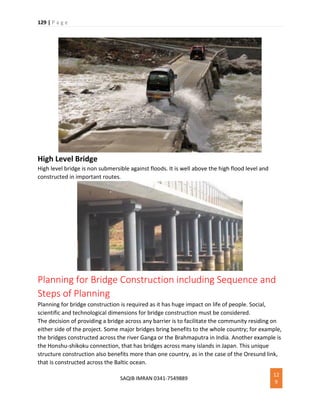
therefore not letting the unwanted sediments enter into the well. The water thus accumulated
is pumped out using a submersible pump or a centrifugal pump.
It is prudent to assess ground-permeability conditions beforehand since the whole process of
accumulation and pumping takes quite a bit of time. This may cause settlement in the nearby
areas and hence a different technique might need to be adopted.
Selection of Excavation Dewatering System for Construction Works
There are number of dewatering options available for excavations to facilitate construction
activities. The choice of best and suitable dewatering system brings economy in construction
activities. For this, it is essential to have knowledge on different dewatering systems and each
of their features in detail.
The best system is selected from different systems gathered. The choice of dewatering system
for a site condition mainly depends on the:
1. Location and site features
2. Type, size and the depth of excavation planned
3. Thickness and the type of stratification
4. Permeability of the foundation soul that is below the water table
5. Water table level of the area, where the dewatering to be performed
6. The potential damage a dewatering system is prone to
7. The cost of installation and the operation of the dewatering system
222 | P a g e
SAQIB IMRAN 0341-7549889
22
2
Factors Influencing the Cost of a Dewatering System
The cost invested for a dewatering system or a dewatering method is dependent on four main
factors. They are:
1. The type and size of the project. This include the pumping requirements for dewatering
2. The power type and availability
3. The labor resources
4. The time period of pumping
The method of slurry cut off walls have helped in controlling the ground water, that have in
turn reduced the amount of pumping. Those projects that require high pumping can make use
of barrier walls like slurry cut off walls.
Factors Affecting the Selection of Dewatering System
If a project involves the construction of foundation in the ground level that is below water table
of that site, it is necessary to undergo dewatering through methods like well point system or
deep well system. This problem cannot be solved by methods like trenching or sump pumping.
The equipment operations, or the sliding or the sloughing of the side slopes can result in
damage to the foundation. These effects on foundation can be reduced by dewatering systems.
The deep well and well point system does not require any detailed analysis or design before
implementing in a site that does not bring huge pressure fluctuation underground. Here
conventional dewatering system can be used.
But wherever there is unusual pressure relief, it is advised to have a detailed design prepared
by the engineer to perform the dewatering. These details must be specified in detail by the
223 | P a g e
SAQIB IMRAN 0341-7549889
22
3
engineer in the contract documents also. The use of unusual dewatering equipment must be
specified by the engineer prior to the construction activities.
Major factors that affect the choice of dewatering system are explained in
detail:
1. The Type of Excavation
2. The Geological and the soil conditions
3. Reliability Requirements
4. The Depth to which the ground water is lowered
5. Rate of Pumping
6. The Intermittent Pumping
7. Adjacent structures affected by ground water lowering
8. Dewatering compared with other procedures
1. Type of Excavation
A conventional well point system is found economical and safe when dewatering has to be
conducted in a ground area where the water table level is at a lower depth. A lowering of the
water table level to a depth of 20 or 30 feet require deep well system or jet-educators to
conduct the dewatering.
For excavations that are surrounded by cofferdams, either well point system or a deep well
system or both in combination can be employed for dewatering.
A deep well system or a jet-eductor well point system is a best choice for dewatering that
requires penetration into a field pervious soil or rock. These are mostly implemented for the
construction of deep shafts or tunnels or caissons. The choice between the two is based on the
soil formation in the area and the rate of pumping that is desired.
Other related factors include:
 The Interference of the dewatering system with the ongoing construction operations
 The space available to include the dewatering system
 The duration of dewatering
 Installation and the operation cost
2. Geological Conditions
The type of dewatering system and drainage system for an area is best dictated based on the
soil and the geological conditions of the area. A conventional well system or well point system
can be used if the soil below the water table of the area is deep, free draining sand and more or
less homogeneous in nature.
If the soil is highly stratified and there exist an impervious layer of rock, shale or clay then well
point systems that are installed closely in space can be employed. Wherever the soil is in need
for the relief of artesian pressure, deep wells or jet educators well points in few numbers can
be installed.
3. Depth of drawdown
224 | P a g e
SAQIB IMRAN 0341-7549889
22
4
The magnitude of depth to which the drawdown has to be conducted is one of the primary
factor based on which the type of dewatering system is chosen. If the drawdown to be made is
very deep, the deep well dewatering system or the jet eductor well points are used. The
conventional well points system requires many stages of drawdown for a single depth of
excavation.
A wide variety of flows can be met by using the deep well system given that appropriate pumps
depending on the flow must be chosen. This type of flexibility is not available for jet eductor
well point system. The jet eductor pumps are more employed where the flow is small as in the
case of silty to find sand cases.
4. Reliability Requirements
The design of dewatering pumps chosen, the standby power, equipment and the power supply
is influenced significantly by the reliability of ground water control for a particular project.
For example, if the problem that is faced during dewatering is the relief of the artesian pressure
so that blow up during the bottom excavation is prevented. This situation affects the choice of
pressure relief system that is selected and the need for a standby equipment with the provision
of automatic power transfer.
5. Required Pumping Rate
The pumping rate that is required to undergo dewatering of an excavation ranges between 5 to
50,000 gallons per minute or higher. The selection of walls, piping system, and the pumps are
affected by the flow to the drainage system.
For deep well dewatering system, the pumps are available from sizes of 3 ro14 inches that have
capacities ranging from 500 to 5000 gallons per minute. These have head value up to 500 feet.
The pumps used in well point system have sizes ranging 6 to 12 in inches with capacities ranging
from 500 to 5000 gallons per minutes. This is dependent on the vacuum and the discharge
heads.
The jet eductor pumps have pumping ability from 3 to 20 gallons per minute that lift upto 100
feet.
The rate of pumping is largely affected by the:
 The distance to the source of seepage
 The thickness of the aquifer
 The perviousness of the aquifer
 The amount of draw down or the pressure relief required
6. Intermittent Pumping Procedure
Having single or double shifts for dewatering per day brings the labor cost down. This principle
cannot be followed wherever the depth of dewatering is very large, the subsoil is pervious and
homogeneous. Under these situations, the pumping system can be operated such that large
drawdowns are taken during single or double shifts.
7. Effect of draw down procedures on Adjacent Structures and Wells
225 | P a g e
SAQIB IMRAN 0341-7549889
22
5
The foundation soils that is below the ground water table is loaded additionally when the
groundwater table of that area is lowered through dewatering system. Application of additional
load results in the consolidation of the soil. This consolidation results in settlement of
structures that are already constructed within the radius of influence.
Before the application of any dewatering system on a site, it is recommended to check for
before mentioned possibility of settlement of active structures around. The water table level of
nearby wells has to observed before and after dewatering. If any claims raised due to the
dewatering procedure is raised, these observations are the basis on which the evaluation is
made.
8. Dewatering Compared with Other Procedures
The control of water during excavation can be best done economically by the process of
dewatering. But for certain applications like for the wet side of a cofferdam or a caisson, a
tremie sealing is done on the bottom side of the excavation. Any other method like slurry cut
off walls or other dewatering procedures are employed.
Other techniques are chosen based on suitability like the use of freezing techniques and rotary
drilling machines that is conducted without the lowering of the water table can be employed.
The use of concrete cut off walls in a slurry supported trench are other examples.
Sumps and Ditches for Dewatering of Excavations -Uses and Advantages
The application of sumps and ditches within an excavation is one of the elementary method of
dewatering employed in construction. The water entering these installed units can be pumped
out.
The general procedure of dewatering with sumps and ditches is depicted in the figure-1.
Fig.1. Dewatering Method by the Installation of Sumps and Ditches
The sump is located below the ground level of the excavation as shown in figure-1, at one or
more corners or the sides. The procedure involves the cutting of a small ditch around the
bottom of the excavation, that is falling towards the sump.
The sumps is the name given for the shallow pits that are dug along the periphery of the
excavation or the drainage area, which is named as ditches. Under the action of gravity, the
water from the slopes will flow to the sumps. The sumps collect the water and is later pumped
out.
Significant amount of seepage can result in raveling or sloughing or softening of the slope in the
lower part. The slump bottom may also be subjected to piping.
226 | P a g e
SAQIB IMRAN 0341-7549889
22
6
The above problems can be solved by the use of inverted filter that is of many layers. These
have coarser material in successive layers from the bottom of the sump pit to the upward
direction.
This is a simple method used for dewatering shallow excavations that have coarse grained soils
or the soils that have permeability that is greater than 10-3 cm/sec.
Suitability of Sumps and Ditches for Dewatering of Excavations
If the construction demands for lowering the water table or the ground water head of the area
to a depth greater than 1 feet, the method of sumps and ditches is not suitable.
If sumps and ditches are employed for greater depth lowering, seepage will be prominent that
will result in the instability of the excavation slopes. This wrong decision will also bring effects
that are detrimental for the integrity of the foundation soils of the area.
In order to overcome the problems that arise due to minor raveling and to support the
collection of seepage water, it is recommended to employ filter blankets or drains in the sump
and ditch system installed.
Use of Sumps and Ditches in Cofferdams
In areas that are confined, the common method of excavation that is followed is the driving of a
sheet pile that is either wood or steel, below the subgrade elevation. Then the bracing is
installed and proceeds with the excavation of earth. Later the water that seeps into the
cofferdam area is pumped out.
The use of sumps and ditches in the dewatering of sheet excavation face the limitation similar
to that of open excavations. The formation of hydraulic heave at the bottom of the excavation
which is found to be very dangerous can be reduced by the driving of sheeting into the
impermeable strata that is underlying. This can help in the reduction of seepage into the
bottom of the excavation.
Those excavation carried out below the water table can be effectively conducted with the help
of sheeting and sump. This is merely dependent on the site conditions. The hydrostatic pressure
and toe support are the two factors that is to be considered important while designing the
sheeting and the bracing.
The construction process and the pumping out activities can be conducted smoothly by
covering the bottom of the excavation by means of a inverted sand and gravel filter blanket.
Advantages of Sumps and Ditches
The advantages of Sumps and Ditches are:
1. The method is widely used. It is appropriate for small depth lowering.
2. This method is found to be most economical one among dewatering systems while
considering the installation and the maintenance procedures
3. This method can be applied for most of the soil and rock conditions.
4. The site is mostly recommended where boulders or massive obstructions are met within
the ground.
5. The greatest depth up to which the water table can be lowered by this method is 8m
227 | P a g e
SAQIB IMRAN 0341-7549889
22
7
Disadvantages of Open Sump and Ditches
The disadvantages of this method are:
1. In areas where there is high heads or steep slopes, the method is not demanded. This
method will bring collapse of the slopes and cause dangerous problems
2. The use of sumps and ditches in open or timbered excavation will bring risk in the
stability of the base.
Deep Well Systems For Dewatering of Excavations
Deep well systems are dewatering methods used to remove the water from pervious sand or
rocks formations beneath the excavations. This method can also be employed to remove the
artesian pressure of the ground area under consideration.
The method of deep well dewatering systems is more suitable in areas where deep excavations
are performed. This hence demands higher rate of pumping for dewatering. This is mainly
employed for the ground preparation for the construction of tunnels, dams, powerhouses,
shafts, and locks.
The excavations and the shaft made can be 300 feet in depth. These can be dewatered by
pumping from deep wells by using a turbine or a submersible pump.
The main significance of deep wells as a means of dewatering is that they can be installed all
around the periphery of the excavation. This will let the construction area to free from burden
by the equipment that is used for dewatering.
This is shown in figure-1. Here the excavation can be pre*drained for the complete depth.
228 | P a g e
SAQIB IMRAN 0341-7549889
22
8
Fig.1: Deep Well Dewatering System
Working and Arrangement of Deep Well System
The deep wells arrangement for the purpose of dewatering is similar to that for commercial
water wells. These systems will make use of a screen that have a diameter of 6 to 4 inches with
lengths ranging up to 300 feet.
When such a system is installed, a filter is placed around the screen. This arrangement helps to
prevent the infiltration of the foundation materials into the well. The installation of filter also
helps to improve the yield.
In order to dewater small deep excavations, the deep well systems can be used in conjunction
with the deep wells. This is applied for related works of tunnels, caissons sunk, shafts and the
areas with fine grained sand or stratified soils that are pervious. In areas, there are rock layer
below the ground table this method work best.
An increase in hydraulic gradient to the well because of the use of vacuum creates a vacuum
within the surrounding. This phenomenon avoids seepage from the perched water into the
excavation.
The installation of deep well system incorporating vacuum is shown in figure-2. This type
requires adequate vacuum capacity to undergo the dewatering operation efficiently.
229 | P a g e
SAQIB IMRAN 0341-7549889
22
9
Fig.2. The use of deep well with vacuum systems to dewater a shaft over a stratified ground
material.
To have sufficient wetted area of intake in the aquifer, adequate well depth have to be
provided. This helps to produce yield and interactive drawdown. In most of the civil engineering
applications, a depth of 60m with a typical depth value of 20m is used.
For a limited distance say 1 to 2m, the well might penetrate an impermeable layer lying below
the pumped aquifer. This is to behave as sump for the fines. The pump must be placed such a
level in the well so that the water circulation helps it to remain cool.
The site layout decides the spacing of the wells. But most commonly, the spacing used is 10 to
30m. The deepening of the well creates drawdown in areas. Sometimes these might be the
areas where the wells cannot be sited.
Special care and precaution must be taken so that with increase in drawdown no kind of
settlement is happening to the adjacent buildings.
The gravity flow of water into the well without affecting the unconsolidated strata that is being
pumped can be facilitated by the use of well screens.
Based on the type of duty performed, the material used can be steel or plastic. Use of different
metal will result in corrosion cells.
230 | P a g e
SAQIB IMRAN 0341-7549889
23
0
Operation of Deep Well System for Dewatering of Excavations
The operation of deep well dewatering requires electric supply from three phase generators.
For the use in long – term operations, it is recommended to have an automatic cut in generator
in case of a power failure.
This equipment is considered as an insurance requirement. Where electric power is not
available, the diesel operated shaft drive pumps is used.
It is advised to have standby pumps in case of any failure. We must calculate the time from the
well failure to the ingress of the water. For a short period of time, the adjacent well must have
the capability to take over the duty of the failed well. This short period is necessary for remedial
action.
In order to maintain the drawdown and to stop the pump from drying, level-monitoring
electrodes are placed at maximum and the minimum levels inside the borehole.
A proper and careful manual tuning of the surface recharge valve will help to maintain pumping
in a steady rate.
The pumps used for this purpose ranges from simple air lift pumps mainly used for short – term
dewatering activities. For large diameter wells, top drive vertical shaft pumps and submersible
electric pumps are good choice.
Do not use pumps to obtain higher output than that is essential. The use of large shaft driven
pipe must have vertical placement accurately with proper vertical liner and screen to have no
kind of vibration.
An electric submersible bore hole pump is the most versatile pump for deep well pumping.
Regular cleaning of pump is necessary. The maintenance will affect the output.
Suitability of Deep Well Dewatering System
The method is more suitable where long term dewatering has to be carried out. This will thus
work for large excavations for a variety of ground conditions.
These systems can help provide under-drainage of the overlying soil that is less permeable into
the permeable stratum that is pumped. This also helps to relieve the pressure below the
confining layer of clay.
Design of Deep Well Dewatering System
A detailed conceptual model has to be developed based on the ground investigation carried
out. It is very important to determine early the distance, the drawdown and the time results
based on the pumping tests carried out.
Some of the basic steps that are involved in relation with the design of deep well dewatering
systems are:
1. The drawdown that is required for the well is initially determined. This will help to suit
the geometry of excavation.
2. The inflow into the excavation is calculated. The inflow in large areas can be assessed
using the flow nets. This can also check the potential during high inflow velocity that
might cause piping or boiling.
231 | P a g e
SAQIB IMRAN 0341-7549889
23
1
3. The yield and the wetted length of the trial well is calculated.
4. The number of wells and spacing is calculated. The zone interaction if any is found for
those wells at less than 20m centers.
5. The filter pack and the screen slots are designed to make sure that the aquifer is not
drawn into the well.
6. The entry velocity to the well is checked
7. Pump size is checked so that it suits the screen or the liner.
8. Sufficient working space for side slopes and excavation have to be provided.
9. The calculations are repeated so that an optimum design is obtained.
Types of Failures in Flexible Pavements and their
Causes and Repair Techniques
Failures in flexible pavements can be due to failure of its component layers which undergo
distress due to various causes. Types of failures in flexible pavements and repair techniques are
discussed.
Types of Failures in Flexible Pavements and their Repair Techniques
In general, the flexible pavement consists of the following component layers:
Sub-grade
Sub-base course
Base Course
Surface Course
Instability in any of the layers will result in the complete failure of the pavement system. This
makes it necessary to construct each layer with utmost care and precision.
There are different types of failures in flexible pavements. Determination of this failure and its
reasons is necessary to facilitate correction in mix design and construction for the future
projects.
232 | P a g e
SAQIB IMRAN 0341-7549889
23
2
Types of Failures in Flexible Pavements due to Exposure
The exposure that affects the flexible pavements adversely are:
Weather conditions
Change in weathers imposes distress in flexible pavements.
Use of chemical and salts in colder climates
The frost heave and the stripping of asphalt due to snow and ice will result in potholes and
other distress.
Ultraviolet rays
The ultraviolet rays make the pavement to undergo oxidation and bring it to a brittle state. On a
hot sunny day, the pavement temperature can be up to 140 degree Celsius. This is the softening
point of liquid asphalt. This will make the pavement to expand and move.
The reduction of temperature will make the pavement to contract. This expansion and
contraction are the main reason for initial cracking.
Water (natural rain and irrigation)
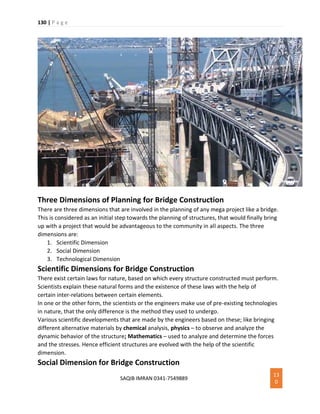
Through the cracks, water can enter to the base and the subgrade, which will result in the
structural damage
Vehicle loads and petroleum
The fuel spillage coming from the vehicles deteriorates the integrity of the pavement. This
increase the softening point of the binder.
233 | P a g e
SAQIB IMRAN 0341-7549889
23
3
A parked vehicle has chances to leak gasoline or brake fluid that make the asphalt to liquefy.
This makes the binder to separate from the rock that may create softer areas. Hence sudden
treatment of oil spots on parking area should not be ignored.
Aging of Flexible Pavements
Aging is a life cycle deterioration of the pavement. This results in highly accelerated oxidation
and cracks formation. Small deterioration determined at the initial stages will help in reducing
the intensity of the aging effect. As the exposure to temperature and ultraviolet increases the
rate of deterioration.
Types of Failures in Flexible Pavements due to Distress
The distress faced by the pavement can be of two types:
Environmental distress, and
Structural distress
Environmental Distress in Flexible Pavements
The outside influence that affects the pavement performance are categorized under
environmental factors. These include snow, the chemicals, water and problems with aging.
These types of distress are observed from the top down. The remedy for such problems is a
surface application. These include crack sealing, seal coating, chip seals, skin-parching. In
certain situations, a hot mixed overlay is added to the surface as part of treatment.
Structural Distress in Flexible Pavements
The structural are categorized as the physical failures that are found on the pavement and the
sub-base. These structural failures are occurred due to overloading, wet subgrade, frosting
effect or lower standards of design. This kind of distress is found from bottom up.
The only remedy for these is removal and their replacement, mentioned as (R & R) of the area
that is affected. Or repaving that includes total removal, milling, pulverizing the area and then
paving back.
Types of Failures in Flexible Pavements due to Structural Distresses
Some of the structural distresses which can cause failures in flexible pavements are:
1. Alligator Cracking of Flexible Pavements
Alligator cracks are also called as map cracking. This is a fatigue failure caused in the asphalt
concrete. A series of interconnected cracks are observed due to such distress.
The tensile stress is maximum at the asphalt surface (base). This is the position where the
cracks are formed, i.e. the area with maximum tensile stress. A parallel of longitudinal cracks
will propagate with time and reaches the surface.
Repeated loading and stress concentration will help the individual cracks to get connected.
These will resemble as a chicken wire or similar to the alligator skin. This is termed as the
alligator cracking. It is also known as the crocodile cracking.
These cracking is observed only in areas that have repeated traffic loading. Alligator cracking is
one of the major structural distress. This distress is later accompanied by rutting. The figure-1
below shows alligator cracks formed in the pavement.
234 | P a g e
SAQIB IMRAN 0341-7549889
23
4
Fig.1: Alligator Cracks Formed in Flexible Pavements
2. Depressions in Flexible Pavements
There are certain areas in the pavement that are localized and have a lower elevation
compared to the surrounding pavement level. These lowering are depressions found on the
pavement. They are mainly noticed only when they are filled with water (After rain).
Depressions in flexible pavements are a very common distress found in parking lot construction
as well as in overlays. These depressions can be caused either by the foundation soil settlement
due to continuous loading or it can be formed during the construction.
There are different severity levels that are considered for the depression in the flexible
pavement that is constructed for airfield purposes.
Fig.2: Depression Distress
3. Corrugations in Flexible Pavements
235 | P a g e
SAQIB IMRAN 0341-7549889
23
5
The corrugations are distress seen in the pavement at regular intervals in the form of ridges and
valleys. These are usually less than 5 feet, along with the direction of the pavement.
The ridges form of corrugations will be perpendicular to the traffic direction. Unstable
pavement plus traffic will create such distress. Where the traffic starts and stops, this distress
are observed.
4. Shoving
A form of plastic movement that is seen in the form of the wave is called as shoving distress.
These are also observed perpendicular to the direction of the traffic.
Fig.3: Shoving
5. Potholes
In road surfaces where a portion of the same has broken away, cause a disruption by forming a
pothole. These are also called as a kettle. In the Western United States, these are known as
chuckhole.
The pavement fatigue is the main reason behind the formation of potholes. The occurrence of
fatigue cracking will interlock to form alligator cracking. These chunks between the cracks
formed in the pavement will become loose and will be picked out under continuous loading and
stresses. This will leave a pothole on the pavement.
In cold temperatures, the water trapped in the pothole will carry out the freezing and thawing
action that leads to additional stresses and crack propagation.
Once the pothole is formed, the distress grows resulting in the continuous removal of
pavement chunks. Water entrapped will increase this rate of expansion of distress. The pothole
can expand to several feet in width. They don’t develop too much in depth. The vehicle tires are
damaged due to large potholes.
236 | P a g e
SAQIB IMRAN 0341-7549889
23
6
Fig.4: Potholes in Pavement
6. Rutting of Flexible Pavements
The depression formed in the surface is called the rutting. This is formed in the wheel path
surface. This depression will make the other sides of the wheel to undergo uplift as shown in
the figure-6. This pavement uplift is also called as shearing.
These ruts like depressions are evident after rain. Where these depressions would be filled with
water. There are two types of rutting that can occur;
Pavement Rutting
Subgrade Rutting
Fig.5: Showing the Rutting Formation under Vehicular Load
237 | P a g e
SAQIB IMRAN 0341-7549889
23
7
Fig.6: Real-Time Formation of Ruts
7. Swelling of Flexible Pavements
These are distress that long and gradual wave. These can be ten feet long. The swelling distress
is characterized by the upward bulge in the pavement surface. Surface cracking is the next
series of distress that is seen after swelling.
The main reason behind swelling in flexible pavement is the frost action in the subgrade. Where
frosting results in the swelling of the soil.
Fig.7: Swelling in Road Pavements
Types of Failures in Flexible Pavements due to Environmental Distresses
1. Bleeding in Flexible Pavements
The phenomenon of formation of a film of asphalt binder over the surface of the pavement
surface is called as bleeding. The occurrence of bleeding will give a shiny glass like reflecting
surface. The layer will have bubbles which are seen as blisters. The asphalt binder formed will
be sticky in nature.
The filling of asphalt binder into the aggregate voids during hot weather conditions and their
expansion in later situations will result in bleeding. As the process of bleeding cannot be
reverted in cold temperatures, they remain on the top of the pavement as such. The bleeding
can be caused due to the following factors:
Excessive asphalt binder in the mix
Excessive application of the binder during surface treatment
238 | P a g e
SAQIB IMRAN 0341-7549889
23
8
Lower air void content – no adequate voids for the bitumen to penetrate
2. Block Cracking in Flexible Pavements
This is also called as thermal cracking. The cracking is happening in the form of blocks. These
cracks are interconnected making the pavement to divide into rectangular pieces (almost
rectangular).
The size of each rectangle may vary from one foot by one foot to ten foot by ten foot. This is
spread over a wide pavement area. But these are observed in areas of no traffic. This is an after
effect of environmental exposure, hence it is called thermal cracking. The temperature effects
and aging are the possible reasons.
3. Bumps and Sags
Pavement surface that is localized, small in area that has undergone an upward displacement
will be named as bumps. These are caused due to the instability factor of pavement.
Several factors contribute to bumping formation. They can be caused even due to buckling or
the bulging of the concrete slabs. Areas, where an asphalt pavement is laid over a concrete
pavement, observes such failures.
Another contribution to bumps are the frost heaves that creates bumps due to expansion.
Oxidation will result in the spelling of the crack edges. Any plant roots growing under the
pavement too can cause bumps in the pavement.
The sags are mainly caused due to the settlement or the displacement of the pavement surface.
Sags are small, abrupt and localized. Large or long dips in the pavement can be created by the
sags.
4. Edge Cracking in Flexible Pavements
In unconfined asphalt pavements, edge cracking is found to occur. During the compaction
process of the pavement, the edges will start to yield, especially when there is no sort of
confinement like curbs or edge barriers.
The edges will yield with age, undergo oxidation and becomes brittle. The edge cracking is
observed in the shape of ‘C’ formed along the edges of the street, parking lot or the roads.
5. Joint Reflection Cracking
These are cracks that are observed in the flexible overlay over a rigid pavement. The rigid
pavement joints that are an underlying experience these cracks.
6. Raveling
The dislodgement of aggregate particles will result in the disintegration of the hot mixed
asphalt progressively from the surface to downward direction. This failure is called as raveling.
This dislodgement is the loss of bonding between the aggregate particles and the asphalt
binder.
The aggregates are sometimes coated with dust particles that result in lack of bonding. This will
make the aggregate to bind with the dust rather than the binder.
7. Cold Joints in Flexible Pavements
239 | P a g e
SAQIB IMRAN 0341-7549889
23
9
These are longitudinal joints which are formed in the asphalt pavement. This failure occurs
when a hot mix asphalt is poured adjacent to an existing pavement. This kind of failure is mainly
common in parking lots, inverted crowns and areas with lower traffic.
The difference in temperature and the plasticity variation will bring a different between the two
layers. This will cause a longitudinal joint to occur between the asphalt mats that are laid.
The longitudinal joint possesses a lesser density compared to other pavements. These
longitudinal joints called the cold joint, with time will let intrusion of water. It increases the
roughness and hence limits the life of the pavement.
Longitudinal and Transverse Cracking Distress
This distress can be considered as either a structural or an environmental distress. The
longitudinal cracks are formed parallel to the pavement alignment or the center line of the
pavement.
Fig.8: Longitudinal Cracks in Asphalt Flexible Pavement
Fig.9: Transverse Cracking in Asphalt Flexible Pavement
240 | P a g e
SAQIB IMRAN 0341-7549889
24
0
This is a fatigue cracking. Here, the cracking occurs in the direction of traffic flow. The
transverse cracking is formed perpendicular to the pavement centerline. This is caused as a
thermal cracking.
Tunnel Engineering -Features, Advantages and Methods of
Tunneling in Construction
Tunnels are underground constructions used for transportations. The features, advantages,
disadvantage and methods of tunneling in construction is discussed.
The tunnel engineering is one of the most interesting disciplines in engineering. The work is
complex and difficult throughout its course, even though it is interesting.
The tunnels are defined as the underground passages that are used for the transportation
purposes. These permit the transmission of passengers and freights, or it may be for the
transportation of utilities like water, sewage or gas etc.
The operations and the constructions are carried out underground without disturbing the
ground surface. This operation is called as the tunneling.
Construction of First Tunnel
It is found that the first tunnel was made by the Egyptians and the Babylonians, 4000 years ago.
This tunnel served the purpose of connecting two buildings in Babylon. The connection was
241 | P a g e
SAQIB IMRAN 0341-7549889
24
1
from the royal palace to the temple. The length of this tunnel was found to be 910m, which was
brick lined.
Construction of Largest Ancient Tunnel
The largest tunnel in ancient times was constructed between Naples and Pozzuoli, in 36.B.C.
This tunnel was 4800-foot-long, 25-foot-wide and 30 foot in height. It was a road tunnel.
During the second half of the twentieth century, the development and progress of explosives
and sophisticated equipment were flourished, that made the tunneling process more feasible.
The tunneling, work better for different approaches under different circumstances. It is hence
dependent on the experience and the knowledge of the engineer. Mainly the tunneling works
are carried out by the civil engineers.
This discipline will let us know, that the knowledge on structural and concrete technology is not
sufficient. An equal and thorough skill and knowledge on geology, mechanical engineering, geo
mechanics and the new construction technologies are also essential.
Selection of Tunneling Route
The two main factors that help in the efficient route of the tunnel are the alignment restraints
and the environmental considerations. The underground, as we know is heterogeneous in
nature. A proper inspection on the nature of soil, rock, the water table level, and all the
alignment restraints had to be made before fixing the route.
The site chosen for tunneling is such a way that the inconvenience and difficulty that is caused
to the environment in that area including living is minimum.
The tunneling method chosen depends on the ground conditions, the water table level, the
tunnel drive length and the diameter, the tunnel depth, final utility requirements, the shape of
the tunnel and the risk of construction.
Advantages of Tunneling
The tunneling method gain certain advantages compared with other methods, which are
mentioned below:
 The tunneling procedure is more economical in nature, compared to open cut trench
method when the depth is beyond a limit
 The surface life or ground activities like transportation are not disturbed when tunneling
is undergone.
 The method ensures high-speed construction with low power consumption
 Reduces Noise Pollution
 These methods have freedom from snow and iceberg hazards, in areas of high altitudes
 Surface and air interference is restricted for tunnels
 Provision of tunnels with easy gradients, help in reducing the cost of hauling
 For the transportation of public utilities, tunneling method has a remarkable advantage
compared to the bridge.
 The dangerous open cut to a nearby structure, when it is needed, is solved by the
tunneling method
242 | P a g e
SAQIB IMRAN 0341-7549889
24
2
 The tunneling grant greater protection in aerial warfare and bombing conditions
Tunneling Disadvantages
The tunneling method gains certain disadvantages, which is due to its complexity and difficulty.
Some of them are:
 The initial investment cost for commencing the tunnel is high compared to the open cut
method.
 Highly skilled and experienced designers and engineer team only will work best for this
operation.
 Higher and constant supervision from the start to the end of the tunneling project is
necessary without any compromise
 Highly sophisticated and specialized equipment are necessary to perform the tunneling
operations.
Comparison between Open Cuts and Tunneling
There are always debate arising on the cost that is consumed between the open cuts and the
tunneling techniques, to conclude which is more economical. Consider the following factors:
a) Open cuts are found very costly at deep cutting for soil with varying nature and slopes. This
method will account for the large volume of excavation, which is costly. At this situation,
tunneling method will bring more economy than the open cuts.
b) When the material of drilling is rock, open cut performs well with less amount of excavation
and finds cheaper. While tunneling method is found difficult to show its activity.
c) Based on the requirement of material for nearby filling, an open cut method can be
suggested, but the tunneling is found comparatively economical in working. For depth of
cutting greater than 60 feet, the method of tunneling is always recommended.
Approaches in Tunneling Method
There are two approaches based on the open cuts on the either ends of a slope. They are short
approach and long approach. The approach is said to be short, when the hill slope is very steep
in nature, as shown in figure.1.
The approach is said to be very long, when the slope of the hill is very flat, as shown in figure.2.
The cost of this mainly depends upon the topography of the considered area. In high altitudes,
these approaches will be bounded with snow or may be blocked by the heavy landslides. These
are the factors that would cause the decision of open cut or tunnel method.
Fig.1: Short Approach in Tunneling
243 | P a g e
SAQIB IMRAN 0341-7549889
24
3
Fig.2: Long Approach in Tunneling
Alignment and Grade in Tunneling Process
Certain factors that must kept in mind in the tunneling procedures are:
 The best and economical alignment was chosen must be straight in nature
 Tunnel should have a grade, which is less than the outside. It is observed that in the
railway tunnels, constant slipping of the wheels takes place due to the wetness of the
rails. This reduces the hauling capacity of the locomotives.
 0.2% gradient must be provided to ensure proper drainage.
 When it comes to long tunnels, two grades at the either ends must be provided (That
rise from each end then towards the center as shown in figure-3).
Fig.3: Surface Alignment and the provision of grade for the tunnel
 If the grade is provided on one side, instead of either side, the effectiveness of
ventilation can be increased.
Ventilation in Tunnels -Types of Ventilation Systems in
Tunnel Construction
There are various types of ventilation systems in tunnel construction provided to remove dust
and poisonous gas during its construction and operation. These ventilation systems in tunnel
construction are discussed in this article.
The tunnel construction works are mainly carried out by drill and blast method, which have
many safety and health issues due to the emission of dust and many poisonous gasses. Hence it
is essential to provide ventilation systems in in tunnel during construction.
The main objectives of providing ventilation systems in tunnel are:
 To provide the working crew an environment of fresh air.
 To exhaust out fumes and gasses, that is injurious to health and explosive in nature.
 To remove the drilling, mucking and blasting gasses emitted.
244 | P a g e
SAQIB IMRAN 0341-7549889
24
4
Ventilation during construction and after completion of tunnel construction is an essential
feature that a tunnel should own to facilitate functional, comfortable and a safe tunnel
environment for both the road and railway tunnels.
Why Ventilation Systems in Tunnel Construction Required?
When the work is being carried out within the tunnel, each worker has to be supplied with 200
c. ft to 500 c. ft of fresh air constantly. The consideration of compressed air emitted during
drilling purpose is contaminated with oil and dust. So this should not be taken as a source of air
to play the role of ventilation.
After each explosion, the face is completely covered with air that is full of fumes and dust,
which is unfit for breathing. Before he starts to remove the debris of the explosion, the foul air
surrounding him must be removed out by any source of exhaustion and get him fresh air.
There exist 30 minutes between the explosion and mucking process, within which the
ventilation system installed should clear the tunnel contaminated with poisonous gas and dust
and refill with fresh air.
There are mainly three factors, based on which the form and capacity of the ventilation system
are dependent:
1. The length of the tunnel and its size.
2. The amount of explosives used for blasting and their respective frequencies
3. The condition and rate of temperature and humidity inside the tunnel
Working Environment inside a Tunnel
The working environment inside a tunnel is contributed by the following factors:
 The dust and the gasses emitted by the tunneling operations
245 | P a g e
SAQIB IMRAN 0341-7549889
24
5
 Exhaust gasses emitted by the diesel operations
 Explosive or organic solvent emitted poisonous gasses. For example Nitrogen oxide,
hydrogen sulfide, sulfurous acid gas, carbon monoxide
 Flammable gasses or oxygen shortage gas in the ground. For example, methane, carbon
monoxide and hydrogen sulfide
 High temperature and humidity factors
Table-1: Density of Dust Emitted due to Tunneling Works
Tunneling Works The Density of Dust Formed in mg/m3
Excavation 10 -1000
Loading of materials that are excavated 10 – 1000
Mucking 10 – 100
Drilling 1-50
Blasting 100 – 300
Shotcreting 10 – 200
Table-2: Volume of Generated Poisonous Gas in Tunnels
The table below shows the allowable density of dust poisonous gas to control the standard
values.
Table.3: Allowable Density Value of Dust inside Tunnel
246 | P a g e
SAQIB IMRAN 0341-7549889
24
6
Table.4: Allowable Density of Poisonous Gas in Tunnels
Tunneling Works Safety and Health
To secure safer and healthier environment during the tunneling works, it is necessary to take
absolute measures while carrying out the operations of drilling, blasting, excavation,
Shotcreting and mucking. Dust, smoke and poisonous gasses inside tunnel can be removed
efficiently with the help of a proper ventilation. The government has considered this step to
safeguard the health and safety of the labors working in the tunnel.
Types of Ventilation Systems in Tunnel Construction
The methods employed for tunnel ventilation generally depends upon the normal, emergency
or congested operation that will be dependent on the actual conditions of the size, cross
section, traffic conditions, intermediate ventilation shafts etc.
Types of Ventilation Airflow Systems in Tunnels
Longitudinal Ventilation Airflow Systems in Tunnels
Here the direction of airflow is longitudinal in nature. At the beginning of the tunnel or the
tunnel section starting, these moves the pollutant gasses and effluents, that is followed by the
fresh air. Then at the end of the tunnel portal or at the tunnel section end, the polluted air is
discharged. This is shown in the figure-1.
The configuration of longitudinal ventilation can be either portal to portal, shaft to shaft or
from portal to shaft. For transit and railway tunnel, the longitudinal airflow system is used.
247 | P a g e
SAQIB IMRAN 0341-7549889
24
7
Fig.1: Configuration of Longitudinal Ventilation in Tunnels
Transverse Airflow Ventilation Systems in Tunnel
Here uniform distribution of fresh air is created along the length of the tunnel. It is mainly
employed in road tunnels. Occasionally it is used for transit tunnels. A consistent level of
temperature and the pollutants will be maintained if this system is employed. The system can
be either fully or semi-transverse.
Transverse or semi-transverse ventilation tunnel is better than a longitudinal one for the
tunnels that are longer than 4 to 5 km.
The ventilation system capability and their choice will depend on the air considerations, the
amount of air within the tunnel that too must be calculated based on the traffic conditions, the
rate of emission of gases within the tunnel, standards of pollution level, the local standard
conditions so that the neighboring environment too is not polluted and harmed.
In the case of railway tunnels, the emergency scenarios of smoke or fire cause is a major
concern behind the choice of ventilation. Here mainly longitudinal ventilation is used- that uses
ventilation plants at intermediate shafts or at the station adjacent. These may be either
combined with exhaust from large caverns.
The ventilation provided can be either Natural or Mechanical ventilation.
Natural Ventilation Systems in Tunnel
When from one portal to next portal of the tunnel, there is a provision of drift, it forms a fair
ventilation during the operations involving enlarging. This is when the tunnel length is short. In
the case of long tunnels, such natural ventilation will be inadequate and we must design
separate mechanical ventilation system.
248 | P a g e
SAQIB IMRAN 0341-7549889
24
8
Fig.2: Natural Ventilation Configuration in Tunnels
The natural ventilation can be configured from portal to portal, shaft to shaft or from portal to
shaft. As shown in figure.5. the roadway has an air velocity that is uniform. The temperature
and the pollutant level increases at the exit portal or the section end.
If the meteorological conditions of the tunnel go adverse, the velocity, the temperature, and
the pollutant level get increased. The pressure differential between the two tunnel portals, that
is formed by the differences in the elevation and the ambient temperatures of wind are the
chief meteorological conditions.
A sudden change in wind direction or the wind velocity will affect the natural effects along with
the vehicle generated piston effect.
Fig.3: Airflow Characteristics in Natural Ventilation System in Tunnels
Mechanical Ventilation System in Tunnels
Mechanical ventilation system employs mechanical devices like electric fans, exhaust, and
blowers, which serves the function of removing the exhaust gasses within the tunnel and help
in blowing fresh air into the tunnel. Now, whatever be the device employed, there are three
main services they can provide:
1. Blowing
2. Exhausting
3. Combination of blowing and exhausting
Blowing Ventilation Systems in Tunnel
As the name tell, fresh clean air is blown to the working face, with the help of pipes. When it
flows back to the portal, it takes the dust and gasses with it. This system of ventilation help
providing fresh air near the working face with ease. But in long tunnels, these systems have a
disadvantage of fogging the atmosphere inside the tunnel when the smoke, dust and foul air
move out.
Exhausting Ventilation Systems in Tunnel
249 | P a g e
SAQIB IMRAN 0341-7549889
24
9
The system incorporates an exhausting duct near the working face, into which, the foul air and
the dust are let. By this fresh air is maintained within the tunnel, through the entrance. Quick
removal of dust and smoke is one advantage of the exhausting system.
The combination of Blowing and Exhausting
The figure below shows a schematic figure of a blowing and exhausting system applied in a
combination. This concept is developed, so that the advantage of each system can be
combined, bringing a ventilation system of higher performance.
Fig.4: Schematic Representation of Combination of a Blowing and Exhausting Ventilation
System in Tunnels
Working: After the explosion or blasting, the exhausting system will operate for a period of 15
to 30 minutes. This will remove harmful air immediately. After this, the blowing system works
continuously to supply the fresh air till the next blasting.
From the figure-4, D is the fan and it is supposed to rotate only in one direction. Now the
valves A, B, and C are valves that are manipulated either to exhaust from or blow into the
tunnel.
Dust Prevention in Tunnel Construction
The dust accumulation within the tunnel is the after effect of conduction the blasting, drilling
mucking operations. If the dust accumulated amount is beyond the permissible limit, it creates
harmful effects for the people working and to the surrounding environment.
The blasting of rocks as a part of tunneling operation will emit a high amount of silica in the
environment. The intake of same will cause a disease called the “silicosis” which is fatal.
Dust Control Methods in Tunnels
The methods used to control dust accumulation are:
1. Wet drilling
2. Use of vacuum hood
3. Use of respirators
Now modern drilling machines are available, that make use of water to drill. Here the area that
is to be bored is made wet, resulting in a reduction of dust emission.
250 | P a g e
SAQIB IMRAN 0341-7549889
25
0
The figure below shows a vacuum hood that is used in tunneling work. A hood is fitted to a drill
face. This is at the rock face. This is connected to an exhaust pipe. The exhaust pipe takes in the
dust formed by the drilling process and that is taken safely out of the tunnel. This reduces no
flying of dust to outside.
Another common and efficient method to prevent dust inhalation is using respirators. These
are well designed units that are worn by the miners and workers, who are highly exposed to the
dusty environment.
Tunnel Surveying -Methods and Procedures of Tunnel
Surveying
Tunnel surveying is a type of underground surveying for the construction of tunnels. Methods
and procedure of tunnel surveying is discussed.
Special instructions on the type of survey and the equipment that must be used in the tunnel
surveying procedure, for the tunnel construction are initially given by the planners.
The basic procedure of tunnel surveying is to align the center line in the ground and transfer
that to the tunnel. This also involves leveling the surface on the ground and the internal of the
tunnel.
Methods and Procedure of Tunnel Surveying
The steps that are involved in the tunnel surveying are detailed in the following points.
251 | P a g e
SAQIB IMRAN 0341-7549889
25
1
1. The initial procedure is to carry out a preliminary survey that is later made more precise by
surveying the line on the surface of the area under consideration
2. From the start of the excavation, as a part of tunnel construction, it is essential to keep up
even minute accuracy with the center line that is already marked. When a new area of
excavation is commenced, the center line of the before finished work has to be carried forward
over the new face. No shifting of the center line in vertical or horizontal direction is accepted,
when the opposite faces meet with adjacent headings.
3. Ordinary engineers transit and properly handled works give satisfactory results for the
construction of short tunnels.
4. Tunnel transit that is large and sophisticated, is fitted to a striding level, that helps in keeping
the transverse axis horizontal. This is necessary for long tunnel construction.
5. The instruments above mentioned should undergo periodic maintenance, calibration as well
as checking.
6. The procedure of leveling is carried out in a normal way. But areas with steep slopes are
measured with utmost care. This is ensured by having equal values for backsight and foresight.
This would reduce the errors that are caused by the human, like improper or mal -adjustments
of the instruments.
7. There are two methods that can be employed to measure the horizontal distances. They are
stepping and inclined sights. Any of these methods can be employed based on the area under
consideration and convenience.
The steel tapes used for the measurement are checked for errors due to any cause of tension or
temperature changes. This would result in cumulative errors in the measures.
The below figure shows the alignment of a curve line, based on which the construction must be
proceeded (figure-1).
252 | P a g e
SAQIB IMRAN 0341-7549889
25
2
Fig.1: Alignment of Curve Line in Tunnel Surveying
The center line of the curve in the figure is the alignment through which the center line of the
tunnel must proceed. This is the curve that must be determined. The headings consist of short
tangents that are drawn to the curved lines as ab, bc, cd etc. To locate the center line of the
area, offsets from the above-mentioned tangents are set off.
When the heading has proceeded up to x y, point like ‘n’ on the tangents is aligned as shown in
the figure. We then set off the calculated offset, i.e. n-o that will intersect the center line of the
heading.
After each blasting of the heading face, the center line recommended being transferred.
How is Transferring of Center Line into the Tunnel Carried Out?
The transferring of the center line is a method that is done with great care, precision and
accuracy. The accuracy throughout the execution of the same must be guided, else it can give
up many related problems. Carelessness can cause the lines from opposite faces not to meet.
Even small deviation from the centerline can cause, over breaking. This whole undesirable work
brings large expenditure than it has to be. The problem because more tiring when the
procedure is undergone on hard rock strata. As shown in the figure, well elaborate equipment
are made ready for the proceeding of the work.
253 | P a g e
SAQIB IMRAN 0341-7549889
25
3
Fig.2: Arrangement in Transferring the Center Line Points to the Tunnel
Through the shaft constructed, the plumb bob weighing 22 lbs are taken down through the
shaft, thus transferring the two center line points to the bottom as shown. It is carried out
vertically downwards. The plumb bobs are suspended with the help of piano wires that are
passing through the grooves, that is connected to a shaft for easily leveled movement of the
plumb bob.
When the plumb bob reaches the bottom, they are replaced by heavy iron so that the weight
will keep the wire straight. For higher precaution of the wire to resist any kind of vibration or
oscillation, it can be immersed in a container of oil.
Once level, the line joining the two plumb bobs are extended with the help os a theodolite that
is placed on the shaft floor, that is designated with respect to one point of the shaft roof, as
shown in the figure.
A similar reference point is made to the opposite side of the roof, initially noted. Hence the
center line is marked on the shaft floor and continued for further tunnel extension.
How to Transfer the Tunnel Grade?
The same piano wire and the plumb bob combination can be used to transfer the tunnel grade
to the shaft bottom. Here at 5 feet below the springing level of the roof, two points are marked
on the wire.
Initially, the reduced level of the top mark is determined, with respect to a benchmark i.e. a
point near to the mouth of the shaft. And later the reduced level of the second mark is also
determined.
With all the above measurements, a benchmark is determined at a point on the tunnel side
wall. Based on this benchmark the floor levels are transferred and continued measurement.
Decision of Shape and Size of the Tunnel
The shape of the tunnel is decided based on the nature and the type of the soil or the ground
that is penetrated during the surveying and the excavation procedure. After surveying and
related construction works, a choice of shape can be made. The size of the tunnel is already
measured in the design, as it is based on the scope or requirement of the project.
254 | P a g e
SAQIB IMRAN 0341-7549889
25
4
Fig.3: Shapes for Tunnels
Among different cross sections, the circular cross sections are found to be the best shape to
bring huge resistance towards the internal and external pressures. This also has another
peculiarity of bringing larger size for a smaller diameter. But in engineers point of view, they
demand high lining and covering to protect it from high vibration in railway uses.
So, an optimized shape is a tunnel with circular top and vertical side walls Another shape is the
horseshoe type. They are compromised with the problems related to the circular tunnel shape.
What is Underground Surveying?
Underground surveying embraces the survey operations performed beneath the surface of the
earth in connection with tunneling, exploration and construction in subterranean passageways.
It is quite different from surveying on the surface.
The following peculiarities of underground surveys indicate how they differ from surface
surveys:
 Artificial illumination is required to view instrument crosshairs, to read verniers, to sight
targets etc. Because of poor lighting.
 Working space in passageways is often cramped.
 Instrument stations and benchmarks for levelling must often be set into the roof of a
passageway to minimize disturbance from the operations being carried on in the
workings.
 Instrument stations are set with some difficulty since plugs must be driven into drill
holes in rock.
 In many instances the underground workings arc wet, with considerable water dripping
from the roofs of passage ways and running along the floors.
255 | P a g e
SAQIB IMRAN 0341-7549889
25
5
Applications of Underground Surveys
The major application of underground surveys is in the construction of tunnels and other
underground utilities. The tunnel is constructed when open excavation becomes uneconomical
usually when it is more than 20 m. It
 Reduces the grade
 Shortens the distance between given points separated by a dividing mountain or ridge.
 Meets the demand of-modern rapid transit in a city.
 Engineering operations to be performed
 Exact alignment
 Proper gradient
 Establishment of permanent stations marking the proposed route.
The survey work in connection with tunneling can be divided into:
1. Surface survey
2. Transferring the alignment underground
3. Levels in tunnels
Surface survey:
Surface survey connects points representing each portal of a tunnel. A traverse connecting the
portal points determines the azimuth, distance and differences in elevation of each end of the
proposed tunnel. Based on the local conditions and proposed length of the tunnel the methods
of working are adopted.
256 | P a g e
SAQIB IMRAN 0341-7549889
25
6
It is always advisable that the survey is based on the suitable local coordinate system. The
alignment is permanently referenced by a system of monuments within an area outside each
tunnel portal. And here is sketch regarding how the tunneling work proceeds.
Central line and grade stakes within the tunnel are usually set in the roof to avoid displacement
and destruction by the constant flow of people and machinery as construction proceeds. If the
stakes are set on the floor they should be offset into an area along the tunnel’s edge.
Transferring the alignment underground
For long tunnel excavation is carried inward from both parties. But vertical shafts are also sunk
up to the required depth along the alignment of the tunnel at intermediate locations along the
routes. The vertical alignment can be done by
 Plumb bob
 Optical collimator
 Laser
A heavy plumb bob (5 to 10 kg) is suspended on either a wire of heavy twine. Oscillations of the
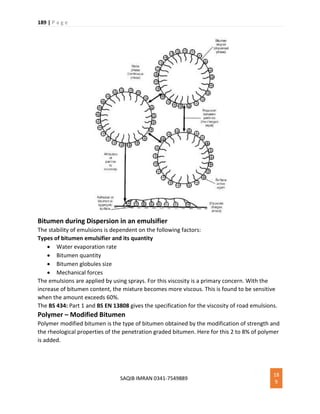
bob can be controlled by suspending it in a pot with high viscosity oil. The bob is suspended
from a removable bracket attached to the surface side of the shaft.
Optical plumbing becomes important with the increase in depth of internal shaft. Various types
of plummet are available for upwards and downward sighting to allow the establishment of a
vertical line and these are normally manufactured so as to be interchangeable with theodolites
on their tripods.
As the line of sight of a theodolite in adjustment will transit in a vertical plane, it can also be
used to check perpendicularity.
The advantages of an optical collimator are:
 More convenient than a plumb bob.
 Can be used to set marks directly on the floor of a completed shaft
 No wires as in case of plumb bob.
257 | P a g e
SAQIB IMRAN 0341-7549889
25
7
A laser equipment can be, used to, provide a vertical line of sight. The laser generates a light
beam of high intensity and of low angular divergence and can be projected over long distances
since the spread of the beam is very small to provide a visible line for constant reference
Levels in tunnels:
In transferring levels underground, little difficulty is encountered at the ends of the tunnel, but
at the shaft use is made of
 Steel tape
 Chain
 Constructed rods
 Steel wires
Now a days EDMI is also used. But in all cases the main idea is to deduct the height of the shaft
measured from the top of a benchmark of known value.
Figure showing how the depth is measured by steel tape
Figure showing Depth measured by EDM
The important features of EDM are:
 EDMI unit and reflectors should be in the same vertical line.
 Both are mounted on stable support.
 Visibility should be good for EDMI to operate.
258 | P a g e
SAQIB IMRAN 0341-7549889
25
8

Road bridge &amp; railway construction pdf

  • 1.
    1 | Pa g e SAQIB IMRAN 0341-7549889 1 Assala mu alykum My Name is saqib imran and I am the student of b.tech (civil) in sarhad univeristy of science and technology peshawer. I have written this notes by different websites and some by self and prepare it for the student and also for engineer who work on field to get some knowledge from it. I hope you all students may like it. Remember me in your pray, allah bless me and all of you friends. If u have any confusion in this notes contact me on my gmail id: Saqibimran43@gmail.com or text me on 0341-7549889. Saqib imran.
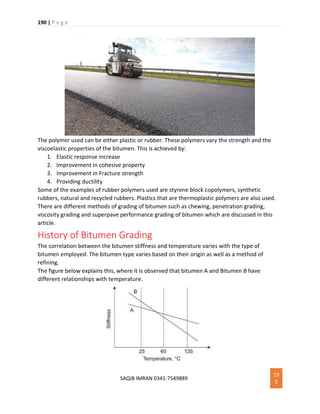
  • 2.
    2 | Pa g e SAQIB IMRAN 0341-7549889 2 Roads & Railway Construction 6 BASIC STEPS COMPRISING WBM ROAD CONSTRUCTION PROCEDURE WBM ROAD CONSTRUCTION PROCEDURE Construction of water bound macadam road involves the following 6 basic steps as given below. 1. Preparation of sub-grade 2. Preparation of sub-base 3. Preparation of base 4. Preparation of wearing course 5. Preparation of shoulders 6. Opening to traffic STEP – 1 (CONSTRUCTION OF SUB-GRADE) Sub-grade act as a cushion for other layers i.e. In order to achieve durable road sub-grade should be strong. Sub-grade is provided by digging up the sub-soil and the level of the sub- grade is decided by subtracting the total thickness of the pavement from the finished level of the road pavement. The sub-grade is thoroughly compacted by rollers weighing 8 tonnes by sprinkling water one night before. Low spots which develop during rolling must be made up and brought to the grades as required. In rocky regions the sub-grades are not rolled whereas in region of clay soils, a layer to natural sand, moorum or gravel, is provided over sub-grade and is duly packed. Sub grade preparation STEP – 2 (CONSTRUCTION OF SUB-BASE)
  • 3.
    3 | Pa g e SAQIB IMRAN 0341-7549889 3 On a well compacted sub-grade, spread 10 to 20 cm size boulders or broken stones, or over burnt bricks in layers of 15 cm thickness and total width of the sub-base to be kept 60 cm wider than pavement width, projecting 30 cm on each side. The sub-base should be compacted by a roller to provide an even surface. Roller Compaction STEP – 3 (CONSTRUCTION OF BASE) On the prepared sub-base or directly on the sub-grade, as the case may be, the specified materials of the base course is spread and proper grade, thickness and cross sections maintained as per design shown on the supplied drawings. STEP – 4 (PREPARATION OF WEARING COURSE) This course may be laid in one or two layers according to the total designed thickness and the thickness of each layer should not exceed 10 cm. this component being very important, the following steps may be taken systematically. 1. Check the defective portions/patches of the newly laid base course i.e. soling and rectify them 2. Provide either bricks on end edging or earthen kerbs strong enough to prevent the new road material from spreading outward and also to retain water used in consolidation of the wearing course. 3. Spread the road metal evenly over the prepared base to the specified thickness and hand pack them so that the finished surface is brought to the required camber. 4. Spread the coarse aggregate over the surface and roll it dry with a suitable roller till interlocking of the aggregate is achieved with sufficient void space. The rolling is started from the edges and gradually shifted towards the centre.
  • 4.
    4 | Pa g e SAQIB IMRAN 0341-7549889 4 5. After dry rolling, spread the screening materials (stones upto 12 mm size) with uniform rate so that voids of coarse aggregates get filled properly. This is achieved by dry rolling and brooming alternatively, till the voids of the coarse aggregates are filled. 6. After spreading the screening material, sprinkle sufficient quantity of water, sweep the surface and roll it with roller again. 7. Now apply the binding material in two to three thick layers at a slow and uniform rate. Each layer of binding material is rolled after adding sufficient water. The slurry is swept in with brooms to fill the void properly. The moving wheel of the roller should be cleaned with water. Continue the operations of spreading of binder, sprinkling of water, sweeping with brooms and rolling till the voids get filled and slurry forms a wave before the moving wheel of the roller. 8. After proper compacting allow it to dry over night. Spread a layer of sand or earth, about 6 mm thick and roll the surface again after sprinkling water lightly. 9. The surface may be allowed for 7 to 10 days of curing. Spreading binder material STEP – 5 (CONSTRUCTION OF SHOULDERS) While curing the pavement surface, prepare the shoulders by filling earth to the specified cross slope and compact them properly by rolling or by tamping. Width and thickness of the shoulder should be as per specification.
  • 5.
    5 | Pa g e SAQIB IMRAN 0341-7549889 5 Construction of shoulders STEP – 6 (OPENING TO TRAFFIC) After properly drying, the road pavement may now be opened to traffic, ensuring that the traffic is distributed uniformly over the full width of the pavement. Steps for Construction of Earth roads General: First of all what is an earth road? Earth road is a type of road whose whole pavement section is constructed with the locally available earth material preferably. Borrow pits are located at the nearby sites preferably outside the land width where, the required earth is available. Sub-grade and the surface of the earth roads are given larger camber of 1in 33 to 1 in 20 because they need faster drainage to be safe from the moisture. A maximum value of camber of 1 in 20 is the limit because higher camber will result in the formation of cross ruts and corrosion of pavement soils. Specifications of Materials: The earth material used for the construction of earth roads are termed as satisfactory if they possess the following properties: Base Course Wearing Course Clay content <5% 10 to 18% Silt content 9 to 32% 5 to 15% Sand content 60 to 80% 65 to 80% Liquid limit <35% <35% Plasticity Index <6% 4 to 10% Construction steps(Procedure):
  • 6.
    6 | Pa g e SAQIB IMRAN 0341-7549889 6 Material: Suitable borrow pits are located by doing the survey of the adjacent land which are easy to reach and at economical haulage distance. The various organic materials like trees, shrubs and grass roots are removed before the excavation of the earth. Location of the centerline: The centerline and the road boundaries are marked on the ground by driving the wooden pegs. To follow the desired vertical profile of the road, reference pegs are also driven at a certain spacing which depends upon the estimated length of the road construction per day. Preparation of the subgrade: Following steps are necessary for the preparation of the sub- grade: (a) Clearing site (b) Excavation and construction of fills (c) Shaping of sub-grade. The site clearance may be done manually using appliances like spade, pick and hand shovel or using the mechanical equipment like Bulldozer and scraper etc. Excavation and construction of fills may also be done manually or using theexcavation, hauling and compaction equipment. Dozers are considered very useful for haulage of short distances. If the compaction is done manually it will not be sufficient and proper, it should be left to get consolidated under atmospheric conditions. Various equipment used by manual labor are shovel, spade, pick-axe, baskets, rammers and hand rollers. The subgrade should be compacted to the desired grade, camber and longitudinal profile. Pavement construction: The soil is dumped on the prepared sub-grade and pulverized. The soil may be a mixture of more than one soil to get the desired properties. The moisture content is checked and if extra moisture is needed, is added to bring it to OMC. The soil is mixed, spread and rolled in layers such that the compaction thickness of each layer does not exceed 10 cm. The type of roller for compaction is decided based on soil type, desired amount of compaction and availability of equipment. At Least 95% of dry density of I.S. light compaction is considered desirable. The camber of the finished surface is checked and corrected when necessary. Opening to traffic: The compacted earth surface is allowed to dry out for few days and then is opened to traffic. 4. COMPONENTS OF ROAD DRAINAGE SYSTEM 4.1. General The primary purpose of a road drainage system is to remove the water from the road and its surroundings. The road drainage system consists of two parts: dewatering and drainage. “Dewatering” means the removal of rainwater from the surface of the road. “Drainage” on the other hand covers all the different infrastructural elements to keep the road structure dry. In Sweden “dewatering” is further divided into two parts: runoff
  • 7.
    7 | Pa g e SAQIB IMRAN 0341-7549889 7 (“avrinning”) and dewatering (“avvattning”). “Runoff” covers the water flowing from the surface of the pavement via road shoulders and inner slopes to the ditches. “Dewatering” covers the collection and transport of water from the surface and structure of the road so that there will be no ponds on the road or in the ditches. “Dewatering” consists of following elements:  Cross fall  Road shoulders  Impermeable road surface materials A typical “drainage” system consists of following elements:  Outlet ditches  Side ditches  Culverts  Inner/outer slopes  Road structures  Underdrains
  • 8.
    8 | Pa g e SAQIB IMRAN 0341-7549889 8 The general score of road drainage system is dependent on its “weakest link”. This means that if any of its elements is out of order, the whole system will not operate as planned and the road will be damaged. On the other hand a well built and maintained road drainage system is a very sustainable investment policy. The main advantages of a good drainage system are: effective removal of rainwater out of the road surface and its surroundings, road structures that stay dry, good bearing capacity, and a road that is nice and safe to drive. 4.2 Pavement and wearing course The pavement or wearing course is the top layer of a road. One function for the pavement is to provide a waterproof covering for the lower pavement structure. This can be achieved if the pavement is impermeable and has no cracks. The topmost wearing course must also have an adequate cross fall to lead water (from rain, melting snow or ice) immediately away from the road surface. The recommended cross fall will depend on the road type and on the material of the topmost layer. On a straight road cross fall will range between 3 and 5 %. On asphalt the recommended cross fall is 3 %, and for gravel roads it is 5%. On a straight road cross fall is normally applied as a crown section.
  • 9.
    9 | Pa g e SAQIB IMRAN 0341-7549889 9 On curves, cross fall is applied in the form of superelevation, also called “one-sided cross fall”. Also, on narrow roads, it is difficult to create and maintain a crown section due to the available width. So for low volume gravel roads it is usually more effective to implement full cross fall (in-sloped or out-sloped road) rather than a crown. The minimum requirements for cross fall on curves have to be determined on a case by case basis. The cross fall will depend for example on the speed limit and the geometry (curve radius) of the road. The cross fall of curves is important also for driving dynamics.
  • 10.
    10 | Pa g e SAQIB IMRAN 0341-7549889 10 A very important issue with cross fall is that it should not have major changes in short distances as this can cause warping problems for high and heavy trucks as well as traffic safety hazards. The importance of proper cross fall is discussed in greater detail in the ROADEX reports on human body vibrations by Johan Granlund
  • 11.
    11 | Pa g e SAQIB IMRAN 0341-7549889 11
  • 12.
    12 | Pa g e SAQIB IMRAN 0341-7549889 12 Crossfalls have been quite difficult and expensive to measure in detail from a moving car in the past but recently profilometers, 3D accelerometers and laser scanner techniques have provided new tools to measure cross fall more effectively. Test results with these techniques have also given also very interesting information on the importance of drainage to cross fall and vice versa.
  • 13.
    13 | Pa g e SAQIB IMRAN 0341-7549889 13
  • 14.
    14 | Pa g e SAQIB IMRAN 0341-7549889 14 4.3 Side ditches Side ditches collect road water and lead it onward to outlet ditches and are especially important when road is in cut. If the road is on a high embankment, side ditches are not always necessary and their need has to be evaluated case by case.
  • 15.
    15 | Pa g e SAQIB IMRAN 0341-7549889 15
  • 16.
    16 | Pa g e SAQIB IMRAN 0341-7549889 16 The longitudinal gradient of side ditch should be at least 4 ‰ (4 mm/m) according to old Finnish guidelines, and in Sweden the longitudinal gradient should be at least 5‰ (5mm/m).
  • 17.
    17 | Pa g e SAQIB IMRAN 0341-7549889 17 In Sweden side ditches are classified into two categories: 1) road cut ditches (“skärningsdike”) and 2) rainwater ditches (“dagsvattendike”). According to Swedish guidelines the depth of the side ditch (“skärnings dike”) should be at least 30 cm below the bottom of the pavement structure. The same minimum depth in Finland is 25cm. Norway has the highest requirements of 35 cm on a newly constructed road. Deeper side ditches than these values do not significantly improve drainage. ROADEX tests in Sweden have confirmed these recommendations are valid.
  • 18.
    18 | Pa g e SAQIB IMRAN 0341-7549889 18
  • 19.
    19 | Pa g e SAQIB IMRAN 0341-7549889 19 A rainwater ditch means that the ditch only collects rainwater from the road and its surroundings, i.e. the surface soil is dry and the groundwater table is deep. In Sweden the design depth of this type of ditch is 0.5m measured from the road surface. This ditch type can be used where the sub grade is water permeable and the groundwater table is deeper than 1.0m below the lower surface of the road. According to old Finnish road design guidelines the depth of this ditch type (rainwater ditch) should be 15 cm below the pavement structure bottom. Additionally the sub grade should be non-frost- susceptible.
  • 20.
    20 | Pa g e SAQIB IMRAN 0341-7549889 20 The condition of ditches has traditionally been evaluated visually, but the method is accepted to be subjective and sensitive to the time when the evaluation was made. Additionally the shape of ditches usually change very slowly with the result that only the worst spots are detected visually, and the ditch bottom is usually unseen. The ROADEX project has tested a number of techniques to resolve these difficulties and the best results were achieved using a combination of laser scanners and GPR techniques.
  • 21.
    21 | Pa g e SAQIB IMRAN 0341-7549889 21
  • 22.
    22 | Pa g e SAQIB IMRAN 0341-7549889 22 Ditches Outlet ditches are drainage structures that lead the water from the side ditches away from the road area. The water from outlet ditches normally discharges to existing waterway systems, such as river channels and lakes. The outlet ditch is a critical part of road drainage system but often ignored. If the outlet is clogged, it can create significant problems to the road over a large area. Outlet ditches are normally located outside the road area with the result that the road administrator may not always own the land that they pass through. This can create difficulties in gaining permissions from the landowner when the outlet ditch is clogged and requires re-opening.
  • 23.
    23 | Pa g e SAQIB IMRAN 0341-7549889 23
  • 24.
    24 | Pa g e SAQIB IMRAN 0341-7549889 24 It is recommended that the longitudinal gradient of an outlet ditch should be at least 4‰. In practice this may require to be reduced to a lower gradient to suit the local circumstances.
  • 25.
    25 | Pa g e SAQIB IMRAN 0341-7549889 25 Outlet ditches should be excavated in such as fashion to discharge into a natural watercourse at the same level as the bottom of the natural channel. If there is no natural channel, the outlet ditch should be excavated for a suitable distance to minimize any accumulations of silt, mud or other harmful materials.
  • 26.
    26 | Pa g e SAQIB IMRAN 0341-7549889 26
  • 27.
    27 | Pa g e SAQIB IMRAN 0341-7549889 27 The location and evaluation of outlet ditches has always been a challenge in an drainage inventory. This is especially the case in drainage surveys from a moving vehicle and ROADEX has tested different techniques to resolve assess the most suitable method. The best option was found to be the use of a video camera installed at a 90o angle to the survey van to record the condition of the ditches. GPS data with z- coordinate information can help to identify likely places for outlet ditches as they are most often on the lowest point of a valley.
  • 28.
    28 | Pa g e SAQIB IMRAN 0341-7549889 28 4.5 Main road culverts
  • 29.
    29 | Pa g e SAQIB IMRAN 0341-7549889 29 A culvert is a pipe or box structure generally used as cross drains for ditch relief and to pass water under a road at natural drainage and stream crossings. In Finland a culvert is defined to be a culvert if its clear opening is less than 2m, if it is more than 2m it is defined as a bridge. If the construction is a large pipe with a clear opening of 2-4 m, the culvert is defined as a pipe bridge. The shape of a culvert is usually a round pipe, but culverts can also be pipe arch, structural arch or box. The shape depends on the site, the required area and the allowable height of soil cover.
  • 30.
    30 | Pa g e SAQIB IMRAN 0341-7549889 30
  • 31.
    31 | Pa g e SAQIB IMRAN 0341-7549889 31
  • 32.
    32 | Pa g e SAQIB IMRAN 0341-7549889 32 Culverts can usually be obtained as plastic, steel or concrete. Some old culverts can also be made of wood or masonry. Plastic culverts are often easier to maintain than culverts made of other materials as ice does not bond so easily to their plastic surfaces.
  • 33.
    33 | Pa g e SAQIB IMRAN 0341-7549889 33
  • 34.
    34 | Pa g e SAQIB IMRAN 0341-7549889 34 Culverts pipes are expensive, and the relatively small culvert pipes used for cross- drains can be susceptible to clogging and require cleaning. That is why, when planning the installation of a culvert, the most important thing to keep in mind is to make sure that the culvert is adequately sized and has overflow protection. Culverts should also be installed in accordance with the manufacturer’s instructions and suitably protected from erosion, scour and road maintenance equipment.
  • 35.
    35 | Pa g e SAQIB IMRAN 0341-7549889 35 Main road culverts should be installed in the lowest point of the terrain. The rule of thumb when installing a culvert is that natural channel modifications should be minimized and that any constriction of the channel flow width must be avoided. This can be done by maintaining the natural grade and alignment of the channel through the culvert.
  • 36.
    36 | Pa g e SAQIB IMRAN 0341-7549889 36 The height and position of a culvert will be dependent on a number of matters:  An adequate longitudinal gradient (at least 1% to prevent the accumulation of silt or mud)  The depth of the side ditch  The level of the drainage system in the surrounding terrain  It should be also kept in mind that many times, in weak soil areas, the road will settle around the culvert which will cause ditch bottom level to rise. Culverts should normally be installed orthogonally to the road alignment. They can also be installed at an angle to the road alignment if required by local circumstances. Materials for the foundation and backfill, as well as material for transition wedges, should be non-frost susceptible and should not contain rocks larger than 75mm. The foundation material should not contain rocks larger than 40 mm. A moist, well graded granular or sandy gravel soil with up to 10 % of fines is an ideal backfill material. In Finland the recommended minimum size for a main road culvert in low volume roads is 400mm (if the length of the culvert is not more than 10m). The “size” of the culvert is defined as the inner diameter of the pipe. There are some exceptions to this rule. For example, installing a new smaller pipe inside an old pipe, when it is known that the old
  • 37.
    37 | Pa g e SAQIB IMRAN 0341-7549889 37 culvert has been too large. Ideally, the width of a culvert should be as wide as the natural channel to avoid channel constriction. DRAINAGE STRUCTURE SIZING Steep slopes Bare, light vegetation Gentle slopes Heavy vegetation Drainage area (Hectares) Round pipe Ø (m) Area (m2) Round pipe Ø (m) Area (m2) 0..4 0.76 0.46 0.46 0.17 4..8 1.07 0.89 0.61 0.29 8..15 1.22 1.17 0.76 0.46
  • 38.
    38 | Pa g e SAQIB IMRAN 0341-7549889 38 15..30 1.83 2.61 1.07 0.89 30..50 2.13 3.58 1.22 1.17 50..80 2.44 4.67 1.52 1.82 80..120 1.83 2.61 120..180 2.13 3.58 When designing the size of culvert a number of matters should be taken into account, i.e. size of drainage area, surrounding terrain type, rainfall intensity, etc. The table below gives some examples of different sizes of culverts. The table is modified after Geller & Sherad: “Low volume roads engineering – Culvert use, installation and sizing”. Rainfall intensity has been assumed to be 75 – 100 mm/h. The situation of bare land with light vegetation and steep slopes has a higher runoff coefficient than forest land with heavy vegetation terrain and gentle slopes. For an intermediate terrain the pipe size can be interpolated. If the suggested pipe size is not available, the next larger pipe size should be used. The outlet of a culvert pipe should ideally be located in a stable, non-erosive area. Well- vegetated or rocky areas are good places to locate a culvert. Water flowing from a culvert can cause erosion problems where it discharges directly on to erosive soil. Channel protection, riprap or other structural solutions are not as good as a correctly sized and well placed pipe.
  • 39.
    39 | Pa g e SAQIB IMRAN 0341-7549889 39
  • 40.
    40 | Pa g e SAQIB IMRAN 0341-7549889 40 4.6 Access road culverts Access road culverts permit the water in side ditches of main roads to pass through side roads joining the main road. Such roads can be main road intersections or simple private access roads. The function of the access road culverts is to provide a continuation of the main road ditch through the side road as if the road did not exist.
  • 41.
    41 | Pa g e SAQIB IMRAN 0341-7549889 41
  • 42.
    42 | Pa g e SAQIB IMRAN 0341-7549889 42 According to old Finnish guidelines the minimum size of exit road culvert should be 400mm when the length of culvert is more than 8m. If the length is less than 8m, the minimum size can be 300mm. The length of the culvert will depend on the width of the access road and is often large where there are shops, petrol stations and other businesses. Access road culverts have historically had a smaller diameter than main road culverts and the water also has a lower flow velocity. These smaller diameter culverts can clog and cause water to infiltrate into the layers of the main road and weaken them, or cause severe erosion problems.
  • 43.
    43 | Pa g e SAQIB IMRAN 0341-7549889 43
  • 44.
    44 | Pa g e SAQIB IMRAN 0341-7549889 44 The responsibility of the maintenance of access road culvert varies across the ROADEX partner countries. In Finland the owner is often a private person and the maintenance responsibility of the culvert belongs to the owner of the access road. This can cause problems as often these private persons neglect their responsibility for keeping the culvert clean. Quite often the culverts are also too small or built incorrectly. This creates problems to the road drainage and leads to damages in the main road. In Sweden the owner of access road culvert is the road administrator (Trafikverket) and the responsibility for maintenance belongs to them. In Scotland too, the responsibility for the maintenance of access road culverts falls on the road authority (i.e. the local Council for low volume roads, and Transport Scotland for the national roads). In Norway the ruling is similar to Sweden. In Norway, the Norwegian Public Road Administration owns 3 metres from the edge of the road. Most of the access road culverts lie in this area and so the NPRA is responsible for them. In Iceland private landowners have to pay all costs concerning their access road culverts. Culverts have to be constructed according to ICERA guidelines. The maintenance of access road culvert is the responsibility of ICERA. ICERA owns 20 metros of land on both sides of the road from the centre line. In Greenland the private landowner builds the access road culvert, but the municipality then takes responsibility for its maintenance. 4.7 Road drainage structures & layers Horizontal road drainage structures include structures such as filter courses, special geotextiles, and special asphalt mixtures (like porous asphalt) that lead the water away from the road, or cut the capillary rise connection from the sub grade to the upper part of the pavement structure. The main purpose of the filter course in road drainage is to cut the capillary rise to the road structural courses above of it. Filter course material should be well graded with a maximum grain size of 31.5mm and should be non-frost-susceptible The thickness of filter courses varies across the Nordic countries from 0.4m to 0.6m thick. The filter course is the lowermost structural layer and is normally spread across the bottom of the excavation. A filter course should always be used in the road structure when the sub grade is frost-susceptible (like clay, silt and silty moraine). The filter course is normally separated from the sub grade soil by a geotextile.
  • 45.
    45 | Pa g e SAQIB IMRAN 0341-7549889 45 Geotextile composites can also be used as drainage layers. An “Underdrain carpet” is like a sandwich structure that conveys water with the help of its cellular core structure. A plastic rigid core is sandwiched between geotextiles. The carpet is laid out on even ground and covered with a layer of aggregates that is thick enough thick to protect the carpet from the action of heavy vehicle loads.
  • 46.
    46 | Pa g e SAQIB IMRAN 0341-7549889 46 Porous asphalt is used in countries suffering from large amounts of rainfall. This special asphalt mix ensures a fast drainage of water away from the pavement surface. This reduces the risk of hydroplaning and bad visibility conditions due to “splash and spray”, and improves overall road safety. Water does not easily collect on a porous asphalt surface during the heavy rains as the majority of the stones in the mixture are of a similar size (i.e a very steep grading curve). The thickness of a porous asphalt layer is typically 20-100mm and it is placed on top of an impermeable asphaltic base. Although the material is good in wet conditions, it has a few disadvantages. It has a lack of durability and it has to be ensured that there is enough bitumen to coat the stones. If there is too much bitumen, the mixture will rut easily and the pores will block with bitumen. If there is too little bitumen, raveling will occur. Porous asphalt can become clogged and lose its efficiency with the ingress of particulates and dust from the environment, blown soil, engine wear and cargoes. Snow, ice and de-icing salts in winter can also clog the pores and prevent the flow of water.
  • 47.
    47 | Pa g e SAQIB IMRAN 0341-7549889 47
  • 48.
    48 | Pa g e SAQIB IMRAN 0341-7549889 48 Finally, special materials such as foamed recycled glass have been used as drainage and frost insulation layers. Wood bark has also been used In forest roads. 4.8 Vertical drainage structures, underdrains
  • 49.
    49 | Pa g e SAQIB IMRAN 0341-7549889 49 Vertical subsurface drainage structures are commonly used along roads in wet areas, for example in a wet cut bank with seepage. The purpose of these vertical drainage structures is to remove the groundwater and keep the sub grade dry under the road. Vertical subsurface drains can be divided in two main groups; 1) interceptor drains and 2) water table lowering drains. It can sometimes be more cost effective to use vertical drainage structures than adding a thick structural section to the road, or making frequent road repairs. This is the case especially with high volume roads. A typical under drain comprises an interceptor trench (depth of 1-2 metres) and a backfill. The drains are usually filled with a highly permeable material, wrapped in a geotextile, with a perforated tube or permeable material near the bottom. Geo- composite based drainage systems, otherwise known as a “fin drain”, are typically only a few centimeters thick. These types of drainage systems are usually placed at the edge of the pavement structure, parallel to the road centerline. Trench drains (”French” drains) A trench drain consists of a drain wrapped in a geotextile. It is made of round or crushed aggregate. In earlier years the drain was installed without a pipe in its base but currently some form of carrier drain pipe is usually included. The geotextile wrapping fabric is provided to prevent migration of fine soil particles into the drain and clogging it. The geotextile should be water permeable allowing water to flow freely from the surrounding ground into the drain.
  • 50.
    50 | Pa g e SAQIB IMRAN 0341-7549889 50 A step by step-example of how to make the Trench drain: 1. Excavate a narrow trench 2. Clean out the excavated trench 3. Line the surfaces of the excavation with a geotextile 4. Place a layer of aggregates in the bottom of the lined trench 5. Install a carrier pipe if needed 6. Fill the drain with aggregates 7. Close the drain and wrap over the geotextile (minimum overlap is 30cm) 8. Cover the closed drain surface with at least 3-5cm of top soil or other low permeability material. If surface runoff is to be collected also the covering material should be permeable.
  • 51.
    51 | Pa g e SAQIB IMRAN 0341-7549889 51 Fin drains are longitudinal drains, manufactured from composite materials. A fin drain usually comprises two geotextiles outer faces, to provide a filter function with the surrounding soil, and a rigid plastic core that is sandwiched between geotextiles. A fin drain can also feed into an integral collector at the bottom of the drain. Water flows through the geotextile facings into the core that then transports the water to an outlet ditch.
  • 52.
    52 | Pa g e SAQIB IMRAN 0341-7549889 52
  • 53.
    53 | Pa g e SAQIB IMRAN 0341-7549889 53 4.9 Inner and outer slope drainage structures The goal in designing the inner and outer slopes on a road is to use as gentle slopes as possible. Gentle slopes are friendlier for the environment, are better for traffic safety and have a higher resistance against erosion. The inclination of a typical slope will depend on the road category (rural road, main road, motorway etc.) and the local topography. The recommended inclination for an inner slope on a main road according to old Finnish guidelines is a minimum of 1:2 and for outer slopes a minimum of 1:4
  • 54.
    54 | Pa g e SAQIB IMRAN 0341-7549889 54 Poor slope stability can cause problems to the drainage of a road and result in road damages. Material flowing to the bottom of a ditch can block the water flow in the ditch and lead to water infiltrating into the road structures. This can then lead to differential frost heave and shoulder deformation. ROADEX research has shown that unstable slopes are one of the main reasons for road failures in test roads in Finland.
  • 55.
    55 | Pa g e SAQIB IMRAN 0341-7549889 55 A special problem that has found to cause problems is that water susceptible material from the ditch bottom has been placed back to inner slope during the ditch cleaning. This material is then flowing quickly back to the ditch bottom and leading to further problems with the road.
  • 56.
    56 | Pa g e SAQIB IMRAN 0341-7549889 56 4.10 Special drainage structures Once water has been collected from a road and its surroundings it has to be led out of the road area to an acceptable discharge point. Usually this is a natural water system such as a river, lake or channel. If this is not possible, one solution can be the use of a “soakaway”. The purpose of a soakaway is to dispose of water back into the natural circulation from where it came, i.e. water seepage back to nature via porous walls. Soakaways can only be used in porous subgrades and not, for example, in clay areas. Soakaways have to be individually designed for size and capacity. The finished soakaway space must be kept open and free from clogging to remain effective.
  • 57.
    57 | Pa g e SAQIB IMRAN 0341-7549889 57 Highway Geometrics- (Camber, Land Width, Carriage way, Sight Distance, Super Elevation, Gradient) Highway Geometric: This is the branch of the highway engineering which deals with the geometrical elements of the roads like, land of width, formation width, carriage way, side slopes, shoulders, kerbs, sight distance, superelevation and highway curves. Land Width: It is total width of the land acquired by the Govt. along the road for the construction and maintenance of the roads. No other buildings by public can be constructed on the land width. Land width depends upon the following factors: (a) It depends on the type of the road to be constructed, like NH require more width as compared to the lower level highways. (b) It depends on the anticipated future increase in the traffic on the route or the economic or industrial development of the areas which it aligns along its route. Carriage Way:
  • 58.
    58 | Pa g e SAQIB IMRAN 0341-7549889 58 Carriage way and formation width It is the width of the road which is used by the traffic for moving on it. It is generally central portion of the total land width and is paved and surfaced with the bituminous concrete for service to the road users. Width of the carriage way depends on the number of the lanes in the road which again depends on the class of the highway. If it is higher level road like NH then it will need more numbers of lanes and therefore the carriageway width will be more. Camber: Camber is the transverse slope provided to the road surface for the drainage of the rainwater for the better performance of the road. Camber can be written as 1 in n or x%. Drainage of the rainwater is necessary (1) To maintain the safe value of the friction between the road surface and the tyres (2) To maintain the strength and durability of the surface concrete (3) To maintain the durability and strength of the sub-grade soil which can be harmed if the infiltration of the water takes place to it. There are generally three types of the cambers: (a) Straight Camber (b) Parabolic Camber (c) Mixed Camber.
  • 59.
    59 | Pa g e SAQIB IMRAN 0341-7549889 59 Types of Camber (a) Straight Camber: This type of camber is provided by meeting two straight surfaces at the crown. Crown is the central and top most point on the surface of the road. The edge shape produces inconvenience to the traffic so it is not used in general. (b) Parabolic Camber: Parabolic camber is provided by providing a parabolic shape to the surface of the road. It is also not used in general because it has steep slopes towards the edges, which can create the outward thrust to the vehicles. (c) Mixed Camber: Mixed camber is formed by use of the straight surfaces at the edges but parabolic surface at the centre. It is mostly used for the road construction because both the problem of the earlier two are solved if we use this camber. Gradient: It is the slope provided to the surface of the road in the longitudinal direction for the vertical alignment of the road. There are three kinds of gradients: A vehicle on ascending gradient (a) Ruling Gradient (b) Limiting Gradient (c) Exceptional Gradient (d) Minimum Gradient.
  • 60.
    60 | Pa g e SAQIB IMRAN 0341-7549889 60 Ruling gradient is the design gradient, so it is used to design the road in the vertical alignment. Limiting and exceptional gradients are provided in the limited stretch of the roads where necessary and in case of the emergencies or exceptional cases when such need arises respectively. Minimum gradient is the gradient which is required as the minimum from the drainage point of view in case of the plane areas. Sight Distance: Sight distance at any instance is the distance along the centerline of the road which is visible to the eye of a driver at an height of 1.2 m from the road surface such that an obstruction of height 0.15 m is visible to him. The heights of the eye of the driver and the obstruction is standardized by the Indian Roads Congress. Sight Distance Most important sight distance which are necessary to be studied here in the design point of view are: (a) Stopping Sight distance (b) Overtaking sight Distance Stopping sight distance(SSD): SSD is the sight distance which is necessary for a driver to stop a vehicle from the design speed to the 0 speed without any collision with the obstruction on the road. It is also known as the absolute minimum sight distance so this much sight distance is provided at all the cross section of the road. Overtaking Sight Distance(OSD): OSD is the sight distance which is necessary for a vehicle running at the design speed to overtake a slower moving vehicle without collision with the vehicles coming from the opposite direction. Generally It is not possible to provide the OSD at every cross section of the road so, it is provided after a stretch of the road.
  • 61.
    61 | Pa g e SAQIB IMRAN 0341-7549889 61 Super- Elevation: The outer edge of the road with respect to the inner edge of the road is raised in case of the horizontal curves, this is called super-elevation. Super-elevation is necessary to counter-act the centrifugal force due to the radius of the curve and speed of the vehicle. Super-elevation e+f = v^2/ gR where e= superelevation f = value of the friction v = Design speed in m/sec R = Radius of the horizontal curve in meters. Traffic rotaries Rotary intersections or round abouts are special form of at-grade intersections laid out for the movement of traffic in one direction around a central traffic island. Essentially all the major conflicts at an intersection namely the collision between through and right-turn movements are converted into milder conflicts namely merging and diverging. The vehicles entering the rotary are gently forced to move in a clockwise direction in orderly fashion. They then weave out of the rotary to the desired direction. The benefits, design principles, capacity of rotary etc. will be discussed in this chapter. Advantages and disadvantages of rotary The key advantages of a rotary intersection are listed below: 1. Traffic flow is regulated to only one direction of movement, thus eliminating severe conflicts between crossing movements. 2. All the vehicles entering the rotary are gently forced to reduce the speed and continue to move at slower speed. Thus, none of the vehicles need to be stopped,unlike in a signalized intersection.
  • 62.
    62 | Pa g e SAQIB IMRAN 0341-7549889 62 3. Because of lower speed of negotiation and elimination of severe conflicts, accidents and their severity are much less in rotaries. 4. Rotaries are self governing and do not need practically any control by police or traffic signals. 5. They are ideally suited for moderate traffic, especially with irregular geometry, or intersections with more than three or four approaches. 6. Although rotaries offer some distinct advantages, there are few specific limitations for rotaries which are listed below. 7. All the vehicles are forced to slow down and negotiate the intersection. Therefore, the cumulative delay will be much higher than channelized intersection. 8. Even when there is relatively low traffic, the vehicles are forced to reduce their speed. 9. Rotaries require large area of relatively flat land making them costly at urban areas. 10. The vehicles do not usually stop at a rotary. They accelerate and exit the rotary at relatively high speed. Therefore, they are not suitable when there is high pedestrian movements. Guidelines for the selection of rotaries Because of the above limitation, rotaries are not suitable for every location. There are few guidelines that help in deciding the suitability of a rotary. They are listed below. 1. Rotaries are suitable when the traffic entering from all the four approaches are relatively equal. 2. A total volume of about 3000 vehicles per hour can be considered as the upper limiting case and a volume of 500 vehicles per hour is the lower limit. 3. A rotary is very beneficial when the proportion of the right-turn traffic is very high; typically if it is more than 30 percent. 4. Rotaries are suitable when there are more than four approaches or if there is no separate lanes available for right-turn traffic. Rotaries are ideally suited if the intersection geometry is complex. Traffic operations in a rotary As noted earlier, the traffic operations at a rotary are three; diverging, merging and weaving. All the other conflicts are converted into these three less severe conflicts. 1. Diverging: It is a traffic operation when the vehicles moving in one direction is separated into different streams according to their destinations. 2. Merging: Merging is the opposite of diverging. Merging is referred to as the process of joining the traffic coming from different approaches and going to a common destination into a single stream. 3. Weaving: Weaving is the combined movement of both merging and diverging movements in the same direction.
  • 63.
    63 | Pa g e SAQIB IMRAN 0341-7549889 63 These movements are shown in figure 1. Figure 1: Traffic operations in a rotary It can be observed that movements from each direction split into three; left, straight, and right turn. Design elements The design elements include design speed, radius at entry, exit and the central island, weaving length and width, entry and exit widths. In addition the capacity of the rotary can also be determined by using some empirical formula. A typical rotary and the important design elements are shown in figure 2.
  • 64.
    64 | Pa g e SAQIB IMRAN 0341-7549889 64 Figure 2: Design of a rotary Design speed All the vehicles are required to reduce their speed at a rotary. Therefore, the design speed of a rotary will be much lower than the roads leading to it. Although it is possible to design roundabout without much speed reduction, the geometry may lead to very large size incurring huge cost of construction. The normal practice is to keep the design speed as 30 and 40 kmph for urban and rural areas respectively. Entry, exit and island radius The radius at the entry depends on various factors like design speed, super-elevation, and coefficient of friction. The entry to the rotary is not straight, but a small curvature is introduced. This will force the driver to reduce the speed. The entry radius of about 20 and 25 metres is ideal for an urban and rural design respectively. The exit radius should be higher than the entry radius and the radius of the rotary island so that the vehicles will discharge from the rotary at a higher rate. A general practice is to keep the exit radius as 1.5 to 2 times the entry radius. However, if pedestrian movement is higher at the exit approach, then the exit radius could be set as same as that of the entry radius. The radius of the central island is governed by the design speed, and the radius of the entry curve. The radius of the central island, in practice, is given a slightly higher radius so that the movement of the traffic already in the rotary will have priority. The radius of
  • 65.
    65 | Pa g e SAQIB IMRAN 0341-7549889 65 the central island which is about 1.3 times that of the entry curve is adequate for all practical purposes. Width of the rotary The entry width and exit width of the rotary is governed by the traffic entering and leaving the intersection and the width of the approaching road. The width of the carriageway at entry and exit will be lower than the width of the carriageway at the approaches to enable reduction of speed. IRC suggests that a two lane road of 7 m width should be kept as 7 m for urban roads and 6.5 m for rural roads. Further, a three lane road of 10.5 m is to be reduced to 7 m and 7.5 m respectively for urban and rural roads. The width of the weaving section should be higher than the width at entry and exit. Normally this will be one lane more than the average entry and exit width. Thus weaving width is given as, (1) where is the width of the carriageway at the entry and is the carriageway width at exit. Weaving length determines how smoothly the traffic can merge and diverge. It is decided based on many factors such as weaving width, proportion of weaving traffic to the non-weaving traffic etc. This can be best achieved by making the ratio of weaving length to the weaving width very high. A ratio of 4 is the minimum value suggested by IRC. Very large weaving length is also dangerous, as it may encourage over-speeding. Advantages and Disadvantages of Road Transport There are numerous advantages of road transport in comparison to other modes of transport: Advantages: 1. Less Capital Outlay: Road transport required much less capital Investment as compared to other modes of transport such as railways and air transport. The cost of constructing, operating and maintaining roads is cheaper than that of the railways. Roads are generally constructed by the government and local authorities and only a small revenue is charged for the use of roads. 2. Door to Door Service:
  • 66.
    66 | Pa g e SAQIB IMRAN 0341-7549889 66 The outstanding advantage of road transport is that it provides door to door or warehouse to warehouse service. This reduces cartage, loading and unloading expenses. 3. Service in Rural Areas: Road transport is most suited for carrying goods and people to and from rural areas which are not served by rail, water or air transport. Exchange of goods, between large towns and small villages is made possible only through road transport. 4. Flexible Service: Road transport has a great advantage over other modes of transport for its flexible service, its routes and timings can be adjusted and changed to individual requirements without much inconvenience. 5. Suitable for Short Distance: It is more economic and quicker for carrying goods and people over short distances. Delays in transit of goods on account of intermediate loading and handling are avoided. Goods can be loaded direct into a road vehicle and transported straight to their place of destination. 6. Lesser Risk of Damage in Transit: As the intermediate loading and handling is avoided, there is lesser risk of damage, breakage etc. of the goods in transit. Thus, road transport is most suited for transporting delicate goods like chinaware and glassware, which are likely to be damaged in the process of loading and unloading. 7. Saving in Packing Cost: As compared to other modes of transport, the process of packing in motor transport is less complicated. Goods transported by motor transport require less packing or no packing in several cases. 8. Rapid Speed: If the goods are to be sent immediately or quickly, motor transport is more suited than the railways or water transport. Water transport is very slow. Also much time is wasted in booking the goods and taking delivery of the goods in case of railway and water transport. 9. Less Cost: Road transport not only requires less initial capital investment, the cost of operation and maintenance is also comparatively less. Even if the rate charged by motor transport is a little higher than that by the railways, the actual effective cost of transporting goods by motor
  • 67.
    67 | Pa g e SAQIB IMRAN 0341-7549889 67 transport is less. The actual cost is less because the motor transport saves in packing costs and the expenses of intermediate loading, unloading and handling charges. 10. Private Owned Vehicles: Another advantage of road transport is that big businessmen can afford to have their own motor vehicles and initiate their own road services to market their products without causing any delay. 11. Feeder to other Modes of Transport: The movement of goods begins and ultimately ends by making use of roads. Road and motor transport act as a feeder to the other modes of transport such as railways, ships and airways. Disadvantages: In spite of various merits, road/motor has some serious limitations: 1. Seasonal Nature: Motor transport is not as reliable as rail transport. During rainy or flood season, roads become unfit and unsafe for use. 2. Accidents and Breakdowns: There are more chances of accidents and breakdowns in case of motor transport. Thus, motor transport is not as safe as rail transport. 3. Unsuitable for Long Distance and Bulky Traffic: This mode of transport is unsuitable and costly for transporting cheap and bulky goods over long distances. 4. Slow Speed: The speed of motor transport is comparatively slow and limited. 5. Lack of Organisation: The road transport is comparatively less organised. More often, it is irregular and undependable. The rates charged for transportation are also unstable and unequal. Suitability and Problems of Road Transport The road transport is one of the most important means of transport and is indispensable to the development of commerce and industry. All the movement of goods begins and ultimately ends
  • 68.
    68 | Pa g e SAQIB IMRAN 0341-7549889 68 by making use of roads. Roads act as an important feeder to the other modes of transport such as railways, ships and airway. Suitability of Road or Motor Transport: Though road transport has certain limitations, it is indispensable to the development of commerce and industry. It plays a very significant role in the economic development of a country. The road transport is particularly suited: 1. For carrying goods which are very cheap, heavy or bulky; 2. For transporting goods of perishable nature such as vegetables, fruits, eggs, milk, etc.; 3. For carrying goods and people over short distances; 4. For transporting delicate goods such as chinaware or glassware. 5. For forests, hilly and rural areas where the other modern modes of transport are not available. Problems of Road Transport: Road transport in India suffers from the following problems: 1. Bad Roads: The roads in India are in bad shape. The link roads are not properly metaled and many are even Kucha Roads. The vehicles have to bear more wear and tear and the cost of operating them is unreasonably high. 2. Slow Growth of Vehicles: The growth of commercial vehicles has been very slow because of higher operation costs. The rates of fuel are growing up every now and then. The prices of vehicles are very high due to heavy excise duties. The taxes on commercial vehicles are also exorbitant. All these factors are responsible for the slow growth of commercial vehicles. 3. Lack of Co-ordination: There is a lack of co-ordination between the centre and the states. The states want the centre to construct and maintain main highways but on the other hand centre is trying to shift this burden on the states. It has resulted in the blocking of rapid development of roads in India. 4. Competition among Different Modes: There is a competition among different modes of transport. The transport policies of different states are different. Some highways have more traffic while on others there are not sufficient transport services.
  • 69.
    69 | Pa g e SAQIB IMRAN 0341-7549889 69 Factors to Consider while choosing the most Suitable Mode of Transport 1. Cost of Service: The cost of transportation adds to the cost of the goods so it should always be kept in mind. Rail transport is comparatively a cheaper mode of transport for carrying heavy and bulky traffic over long distances. Motor transport is best suited and economical to carry small traffic over short distances. Motor transport saves packing and handling costs. Water transport is the cheapest mode of transport. It is suitable to carry only heavy and bulky goods over long distances where time is not an important factor. Air transport is the most costly means of transport but is particularly suited for carrying perishable, light and valuable goods which require quick delivery. 2. Speed of Transport: Air transport is the quickest mode of transport but it is costliest of all. Motor transport is quicker than railways over short distances. However, the speed of railways over long distances is more than that of other modes of transport except air transport and is most suitable for long distances. Water transport is very slow and thus unsuitable where time is an important factor. 3. Flexibility: Railways, water and air transport are inflexible modes of transport. They operate services on fixed routes and at preplanned time schedules. The goods have to be carried to the stations, ports and airports and then taken from there. Motor transport provides the most flexible service because it is not tied to fixed routes or time schedules. It can operate at any time and can reach the business premises for loading and unloading. 4. Regularity of Service: Railway service is more certain, uniform and regular as compared to any other mode of transport. It is not much affected by weather conditions. On the other hand, motor transport, ocean transport and air transport are affected by bad weather such as heavy rains, snow, fog, storms etc. 5. Safety: Safety and security of goods in transit also influence the choice of a suitable means of transport. Motor transport may be preferred to railway transport because losses are generally less in motor transport. Water transport exposes the goods to the perils of sea and, hence from safety point of view, sea transport is thought of as a last resort.
  • 70.
    70 | Pa g e SAQIB IMRAN 0341-7549889 70 6. Nature of Commodity: Rail transport is most suitable for carrying cheap, bulk and heavy goods. Perishable goods which require quick delivery may be carried through motor transport or air transport keeping in mind the cost and distance. 7. Other Considerations: A number of special services such as warehousing, packing, loading and unloading are also taken into consideration while deciding about a mode of transport. From the above discussion it is clear that each mode of transport is suited for a particular type of traffic. The rail transport is particularly suited for carrying heavy and bulky goods over long distances. Motor transport is suitable for carrying small consignments over short distances. Air transport is suited to light and precious articles which are to be delivered quickly. Ocean transport is appropriate for carrying heavy bulky goods over long distances at the cheapest possible cost. Water Transport: Kinds, Advantages and Disadvantages of Water Transport Water transport is the cheapest and the oldest mode of transport. It operates on a natural track and hence does not require huge capital investment in the construction and maintenance of its track except in case of canals. The cost of operation of water transport is also very less. It has the largest carrying capacity and is most suitable for carrying bulky goods over long distances. It has played a very significant role in bringing different parts of the world closer and is indispensable to foreign trade. Kinds of Water Transport: Water transport consists of: (i) Inland water transport (ii) Ocean-transport
  • 71.
    71 | Pa g e SAQIB IMRAN 0341-7549889 71 Inland Water Transport: As shown in the chart, inland water transport consists of transport by rivers, canals and lakes. Rivers: Rivers are a natural waterway which can be used as a means of transport. They are suitable for small boats as well as big barrages. River transport played a very important role prior to the development of modern means of land transport. Their importance has gradually declined on account of more reliable and cheaper transport services offered by the railways. Canals: They are artificial waterways made for the purpose of irrigation or navigation or both. Canal transport requires a huge amount of capital investment in construction and maintenance of its track i.e., the artificial waterways. The cost of the canal transport is, therefore, higher than that of river transport. To add to it, the cost of providing water for the canals is also a very big problem of canal transport. Lakes: Lakes can be either natural like rivers or artificial like canals. Advantages: 1. Low Cost: Rivers are a natural highway which does not require any cost of construction and maintenance. Even the cost of construction and maintenance of canals is much less or they are used, not only for transport purposes but also for irrigation, etc. Moreover, the cost of operation of the inland water transport is very low. Thus, it is the cheapest mode of transport for carrying goods from one place to another.
  • 72.
    72 | Pa g e SAQIB IMRAN 0341-7549889 72 2. Larger Capacity: It can carry much larger quantities of heavy and bulky goods such as coal, and, timber etc. 3. Flexible Service: It provides much more flexible service than railways and can be adjusted to individual requirements. 4. Safety: The risks of accidents and breakdowns, in this form of transport, are minimum as compared to any other form of transport. Disadvantages: 1. Slow: Speed of Inland water transport is very slow and therefore this mode of transport is unsuitable where time is an important factor. 2. Limited Area of Operation: It can be used only in a limited area which is served by deep canals and rivers. 3. Seasonal Character: Rivers and canals cannot be operated for transportation throughout the year as water may freeze during winter or water level may go very much down during summer. 4. Unreliable: The inland water transport by rivers is unreliable. Sometimes the river changes its course which causes dislocation in the normal route of the trade. 5. Unsuitable for Small Business: Inland water transport by rivers and canals is not suitable for small traders, as it takes normally a longer time to carry goods from one place to another through this form of transport. Ocean transport: Ocean transport is indispensable for foreign trade. It has brought the different parts of the world closer and has knitted together all the nations of the world into one big world market. It operates on a natural track, i.e., the sea and does not require any investment in the construction and maintenance of its track. It is, obviously, the cheapest mode of transport. Ocean transport includes:
  • 73.
    73 | Pa g e SAQIB IMRAN 0341-7549889 73 1. Coastal Shipping 2. Overseas Shipping 1. Coastal Shipping: It is one of the most important means of transport for carrying goods from one part to another in a country. It is a cheaper and quicker mode of transport and is most suitable for carrying heavy, bulky and cheap traffic like coal, iron ore, etc. to distant places. But it can serve only limited areas. Earlier, coastal shipping in India was mainly in the hands of foreign shipping companies. But now from 1951 onwards, it is exclusively reserved for Indian ships. 2. Overseas Shipping: There are three types of vessels employed in the overseas shipping: (i) Liners, (ii) Tramps, (iii) Tankers. (i) Liners: Liners are the ships which have regular fixed routes, time and charges. They are, usually, a collection of vessels under one ownership, i.e., a fleet. They provide a uniform and regular service. Liners sail on scheduled dates and time, whether full of cargo or not. (ii) Tramps: Tramps are ships which have no fixed routes. They have no set rules or rate schedule. Usually, they do not sail till they have full cargo. They can be chartered by exporters and are ready to sail anywhere and at any time. They are not as fast in speed as liners. Tramps are more suitable to carry seasonal and bulky goods. (iii) Tankers: Tankers are the vessels which are specially designed to carry oil, petrol and such other liquids. They have a large capacity, 2 to 3 lakh tons of oil, and very shortly, we may have super tankers with a capacity of about 10 lakh tons of oil. Advantages: 1. It operates on a natural track as sea provides a readymade ‘road bed’ for the ships to sail. Hence, it does not require huge amount of capital investment in the construction and maintenance of its track.
  • 74.
    74 | Pa g e SAQIB IMRAN 0341-7549889 74 2. Due to the smooth surface of sea, comparatively less tractive power is required for its operation which results in a lesser cost of operation. Thus, it is the cheapest mode of transport. 3. It has the largest carrying capacity as compared to any other transport. 4. The risk of damage in transit of the goods is also less as compared to other modes of transport. But the goods are exposed to the ‘perils of sea’. 5. It is the only suitable mode of transport for carrying heavy and bulky goods to distant places. 6. It is indispensable to foreign trade. Air Transport: Characteristics, Advantages and Disadvantages Air transport is the most recent mode of transport. It is the gift of the 20th century to the world. The two world wars gave a great impetus to the development of air transport in almost all the countries of the world. The peculiar characteristic of air transport is that is does not need a specific surface track for its operations. It has no physical barriers as in the case of other mode of transport. Political boundaries are also immaterial although it has to observe the requirements of the International Law. The supreme advantage of air transport lies in its quickness. It is the fastest mode of transport. But the cost of its operation is very high and thus it is suitable for only rich passengers, mails and light and costly cargo. However, in advanced countries like U.S.A., Germany, etc. it offers a tough competition to the railways. Characteristics: Air transport has the following characteristics: 1. Unbroken Journey: Air transport provides unbroken journey over land and sea. It is the fastest and quickest means of transport. 2. Rapidity: Air transport had the highest speed among all the modes of transport. 3. Expensive: Air transport is the most expensive means of transport. There is huge investment in purchasing aero planes and constructing of aerodromes.
  • 75.
    75 | Pa g e SAQIB IMRAN 0341-7549889 75 4. Special Preparations: Air transport requires special preparations like wheelers links, meteorological stations, flood lights, searchlights etc. Fastest Mode of Transport: Advantages: 1. High Speed: The supreme advantage of air transport is its high speed. It is the fastest mode of transport and thus it is the most suitable mean where time is an important factor. 2. Comfortable and Quick Services: It provides a regular, comfortable, efficient and quick service. 3. No Investment in Construction of Track: It does not require huge capital investment in the construction and maintenance of surface track. 4. No Physical Barriers: It follows the shortest and direct route as seas, mountains or forests do not come in the way of air transport. 5. Easy Access: Air transport can be used to carry goods and people to the areas which are not accessible by other means of transport. 6. Emergency Services: It can operate even when all other means of transport cannot be operated due to the floods or other natural calamities. Thus, at that time, it is the only mode of transport which can be employed to do the relief work and provide the essential commodities of life. 7. Quick Clearance: In air transport, custom formalities can be very quickly complied with and thus it avoids delay in obtaining clearance. 8. Most Suitable for Carrying Light Goods of High Value: It is most suitable for carrying goods of perishable nature which require quick delivery and light goods of high value such as diamonds, bullion etc. over long distances.
  • 76.
    76 | Pa g e SAQIB IMRAN 0341-7549889 76 9. National Defence: Air transport plays a very important role in the defence of a country. Modern wars have been fought mainly by aeroplanes. It has upper hand in destroying the enemy in a very short period of time. It also supports over wings of defence of a country. 10. Space Exploration: Air transport has helped the world in the exploration of space. Disadvantages: In spite of many advantages, air transport has the following limitations: 1. Very Costly: It is the costliest means of transport. The fares of air transport are so high that it is beyond the reach of the common man. 2. Small Carrying Capacity: Its carrying capacity is very small and hence it is not suitable to carry cheap and bulky goods. 3. Uncertain and Unreliable: Air transport is uncertain and unreliable as it is controlled to a great extent by weather conditions. Unfavourable weather such as fog, snow or heavy rain etc. may cause cancellation of scheduled flights and suspension of air service. 4. Breakdowns and Accidents: The chances of breakdowns and accidents are high as compared to other modes of transport. Hence, it involves comparatively greater risk. 5. Large Investment: It requires a large amount of capital investment in the construction and maintenance of aeroplanes. Further, very trained and skilled persons are required for operating air service. 6. Specialised Skill: Air transport requires a specialised skill and high degree of training for its operation. 7. Unsuitable for Cheap and Bulky Goods: Air transport is unsuitable for carrying cheap, bulky and heavy goods because of its limited capacity and high cost.
  • 77.
    77 | Pa g e SAQIB IMRAN 0341-7549889 77 8. Legal Restrictions: There are many legal restrictions imposed by various countries in the interest of their own national unity and peace. Advantages and Disadvantages of Railway Transport Advantages: 1. Dependable: The greatest advantage of the railway transport is that it is the most dependable mode of transport as it is the least affected by weather conditions such as rains, fog etc. compared to other modes of transport. 2. Better Organised: The rail transport is better organised than any other form of transport. It has fixed routes and schedules. Its service is more certain, uniform and regular as compared to other modes of transport. 3. High Speed over Long Distances: Its speed over long distances is more than any other mode of transport, except airways. Thus, it is the best choice for long distance traffic. 4. Suitable for Bulky and Heavy Goods: Railway transport is economical, quicker and best suited for carrying heavy and bulky goods over long distances. 5. Cheaper Transport: It is a cheaper mode of transport as compared to other modes of transport. Most of the working expenses of railways are in the nature of fixed costs. Every increase in the railway traffic is followed by a decrease in the average cost. Rail transport is economical in the use of labour also as one driver and one guard are sufficient to carry much more load than the motor transport. 6. Safety: Railway is the safest form of transport. The chances of accidents and breakdowns of railways are minimum as compared to other modes of transport. Moreover, the traffic can be protected from the exposure to sun, rains, snow etc. 7. Larger Capacity:
  • 78.
    78 | Pa g e SAQIB IMRAN 0341-7549889 78 The carrying capacity of the railways is extremely large. Moreover, its capacity is elastic which can easily be increased by adding more wagons. 8. Public Welfare: It is the largest public undertaking in the country. Railways perform many public utility services. Their charges are based on ‘charge what the traffic can bear’ principle which helps the poor. In fact, it is national necessity. 9. Administrative Facilities of Government: Railways provide administrative facilities to the Government. The defence forces and the public servants drive their mobility primarily from the railways. 10. Employment Opportunities: The railways provide greater employment opportunities for both skilled and unskilled labour. Over 16 lakh persons are depending upon railways for their livelihood. Disadvantages: Although railway transport has many advantages, it suffers from certain serious limitations: 1. Huge Capital Outlay: The railway requires is large investment of capital. The cost of construction, maintenance and overhead expenses are very high as compared to other modes of transport. Moreover, the investments are specific and immobile. In case the traffic is not sufficient, the investments may mean wastage of huge resources. 2. Lack of Flexibility: Another disadvantage of railway transport is its inflexibility. Its routes and timings cannot be adjusted to individual requirements. 3. Lack of Door to Door Service: Rail transport cannot provide door to door service as it is tied to a particular track. Intermediate loading or unloading involves greater cost, more wear and tear and wastage of time. The time and cost of terminal operations are a great disadvantage of rail transport. 4. Monopoly: As railways require huge capital outlay, they may give rise to monopolies and work against public interest at large. Even if controlled and managed by the government, lack of competition may breed inefficiency and high costs.
  • 79.
    79 | Pa g e SAQIB IMRAN 0341-7549889 79 5. Unsuitable for Short Distance and Small Loads: Railway transport is unsuitable and uneconomical for short distance and small traffic of goods. 6. Booking Formalities: It involves much time and labour in booking and taking delivery of goods through railways as compared to motor transport. 7. No Rural Service: Because of huge capital requirements and traffic, railways cannot be operated economically in rural areas. Thus, large rural areas have no railway service even today. This causes much inconvenience to the people living in rural areas. 8. Under-utilised Capacity: The railway must have full load for its ideal and economic operation. As it has a very large carrying capacity, under-utilisation of its capacity, in most of the regions, is a great financial problem and loss to the economy. 9. Centralised Administration: Being the public utility service railways have monopoly position and as such there is centralised administration. Local authorities fail to meet the personal requirements of the people as compared to roadways. Bridges The five major parts of Bridges – Concrete Span Bridge Even though there are various types of bridges to be discussed, in this post we will stick to major parts of Bridges – Concrete span bridges. Every bridge engineer should have a clear knowledge of the various terminologies used during the Bridge design process. During the design process, every bridge can be divided broadly into three parts. 1. Superstructure 2. Substructure 3. Foundation Superstructure Superstructure that part of the structure which supports traffic and includes deck, slab and girders. All the parts of the bridge which is mounted on a supporting system can be classified as a Super structure. Substructure Substructure that part of the structure, ie piers and abutments, which supports the superstructure and which transfers the structural load to the foundations. Foundation
  • 80.
    80 | Pa g e SAQIB IMRAN 0341-7549889 80 Foundation is the component which transfers loads from the substructure to the bearing strata. Depending on the geotechnical properties of the bearing strata, shallow or deep foundations are adopted. Usually, piles and well foundations are adopted for bridge foundations. Now let us discuss the five major parts of a RC bridge Prestressed I girders Beam / Girder Beam or girder is that part of superstructure structure which is under bending along the span. it is the load bearing member which supports the deck. Span is the distance between points of support (eg piers, abutment). Deck is bridge floor directly carrying traffic loads. Deck transfers loads to the Girders depending on the decking material.
  • 81.
    81 | Pa g e SAQIB IMRAN 0341-7549889 81 Bridge Beam girders Bearing Bearing transfers loads from the girders to the pier caps. Bearing is a component which supports part of the bridge and which transmits forces from that part to another part of the structure whilst permitting angular and/or linear movement between parts. Laminated Elastomeric Bearings
  • 82.
    82 | Pa g e SAQIB IMRAN 0341-7549889 82 Pier Cap / Headstock Pier Cap / Headstock is the component which transfers loads from the superstructure to the piers. Pier cap provide sufficient seating for the Bridge girders and disperse the loads from the bearings to the Piers. RC Pier Cap Pier Pier is that part of a part of the substructure which supports the superstructure at the end of the span and which transfers loads on the superstructure to the foundations. Depending up on aesthetics, site, space and economic constraints various shapes of piers are adopted to suit to the requirement. Mostly Reinforced Concrete or Prestressed concrete are adopted for the construction of piers. Piers are compression members. Depending on the loading and bearing articulations, piers may be subjected to bending as well.
  • 83.
    83 | Pa g e SAQIB IMRAN 0341-7549889 83 Bridge Pier Substructure Pile cap and Piles Pile foundation is the most commonly used foundation system for bridges. Pile is a slender compression member driven into or formed in the ground to resist loads. A reinforced concrete mass cast around the head of a group of piles to ensure they act together and distribute the load among them it is known as pile cap.
  • 84.
    84 | Pa g e SAQIB IMRAN 0341-7549889 84 Completed pile cap rebar framing 12 Types of Loads Considered for Design of Bridge Structures Various types of loads are considered for design of bridge structures. These loads and their combinations decides the safety of the bridge construction during its use under all circumstances. The design loads should be considered properly for perfect design of bridge. Different design loads acting on bridges are explained below. Types of Loads for Design of Bridge Structures Various design loads to be considered in the design of bridges are: 1. Dead load 2. Live load 3. Impact load 4. Wind load
  • 85.
    85 | Pa g e SAQIB IMRAN 0341-7549889 85 5. Longitudinal forces 6. Centrifugal forces 7. Buoyancy effect 8. Effect of water current 9. Thermal effects 10. Deformation and horizontal effects 11. Erection stresses 12. Seismic loads 1. Dead Load The dead load is nothing but a self-weight of the bridge elements. The different elements of bridge are deck slab, wearing coat, railings, parapet, stiffeners and other utilities. It is the first design load to be calculated in the design of bridge. 2. Live Load The live load on the bridge, is moving load on the bridge throughout its length. The moving loads are vehicles, Pedestrians etc. but it is difficult to select one vehicle or a group of vehicles to design a safe bridge. So, IRC recommended some imaginary vehicles as live loads which will give safe results against the any type of vehicle moving on the bridge. The vehicle loadings are categorized in to three types and they are  IRC class AA loading  IRC class A loading  IRC class B loading IRC Class AA Loading
  • 86.
    86 | Pa g e SAQIB IMRAN 0341-7549889 86 This type of loading is considered for the design of new bridge especially heavy loading bridges like bridges on highways, in cities, industrial areas etc. In class AA loading generally two types of vehicles considered, and they are  Tracked type  Wheeled type e
  • 87.
    87 | Pa g e SAQIB IMRAN 0341-7549889 87 IRC Class A Loading This type of loading is used in the design of all permanent bridges. It is considered as standard live load of bridge. When we design a bridge using class AA type loading, then it must be checked for class A loading also. IRC Class B Loading This type of loading is used to design temporary bridges like Timber Bridge etc. It is considered as light loading. Both IRC class A and Class B are shown in below figure.
  • 88.
    88 | Pa g e SAQIB IMRAN 0341-7549889 88 3. Impact Loads The Impact load on bridge is due to sudden loads which are caused when the vehicle is moving on the bridge. When the wheel is in movement, the live load will change periodically from one wheel to another which results the impact load on bridge. To consider impact loads on bridges, an impact factor is used. Impact factor is a multiplying factor which depends upon many factors such as weight of vehicle, span of bridge, velocity of vehicle etc. The impact factors for different IRC loadings are given below. For IRC Class AA Loading and 70R Loading Span Vehicle type Impact factor Less than 9 meters Tracked vehicle 25% up to 5m and linearly reducing to 10% from 5 m to 9 m. Wheeled vehicle 25% up to 9 m Greater than 9 meters Tracked vehicle (RCC bridge) 10% up to 40 m Wheeled vehicle (RCC bridge) 25% up to 12m Tracked vehicle (steel bridge) 10% for all spans
  • 89.
    89 | Pa g e SAQIB IMRAN 0341-7549889 89 Wheeled vehicle (steel bridge) 25% up to 23 m If the length exceeds in any of the above limits, the impact factor should be considered from the graph given by IRC which is shown below. For IRC class A and class B loadings Impact factor If = A/(B+L) Where L = span in meters A and B are constants Bridge type A B RCC 4.5 6.0 Steel 9.0 13.50 Apart from the super structure impact factor is also considered for substructures For bed blocks, If = 0.5 For substructure up to the depth of 3 meters If = 0.5 to 0 For substructure greater than 3 m depth If = 0 4. Wind Loads Wind load also an important factor in the bridge design. For short span bridges, wind load can be negligible. But for medium span bridges, wind load should be considered for substructure design. For long span bridges, wind load is considered in the design of super structure.
  • 90.
    90 | Pa g e SAQIB IMRAN 0341-7549889 90 5. Longitudinal Forces The longitudinal forces are caused by braking or accelerating of vehicle on the bridge. When the vehicle stops suddenly or accelerates suddenly it induces longitudinal forces on the bridge structure especially on the substructure. So, IRC recommends 20% of live load should be considered as longitudinal force on the bridges. 6. Centrifugal Forces If bridge is to be built on horizontal curves, then the movement of vehicle along curves will cause centrifugal force on to the super structure. Hence, in this case design should be done for centrifugal forces also. Centrifugal force can be calculated by C (kN/m) = (WV2)/(12.7R) Where W = live load (kN) V = Design speed (kmph) R = Radius of curve (m)
  • 91.
    91 | Pa g e SAQIB IMRAN 0341-7549889 91 7. Buoyancy Effect Buoyancy effect is considered for substructures of large bridges submerged under deep water bodies. Is the depth of submergence is less it can be negligible. 8. Forces by Water Current When the bridge is to be constructed across a river, some part of the substructure is under submergence of water. The water current induces horizontal forces on submerged portion. The forces caused by water currents are maximum at the top of water level and zero at the bottom water level or at the bed level. The pressure by water current is P = KW [V2/2g] Where P = pressure (kN/m2) K = constant (value depending upon shape of pier) W = unit weight of water V = water current velocity (m/s) G = acceleration due to gravity (m/s2) 9. Thermal Stresses Thermal stresses are caused due to temperature. When the temperature is very high or very low they induce stresses in the bridge elements especially at bearings and deck joints. These stresses are tensile in nature so, concrete cannot withstand against this and cracks are formed. To resist this, additional steel reinforcement perpendicular to main reinforcement should be provided. Expansion joints are also provided.
  • 92.
    92 | Pa g e SAQIB IMRAN 0341-7549889 92 10. Seismic Loads When the bridge is to be built in seismic zone or earthquake zone, earthquake loads must be considered. They induce both vertical and horizontal forces during earthquake. The amount of forces exerted is mainly depends on the self-weight of the structure. If weight of structure is more, larger forces will be exerted. 11. Deformation and Horizontal Effects Deformation stresses are occurred due to change is material properties either internally or externally. The change may be creep, shrinkage of concrete etc. similarly horizontal forces will develop due to temperature changes, braking of vehicles, earthquakes etc. Hence, these are also be considered as design loads in bridge design. 12. Erection Stresses Erection stress are induced by the construction equipment during the bridge construction. These can be resisted by providing suitable supports for the members. Common Causes of Failure of Bridge Structures Different modes of failures of bridge structures under different stages of load either man-made or natural cause, is necessary to develop strong and highly sustainable structures. Cause of Failure of Bridge Structures
  • 93.
    93 | Pa g e SAQIB IMRAN 0341-7549889 93 Bridges are vast and heavy structures whose design is complicated and sophisticated similar to the way it is constructed. It can consume large time period and a huge investment. Any failure to this will affect the economy in terms of life safety and wealth. The main factors that will affect the bridge failure are: 1. The span length of the bridge 2. The heavy load pattern acting on the structure with both the impact and the cyclic loads. 3. Chances of load increasing for lifetime. 4. The structure is subjected to extreme weather conditions without any form of cladding. They are subjected to aggressive climate changes, wind and moisture conditions. 5. Foundations subjected to different changes based on different soil conditions. This is also subjected to various hydraulic effects. 6. Heavy vehicle movements create damage to different structural elements of the bridge.
  • 94.
    94 | Pa g e SAQIB IMRAN 0341-7549889 94 Fig: Failure of Bridge due to the scouring The bridge use and function are mainly dependent on the loading of the bridge and the object over which the bridge must span. From past histories and studies, major failures in the bridge is recorded due to the following issues: 1. Foundation scouring causing overall collapse of the structure 2. Steel members of the structure subjected to brittle, stress and fatigue corrosion cracking. 3. Collision of vehicles with the girders and the piers, collision of the vehicles with the truss members or guides, shifting of the train loads, derailment of the train. 4. Salting of the surface of the deck, resulting in the corrosion of the structure reinforcement. This results in the distress of the deck surface. 5. Floor system subjected to corrosion damaging the roadway or the deck. 6. Flood at the bottom of the bridge will result in horizontal loads on the bottom. Materials Used in Bridge Construction Stones, Timber, Concrete and Steel are the traditional materials that are used to carry out bridge construction. During the initial period, timber and stones were used in the construction, as they are directly obtained from nature and easily available. Brick was used as a subgroup construction material along with stone construction. Stones as construction materials were very popular because of its durable properties. Many historic bridges made from stones are still present as a symbol of past architectural culture. But some of the timber bridge have been washed away or are in the stage of degradation due to their exposure to the environmental conditions. As time passed, the bridge construction has undergone more development in terms of materials used for construction than based on the bridge technology. The concrete and steel are manmade refined materials. The bridge construction with these artificial materials can be called the second period of the bridge engineering. This hence was the start of modern bridge engineering technology.
  • 95.
    95 | Pa g e SAQIB IMRAN 0341-7549889 95 Modern bridges make use of concrete or steel or in combination. Different other innovative materials are being developed so that they can well suit with the bridge terminologies. Incorporation of fibers which comes in the category of high strength gaining materials is now incorporated for the construction of bridges. These materials are also used in order to strengthen the existing bridges. Stones for Bridge Construction For a long time in the history, the stone has been used in and as a single form. They are mainly used in the form of arches. This is because they possess higher compressive strength. The use of stones gave the engineers ease of constructing bridges that are aesthetically top and high in durability. When considering the history of bridge construction with stones, the Romans were the greatest builders of bridges with stones. They had a clear idea and understanding of the load over bridge, the geometry as well as the material properties. This made them construct very larger span bridges when compared with any other bridge construction during that period. The period was also competitive for Chinese. China had also developed large bridge called the famous Zhuzhou Bridge. The Zhuzhou bridge is the world’s known oldest open-spandrel, stone and segmental arch bridge. Nihonbashi is the most famous stone bridge in Japan. This is called as the Japan Bridge. Fig.1: The Zhuzhou bridge, China
  • 96.
    96 | Pa g e SAQIB IMRAN 0341-7549889 96 With time, the stone bridges have proved most efficient and economical due to the durability and low maintenance guaranty it provides throughout its life period. Timber or Wood for Bridge Construction The wood material was used highly in the construction of bridges, unlike today, where it is used for the construction of building works and related. Nowadays, steel and concrete grant a higher range of work flexibility, that the use of wood and timber for mega works diminished. But, there are innovations related to the preservation of wood, which has helped to increase the demand of wood in structures. Wood as an engineering material has the advantage of high toughness and renewable in nature. They are obtained directly from nature and hence are environmentally friendly. The low density of wood makes it gain high specific strength. They have an appreciable strength value with a lower value of density. This property makes them be transported easily. Some of the disadvantages related to wood as a construction material are that it is:  Highly Anisotropic in Nature  Susceptible to termites, infestations, and woodworm  Highly combustible  Susceptible to rot and disease  Cannot be used for High temperature There are a variety of timber bridges around the world. Figure-2 shows the Mathematical Bridge located in Cambridge. Another bridge is the Togetsu-Kyo Bridge over the Katsura River in Kyoto. Fig.2: The Mathematical Bridge, Cambridge
  • 97.
    97 | Pa g e SAQIB IMRAN 0341-7549889 97 Fig.3. The Togetsu-Kyo Bridge, Japan Steel for Bridge Construction Steel gain high strength when compared with any other material. This makes its suitable for the construction of bridges with longer span. We know that steel is a combination of alloys of iron and other elements, mainly carbon. Based on the amount and variation of the elements, the properties of the same is altered accordingly. The properties of tensile strength, ductility and hardness are influenced by the change in its constitution. The steel used for normal construction have several hundred Mega Pascal strength. This strength is almost 10 times greater than the compressive and the tensile strength obtained from a normal concrete mix. The major inbuilt property of steel is the ductility property. This is the deformation capability before the final breakage tends to happen. This property of steel is an important criterion in the design of structures.
  • 98.
    98 | Pa g e SAQIB IMRAN 0341-7549889 98 Fig.4. The Hachimanbashi Bridge The first iron bridge, Danjobashi Bridge which was built in 1878 in Japan. The figure-4 below shows the Danjobashi Bridge. Danjobashi Bridge was relocated to the present location and was named as Hachimanbashi Bridge in 1929. It has great historical and technical value as a modern bridge. The bridge was honored by the American Society of Civil Engineers in the year 1989. The chemical composition and the method of manufacture determines the properties of structural steel. The main properties that are to be specified by the bridge designers when it is required to specify the products are:  Strength  Toughness  Ductility  Durability  Weldability When we mention the steel strength, it implies both the yield and the tensile strength. As the structures are more designed in the elastic stage, it is very essential to know the value of yield strength. Yield strength is mostly used as it is more specified in the design codes. In Japan, the code recommended is designed for ultimate strength. For example, SS400 designated by the ultimate strength of 400MPa. This is an exception. The property of ductility is very much relied on by designers and engineers for the design aspects related to the bolt group designs and the distribution of stress at the ultimate limit state conditions. Another important property is the corrosion resistance by the use of weathering steel. Concrete for Bridge Construction
  • 99.
    99 | Pa g e SAQIB IMRAN 0341-7549889 99 Most of the modern bridge construction make use of concrete as the primary material. The concrete is good in compression and weak in tensile strength. The reinforced concrete structures are the remedy put forward for this problem. The concrete tends to have a constant value of modulus of elasticity at lower stress levels. But this value decreases at a higher stress condition. This will welcome the formation of cracks and later their propagation. Other factors to which concrete is susceptible are the thermal expansion and shrinkage effects. Creep is formed in concrete due to long time stress on it. The mechanical properties of concrete are determined by the compressive strength of concrete. The reinforced or the prestressed concrete is used for the construction of bridges. The reinforcement in R.C.C provides the ductility property to the structure. Nowadays, ductility reinforcement is provided as an additional requirement mainly in the earthquake resistant construction. RCC is nowadays made from steel, polymer or other combination of composite materials. Much sustainable materials is available that can take the role of cement. This is a new innovation in sustainable bridge construction. When compared with RCC bridge construction, prestressed concrete is the most preferred and employed. A pre-compressive force is induced in the concrete with the help of high strength steel tendons before the actual service load. Hence this compressive stress will resist the tensile stress that is coming during the actual load conditions. The prestress is induced in concrete either by means of post tensioning or by means of pretensioning the steel reinforcement. Many disadvantages of normal reinforced concrete like strength limitations, heavy structures, building difficulty is solved using prestressed concrete. Composite Materials in Bridge Construction Composite materials are developed and used for both the construction of new bridges as well as for the rehabilitation purposes. Fiber reinforced plastic is one such material which is a polymer matrix. This is reinforced with fibers which can be either glass or carbon. These materials are light in weight, durable, high strength giving and ductile in nature. New solution and materials are encouraged due to the problems of deterioration the steel and concrete bridges are facing. Another material is the reactive powder concrete (RPC ) that was developed in Korea. This material is a form of high performance concrete that is reinforced with steel fibers. This mix will help to make slender columns for bridges of a longer span. This also guarantees durability extensively. Composite materials are used in the repair of bridge columns and any other supporting elements to improve the ductility and the resistance against the seismic force.
  • 100.
    100 | Pa g e SAQIB IMRAN 0341-7549889 10 0 Epoxy impregnated fiberglass are used to cover the column (columns that are non-ductile in nature). This is an alternative for the steel jacket technique. Bridge Bearings -Types of Bearings for Bridge Structures and Details Bridge bearings are structural equipment or devices installed between bridge substructure and superstructure to transfer the applied load including earthquake loads; wind loads; traffic loads; and superstructure self-weight. Bridge bearings also makes rooms for relative movements between superstructure and substructure, for instance, rotation movements and translational movements in horizontal and transverse direction. Bearing used in the construction of bridge structure is divided into two major categories namely expansion bearings and fixed bearings. The former permits both translational and rotational movements whereas the latter allow rotational and limited translational movements. There are several types of bridge bearings which have been employed in bridge construction which are discussed below.
  • 101.
    101 | Pa g e SAQIB IMRAN 0341-7549889 10 1 Types of Bridge Bearings and their Details Different types of bearings for bridges include:  Sliding bearings  Rocker and pin bearings  Roller bearings  Elastomeric bearings  Curved bearings  Pot bearings  Disk bearings Sliding Bearings for Bridges Sliding bearing consist of two metal plates, commonly stainless-steel plates, that slide relative to each other and hence makes room for translational movement and lubricating material between them as illustrated in Figure-1. Fig.1: Sliding Bridge Bearing A friction force is generated in sliding bearing and it is imposed on substructure, superstructure and sliding bearing itself. So, it may be required to provide lubricant such as polytetrafluoroethylene (PTFE) to decline generated friction. It is specified by ASSHTO that sliding bearing cannot be used unless the bridge span is smaller than 15m. This is because sliding bearing cannot be purely used if the bridge experiences rotation movement. However, the span restriction for sliding bearing utilization can be disregarded when it is used in combination with other bearing types. Rocker and Pin Bearings for Bridge Structures Rocker is an expansion bearing composed of curved surface at the bottom, which accommodate translational movement and a pin at the top makes room for rotation movement as illustrated Figure-2 and Figure-3 in detail.
  • 102.
    102 | Pa g e SAQIB IMRAN 0341-7549889 10 2 Fig.2: Rocker Bridge Bearing Fig.3: Rocker Bridge Bearing Pin bearing is a fixed bearing that make room for rotation movement through the application of steel pin. It has similar structure and component like rocker bearing apart from the bottom of pin bearing which is flat and fixed to the concrete pier, as can be observed in Figure-4.
  • 103.
    103 | Pa g e SAQIB IMRAN 0341-7549889 10 3 Fig.4: Pin Bearing for Bridges Both rocker and pin bearings are mainly employed in steel bridge structure. Rocker and pin bearing should be considered when the bridge movement is adequately known and described, since such bearings can make rooms for both translational and rotational movements in one direction only. These bearings are likely to suffer deterioration and corrosion, so it is necessary to conduct regular inspection and maintenance. Roller Bearings for Bridges Roller bearing can be used in the construction of reinforced concrete and steel bridge structure. There are two main configurations including single roller bearing which is composed of one roller placed between two plates and multiple roller bearing that consist of several rollers installed between two plates. The former as shown in Figure-5 can accommodate both rotation and translation movement in longitudinal direction and it is cheap to manufacture but its vertical load capacity is limited. In contrary, the latter as shown in Figure-6 can make room for translation movement only and rotation movement can be accommodated if rollers are combined with pin bearing. Multiple roller bearings are expensive and support considerably large vertical loads. Regular inspection and rehabilitation should be conducted since roller bearing are susceptible to corrosion and damages.
  • 104.
    104 | Pa g e SAQIB IMRAN 0341-7549889 10 4 Fig.5: Single Roller Bridge Bearing Fig.6: Multiple Roller Bridge Bearing Elastomeric Bearings for Bridge Structures It consists of elastomer manufactured from synthetic or natural rubber and can take both translation and rotation movements through elastomer deformation. The ability of elastomer to carry large vertical loads is because of reinforcement provision that prevents lateral bulging of elastomer. There are number of elastomeric bearing pads classified based on types of reinforcements used. For example, steel reinforced, plain, fiberglass reinforced and cotton duck reinforced elastomeric bearing pads. Strength and response of each type is different, steel reinforced elastomeric bearing is the strongest one and plain elastomeric pad is the weakest. Elastomeric bearing is neither expensive nor requires considerable maintenance, that is why it the most desired bearing type. Figure-7 show details of elastomeric bearing and its application in bridge structure.
  • 105.
    105 | Pa g e SAQIB IMRAN 0341-7549889 10 5 Fig.7: Elastomeric Bridge Bearing Curved Bearings for Bridges It consists of two curved plate that match each other as shown in Figure 8. If curved bearing is cylindrical, then it only accommodates rotation movements. However, both rotation and translational movements can be dealt with if curved bearing is spherical. Due to the fact that both gravity loads and curved geometry generate lateral resistance against and consequently lateral movement would be limited, that is why polytetrafluoroethylene (PTFE) slider is adhered to the bearings in order to make rooms for lateral movements. Details of curve bearings can be seen in Figure-8. Fig.8: Spherical Bearing for Bridges Pot Bearings for Bridge Structures As shown in Figure-9, pot bearing consists of elastomeric disk confined in a pot, steel piston that is properly tailored into the pot wall and flat sealing rings which keeps elastomeric inside the pot. Pot bearing can support considerable vertical loads and it is commonly transferred through steel piston to the elastomeric disc which is almost incompressible. As far as lateral load is concerned, it is transferred as the steel pistol moves toward pot wall. Translational movement is limited in pure pot bearing that is why PTFE are introduced to the sliding surface to make rooms for translation movement.
  • 106.
    106 | Pa g e SAQIB IMRAN 0341-7549889 10 6 Fig.9: Pot Bridge Bearing Disk Bearings for Bridges Different components of disk bearing are shown in Figure-10 in detail. Rotation movement is accommodated through the deformation of elastomer whereas the translation movement is considered through the application of PTFE slider. Fig.10: Disk Bearing The utilized elastomer should be adequately hard to support vertical loads without suffering large deformations and sufficiently flexible to allow rotational movement. Both vertical loads and lateral loads are supported by elastomeric disk and metal ring in the center of the bearing respectively. Basic Components and Parts of Bridge Structures The bridge structure consists of the following components: 1. Superstructure or decking component 2. Bearings 3. Substructure Components
  • 107.
    107 | Pa g e SAQIB IMRAN 0341-7549889 10 7 Fig: Semi-Through Section of a Concrete Slab Road Bridge Superstructure Components of Bridges The superstructure of the bridge structure consists of deck slab, girder, truss etc. These components vary based on the type of bridge (whether concrete or steel or composite). Superstructure of the bridge bears the load passing over it. This helps in transmitting the forces formed by the loads to the below substructures. Decks The decking is considered as the road or the rail surface of the bridge. The decks are supported by the girders or the huge beams that is in turn supported by the piers. The whole arrangement is supported with a deep foundation mainly piles and cap arrangement. Bearings in Bridges The loads received by the decks are properly and safely transmitted to the substructure with the help of bearings. These are components of bridge that enables even distribution of load on
  • 108.
    108 | Pa g e SAQIB IMRAN 0341-7549889 10 8 the substructure material. This transmission is very essential in situations where the substructure is not designed to take the load action directly. The bearings in bridges allows the longitudinal movement of the girders. This movement is created due to the forces acting on the longitudinal direction. The forces due to the moving loads and the variation in temperature are the main causes for longitudinal forces. The selection of bearing is dependent on certain parameters, which are: Loads acting, the geometry, the extent of maintenance, the clearance available, the displacement, rotation and deflection policy, availability, preference of the designer, the construction tolerances, and the cost criteria. For the bridge design, all the above-mentioned aspect is considered for the design and the choice of bearings. The designer must consider the bearing arrangement in the bridge construction as a separate system. In most of construction practice, the bearing is selected or the decision for bearing is done in the last moment. This results in increase of maintenance in the future, which must be avoided. Substructure Components of Bridges The components involved in substructure of bridges are: 1. Piers 2. Abutments 3. Wing Walls and the Returns 4. Foundation Piers The piers are vertical structures used to support deck or the bearings provided for load transmission to underground soil through foundation. These structures serve as supports for the bridge spans at intermediate points. The pier structure has mainly two functions:
  • 109.
    109 | Pa g e SAQIB IMRAN 0341-7549889 10 9 1. Load transmission to the Foundation 2. Resistance to the horizontal forces Most of the cases, piers are designed to resist the vertical loads alone. In areas which lie in the seismic zone, it is recommended to design the pier for lateral loads also. Most of the piers are constructed using concrete. Steel for the construction of pier is used in very few cases till now. Use of composite columns i.e. steel columns filled with concrete is used as new technology of pier construction. The pier is a vertical member that resist the forces by means of shear mechanism. These forces are mainly lateral forces. The pier that consist of multiple columns are called as bent. Types of Piers in Bridge Construction There are different types of piers based on the structural connectivity, the shape of the section and the framing configuration. Based on the structural connectivity, the pier can be classified as monolithic or cantilevered. Based on the shape of the section pier can be classified as solid or hollow, hexagonal, round or octagonal or rectangular. Based on the framing configuration the pier can be classified as single or multiple column bent, hammerhead or pier wall type. Abutments Abutments are vertical structures used to retain the earth behind the structure. The dead and the live loads from the bridge superstructure is supported by the bridge abutments.
  • 110.
    110 | Pa g e SAQIB IMRAN 0341-7549889 11 0 The abutments are also subjected to lateral pressures mainly from the approach embankment. The design loads on the abutment is mainly dependent on the:  Type of abutment selected  The sequence of construction The figure below shows the primary functions carried out by an abutment. Fig: Abutments in Bridge Construction- Primary Functions
  • 111.
    111 | Pa g e SAQIB IMRAN 0341-7549889 11 1 As seen from the above figure, the abutments have the design requirements similar to retaining walls as well as in pier construction. The abutments are primarily designed to resists the overturning and sliding. More focus is on the stability of the whole system. The special care has to be provided for the foundations of abutments. The abutment foundation must overcome the problems of differential settlement and excessive movements caused due to lateral forces or loads. The below figure shows the components of abutments. Fig: Abutments Components Wing Walls and Returns Structures constructed as an extension of the abutments to retain the earth present in the approach bank are called wing walls. This portion will otherwise have a natural angle of repose. These are retaining walls constructed adjacent to the abutments. This wall can be constructed either integrally or independent with the abutment wall. The rear of the wall must consider three design loads while designing. This includes:  The earth pressure from the backfill  The surcharge from the live loads or the compacting plant  The hydraulic loads from the saturated soil conditions The stability of the wing wall is mainly based on its resistance against the active earth pressures. The structural elements of the bridges are hereby designed and constructed to resist the earth pressures at rest.
  • 112.
    112 | Pa g e SAQIB IMRAN 0341-7549889 11 2 Parapets and Handrails/ Guard Rails or Curbs These components of bridges are not of structural importance, but provided for the safety concerns. These are provided above the decks. This will help in prevention of the vehicle from falling off the bridge into the water body below or as a means for the separation of traffic streams. Foundation of Bridges Foundation are structures constructed to transmit the load from the piers, abutments, wing walls and the returns evenly on the strata.
  • 113.
    113 | Pa g e SAQIB IMRAN 0341-7549889 11 3 The foundation provided for bridge structures are deep in sufficient manner to avoid scouring due to the water movement or to reduce the chances of undermining. Types of Bridges Based on Span, Materials, Structures, Functions, Utility etc. There are various types of bridges classified based on span, materials, types of bridge structures, functions, utility and position etc. A bridge is structure which allows passage over an obstruction. The obstructions may be river, valley, rail route or road way etc. Types of Bridges Bridges are classified into so many types based on different criteria’s. They are explained below. Types of Bridges based on Type of Super Structure  Arch bridge  Girder bridge  Truss bridge  Suspension bridge Arch Bridge Arch bridge is curve shaped bridge, in which horizontal thrust is developed and is restrained by the abutments at each end of the bridge. There are many types of arch bridges are there. In some cases, the arch may be under the deck slab also.
  • 114.
    114 | Pa g e SAQIB IMRAN 0341-7549889 11 4 Girder Bridge In case of Girder Bridge, the deck slab is supported by means of girders. The girder may be of rolled steel girder or plate girder or box girder. Load coming from the deck are taken by girder and transferred them to the piers and abutments. Truss Bridge Truss is member consisting connected elements to form triangular units. In case of truss bridge the super structure is provided with trusses. Generally, trusses are made of steel. There are several types of trusses are available.
  • 115.
    115 | Pa g e SAQIB IMRAN 0341-7549889 11 5 Suspension Bridge In case of Suspension bridge, deck slab is suspended with the help of cables and suspenders. These will give good appearance. For long span bridges, this type of suspension is suitable. Types of Bridges based on Materials  Timber bridge
  • 116.
    116 | Pa g e SAQIB IMRAN 0341-7549889 11 6  Masonry bridge  Steel bridge  R.C.C bridge  Pre stressed concrete bridge Timber Bridge Bridges constructed using timber are called timber bridges. These are generally constructed for short spans or as temporary bridges. They are not useful for heavy loads. Masonry Bridge Masonry Bridge constructed by using bricks or stones. These are generally constructed for short spans and in low depth canals.
  • 117.
    117 | Pa g e SAQIB IMRAN 0341-7549889 11 7 Steel Bridge Steel bridges are constructed using steel bars or trusses or steel cables. These are more durable and bear heavy loads. R.C.C Bridge R.C.C bridges are constructed using reinforced cement concrete. These are more stable and durable. They can bear heavy loads and are widely using nowadays. Prestressed Concrete Bridge If concrete material is placed under compression before applying the loads, then it is called as prestressed concrete. To construct pre stressed concrete bridge, pre-stressed concrete blocks
  • 118.
    118 | Pa g e SAQIB IMRAN 0341-7549889 11 8 are arranged as deck slab with the help of girders. These blocks are suitable for shorter span to longer span bridges. Types of Bridges based on Span  Culvert bridge  Minor bridge  Major bridge  Long span bridge Culvert Bridge When the bridge span length is below 6meters then it is called as Culvert Bridge.
  • 119.
    119 | Pa g e SAQIB IMRAN 0341-7549889 11 9 Minor Bridge If the bridge span length is in between 8 to 30 meters, then it is called minor bridge. Major Bridge For major bridge, the span is generally about 30 to 120 meters.
  • 120.
    120 | Pa g e SAQIB IMRAN 0341-7549889 12 0 Long Span Bridge When the span of bridge is more than 120 meters then it is termed as long span bridge. Types of Bridges based on Level of Crossing  Over bridge  Under bridge Over Bridge To pass over another route (railway or highway), a bridge is constructed to allow traffic. This is called over bridge or fly over bridge.
  • 121.
    121 | Pa g e SAQIB IMRAN 0341-7549889 12 1 Under Bridge If over bridge is not possible, an underground type bridge is constructed to pass another route. This is called under bridge. Types of Bridges based on Function
  • 122.
    122 | Pa g e SAQIB IMRAN 0341-7549889 12 2  Foot bridge  Highway bridge  Rail way bridge  Aqueduct bridge  Road cum railway bridge Foot Bridge Foot Bridge is generally constructed for humans to cross the roads or rail route or any canal by foot. Vehicles are not allowed in this bridge. Highway Bridge High way or road Way Bridge is used for road transportation. These are constructed over rivers or another routes to allow road way traffic. Girder type bridges are used as highway bridges over rivers or canals.
  • 123.
    123 | Pa g e SAQIB IMRAN 0341-7549889 12 3 Railway Bridge Rail bridges are constructed for rail transportation. Truss type bridges are preferred for railways but how ever r.c.c bridges are also used. Aqueduct Bridge Aqueduct bridges are nothing but water carrying bridges which are constructed to0 transport water from source to system.
  • 124.
    124 | Pa g e SAQIB IMRAN 0341-7549889 12 4 Road cum Railway Bridge This type of bridge is useful for both road way and railway transport. It may be of one floor or two floors. If one floor is there then, rail and road way are arranged side by side. Otherwise roadway on top deck and railway in bottom deck is preferred. Types of Bridges based on Inter Span Relation  Simple bridge  Continuous bridge  Cantilever bridge Simple Bridge Simple bridge is like simply supported beam type which consist two supports at its ends. For shorter spans, simple bridges are suitable.
  • 125.
    125 | Pa g e SAQIB IMRAN 0341-7549889 12 5 Continuous Bridge If the bridge span is very long, then we have to build more supports in between end supports. This type of bridge is termed as continuous bridge. Cantilever Bridge
  • 126.
    126 | Pa g e SAQIB IMRAN 0341-7549889 12 6 Cantilever type of bridge have only supported at one end and another end is free to space. Generally, two cantilever portions are joined to make way to the vehicles or humans. Types of Bridges based on Utility  Temporary bridge  Permanent bridge Temporary Bridge During construction of dams or bridges or during floods, temporary bridges are constructed at low cost for temporary usage. These bridges are maintained at low cost. After construction of original structure temporary bridges are dismantled. Generally timber is used to construct temporary bridges. Permanent Bridge These bridges are constructed for long term use and maintained at high level. Steel or R.C.C bridges are come under this category.
  • 127.
    127 | Pa g e SAQIB IMRAN 0341-7549889 12 7 Types of Bridges based on Position of Floor  Deck bridge  Through bridge  Semi-through bridge Deck Bridge In case of Deck Bridge, super structure or floor of bridge is positioned in between the high flood level and formation level. Through Bridge In case of through bridge, Super structure of bridge is completely above the formation level.
  • 128.
    128 | Pa g e SAQIB IMRAN 0341-7549889 12 8 Semi-Through Bridge If the super structure of bridge is partly above and partly below the formation level, then it is called as semi-through bridge. Types of Bridges based on High Flood Level (HFL)  Low level bridge  High level bridge Low Level Bridge The super structure of bridge is generally below high flood level. So, whenever floods occurred these are submersed in water. So, these are also called as submersible bridges. These are generally constructed for unimportant routes with low cost.
  • 129.
    129 | Pa g e SAQIB IMRAN 0341-7549889 12 9 High Level Bridge High level bridge is non submersible against floods. It is well above the high flood level and constructed in important routes. Planning for Bridge Construction including Sequence and Steps of Planning Planning for bridge construction is required as it has huge impact on life of people. Social, scientific and technological dimensions for bridge construction must be considered. The decision of providing a bridge across any barrier is to facilitate the community residing on either side of the project. Some major bridges bring benefits to the whole country; for example, the bridges constructed across the river Ganga or the Brahmaputra in India. Another example is the Honshu-shikoku connection, that has bridges across many islands in Japan. This unique structure construction also benefits more than one country, as in the case of the Oresund link, that is constructed across the Baltic ocean.
  • 130.
    130 | Pa g e SAQIB IMRAN 0341-7549889 13 0 Three Dimensions of Planning for Bridge Construction There are three dimensions that are involved in the planning of any mega project like a bridge. This is considered as an initial step towards the planning of structures, that would finally bring up with a project that would be advantageous to the community in all aspects. The three dimensions are: 1. Scientific Dimension 2. Social Dimension 3. Technological Dimension Scientific Dimensions for Bridge Construction There exist certain laws for nature, based on which every structure constructed must perform. Scientists explain these natural forms and the existence of these laws with the help of certain inter-relations between certain elements. In one or the other form, the scientists or the engineers make use of pre-existing technologies in nature, that the only difference is the method they used to undergo. Various scientific developments that are made by the engineers based on these; like bringing different alternative materials by chemical analysis, physics – to observe and analyze the dynamic behavior of the structure; Mathematics – used to analyze and determine the forces and the stresses. Hence efficient structures are evolved with the help of the scientific dimension. Social Dimension for Bridge Construction
  • 131.
    131 | Pa g e SAQIB IMRAN 0341-7549889 13 1 Enhancement of quality of life of the people, are greatly facilitated by the bridge construction. These structures improve the mobility of people as well as the material. This dimension helps to realize the pros and cons of such construction and their related precautions. Such a huge construction brings changes to the society and the people, but also bring adverse changes to the environment. It is not only required for the bridges to satisfy the need of mobility and the future demands but also must satisfy the problems related to noise, pollution, during and after construction. As the structure is the for the welfare of the whole community, the people are also committed and responsible for bringing their contribution to this welfare in the form of taxes, levies or in the forms of tolls. This would help in looking the construction as a cost benefited work and as a means of economic development. The above considerations come under the social dimension. There are also chances for the incorporation of political dimension with the social dimension. This arises in the situation of choice of location or the facility, or in prioritizing the needs for the welfare of the economy. The social dimension has a direct close connection with the scientific and the technological dimension. Technological Dimensions for Bridge Construction There have been many technological developments over decades in the field of new structures, methods of construction and materials, as an alternative for rare ones and in bringing new machinery that works over human workers. This technology has helped in bringing and refining alternatives in the bridge construction. Now instead of bricks, steel, cement etc., construction are carried out by glass fibers, carbon fibers etc. Going through such innovations in technologies, the first FRP material constructed bridge was in China in the year 1982. It composed of five box girders with a clear span of 20.4m. The development of carbon fiber reinforced polymer i.e. CFRP cables, that gain a strength of 3300Mpa and modulus of elasticity of 165GPa, was also made. The Winterthur Bridge in Switzerland, make use of such cables. Two cables out of twenty-two are made of this material. The steel is available with higher capabilities, like high strength varying from 60MPa to 100MPa, that have remarkable ductility and corrosion resistance. These had led to the new construction choices in arches, cable supported structures, slender structures and longer spans. The accurate behavior of structures is clearly analyzed with the help of new techniques of scale models, computers for huge analysis and aerodynamic studies. With the development of new heavy vehicles with huge capacities, the engineers are forced to construct the bridges with higher capacity. This will influence the strength and the dimensions of the bridge and affect the maintenance related to the same. All these bring up a higher impact on the environment, in the form of air pollution, higher depletion of natural resources. These massive structures make use of huge amount of concrete, which in turn make use of aggregates from nature.
  • 132.
    132 | Pa g e SAQIB IMRAN 0341-7549889 13 2 When it comes to the concern of a structural engineer, the scientific dimension comes to be the primary criteria. But he must balance with the other two dimensions i.e. the social and the technological dimension. This concludes that he must evolve a structure that is acceptable socially at the same time economic, durable and efficient. This depends on how he chooses the technological dimension, which must be conducted at the conceptual stage of the project. Planning Sequence for Bridge Construction The planning sequence for the construction of a new highway or a railway project is a major part of the project planning. Based on the complexity of the barrier across which the bridge must be constructed, the detailing of the project planning increases, because more investigation must be carried out. In general, the major steps that are involved in the planning for the construction of a new project is mentioned below: 1. Identifying the need for the bridge 2. Assessment of traffic possible and required in the area proposed to construct the bridge 3. Study the location 4. Study of all possible alternatives 5. Refining and short listing all possible alternatives 6. Identifying conceptual plans for the alternatives. This involves finding the materials, the arrangement of the span and the form. 7. Preliminary design and the cost estimation 8. Evaluating the alternatives, its risk and the final choice of decision 9. Resource source identification by detailed surveying 10. Implementation with the help of bidding documents. This is followed by carrying out by fixing the agency, the construction details, and their commissioning. Different Stages of Planning in Bridge Construction The major steps that are involved in the planning for bridge construction are: 1. Study on Need for Bridge 2. Traffic Assessment 3. Location study 4. Reconnaissance Study a) Study of alternatives b) Feasible alternative study 5. Preliminary Engineering a) Developing plans b) Preliminary design and costing c) Evaluation of alternatives, risk analysis, and final choice 6. Detailed Project Report 7. Implementation
  • 133.
    133 | Pa g e SAQIB IMRAN 0341-7549889 13 3 A brief idea on each stage is explained in the following section. 1. Study on need for Bridge The decision of having a new bridge in an area is taken as a part of development of the society. This facilitates the feasibility of linking the cities and towns, which gain more importance in the overall growth of a nation. Their need is studied based on the socio-economic viabilities. 2. Traffic Assessment for Bridge Construction An assessment of the traffic type and its quantum is necessary to decide the following factors:  Number of lanes on the road or the railway tracks  The geometric design parameters  Benefits acquired by the society The data collection for this must be done carefully so that a proper idea on how the traffic pattern, the growth strategies such as agricultural, industrial as well commercial developments are influenced. The bridge construction has a huge investment at the initial stages. Once completed, a small variation or renovation is not recommended. So, it is advised to bring a design that considers the future capacity requirements and traffic factors. The traffic assessment study should be considered the following factors into consideration. This mainly is carried out with the help of a traffic planner or an Economist.  The traffic composition, in terms of light and the heavy vehicles  The maximum and the minimum speed requirements  The annual growth rate and their variations  The design life of the bridge 3. Location Study for Bridge Construction While having a location study and fixing the location of the bridge, it is very essential to consider the need and the location of cross drainage works if any. The cross-drainage work is said to have 15 to 20 % of the overall project cost if it must be implemented. Hence before choosing the alignment for bridge construction, it is necessary to determine all the possible CD works and its effect. The following factors are considered reliable in fixing the location of the bridge.  Location chosen over a stream with no bends or meanders. It will be straight in reach.  A stream with no branches or tributaries  The location being confined with properly defined banks  If the bridge or the culvert is with the road approach, on either side having maximum extent  If the crossing is normal to the alignment of the road and angle of skew is necessary, limit it. Other than the above-specified conditions, the major river crossings of the bridge construction should satisfy the following conditions: a) River regime
  • 134.
    134 | Pa g e SAQIB IMRAN 0341-7549889 13 4 The river upstream must be straight. If there is bend in the downstream, it must be avoided. The river in the reach must be free from whirls, excess current due to eddies. The channel in reach must is narrow and well defined. The river regime should have inerodable banks that are firm. If there are no inerodable banks, over gorging, guide banks in dry locations also must be provided. b) Approaches During floods, the approaches must be secure from flood attacks or any major spills. High expensive approach construction must be avoided. It is recommended to pass through built-up areas, or high hills or through major basin or religious structures. The approaches have a reasonable proximity to the main road. It should not let construction of costly connecting link. The ideal approach will avoid the construction under water that is highly costly and uneconomical. They should help in a way to bring lesser maintenance to the whole system, hence increasing the life period of the bridges. 4. Reconnaissance Survey for Bridge Construction This is a pre-feasibility study, which studies the entire reach of the river, that must be crossed; to find out best and suitable position for bridge location. The factors each site satisfies are taken as lists and each is analyzed individually, from which the best consideration is chosen. The final number of feasible sites must be refined down to three or four, this can be done only by going in detail of each site and refining the most suitable ones. During this stage, maps are used to locate theses feasible sites. The direct assessment of the site is made to understand the location features (local criteria), studying the existing and growth of traffic with the help of surveys, knowing information from the people residing, simple routes and short cuts in the area, river flow and its spread are also studied. A feasibility study on the economy of cost, the duration of construction, the sources of resources are also assessed. Now the whole information is gathered and a comparison is made. Based on the discussion and refinement, the best feasible site for implementation is chosen. 5. Preliminary Engineering for Bridge Construction This stage of planning can be called as a techno-economic feasibility study. Here, the technical details related to the bridge construction is studied in a detailed manner, to bring all possible alternatives to proceed the construction. Mainly it is found that the total cost of the project is plus or minus 15% of the cost that is estimated at this stage of planning. To process the technical study, minimum level of field study and measurements, the location study, and related parameters must be done. This study carried out at the bridge construction site should bring the following tabulated content details: 1. The total length of the bridge 2. The length of approaches 3. If detours are present, their respective savings
  • 135.
    135 | Pa g e SAQIB IMRAN 0341-7549889 13 5 4. The anticipated volume of traffic 5. The distance to the nearby city or town from the site 6. Expected bridge project period 7. The nature of stream flowing into the site 8. The nature and behavior of soil strata for foundation 9. The construction problems existing with bridges or approaches 10. Maintenance for the bridges or approaches if any 11. The internal rate of return or the cost benefit ratio 12. The impact on the environment For each element that is noted, must be assigned with a certain amount of scoring and weightage, that would finally help in choosing the best site. 7. Detailed Project Report of Bridge Construction Planning This stage is the final stage of planning in the bridge construction, before the commencement of the construction work. Full investigation from the roots is taken and documented. The investigations conducted are:  Ground survey  Soil exploration- foundation details  Hydrological data  Model studies and analysis METHODS OF BRIDGE CONSTRUCTION: Before a bridge can be built an appropriate method of construction must be chosen. The decision is made by the design team. The principle factors considered by the design team when chosing a suitable method of construction are given below:  The scale of the bridge  The obstacles to be crossed 1. The regularity of the span lengths 2. The horizontal and vertical profiles of the bridge decks 3. The nature of the soil strata 4. The local weather 5. The local cost of materials 6. The local labour market 7. The accessibility of the site 8. The time allowed for construction.
  • 136.
    136 | Pa g e SAQIB IMRAN 0341-7549889 13 6 Following are the methods of bridge construction: 1. Cast-in-situ Method of Bridge Construction 2. Balanced Cantilever Method of Bridge Construction 3. Precast Method of Bridge Construction 4. Span by Span Casting method of Bridge Construction 5. Incremental Launching Method of Bridge Construction 6. Cable Stayed Method of Bridge Construction 7. Arch Method for Bridge Construction 1. Cast-in-situ Method of Bridge Construction: Cast-in-situ method of construction of bridges is a flexible method in which the demands of more unusual geometrical shapes can be easily coped with. This method is commonly used for short span bridges for the cost effective construction of solid, voided or ribbed reinforced concrete slab bridges. Each bridge type is build by designing the decks to allow each span to be cast in one continuous pour. Construction is simplicitic in form consisting of a birdcage scaffold with plywood formwork. Where cast-in-situ construction is used for longer span bridges, the falsework system required becomes more sophisticated. Semi or fully mechanical falsework will require a specialized contractor. Semi-mechanical falsework will generally consists of steel beams or trusses which are then spanned between temporary towers. Fully mechanical falsework system is where a self launching gantry with steel lined shutters is used.
  • 137.
    137 | Pa g e SAQIB IMRAN 0341-7549889 13 7 The type of false work system used will also have a bearing on the rate of span construction. For semi mechanical system each span will take between 2 to 6 weeks to construct. While for fully mechanical systems a span may be placed within 1 to 2 weeks. 2. Balanced Cantilever method of Bridge Construction: Balanced cantilever method of bridge construction is chosen where a bridge has few spans which range from 50 to 250m. Construction begins at each bridge pier. Special formwork is positioned and cast-in-situ pier segment is begun. The complete pier segment is then used as an erection platform and launching base for all subsequent travelling formwork and concrete segment construction. Cast-in-situ segments range between 3mm to 5m in length with formwork moving in tandem with each segment. Segment construction is continued until a joining midpoint is reached where a balanced pair is closed. Stability of the end cantilever is maintained by using temporary pier supports as the end span is begun. The length of the end spans is equal to between 0.55 and 0.65 times the length of the typical span in the bridge.
  • 138.
    138 | Pa g e SAQIB IMRAN 0341-7549889 13 8 Although this is a flexible method with its repetitive construction cycle improving efficiency it is still relatively slow. This restriction was improved in 1962 with the introduction of precast segments. 3. Precast Method of Bridge Construction: (i) Precast Beams: Precast beam decks are generally used for short span bridges ranging between 5m to 50m – these may be railway or motorway bridges. Standard inverted tee beams or M-beams are chosen and positioned by crane. Where precast beams are considered for a motorway bridge construction, the bridge cross- section for a typical carriageway will generally consist of four beams. Erection time of such bridge should have a rate of construction of four beams per day. A cast-in-situ slab top deck is normally used with an expected rate of construction of one span a week. (ii) Precast Decks: Precast deck construction is often used for the construction of long viaducts. It is a time saving method which is beneficial for long bridges where construction time for the final completion stage is tight.
  • 139.
    139 | Pa g e SAQIB IMRAN 0341-7549889 13 9 A long viaduct can have a complete precast deck speedily placed with this method. The decks are positioned using either a large crane or purpose made gantry. A rate of construction of two spans per day is considered normal where a gantry system is in use, if this pace is maintained a one kilometer deck can be placed in three weeks. However, if this method of construction is chosen it is imperative that the engineer has clearly organized the deck construction schedule. The speed of this method depends on the timely delivery of prefabricated decks, the engineer and deck contractor must set out a rate of construction which allows the supplier to produce a sufficient decks to time while the deck contractor must be ready to place and store decks on receipt of delivery. (iii) Precast segmental decks: Precast segmental deck construction is used for long bridges where the deck depth is difficult for cast in situ construction. Box girder deck segments are generally used where the segment can be 2m or less deep, between 2.5m and 4m long carrying a deck upto 15m wide are generally used.
  • 140.
    140 | Pa g e SAQIB IMRAN 0341-7549889 14 0 Where in-situ post-tensioning is favoured the segments can be prestressed either internally or externally. Internal tendons must be protected from moisture attack. The repetitive nature of this method allows for a variety of modern placement techniques to be used, though balanced or free cantilever about a pier is a preferred choice. With this method a crane or self launching gantry system can place upto six segments per day. The rate of construction for internally prestressed segments is considered to be a span per week. If externally prestressed tendons are used it should be feasible to complete three spans per week. 4. Span by Span Casting method of Bridge Construction: Span by span is a relatively new construction technique historically associated with cantilever construction but the advancement in external prestressing has enabled its own potential use to grow. Today it is considered to be the most economic and rapid method of construction available for long bridges and viaducts with individual spans upto 60m.
  • 141.
    141 | Pa g e SAQIB IMRAN 0341-7549889 14 1 Decks are begun at one abutment and constructed continuously by placing segments to the other end of the bridge. Segments can be positioned by either a temporary staying mast system through more commonly using an assembly truss. Before segments are placed the truss with sliding pads is braced over two piers. Depending on the bridge location the segments are then transported by lorry or barge to the span under construction. Each segment is then placed on the sliding pads and slid into its position. Once all segments are in position the pier segment is then placed. The final stage is then begun by running longitudinal prestressing tendons through segments ducts and prestressing entire span. Deck joints are then cast and closed and ducts grouted. When the span is complete the assembly truss is lowered and moved to the next span where construction cycle begins until the bridge is complete. 5. Incremental Launching Method of Bridge Construction: For bridge decks greater than 250m in length, the method of incremental launching can be considered. With this method of construction the bridge deck is built in sections by pushing the structure outwards from an abutments towards the pier. It is most suited to the rapid construction of bridges with a constant radius of curvature such as constant depth of box girder segments.
  • 142.
    142 | Pa g e SAQIB IMRAN 0341-7549889 14 2 The construction sequence begins behind one abutment where a highly mechanized prefabrication deck mould is set up removing the need for temporary supports with this method. A rigid framework is then attached enabling the production of cast-in-situ segments. In-situ deck segments range in length from 5m to 30m. when each segment is complete it is placed on sliding bearings and pushed through into the span. A steel nose is also positioned at the front of the first span formwork. This allows for the necessary deck cantilever length as the span approaches the first pier. 6. Cable Stayed Method of Bridge Construction: The technique of cable-stayed construction has been used and continually developed over the last 50years. It is the most common construction choice today when a bridge is required to span more than 300. Cable-stayed bridges can be either concrete or steel though a combination of both materials is often chosen. Fig: Stay cable anchorages on a concrete deck For concrete cable stayed bridges free cantilever construction is considered economical. With this method the deck segments can be either precast or cast-in-situ by travelling shutter arrangement. In ca cable stayed bridge, depending on its design, the cables carry the bridge deck from one or both sides of the supporting tower. The stay cables carry the deck and transfer all bridge loads to the foundations. This is done by transmitting the cable stay forces, through its extremeties, at it anchorage points. Stay cables are firmly attached to the anchorages which are designed to resist the buckling forces of the loads. Detailing of all anchorages should allow for their safe construction and accessibility for inspection and maintenance on completion. In concrete stay-cabled anchorages are placed under the deck. 7. Arch Method of Bridge Construction:
  • 143.
    143 | Pa g e SAQIB IMRAN 0341-7549889 14 3 The arch is the most natural bridge shape in nature. Originally constructed of stone, today such bridges are built of reinforced or precast concrete. They are often the most economical choice where a bridge is required to cross over inaccessible landscapes. The development of modern arch construction methods has made the use of arch construction more economical by removing the need of expensive centring formwork. Though abutments still must be well founded on rock or soild ground. Two construction techniques are most commonly used today. (i) Cast-in-situ free cantilever method This method involves the partially built arch tied back to rock anchors in the valley side slopes. (ii) Slip formed sections This method involves half arch sections being held vertically over each abutment and then rotating each arch section into position. Tee-beams are generally used for arch bridge decks for their functionality and self weight. Methods of Bridge Column Casing -Properties, Details and Uses The purpose of providing bridge column casing is to improve ductility, shear and flexural capacity of the column and occasionally restricting bridge column radial dilating strain at plastic hinge areas. There are different methods employed for bridge column casing such as steel casing, concrete casing, fiber reinforced plastic composite casing, and wire wrap casing.
  • 144.
    144 | Pa g e SAQIB IMRAN 0341-7549889 14 4 Methods of Bridge Column Casing  Steel casing  Bridge concrete column casing  Fiber reinforced plastic composite casings  Wire wrap casings Steel Casing of Bridge Columns Generally, there are three classes of steel casing which is being practiced and used to improve seismic performance of bridge columns. The first type termed as class F type of column casing is completely grouted and it covers up the entire height of the column. Not only does it utilized to enhance flexural capacity of the column but also improves shear capacity. Therefore, it is suitable for column with shear and flexural deficiency. It almost completely prevents slippage of column lap splice and decline radial dilating strain to less than 0.001. So important is the class F steel casing that increase confinement and improve shear strength considerably. Figure-1 and Figure-2 show detailing and execution of Class F type of steel casing of bridge column.
  • 145.
    145 | Pa g e SAQIB IMRAN 0341-7549889 14 5 Fig.1: Detail of Class F Type of Column Casing Fig.2: Bridge Column Steel Casing As far as the partial height column casing is concerned, it is the second category of column casing that covers part of column height. The main difference between class F and class P type is a layer of polyethylene which is not provided in the former type as it is shown in Figure-3.
  • 146.
    146 | Pa g e SAQIB IMRAN 0341-7549889 14 6 It should be bore in mind that, this class of steel casing is not suitable for improving shear capacity of the member. Added to that, the class P type allows dilating strain greater than 0.001 and a pin would be created at the base of the column. It is allowed to extended partial casing to the full height of the column for aesthetic purposes in locations where the column is highly visible. Fig.3: Details of Class P Type of Bridge Column Steel Casing
  • 147.
    147 | Pa g e SAQIB IMRAN 0341-7549889 14 7 Fig.4: Application of Class P Type of Column Casing The third class of the column bridge steel casing is composed of the combination of the two aforementioned classes. The third class of bridge casing can be employed to improve column that does not have adequate shear strength. The details of third class steel casing is provided in Figure-5.
  • 148.
    148 | Pa g e SAQIB IMRAN 0341-7549889 14 8 Fig.5: Details of Third Class Bridge Column Casing Bridge Concrete Column Casing Concrete casing of bridge column is considered to be a suitable option when the column shape is not common and it needs to be maintained after the retrofit for aesthetic purposes. The requirements of new column design are employed for the design of bridge column jacking. Not only does this method increase flexural capacity of the bridge column but also enhance its shear strength in addition to improve column confinement. The practical work includes the placement stirrups or hoop reinforcement around the column followed by drilling and bonding bars into the column as it can be seen from Figure-6. Finally, concrete will be placed and the aesthetic appearance of the column will be maintained. It should be remembered that the practical works is messy and could be costly.
  • 149.
    149 | Pa g e SAQIB IMRAN 0341-7549889 14 9 Fig.6: Placing and Bonding of Reinforcement Bars around Concrete Column Fiber Reinforced Plastic Composite Casings of Columns This method can be used to increase shear capacity and confinement of bridge column. it could be an economic approach for enhancing bridge column apart from the cases where the restriction the of lap splice slippage inside the anticipated plastic hinge areas is needed. Fiber reinforced plastic composite is flexible and can be wrapped around bridge column which means the original shape of the column would be maintained. This is especially significant when the aesthetic appeal of the element is intended to be kept.
  • 150.
    150 | Pa g e SAQIB IMRAN 0341-7549889 15 0 Fig.7: Bride Column Casing using Fiber Reinforced Plastic Composite Wire Wrap Casings of Bridge Columns This technique includes hand wrapping of prestressing strands onto the column and placing wedges between strand column interface. This system can be employed to various column shapes similar to fiber reinforced plastic composite casing. It should be mentioned that, the wire wrap technique need extensive labor work to execute and it currently adopted for circular columns. Types of Movable Bridges and their Construction Details Movable bridges are designed and constructed to change its position and occasionally its shapes to permit the passage of vessels and boats in the waterway. This type of bridge is generally cost effective since the utilization of long approaches and high piers are not required. When the waterway is opened to vessels and ships, traffics over the bridge would be stopped and vice-versa. There are different types of movable bridges and many of them are not construct nowadays while some of them are still considered as a movable bridge. Different types of movable bridges which are still desirable and applicable are discussed.
  • 151.
    151 | Pa g e SAQIB IMRAN 0341-7549889 15 1 Fig.1: One Type of Movable Bridge in London, UK Fig.2: Movable Bridge in Chicago, USA Types of Movable Bridges Various types of movable bridge are available, but three of them are significantly desirable and practical are discussed in the following sections and number of special types of movable bridge will be discussed as well:  Bascule bridge  Swing bridge
  • 152.
    152 | Pa g e SAQIB IMRAN 0341-7549889 15 2  Vertical lifting bridge  Special types of movable bridge Bascule Bridge Bascule bridge, which is also called as drawbridge, is fixed and supported on an axis which is perpendicular to the bridge longitudinal centerline axis. The horizontal line on which the bridge is pivoted is commonly located at the center of gravity of the bridge to create a balance between the weight of the bridge on either side of the horizontal pivotal axis. It should be known that the weight balance is not accurate and slight inaccuracies are provided based on the future utilization of the bridge, for example, if the tendency is to open the waterway, then the weight is distributed to help opening the bridge and this weight distribution is termed as counterweight heavy, but if the trend is to employ the weight for closing the bridge, then it is called heavy span. There are two major types of bascule bridges including single leaf and double leaf bascule bridge. In addition to tripe and quadrable types which are occasionally constructed. The term leaf is used for the part of the bridge that moves and opens the waterway consequently. Fig.3: Single Leaf Bascule Bridge
  • 153.
    153 | Pa g e SAQIB IMRAN 0341-7549889 15 3 Fig.4: Double Leaf Bascule Bridge Bascule bridge is a suitable type of movable bridge for most situations. Not only does it structurally sound and reliable but also both construction and operation can be carried out economically. Vertical Lifting Bridge It is one of the most widely constructed and used type of movable bridge. It is composed of a span commonly truss type span which is supported by towers at the end of the span or at each corner of the span. Counterweight is usually used to balance the weight of the span. Ropes, which travels over counterweight rotating sheaves fixed on towers, are utilized to connect the end of the span to the counter weight. Added to that, waterway is opened by moving the span up exactly in vertical direction. Types of vertical lifting bridge includes double, triple and quadrable and the last two types are suitable for crowded areas such as in front of terminals. If the machinery used to open and close the water way is fixed on the span, then the bridge is called span drive vertical lift bridge, whereas the bridge is termed as tower drive vertical lift bridge if machineries applied to lift and down the lift span is fixed on towers, in addition to many other variations of vertical lift bridges. This type of bridge is considerably suitable for locations or cases where long spans are required because vertical lift bridges are substantially stable.
  • 154.
    154 | Pa g e SAQIB IMRAN 0341-7549889 15 4 Fig.5: Vertical Lifting Bridge Fig.6: Details of Lifting Bridges Swing Bridge Swing bridge is fixed on horizontal plane that turns around vertical axis to provide ways for vessels and ships to travel through the bridge. The horizontal plane is on a bearing installed on a pier which is termed as pivotal pier. When the swing bridge is closed, the end of the span should be supported by resting piers or abutments if the total length of the bridge span is not very long. Machineries used to open and
  • 155.
    155 | Pa g e SAQIB IMRAN 0341-7549889 15 5 close swing bridge is more complicated compared to other types of movable bridges. The end of its span should be free during opening and closing that is why retractable rollers, wedges, shoe or jacks are introduced to lift the end of swing span. Therefore, swing bridge moves horizontally around vertical axis to provide water way and vertical movement is not involved whereas other types of movable bridges need to move vertically to provide passage spaces for vessels. From this discussion, one can conclude that the influence of wind force in swing bridge is less than that of bascule and vertical lifting bridge. However, the effect of wind force cannot be neglected since it can increase overturning moment significantly especially if the bridge is fixed on a bearing at its center. The swing bridge should be supported both horizontally and vertically to carry traffics and prevent overstressing. This is because bridge stabilization due to gravity is not available as in the case of bascule and vertical lifting bridges The span of swing bridge can be either truss or plate girder which is developed in latter times. The latter is more desired to be used since it is cost effective. Fig.7: Swing Bridge
  • 156.
    156 | Pa g e SAQIB IMRAN 0341-7549889 15 6 Fig.8: Swing Bridge Special Types of Movable Bridge Bridges that fall into this category are rarely constructed and uncommon. The decline in the application of such movable bridges is due to some factors such as the increase of applied loads, newly developed materials and safety precautions and concerns. Retractile, pontoon retractile, pontoon swing, shear pole swing, Folding, Curling, removable spans, Submersible bridge, Tilt bridge, Transporter bridge, Jet bridge etc. are the special types of movable bridges. Fig.9: Folding Bridge
  • 157.
    157 | Pa g e SAQIB IMRAN 0341-7549889 15 7 Fig.10: Transporter Bridge Fig.11: Pontoon Bridge Advantages and Disadvantages of Different Types of Movable Bridges Movable bridges are used to provide both waterway for vessels and ships to pass though the bridge and provide traffic way for cars, trains, and other forms of transportation. There are different types of movable bridges which can be constructed based on conditions of the project site and bridge related factors. Certainly, each type of movable bridge has various advantages and disadvantages. Benefits and drawbacks of three distinct type of movable bridges including bascule, vertical lifting bridge and swing bridges are discussed.
  • 158.
    158 | Pa g e SAQIB IMRAN 0341-7549889 15 8 Advantages and Disadvantages of Bascule Bridge Advantages of Bascule Bridge  It opens the water way for ships and vessels with considerable speed and it permits the passage of small size boats to pass through even if the passage is not opened completely.  It is reported that, the passage of small boat through partially opened bascule bridge is safer compare with partial opening of vertical lift bridge and swing bridge, especially if the bascule bridge is double leaf.  Whether fully or partially opened, most of bascule superstructure bridge is out of vessel reach during collision, so it would not suffer considerable damage.  The time required to pass vessels through bascule bridge is smaller than that of vertical lifting bridge and swing bridge. This is because vessels may come closer to the partially opened bascule than partially opened swing or vertical lifting bridge.
  • 159.
    159 | Pa g e SAQIB IMRAN 0341-7549889 15 9  Both single leaf and double leaf bascule bridge provide obstacles for the cars, but single leaf provides barrier at one side of the road.  Double leaf bascule bridge offers the broadest spaces for vessels compared with other types of movable bridges.  The depth of the span that extended from the pier to the center of the bridge can be decreased. Disadvantages of Bascule Bridge  Bascule bridge is subjected to considerable wind load especially when it is opened. So, this should be accounted for during the design of bascule bridge.  The machinery used to control bascule bridge should be crucially strong and robust compared to the case where wind load is not present.  In the double leaf bascule bridge where the behavior of each leaf is similar to that of cantilever in carrying live loads, shear locks are provided at the location where the end of each leaf meet which normally at the center of the channel. These shear locks are likely to suffer from wearing. This is because road dirt and other detrimental material would pollute lubricant material, and heavy traffics will impose serious shocks on the locks. The shocks will be greater as the locks are getting weaker and consequently the locks would not be suitable to perform their tasks.  The stability of double leaf bascule bridge is based on the adequate seating of leaves on their live load shoe, alignment of the leaves, and fitting the end of each leaf by their locks. Any damages of these components due to differential temperature or wearing on the aligning components will lead to improper seating of bridge, and consequently the leaves will jump up and down under traffics which is not desirable. Vertical Lifting Bridge Advantages and Disadvantages Advantages of Vertical Lifting Bridge  Vertical lifting angle can be built approximately with any length that is required according to the project location and it is only restricted by ultimate simple span.  The design and construction of vertical lifting bridge is easier compared with swing and bascule bridges.  It is suitable to support heavy load structures like railroad bridge since vertical lifting bridge spans are approximately fixed.  There is no restriction on the width and the number of trusses or main girders of vertical lifting bridge.  Since vertical lifting bridge does not turn around in relation with railroads, double deck vertical lifting bridge is possible to construct and upper and lower decks can be moved up or down disregard of each other. Therefore, traffic of cars or trains need not to be blocked completely during the passage of small vessels that only lower deck required to be lifted.
  • 160.
    160 | Pa g e SAQIB IMRAN 0341-7549889 16 0 Disadvantages of Vertical Lifting Bridge  The most outstanding disadvantage of vertical lifting bridge is the restricted vertical space offered for the vessel passage. However, this has rarely caused undesired events.  The entire width navigation channel cannot be used due to hinders posed by vertical lifting bridges even when the bridge is completely opened.  The construction of vertical lifting towers is expensive. This is because towers should be at least 18m taller than required vertical space due to machineries and rope connection and as the height of towers increase the influence of wind load increases and consequently the construction cost rockets disproportionately.  Vertical lifting bridges does not demonstrate satisfactory aesthetic appearance. Advantages and Disadvantages of Swing Bridges Advantage of Swing Bridges  Wind load on swing bridge is minimum compared with other types of movable bridges.  Since swing span moves horizontally during opening of the bridge, the moment generated by wind force is smaller compared with other movable bridge types (bascule and vertical lifting bridge).  Two movable spans in one moving structure can be achieved in symmetrical swing bridge. This would be greatly advantageous to manage busy water way properly.  It is a desirable option for locations where aesthetic play significant role in the construction of movable bridge because swing bridge does not move up to open so aesthetic of the bridge would not be affected as the bridge is opened for ships to pass through.  Sizable piers are not required to support swing bridge because it neither lift during opening nor need counterweight as it is the case in bascule and vertical lift bridge.  It is possible to construct double deck swing bridge because it does not lift into air to open. Disadvantages of Swing Bridge  It requires considerable maintenance because of large number of moving elements. So, this factor would make this type of bridge undesirable option when there is shortage of labor force.  It needs longer times to operate compared to other types of moving bridge because it has larger number of main mechanical functions to undergo during opening and closing. Therefore, longer times will be needed to open and close the water way.  Generally, it is assumed that wind load does not affect swing bridge considerably, but this statement is not entirely true and wind load may impose noticeable effect on the bridge for example it may exert shocking load on machinery of the bridge and as result machineries might fail to operate.
  • 161.
    161 | Pa g e SAQIB IMRAN 0341-7549889 16 1  Swing bridge needs more machinery to open and close the water way compared to bascule and vertical lifting bridge.  The construction of supporting piers at the center of the channel provide two-way marine traffic, but this makes the bridge vulnerable to bridge collision and the size of vessel that can travel though the bridge may be decreased.  Tools or devices used to detach swing railroad bridges is considerably expensive and fragile. That is why numerous undesired events occurred due to malfunction of such devices. Classification of Bridges Bridge Engineering – Components of Bridge Structures A bridge is a structure providing passage over an obstacle without closing the way beneath. The required passage may be for a road, a railway, pedestrians, a canal or a pipeline. The obstacle to be crossed may be a river, a road, railway or a valley. components of bridge Classification of Bridges Classification of Bridges (According to form (or) type of superstructures) 1. Slab bridge 2. Beam bridge 3. Truss bridge 4. Arch bridge 5. Cable stayed (or )suspended bridge
  • 162.
    162 | Pa g e SAQIB IMRAN 0341-7549889 16 2 Classification of bridges (According to material of construction of superstructure) 1. Timber bridge 2. Concrete bridge 3. Stone bridge 4. R.C.C bridge 5. Steel bridge 6. P.C.C bridge 7. Composite bridge 8. Aluminum bridge Scherzer Rolling Lift Bridge Classification of bridges (According to inter-span relationship) 1. Simply supported bridge 2. Cantilever bridge 3. Continuous bridge Classification of bridges (According to the position of the bridge floor relative to superstructures) 1. Deck through bridge 2. Half through or suspension bridge Classification according to method of connection of different part of superstructures
  • 163.
    163 | Pa g e SAQIB IMRAN 0341-7549889 16 3 1. Pinned connection bridge 2. Riveted connection bridge 3. Welded connection bridge New River Gorge Bridge made of weather resistant steel According to length of bridge 1. Culvert bridge(less than 6 m) 2. Minor bridge(less than 6 m-60m) 3. Major bridge(more than 60 m) 4. Long span bridge(more than 120 m) According to function 1. Aqueduct bridge(canal over a river) 2. Viaduct(road or railway over a valley or river) 3. Pedestrian bridge 4. Highway bridge 5. Railway bridge 6. Road-cum-rail or pipe line bridge
  • 164.
    164 | Pa g e SAQIB IMRAN 0341-7549889 16 4 Steps in Bituminous Road Construction 1. Preparation of the existing base course layer The existing surface is prepared by removing the pot holes or rust if any. The irregularities are filled in with premix chippings at least a week before laying surface course. If the existing pavement is extremely way, a bituminous leveling course of adequate thickness is provided to lay a bituminous concrete surface course on a binder course instead of directly laying it on a WBM. 2. Application of Tuck Coat It is desirable to lay AC layer over a bituminous base or binder course. A tack coat of bitumen is applied at 6.0 to 7.5 kg per 10 sq.m area, this quantity may be increased to 7.5 to 10 kg for non- bituminous base. 3. Preparation and placing of Premix The premix is prepared in a hot mix plant of a required capacity with the desired quality control. The bitumen may be heated up to 150 – 177 deg C and the aggregate temperature should not differ by over 14 deg C from the binder temperature. The hot mixed material is collected from the mixture by the transporters, carried to the location is spread by a mechanical paver at a temperature of 121 to 163 deg C. the camber and the thickness of the layer are accurately verified. The control of the temperatures during the mixing and the compaction are of great significance in the strength of the resulting pavement structure. 4. Rolling A mix after it is placed on the base course is thoroughly compacted by rolling at a speed not more than 5km per hour.
  • 165.
    165 | Pa g e SAQIB IMRAN 0341-7549889 16 5 The initial or break down rolling is done by 8 to 12 tonnes roller and the intermediate rolling is done with a fixed wheel pneumatic roller of 15 to 30 tonnes having a tyre pressure of 7kg per sq.cm. the wheels of the roller are kept damp with water. The number of passes required depends on the thickness of the layer. In warm weather rolling on the next day, helps to increase the density if the initial rolling was not adequate. The final rolling or finishing is done by 8 to 10 tonne tandem roller. Fig: Tandem Roller 5. Quality control of bituminous concrete construction The routine checks are carried out at site to ensure the quality of the resulting pavement mixture and the pavement surface. Periodical checks are made for a) Aggregate grading b) Grade of bitumen c) Temperature of aggregate d) Temperature of paving mix during mixing and compaction. At least one sample for every 100 tonnes of the mix discharged by the hot mix plant is collected and tested for above requirements. Marshall tests are also conducted. For every 100 sq.m of the compacted surface, one test of the field density is conducted to check whether it is at least 95% of the density obtained in the laboratory. The variation in the thickness allowed is 6mm per 4.5m length of construction. 6. Finished surface
  • 166.
    166 | Pa g e SAQIB IMRAN 0341-7549889 16 6 The AC surface should be checked by a 3.0 m straight edge. The longitudinal undulations should not exceed 8.0 mm and the number of undulations higher than 6.0 mm should not exceed 10 in a length of 300 m. The cross-traffic profile should not have undulations exceeding 4.0mm. Bitumen is used in road construction due to various properties and advantages it has over other pavement construction materials. Advantages of bitumen for road construction is discussed. Why is Bitumen Used in Road Construction? Bitumen gain certain unique properties that are inbuilt in it during its manufacture. The bitumen as a raw material in flexible road construction and bitumen as a mix (composing other materials i.e. aggregates/ pozzolans) serves certain advantages, that prompt to use bitumen widely in road construction.
  • 167.
    167 | Pa g e SAQIB IMRAN 0341-7549889 16 7 Use of Bitumen in Flexible Road Construction The reason behind the significant application of bitumen in flexible pavements are explained below: 1. Production of Bitumen is economical Bitumen is a by-product of crude oil distillation process. Crude oil itself is a composition of hydrocarbons. The primary products that are available are the petrol, diesel, high octane fuels and gasoline. When these fuels are refined from the crude oil, the bitumen is left behind. Further treatment of by-product, to make it free from impurities give pure bitumen. As the primary product demand is of utmost importance to the society, the bitumen as a by product has survival for long. This by product is utilized as a new construction material, without going for any other new resource. 2. Physical and Rheological Properties of Bitumen bring Versatility The physical and the chemical properties of Bitumen are found to be a function of load level, temperature and the duration of loading. It is a thermoplastic and viscoelastic material. These dependencies make us to truly access the traffic on the road so that a bitumen mix properties can be varied based on the stress levels calculated. This versatility of bitumen results in a large variety of bitumen mix, based on the road application. 3. The Melting Point of Bitumen is low It is highly appreciable about the fact that bitumen has a favorable melting point, that helps in both surface dressing and wearing resistance with ease. The melting point of the bitumen should not be too high, that it can be melted easily during laying the pavement. At the same time, bitumen has a melting point, which would not let the already casted road pave to melt and deform under high temperatures. In areas of high temperatures, along with this quality of bitumen, the aggregate composition helps to cover up the effect of large temperature. 4. Bitumen can undergo Recycling As the melting point of bitumen is favorable, it can be melted back to its original state. This is called as asphalt recycling process. The torn-up asphalt pieces are taken up to the recycling plant, instead of sending them to landfills. This recycled mix can be reused. If necessary, the old bitumen is mixed with new bitumen and new aggregates to make the mix live again. 5. Bitumen gain Adhesive Nature As explained in the production of bitumen, it is free from hydrocarbon and hence not toxic. The by product is refined to maximum to get rid of organic materials and impurities. The bitumen has a highly adhesive nature, which keeps the materials in the road mix bind together under strong bonds. These become stronger when the mix is set i.e. ready for vehicle movement.
  • 168.
    168 | Pa g e SAQIB IMRAN 0341-7549889 16 8 6. Bitumen has Color Variety The traditional bitumen is black in color. This is because the dense organic material within bitumen is black in color. Now, when certain pigments are added to bitumen, the color of our choice can be obtained. These are colored bitumen. It is costly than the normal colored bitumen. The disadvantage of colored bitumen is that it requires more chemical additives and materials. Requirements of Bitumen Mixes for Road Construction An overall bitumen mix is used in the construction of flexible pavement to serve the following needs.  Structural Strength  Surface Drainage  Surface Friction Structural Strength of Bituminous Pavements The figure below shows a typical cross section of flexible pavement, that was developed in the USA. The structural bitumen layer composes of:  Bituminous surface or wearing course  Bituminous binder course  Bituminous base course The primary purpose of these bitumen mixes is structural strength provision. This involves even load dispersion throughout the layers of the pavement. The loads involved are dynamic or static loads, which is transferred to the base subgrade through the aggregate course. A granular base with a bituminous surface course is only provided for roads of low traffic. It is just sufficient and economical. The rebounding effect of bitumen upper layers helps in having resistance against high dynamic effect due to the heavy traffic. Rebounding property is reflected by the stiffness and the flexibility characteristics of the bitumen top layers. When looking from bottom to top, the flexibility characteristics should increase. Studies have shown that the above mentioned characteristics of aggregates are attained using densely graded bitumen mixes. This mix should make use of nominal maximum size aggregate (NMAS), that must decrease from the base course- binder course – surface course. The nominal maximum size aggregate (NMAS) = One sieve larger than first sieve-to retain more than 10% of combined aggregate. There is a higher amount of bitumen content in the wearing course, that make the layer more flexible. This would help in increasing the durability. Surface Drainage of Bituminous Pavements Subsurface drainage can be facilitated using granular sub base in the construction of flexible pavement. Permeable asphalt treated base (PATB) can be used to provided positive surface
  • 169.
    169 | Pa g e SAQIB IMRAN 0341-7549889 16 9 drainage in major highways. This would behave as a separate course for facilitating subsurface drainage. Surface Friction of Bituminous Roads It is essential for the pavement layer to provide enough skid resistance and friction, during vehicle passage, especially in wet condition. This would ensure the safety of the passengers. The macro and the micro surface texture of the asphalt mix contributes towards the surface friction. The mix gradation i.e. open graded or dense graded will contribute to macro surface texture. The open graded mix have higher macro surface than dense graded. The water is squeezed out from the bottom of vehicle tire when the high macro surface texture is implemented. The micro surface texture is contributed by the aggregate surface, that is exposed when the above bitumen layer is torn. Advantages of Bituminous Road Construction Over Concrete Pavements 1. A smooth Ride Surface It does not make use of any joints; Hence provide a smooth surface to ride. It also gives less sound emission when compared with concrete pavements. The wear and tear are less in the bituminous pavement, thus maintaining the smoothness. 2. Gradual Failure The deformation and the failure in the bituminous pavement is a gradual process. The concrete pavement shows brittle failures. 3. Quick Repair They have an option to be repaired to be quick. They don’t consume time in reverting the path for traffic; as they set fast. 4. Staged Construction This helps in carrying out staged construction in a situation when problems of fund constraint or traffic estimation problems are faced. 5. Life Cost is Less The initial cost and overall maintenance cost of bituminous pavement are less compared to concrete pavement. 6. Temperature Resistant They act resistant against high temperature from melting and are not affected by de-icing materials. Disadvantages of Bituminous Pavement
  • 170.
    170 | Pa g e SAQIB IMRAN 0341-7549889 17 0 1. Bituminous pavements are less durable 2. Low tensile strength compared to concrete pavement 3. Extreme weather and improper weather conditions tend to make bituminous pavement slick and soft. 4. Bitumen with impurities can cause pollution to soil, hence ground water by their melting. These may have hydrocarbons in small amounts. 5. Clogging of pores and drainage path during construction and service life 6. More salting- to prevent snow during winter season 7. Cost of construction high during extreme conditions of temperature Various laboratory tests on bitumen is conducted to check quality and different properties of bitumen for pavement construction. Bitumen is a black or brown mixture of hydrocarbons obtained by partial distillation of crude petroleum. Bitumen is insoluble in water. It composes 87% carbon, 11% hydrogen and 2% oxygen by weight. It is obtained in solid or semi-solid state. It is generally used as surface coarse for roads, roof coverings etc. Tests on Bitumen to Check Quality and Properties for Pavement To ensure the quality of bitumen several tests are performed which are as follows.  Ductility test  Flash and Fire point test  Float test  Loss on heating test
  • 171.
    171 | Pa g e SAQIB IMRAN 0341-7549889 17 1  Penetration test  Softening point test  Specific gravity test  Viscosity test  Water content test 1. Ductility Tests on Bitumen The property of bitumen which allows it to undergo deformation or elongation is called ductility of bitumen. The ductility of bitumen is measured by the distance in Cm (centimeter), to which the bitumen sample will elongate before breaking when it is pulled by standard specimen at specified speed and temperature. Firstly the bitumen sample is heated to 75-100oC and melted completely. This is poured into the assembled mold which is placed on brass plate. To prevent sticking the mold and plate are coated with glycerin and dextrin. After filling the mold, placed it in room temperature for 30-40 minutes and then placed it in water for 30 minutes. Then take it out and cut the excess amount of bitumen with the help of hot knife and level the surface. Then place the whole assembly in water bath of ductility machine for 85 to 95 minutes. Then detach the brass plate and the hooks of mold are fixed to machine and operate the machine. The machine pulls the two clips of the mold horizontally and then bitumen elongates. The distance up to the point of breaking from the starting point is noted as ductility value of bitumen. The minimum value should be 75cm.
  • 172.
    172 | Pa g e SAQIB IMRAN 0341-7549889 17 2 2. Flash and Fire Point Tests on Bitumen Flash point of bitumen is defined as the point of lowest temperature at which bitumen catches vapors of test flame and fires in the form of flash. Fire point of bitumen is defined as the point of lowest temperature at which the bitumen ignites and burns at least for 5 second under specific conditions of test. Flash and fire point test helps to control fire accidents in bitumen coated areas. By this test we can decide the bitumen grade with respect to temperature for particular areas of high temperatures.
  • 173.
    173 | Pa g e SAQIB IMRAN 0341-7549889 17 3 3. Float Tests on Bitumen Float test is used to determine the consistency of bitumen. But we generally use penetration test and viscosity test to find out the consistency of bitumen except for certain range of consistencies. The float test apparatus consists of aluminum float and brass collars as shown in below figure. These collars are filled with melted bitumen sample and cooled to 5oC and then attached them into aluminum floats and this assembly is placed in water bath at a temperature of 50oC. Note down the time in seconds from the instant the float is put on the water bath until the water breaks the material and enters the float. 4. Loss on Heating Tests on Bitumen When the bitumen is heated, water content present in the bitumen is evaporated and bitumen becomes brittle which can be damaged easily. So, to know the amount of loss ness we will
  • 174.
    174 | Pa g e SAQIB IMRAN 0341-7549889 17 4 perform this test. In this test, take the bitumen sample and note down its weight to 0.01gm accuracy at room temperature. Then place the sample in oven and heat it for 5 hours at 163oC. After that take out the sample and cooled it to room temperature and take the weight to 0.01gm accuracy and note down the value. Then for the two values of weight before and after heating we can compute the loss of mass. The loss should be less than 5% of total weight otherwise it is not preferred for construction. 5. Penetration Test on Bitumen The penetration value of bitumen is measured by distance in tenths of mm that a standard needle would penetrate vertically into bitumen sample under standard conditions of test. By this test we can determine the hardness or softness value of bitumen. In this test, firstly heat the bitumen above its softening point and pour it into a container of depth attest 15mm. bitumen should be stirred wisely to remove air bubbles. Then cool it to room temperature for 90 minutes and then placed it in water bath for 90 minutes. Then place the container in penetration machine adjust the needle to make contact with surface of sample. Make dial reading zero and release the needle for exactly 5 seconds and note down the penetration value of needle for that 5 seconds. Just repeat the procedure thrice and note down the average value.
  • 175.
    175 | Pa g e SAQIB IMRAN 0341-7549889 17 5 6. Softening Point Test on Bitumen Softening point of bitumen indicates the point at which bitumen attains a particular degree of softening under specified conditions of the test. Take small amount of bitumen sample and heat it up to 75-100oC. Ring and ball apparatus is used to conduct this test. Heat the rings and apply glycerin to prevent from sticking. Fill this rings with bitumen and remove the excess material with hot sharp knife. Assemble the apparatus parts, balls are arranged in guided position that is on the top of bitumen sample. And fill the beaker with boiled distilled water. Then apply temperature @ 5oC per minute. At certain temperature bitumen softens and ball slowly move downwards and touches the bottom plate, this point is noted as softening point.
  • 176.
    176 | Pa g e SAQIB IMRAN 0341-7549889 17 6 7. Specific Gravity Test on Bitumen Specific gravity of bitumen is the ration of mass of given volume of bitumen to the mass of equal volume of water at specified temperature. Specific gravity is the good indicator of quality of binder. It can be determined by pycnometer method. In this method, take clean and dry specific gravity bottle and take its weight(w1).in the 2ndcase, fill the bottle with distilled water and dip it in water bath for 30 minutes and note down the weight(w2). Next, fill half the bottle with bitumen sample and weigh (w3). Finally fill the bottle with half water and half portion with bitumen and weigh (w4). Now we can find out specific gravity from the formulae. 8. Viscosity Test on Bitumen Viscosity is the property of bitumen which influences the ability of bitumen to spread, penetrate into the voids and also coat the aggregates. That is it influences the fluid property of
  • 177.
    177 | Pa g e SAQIB IMRAN 0341-7549889 17 7 bitumen. If viscosity of bitumen is higher, compactive effort of bitumen reduces and heterogeneous mixture arises. If viscosity is lower, then it will lubricate the aggregate particles. Viscosity is determined by using tar viscometer. The viscosity of bitumen is expressed in seconds is the time required for the 50 ml bitumen sample to pass through the orifice of a cup, under standard conditions of test and at specified temperature. 9. Water Content Test on Bitumen When bitumen is heated above the boiling point of water, sometimes foaming of bitumen occurs. To prevent this bitumen should have minimum water content in it. Water content in bitumen is determined by dean and stark method. In this method, the bitumen sample is kept in 500ml heat resistant glass container. Container is heated to just above the boiling point of water. The evaporated water is condensed and collected. This collected water is expressed in terms of mass percentage of sample. It should not more than 0.2% by weight.
  • 178.
    178 | Pa g e SAQIB IMRAN 0341-7549889 17 8 Materials that are bound together with bitumen are called bituminous materials. The use of bituminous materials were initially limited to road construction. Now the applications have spread over the area of roof construction, for industrial purposes, carpet tiles, paints and as a special coating for waterproofing.
  • 179.
    179 | Pa g e SAQIB IMRAN 0341-7549889 17 9 History of Bituminous Materials Before the era of bitumen, tar was used as the binder material for bituminous materials. After the 20th century, the new types of vehicles with pneumatic tires came into its existence in the UK. The time was when tar was used in road construction in larger areas. The road was constructed using water bound and graded aggregates as per the principles that were developed by Macadam. Macadam roads produced large amount of dust due to the action of the pneumatic tires and the speed of the vehicles moving. This led to binding the surface of the road with this tar. Tar would act as a dressing to coat the surface. It is well suited for the purpose as it can be made semi-fluid and sprayed accordingly. This on cooling will get stiffened and protects the road from water attacks. The history of bitumen came from the refinery bitumen that was used in Mexican oil fields in the UK, around 1913. But in 1920, the Shell Haven refinery was the one who has a role in bringing the bitumen into road construction. Difference between Bitumen and Tar When compared to tar, bitumen is less temperature susceptible. So, for a given temperature, the bitumen has larger stiffness compared to the tar at the same temperature. This proved higher deformation resistance and softening resistance compared to the tar. In future, under high abrasion forces, they behave more brittle and highly crack resistant. With time, the vehicles increase, so the traffic. Hence it was essential to bring roads with increasing performance. This lead to the complete use of bitumen than tar.
  • 180.
    180 | Pa g e SAQIB IMRAN 0341-7549889 18 0 Types of Bitumen To go with a wide variety of circumstances, a wide variety of bituminous mixtures were developed. The main variation is brought by the change in the bitumen content, the bitumen grade, the aggregate type used and the size of the aggregates. Traditionally in UK, the bitumen is categorized into two. The first one is “asphalt” and the second one is “macadam“. In North America, the asphalt is called as bitumen itself. Asphalts are bitumen mixture whose strength and stiffness is gained through the mortar property. While in the case of macadam, the strength is dependent on the aggregates that are used in the mix (i.e. grading of the aggregates). For each case mentioned, the property of the bitumen change. It is found that the asphalt properties are more governed by the bitumen properties than in the case of macadam. Fig.1: Representation of Asphalt Mix and its Characteristics Fig.2: A Representation of Macadam Mix and its Characteristics Use of Bituminous Material in Flexible Pavement The bituminous materials are mostly employed for the construction of flexible pavement. When the road construction makes use of concrete slabs, we call it a rigid construction. The flexible pavement itself have several layers, each having specific functions to be carried out, under loads. A general flexible pavement layer in a flexible pavement is shown in figure.3.
  • 181.
    181 | Pa g e SAQIB IMRAN 0341-7549889 18 1 Fig.3: Different Layers in a Flexible Pavement Construction Based on the position and the function of the material, the nature of the material also varies. The surface course, the binder as well as the base may be of asphalt. But the type and the properties of asphalt in each of these layers vary based on the location and the function. The asphalt in the surface course is different when compared with the asphalt that is used in the binder course or in the base. Constituents of Bituminous Materials Graded aggregate and bitumen are the compositions of bituminous material. There is a small proportion of air present in the same, which make the bituminous material a three-phase material. The whole property of the bituminous material is highly dependent on the individual properties of each phase and their respective mix proportions. The two solid phases i.e. the bitumen and the aggregate are different in nature. The aggregate is stiff and hard in nature. The bitumen is flexible and vary under temperature as they are soft. So, the whole performance of the material is greatly influenced by the bitumen proportion in the whole mix. The supply of bitumen can be carried out in a variety ways based on whether the demand is for laying or is to facilitate some other performance. When the quality and the performance of the bituminous material is concerned, the aggregate constituent quality is also a primary factor. We can either go for continuously graded aggregates, which are called as asphalt concrete (Before in the UK, it was called as macadam as discussed in before sections) or else the aggregates used can be gap graded, which are known as hot rolled asphalts or stone asphalt (This was known before as asphalts in the UK). The filler is the fine component of the aggregates, that would pass through 63 microns. The graded aggregate mix might contain some quantity of fillers. But when it is not adequate, extra filler either in the form of Portland cement, or hydrated lime, or limestone dust are used. Sources of Bitumen
  • 182.
    182 | Pa g e SAQIB IMRAN 0341-7549889 18 2 The bitumen has mainly two sources, they are:  Natural Bitumen  Refinery Bitumen Natural Bitumen or Natural Asphalts The bitumen is obtained from petroleum naturally with the help of geological forces. They are found to seen intimately connected with the mineral aggregates. They are found deposited at bitumen impregnated rocks and bituminous sands that have only a few bitumen in percentage. The Val de Travers region of Switzerland and the ‘tar sand’ area of North America gain notable range of bitumen deposits. The rock asphalts gain bitumen in 10%, in the form of limestone or sandstone impregnated bitumen. Lake asphalt composes of bitumen ‘lake’ that is found as dispersed finely divided mineral matter in bitumen. The roads in the UK make use of bitumen from the deposits of before mentioned lake deposits found in the Trinidad Lake. The asphalt found from the lake are refined to a partial state by heating it to a temperature of 1600C. This is done in open skill to remove out the excess water. Later the material is filtered. This is then barreled and transported. It is hard to use the material directly on the roads as it consists of 55% of bitumen, mineral matter of 35% and 10% of organic matter. This even after treatment is blended with refinery bitumen before use. Refinery Bitumen This bitumen is the residual material that is left behind after the crude oil fractional distillation process. The crudes from different countries vary based on their respective bitumen content. It is found that crudes from Middle east and the North Sea have to undergo further process even after distillation to get final bitumen. These sources have a very small bitumen content. But crude from the Caribbean and around countries give the higher content of bitumen that can be extracted with great ease. Manufacture of Bitumen The manufacture of bitumen is a lengthy process which is represented briefly in the below flowchart. The bitumen is a residual material. The final bitumen property will depend upon the extent of extraction, the viscosity, and the distillation process. The present refinery plant has the capability to extract bitumen more precisely as the required viscosity and consistency.
  • 183.
    183 | Pa g e SAQIB IMRAN 0341-7549889 18 3 Fig.4: Flowchart Showing Preparation of Refinery Bitumen Structure of Bitumen The hydrocarbons and its derivatives formed in a complex colloidal system will compose to form the bitumen structure. Bitumen is a colloidal system that dissolves in trichloroethylene. This solvent is used to determine the constituents that are present in the bitumen. The bitumen constituents can be subdivided as follows:  Asphaltenes: These are found to be insoluble in light aliphatic hydrocarbon solvents  Maltenes: These are soluble in n-heptane The colloidal system of bitumen is a system with solid particles of Asphaltenes, that together form a cluster of molecules or these can be micelles; a continuum of Maltenes. Based on the micelles dispersion, the bitumen can either exist in the form of a sol or in the form of a gel. Sol is formed when there is complete dispersal. The gel is formed when the micelles undergo flocculation to become flakes. The bitumen take a gel character, when it has a higher quantity of saturated oil of molecular weight less. That bitumen with aromatic oils show sol character. This is one with more Asphaltenes. Influence of Bitumen Constituents in the Material Properties The individual fractions that form a bitumen surely have some contribution towards the properties of the bitumen material.  The Asphaltenes is the fraction that shapes body for the material.  The resin in the bitumen contributes to adhesiveness and ductility of the material.  The viscosity and the rheology of the material are taken care by the oils present in the bitumen material.  The stiffness of the material is governed by the sulfur that is present in significant amounts mainly in high molecular weighed fractions.  The presence of a certain complex of oxygen will affect the acidity of the bitumen. The acidity of the bitumen is a factor whose determination will help in knowing the adhering capability of the bitumen with the aggregate particles.
  • 184.
    184 | Pa g e SAQIB IMRAN 0341-7549889 18 4 There are different types of bitumen available with different properties, specifications and uses based on requirements of consuming industry. The specification of bitumen also shows variation with the safety, solubility, physical properties, and the durability. To understand the performance of the bitumen when it is on service, the design of physical properties of the material is highly essential. The standard testing methods are carried out to grade bitumen. Types of Bitumen and their Properties and Uses The bitumen can be classified into the following grade types:  Penetration Grade Bitumen  Oxidized Bitumen Grades  Cut Back Bitumen  Bitumen Emulsion  Polymer Modified Bitumen Penetration Grade Bitumen The penetration grade bitumen is refinery bitumen that is manufactured at different viscosities. The penetration test is carried out to characterize the bitumen, based on the hardness. Thus, it has the name penetration bitumen. The penetration bitumen grades range from 15 to 450 for road bitumen. But the most commonly used range is 25 to 200. This is acquired by controlling the test carried out i.e. the distillation process. The partial control of fluxing the residual bitumen with the oils can help in bringing the required hardness.
  • 185.
    185 | Pa g e SAQIB IMRAN 0341-7549889 18 5 The table below shows the penetration grade bitumen’s test carried out as per BS EN 12591. This test is for bitumen that is for road application. Table.1. Paving Grade Bitumen Specification As per BS EN 12591 The BS EN 1426 and BS EN 1427 provides the penetration and softening point values for the respective grades, as from Table-1. This will help in identifying the equiviscosity and the hardness of the bitumen grade. The grades are represented by the penetration values i.e. For example, 40/60 as a penetration value of 50 ± 10.
  • 186.
    186 | Pa g e SAQIB IMRAN 0341-7549889 18 6 The BS EN 13303 also gives the measure of loss on heating with respective limits for all penetration bitumen grades. This measure is to ensure that there are no volatile components present. So, no component whose loss will contribute to the setting and hardening of bitumen during its preparation or lay course is undergone. The BS EN 12592 provides the solubility values to ensure that there is less or no impurities in the bitumen material. Oxidized Bitumen The refinery bitumen is further treated by the introduction of processed air. This will give us oxidized bitumen. By maintaining a controlled temperature, the air is introduced under pressure into soft bitumen. Compounds of higher molecular weight are formed by the reaction of this introduced oxygen and bitumen components. Thus, the Asphaltenes and the Maltenes content increases resulting in a harder mix. This harder mix has a lower ductility and temperature susceptibility. The oxidized bitumen is used in industrial applications such as roofing and coating for pipes. By this method of processing, the bitumen that has a lower penetration can be manufactured, which can be employed for paving roads. Cutback Bitumen These are a grade of bitumen that comes under penetration grade bitumen. This type of bitumen has a temporarily reduced viscosity by the introduction of a volatile oil. Once after the application, the volatile material is evaporated and bitumen gain its original viscosity. The penetration grade bitumen is a thermoplastic material. It shows the different value of viscosity for different temperature. In areas of road construction, it is necessary for the material to be fluid in nature at the time of laying i.e. during surface dressing. It is also essential for the material to regain back to its original hardness and property after setting. This is ensured by cutback bitumen. The fluidity is obtained for any bitumen by raising the temperature. But when it is necessary to have fluidity at lower temperatures during surface dressing, cutback bitumen is employed. The time for curing and the viscosity of cutback bitumen can be varied and controlled by the 1. dilution of volatile oil, and
  • 187.
    187 | Pa g e SAQIB IMRAN 0341-7549889 18 7 2. the volatility of the oil added. 70/100 or 160/220 pen bitumen that is diluted with kerosene are the main composition of bitumen in the construction of roads in the UK. The standard tar viscometer is used to test the standard viscosity. The table-2, shows the cutback specifications based on BS 3690. This provides the requirement of the bitumen to satisfy solubility property, distillation property as well as recovery of properties after curing. Table-2: The Cutback Bitumen Specification As per BS 3690: Part 1 & BS EN 12591 Bitumen Emulsion The this type of bitumen forms a two-phase system with two immiscible liquids. One of them is dispersed as fine globules within the other liquid. When discrete globules of bitumen are dispersed in a continuous form of water, bitumen emulsion is formed. This is a form of penetration grade bitumen that is mixed and used for laying purposes. An emulsifier having a long hydrocarbon chain with either a cationic or anionic ending is used for dispersing the bitumen globules. This emulsifier provides an electrochemical environment.
  • 188.
    188 | Pa g e SAQIB IMRAN 0341-7549889 18 8 The ionic part of the chain has an affinity towards water and the bitumen is attracted by hydrocarbon part. As shown in figure below, the hydrocarbon binds the bitumen globules strongly and the ionic part is seen on the surface of the globules. Depending on the ions present, the droplets take a charge. The emulsions can be cationic (positive charge) or anionic (negatively charged). The globules of the same charge hence repel each other, making the whole system stable. To facilitate adhesion with the aggregates (that are negatively charged), cationic emulsions are more preferred.
  • 189.
    189 | Pa g e SAQIB IMRAN 0341-7549889 18 9 Bitumen during Dispersion in an emulsifier The stability of emulsions is dependent on the following factors: Types of bitumen emulsifier and its quantity  Water evaporation rate  Bitumen quantity  Bitumen globules size  Mechanical forces The emulsions are applied by using sprays. For this viscosity is a primary concern. With the increase of bitumen content, the mixture becomes more viscous. This is found to be sensitive when the amount exceeds 60%. The BS 434: Part 1 and BS EN 13808 gives the specification for the viscosity of road emulsions. Polymer – Modified Bitumen Polymer modified bitumen is the type of bitumen obtained by the modification of strength and the rheological properties of the penetration graded bitumen. Here for this 2 to 8% of polymer is added.
  • 190.
    190 | Pa g e SAQIB IMRAN 0341-7549889 19 0 The polymer used can be either plastic or rubber. These polymers vary the strength and the viscoelastic properties of the bitumen. This is achieved by: 1. Elastic response increase 2. Improvement in cohesive property 3. Improvement in Fracture strength 4. Providing ductility Some of the examples of rubber polymers used are styrene block copolymers, synthetic rubbers, natural and recycled rubbers. Plastics that are thermoplastic polymers are also used. There are different methods of grading of bitumen such as chewing, penetration grading, viscosity grading and superpave performance grading of bitumen which are discussed in this article. History of Bitumen Grading The correlation between the bitumen stiffness and temperature varies with the type of bitumen employed. The bitumen type varies based on their origin as well as a method of refining. The figure below explains this, where it is observed that bitumen A and Bitumen B have different relationships with temperature.
  • 191.
    191 | Pa g e SAQIB IMRAN 0341-7549889 19 1 Fig.1: Graph representing relationship between temperature and stiffness for different bitumen Due to these variations, it was necessary to fix a test temperature. A temperature at which the grading of bitumen can be carried out. This will also give a way to compare different binders of bitumen. For example, if we have bitumen A and B, bitumen B at 25oC is stiffer than bitumen A at the same temperature. But at 60 degree Celsius the condition is reversed. The bitumen stiffness at a lower temperature is also an essential criterion to have resistance against thermal cracking. The above explanation of bitumen A and B are from the estimates obtained for three temperatures 25, 60 and 135 degree Celsius as shown in figure-1. The temperature of 135 degrees is near to those temperatures at which the bitumen mix is used for mixing and compacting during the construction. This temperature would give bitumen possess a motor oil form; thin in layers. This state makes them be easily mixed with aggregates. To have proper mixing and compaction temperatures for asphalt mixtures, it is necessary to find the stiffness of bitumen. Here the stiffness in terms of kinetic viscosity must be determined. The temperature 60 degree Celsius is similar to a temperature of the bituminous pavement on an extremely summer day. Here the possible failure caused will be rutting. The determination of stiffness at 60 degrees will be more useful in bringing adequate resistance in the summer season. Based on this value, a minimum stiffness value for the binder can be maintained. Here the stiffness is determined in terms of viscosity. Fig.2: Rutting Damage Caused in Bituminous Pavement Just after few period of construction The average annual temperature of an asphalt pavement during a year is almost near to 25 degree Celsius. The stiffness determination of bitumen at 25 degrees will help us to find the maximum stiffness that is needed to resist the damages like fatigue cracking or raveling. These damages are caused after five to ten years of service life i.e. with age. Rutting is caused just by construction. But raveling is caused after a duration showing the inadequacy of the structure.
  • 192.
    192 | Pa g e SAQIB IMRAN 0341-7549889 19 2 Fig.3: Fatigue Crack formed in Bitumen pavement after certain age Different Methods of Grading of Bitumen Following are the different methods used for grading of bitumen 1. Grading by chewing 2. Penetration grading 3. Viscosity grading 4. Superpave performance grade Grading of Bitumen by Chewing During the 19th century, chewing was the method used to determine the stiffness i.e. hardness if the bitumen. This was the time when no penetration test was developed. It was carried out by experienced US inspectors. Based on the test conducted, the sample was either accepted or rejected. The temperature of bitumen tested was such that, it favors human body temperature. Penetration Grading of Bitumen The American Society for Testing Materials (ASTM) D 04 carried out bitumen grading at a temperature of 25 degree Celsius for the testing of the road and pavement materials in 1903.
  • 193.
    193 | Pa g e SAQIB IMRAN 0341-7549889 19 3 The penetration test involves penetration of a needle that is loaded by 100g, into a bitumen sample maintained at a temperature of 25-degree Celsius in a water bath for a period of 5 seconds. The penetration value is measured in millimeters. 1 penetration unit = 0.1mm. The greater the penetration value, the softer the bitumen become. The ASTM standard D 946 gives 5 penetration grades for the bitumen binders. They are: 1. Hardest Bitumen Grade 40 –50 2. 60 –70 3. 85-100 4. 120-150 5. Softest Bitumen Grade 200-300 The penetration grading system is 100 years old bitumen grading method. In India, before 2006, the most widely used grade of bitumen was 60 to 70. For the construction of low volume roads and to perform spraying, penetration value from 80 to 100 was used. The disadvantages of penetration grading of bitumen are:  The method of penetration grading is not a fundamental test. It makes use of empirical tests.  For polymer modified bitumen, this method cannot be employed  At higher and lower temperatures during service, similitude at 25 degree Celsius affects the performance. As shown in below figure, three bitumen binders with 60 to 70 penetration grade is plotted against stiffness values. Fig.4: Graph representing relationship between stiffness and temperature of three binders A, B and C with penetration grade 60 -70 The three binders A, B, and C have same stiffness vale of 65 at 25 degree Celsius, but different values at higher and lower temperatures. Hence the bitumen C is subjected to rutting under higher service temperature, as its stiffness is low at higher temperatures.  To guide the contractors for asphalt mixing and to know the temperature of compaction, no bitumen viscosity is available.
  • 194.
    194 | Pa g e SAQIB IMRAN 0341-7549889 19 4  The temperature susceptibility of the binders is not controlled by the penetration grading. The temperature susceptibility is the slope of temperature v/s stiffness line. Steep slope curve represents high temperature susceptible binders, which are not appreciated. This is because, at high temperatures, they are very soft and low temperatures they are stiff. Viscosity Grading of Bitumen In the 1970s, US introduced the method of viscosity grading at 60 degree Celsius. This was to ensure a solution for construction problems and to have high temperature performance. These were tender mixes that must undergo mix pushing and shoving under the roller, without which it cannot be rolled properly. Prior to 1970s, the US construction used 60 to 70 penetration grade that shows variation towards rutting action. They showed lower viscosity at 135 degree Celsius. This caused tender mix problems during the construction process. The viscosity test, unlike penetration grading, is a fundamental test carried out at 60 degree Celsius. This temperature is the maximum temperature to which the road pavement is subjected to at summer. The measurement is in terms of Poise. In India, the equipment for testing the viscosity at 60 and 135 degrees are available. They are very simple to handle with. In the US, Six Asphalt Cement (AC) viscosity grades were specified. They are, Grade Viscosity at 60 degree Celsius, Poises AC -2.5 SOFTEST 250±/-50 AC-5 500±/-100 AC-10 1000±/-200 AC-20 2000±/-400 AC-30 3000±/-600 AC-40 HARDEST 4000 ±/-800 In the US, Bitumen is mentioned as asphalt cement or asphalt. The grades with lower viscosity i.e. AC-2.5 and AC-5 were used for cold service temperatures; areas like Canada. In Northern tier states, AC-10 was used. Mostly in the US, AC-2- was used. Only five grades excluding AC-30 was initially determined. These have a mean viscosity that will double from grade to grade. This resulted in no overlap in viscosity range. But the problem of AC-20 to be too soft and AC-40 to be too hard, that was faced by countries Florida, Georgia, and Alabama made AC-30 to be incorporated and hence six grades. The figure below shows the AC-30 bitumen viscosity grade which is equivalent to VG-30 in India.
  • 195.
    195 | Pa g e SAQIB IMRAN 0341-7549889 19 5 Fig.5: Graph representing temperature and stiffness (in terms of viscosity) relationship of AC- 30 (VG-30) Bitumen Advantages of Viscosity Grading of Bitumen The advantages of viscosity grading system are: 1. Same rutting performance is given by the binders of same viscosity grade, unlike the case of penetration grades. 2. The viscosity grading system retains minimum performance in terms of fatigue cracking. This will enable acceptable performance. This is for an average yearly temperature of 25 degrees. 3. The potential on tender mixes can be minimized with the minimum specified values of kinematic viscosity at a temperature of 135 degrees Celsius. 4. The maximum allowable temperature susceptibility can be established by specifying the minimum value of penetration at 25 degrees and the kinematic viscosity at 135 degrees. 5. For a wide variety of temperatures, the viscosity binders were employed. A temperature of 60 degrees for rutting, 25 degrees for raveling or fatigue problems or 135 degrees for construction activity. 6. The suppliers can provide the users with accurate asphalt mixing and temperature values for construction. This is possible because of the measurement of viscosity at two temperatures. Superpave Performance Grading of Bitumen The performance grading of bitumen is based on the evaluation of the material performance when in use, unlike being rational as in viscosity grading system. The viscosity grading system is more into experience based method of grading. And this has proved to have excellent performance for over 20 years in US pavement construction. The Superpave grading was developed as a part of a 5year strategic highway research planning (SHRP) from 1987 to 1992, to have a performance based grading system for bitumen. These were developed based on the engineering features that will help in solving many of the engineering problems.
  • 196.
    196 | Pa g e SAQIB IMRAN 0341-7549889 19 6 Features of Superpave Performance Grading of Bitumen The Superpave performance grading system make use of a new set of bitumen tests. The method incorporates the following salient features:  The system includes tests and specification for bitumen binders. This bitumen binder may have either modified or unmodified bitumen.  The field performance by the engineering principles will influence the physical properties determined from the Superpave bitumen tests. That is, it is not achieved by experience alone.  The bitumen simulation for a period of 5 to 10 years, to understand its performance with age was developed. This is a long-term bitumen aging test.  The tests and specification of Superpave system intend to avoid three main damages in bitumen i.e. raveling, fatigue cracking and thermal cracking. These failures happen at high, intermediate and low temperature respectively.  The pavement is taken for testing for the entire range of temperature as shown in the figure below. A rotational viscometer is taken to determine the viscosity at 135 degree Celsius. The viscoelastic property of bitumen at two temperatures is determined with the help of a dynamic shear rheometer. The first temperature is “high temperatures” maximum 7-day temperature during a hot summer day of the project site. The second one is “intermediate temperature”, which is the average annual temperature of the pavement at the project site.  During Winter a bending beam rheometer and direct tension tester are used to measure the bitumen rheological properties at the project site. Fig.6: The testing carried on the pavement at project site for entire range of temperature in a Superpave grading system (As per FHWA) The performance of Superpave is dependent on climate. The Superpave performance grade (PG) for project location where the temperature during 7 days is greater than 64 degree Celsius and a minimum temperature of -22 degrees are PG 64 to 22. The available higher grades are PG 52, PG 58, PG 64, PG 70, PG 76 and PG 82. The lower grades are -4, -10, -16, -22, -28, -34 and so on. Both the temperature levels increment at a rate of 6 degrees.
  • 197.
    197 | Pa g e SAQIB IMRAN 0341-7549889 19 7 If in Rajasthan the project site has maximum 7-day record temperature of pavement as 70 degrees and a minimum temperature of -3 degree, PG 70 to 4 bitumen will be specified for that project. There are different types of cranes used in construction projects. Crane is a machine capable of lifting, lowering and moving of heavy materials with the use of pulleys and cables. Cranes are valuable assets for the construction industry because they made things easy for any type of construction. These are helpful for construction of high-rise buildings as well as in areas inaccessible. Types of Cranes Used in Construction 1. Vehicle Mounted Crane 2. Tower Crane 3. Rough Terrain Crane 4. Crawler Crane 5. All Terrain Crane 6. Railroad Crane 7. Telescopic Handler Crane 8. Harbor Cranes 9. Floating Crane 10. Aerial Crane 11. Telescopic Crane 12. Level Luffing Cranes 1. Vehicle Mounted Crane Cranes are required only during the construction as temporary structures. So, these are mounted to vehicles for easy movement. Mostly cranes are truck mounted except some heavy cranes. The wheels of vehicle mounted cranes are made with rubber. These wheeled vehicles can move faster than trucked but are not accessible to uneven areas. Outriggers are provided to the base of vehicle to provide stability to the crane while working.
  • 198.
    198 | Pa g e SAQIB IMRAN 0341-7549889 19 8 2. Tower Crane Tower cranes are widely used for construction of tall buildings as they can work up to 265 feet as well as lower to 230 feet. These have lifting capacity approximately equal to 20 tons and are fixed to the ground during construction period. These cranes are fixed using strong concrete base and anchored by large bolts which can be removed easily after construction.
  • 199.
    199 | Pa g e SAQIB IMRAN 0341-7549889 19 9 3. Rough Terrain Crane Rough terrain crane is special type of vehicle mounted crane. This crane is used for off-road construction work or rough terrain places where a normal vehicle mounted crane is not suitable. Specially designed rubber tires are used for this crane and outriggers are provided at the base of the vehicle to provide stability while working.
  • 200.
    200 | Pa g e SAQIB IMRAN 0341-7549889 20 0 4. Crawler Crane This is a movable crane but the movement of vehicle is done by tracks due to which they do not require outriggers for stability. Their lifting capacity is very high (40 tons to 3500 tons). Because of tracked system it can move to any site even in soft soils. It is capable of traveling with load and is used for heavy load transport in the construction site.
  • 201.
    201 | Pa g e SAQIB IMRAN 0341-7549889 20 1 5. All Terrain Crane It is also mobile crane which can move at same speed in the paved road as well as in rough terrains. It has more number of wheels than normal vehicle and they balance the vehicle without overturning in rough terrains. So we can use this crane instead of both truck mounted crane and rough terrain crane for dual purpose.
  • 202.
    202 | Pa g e SAQIB IMRAN 0341-7549889 20 2 6. Railroad Crane Railroad cranes are used for construction of railway line, repairing and maintaining of railroad. These have flanged wheels at its bottom which can be moved in rail track only.
  • 203.
    203 | Pa g e SAQIB IMRAN 0341-7549889 20 3 7. Telescopic Handler Crane Telescopic cranes are used to handle pallet of bricks, to install steel trusses at the top etc. and has forklift type part at the end of boom. They also have outriggers at its base. The crane part is rotatable to 360o.
  • 204.
    204 | Pa g e SAQIB IMRAN 0341-7549889 20 4 8. Harbor Cranes Harbor cranes are provided in port areas for loading and unloading of ships. 9. Floating Crane Floating cranes are required for bridge construction, port construction. They are also used to load and unload the ships. They have capacity up to 9000 tons. So these are also useful to lift sunk ships from water.
  • 205.
    205 | Pa g e SAQIB IMRAN 0341-7549889 20 5 10. Aerial Crane These are also called as sky cranes. It looks like helicopter and are used when the target is difficult to reach by land. Cables are used to lift the material.
  • 206.
    206 | Pa g e SAQIB IMRAN 0341-7549889 20 6 11. Telescopic Crane Telescopic crane has a large boom in which number of tubes are fitted one inside the other. These tubes extend outwards by hydraulic mechanism. It is used to build signal towers, rescue operations, lifting boats from water etc..
  • 207.
    207 | Pa g e SAQIB IMRAN 0341-7549889 20 7 12. Level Luffing Cranes Level luffing crane has a hinged jib which move up and down enabling the crane arm to move inwards and outwards. It is used in shipyards to place containers or to unload ships.
  • 208.
    208 | Pa g e SAQIB IMRAN 0341-7549889 20 8 Detailing of reinforcements in beams and slabs plays an important role in providing strength, durability and cost optimization. Reinforcement details of concrete beams and slabs should specify clearly about cover to reinforcement, length of reinforcement, curtailment of reinforcement, number and diameter of reinforcement to be provided. For a simply supported beam and slab, the maximum bending moment occurs at the center of the span and shear force at a distance of d/2 from the face of the support, where d is the effective depth of beam or slab. Considering this, the bending reinforcement is necessary at the center of the span and not required at the support where as shear reinforcements are required at the support. So, it is not necessary to provide full length bending (tension) reinforcement and 50% of the reinforcement can be curtailed at suitable locations as shown in images below or can be bent upwards to provide as shear reinforcements. Reinforcement Detailing of Simple Beams and Slabs 1. Reinforcement Details of Simply Supported Beam and Slab As seen in figure-1 below, for a simply supported beam and slab, 100% reinforcement as per the design is provided as tension reinforcement at the mid span of the beam and slab, and 50% is curtailed at the distance of 0.08L from the center support. Fig.1: Curtailment of tension steel in simply supported beam and slab 2. Reinforcement Details of Continuous Beams and Slabs For a continuous beams and slabs, the shear force and bending moment diagrams are drawn and reinforcement details are provided based on the value of the shear force and bending moment. As can be seen from the figure-2 below, the tension reinforcement are 100% at the mid-span of the beam and slab, while it is curtailed at the distance of 0.1 L from the center of the support at end support and 0.2L at the intermediate support. L is the effective length of the beam and slab. The shear reinforcements are provided from the support to the distance of 0.1L from the face of support on end support and at a distance of 0.3L from the center of support at intermediate support.
  • 209.
    209 | Pa g e SAQIB IMRAN 0341-7549889 20 9 Fig.2: Curtailment of reinforcement in beam and slab construction 3. Typical reinforcement detail for concrete beam The typical reinforcement details of a concrete beam shall indicate the number of reinforcements, diameter and length of reinforcement for both top and bottom reinforcements. Fig.3: Typical reinforcement detail for concrete beam What is Pitched Roof? Pitched roof is a type of roof which is provided with some slope as structure covering. We know that the roofs are generally provided at top to cover and protect the structure from different weather conditions. Pitched roofs are generally used where rainfall is heavy. If buildings are constructed with some limited width, then also we can go for pitched roofs. Components or Elements of Pitched Roofs Following are the elements of pitched roofs:
  • 210.
    210 | Pa g e SAQIB IMRAN 0341-7549889 21 0 1. Span Span of roof is the clear distance between the two supports on which roof is positioned by some other elements. 2. Ridge The apex of the angle which is developed at top by the inclined surfaces at the top of slope. 3. Rise The vertical distance or height of top of ridge from wall plate is called as rise. 4. Wall plates Wall plates are provided at top of wall or supports. And these are generally made of wood and are used to fix the common rafters. 5. Pitch Pitch is nothing but slope of roof with the horizontal plane and is calculated as the ration of rise to span. 6. Eaves The bottom edge of sloped roof surface is called as eaves from which rain water is drops down during raining. 7. Hip Hip is a place where two sloping surfaces meet, where exterior angle is more than 180o. 8. Hipped end At the end of a roof sloped triangular surface is formed which is called as hipped end. 9. Valley It is also a place where two sloping surfaces intersects but the exterior angle is less than 180. 10. Verge
  • 211.
    211 | Pa g e SAQIB IMRAN 0341-7549889 21 1 Verge is the edge of gable roof which runs between ridge and eaves. 11. Ridge board Ridge board is a wooden member which is provided long the ridge lie or apex of the roof. Common rafters are supported by this ridge board. This is also called as ridge beam or ridge piece. 12. Common Rafters Common rafters are wooden members fixed to the ridge board perpendicularly. They run from ridge to the eaves. These are fixed to the purlins at intermediate points. Batten or boarding’s are supported by this rafter. In general, the spacing between rafters is 30 to 45 cm. 13. Purlins Purlins are wooden or steel members supported by truss or wall. If the span is large they are used to support the common rafters. 14. Hip rafters These rafters are provided at the hip end. And they run diagonally from ridge to the corners of the wall. 15. Valley rafters Valley rafters run diagonally from ridge to the eaves. They are provided in sloping positions to bear support valley gutters. The ends of purlins and jack rafters will receive by the valley rafters. 16. Jack rafters The rafters run from hip to the valley are called as jack rafters and usually they are short in length. 17. Eaves board
  • 212.
    212 | Pa g e SAQIB IMRAN 0341-7549889 21 2 The ends of lower most roof covering materials are rests on eaves board. It is made of wood and usually 25mm x 25mm thickness and width. It is placed at the feet of common rafters. 18. Barge board To hold the verge formed by the common rafters a wooden board is used which is called as barge board. 19. Post plate Post plate is similar to wall plate. Post plates are parallel to the face of the wall and run continuous. Post plates provide support for the rafters. 20. Battens Battens are usually made of wood and they are nailed to the rafters to give supports for the roof covering material. 21. Template Template is a masonry block made of concrete or stone which is placed under the truss to provide larger load area of the wall. 22. Boarding’s Boarding’s are similar to battens and these are also used to give support for the roof covering material by nailing them to the rafters. 23. Truss Truss is frame which consists of triangles and designed to support the roof tops. 24. Cleats To support the purlins, short sections of steel or wood are fixed to the rafters and these sections are called as Cleats. Types of Pipes for Underground Drain Construction 1. Concrete Drainage Pipes Concrete drainage pipes are available as precast pipes in various sizes and shapes such as round and elliptical. Precast concrete pipes provide easy fittings and easy to install. These have following advantages:  Adaptability – The precast concrete pipes can be designed, built and installed as per specifications and requirements at construction site.  Strength – The underground concrete drainage pipes can be designed to withstand any combination of loads.  Hydraulic Efficiency – It provides required Manning’s “n” value of 0.012 for better hydraulic efficiency.  Availability – Precast concrete pipes are produced locally to meet local needs, so it is readily available for construction without much transportation.  Economy – It offers long service life, thus it is cost-effective for use in underground drains.
  • 213.
    213 | Pa g e SAQIB IMRAN 0341-7549889 21 3 Concrete pipes can be coated both internally and externally using proprietary coatings to improve its resistance against various chemical attacks underground. 2. Asbestos Cement Drainage Pipes Asbestos cement pipes are used for wastewater and storm water drainage. The use of the asbestos fibers in place of reinforcing steel makes the AC pipes lighter in weight and provides adequate strength. AC pipes have good resistance to hydrogen sulfide corrosion and aggressive soils as it does not have reinforcement steel. This pipe provides low operating costs because the smooth walls of the pipe provides low friction factors. There are four types of AC drainage pipes such as Non-pressure pipes for sanitary sewers, pressure pipes for local water mains, storm drain pipes for carrying storm drains and transmission pipes for use as water mains.
  • 214.
    214 | Pa g e SAQIB IMRAN 0341-7549889 21 4 3. Iron Drainage Pipes Iron pipes are used for drainage works where the strength of pipe is most important and not for general purpose such as gravity flow. The uses of iron pipes in locations such as under shallow depth, under road surface, in water logged ground where large soil movement is expected. 4. Clay Drainage Pipes Clay pipes are used for drainage works at it resists various substances such as acid and alkaline attacks. But, organic solvents could affect the plastic materials and rubber rings used for flexible joints of clay pipes. What is a Culvert?
  • 215.
    215 | Pa g e SAQIB IMRAN 0341-7549889 21 5 Culvert is a tunnel structure constructed under roadways or railways to provide cross drainage or to take electrical or other cables from one side to other. The culvert system is totally enclosed by soil or ground. Materials for Culvert Construction Culverts are like pipes but very large in size. They are made of many materials like  Concrete  Steel  Plastic  Aluminum  high density polyethylene In most cases concrete culverts are preferred. Concrete culverts may be reinforced or non- reinforced. In some cases culverts are constructed in site called cast in situ culverts. Precast culverts are also available. By the combination above materials we can also get composite culvert types. Location of Culverts The location of culverts should be based on economy and usage. Generally it is recommended that the provision of culverts under roadway or railway are economical. There is no need to construct separate embankment or anything for providing culverts. The provided culverts should be perpendicular to the roadway. It should be of greater dimensions to allow maximum water level and should be located in such a way that flow should be easily done. It is possible by providing required gradient. Types of Culverts Following are the types of culverts generally used in construction:  Pipe culvert ( single or multiple)  Pipe Arch ( single or multiple)  Box culvert ( single or multiple)  Arch culvert  Bridge culvert Pipe Culvert (Single or Multiple) Pipe culverts are widely used culverts and rounded in shape. The culverts may be of single in number or multiple. If single pipe culvert is used then larger diameter culvert is installed. If the width of channel is greater than we will go for multiple pipe culverts. They are suitable for larger flows very well. The diameter of pipe culverts ranges from 1 meter to 6m. These are made of concrete or steel etc..
  • 216.
    216 | Pa g e SAQIB IMRAN 0341-7549889 21 6 Pipe Arch Culvert (Single or Multiple) Pipe arch culverts means nothing but they looks like half circle shaped culverts. Pipe arch culverts are suitable for larger water flows but the flow should be stable. Because of arch shape fishes or sewage in the drainage easily carried to the outlet without stocking at the inlet or bottom of channel. This type of culverts can also be provided in multiple numbers based on the requirement. They also enhance beautiful appearance. Box Culvert (Single or Multiple) Box culverts are in rectangular shape and generally constructed by concrete. Reinforcement is also provided in the construction of box culvert. These are used to dispose rain water. So, these are not useful in the dry period. They can also be used as passages to cross the rail or roadway during dry periods for animals etc. Because of sharp corners these are not suitable for larger velocity. Box culverts can also be provided in multiple numbers.
  • 217.
    217 | Pa g e SAQIB IMRAN 0341-7549889 21 7 Arch Culvert Arch culvert is similar to pipe arch culvert but in this case an artificial floor is provided below the arch. For narrow passages it is widely used. The artificial floor is made of concrete and arch also made of concrete. Steel arch culverts are also available but very expensive. Bridge Culvert Bridge culverts are provided on canals or rivers and also used as road bridges for vehicles. For this culverts a foundation is laid under the ground surface. A series of culverts are laid and pavement surface is laid on top this series of culverts. Generally these are rectangular shaped culverts these can replace the box culverts if artificial floor is not necessary. Methods of Dewatering Excavations at Construction Site Dewatering of excavations are required at construction sites generally for foundation works. Various methods for dewatering of excavations are described. Firm and sound working conditions are indispensable when construction of buildings, powerhouse, dams, and other structures has to be executed. These structures not only require a dry base for their foundations but also a good water-table-stability in the girth. Dewatering of any excavated area is done in order to keep the excavation bottom dry, to prevent the leakage of water or sand and to avoid upheaval failure. Dewatering could turn out to be a herculean task if one doesn’t adopt the right method.
  • 218.
    218 | Pa g e SAQIB IMRAN 0341-7549889 21 8 The different methods available for dewatering of excavations at constructions sites are not necessarily interchangeable as each one has a narrow range of applications therefore adopting the right method of dewatering for a particular ground condition is always a critical and a difficult decision to make. Minor amount of water can always be pumped out by creating a sump but when other factors like continuous seepage, excessive smudge come into play one has to resort to a bit of sophistication. Methods of Dewatering Excavations at Construction Site There are four important dewatering methods one should be aware of:  Wellpoint method of dewatering,  Eductor wells,  Open sump pumping and  Deep wellpoint method Wellpoint Method of Dewatering Excavations 1) A series of wells of required depth are created in the vicinity of the excavated area from where the water has to be pumped out. The wells are arranged either in a line or a rectangular form where the wellpoints are created at a distance of at least 2m from each other. 2) Riser pipes or dewatering pipes are then installed into those closely spaced wells which on the surface are connected to a flexible swing pipe which is ultimately appended to a common header pipe that is responsible for discharging the water away from the site. The purpose of using a flexible swing pipe is just to provide a clear view of what is being pumped and the purpose of header pipe is to create suction as well as discharge the water off the working area. 3) One end of the header pipe is connected to a vacuum pump which draws water through notches in the wellpoint. The water then travels from the wellpoints through the flexible swing
  • 219.
    219 | Pa g e SAQIB IMRAN 0341-7549889 21 9 pipe into the header pipe to the pump. It is then discharged away from the site or to other processes to remove unwanted properties such as contaminants. 4) The drawdown using this method is restricted to around five to six meters below the wellpoint pump level. If a deeper drawdown is required, multiple stages of wellpoints must be used. Fig: Details of Wellpoint Method for Excavation Dewatering Eductor Wells Method of Dewatering Excavations The method is very similar to the wellpoint method of dewatering; the only difference lies in the usage of high pressure water in the riser units instead of vacuum to draw out water from the wellpoints. The method uses the venturi principle which is the reduction in fluid pressure that results when a high pressure fluid flows through a constricted section of a pipe.
  • 220.
    220 | Pa g e SAQIB IMRAN 0341-7549889 22 0 A high pressure supply main feeds water through a venturi-tube just above the well-screen, creating a reduction in pressure which draws water through the riser pipe. The high pressure main feeds off the return water. The biggest advantage of using the eductor system is, the water table can be lowered from depths of 10-45 m if multiple pumps are operated from a single pump station. This method therefore becomes economically competitive at depth in soils of low permeability. Open Sump Pumping Method of Dewatering Excavations This is the most common and economical method of dewatering as gravity is the main playing force. Sump is created in the excavated area into which the surrounding water converges and accumulates facilitating easy discharge of water through robust solid handling pumps. Its application is however confined to the areas where soil is either gravelly or sandy. Since the bottom of the sump is situated at a level lower than that of the excavation bottom, it will abridge the seepage way along which groundwater from outside seeps into the excavation zone and as a result the exit gradient of the sump bottom will be larger than that on the excavation surface. If the excavation area is large, several sumps may be placed along the longer side or simply use a long narrow sump which is called a ditch. Deep Well Method of Dewatering Excavations Just like the wellpoint method, wells are drilled around the excavated area, but the diameter of wells in this case varies between 150-200mm. By creating deep wells around the vicinity, the ground water is made to fall into them under the influence of gravity.
  • 221.
    221 | Pa g e SAQIB IMRAN 0341-7549889 22 1 As a result, the ground water level in the surroundings would decline. According to the type and arrangement of pumps, the depths of the wells could reach up to 30m. This method is generally adopted when a heavy amount of water from the ground has to be drawn out. Casings of diameter fitting to wells are installed in order to retain the wells. Additionally, well screens and filters (between sidewalls and casing) are used which serve as a filtering device therefore not letting the unwanted sediments enter into the well. The water thus accumulated is pumped out using a submersible pump or a centrifugal pump. It is prudent to assess ground-permeability conditions beforehand since the whole process of accumulation and pumping takes quite a bit of time. This may cause settlement in the nearby areas and hence a different technique might need to be adopted. Selection of Excavation Dewatering System for Construction Works There are number of dewatering options available for excavations to facilitate construction activities. The choice of best and suitable dewatering system brings economy in construction activities. For this, it is essential to have knowledge on different dewatering systems and each of their features in detail. The best system is selected from different systems gathered. The choice of dewatering system for a site condition mainly depends on the: 1. Location and site features 2. Type, size and the depth of excavation planned 3. Thickness and the type of stratification 4. Permeability of the foundation soul that is below the water table 5. Water table level of the area, where the dewatering to be performed 6. The potential damage a dewatering system is prone to 7. The cost of installation and the operation of the dewatering system
  • 222.
    222 | Pa g e SAQIB IMRAN 0341-7549889 22 2 Factors Influencing the Cost of a Dewatering System The cost invested for a dewatering system or a dewatering method is dependent on four main factors. They are: 1. The type and size of the project. This include the pumping requirements for dewatering 2. The power type and availability 3. The labor resources 4. The time period of pumping The method of slurry cut off walls have helped in controlling the ground water, that have in turn reduced the amount of pumping. Those projects that require high pumping can make use of barrier walls like slurry cut off walls. Factors Affecting the Selection of Dewatering System If a project involves the construction of foundation in the ground level that is below water table of that site, it is necessary to undergo dewatering through methods like well point system or deep well system. This problem cannot be solved by methods like trenching or sump pumping. The equipment operations, or the sliding or the sloughing of the side slopes can result in damage to the foundation. These effects on foundation can be reduced by dewatering systems. The deep well and well point system does not require any detailed analysis or design before implementing in a site that does not bring huge pressure fluctuation underground. Here conventional dewatering system can be used. But wherever there is unusual pressure relief, it is advised to have a detailed design prepared by the engineer to perform the dewatering. These details must be specified in detail by the
  • 223.
    223 | Pa g e SAQIB IMRAN 0341-7549889 22 3 engineer in the contract documents also. The use of unusual dewatering equipment must be specified by the engineer prior to the construction activities. Major factors that affect the choice of dewatering system are explained in detail: 1. The Type of Excavation 2. The Geological and the soil conditions 3. Reliability Requirements 4. The Depth to which the ground water is lowered 5. Rate of Pumping 6. The Intermittent Pumping 7. Adjacent structures affected by ground water lowering 8. Dewatering compared with other procedures 1. Type of Excavation A conventional well point system is found economical and safe when dewatering has to be conducted in a ground area where the water table level is at a lower depth. A lowering of the water table level to a depth of 20 or 30 feet require deep well system or jet-educators to conduct the dewatering. For excavations that are surrounded by cofferdams, either well point system or a deep well system or both in combination can be employed for dewatering. A deep well system or a jet-eductor well point system is a best choice for dewatering that requires penetration into a field pervious soil or rock. These are mostly implemented for the construction of deep shafts or tunnels or caissons. The choice between the two is based on the soil formation in the area and the rate of pumping that is desired. Other related factors include:  The Interference of the dewatering system with the ongoing construction operations  The space available to include the dewatering system  The duration of dewatering  Installation and the operation cost 2. Geological Conditions The type of dewatering system and drainage system for an area is best dictated based on the soil and the geological conditions of the area. A conventional well system or well point system can be used if the soil below the water table of the area is deep, free draining sand and more or less homogeneous in nature. If the soil is highly stratified and there exist an impervious layer of rock, shale or clay then well point systems that are installed closely in space can be employed. Wherever the soil is in need for the relief of artesian pressure, deep wells or jet educators well points in few numbers can be installed. 3. Depth of drawdown
  • 224.
    224 | Pa g e SAQIB IMRAN 0341-7549889 22 4 The magnitude of depth to which the drawdown has to be conducted is one of the primary factor based on which the type of dewatering system is chosen. If the drawdown to be made is very deep, the deep well dewatering system or the jet eductor well points are used. The conventional well points system requires many stages of drawdown for a single depth of excavation. A wide variety of flows can be met by using the deep well system given that appropriate pumps depending on the flow must be chosen. This type of flexibility is not available for jet eductor well point system. The jet eductor pumps are more employed where the flow is small as in the case of silty to find sand cases. 4. Reliability Requirements The design of dewatering pumps chosen, the standby power, equipment and the power supply is influenced significantly by the reliability of ground water control for a particular project. For example, if the problem that is faced during dewatering is the relief of the artesian pressure so that blow up during the bottom excavation is prevented. This situation affects the choice of pressure relief system that is selected and the need for a standby equipment with the provision of automatic power transfer. 5. Required Pumping Rate The pumping rate that is required to undergo dewatering of an excavation ranges between 5 to 50,000 gallons per minute or higher. The selection of walls, piping system, and the pumps are affected by the flow to the drainage system. For deep well dewatering system, the pumps are available from sizes of 3 ro14 inches that have capacities ranging from 500 to 5000 gallons per minute. These have head value up to 500 feet. The pumps used in well point system have sizes ranging 6 to 12 in inches with capacities ranging from 500 to 5000 gallons per minutes. This is dependent on the vacuum and the discharge heads. The jet eductor pumps have pumping ability from 3 to 20 gallons per minute that lift upto 100 feet. The rate of pumping is largely affected by the:  The distance to the source of seepage  The thickness of the aquifer  The perviousness of the aquifer  The amount of draw down or the pressure relief required 6. Intermittent Pumping Procedure Having single or double shifts for dewatering per day brings the labor cost down. This principle cannot be followed wherever the depth of dewatering is very large, the subsoil is pervious and homogeneous. Under these situations, the pumping system can be operated such that large drawdowns are taken during single or double shifts. 7. Effect of draw down procedures on Adjacent Structures and Wells
  • 225.
    225 | Pa g e SAQIB IMRAN 0341-7549889 22 5 The foundation soils that is below the ground water table is loaded additionally when the groundwater table of that area is lowered through dewatering system. Application of additional load results in the consolidation of the soil. This consolidation results in settlement of structures that are already constructed within the radius of influence. Before the application of any dewatering system on a site, it is recommended to check for before mentioned possibility of settlement of active structures around. The water table level of nearby wells has to observed before and after dewatering. If any claims raised due to the dewatering procedure is raised, these observations are the basis on which the evaluation is made. 8. Dewatering Compared with Other Procedures The control of water during excavation can be best done economically by the process of dewatering. But for certain applications like for the wet side of a cofferdam or a caisson, a tremie sealing is done on the bottom side of the excavation. Any other method like slurry cut off walls or other dewatering procedures are employed. Other techniques are chosen based on suitability like the use of freezing techniques and rotary drilling machines that is conducted without the lowering of the water table can be employed. The use of concrete cut off walls in a slurry supported trench are other examples. Sumps and Ditches for Dewatering of Excavations -Uses and Advantages The application of sumps and ditches within an excavation is one of the elementary method of dewatering employed in construction. The water entering these installed units can be pumped out. The general procedure of dewatering with sumps and ditches is depicted in the figure-1. Fig.1. Dewatering Method by the Installation of Sumps and Ditches The sump is located below the ground level of the excavation as shown in figure-1, at one or more corners or the sides. The procedure involves the cutting of a small ditch around the bottom of the excavation, that is falling towards the sump. The sumps is the name given for the shallow pits that are dug along the periphery of the excavation or the drainage area, which is named as ditches. Under the action of gravity, the water from the slopes will flow to the sumps. The sumps collect the water and is later pumped out. Significant amount of seepage can result in raveling or sloughing or softening of the slope in the lower part. The slump bottom may also be subjected to piping.
  • 226.
    226 | Pa g e SAQIB IMRAN 0341-7549889 22 6 The above problems can be solved by the use of inverted filter that is of many layers. These have coarser material in successive layers from the bottom of the sump pit to the upward direction. This is a simple method used for dewatering shallow excavations that have coarse grained soils or the soils that have permeability that is greater than 10-3 cm/sec. Suitability of Sumps and Ditches for Dewatering of Excavations If the construction demands for lowering the water table or the ground water head of the area to a depth greater than 1 feet, the method of sumps and ditches is not suitable. If sumps and ditches are employed for greater depth lowering, seepage will be prominent that will result in the instability of the excavation slopes. This wrong decision will also bring effects that are detrimental for the integrity of the foundation soils of the area. In order to overcome the problems that arise due to minor raveling and to support the collection of seepage water, it is recommended to employ filter blankets or drains in the sump and ditch system installed. Use of Sumps and Ditches in Cofferdams In areas that are confined, the common method of excavation that is followed is the driving of a sheet pile that is either wood or steel, below the subgrade elevation. Then the bracing is installed and proceeds with the excavation of earth. Later the water that seeps into the cofferdam area is pumped out. The use of sumps and ditches in the dewatering of sheet excavation face the limitation similar to that of open excavations. The formation of hydraulic heave at the bottom of the excavation which is found to be very dangerous can be reduced by the driving of sheeting into the impermeable strata that is underlying. This can help in the reduction of seepage into the bottom of the excavation. Those excavation carried out below the water table can be effectively conducted with the help of sheeting and sump. This is merely dependent on the site conditions. The hydrostatic pressure and toe support are the two factors that is to be considered important while designing the sheeting and the bracing. The construction process and the pumping out activities can be conducted smoothly by covering the bottom of the excavation by means of a inverted sand and gravel filter blanket. Advantages of Sumps and Ditches The advantages of Sumps and Ditches are: 1. The method is widely used. It is appropriate for small depth lowering. 2. This method is found to be most economical one among dewatering systems while considering the installation and the maintenance procedures 3. This method can be applied for most of the soil and rock conditions. 4. The site is mostly recommended where boulders or massive obstructions are met within the ground. 5. The greatest depth up to which the water table can be lowered by this method is 8m
  • 227.
    227 | Pa g e SAQIB IMRAN 0341-7549889 22 7 Disadvantages of Open Sump and Ditches The disadvantages of this method are: 1. In areas where there is high heads or steep slopes, the method is not demanded. This method will bring collapse of the slopes and cause dangerous problems 2. The use of sumps and ditches in open or timbered excavation will bring risk in the stability of the base. Deep Well Systems For Dewatering of Excavations Deep well systems are dewatering methods used to remove the water from pervious sand or rocks formations beneath the excavations. This method can also be employed to remove the artesian pressure of the ground area under consideration. The method of deep well dewatering systems is more suitable in areas where deep excavations are performed. This hence demands higher rate of pumping for dewatering. This is mainly employed for the ground preparation for the construction of tunnels, dams, powerhouses, shafts, and locks. The excavations and the shaft made can be 300 feet in depth. These can be dewatered by pumping from deep wells by using a turbine or a submersible pump. The main significance of deep wells as a means of dewatering is that they can be installed all around the periphery of the excavation. This will let the construction area to free from burden by the equipment that is used for dewatering. This is shown in figure-1. Here the excavation can be pre*drained for the complete depth.
  • 228.
    228 | Pa g e SAQIB IMRAN 0341-7549889 22 8 Fig.1: Deep Well Dewatering System Working and Arrangement of Deep Well System The deep wells arrangement for the purpose of dewatering is similar to that for commercial water wells. These systems will make use of a screen that have a diameter of 6 to 4 inches with lengths ranging up to 300 feet. When such a system is installed, a filter is placed around the screen. This arrangement helps to prevent the infiltration of the foundation materials into the well. The installation of filter also helps to improve the yield. In order to dewater small deep excavations, the deep well systems can be used in conjunction with the deep wells. This is applied for related works of tunnels, caissons sunk, shafts and the areas with fine grained sand or stratified soils that are pervious. In areas, there are rock layer below the ground table this method work best. An increase in hydraulic gradient to the well because of the use of vacuum creates a vacuum within the surrounding. This phenomenon avoids seepage from the perched water into the excavation. The installation of deep well system incorporating vacuum is shown in figure-2. This type requires adequate vacuum capacity to undergo the dewatering operation efficiently.
  • 229.
    229 | Pa g e SAQIB IMRAN 0341-7549889 22 9 Fig.2. The use of deep well with vacuum systems to dewater a shaft over a stratified ground material. To have sufficient wetted area of intake in the aquifer, adequate well depth have to be provided. This helps to produce yield and interactive drawdown. In most of the civil engineering applications, a depth of 60m with a typical depth value of 20m is used. For a limited distance say 1 to 2m, the well might penetrate an impermeable layer lying below the pumped aquifer. This is to behave as sump for the fines. The pump must be placed such a level in the well so that the water circulation helps it to remain cool. The site layout decides the spacing of the wells. But most commonly, the spacing used is 10 to 30m. The deepening of the well creates drawdown in areas. Sometimes these might be the areas where the wells cannot be sited. Special care and precaution must be taken so that with increase in drawdown no kind of settlement is happening to the adjacent buildings. The gravity flow of water into the well without affecting the unconsolidated strata that is being pumped can be facilitated by the use of well screens. Based on the type of duty performed, the material used can be steel or plastic. Use of different metal will result in corrosion cells.
  • 230.
    230 | Pa g e SAQIB IMRAN 0341-7549889 23 0 Operation of Deep Well System for Dewatering of Excavations The operation of deep well dewatering requires electric supply from three phase generators. For the use in long – term operations, it is recommended to have an automatic cut in generator in case of a power failure. This equipment is considered as an insurance requirement. Where electric power is not available, the diesel operated shaft drive pumps is used. It is advised to have standby pumps in case of any failure. We must calculate the time from the well failure to the ingress of the water. For a short period of time, the adjacent well must have the capability to take over the duty of the failed well. This short period is necessary for remedial action. In order to maintain the drawdown and to stop the pump from drying, level-monitoring electrodes are placed at maximum and the minimum levels inside the borehole. A proper and careful manual tuning of the surface recharge valve will help to maintain pumping in a steady rate. The pumps used for this purpose ranges from simple air lift pumps mainly used for short – term dewatering activities. For large diameter wells, top drive vertical shaft pumps and submersible electric pumps are good choice. Do not use pumps to obtain higher output than that is essential. The use of large shaft driven pipe must have vertical placement accurately with proper vertical liner and screen to have no kind of vibration. An electric submersible bore hole pump is the most versatile pump for deep well pumping. Regular cleaning of pump is necessary. The maintenance will affect the output. Suitability of Deep Well Dewatering System The method is more suitable where long term dewatering has to be carried out. This will thus work for large excavations for a variety of ground conditions. These systems can help provide under-drainage of the overlying soil that is less permeable into the permeable stratum that is pumped. This also helps to relieve the pressure below the confining layer of clay. Design of Deep Well Dewatering System A detailed conceptual model has to be developed based on the ground investigation carried out. It is very important to determine early the distance, the drawdown and the time results based on the pumping tests carried out. Some of the basic steps that are involved in relation with the design of deep well dewatering systems are: 1. The drawdown that is required for the well is initially determined. This will help to suit the geometry of excavation. 2. The inflow into the excavation is calculated. The inflow in large areas can be assessed using the flow nets. This can also check the potential during high inflow velocity that might cause piping or boiling.
  • 231.
    231 | Pa g e SAQIB IMRAN 0341-7549889 23 1 3. The yield and the wetted length of the trial well is calculated. 4. The number of wells and spacing is calculated. The zone interaction if any is found for those wells at less than 20m centers. 5. The filter pack and the screen slots are designed to make sure that the aquifer is not drawn into the well. 6. The entry velocity to the well is checked 7. Pump size is checked so that it suits the screen or the liner. 8. Sufficient working space for side slopes and excavation have to be provided. 9. The calculations are repeated so that an optimum design is obtained. Types of Failures in Flexible Pavements and their Causes and Repair Techniques Failures in flexible pavements can be due to failure of its component layers which undergo distress due to various causes. Types of failures in flexible pavements and repair techniques are discussed. Types of Failures in Flexible Pavements and their Repair Techniques In general, the flexible pavement consists of the following component layers: Sub-grade Sub-base course Base Course Surface Course Instability in any of the layers will result in the complete failure of the pavement system. This makes it necessary to construct each layer with utmost care and precision. There are different types of failures in flexible pavements. Determination of this failure and its reasons is necessary to facilitate correction in mix design and construction for the future projects.
  • 232.
    232 | Pa g e SAQIB IMRAN 0341-7549889 23 2 Types of Failures in Flexible Pavements due to Exposure The exposure that affects the flexible pavements adversely are: Weather conditions Change in weathers imposes distress in flexible pavements. Use of chemical and salts in colder climates The frost heave and the stripping of asphalt due to snow and ice will result in potholes and other distress. Ultraviolet rays The ultraviolet rays make the pavement to undergo oxidation and bring it to a brittle state. On a hot sunny day, the pavement temperature can be up to 140 degree Celsius. This is the softening point of liquid asphalt. This will make the pavement to expand and move. The reduction of temperature will make the pavement to contract. This expansion and contraction are the main reason for initial cracking. Water (natural rain and irrigation) Through the cracks, water can enter to the base and the subgrade, which will result in the structural damage Vehicle loads and petroleum The fuel spillage coming from the vehicles deteriorates the integrity of the pavement. This increase the softening point of the binder.
  • 233.
    233 | Pa g e SAQIB IMRAN 0341-7549889 23 3 A parked vehicle has chances to leak gasoline or brake fluid that make the asphalt to liquefy. This makes the binder to separate from the rock that may create softer areas. Hence sudden treatment of oil spots on parking area should not be ignored. Aging of Flexible Pavements Aging is a life cycle deterioration of the pavement. This results in highly accelerated oxidation and cracks formation. Small deterioration determined at the initial stages will help in reducing the intensity of the aging effect. As the exposure to temperature and ultraviolet increases the rate of deterioration. Types of Failures in Flexible Pavements due to Distress The distress faced by the pavement can be of two types: Environmental distress, and Structural distress Environmental Distress in Flexible Pavements The outside influence that affects the pavement performance are categorized under environmental factors. These include snow, the chemicals, water and problems with aging. These types of distress are observed from the top down. The remedy for such problems is a surface application. These include crack sealing, seal coating, chip seals, skin-parching. In certain situations, a hot mixed overlay is added to the surface as part of treatment. Structural Distress in Flexible Pavements The structural are categorized as the physical failures that are found on the pavement and the sub-base. These structural failures are occurred due to overloading, wet subgrade, frosting effect or lower standards of design. This kind of distress is found from bottom up. The only remedy for these is removal and their replacement, mentioned as (R & R) of the area that is affected. Or repaving that includes total removal, milling, pulverizing the area and then paving back. Types of Failures in Flexible Pavements due to Structural Distresses Some of the structural distresses which can cause failures in flexible pavements are: 1. Alligator Cracking of Flexible Pavements Alligator cracks are also called as map cracking. This is a fatigue failure caused in the asphalt concrete. A series of interconnected cracks are observed due to such distress. The tensile stress is maximum at the asphalt surface (base). This is the position where the cracks are formed, i.e. the area with maximum tensile stress. A parallel of longitudinal cracks will propagate with time and reaches the surface. Repeated loading and stress concentration will help the individual cracks to get connected. These will resemble as a chicken wire or similar to the alligator skin. This is termed as the alligator cracking. It is also known as the crocodile cracking. These cracking is observed only in areas that have repeated traffic loading. Alligator cracking is one of the major structural distress. This distress is later accompanied by rutting. The figure-1 below shows alligator cracks formed in the pavement.
  • 234.
    234 | Pa g e SAQIB IMRAN 0341-7549889 23 4 Fig.1: Alligator Cracks Formed in Flexible Pavements 2. Depressions in Flexible Pavements There are certain areas in the pavement that are localized and have a lower elevation compared to the surrounding pavement level. These lowering are depressions found on the pavement. They are mainly noticed only when they are filled with water (After rain). Depressions in flexible pavements are a very common distress found in parking lot construction as well as in overlays. These depressions can be caused either by the foundation soil settlement due to continuous loading or it can be formed during the construction. There are different severity levels that are considered for the depression in the flexible pavement that is constructed for airfield purposes. Fig.2: Depression Distress 3. Corrugations in Flexible Pavements
  • 235.
    235 | Pa g e SAQIB IMRAN 0341-7549889 23 5 The corrugations are distress seen in the pavement at regular intervals in the form of ridges and valleys. These are usually less than 5 feet, along with the direction of the pavement. The ridges form of corrugations will be perpendicular to the traffic direction. Unstable pavement plus traffic will create such distress. Where the traffic starts and stops, this distress are observed. 4. Shoving A form of plastic movement that is seen in the form of the wave is called as shoving distress. These are also observed perpendicular to the direction of the traffic. Fig.3: Shoving 5. Potholes In road surfaces where a portion of the same has broken away, cause a disruption by forming a pothole. These are also called as a kettle. In the Western United States, these are known as chuckhole. The pavement fatigue is the main reason behind the formation of potholes. The occurrence of fatigue cracking will interlock to form alligator cracking. These chunks between the cracks formed in the pavement will become loose and will be picked out under continuous loading and stresses. This will leave a pothole on the pavement. In cold temperatures, the water trapped in the pothole will carry out the freezing and thawing action that leads to additional stresses and crack propagation. Once the pothole is formed, the distress grows resulting in the continuous removal of pavement chunks. Water entrapped will increase this rate of expansion of distress. The pothole can expand to several feet in width. They don’t develop too much in depth. The vehicle tires are damaged due to large potholes.
  • 236.
    236 | Pa g e SAQIB IMRAN 0341-7549889 23 6 Fig.4: Potholes in Pavement 6. Rutting of Flexible Pavements The depression formed in the surface is called the rutting. This is formed in the wheel path surface. This depression will make the other sides of the wheel to undergo uplift as shown in the figure-6. This pavement uplift is also called as shearing. These ruts like depressions are evident after rain. Where these depressions would be filled with water. There are two types of rutting that can occur; Pavement Rutting Subgrade Rutting Fig.5: Showing the Rutting Formation under Vehicular Load
  • 237.
    237 | Pa g e SAQIB IMRAN 0341-7549889 23 7 Fig.6: Real-Time Formation of Ruts 7. Swelling of Flexible Pavements These are distress that long and gradual wave. These can be ten feet long. The swelling distress is characterized by the upward bulge in the pavement surface. Surface cracking is the next series of distress that is seen after swelling. The main reason behind swelling in flexible pavement is the frost action in the subgrade. Where frosting results in the swelling of the soil. Fig.7: Swelling in Road Pavements Types of Failures in Flexible Pavements due to Environmental Distresses 1. Bleeding in Flexible Pavements The phenomenon of formation of a film of asphalt binder over the surface of the pavement surface is called as bleeding. The occurrence of bleeding will give a shiny glass like reflecting surface. The layer will have bubbles which are seen as blisters. The asphalt binder formed will be sticky in nature. The filling of asphalt binder into the aggregate voids during hot weather conditions and their expansion in later situations will result in bleeding. As the process of bleeding cannot be reverted in cold temperatures, they remain on the top of the pavement as such. The bleeding can be caused due to the following factors: Excessive asphalt binder in the mix Excessive application of the binder during surface treatment
  • 238.
    238 | Pa g e SAQIB IMRAN 0341-7549889 23 8 Lower air void content – no adequate voids for the bitumen to penetrate 2. Block Cracking in Flexible Pavements This is also called as thermal cracking. The cracking is happening in the form of blocks. These cracks are interconnected making the pavement to divide into rectangular pieces (almost rectangular). The size of each rectangle may vary from one foot by one foot to ten foot by ten foot. This is spread over a wide pavement area. But these are observed in areas of no traffic. This is an after effect of environmental exposure, hence it is called thermal cracking. The temperature effects and aging are the possible reasons. 3. Bumps and Sags Pavement surface that is localized, small in area that has undergone an upward displacement will be named as bumps. These are caused due to the instability factor of pavement. Several factors contribute to bumping formation. They can be caused even due to buckling or the bulging of the concrete slabs. Areas, where an asphalt pavement is laid over a concrete pavement, observes such failures. Another contribution to bumps are the frost heaves that creates bumps due to expansion. Oxidation will result in the spelling of the crack edges. Any plant roots growing under the pavement too can cause bumps in the pavement. The sags are mainly caused due to the settlement or the displacement of the pavement surface. Sags are small, abrupt and localized. Large or long dips in the pavement can be created by the sags. 4. Edge Cracking in Flexible Pavements In unconfined asphalt pavements, edge cracking is found to occur. During the compaction process of the pavement, the edges will start to yield, especially when there is no sort of confinement like curbs or edge barriers. The edges will yield with age, undergo oxidation and becomes brittle. The edge cracking is observed in the shape of ‘C’ formed along the edges of the street, parking lot or the roads. 5. Joint Reflection Cracking These are cracks that are observed in the flexible overlay over a rigid pavement. The rigid pavement joints that are an underlying experience these cracks. 6. Raveling The dislodgement of aggregate particles will result in the disintegration of the hot mixed asphalt progressively from the surface to downward direction. This failure is called as raveling. This dislodgement is the loss of bonding between the aggregate particles and the asphalt binder. The aggregates are sometimes coated with dust particles that result in lack of bonding. This will make the aggregate to bind with the dust rather than the binder. 7. Cold Joints in Flexible Pavements
  • 239.
    239 | Pa g e SAQIB IMRAN 0341-7549889 23 9 These are longitudinal joints which are formed in the asphalt pavement. This failure occurs when a hot mix asphalt is poured adjacent to an existing pavement. This kind of failure is mainly common in parking lots, inverted crowns and areas with lower traffic. The difference in temperature and the plasticity variation will bring a different between the two layers. This will cause a longitudinal joint to occur between the asphalt mats that are laid. The longitudinal joint possesses a lesser density compared to other pavements. These longitudinal joints called the cold joint, with time will let intrusion of water. It increases the roughness and hence limits the life of the pavement. Longitudinal and Transverse Cracking Distress This distress can be considered as either a structural or an environmental distress. The longitudinal cracks are formed parallel to the pavement alignment or the center line of the pavement. Fig.8: Longitudinal Cracks in Asphalt Flexible Pavement Fig.9: Transverse Cracking in Asphalt Flexible Pavement
  • 240.
    240 | Pa g e SAQIB IMRAN 0341-7549889 24 0 This is a fatigue cracking. Here, the cracking occurs in the direction of traffic flow. The transverse cracking is formed perpendicular to the pavement centerline. This is caused as a thermal cracking. Tunnel Engineering -Features, Advantages and Methods of Tunneling in Construction Tunnels are underground constructions used for transportations. The features, advantages, disadvantage and methods of tunneling in construction is discussed. The tunnel engineering is one of the most interesting disciplines in engineering. The work is complex and difficult throughout its course, even though it is interesting. The tunnels are defined as the underground passages that are used for the transportation purposes. These permit the transmission of passengers and freights, or it may be for the transportation of utilities like water, sewage or gas etc. The operations and the constructions are carried out underground without disturbing the ground surface. This operation is called as the tunneling. Construction of First Tunnel It is found that the first tunnel was made by the Egyptians and the Babylonians, 4000 years ago. This tunnel served the purpose of connecting two buildings in Babylon. The connection was
  • 241.
    241 | Pa g e SAQIB IMRAN 0341-7549889 24 1 from the royal palace to the temple. The length of this tunnel was found to be 910m, which was brick lined. Construction of Largest Ancient Tunnel The largest tunnel in ancient times was constructed between Naples and Pozzuoli, in 36.B.C. This tunnel was 4800-foot-long, 25-foot-wide and 30 foot in height. It was a road tunnel. During the second half of the twentieth century, the development and progress of explosives and sophisticated equipment were flourished, that made the tunneling process more feasible. The tunneling, work better for different approaches under different circumstances. It is hence dependent on the experience and the knowledge of the engineer. Mainly the tunneling works are carried out by the civil engineers. This discipline will let us know, that the knowledge on structural and concrete technology is not sufficient. An equal and thorough skill and knowledge on geology, mechanical engineering, geo mechanics and the new construction technologies are also essential. Selection of Tunneling Route The two main factors that help in the efficient route of the tunnel are the alignment restraints and the environmental considerations. The underground, as we know is heterogeneous in nature. A proper inspection on the nature of soil, rock, the water table level, and all the alignment restraints had to be made before fixing the route. The site chosen for tunneling is such a way that the inconvenience and difficulty that is caused to the environment in that area including living is minimum. The tunneling method chosen depends on the ground conditions, the water table level, the tunnel drive length and the diameter, the tunnel depth, final utility requirements, the shape of the tunnel and the risk of construction. Advantages of Tunneling The tunneling method gain certain advantages compared with other methods, which are mentioned below:  The tunneling procedure is more economical in nature, compared to open cut trench method when the depth is beyond a limit  The surface life or ground activities like transportation are not disturbed when tunneling is undergone.  The method ensures high-speed construction with low power consumption  Reduces Noise Pollution  These methods have freedom from snow and iceberg hazards, in areas of high altitudes  Surface and air interference is restricted for tunnels  Provision of tunnels with easy gradients, help in reducing the cost of hauling  For the transportation of public utilities, tunneling method has a remarkable advantage compared to the bridge.  The dangerous open cut to a nearby structure, when it is needed, is solved by the tunneling method
  • 242.
    242 | Pa g e SAQIB IMRAN 0341-7549889 24 2  The tunneling grant greater protection in aerial warfare and bombing conditions Tunneling Disadvantages The tunneling method gains certain disadvantages, which is due to its complexity and difficulty. Some of them are:  The initial investment cost for commencing the tunnel is high compared to the open cut method.  Highly skilled and experienced designers and engineer team only will work best for this operation.  Higher and constant supervision from the start to the end of the tunneling project is necessary without any compromise  Highly sophisticated and specialized equipment are necessary to perform the tunneling operations. Comparison between Open Cuts and Tunneling There are always debate arising on the cost that is consumed between the open cuts and the tunneling techniques, to conclude which is more economical. Consider the following factors: a) Open cuts are found very costly at deep cutting for soil with varying nature and slopes. This method will account for the large volume of excavation, which is costly. At this situation, tunneling method will bring more economy than the open cuts. b) When the material of drilling is rock, open cut performs well with less amount of excavation and finds cheaper. While tunneling method is found difficult to show its activity. c) Based on the requirement of material for nearby filling, an open cut method can be suggested, but the tunneling is found comparatively economical in working. For depth of cutting greater than 60 feet, the method of tunneling is always recommended. Approaches in Tunneling Method There are two approaches based on the open cuts on the either ends of a slope. They are short approach and long approach. The approach is said to be short, when the hill slope is very steep in nature, as shown in figure.1. The approach is said to be very long, when the slope of the hill is very flat, as shown in figure.2. The cost of this mainly depends upon the topography of the considered area. In high altitudes, these approaches will be bounded with snow or may be blocked by the heavy landslides. These are the factors that would cause the decision of open cut or tunnel method. Fig.1: Short Approach in Tunneling
  • 243.
    243 | Pa g e SAQIB IMRAN 0341-7549889 24 3 Fig.2: Long Approach in Tunneling Alignment and Grade in Tunneling Process Certain factors that must kept in mind in the tunneling procedures are:  The best and economical alignment was chosen must be straight in nature  Tunnel should have a grade, which is less than the outside. It is observed that in the railway tunnels, constant slipping of the wheels takes place due to the wetness of the rails. This reduces the hauling capacity of the locomotives.  0.2% gradient must be provided to ensure proper drainage.  When it comes to long tunnels, two grades at the either ends must be provided (That rise from each end then towards the center as shown in figure-3). Fig.3: Surface Alignment and the provision of grade for the tunnel  If the grade is provided on one side, instead of either side, the effectiveness of ventilation can be increased. Ventilation in Tunnels -Types of Ventilation Systems in Tunnel Construction There are various types of ventilation systems in tunnel construction provided to remove dust and poisonous gas during its construction and operation. These ventilation systems in tunnel construction are discussed in this article. The tunnel construction works are mainly carried out by drill and blast method, which have many safety and health issues due to the emission of dust and many poisonous gasses. Hence it is essential to provide ventilation systems in in tunnel during construction. The main objectives of providing ventilation systems in tunnel are:  To provide the working crew an environment of fresh air.  To exhaust out fumes and gasses, that is injurious to health and explosive in nature.  To remove the drilling, mucking and blasting gasses emitted.
  • 244.
    244 | Pa g e SAQIB IMRAN 0341-7549889 24 4 Ventilation during construction and after completion of tunnel construction is an essential feature that a tunnel should own to facilitate functional, comfortable and a safe tunnel environment for both the road and railway tunnels. Why Ventilation Systems in Tunnel Construction Required? When the work is being carried out within the tunnel, each worker has to be supplied with 200 c. ft to 500 c. ft of fresh air constantly. The consideration of compressed air emitted during drilling purpose is contaminated with oil and dust. So this should not be taken as a source of air to play the role of ventilation. After each explosion, the face is completely covered with air that is full of fumes and dust, which is unfit for breathing. Before he starts to remove the debris of the explosion, the foul air surrounding him must be removed out by any source of exhaustion and get him fresh air. There exist 30 minutes between the explosion and mucking process, within which the ventilation system installed should clear the tunnel contaminated with poisonous gas and dust and refill with fresh air. There are mainly three factors, based on which the form and capacity of the ventilation system are dependent: 1. The length of the tunnel and its size. 2. The amount of explosives used for blasting and their respective frequencies 3. The condition and rate of temperature and humidity inside the tunnel Working Environment inside a Tunnel The working environment inside a tunnel is contributed by the following factors:  The dust and the gasses emitted by the tunneling operations
  • 245.
    245 | Pa g e SAQIB IMRAN 0341-7549889 24 5  Exhaust gasses emitted by the diesel operations  Explosive or organic solvent emitted poisonous gasses. For example Nitrogen oxide, hydrogen sulfide, sulfurous acid gas, carbon monoxide  Flammable gasses or oxygen shortage gas in the ground. For example, methane, carbon monoxide and hydrogen sulfide  High temperature and humidity factors Table-1: Density of Dust Emitted due to Tunneling Works Tunneling Works The Density of Dust Formed in mg/m3 Excavation 10 -1000 Loading of materials that are excavated 10 – 1000 Mucking 10 – 100 Drilling 1-50 Blasting 100 – 300 Shotcreting 10 – 200 Table-2: Volume of Generated Poisonous Gas in Tunnels The table below shows the allowable density of dust poisonous gas to control the standard values. Table.3: Allowable Density Value of Dust inside Tunnel
  • 246.
    246 | Pa g e SAQIB IMRAN 0341-7549889 24 6 Table.4: Allowable Density of Poisonous Gas in Tunnels Tunneling Works Safety and Health To secure safer and healthier environment during the tunneling works, it is necessary to take absolute measures while carrying out the operations of drilling, blasting, excavation, Shotcreting and mucking. Dust, smoke and poisonous gasses inside tunnel can be removed efficiently with the help of a proper ventilation. The government has considered this step to safeguard the health and safety of the labors working in the tunnel. Types of Ventilation Systems in Tunnel Construction The methods employed for tunnel ventilation generally depends upon the normal, emergency or congested operation that will be dependent on the actual conditions of the size, cross section, traffic conditions, intermediate ventilation shafts etc. Types of Ventilation Airflow Systems in Tunnels Longitudinal Ventilation Airflow Systems in Tunnels Here the direction of airflow is longitudinal in nature. At the beginning of the tunnel or the tunnel section starting, these moves the pollutant gasses and effluents, that is followed by the fresh air. Then at the end of the tunnel portal or at the tunnel section end, the polluted air is discharged. This is shown in the figure-1. The configuration of longitudinal ventilation can be either portal to portal, shaft to shaft or from portal to shaft. For transit and railway tunnel, the longitudinal airflow system is used.
  • 247.
    247 | Pa g e SAQIB IMRAN 0341-7549889 24 7 Fig.1: Configuration of Longitudinal Ventilation in Tunnels Transverse Airflow Ventilation Systems in Tunnel Here uniform distribution of fresh air is created along the length of the tunnel. It is mainly employed in road tunnels. Occasionally it is used for transit tunnels. A consistent level of temperature and the pollutants will be maintained if this system is employed. The system can be either fully or semi-transverse. Transverse or semi-transverse ventilation tunnel is better than a longitudinal one for the tunnels that are longer than 4 to 5 km. The ventilation system capability and their choice will depend on the air considerations, the amount of air within the tunnel that too must be calculated based on the traffic conditions, the rate of emission of gases within the tunnel, standards of pollution level, the local standard conditions so that the neighboring environment too is not polluted and harmed. In the case of railway tunnels, the emergency scenarios of smoke or fire cause is a major concern behind the choice of ventilation. Here mainly longitudinal ventilation is used- that uses ventilation plants at intermediate shafts or at the station adjacent. These may be either combined with exhaust from large caverns. The ventilation provided can be either Natural or Mechanical ventilation. Natural Ventilation Systems in Tunnel When from one portal to next portal of the tunnel, there is a provision of drift, it forms a fair ventilation during the operations involving enlarging. This is when the tunnel length is short. In the case of long tunnels, such natural ventilation will be inadequate and we must design separate mechanical ventilation system.
  • 248.
    248 | Pa g e SAQIB IMRAN 0341-7549889 24 8 Fig.2: Natural Ventilation Configuration in Tunnels The natural ventilation can be configured from portal to portal, shaft to shaft or from portal to shaft. As shown in figure.5. the roadway has an air velocity that is uniform. The temperature and the pollutant level increases at the exit portal or the section end. If the meteorological conditions of the tunnel go adverse, the velocity, the temperature, and the pollutant level get increased. The pressure differential between the two tunnel portals, that is formed by the differences in the elevation and the ambient temperatures of wind are the chief meteorological conditions. A sudden change in wind direction or the wind velocity will affect the natural effects along with the vehicle generated piston effect. Fig.3: Airflow Characteristics in Natural Ventilation System in Tunnels Mechanical Ventilation System in Tunnels Mechanical ventilation system employs mechanical devices like electric fans, exhaust, and blowers, which serves the function of removing the exhaust gasses within the tunnel and help in blowing fresh air into the tunnel. Now, whatever be the device employed, there are three main services they can provide: 1. Blowing 2. Exhausting 3. Combination of blowing and exhausting Blowing Ventilation Systems in Tunnel As the name tell, fresh clean air is blown to the working face, with the help of pipes. When it flows back to the portal, it takes the dust and gasses with it. This system of ventilation help providing fresh air near the working face with ease. But in long tunnels, these systems have a disadvantage of fogging the atmosphere inside the tunnel when the smoke, dust and foul air move out. Exhausting Ventilation Systems in Tunnel
  • 249.
    249 | Pa g e SAQIB IMRAN 0341-7549889 24 9 The system incorporates an exhausting duct near the working face, into which, the foul air and the dust are let. By this fresh air is maintained within the tunnel, through the entrance. Quick removal of dust and smoke is one advantage of the exhausting system. The combination of Blowing and Exhausting The figure below shows a schematic figure of a blowing and exhausting system applied in a combination. This concept is developed, so that the advantage of each system can be combined, bringing a ventilation system of higher performance. Fig.4: Schematic Representation of Combination of a Blowing and Exhausting Ventilation System in Tunnels Working: After the explosion or blasting, the exhausting system will operate for a period of 15 to 30 minutes. This will remove harmful air immediately. After this, the blowing system works continuously to supply the fresh air till the next blasting. From the figure-4, D is the fan and it is supposed to rotate only in one direction. Now the valves A, B, and C are valves that are manipulated either to exhaust from or blow into the tunnel. Dust Prevention in Tunnel Construction The dust accumulation within the tunnel is the after effect of conduction the blasting, drilling mucking operations. If the dust accumulated amount is beyond the permissible limit, it creates harmful effects for the people working and to the surrounding environment. The blasting of rocks as a part of tunneling operation will emit a high amount of silica in the environment. The intake of same will cause a disease called the “silicosis” which is fatal. Dust Control Methods in Tunnels The methods used to control dust accumulation are: 1. Wet drilling 2. Use of vacuum hood 3. Use of respirators Now modern drilling machines are available, that make use of water to drill. Here the area that is to be bored is made wet, resulting in a reduction of dust emission.
  • 250.
    250 | Pa g e SAQIB IMRAN 0341-7549889 25 0 The figure below shows a vacuum hood that is used in tunneling work. A hood is fitted to a drill face. This is at the rock face. This is connected to an exhaust pipe. The exhaust pipe takes in the dust formed by the drilling process and that is taken safely out of the tunnel. This reduces no flying of dust to outside. Another common and efficient method to prevent dust inhalation is using respirators. These are well designed units that are worn by the miners and workers, who are highly exposed to the dusty environment. Tunnel Surveying -Methods and Procedures of Tunnel Surveying Tunnel surveying is a type of underground surveying for the construction of tunnels. Methods and procedure of tunnel surveying is discussed. Special instructions on the type of survey and the equipment that must be used in the tunnel surveying procedure, for the tunnel construction are initially given by the planners. The basic procedure of tunnel surveying is to align the center line in the ground and transfer that to the tunnel. This also involves leveling the surface on the ground and the internal of the tunnel. Methods and Procedure of Tunnel Surveying The steps that are involved in the tunnel surveying are detailed in the following points.
  • 251.
    251 | Pa g e SAQIB IMRAN 0341-7549889 25 1 1. The initial procedure is to carry out a preliminary survey that is later made more precise by surveying the line on the surface of the area under consideration 2. From the start of the excavation, as a part of tunnel construction, it is essential to keep up even minute accuracy with the center line that is already marked. When a new area of excavation is commenced, the center line of the before finished work has to be carried forward over the new face. No shifting of the center line in vertical or horizontal direction is accepted, when the opposite faces meet with adjacent headings. 3. Ordinary engineers transit and properly handled works give satisfactory results for the construction of short tunnels. 4. Tunnel transit that is large and sophisticated, is fitted to a striding level, that helps in keeping the transverse axis horizontal. This is necessary for long tunnel construction. 5. The instruments above mentioned should undergo periodic maintenance, calibration as well as checking. 6. The procedure of leveling is carried out in a normal way. But areas with steep slopes are measured with utmost care. This is ensured by having equal values for backsight and foresight. This would reduce the errors that are caused by the human, like improper or mal -adjustments of the instruments. 7. There are two methods that can be employed to measure the horizontal distances. They are stepping and inclined sights. Any of these methods can be employed based on the area under consideration and convenience. The steel tapes used for the measurement are checked for errors due to any cause of tension or temperature changes. This would result in cumulative errors in the measures. The below figure shows the alignment of a curve line, based on which the construction must be proceeded (figure-1).
  • 252.
    252 | Pa g e SAQIB IMRAN 0341-7549889 25 2 Fig.1: Alignment of Curve Line in Tunnel Surveying The center line of the curve in the figure is the alignment through which the center line of the tunnel must proceed. This is the curve that must be determined. The headings consist of short tangents that are drawn to the curved lines as ab, bc, cd etc. To locate the center line of the area, offsets from the above-mentioned tangents are set off. When the heading has proceeded up to x y, point like ‘n’ on the tangents is aligned as shown in the figure. We then set off the calculated offset, i.e. n-o that will intersect the center line of the heading. After each blasting of the heading face, the center line recommended being transferred. How is Transferring of Center Line into the Tunnel Carried Out? The transferring of the center line is a method that is done with great care, precision and accuracy. The accuracy throughout the execution of the same must be guided, else it can give up many related problems. Carelessness can cause the lines from opposite faces not to meet. Even small deviation from the centerline can cause, over breaking. This whole undesirable work brings large expenditure than it has to be. The problem because more tiring when the procedure is undergone on hard rock strata. As shown in the figure, well elaborate equipment are made ready for the proceeding of the work.
  • 253.
    253 | Pa g e SAQIB IMRAN 0341-7549889 25 3 Fig.2: Arrangement in Transferring the Center Line Points to the Tunnel Through the shaft constructed, the plumb bob weighing 22 lbs are taken down through the shaft, thus transferring the two center line points to the bottom as shown. It is carried out vertically downwards. The plumb bobs are suspended with the help of piano wires that are passing through the grooves, that is connected to a shaft for easily leveled movement of the plumb bob. When the plumb bob reaches the bottom, they are replaced by heavy iron so that the weight will keep the wire straight. For higher precaution of the wire to resist any kind of vibration or oscillation, it can be immersed in a container of oil. Once level, the line joining the two plumb bobs are extended with the help os a theodolite that is placed on the shaft floor, that is designated with respect to one point of the shaft roof, as shown in the figure. A similar reference point is made to the opposite side of the roof, initially noted. Hence the center line is marked on the shaft floor and continued for further tunnel extension. How to Transfer the Tunnel Grade? The same piano wire and the plumb bob combination can be used to transfer the tunnel grade to the shaft bottom. Here at 5 feet below the springing level of the roof, two points are marked on the wire. Initially, the reduced level of the top mark is determined, with respect to a benchmark i.e. a point near to the mouth of the shaft. And later the reduced level of the second mark is also determined. With all the above measurements, a benchmark is determined at a point on the tunnel side wall. Based on this benchmark the floor levels are transferred and continued measurement. Decision of Shape and Size of the Tunnel The shape of the tunnel is decided based on the nature and the type of the soil or the ground that is penetrated during the surveying and the excavation procedure. After surveying and related construction works, a choice of shape can be made. The size of the tunnel is already measured in the design, as it is based on the scope or requirement of the project.
  • 254.
    254 | Pa g e SAQIB IMRAN 0341-7549889 25 4 Fig.3: Shapes for Tunnels Among different cross sections, the circular cross sections are found to be the best shape to bring huge resistance towards the internal and external pressures. This also has another peculiarity of bringing larger size for a smaller diameter. But in engineers point of view, they demand high lining and covering to protect it from high vibration in railway uses. So, an optimized shape is a tunnel with circular top and vertical side walls Another shape is the horseshoe type. They are compromised with the problems related to the circular tunnel shape. What is Underground Surveying? Underground surveying embraces the survey operations performed beneath the surface of the earth in connection with tunneling, exploration and construction in subterranean passageways. It is quite different from surveying on the surface. The following peculiarities of underground surveys indicate how they differ from surface surveys:  Artificial illumination is required to view instrument crosshairs, to read verniers, to sight targets etc. Because of poor lighting.  Working space in passageways is often cramped.  Instrument stations and benchmarks for levelling must often be set into the roof of a passageway to minimize disturbance from the operations being carried on in the workings.  Instrument stations are set with some difficulty since plugs must be driven into drill holes in rock.  In many instances the underground workings arc wet, with considerable water dripping from the roofs of passage ways and running along the floors.
  • 255.
    255 | Pa g e SAQIB IMRAN 0341-7549889 25 5 Applications of Underground Surveys The major application of underground surveys is in the construction of tunnels and other underground utilities. The tunnel is constructed when open excavation becomes uneconomical usually when it is more than 20 m. It  Reduces the grade  Shortens the distance between given points separated by a dividing mountain or ridge.  Meets the demand of-modern rapid transit in a city.  Engineering operations to be performed  Exact alignment  Proper gradient  Establishment of permanent stations marking the proposed route. The survey work in connection with tunneling can be divided into: 1. Surface survey 2. Transferring the alignment underground 3. Levels in tunnels Surface survey: Surface survey connects points representing each portal of a tunnel. A traverse connecting the portal points determines the azimuth, distance and differences in elevation of each end of the proposed tunnel. Based on the local conditions and proposed length of the tunnel the methods of working are adopted.
  • 256.
    256 | Pa g e SAQIB IMRAN 0341-7549889 25 6 It is always advisable that the survey is based on the suitable local coordinate system. The alignment is permanently referenced by a system of monuments within an area outside each tunnel portal. And here is sketch regarding how the tunneling work proceeds. Central line and grade stakes within the tunnel are usually set in the roof to avoid displacement and destruction by the constant flow of people and machinery as construction proceeds. If the stakes are set on the floor they should be offset into an area along the tunnel’s edge. Transferring the alignment underground For long tunnel excavation is carried inward from both parties. But vertical shafts are also sunk up to the required depth along the alignment of the tunnel at intermediate locations along the routes. The vertical alignment can be done by  Plumb bob  Optical collimator  Laser A heavy plumb bob (5 to 10 kg) is suspended on either a wire of heavy twine. Oscillations of the bob can be controlled by suspending it in a pot with high viscosity oil. The bob is suspended from a removable bracket attached to the surface side of the shaft. Optical plumbing becomes important with the increase in depth of internal shaft. Various types of plummet are available for upwards and downward sighting to allow the establishment of a vertical line and these are normally manufactured so as to be interchangeable with theodolites on their tripods. As the line of sight of a theodolite in adjustment will transit in a vertical plane, it can also be used to check perpendicularity. The advantages of an optical collimator are:  More convenient than a plumb bob.  Can be used to set marks directly on the floor of a completed shaft  No wires as in case of plumb bob.
  • 257.
    257 | Pa g e SAQIB IMRAN 0341-7549889 25 7 A laser equipment can be, used to, provide a vertical line of sight. The laser generates a light beam of high intensity and of low angular divergence and can be projected over long distances since the spread of the beam is very small to provide a visible line for constant reference Levels in tunnels: In transferring levels underground, little difficulty is encountered at the ends of the tunnel, but at the shaft use is made of  Steel tape  Chain  Constructed rods  Steel wires Now a days EDMI is also used. But in all cases the main idea is to deduct the height of the shaft measured from the top of a benchmark of known value. Figure showing how the depth is measured by steel tape Figure showing Depth measured by EDM The important features of EDM are:  EDMI unit and reflectors should be in the same vertical line.  Both are mounted on stable support.  Visibility should be good for EDMI to operate.
  • 258.
    258 | Pa g e SAQIB IMRAN 0341-7549889 25 8