Subject teacher
Respected Sir,
Ahmad Faraz
Abro Sahib
Participants
 Khalil ur Rehman (G L) L-14CE-55
 Shankar Lal Sachdev L-14CE-40
 Naeem Abbas L-14CE-06
 Kamran Khan L-14CE-14
 Ghulam Murtajiz L-14-CE-54
 M Tashfeen L-14CE-45
 preapared by; Engr Khalil Dawar
Topics to be covered
1. Design of pavement
2. Flexible Pavement & Rigid Pavement
3. Pavement Design Methods
1.Design of Pavement
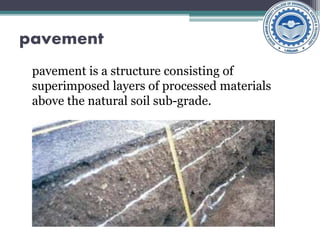
pavement
pavement is a structure consisting of
superimposed layers of processed materials
above the natural soil sub-grade.
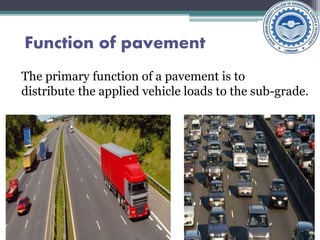
Function of pavement
The primary function of a pavement is to
distribute the applied vehicle loads to the sub-grade.
PAVEMNT STRUCTURE AND ITS
COMPONENTS
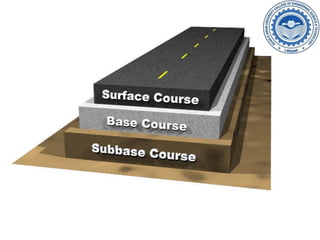
Pavement structure is a combination of
 Sub base course
 Base course
 and Surface course
Which are placed on a sub grade to support the
traffic load and distribute it to the roadbed soil.
SUBGRADE
• The top surface of the roadbed soil upon which
the pavement structure and shoulders are
constructed.
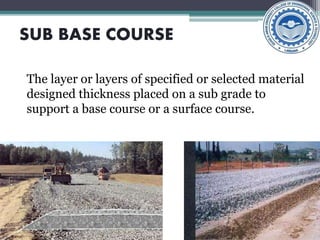
SUB BASE COURSE
The layer or layers of specified or selected material
designed thickness placed on a sub grade to
support a base course or a surface course.
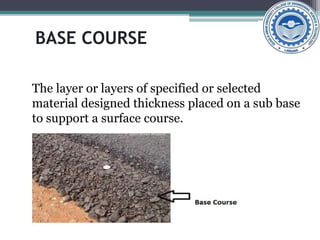
BASE COURSE
The layer or layers of specified or selected
material designed thickness placed on a sub base
to support a surface course.
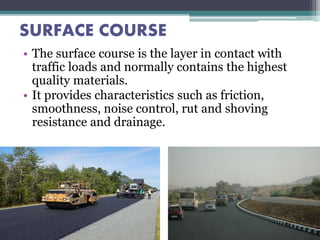
SURFACE COURSE
• The surface course is the layer in contact with
traffic loads and normally contains the highest
quality materials.
• It provides characteristics such as friction,
smoothness, noise control, rut and shoving
resistance and drainage.
What is pavement Design ..?
Pavement design is a process by which a structural
component of a road is determined, taking into
account nature of subgrade ,density and traffic
composition
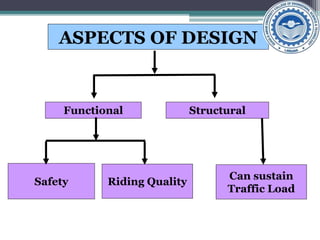
ASPECTS OF DESIGN
Functional Structural
Safety Riding Quality
Can sustain
Traffic Load
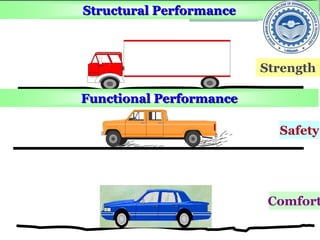
Structural Performance
Strength
Safety
Comfort
Functional Performance
Design requirements
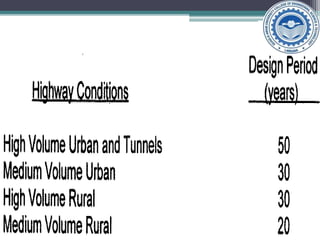
1) Design period; Design period is a time period for
which the pavement structure is going to be
designed. Design period generally determined the
thickness of different layer of the pavement
structure .
Design period is generally dependent on the
classification of the route under consideration
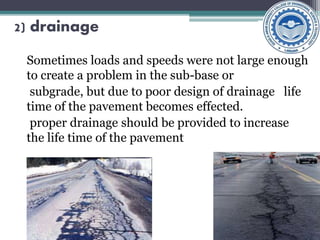
2) drainage
Sometimes loads and speeds were not large enough
to create a problem in the sub-base or
subgrade, but due to poor design of drainage life
time of the pavement becomes effected.
proper drainage should be provided to increase
the life time of the pavement
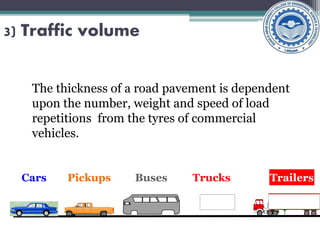
3) Traffic volume
The thickness of a road pavement is dependent
upon the number, weight and speed of load
repetitions from the tyres of commercial
vehicles.
Cars Pickups Buses Trucks Trailers
4) Measurement of Subgrade
• The overall strength and performance of a
pavement is dependent not only upon on pavement
components but also on the load-bearing capacity
of the Subgrade soil, because overall loads are
transferred to the subgrade by the pavement.
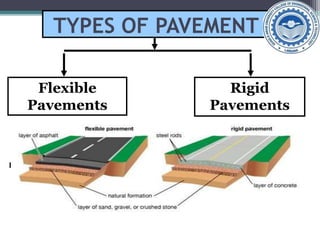
TYPES OF PAVEMENT
Flexible
Pavements
Rigid
Pavements
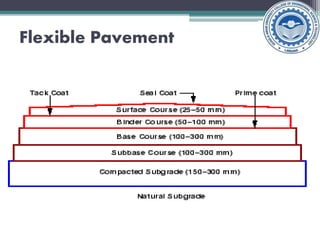
Flexible Pavement.
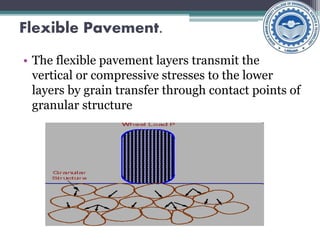
• The flexible pavement layers transmit the
vertical or compressive stresses to the lower
layers by grain transfer through contact points of
granular structure
Flexible Pavement
• The vertical compressive stress is maximum on the
pavement surface directly under the wheel load and
is equal to contact pressure under the wheels. Due to
the ability to distribute the stress to large area in the
shape of truncated cone, the stresses get decreased
in the lower layer.
• As such the flexible pavement may be constructed in
a number of layers and the top layer has to be
strongest as the highest compressive stresses.
• in addition to wear and tear, the lower layer have to
take up only lesser magnitude of stress as there is no
direct wearing action die to traffic loads, therefore
inferior material with lower cast can be used in the
lower layers
Flexible Pavement
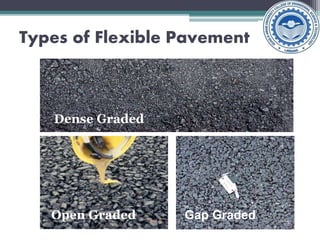
Types of Flexible Pavement
Dense Graded
Open Graded Gap Graded
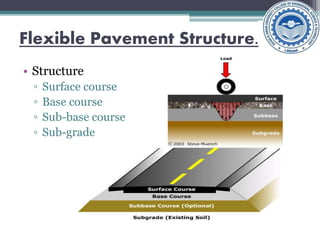
Flexible Pavement Structure.
• Structure
▫ Surface course
▫ Base course
▫ Sub-base course
▫ Sub-grade
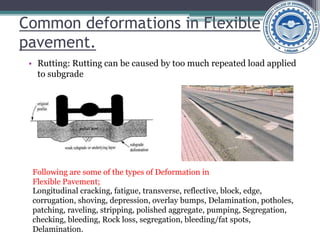
Common deformations in Flexible
pavement.
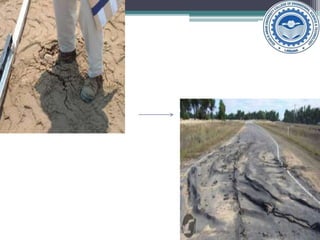
• Rutting: Rutting can be caused by too much repeated load applied
to subgrade
Longitudinal cracking, fatigue, transverse, reflective, block, edge,
corrugation, shoving, depression, overlay bumps, Delamination, potholes,
patching, raveling, stripping, polished aggregate, pumping, Segregation,
checking, bleeding, Rock loss, segregation, bleeding/fat spots,
Delamination.
Following are some of the types of Deformation in
Flexible Pavement;
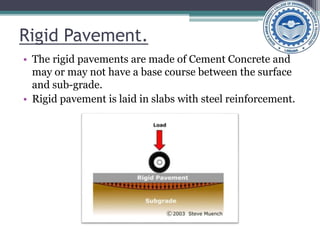
Rigid Pavement.
• The rigid pavements are made of Cement Concrete and
may or may not have a base course between the surface
and sub-grade.
• Rigid pavement is laid in slabs with steel reinforcement.
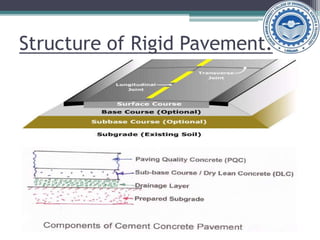
Structure of Rigid Pavement.
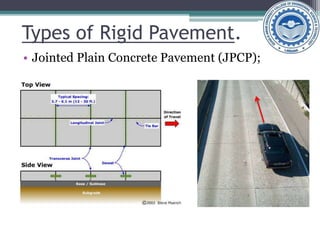
Types of Rigid Pavement.
• Jointed Plain Concrete Pavement (JPCP);
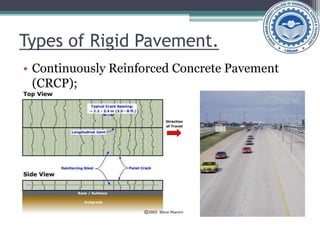
Types of Rigid Pavement.
• Continuously Reinforced Concrete Pavement
(CRCP);
Common deformations in
Rigid Pavement.
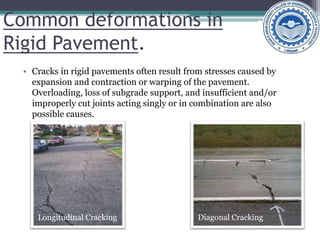
• Cracks in rigid pavements often result from stresses caused by
expansion and contraction or warping of the pavement.
Overloading, loss of subgrade support, and insufficient and/or
improperly cut joints acting singly or in combination are also
possible causes.
Longitudinal Cracking Diagonal Cracking
Common deformations in Rigid
Pavement.
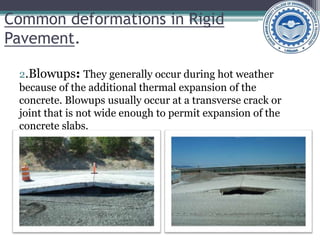
2.Blowups: They generally occur during hot weather
because of the additional thermal expansion of the
concrete. Blowups usually occur at a transverse crack or
joint that is not wide enough to permit expansion of the
concrete slabs.
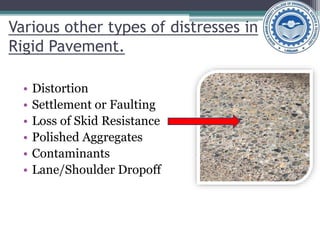
Various other types of distresses in
Rigid Pavement.
• Distortion
• Settlement or Faulting
• Loss of Skid Resistance
• Polished Aggregates
• Contaminants
• Lane/Shoulder Dropoff
Methods Of Pavement
Designing
A)EMPIRICAL METHODS
B)Mechanistic-Empirical Method
Flexible Pavement
A) EMPIRICAL METHODS
An empirical approach is one which is based
on the results of experiments, experience or a
combination of both.
between
Pavement
performance,
traffic loads &
pavement
thickness
for
A given set of
paving
materials and
soils,
geographic
location and
climatic
conditions
These procedures define the
interaction
Mechanistic-Empirical Method
 These Method, as the name implies, have two parts:
=> A mechanistic part in which a structural model (theory)
is used to calculate stresses, strains and deflections
induced by traffic and environmental loading.
=>An empirical part in which distress models are used
to predict the future performance of the pavement
structure.
 The distress models are typically developed from the
laboratory data and calibrated with the field data.
 EXAMPLES
• (The 2002 AASHTO Guide for Design of Pavement
Structures)
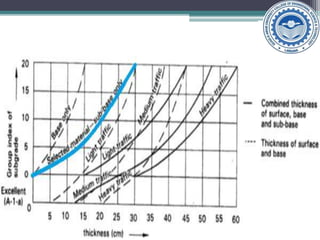
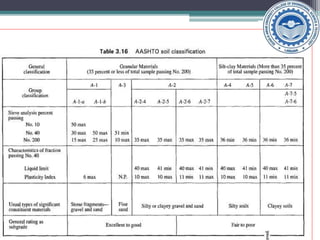
1) Group Index Method
Group Index method of flexible pavement design is an
empirical method which is based on the physical
properties of the soil sub-grade.
Group Index is a number assigned to the soil based on
its physical properties like particle size, Liquid limit
and plastic limit. It varies from a value of 0 to 20,
lower the value higher is the quality of the sub-grade
and greater the value, poor is the sub-grade.
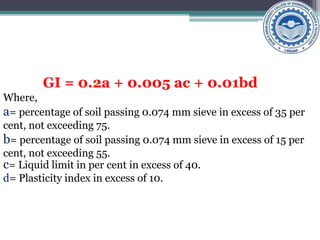
GI = 0.2a + 0.005 ac + 0.01bd
Where,
a= percentage of soil passing 0.074 mm sieve in excess of 35 per
cent, not exceeding 75.
b= percentage of soil passing 0.074 mm sieve in excess of 15 per
cent, not exceeding 55.
c= Liquid limit in per cent in excess of 40.
d= Plasticity index in excess of 10.
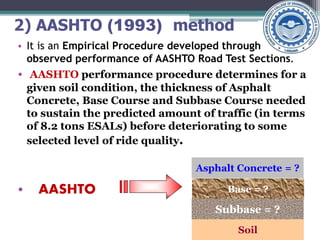
2) AASHTO (1993) method
• It is an Empirical Procedure developed through
observed performance of AASHTO Road Test Sections.
• AASHTO performance procedure determines for a
given soil condition, the thickness of Asphalt
Concrete, Base Course and Subbase Course needed
to sustain the predicted amount of traffic (in terms
of 8.2 tons ESALs) before deteriorating to some
selected level of ride quality.
• AASHTO
Asphalt Concrete = ?
Base = ?
Subbase = ?
Soil
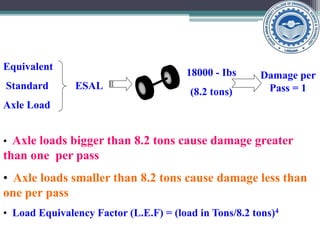
Equivalent
Standard ESAL
Axle Load
18000 - Ibs
(8.2 tons)
Damage per
Pass = 1
• Axle loads bigger than 8.2 tons cause damage greater
than one per pass
• Axle loads smaller than 8.2 tons cause damage less than
one per pass
• Load Equivalency Factor (L.E.F) = (load in Tons/8.2 tons)4
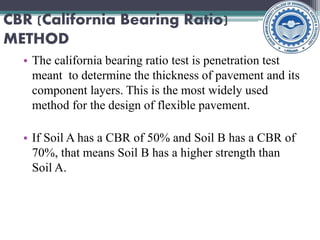
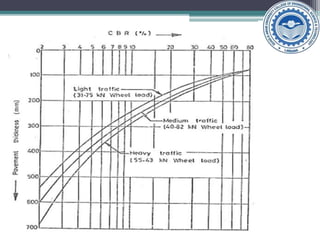
• The california bearing ratio test is penetration test
meant to determine the thickness of pavement and its
component layers. This is the most widely used
method for the design of flexible pavement.
• If Soil A has a CBR of 50% and Soil B has a CBR of
70%, that means Soil B has a higher strength than
Soil A.
CBR (California Bearing Ratio)
METHOD
20k Npenerationmm5.02forloadstadaredThe
13.2k Npenerationmm2.5forloadstadaredThe
:Note
x100
rock sstandardfromnPenetratiomm5.08atload
testfromnPenetratiomm5.08atLoad
CBR
x100
rock sstandardfromnPenetratiomm2.5atload
testfromnPenetratiomm2.5atLoad
CBR
rock sstandardoftestnPenetratioP
loadnPenetrarioP
x100
P
P
CBR
s
s







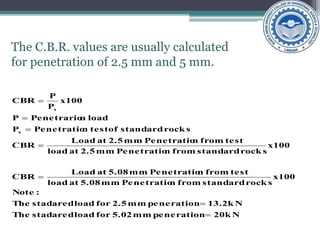
The C.B.R. values are usually calculated
for penetration of 2.5 mm and 5 mm.
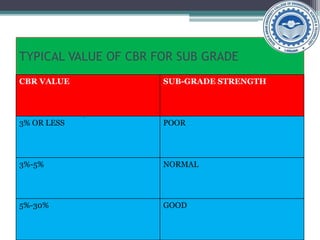
TYPICAL VALUE OF CBR FOR SUB GRADE
CBR VALUE SUB-GRADE STRENGTH
3% OR LESS POOR
3%-5% NORMAL
5%-30% GOOD
.
Pavement
Pavement
Pavement

Pavement

  • 2.
  • 3.
    Participants  Khalil urRehman (G L) L-14CE-55  Shankar Lal Sachdev L-14CE-40  Naeem Abbas L-14CE-06  Kamran Khan L-14CE-14  Ghulam Murtajiz L-14-CE-54  M Tashfeen L-14CE-45  preapared by; Engr Khalil Dawar
  • 4.
    Topics to becovered 1. Design of pavement 2. Flexible Pavement & Rigid Pavement 3. Pavement Design Methods
  • 5.
  • 6.
    pavement pavement is astructure consisting of superimposed layers of processed materials above the natural soil sub-grade.
  • 7.
    Function of pavement Theprimary function of a pavement is to distribute the applied vehicle loads to the sub-grade.
  • 8.
    PAVEMNT STRUCTURE ANDITS COMPONENTS Pavement structure is a combination of  Sub base course  Base course  and Surface course Which are placed on a sub grade to support the traffic load and distribute it to the roadbed soil.
  • 10.
    SUBGRADE • The topsurface of the roadbed soil upon which the pavement structure and shoulders are constructed.
  • 11.
    SUB BASE COURSE Thelayer or layers of specified or selected material designed thickness placed on a sub grade to support a base course or a surface course.
  • 12.
    BASE COURSE The layeror layers of specified or selected material designed thickness placed on a sub base to support a surface course.
  • 13.
    SURFACE COURSE • Thesurface course is the layer in contact with traffic loads and normally contains the highest quality materials. • It provides characteristics such as friction, smoothness, noise control, rut and shoving resistance and drainage.
  • 14.
    What is pavementDesign ..? Pavement design is a process by which a structural component of a road is determined, taking into account nature of subgrade ,density and traffic composition
  • 15.
    ASPECTS OF DESIGN FunctionalStructural Safety Riding Quality Can sustain Traffic Load
  • 16.
  • 17.
    Design requirements 1) Designperiod; Design period is a time period for which the pavement structure is going to be designed. Design period generally determined the thickness of different layer of the pavement structure . Design period is generally dependent on the classification of the route under consideration
  • 19.
    2) drainage Sometimes loadsand speeds were not large enough to create a problem in the sub-base or subgrade, but due to poor design of drainage life time of the pavement becomes effected. proper drainage should be provided to increase the life time of the pavement
  • 20.
    3) Traffic volume Thethickness of a road pavement is dependent upon the number, weight and speed of load repetitions from the tyres of commercial vehicles. Cars Pickups Buses Trucks Trailers
  • 21.
    4) Measurement ofSubgrade • The overall strength and performance of a pavement is dependent not only upon on pavement components but also on the load-bearing capacity of the Subgrade soil, because overall loads are transferred to the subgrade by the pavement.
  • 23.
  • 24.
    Flexible Pavement. • Theflexible pavement layers transmit the vertical or compressive stresses to the lower layers by grain transfer through contact points of granular structure
  • 25.
    Flexible Pavement • Thevertical compressive stress is maximum on the pavement surface directly under the wheel load and is equal to contact pressure under the wheels. Due to the ability to distribute the stress to large area in the shape of truncated cone, the stresses get decreased in the lower layer. • As such the flexible pavement may be constructed in a number of layers and the top layer has to be strongest as the highest compressive stresses. • in addition to wear and tear, the lower layer have to take up only lesser magnitude of stress as there is no direct wearing action die to traffic loads, therefore inferior material with lower cast can be used in the lower layers
  • 26.
  • 27.
    Types of FlexiblePavement Dense Graded Open Graded Gap Graded
  • 28.
    Flexible Pavement Structure. •Structure ▫ Surface course ▫ Base course ▫ Sub-base course ▫ Sub-grade
  • 29.
    Common deformations inFlexible pavement. • Rutting: Rutting can be caused by too much repeated load applied to subgrade Longitudinal cracking, fatigue, transverse, reflective, block, edge, corrugation, shoving, depression, overlay bumps, Delamination, potholes, patching, raveling, stripping, polished aggregate, pumping, Segregation, checking, bleeding, Rock loss, segregation, bleeding/fat spots, Delamination. Following are some of the types of Deformation in Flexible Pavement;
  • 30.
    Rigid Pavement. • Therigid pavements are made of Cement Concrete and may or may not have a base course between the surface and sub-grade. • Rigid pavement is laid in slabs with steel reinforcement.
  • 31.
  • 32.
    Types of RigidPavement. • Jointed Plain Concrete Pavement (JPCP);
  • 33.
    Types of RigidPavement. • Continuously Reinforced Concrete Pavement (CRCP);
  • 34.
    Common deformations in RigidPavement. • Cracks in rigid pavements often result from stresses caused by expansion and contraction or warping of the pavement. Overloading, loss of subgrade support, and insufficient and/or improperly cut joints acting singly or in combination are also possible causes. Longitudinal Cracking Diagonal Cracking
  • 35.
    Common deformations inRigid Pavement. 2.Blowups: They generally occur during hot weather because of the additional thermal expansion of the concrete. Blowups usually occur at a transverse crack or joint that is not wide enough to permit expansion of the concrete slabs.
  • 36.
    Various other typesof distresses in Rigid Pavement. • Distortion • Settlement or Faulting • Loss of Skid Resistance • Polished Aggregates • Contaminants • Lane/Shoulder Dropoff
  • 37.
    Methods Of Pavement Designing A)EMPIRICALMETHODS B)Mechanistic-Empirical Method
  • 38.
    Flexible Pavement A) EMPIRICALMETHODS An empirical approach is one which is based on the results of experiments, experience or a combination of both. between Pavement performance, traffic loads & pavement thickness for A given set of paving materials and soils, geographic location and climatic conditions These procedures define the interaction
  • 39.
    Mechanistic-Empirical Method  TheseMethod, as the name implies, have two parts: => A mechanistic part in which a structural model (theory) is used to calculate stresses, strains and deflections induced by traffic and environmental loading. =>An empirical part in which distress models are used to predict the future performance of the pavement structure.  The distress models are typically developed from the laboratory data and calibrated with the field data.  EXAMPLES • (The 2002 AASHTO Guide for Design of Pavement Structures)
  • 40.
    1) Group IndexMethod Group Index method of flexible pavement design is an empirical method which is based on the physical properties of the soil sub-grade. Group Index is a number assigned to the soil based on its physical properties like particle size, Liquid limit and plastic limit. It varies from a value of 0 to 20, lower the value higher is the quality of the sub-grade and greater the value, poor is the sub-grade.
  • 41.
    GI = 0.2a+ 0.005 ac + 0.01bd Where, a= percentage of soil passing 0.074 mm sieve in excess of 35 per cent, not exceeding 75. b= percentage of soil passing 0.074 mm sieve in excess of 15 per cent, not exceeding 55. c= Liquid limit in per cent in excess of 40. d= Plasticity index in excess of 10.
  • 43.
    2) AASHTO (1993)method • It is an Empirical Procedure developed through observed performance of AASHTO Road Test Sections. • AASHTO performance procedure determines for a given soil condition, the thickness of Asphalt Concrete, Base Course and Subbase Course needed to sustain the predicted amount of traffic (in terms of 8.2 tons ESALs) before deteriorating to some selected level of ride quality. • AASHTO Asphalt Concrete = ? Base = ? Subbase = ? Soil
  • 44.
    Equivalent Standard ESAL Axle Load 18000- Ibs (8.2 tons) Damage per Pass = 1 • Axle loads bigger than 8.2 tons cause damage greater than one per pass • Axle loads smaller than 8.2 tons cause damage less than one per pass • Load Equivalency Factor (L.E.F) = (load in Tons/8.2 tons)4
  • 46.
    • The californiabearing ratio test is penetration test meant to determine the thickness of pavement and its component layers. This is the most widely used method for the design of flexible pavement. • If Soil A has a CBR of 50% and Soil B has a CBR of 70%, that means Soil B has a higher strength than Soil A. CBR (California Bearing Ratio) METHOD
  • 47.
    20k Npenerationmm5.02forloadstadaredThe 13.2k Npenerationmm2.5forloadstadaredThe :Note x100 rocksstandardfromnPenetratiomm5.08atload testfromnPenetratiomm5.08atLoad CBR x100 rock sstandardfromnPenetratiomm2.5atload testfromnPenetratiomm2.5atLoad CBR rock sstandardoftestnPenetratioP loadnPenetrarioP x100 P P CBR s s        The C.B.R. values are usually calculated for penetration of 2.5 mm and 5 mm.
  • 48.
    TYPICAL VALUE OFCBR FOR SUB GRADE CBR VALUE SUB-GRADE STRENGTH 3% OR LESS POOR 3%-5% NORMAL 5%-30% GOOD .