The document discusses various aspects of road design and construction including:
1. Road categories and hierarchy such as expressways, federal roads, state roads, and urban/rural area roads.
2. Factors that govern road alignment including obligatory points, geometric design, precautions at river/railway crossings, and topographical considerations.
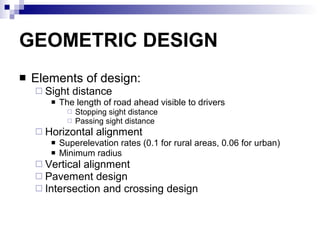
3. Elements of geometric design for roads including sight distance, horizontal and vertical alignment, pavement design, and intersection design.
4. Components of a flexible pavement cross-section and the functions of the different layers.
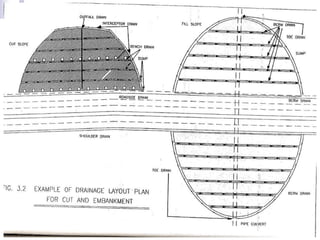
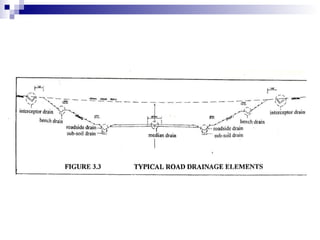
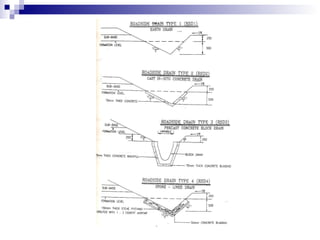
5. Importance of drainage in road construction and different drainage system components.
6. Typical stages of road construction including earthworks, pavement/drain
Explains road categories including Expressway, Federal Road, State Road, and local authority roads. Highlights maintenance responsibilities and funding sources.
Discusses factors influencing road alignment such as avoiding obstructions, design features, and requirements for bridges and railway crossings.Focuses on geometric design elements like sight distance, horizontal and vertical alignment adjustments ensuring stability and minimizing earthwork.
Describes key cross-section components including pavement types, normal cross slope, lane widths, shoulders, kerbs, and medians for road safety.Details pavement structure: subgrade, sub base, base course, and surface course including their materials and functions for traffic load support.
Emphasizes drainage systems' critical role in road construction and maintenance to prevent surface and subgrade softening due to water accumulation.
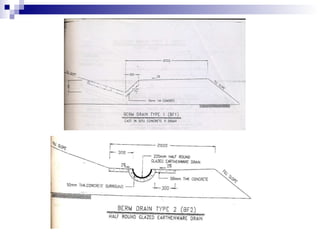
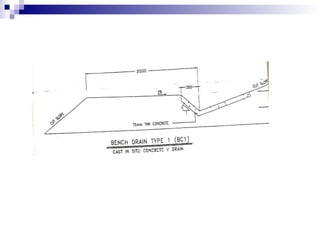
Identifies various components of surface drainage including shoulder slope and different drains that help to manage water runoff effectively.
Describes the three construction stages: road formation, pavement structure, drainage, and the importance of soil compaction and fill widening.
Presents discussion questions regarding road alignment factors, soil characteristics, compaction principles, and drainage system design.
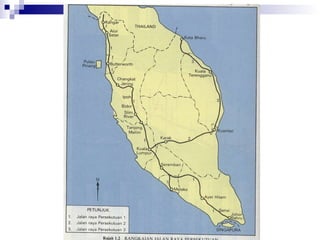
ROAD CATEGORY EXPRESSWAY Bukit Kayu Hitam to Johor Bahru FEDERAL ROAD Interstate national network and complements the expressway network Route 1 (Kangar to JB) Route II ( West Coast to East Coast) Route III (East Coast-state) Maintenance under the Federal Government and is done through the State JKR with fund from Federal
3.
ROAD CATEGORY STATEROAD Roads within the state Constructed with state funds Maintenance under state government URBAN AREA ROAD Local Authority RURAL AREA ROAD Under the jurisdiction of the District Office
4.
5.
6.
Factors governing alignmentObligatory points The location should avoid obstructions such as places of cemeteries, archeological, historical monument, public facilities like schools and hospitals, utility services Geometric design features Facilitate easy grade and curvature Enable ruling gradient in most sections Void sudden changes in sight distance, especially near crossings Avoid sharp horizontal curves Avoid road intersections near bend or at the top or bottom of a hill
7.
Factors governing alignmentPrecautions at river and railway crossings Bridges should be preferably be located at right angles to the river flow, not located on a horizontal curve Crossing railway lines should avoid intersections at gradient, frequent crossing and recrossing
8.
Factors governing alignmentTopographical control points The alignment, where possible should avoid passing through Marshy and low lying land with poor drainage Flood prone areas Unstable hilly features Avalanche prone areas Flat terrain-below 3% Rolling terrain -3 to 25% Mountainous terrain – above 25% A location on high ground should be preferred rather than valley to avoid cross drainage works
9.
Factors governing alignmentMaterials and constructional features Deep cutting should be avoided Earth work is to be balanced; quantities for filling and excavation Alignment should preferably be through better soil area to minimize pavement thickness Location may be near sources of embankment and pavement materials
10.
GEOMETRIC DESIGN Elementsof design: Sight distance The length of road ahead visible to drivers Stopping sight distance Passing sight distance Horizontal alignment Superelevation rates (0.1 for rural areas, 0.06 for urban) Minimum radius Vertical alignment Pavement design Intersection and crossing design
11.
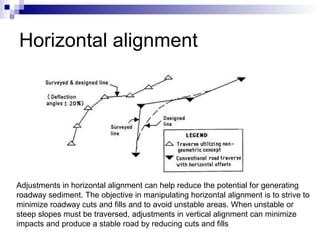
Horizontal alignment Adjustmentsin horizontal alignment can help reduce the potential for generating roadway sediment. The objective in manipulating horizontal alignment is to strive to minimize roadway cuts and fills and to avoid unstable areas. When unstable or steep slopes must be traversed, adjustments in vertical alignment can minimize impacts and produce a stable road by reducing cuts and fills
12.
13.
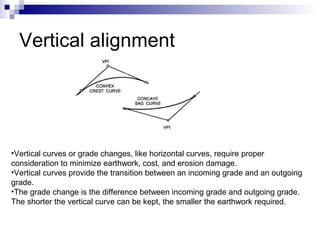
Vertical alignment Verticalcurves or grade changes, like horizontal curves, require proper consideration to minimize earthwork, cost, and erosion damage. Vertical curves provide the transition between an incoming grade and an outgoing grade. The grade change is the difference between incoming grade and outgoing grade. The shorter the vertical curve can be kept, the smaller the earthwork required.
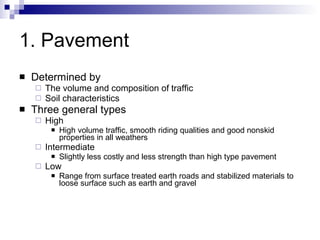
1. Pavement Determinedby The volume and composition of traffic Soil characteristics Three general types High High volume traffic, smooth riding qualities and good nonskid properties in all weathers Intermediate Slightly less costly and less strength than high type pavement Low Range from surface treated earth roads and stabilized materials to loose surface such as earth and gravel
16.
2. Normal crossslope Cross slope to minimise water ponding on flat sections of uncurbed pavements due to pavement imperfections or unequal settlement To control the flow of water adjacent to the curb on curbed pavements 2.5% for high surface type 2.5 %- 3.5% for intermediate surface 2.5 % - 6% for low surface
17.
3. Lane widths3.5 m – normal road width 2.75 m – minor roads and local street 3.5 m – 3.75 m width - Divided highways
18.
4. ShoulderEmergency stopping free of the traffic lane The sense of openness contributes to driving ease and comfort Sight distances is improved in in cut sections, thereby improving safety Highway capacity is improved and uniform speed is encouraged Structural support is given to the pavement Minimum 0.6 m should be considered Maximum 3 m for high type facilities Should be sloped sufficiently 2 to 6 % - Bituminous and concrete surfaced shoulders 4 to 6% - gravel or crushed rock shoulders 6 % - turf shoulders
19.
5. Kerbs Urbanareas Drainage control Delineation of pedestrian walkways Aesthetics Two general classes of kerbs; Barrier kerbs High and steep faced Designed to discourage vehicles from leaving the roadway Should not be used on expressways Should not be used where the design speed exceed 70 km/hr Mountable kerbs To define pavement edges of through carriageways
20.
6. Medians Roadcarrying four or more lanes To provide the desired freedom from the interface of opposing traffic To provide for speed changes and storage of right-turning and U-turning vehicles To provide for future lanes
21.
Cross-section of aflexible pavement Wearing course Binder course Road base/ base course Sub base Sub grade
22.
Subgrade Uppermost partof the soil Natural or imported Supporting the load transmitted from the overlying layers
23.
Sub base :-Consists of granular materials, either naturally or compacted or ocassionally stabilized with cement or lime. To disperse the load from the base course before transmitting it to the subgrade. Help as a drainage layer Prevent moisture migration from subgrade Menahan tanah subgrade dari bercampur dengan road base Sand and aggregate Standard CBR % : Crushed aggregate 30 Sand, Laterite, etc 20
24.
Base course /Road base (1”) Plays a prominent role in the support and dispersion of the traffic The thickest layer 3 types : Crushed aggregates Cement stabilised Bitumen stabilised base courses
25.
Surface course Allthe bound layer(s) within the pavement i.e wearing course, intermediate course and binder course An impermeable and flexible lining of high elastic modulus Hot-mixed bituminous mixtures-consist of well graded mixture of coarse aggregates, fine aggregates and filler, bound together with bitumen Binder course Overlying the base course Supporting and dispersing the traffic load Resists shear Wearing course Topmost layer Resist abrasion and prevent skidding
26.
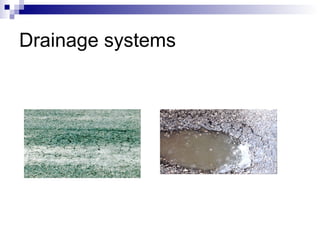
Drainage system DRAINAGEis VERY! VERY! VERY! IMPORTANT , both in relation to road pavement construction and maintenance. Good drainage will help to keep the water table (and strength) of the road pavement in equilibrium. Water below the road pavement must be kept low and not be allowed to rise up into the construction layers The road pavement must be constructed so that it will drain in the event of a failure of the integrity of the surfacing layers, i.e. if water is able to enter the road pavement there must be a path for it to exit.
27.
Important of surfacedrainage Softening the road surface when it is constructed of soil or sand-clay or gravel or water bound macadam Washing out unprotected areas of the top surface, erosion of side slopes forming gullies, erosion of side drain Generally softening of the ground giving rise to land slides or slips Softening the subgrade soil and decreasing its bearing power
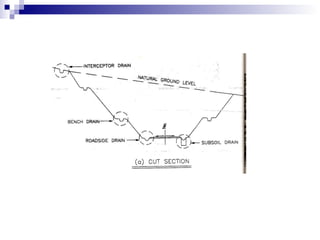
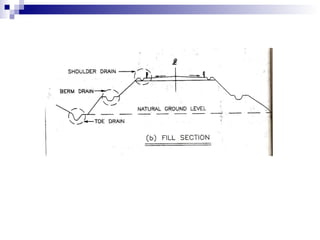
Components of surfacedrainage Shoulder slope Roadside drain/ shoulder drain Toe drain Bench and Berm drain Interceptor drain Out fall drain Median Drain Kerb drain
30.
31.
32.
33.
34.
35.
36.
37.
Road construction Threestages Stage I – Construction of road formation, i.e earthwork Stage II – Construction of the pavement structure and drainage Stage III – Provision of traffic engineering facilities
38.
Road construction Typicalroad construction equipment Plant for clearing- bull dozers, tractors Plant for drilling/ripping Plant for each mining and moving process- mechanical showels bulldozers, scrapers, trucks Plant for formation construction-graders, scrapers, bulldozers Compaction plant-rollers of various types tracked, smooth, or rubber tyred Bituminous mixing plant
39.
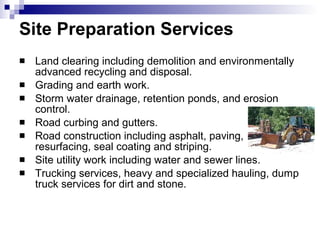
Site Preparation ServicesLand clearing including demolition and environmentally advanced recycling and disposal. Grading and earth work. Storm water drainage, retention ponds, and erosion control. Road curbing and gutters. Road construction including asphalt, paving, resurfacing, seal coating and striping. Site utility work including water and sewer lines. Trucking services, heavy and specialized hauling, dump truck services for dirt and stone.
40.
Earth work Cut/fillCut and fill – involve the cutting or excavation of earth materials and the compaction as fill in conformance. Fill is placed in horizontal lifts and then each lift of fill is compacted to setup a uniformly compacted material. Fill materials - Only suitable materials such as medium stiff clays, clayey sand or other approved soils shall be used for filling Materials from swamps, top soils and other highly organic clay or silts, materials containing boulders materials, materials with chemical composition or at their moisture content will not compact properly shall not be used for filling
41.
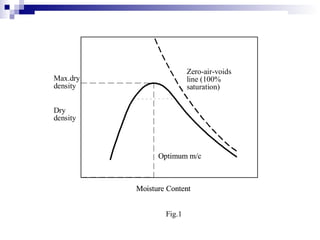
Soil compaction Processby which a mass of soil consisting of solid soil particles, air and water is reduced in volume by momentary application of loads, such as rolling, tamping or vibration Compaction of the soil generally increases its shear strength, decreases its compressibility and decreases its permeability
42.
43.
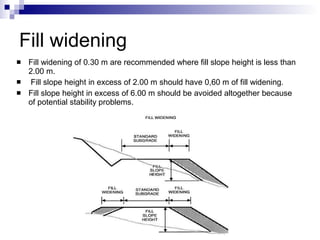
Fill widening Fillwidening of 0.30 m are recommended where fill slope height is less than 2.00 m. Fill slope height in excess of 2.00 m should have 0,60 m of fill widening. Fill slope height in excess of 6.00 m should be avoided altogether because of potential stability problems.
44.
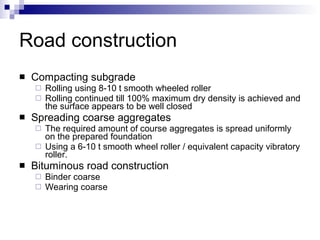
Road construction Compactingsubgrade Rolling using 8-10 t smooth wheeled roller Rolling continued till 100% maximum dry density is achieved and the surface appears to be well closed Spreading coarse aggregates The required amount of course aggregates is spread uniformly on the prepared foundation Using a 6-10 t smooth wheel roller / equivalent capacity vibratory roller. Bituminous road construction Binder coarse Wearing coarse
45.
Discussion topics Whatare the factors controlling alignment of roads What are the important engineering characteristics of soils that are likely to influence the performance of a road? Discuss the basic principles of field compaction. Can climatic conditions influence compaction in road construction? Pavement deterioration; causes and rehabilitation A properly designed highway requires a well-designed drainage system