Road Construction
Group 02
Content of Presentation
• Introduction to road construction
• Main segments of road pavement
– Flexible pavement :Advantages & Disadvantages
– Rigid pavement: Advantages & Disadvantages
• Selected flexible road project
• Selected rigid road project
• Comparative analysis of time and cost
• Conclusions
Introduction
 Roads are designed and built for primary use by vehicular and
pedestrian traffic.
 In the past they were constructed using stone, gravel and sand.
 All hard road pavements fall into two categories
– Flexible pavement
– Rigid pavement
 Report includes details, pros and cons of the two types and two
selected road construction projects
Flexible Pavement
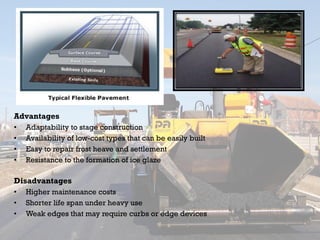
• Flexible pavements are composed of a
bituminous material surface course, underlying
base and sub base course
• Asphalt is mostly used as bituminous material
• The flexible pavement design is based on the load
distributing characteristics of a layered system.
Advantages
• Adaptability to stage construction
• Availability of low-cost types that can be easily built
• Easy to repair frost heave and settlement
• Resistance to the formation of ice glaze
Disadvantages
• Higher maintenance costs
• Shorter life span under heavy use
• Weak edges that may require curbs or edge devices
Rigid Pavements
• Rigid pavement is laid in slabs with steel
reinforcement.
• The rigid characteristic of the pavement
are associated with rigidity or flexural
strength
• Rigid pavement is designed and
analyzed by using the elastic theory.
Advantages
• Low maintenance costs
• Long life with extreme durability
• Ability to be placed directly on poor soils
• No damage from oil and grease.
• Strong edges
Disadvantages
• High initial costs
• Joints required for contraction and expansion
• Generally rough riding quality
Selected Flexible Road Project
• The rehabilitation and improvement of Ambepussa-
Kurunegala-Trincomalee Road
• From Kanthale to Trincomalee covering a distance of 40km.
• Four contractors used: M/s Access Engineering (Pvt) Ltd,
Tudawe Brothers (Pvt) ltd, CEC and VV Krunarathna and
Company.
• The existing road is to be widened to a carriageway width
of 9.0 m and 0.8 m paved shoulder
Details of Selected Project
Employer : Road Development Authority
Consultants : Road Development Authority (Scott Wilson)
Contractor :Tudawe Brothers
Contract Sum : Rs. 824,106,004.73 (Excluding VAT )
Duration : 15 months
Date of Commencement : 2011-07-11
Expected date of Completion : 2012-10- 31
Type of Contract : Measure & Pay
Conditions of Contract : FIDIC
Road Type : Double base bitumen
Road Dimensions : 10.5km long, 9m wide
Designed Aspects: Flexible Road
• WATER TABLE
– 2.0- 2.1m below ground level
– Vertical band drain installation is used to control the
groundwater levels.
• SOIL TYPE
– Main types were peat and clay
– For Site investigations Wash Boring, Machine Boring and
also Standard Penetration Tests were carried out
• SERVICES
– Existing electrical services are removed and replaced
by the Ceylon Electricity Board
Designed Aspects: Flexible Road
• CUTTING AND FILLING
– No cutting and filling done since the road was not over
any hilly or mountainous area.
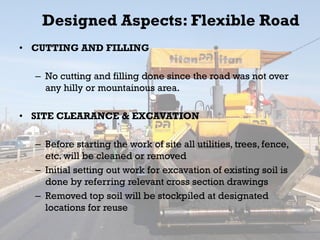
• SITE CLEARANCE & EXCAVATION
– Before starting the work of site all utilities, trees, fence,
etc. will be cleaned or removed
– Initial setting out work for excavation of existing soil is
done by referring relevant cross section drawings
– Removed top soil will be stockpiled at designated
locations for reuse
Designed Aspects: Flexible Road
• DRAINS
– Located at the low points of gradients
– On the existing surfaces which are to be overlaid, a level
survey is made at sufficiently close centres to enable the
gradients to be calculated
• STAKING METHOD
– It is the transferring of the design information from the
plan to the ground
– On average reference points were set at least every 70 to
100 meters
– reference points were placed at points where the centre
line alignment can be easily re-established, such as
points of curvature.
Flexible Road Layers & Functions
BASE COURSE
•Functions include the ability to resist cracking and
structural deformation and to spread load
•Ensures that strength capacities of the weaker sub base
and sub grade are not exceeded.
BINDER COURSE
•It is bitumen bound and provides a surface on which to
lay the surface course
•Provides part of the structural strength
•It also ensures the surface course has a good riding
quality
Flexible Road Layers & Functions
SURFACE COURSE
Performs functions such as:
•Providing a skid resistant surface,
•Resistant to abrasion,
•Resistant to indentation,
•Minimize traffic noise,
•Protect the underlying road structure,
•Seals the pavement and pre vents surface water from
penetrating and weakening the base and sub-grade
•Resistant to deformation.
Process of Road Construction
Applying Wearing Course
Preparing the binding coat
Preparing the Prime Coat
Preparing the base course
Preparing the Sub base Course
Preparing the Sub Grade
Shoulder Preparation
Culvert Preparation
Excavation Process
Establishing the string line/Site Survey
Site Clearance
Equipments Used
Dump Truck Backhoe Loader Asphalt Paver
Selected Rigid Road Project
• Large scale rigid pavement road projects are not
commonly found in Sri Lanka
• Rigid road constructions initiate in sub-urban
and rural areas under “Maga Naguma”- Rural
Development Program (MNRDP)
– Jointed plain concrete pavements
– Pavement with interlocking cement blocks
Details of Selected Project
Employer : Homagama Pradeshiya Sabha
Consultants : Provincial Road Development Authority
Contractor : Sunil Contractors (Pvt) Ltd
Contract Sum : Rs. 25,106,004.73 (Excluding VAT )
Duration : 1.5 months
Date of Commencement : 2010-07-11
Expected date of Completion : 2010-08- 31
Type of Contract : Measure & Pay
Conditions of Contract : SBD 1
Road Type : Jointed plain concrete pavement
Road Dimensions : 600m long, 3m wide and 125mm thick
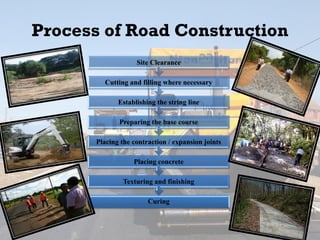
Process of Road Construction
Curing
Texturing and finishing
Placing concrete
Placing the contraction / expansion joints
Preparing the base course
Establishing the string line
Cutting and filling where necessary
Site Clearance
Equipments Used
Concrete Drum Mixer Backhoe Loader
Comparing Cost & Time
Flexible Pavements Rigid Pavements
Time Analysis
Takes relatively higher time period to construction Takes lesser time period
Can be used after 24 hours from laying the bitumen
layer
It takes relatively higher time period to cure the
concrete road, hence road cannot be used
immediately after placing the concrete for traffic
movement
Life span may be around 4 to 10 years Can be used for 30 years without major defects
Cost Analysis
Initial cost of construction is relatively lower Initial cost of construction is relatively higher
Life cycle cost is relatively higher, maintenance
requirements may arise after 2 to 3 years of project
completion
Life cycle cost of rigid roads is lower compared to
flexible pavements because wearing of the road is
minimum
The cost of bitumen has a tendency to increase Cement prices doesn’t have a trend to
Cost per m2 of a 3m wide 2km long road 3,000.00 Cost per m2 of a 3m wide 600m long road 2,200.00
Cost per m2 of a 9m wide 10km long road 8,300.00 Cost per m2 of a 3m wide 10km long road 12,100.00
Flexible road has relatively higher carbon footprint
because of extensive the use of heavy equipment
Roller compaction is not used, damage to vehicle
and life cycle cost is less, minimum carbon
footprint
Conclusion
• In Civil Engineering works, road construction
has a vital position.
• Initial cost is generally the major factor in
deciding the type of the pavement in design
• For large scale road construction projects
concrete pavements are economical if the sub-
grade of the area is stable and heavy traffic is
expected to move after completion.
• Minor roads with difficult access for
conventional road-making plant, may sometimes
be economic to construct in concrete
ThankYou 

ROAD CONSTRUCTION (FLEXIBLE & RIGID) - SLIDES.pdf

  • 1.
  • 2.
    Content of Presentation •Introduction to road construction • Main segments of road pavement – Flexible pavement :Advantages & Disadvantages – Rigid pavement: Advantages & Disadvantages • Selected flexible road project • Selected rigid road project • Comparative analysis of time and cost • Conclusions
  • 3.
    Introduction  Roads aredesigned and built for primary use by vehicular and pedestrian traffic.  In the past they were constructed using stone, gravel and sand.  All hard road pavements fall into two categories – Flexible pavement – Rigid pavement  Report includes details, pros and cons of the two types and two selected road construction projects
  • 4.
    Flexible Pavement • Flexiblepavements are composed of a bituminous material surface course, underlying base and sub base course • Asphalt is mostly used as bituminous material • The flexible pavement design is based on the load distributing characteristics of a layered system.
  • 5.
    Advantages • Adaptability tostage construction • Availability of low-cost types that can be easily built • Easy to repair frost heave and settlement • Resistance to the formation of ice glaze Disadvantages • Higher maintenance costs • Shorter life span under heavy use • Weak edges that may require curbs or edge devices
  • 6.
    Rigid Pavements • Rigidpavement is laid in slabs with steel reinforcement. • The rigid characteristic of the pavement are associated with rigidity or flexural strength • Rigid pavement is designed and analyzed by using the elastic theory.
  • 7.
    Advantages • Low maintenancecosts • Long life with extreme durability • Ability to be placed directly on poor soils • No damage from oil and grease. • Strong edges Disadvantages • High initial costs • Joints required for contraction and expansion • Generally rough riding quality
  • 8.
    Selected Flexible RoadProject • The rehabilitation and improvement of Ambepussa- Kurunegala-Trincomalee Road • From Kanthale to Trincomalee covering a distance of 40km. • Four contractors used: M/s Access Engineering (Pvt) Ltd, Tudawe Brothers (Pvt) ltd, CEC and VV Krunarathna and Company. • The existing road is to be widened to a carriageway width of 9.0 m and 0.8 m paved shoulder
  • 9.
    Details of SelectedProject Employer : Road Development Authority Consultants : Road Development Authority (Scott Wilson) Contractor :Tudawe Brothers Contract Sum : Rs. 824,106,004.73 (Excluding VAT ) Duration : 15 months Date of Commencement : 2011-07-11 Expected date of Completion : 2012-10- 31 Type of Contract : Measure & Pay Conditions of Contract : FIDIC Road Type : Double base bitumen Road Dimensions : 10.5km long, 9m wide
  • 10.
    Designed Aspects: FlexibleRoad • WATER TABLE – 2.0- 2.1m below ground level – Vertical band drain installation is used to control the groundwater levels. • SOIL TYPE – Main types were peat and clay – For Site investigations Wash Boring, Machine Boring and also Standard Penetration Tests were carried out • SERVICES – Existing electrical services are removed and replaced by the Ceylon Electricity Board
  • 11.
    Designed Aspects: FlexibleRoad • CUTTING AND FILLING – No cutting and filling done since the road was not over any hilly or mountainous area. • SITE CLEARANCE & EXCAVATION – Before starting the work of site all utilities, trees, fence, etc. will be cleaned or removed – Initial setting out work for excavation of existing soil is done by referring relevant cross section drawings – Removed top soil will be stockpiled at designated locations for reuse
  • 12.
    Designed Aspects: FlexibleRoad • DRAINS – Located at the low points of gradients – On the existing surfaces which are to be overlaid, a level survey is made at sufficiently close centres to enable the gradients to be calculated • STAKING METHOD – It is the transferring of the design information from the plan to the ground – On average reference points were set at least every 70 to 100 meters – reference points were placed at points where the centre line alignment can be easily re-established, such as points of curvature.
  • 13.
    Flexible Road Layers& Functions BASE COURSE •Functions include the ability to resist cracking and structural deformation and to spread load •Ensures that strength capacities of the weaker sub base and sub grade are not exceeded. BINDER COURSE •It is bitumen bound and provides a surface on which to lay the surface course •Provides part of the structural strength •It also ensures the surface course has a good riding quality
  • 14.
    Flexible Road Layers& Functions SURFACE COURSE Performs functions such as: •Providing a skid resistant surface, •Resistant to abrasion, •Resistant to indentation, •Minimize traffic noise, •Protect the underlying road structure, •Seals the pavement and pre vents surface water from penetrating and weakening the base and sub-grade •Resistant to deformation.
  • 15.
    Process of RoadConstruction Applying Wearing Course Preparing the binding coat Preparing the Prime Coat Preparing the base course Preparing the Sub base Course Preparing the Sub Grade Shoulder Preparation Culvert Preparation Excavation Process Establishing the string line/Site Survey Site Clearance
  • 16.
    Equipments Used Dump TruckBackhoe Loader Asphalt Paver
  • 17.
    Selected Rigid RoadProject • Large scale rigid pavement road projects are not commonly found in Sri Lanka • Rigid road constructions initiate in sub-urban and rural areas under “Maga Naguma”- Rural Development Program (MNRDP) – Jointed plain concrete pavements – Pavement with interlocking cement blocks
  • 18.
    Details of SelectedProject Employer : Homagama Pradeshiya Sabha Consultants : Provincial Road Development Authority Contractor : Sunil Contractors (Pvt) Ltd Contract Sum : Rs. 25,106,004.73 (Excluding VAT ) Duration : 1.5 months Date of Commencement : 2010-07-11 Expected date of Completion : 2010-08- 31 Type of Contract : Measure & Pay Conditions of Contract : SBD 1 Road Type : Jointed plain concrete pavement Road Dimensions : 600m long, 3m wide and 125mm thick
  • 19.
    Process of RoadConstruction Curing Texturing and finishing Placing concrete Placing the contraction / expansion joints Preparing the base course Establishing the string line Cutting and filling where necessary Site Clearance
  • 20.
    Equipments Used Concrete DrumMixer Backhoe Loader
  • 21.
    Comparing Cost &Time Flexible Pavements Rigid Pavements Time Analysis Takes relatively higher time period to construction Takes lesser time period Can be used after 24 hours from laying the bitumen layer It takes relatively higher time period to cure the concrete road, hence road cannot be used immediately after placing the concrete for traffic movement Life span may be around 4 to 10 years Can be used for 30 years without major defects Cost Analysis Initial cost of construction is relatively lower Initial cost of construction is relatively higher Life cycle cost is relatively higher, maintenance requirements may arise after 2 to 3 years of project completion Life cycle cost of rigid roads is lower compared to flexible pavements because wearing of the road is minimum The cost of bitumen has a tendency to increase Cement prices doesn’t have a trend to Cost per m2 of a 3m wide 2km long road 3,000.00 Cost per m2 of a 3m wide 600m long road 2,200.00 Cost per m2 of a 9m wide 10km long road 8,300.00 Cost per m2 of a 3m wide 10km long road 12,100.00 Flexible road has relatively higher carbon footprint because of extensive the use of heavy equipment Roller compaction is not used, damage to vehicle and life cycle cost is less, minimum carbon footprint
  • 22.
    Conclusion • In CivilEngineering works, road construction has a vital position. • Initial cost is generally the major factor in deciding the type of the pavement in design • For large scale road construction projects concrete pavements are economical if the sub- grade of the area is stable and heavy traffic is expected to move after completion. • Minor roads with difficult access for conventional road-making plant, may sometimes be economic to construct in concrete
  • 23.