7
7
7
7
7
7
7
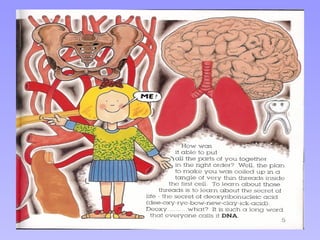
DNA is Here to Stay By Dr. Fran Balkwill and  Mic Rolph 7
7
7
7
7
7
7
7
7
7
7
7
7
7
7
The Cell Cycle and DNA Replication 7
7
7
The Cell Cycle To understand how organisms grow and develop, we will study how cells make copies of themselves.  We will study the Cell Cycle and two of its components: DNA replication  (copying genetic information so that both new cells have exactly the same DNA) Mitosis  (dividing one cell into two)  7
The lifespan of a eukaryotic is best described as a circle (as opposed to a line) As a cell grows, it reaches a point where it gets big enough to divide. To do this, all the DNA and other cellular components must be copied and shared equally.  Thus one cell becomes two  identical  daughter cells in a process called  mitosis. 7
Phases of the Cell Cycle Cell Cycle can be divided into 2 main parts:  1. Interphase -  the period  between cell divisions  Chromosomes are  not  visible in the nucleus 2. Mitosis  – cell division Chromosomes visible 7
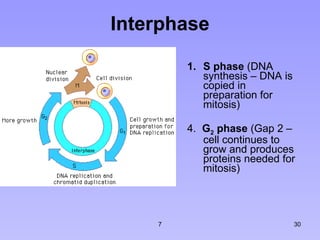
Interphase Interphase has 4 sub-phases 1.  G 1  phase  (Gap 1 – growth, normal cell activities, preparation for DNA replication)  During G 1 , cells can enter 2.  G 0  phase  (Gap 0 or nondividing cells) a. Cells still metabolically active, just not making new cells. b. Examples - Nerve cells do not re-enter G 1 - Muscle, liver cells can re-enter G 1  if damaged 7
Interphase S phase  (DNA synthesis – DNA is copied in preparation for mitosis) 4.  G 2  phase  (Gap 2 – cell continues to grow and produces proteins needed for mitosis) 7
Mitosis Mitosis – replicated DNA distributed to daughter cells Cytokinesis  – cytoplasm divided between daughter cells.  - Happens at the very end of mitosis 7
http://www.cellsalive.com/cell_cycle.htm 7
Mitosis Vocabulary Chromosomes Molecules of DNA complexed with specific proteins responsible in eukaryotes for storage and transmission of genetic information.  Chromatin   Protein/DNA complex making the chromosome Chromatid   Each of a pair of identical DNA molecules after DNA replication, joined at the  centromere .  Histones   Proteins forming complexes with Eukaryotic DNA.  7
Mitosis Vocabulary Centromere The point at which two chromatids of a chromosome join and at which the spindle fibers attach during cell division Spindle fibers a network of microtubule fibers along which chromosomes are drawn apart during mitosis 7
Mitosis Mitosis further divided into 4 phases: 1. Prophase 2. Metaphase 3. Anaphase 4. Telophase 7
Mitosis Animation:  http://www.mhhe.com/biosci/esp/2001_gbio/default. htm ABC # 16 7
Mitosis Prophase  Nuclear envelope breaks down Chromatin condenses into chromosomes (each with two sister  chromatids ) and becomes visible Microtubules begin to assemble into the  mitotic spindle Spindle attaches to chromosomes at the  centromere 7
Mitosis Metaphase Chromosomes align at the center of the cell 7
Mitosis Anaphase  - chromatids  (daughter chromosomes) are pulled apart by the spindle fibers and begin moving to the cell poles  7
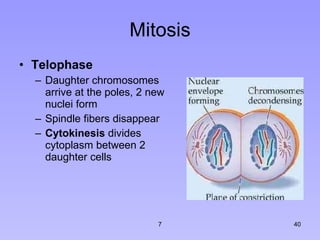
Mitosis Telophase  Daughter chromosomes arrive at the poles, 2 new nuclei form Spindle fibers disappear  Cytokinesis  divides cytoplasm between 2 daughter cells 7
7
Mitosis Animation:  Repeat  http://www.mhhe.com/biosci/esp/2001_gbio/default.htm http://www.cellsalive.com/mitosis.htm Also consult  http://www.mhhe.com/biosci/esp/2001_gbio/default.htm  for general Biology help 7
Mitosis 7
Mitosis 7
DNA Replication 7
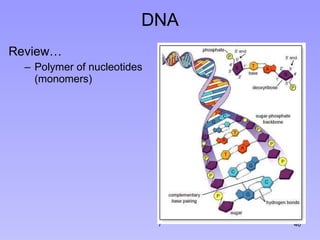
DNA Review… Polymer of nucleotides (monomers) 7
DNA Nucleotides made of 5 carbon sugar   Deoxyribose (DNA) – missing an –OH group 7
DNA Phosphate group  – link sugars together into sugar-phosphate backbone 7
DNA Nitrogenous base   a. Purines (large double ring organic base)  1. Adenine (A) 2. Guanine (G) b. Pyrimidines (single ringed organic base) 1. Cytosine (C) 2. Thymine (T) 3. Uracil (U) – found only in  RNA 7
DNA DNA polymer made by combining monomers (nucleotides) in specific order.    -  Catalyzed by enzyme DNA polymerase  7
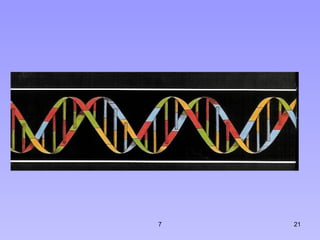
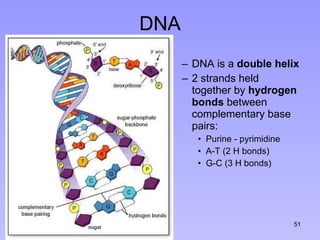
DNA DNA is a  double helix   2 strands held together by  hydrogen bonds  between complementary base pairs: Purine - pyrimidine A-T (2 H bonds) G-C (3 H bonds) 7
The two DNA strands are  anti-parallel  (run in opposite directions) Both strands go in the 5’ to 3’ direction 7
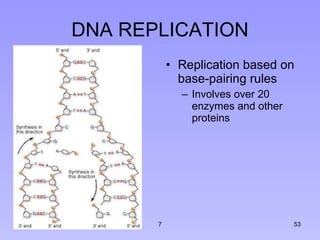
DNA REPLICATION Replication based on base-pairing rules Involves over 20 enzymes and other proteins 7
Animation http://www.mhhe.com/biosci/esp/2001_gbio/folder_structure/ge/m4/s2/index.htm 7
Helicase  unzips the DNA double helix by breaking the H-bonds between bases, forming a replication bubble There are multiple bubbles on each eukaryotic chromosome 7
DNA polymerase adds nucleotides to the new DNA strand according to base-pairing rules  The entire length of the DNA molecule is replicated as the bubbles meet.  7
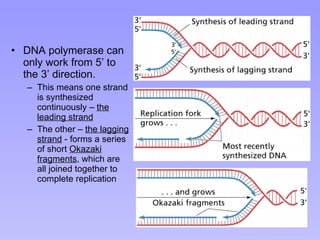
DNA polymerase can only work from 5’ to the 3’ direction.  This means one strand is synthesized continuously –  the leading strand The other –  the lagging strand  - forms a series of short  Okazaki fragments , which are all joined together to complete replication 7
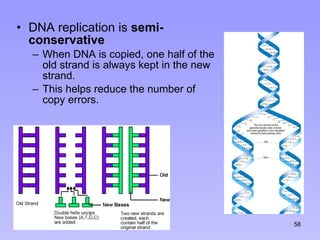
DNA replication is  semi-conservative When DNA is copied, one half of the old strand is always kept in the new strand.  This helps reduce the number of copy errors. 7
DNA REPLICATION Results in two  exact  copies of DNA. Highly accurate — only one error for every 2x10 9  (billion) nucleotides. Any error (mutation) can be harrmful, even deadly, but a few can cause beneficial change. 7
Practice replicating… 7
Histones What are histones? Proteins that form complexes with eukaryotic DNA  DNA wraps around histones to form  nucleosomes Consist of many  basic  amino acids, so they have a strong  positive charge 7
7
Histones What do histones do? Allow negatively-charged DNA (nucleic acid) to be packed into small space of the nucleus Help control which DNA can be used to make proteins (more on this later…  ) 7
Lab 8B 7
Control of Cell Cycle Review cell cycle and mitosis 7
What would happen if cells divided whenever they “felt” like it?  7
7
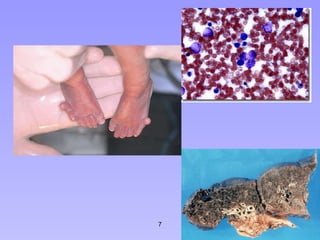
God is a God of order, not chaos. This is true of our world and of our bodies! Every activity in our bodies is remarkably and precisely controlled and coordinated through chemical signals (hormones, neurotransmitters) Breakdown in control, coordination is called disease  7
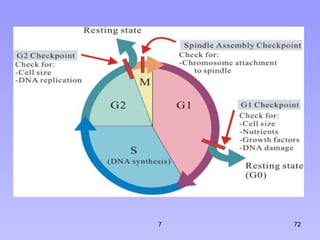
Our Creator has placed controls called  checkpoints  throughout the cell cycle to keep it under control. 7
What controls the cell cycle? The cell receives chemical signals that stimulate or restrict it from continuing the cycle -  CHECKPOINTS 7
Checkpoint #1 1. The cell growth checkpoint (G 1 ) Is the cell large/mature enough? Is the DNA intact, ready to be copied? If “yes”, proteins called cyclins, acting as chemical signals, cause the cell to enter the  S   phase . If “no”, the cell cycle stops and the cell enters the G 0  phase.  (nerve cells) 7
7
Checkpoint #2 2. DNA synthesis checkpoint (G 2 ) Did DNA replication occur without error? (Repair enzymes check the DNA) If “yes”, different cyclins trigger  mitosis If “no”, the DNA repair enzymes try to correct the problem so the cell can continue the cell cycle. 7
7
Checkpoint #3 3. Mitosis/Spindle Assembly Checkpoint Can mitosis proceed without errors? If “yes”, mitosis can be completed and the G 1  phase can begin.  The cell can return to Interphase. 7
Sometimes the checkpoint controls are damaged by… Mutation - any change in the nucleotide sequence of DNA A single base or a larger piece of DNA can be accidentally added, deleted or changed  Change in DNA   of a  gene  can change which amino acid goes in the protein it produces. This can change the structure/function of the protein. Cancer 7
Cancer Cells cannot stop dividing and go through uncontrolled cell division, becoming cancerous cells  Cancer  refers to  any abnormal growth of cells . Tumor is a mass of cancerous cells 7
Cancer Types of tumors Benign  tumors do not spread beyond their original area of growth Can be harmful if they grow large enough to interfere with normal body function Examples – lipoma, tumors on acoustic (hearing) nerve, meningiomas 7
Cancer Malignant tumors can metastasize -  spread to other parts of the body and establish new colonies These are the most familiar “bad guys” – lung, colon, melanoma, breast, pancreatic and other cancers What are some things that you know of that cause cancer? 7
7
Cancer Carcinogens/mutagens  are agents known to cause cancer/mutations Radiation X-rays UV light from the sun and tanning lamps Carcinogens Nicotine, tar (mainly from tobacco products) Asbestos PVC’s Alcohol Viruses Hepatitis B Herpes  Papilloma virus (HPV) Many cancers also have a genetic component (run in families) like breast, colon, lung and some leukemias 7
Cancer and the Cell Cycle At a very basic level, cancer is usually due to one of the following factors: 1.  Oncogenes -  mutations cause normal “go” genes to become cancer-causing genes  Normally, proto-oncogenes act  with  a growth factor to stimulate cell division. Mutation causes proto-oncogene to become an oncogene that “tells” the cell to divide without the presence of a growth factor (by-passes checkpoints) Cells start dividing and keep dividing with no control mechanism to stop them. 7
7
7
Cells also contain “brake” genes that keep dividing cells from becoming tumors.  These genes are called… 2.  Tumor-Suppressor genes  -  mutations to tumor suppressor genes ‘inactivate’ them.  This cell cycle ‘brake’ is removed. Checkpoint proteins are inactivated  With no inhibitors to stop it, the cell begins rapid and out of control division.  Many cancer cells result from mutations in tumor-suppressor genes. 7
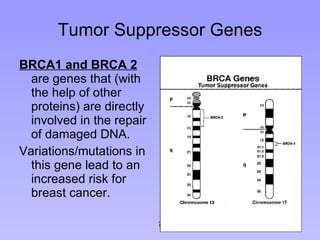
Tumor Suppressor Genes BRCA1 and BRCA 2  are genes that (with the help of other proteins) are directly involved in the repair of damaged DNA. Variations/mutations in this gene lead to an increased risk for breast cancer. 7
Tumor Suppressor Genes p53  is a protein that blocks the cell cycle at the G 2  checkpoint if the DNA is damaged. Normal p53 function gives the cell time to repair its DNA 7
Tumor Suppressor Genes Cells with mutant p53 can’t inhibit the growth of abnormal cells.  A p53 mutation is the most frequent mutation found in cancer cells.  p53 is mutant in about 50% of all cancers.   7
FIGHTING CANCER Surgery – many solid tumors can be removed. Radiation – Kills cells by damaging DNA  Most effective when aimed at a particular region of the body.  7
FIGHTING CANCER Chemotherapy – using chemicals (drugs) to attack  rapidly dividing cells Drugs typically interfere with DNA replication or cell division Antimetabolites  look like normal nutrients, but once incorporated into cell cause it to die Methotrexate Helicase inhibitors  – prevent DNA from unzipping, so it can’t replicate Alkyloids  – disrupt the mitotic spindle so chromatids don’t separate Vinchristine (from vinca plants) 7
FIGHTING CANCER Also harms normal healthy cells which divide frequently White blood cells, lining of digestive tract, hair 7
7
GENE EXPRESSION A single segment of DNA can have thousands of protein-coding regions. How does a cell know where to start transcription? How does a cell know which is the coding strand? How does a cell know when to stop the protein synthesis? 7
7
7
GENE EXPRESSION Genes have four regions: The promoter region Protein coding region Termination sequence  Regulatory region(s) The promoter is a specific sequence (recognized by RNA polymerase) found upstream of the protein coding sequence of a DNA. 7
CODON Here are examples of codons: AUG codes for a start UAA, UAG, and UGA code for a  stop The other 61 remaining codons code for amino acids.  The human genome has 46 chromosomes and about 5,000,000,000 base pairs. 7
GENE EXPRESSION RNA polymerase finishes making an RNA when it encounters the termination site. The mRNA is then used to translate to direct protein synthesis.  A gene is expressed when its product, usually a protein, is produced for use by the cell. 7
GENE EXPRESSION Regulatory regions are important as to when and how genes are expressed. Gene regulation works by using proteins that bind to the regulatory regions. These proteins are called  transcription factors  and are only present at certain times and make the promoter region more noticeable.  7
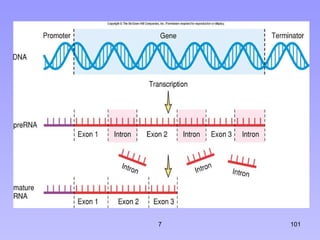
SPLICING  Unlike in prokayotic cells, in eukaryoatic cells, transcription of the protein-coding regions are not continuous.  Transcription starts at the promoter and finishes at the termination site. The regions that are not needed (introns) are spliced (removed).  7
7
GENETIC ENGINEERING  AND BIOTECHNOLOGY Knowledge of the biology of DNA has resulted in major advances in: Medicine Agriculture  Industry Environmental sciences   We now have organisms with genetic changes in their DNA known as genetically modified (GM) or transgenic organisms. 7
DNA and CHROMOSOMES When the chromatin fiber is condensed it is referred to as a chromosome.  7
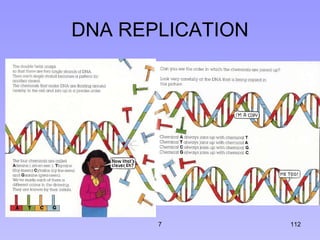
During replication of the DNA molecule, each strand serves as a template (model) for the assembly of a new strand. The DNA strands separate, and free, unattached nucleotides associate with their complementary bases through hydrogen bonding. DNA polymerase is the enzyme that adds nucleotides to the newly-forming strand. Ultimately two DNA complexes are formed, each containing one old strand and one newly formed strand.  7
www.pbs.org/faithandreason/media/chrom-body.html   7
7
7
7
Mitosis 7
DNA All cell’s activities are controlled by its DNA DNA found in the nucleus Chromosomes are made of DNA  Genes are specific sections of DNA that code for proteins   Not all DNA codes for proteins 7
DNA REPLICATION Copying DNA  when a cell is preparing to divide into 2 identical cells (daughter cells) Each daughter cell keeps the same amount of DNA. 7
DNA REPLICATION 7
MUTATION Types of mutations: 1 base is substituted for another, and the amino acid changes TH Q  ONE BIG FLY HAD ONE RED EYE Frameshift  – 1 base is added or deleted THE ONE  Q BI GFL YHA DON ERE DEY E (insertion) TEO NEB IGF LYH ADO NER EDE YE (deletion) Nonsense  – base change codes for a stop codon, so the protein is incomplete. THE ONE BIG FLY THE ONE BIG FLY HAD ONE RED EYE 7
Sometimes the checkpoint controls are damaged… … a cell repeatedly divides (ignoring checkpoint commands)… What is this condition called? CANCER Cells that repeatedly divide may form a mass of cells called a… TUMOR So, what is cancer? It is a cell division disorder.  It occurs when the cell cycle malfunctions. 7

DNA replication

  • 1.
  • 2.
  • 3.
  • 4.
  • 5.
  • 6.
  • 7.
  • 8.
    DNA is Hereto Stay By Dr. Fran Balkwill and Mic Rolph 7
  • 9.
  • 10.
  • 11.
  • 12.
  • 13.
  • 14.
  • 15.
  • 16.
  • 17.
  • 18.
  • 19.
  • 20.
  • 21.
  • 22.
  • 23.
    The Cell Cycleand DNA Replication 7
  • 24.
  • 25.
  • 26.
    The Cell CycleTo understand how organisms grow and develop, we will study how cells make copies of themselves. We will study the Cell Cycle and two of its components: DNA replication (copying genetic information so that both new cells have exactly the same DNA) Mitosis (dividing one cell into two) 7
  • 27.
    The lifespan ofa eukaryotic is best described as a circle (as opposed to a line) As a cell grows, it reaches a point where it gets big enough to divide. To do this, all the DNA and other cellular components must be copied and shared equally. Thus one cell becomes two identical daughter cells in a process called mitosis. 7
  • 28.
    Phases of theCell Cycle Cell Cycle can be divided into 2 main parts: 1. Interphase - the period between cell divisions Chromosomes are not visible in the nucleus 2. Mitosis – cell division Chromosomes visible 7
  • 29.
    Interphase Interphase has4 sub-phases 1. G 1 phase (Gap 1 – growth, normal cell activities, preparation for DNA replication) During G 1 , cells can enter 2. G 0 phase (Gap 0 or nondividing cells) a. Cells still metabolically active, just not making new cells. b. Examples - Nerve cells do not re-enter G 1 - Muscle, liver cells can re-enter G 1 if damaged 7
  • 30.
    Interphase S phase (DNA synthesis – DNA is copied in preparation for mitosis) 4. G 2 phase (Gap 2 – cell continues to grow and produces proteins needed for mitosis) 7
  • 31.
    Mitosis Mitosis –replicated DNA distributed to daughter cells Cytokinesis – cytoplasm divided between daughter cells. - Happens at the very end of mitosis 7
  • 32.
  • 33.
    Mitosis Vocabulary ChromosomesMolecules of DNA complexed with specific proteins responsible in eukaryotes for storage and transmission of genetic information. Chromatin Protein/DNA complex making the chromosome Chromatid Each of a pair of identical DNA molecules after DNA replication, joined at the centromere . Histones Proteins forming complexes with Eukaryotic DNA. 7
  • 34.
    Mitosis Vocabulary CentromereThe point at which two chromatids of a chromosome join and at which the spindle fibers attach during cell division Spindle fibers a network of microtubule fibers along which chromosomes are drawn apart during mitosis 7
  • 35.
    Mitosis Mitosis furtherdivided into 4 phases: 1. Prophase 2. Metaphase 3. Anaphase 4. Telophase 7
  • 36.
    Mitosis Animation: http://www.mhhe.com/biosci/esp/2001_gbio/default. htm ABC # 16 7
  • 37.
    Mitosis Prophase Nuclear envelope breaks down Chromatin condenses into chromosomes (each with two sister chromatids ) and becomes visible Microtubules begin to assemble into the mitotic spindle Spindle attaches to chromosomes at the centromere 7
  • 38.
    Mitosis Metaphase Chromosomesalign at the center of the cell 7
  • 39.
    Mitosis Anaphase - chromatids (daughter chromosomes) are pulled apart by the spindle fibers and begin moving to the cell poles 7
  • 40.
    Mitosis Telophase Daughter chromosomes arrive at the poles, 2 new nuclei form Spindle fibers disappear Cytokinesis divides cytoplasm between 2 daughter cells 7
  • 41.
  • 42.
    Mitosis Animation: Repeat http://www.mhhe.com/biosci/esp/2001_gbio/default.htm http://www.cellsalive.com/mitosis.htm Also consult http://www.mhhe.com/biosci/esp/2001_gbio/default.htm for general Biology help 7
  • 43.
  • 44.
  • 45.
  • 46.
    DNA Review… Polymerof nucleotides (monomers) 7
  • 47.
    DNA Nucleotides madeof 5 carbon sugar Deoxyribose (DNA) – missing an –OH group 7
  • 48.
    DNA Phosphate group – link sugars together into sugar-phosphate backbone 7
  • 49.
    DNA Nitrogenous base a. Purines (large double ring organic base) 1. Adenine (A) 2. Guanine (G) b. Pyrimidines (single ringed organic base) 1. Cytosine (C) 2. Thymine (T) 3. Uracil (U) – found only in RNA 7
  • 50.
    DNA DNA polymermade by combining monomers (nucleotides) in specific order. - Catalyzed by enzyme DNA polymerase 7
  • 51.
    DNA DNA isa double helix 2 strands held together by hydrogen bonds between complementary base pairs: Purine - pyrimidine A-T (2 H bonds) G-C (3 H bonds) 7
  • 52.
    The two DNAstrands are anti-parallel (run in opposite directions) Both strands go in the 5’ to 3’ direction 7
  • 53.
    DNA REPLICATION Replicationbased on base-pairing rules Involves over 20 enzymes and other proteins 7
  • 54.
  • 55.
    Helicase unzipsthe DNA double helix by breaking the H-bonds between bases, forming a replication bubble There are multiple bubbles on each eukaryotic chromosome 7
  • 56.
    DNA polymerase addsnucleotides to the new DNA strand according to base-pairing rules The entire length of the DNA molecule is replicated as the bubbles meet. 7
  • 57.
    DNA polymerase canonly work from 5’ to the 3’ direction. This means one strand is synthesized continuously – the leading strand The other – the lagging strand - forms a series of short Okazaki fragments , which are all joined together to complete replication 7
  • 58.
    DNA replication is semi-conservative When DNA is copied, one half of the old strand is always kept in the new strand. This helps reduce the number of copy errors. 7
  • 59.
    DNA REPLICATION Resultsin two exact copies of DNA. Highly accurate — only one error for every 2x10 9 (billion) nucleotides. Any error (mutation) can be harrmful, even deadly, but a few can cause beneficial change. 7
  • 60.
  • 61.
    Histones What arehistones? Proteins that form complexes with eukaryotic DNA DNA wraps around histones to form nucleosomes Consist of many basic amino acids, so they have a strong positive charge 7
  • 62.
  • 63.
    Histones What dohistones do? Allow negatively-charged DNA (nucleic acid) to be packed into small space of the nucleus Help control which DNA can be used to make proteins (more on this later…  ) 7
  • 64.
  • 65.
    Control of CellCycle Review cell cycle and mitosis 7
  • 66.
    What would happenif cells divided whenever they “felt” like it? 7
  • 67.
  • 68.
    God is aGod of order, not chaos. This is true of our world and of our bodies! Every activity in our bodies is remarkably and precisely controlled and coordinated through chemical signals (hormones, neurotransmitters) Breakdown in control, coordination is called disease 7
  • 69.
    Our Creator hasplaced controls called checkpoints throughout the cell cycle to keep it under control. 7
  • 70.
    What controls thecell cycle? The cell receives chemical signals that stimulate or restrict it from continuing the cycle - CHECKPOINTS 7
  • 71.
    Checkpoint #1 1.The cell growth checkpoint (G 1 ) Is the cell large/mature enough? Is the DNA intact, ready to be copied? If “yes”, proteins called cyclins, acting as chemical signals, cause the cell to enter the S phase . If “no”, the cell cycle stops and the cell enters the G 0 phase. (nerve cells) 7
  • 72.
  • 73.
    Checkpoint #2 2.DNA synthesis checkpoint (G 2 ) Did DNA replication occur without error? (Repair enzymes check the DNA) If “yes”, different cyclins trigger mitosis If “no”, the DNA repair enzymes try to correct the problem so the cell can continue the cell cycle. 7
  • 74.
  • 75.
    Checkpoint #3 3.Mitosis/Spindle Assembly Checkpoint Can mitosis proceed without errors? If “yes”, mitosis can be completed and the G 1 phase can begin. The cell can return to Interphase. 7
  • 76.
    Sometimes the checkpointcontrols are damaged by… Mutation - any change in the nucleotide sequence of DNA A single base or a larger piece of DNA can be accidentally added, deleted or changed Change in DNA of a gene can change which amino acid goes in the protein it produces. This can change the structure/function of the protein. Cancer 7
  • 77.
    Cancer Cells cannotstop dividing and go through uncontrolled cell division, becoming cancerous cells Cancer refers to any abnormal growth of cells . Tumor is a mass of cancerous cells 7
  • 78.
    Cancer Types oftumors Benign tumors do not spread beyond their original area of growth Can be harmful if they grow large enough to interfere with normal body function Examples – lipoma, tumors on acoustic (hearing) nerve, meningiomas 7
  • 79.
    Cancer Malignant tumorscan metastasize - spread to other parts of the body and establish new colonies These are the most familiar “bad guys” – lung, colon, melanoma, breast, pancreatic and other cancers What are some things that you know of that cause cancer? 7
  • 80.
  • 81.
    Cancer Carcinogens/mutagens are agents known to cause cancer/mutations Radiation X-rays UV light from the sun and tanning lamps Carcinogens Nicotine, tar (mainly from tobacco products) Asbestos PVC’s Alcohol Viruses Hepatitis B Herpes Papilloma virus (HPV) Many cancers also have a genetic component (run in families) like breast, colon, lung and some leukemias 7
  • 82.
    Cancer and theCell Cycle At a very basic level, cancer is usually due to one of the following factors: 1. Oncogenes - mutations cause normal “go” genes to become cancer-causing genes Normally, proto-oncogenes act with a growth factor to stimulate cell division. Mutation causes proto-oncogene to become an oncogene that “tells” the cell to divide without the presence of a growth factor (by-passes checkpoints) Cells start dividing and keep dividing with no control mechanism to stop them. 7
  • 83.
  • 84.
  • 85.
    Cells also contain“brake” genes that keep dividing cells from becoming tumors. These genes are called… 2. Tumor-Suppressor genes - mutations to tumor suppressor genes ‘inactivate’ them. This cell cycle ‘brake’ is removed. Checkpoint proteins are inactivated With no inhibitors to stop it, the cell begins rapid and out of control division. Many cancer cells result from mutations in tumor-suppressor genes. 7
  • 86.
    Tumor Suppressor GenesBRCA1 and BRCA 2 are genes that (with the help of other proteins) are directly involved in the repair of damaged DNA. Variations/mutations in this gene lead to an increased risk for breast cancer. 7
  • 87.
    Tumor Suppressor Genesp53 is a protein that blocks the cell cycle at the G 2 checkpoint if the DNA is damaged. Normal p53 function gives the cell time to repair its DNA 7
  • 88.
    Tumor Suppressor GenesCells with mutant p53 can’t inhibit the growth of abnormal cells. A p53 mutation is the most frequent mutation found in cancer cells. p53 is mutant in about 50% of all cancers. 7
  • 89.
    FIGHTING CANCER Surgery– many solid tumors can be removed. Radiation – Kills cells by damaging DNA Most effective when aimed at a particular region of the body. 7
  • 90.
    FIGHTING CANCER Chemotherapy– using chemicals (drugs) to attack rapidly dividing cells Drugs typically interfere with DNA replication or cell division Antimetabolites look like normal nutrients, but once incorporated into cell cause it to die Methotrexate Helicase inhibitors – prevent DNA from unzipping, so it can’t replicate Alkyloids – disrupt the mitotic spindle so chromatids don’t separate Vinchristine (from vinca plants) 7
  • 91.
    FIGHTING CANCER Alsoharms normal healthy cells which divide frequently White blood cells, lining of digestive tract, hair 7
  • 92.
  • 93.
    GENE EXPRESSION Asingle segment of DNA can have thousands of protein-coding regions. How does a cell know where to start transcription? How does a cell know which is the coding strand? How does a cell know when to stop the protein synthesis? 7
  • 94.
  • 95.
  • 96.
    GENE EXPRESSION Geneshave four regions: The promoter region Protein coding region Termination sequence Regulatory region(s) The promoter is a specific sequence (recognized by RNA polymerase) found upstream of the protein coding sequence of a DNA. 7
  • 97.
    CODON Here areexamples of codons: AUG codes for a start UAA, UAG, and UGA code for a stop The other 61 remaining codons code for amino acids. The human genome has 46 chromosomes and about 5,000,000,000 base pairs. 7
  • 98.
    GENE EXPRESSION RNApolymerase finishes making an RNA when it encounters the termination site. The mRNA is then used to translate to direct protein synthesis. A gene is expressed when its product, usually a protein, is produced for use by the cell. 7
  • 99.
    GENE EXPRESSION Regulatoryregions are important as to when and how genes are expressed. Gene regulation works by using proteins that bind to the regulatory regions. These proteins are called transcription factors and are only present at certain times and make the promoter region more noticeable. 7
  • 100.
    SPLICING Unlikein prokayotic cells, in eukaryoatic cells, transcription of the protein-coding regions are not continuous. Transcription starts at the promoter and finishes at the termination site. The regions that are not needed (introns) are spliced (removed). 7
  • 101.
  • 102.
    GENETIC ENGINEERING AND BIOTECHNOLOGY Knowledge of the biology of DNA has resulted in major advances in: Medicine Agriculture Industry Environmental sciences We now have organisms with genetic changes in their DNA known as genetically modified (GM) or transgenic organisms. 7
  • 103.
    DNA and CHROMOSOMESWhen the chromatin fiber is condensed it is referred to as a chromosome. 7
  • 104.
    During replication ofthe DNA molecule, each strand serves as a template (model) for the assembly of a new strand. The DNA strands separate, and free, unattached nucleotides associate with their complementary bases through hydrogen bonding. DNA polymerase is the enzyme that adds nucleotides to the newly-forming strand. Ultimately two DNA complexes are formed, each containing one old strand and one newly formed strand. 7
  • 105.
  • 106.
  • 107.
  • 108.
  • 109.
  • 110.
    DNA All cell’sactivities are controlled by its DNA DNA found in the nucleus Chromosomes are made of DNA Genes are specific sections of DNA that code for proteins Not all DNA codes for proteins 7
  • 111.
    DNA REPLICATION CopyingDNA when a cell is preparing to divide into 2 identical cells (daughter cells) Each daughter cell keeps the same amount of DNA. 7
  • 112.
  • 113.
    MUTATION Types ofmutations: 1 base is substituted for another, and the amino acid changes TH Q ONE BIG FLY HAD ONE RED EYE Frameshift – 1 base is added or deleted THE ONE Q BI GFL YHA DON ERE DEY E (insertion) TEO NEB IGF LYH ADO NER EDE YE (deletion) Nonsense – base change codes for a stop codon, so the protein is incomplete. THE ONE BIG FLY THE ONE BIG FLY HAD ONE RED EYE 7
  • 114.
    Sometimes the checkpointcontrols are damaged… … a cell repeatedly divides (ignoring checkpoint commands)… What is this condition called? CANCER Cells that repeatedly divide may form a mass of cells called a… TUMOR So, what is cancer? It is a cell division disorder. It occurs when the cell cycle malfunctions. 7

Editor's Notes

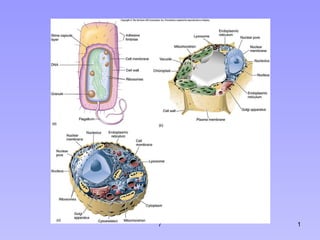
  • #2 Started out learning about cells
  • #3 Learned about what cells are made of:
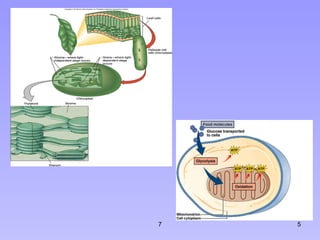
  • #4 Proteins, dna
  • #5 Membranes, mbr transport, excretory system, respiratory system, and CV system
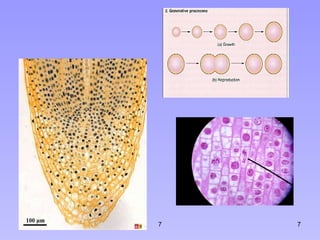
  • #7 Now we’re going to see how organisms grow
  • #8 And how they reproduce.
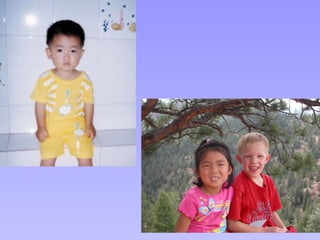
  • #9 Start with one of my kids’ favorite bedtime stories…
  • #25 Now we’re going to see how organisms grow
  • #26 And how they reproduce.
  • #28 Organisms are born, grow, then die, but cells are more circular.
  • #29 Chromosomes are visible in the nucleus
  • #30 Cells may appear inactive during this stage, but they are quite the opposite. This is the longest period of the complete cell cycle during which DNA replicates, the centrioles divide, and proteins are actively produced.
  • #34 kinetochore Structure forming at centromere during Mitosis for binding microtubules. Nucleosomes Basic structural unit of eukaryotic chromosome forming "beads on a string."
  • #38 Microtubules of the cytoskeleton from the region of the centrioles.
  • #41 that have pulled them apart
  • #46 We’ve studied cell cycle, taken apart mitosis, and now we’ll dissect DNA replication
  • #53 Antiparallel is like a divided highway
  • #54 During replication of the DNA molecule, each strand serves as a template for the assembly of a new strand. The DNA strands separate, and free, unattached nucleotides associate with their complementary bases through hydrogen bonding. DNA polymerase, the enzyme that adds nucleotides to the newly-forming strand, can add them only at the 3' end. Ultimately, two DNA duplexes are formed, each containing one old strand and one newly formed strand. This is called semiconservative replication.
  • #57 DNA synthesis begins in both directions in many places along the DNA. These are called replication bubbles .
  • #65 Lab 8b: 13, 7, 11, 9 16, 2, 12, 33
  • #66 Draw on board
  • #67 Ideas? One arm or leg longer than the other, anemia (low RBC count), wounds wouldn’t heal, cancer Growth would be uncoordinated, not controlled
  • #68 Child with trisomy 13 Patau syndrome, lung cancer, acute myologenous leukemia Myelomonocytic Leukemia (Acute) Leukemias are a group of diseases characterized by an abnormal proliferation of white blood cells . Acute and chronic leukemias are differentiated by the maturity level of the cells they affect. Acute forms affect immature cells, hindering them from completing their development, and chronic forms involve atypical mature cells.
  • #71 2 way system at each point; both gas and brakes. You have to have a “go” signal and a “get off the brakes” signal.
  • #78 melanoma
  • #81 Student ideas
  • #87 p27 is a protein that blocks some cells from entering the S phase of the cell cycle. Recent research suggests that breast cancer prognosis is determined by p27 levels. Reduced levels of p27 predict a poor outcome for breast cancer patients. (Nat. Med. 3, 152 (97))
  • #91 Alkylating agents – severely damage DNA so that it can’t be repaired, so cell is destroyed Plant
  • #92 Toxic – usually must be administered right into blood vessels. If spilled on skin, very harmful
  • #96 Trisomy 13
  • #110 Once chromosomes are in the center of the spindle, the sister chromatids separate and move in opposite directions. At the end of mitosis there are 2 nuclei, each with a complete set of chromosomes
  • #111 Organisms can have 1 -82 (turkeys) chromosomes