GREENA JOSHY
S5 BT
ROLL NO - 21
In all prokaryotic and eukaryotic
organisms,
three main classes of RNA molecules
exist-
1) Messenger RNA(m RNA)
2) Transfer RNA (t RNA)
3) Ribosomal RNA (r RNA)
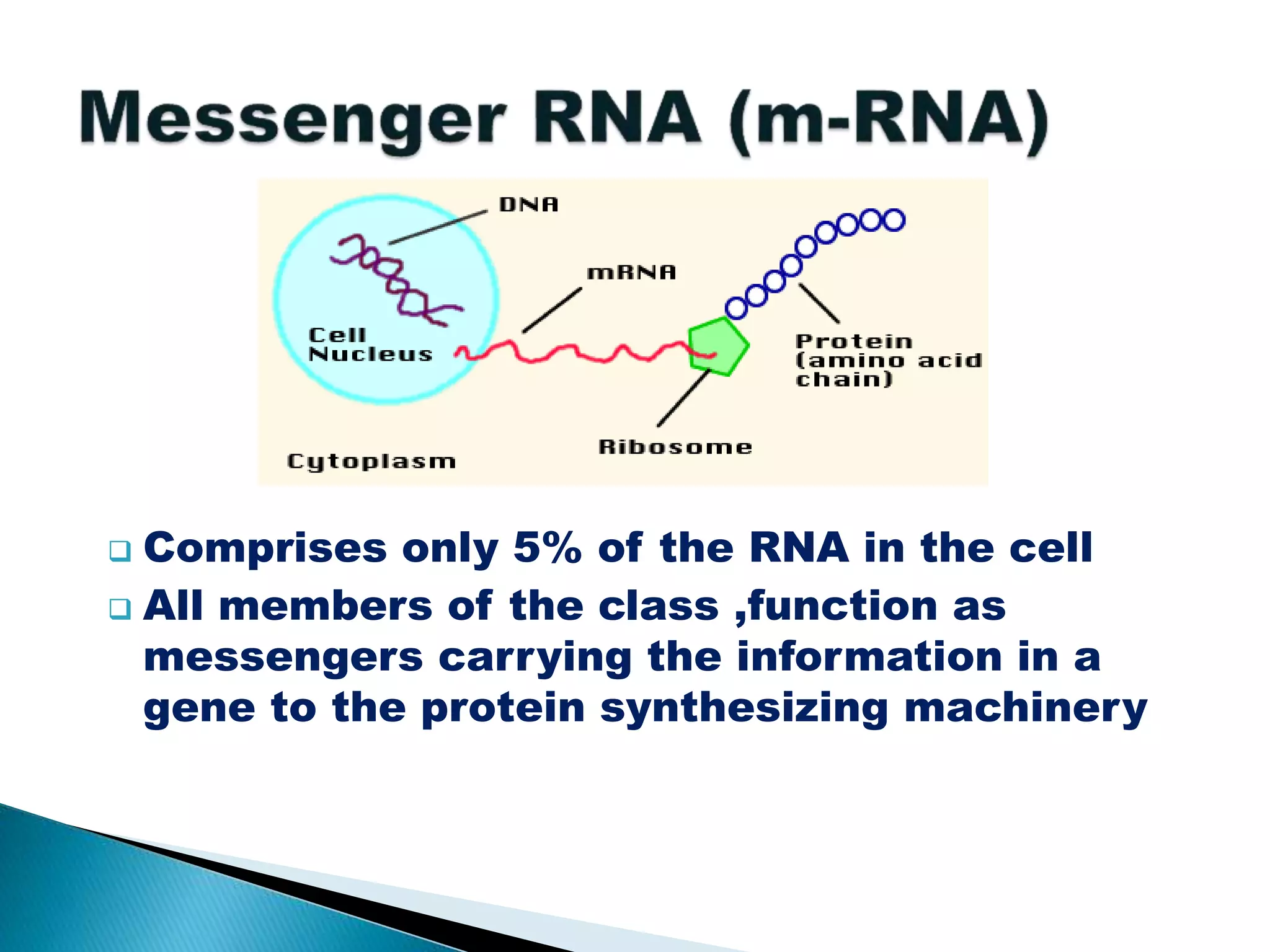
 Comprises only 5% of the RNA in the cell
 All members of the class ,function as
messengers carrying the information in a
gene to the protein synthesizing machinery
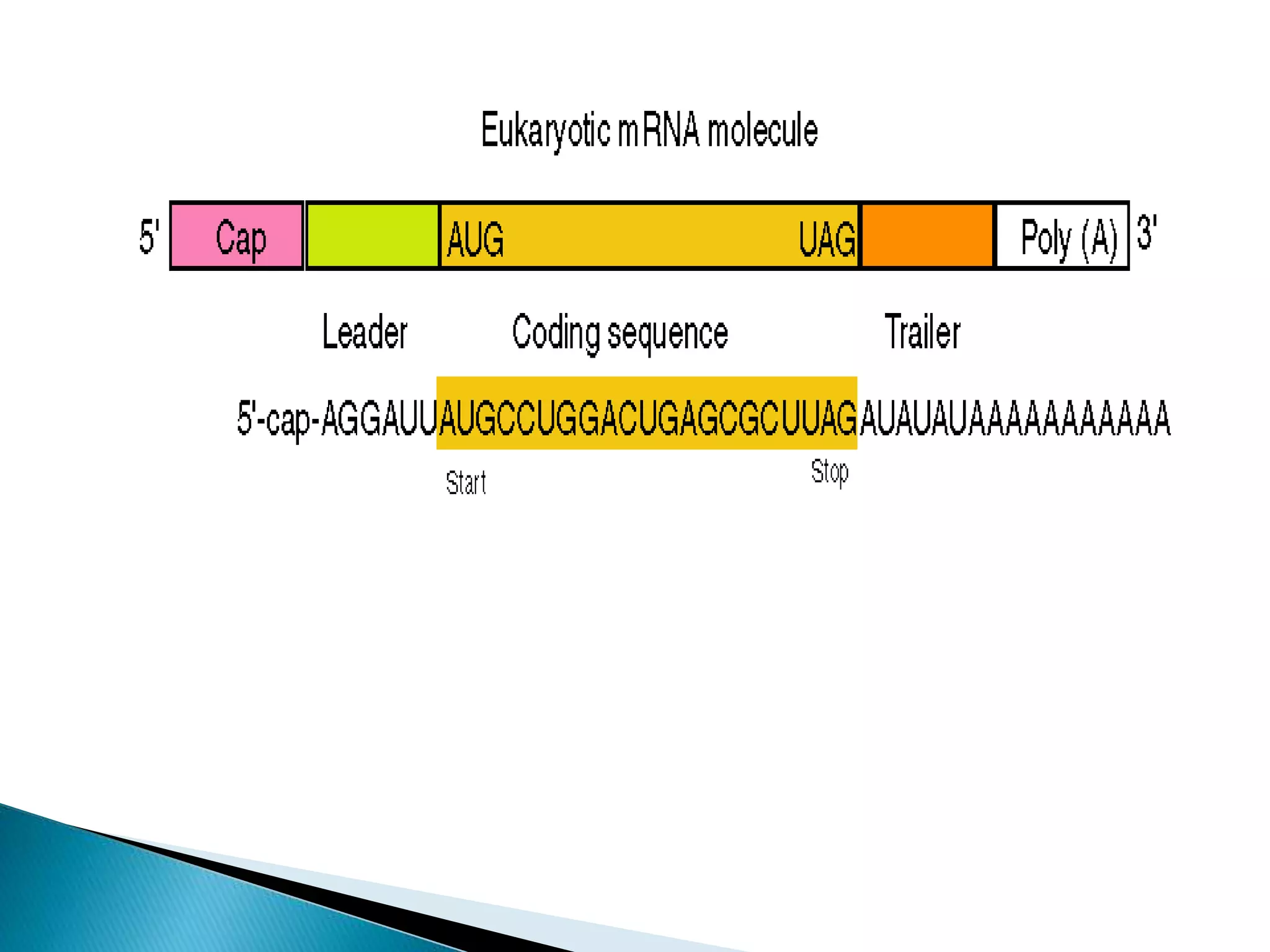
The 5’ terminal end is capped
by 7- methyl guanosine
triphosphate cap.
The cap is involved in the
recognition of mRNA by the
translating machinery
It stabilizes m RNA by
protecting it from 5’
exonuclease
 The 3’end of most m-RNAs have a
polymer of Adenylate residues
 The tail prevents the attack by 3’
exonucleases
 On both 5’ and 3’ end there are non
coding sequences which are not
translated
 The intervening region between non
coding sequences present between 5’
and 3’ end is called coding region. This
region encodes for the synthesis of a
protein.
 The m- RNA molecules are formed with
the help of DNA template during the
process of transcription.
 The sequence of nucleotides in m RNA
is complementary to the sequence of
nucleotides on template DNA.
 The sequence carried on m -RNA is
read in the form of codons.
 A codon is made up of 3 nucleotides
 The m-RNA is formed after processing
of heterogeneous nuclear RNA
8
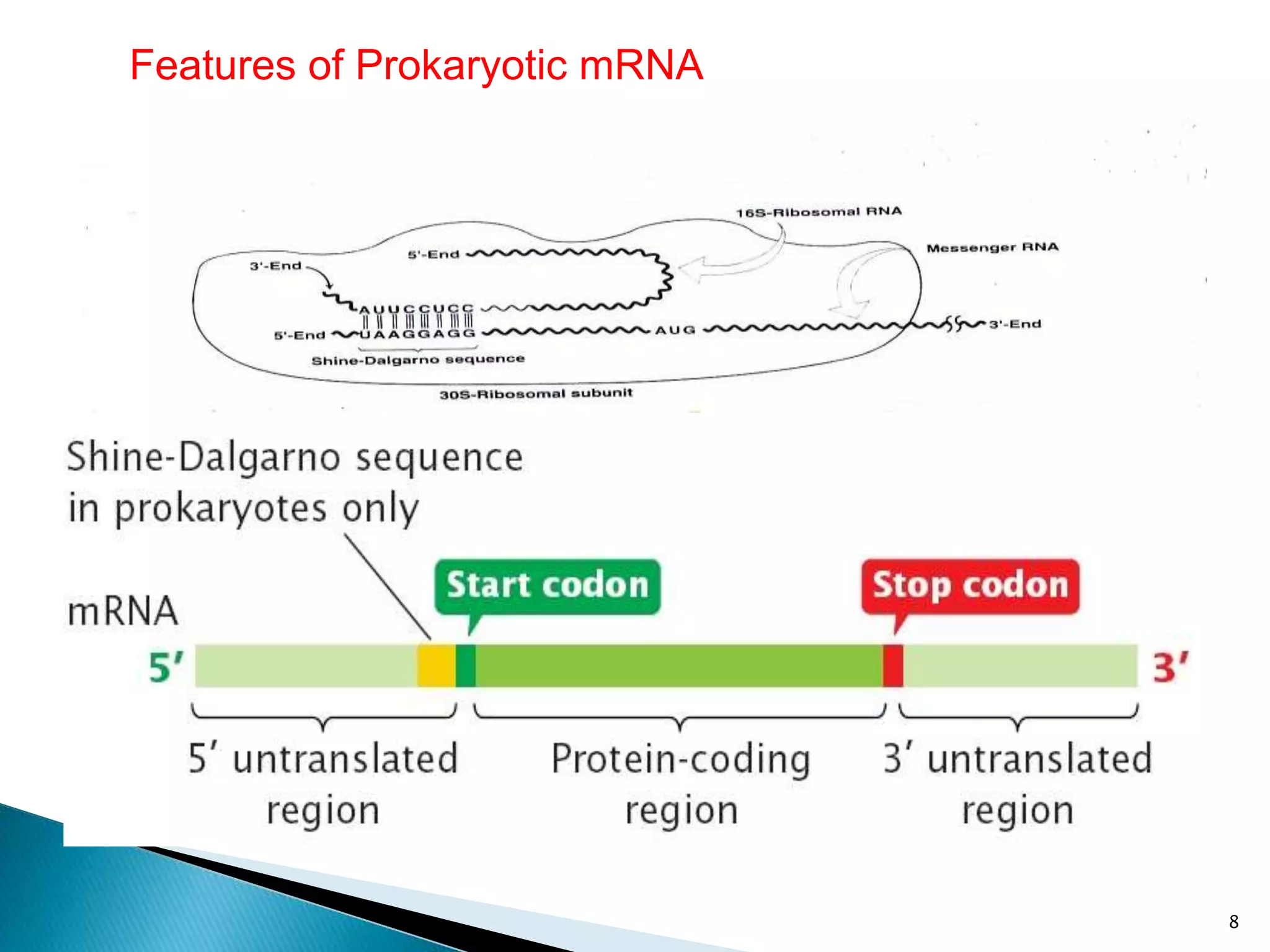
Features of Prokaryotic mRNA
Transfer RNA are the smallest of three major
species of RNA molecules
 They are synthesized by the nuclear processing of
a precursor molecule
They transfer the amino acids from cytoplasm to
the protein synthesizing machinery, hence the
name t RNA.
They are easily soluble , hence called “Soluble
RNA or s RNA
They are also called Adapter molecules, since
they act as adapters for the translation of the
sequence of nucleotides of the m RNA in to specific
amino acids
9
1) Primary structure- The nucleotide
sequence of all the t RNA molecules
allows extensive intrastand
complimentarity that generates a
secondary structure.
2) Secondary structure- Each single t-
RNA shows extensive internal base
pairing and acquires a clover leaf like
structure. The structure is stabilized by
hydrogen bonding between the bases and
is a consistent feature.
Structure of t-rna
 Secondary structure (Clover leaf
structure)
 All t-RNA contain 5 main arms or
loops which are as follows-
a) Acceptor arm
b) Anticodon arm
c) D HU arm
d) TΨ C arm
e) Extra arm
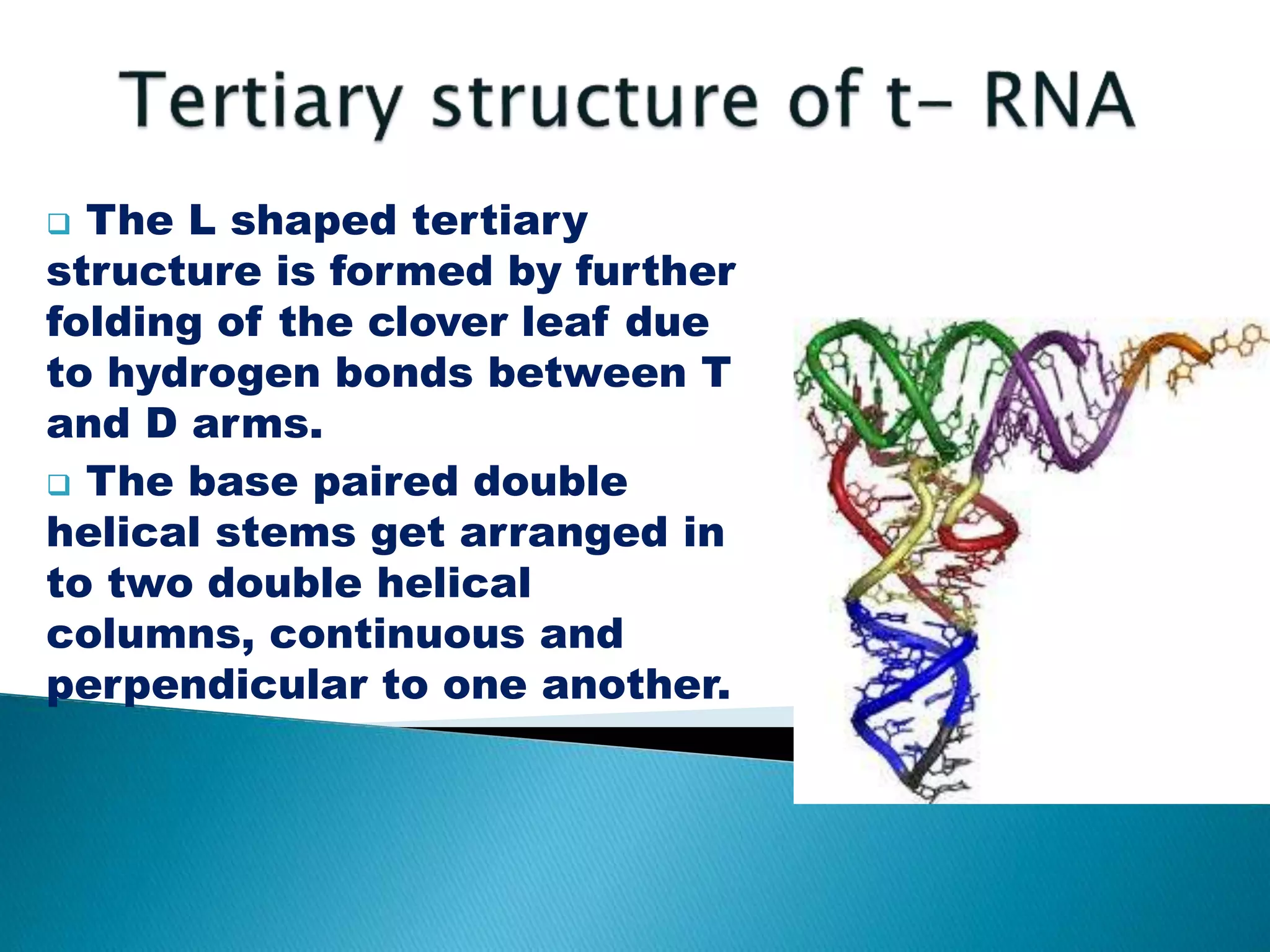
 The L shaped tertiary
structure is formed by further
folding of the clover leaf due
to hydrogen bonds between T
and D arms.
 The base paired double
helical stems get arranged in
to two double helical
columns, continuous and
perpendicular to one another.
•The mammalian ribosome contains
two major nucleoprotein subunits—a
larger one with a larger subunit
(60S) and a smaller subunit (40S).
The 60S subunit contains a 5S
ribosomal RNA (rRNA), a 5.8S rRNA,
and a 28S rRNA; there are also
probably more than 50 specific
polypeptides.
14
The 40S subunit is smaller and
contains a single 18S rRNA and
approximately 30 distinct
polypeptide chains.
All of the ribosomal RNA
molecules except the 5S rRNA are
processed from a single 45S
precursor RNA molecule in the
nucleolus .
5S rRNA is independently
transcribed
The functions of the ribosomal
RNA molecules in the ribosomal
particle are not fully understood,
but they are necessary for
ribosomal assembly and seem to
play key roles in the binding of
mRNA to ribosomes and its
translation
Recent studies suggest that an
rRNA component performs the
peptidyl transferase activity and
thus is an enzyme (a ribozyme).
Types of rna

Types of rna

  • 1.
  • 2.
    In all prokaryoticand eukaryotic organisms, three main classes of RNA molecules exist- 1) Messenger RNA(m RNA) 2) Transfer RNA (t RNA) 3) Ribosomal RNA (r RNA)
  • 3.
     Comprises only5% of the RNA in the cell  All members of the class ,function as messengers carrying the information in a gene to the protein synthesizing machinery
  • 4.
    The 5’ terminalend is capped by 7- methyl guanosine triphosphate cap. The cap is involved in the recognition of mRNA by the translating machinery It stabilizes m RNA by protecting it from 5’ exonuclease
  • 6.
     The 3’endof most m-RNAs have a polymer of Adenylate residues  The tail prevents the attack by 3’ exonucleases  On both 5’ and 3’ end there are non coding sequences which are not translated  The intervening region between non coding sequences present between 5’ and 3’ end is called coding region. This region encodes for the synthesis of a protein.
  • 7.
     The m-RNA molecules are formed with the help of DNA template during the process of transcription.  The sequence of nucleotides in m RNA is complementary to the sequence of nucleotides on template DNA.  The sequence carried on m -RNA is read in the form of codons.  A codon is made up of 3 nucleotides  The m-RNA is formed after processing of heterogeneous nuclear RNA
  • 8.
  • 9.
    Transfer RNA arethe smallest of three major species of RNA molecules  They are synthesized by the nuclear processing of a precursor molecule They transfer the amino acids from cytoplasm to the protein synthesizing machinery, hence the name t RNA. They are easily soluble , hence called “Soluble RNA or s RNA They are also called Adapter molecules, since they act as adapters for the translation of the sequence of nucleotides of the m RNA in to specific amino acids 9
  • 10.
    1) Primary structure-The nucleotide sequence of all the t RNA molecules allows extensive intrastand complimentarity that generates a secondary structure. 2) Secondary structure- Each single t- RNA shows extensive internal base pairing and acquires a clover leaf like structure. The structure is stabilized by hydrogen bonding between the bases and is a consistent feature. Structure of t-rna
  • 12.
     Secondary structure(Clover leaf structure)  All t-RNA contain 5 main arms or loops which are as follows- a) Acceptor arm b) Anticodon arm c) D HU arm d) TΨ C arm e) Extra arm
  • 13.
     The Lshaped tertiary structure is formed by further folding of the clover leaf due to hydrogen bonds between T and D arms.  The base paired double helical stems get arranged in to two double helical columns, continuous and perpendicular to one another.
  • 14.
    •The mammalian ribosomecontains two major nucleoprotein subunits—a larger one with a larger subunit (60S) and a smaller subunit (40S). The 60S subunit contains a 5S ribosomal RNA (rRNA), a 5.8S rRNA, and a 28S rRNA; there are also probably more than 50 specific polypeptides. 14
  • 15.
    The 40S subunitis smaller and contains a single 18S rRNA and approximately 30 distinct polypeptide chains. All of the ribosomal RNA molecules except the 5S rRNA are processed from a single 45S precursor RNA molecule in the nucleolus . 5S rRNA is independently transcribed
  • 17.
    The functions ofthe ribosomal RNA molecules in the ribosomal particle are not fully understood, but they are necessary for ribosomal assembly and seem to play key roles in the binding of mRNA to ribosomes and its translation Recent studies suggest that an rRNA component performs the peptidyl transferase activity and thus is an enzyme (a ribozyme).