Internal Migration
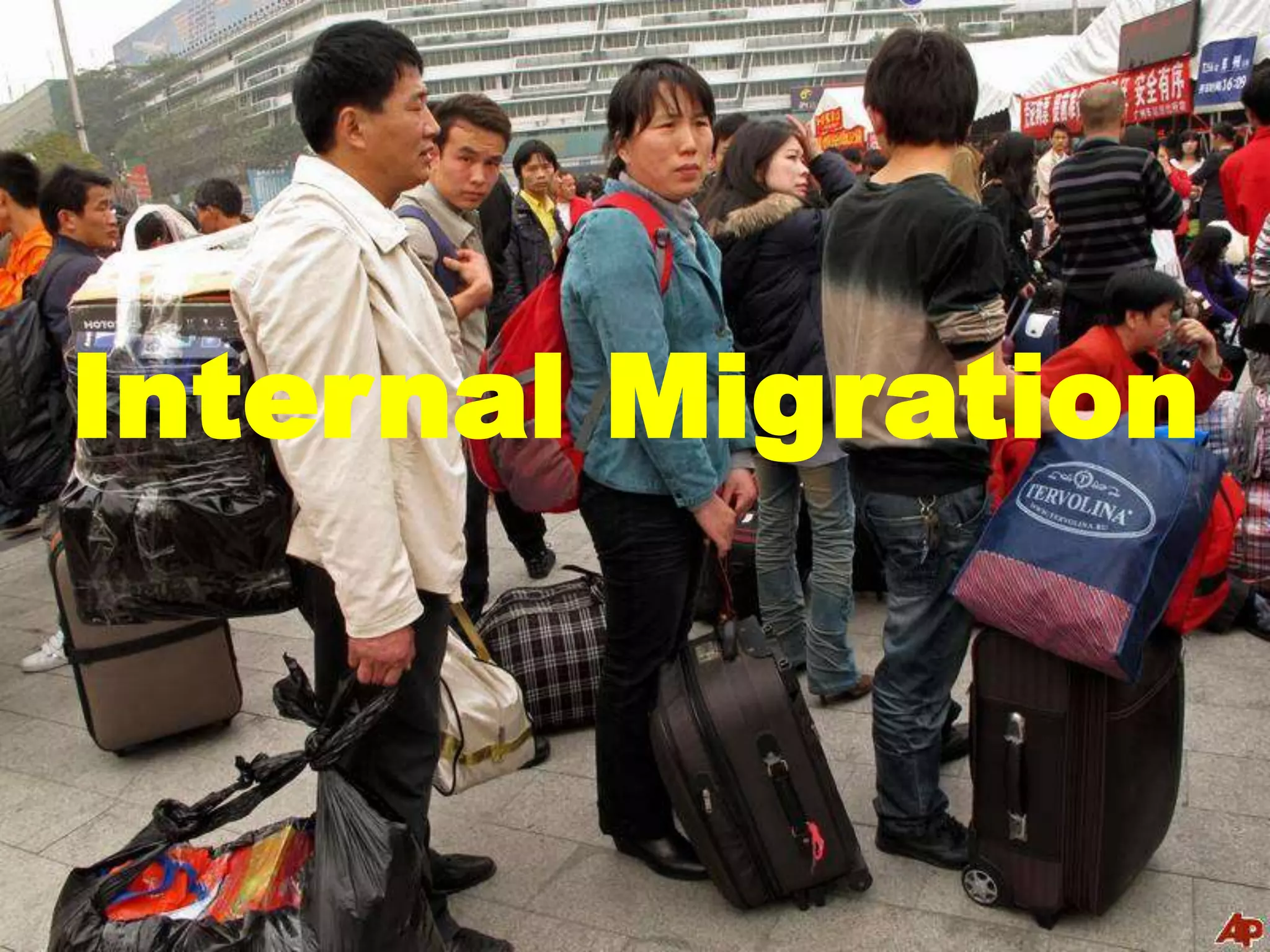
Internal Migration
• A movement between regions within the
  same country and over relatively short
  distances

• Does not alter the total population of a
  country but will change population density
  and population distribution patterns within
  the country
Types of internal migration
•   Rural to urban
•   Urban to rural
•   Inter-urban
•   Intra-urban
•   Rural to rural
•   transmigration
Rural – Urban Migration
• People moving from countryside to cities

• Usually repelled by the push factors in the rural areas

• attracted by the pull factors in the urban areas

• This type of migration increased rapidly in the
  developing countries in the second half of the 20th
  century causing rapid urbanisation

• Caused growth of cities in Europe during the industrial
  revolution
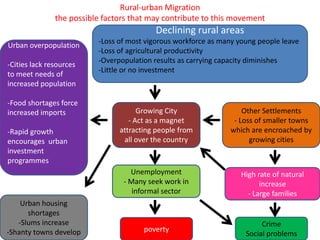
Rural-urban Migration
               the possible factors that may contribute to this movement
                                          Declining rural areas
                          -Loss of most vigorous workforce as many young people leave
Urban overpopulation
                          -Loss of agricultural productivity
                          -Overpopulation results as carrying capacity diminishes
-Cities lack resources
                          -Little or no investment
to meet needs of
increased population

-Food shortages force
increased imports                     Growing City                  Other Settlements
                                   - Act as a magnet             - Loss of smaller towns
-Rapid growth                   attracting people from          which are encroached by
encourages urban                 all over the country                 growing cities
investment
programmes
                                   Unemployment                    High rate of natural
                                 - Many seek work in                     increase
                                    informal sector                  - Large families
    Urban housing
      shortages
   -Slums increase                                                        Crime
-Shanty towns develop                  poverty
                                                                     Social problems
How do government response to rural-urban migration

1. Investment in rural development projects
2. Land redistribution – under traditional inherotance
   laws, land are fragmented into smaller pieces but

3. Prohibiting migrants from becoming urban residents.
   E.g. Hukou System in China

4. Redirect migration to other reception areas. E.g.
   Indonesia transmigration

5. Encourage emigration instead of internal migration
     Bangladesh – governemnt actively promotes emigration
     to reduce the problems of overpopulation
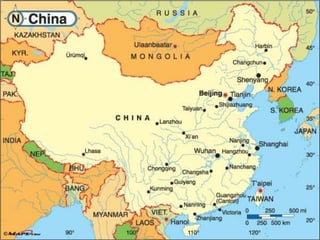
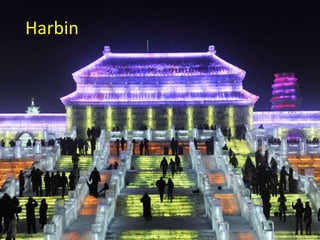
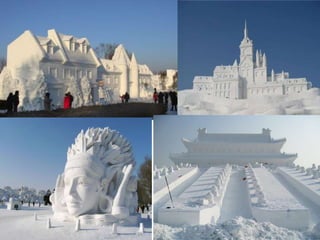
Harbin
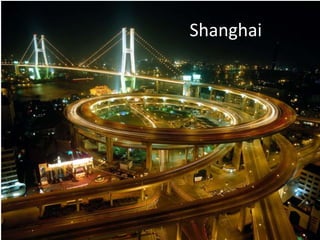
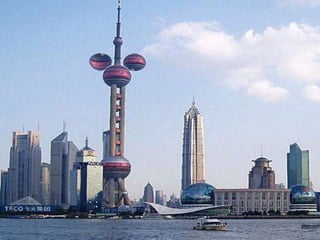
Shanghai
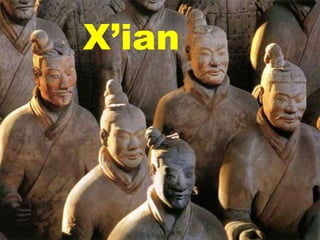
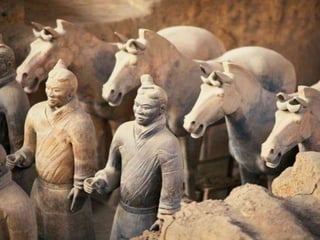
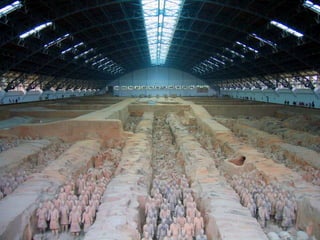
X’ian
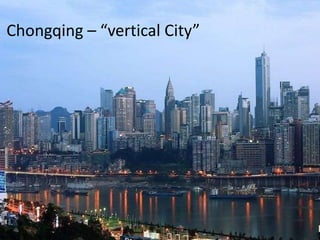
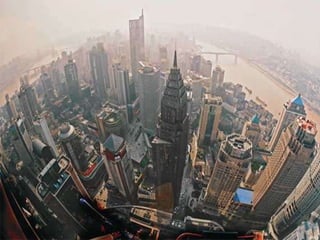
Chongqing – “vertical City”
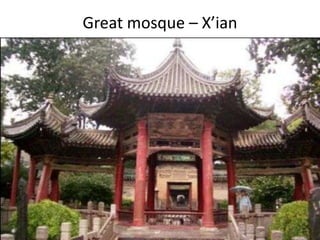
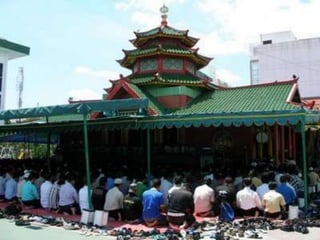
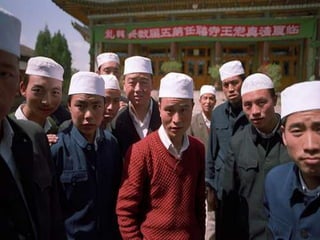
Great mosque – X’ian
Rural – urban migration
 Case Study: Migration in China
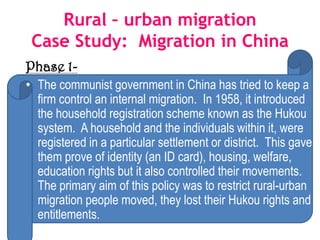
Phase 1-
• The communist government in China has tried to keep a
  firm control an internal migration. In 1958, it introduced
  the household registration scheme known as the Hukou
  system. A household and the individuals within it, were
  registered in a particular settlement or district. This gave
  them prove of identity (an ID card), housing, welfare,
  education rights but it also controlled their movements.
  The primary aim of this policy was to restrict rural-urban
  migration people moved, they lost their Hukou rights and
  entitlements.
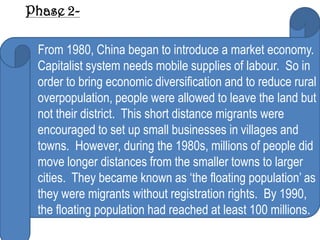
Phase 2-

 From 1980, China began to introduce a market economy.
 Capitalist system needs mobile supplies of labour. So in
 order to bring economic diversification and to reduce rural
 overpopulation, people were allowed to leave the land but
 not their district. This short distance migrants were
 encouraged to set up small businesses in villages and
 towns. However, during the 1980s, millions of people did
 move longer distances from the smaller towns to larger
 cities. They became known as ‘the floating population’ as
 they were migrants without registration rights. By 1990,
 the floating population had reached at least 100 millions.
Phase 3-


 In the late 1980s, to encourage rapid
 industrialisation, a scheme of temporary
 residence permits was introduced. This
 allows people to move to cities but does
 not give them full Hokou rights. Since then
 there have been huge migratory surges to
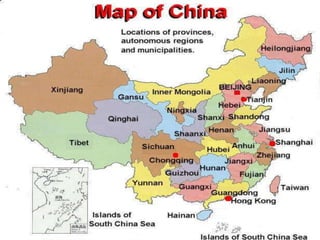
 the east coast cities such as
 Shanghai, Hong Kong and Guangzhou.
Question
• Summarise the stages of Chinese Migration

Internal migration lesson 4

  • 1.
  • 2.
    Internal Migration • Amovement between regions within the same country and over relatively short distances • Does not alter the total population of a country but will change population density and population distribution patterns within the country
  • 3.
    Types of internalmigration • Rural to urban • Urban to rural • Inter-urban • Intra-urban • Rural to rural • transmigration
  • 4.
    Rural – UrbanMigration • People moving from countryside to cities • Usually repelled by the push factors in the rural areas • attracted by the pull factors in the urban areas • This type of migration increased rapidly in the developing countries in the second half of the 20th century causing rapid urbanisation • Caused growth of cities in Europe during the industrial revolution
  • 5.
    Rural-urban Migration the possible factors that may contribute to this movement Declining rural areas -Loss of most vigorous workforce as many young people leave Urban overpopulation -Loss of agricultural productivity -Overpopulation results as carrying capacity diminishes -Cities lack resources -Little or no investment to meet needs of increased population -Food shortages force increased imports Growing City Other Settlements - Act as a magnet - Loss of smaller towns -Rapid growth attracting people from which are encroached by encourages urban all over the country growing cities investment programmes Unemployment High rate of natural - Many seek work in increase informal sector - Large families Urban housing shortages -Slums increase Crime -Shanty towns develop poverty Social problems
  • 6.
    How do governmentresponse to rural-urban migration 1. Investment in rural development projects 2. Land redistribution – under traditional inherotance laws, land are fragmented into smaller pieces but 3. Prohibiting migrants from becoming urban residents. E.g. Hukou System in China 4. Redirect migration to other reception areas. E.g. Indonesia transmigration 5. Encourage emigration instead of internal migration Bangladesh – governemnt actively promotes emigration to reduce the problems of overpopulation
  • 9.
  • 14.
  • 16.
  • 19.
  • 21.
  • 25.
    Rural – urbanmigration Case Study: Migration in China Phase 1- • The communist government in China has tried to keep a firm control an internal migration. In 1958, it introduced the household registration scheme known as the Hukou system. A household and the individuals within it, were registered in a particular settlement or district. This gave them prove of identity (an ID card), housing, welfare, education rights but it also controlled their movements. The primary aim of this policy was to restrict rural-urban migration people moved, they lost their Hukou rights and entitlements.
  • 26.
    Phase 2- From1980, China began to introduce a market economy. Capitalist system needs mobile supplies of labour. So in order to bring economic diversification and to reduce rural overpopulation, people were allowed to leave the land but not their district. This short distance migrants were encouraged to set up small businesses in villages and towns. However, during the 1980s, millions of people did move longer distances from the smaller towns to larger cities. They became known as ‘the floating population’ as they were migrants without registration rights. By 1990, the floating population had reached at least 100 millions.
  • 27.
    Phase 3- Inthe late 1980s, to encourage rapid industrialisation, a scheme of temporary residence permits was introduced. This allows people to move to cities but does not give them full Hokou rights. Since then there have been huge migratory surges to the east coast cities such as Shanghai, Hong Kong and Guangzhou.
  • 28.
    Question • Summarise thestages of Chinese Migration